Abhinav L. Purkar1, Prof. Prasanna D Bharadwaj2 1
P.G. Student, 2Associate Professor, Department of Electrical Engineering Bharati Vidyapeeth Deemed University College of Engineering, Pune, India.
Abstract- Power systems have ability to come back to normal operation after some types of disturbances which is termed as system stability. Instability is a loss of synchronism. From a very long time, Stability has been an important factor in power system planning. To maintain such synchronism is more difficult as a system is increasing by size and expanding over a large geographical area. A FACTS device has given satisfactory results when put in the system to enhance the overall performance of power system. They have been very useful for damping the oscillations in a power system. Various problems related to control stability of the system will be elucidated by introducing FACTS controllers in the system. Within the Paper, author has done analysis and investigation to compliment the transient stability in Two-machine systems by correct implementation of SSSC.In a MATLAB software, a complete simulation of two machine system with the inclusion of a SSSC is done by using various power system blocks. As per the result that we get from simulation after applying unsymmetrical faults, Voltage stability has been improved by implementing SSSC in the system.
Keywords- SSSC in multi machine system, unbalanced fault on multi-machine system, voltage stability in multi machine system
I. INTRODUCTION
The use of FACTS controller has been increased in a power system due to recent growth in power electronic devices. System stability can be improved by the particular feature of FACTS controller of fast controlling the network condition. The facts controllers are illustrated in the paper. This system has been established in recent years to increase the system power flow capability. This new technology consists of various power electronics based controller. The detailed explanation about FACTS devices are explained in [1].
These days all the power systems are interconnected. Poor voltage profile affects the system stability which causes due to inadequacy in fulfilling the demand. FACTS controller compliments the stability by damping the oscillations when combining with POD.Hingorani [2] has come with FACTS controller where it introduce the technology on the basis of the thyristor in A.C system. To control the transmission line parameters and to improve the power flow capability, FACTS controller plays very important role [3].
Among various facts devices, SSSC has been important for voltage profile, reactive & active power. Higher nonlinear characteristics causes continue change in a main operating parameter of the system. The facts devices can be overcome the disadvantages of the electromechanical devices like wear and slowness and support voltages by varying different parameters like current and voltage , series impedance, phase angle, shunt impedance. Also reduces a flow of densely loaded lines.
II. SSSCCONFIGURATION
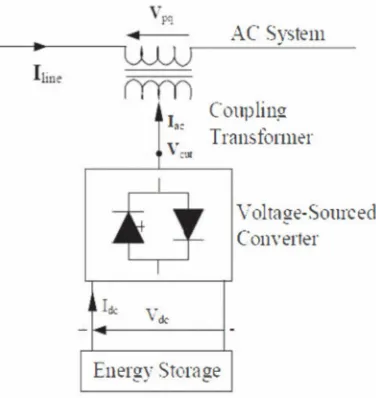
Fig.1 shows the basic layout of an SSSC.The energy source is connected to compensator with reactive power flow control with a capability of supplying or absorbing active power to or from the system. To increase the voltage magnitude, voltage across capacitor forces opposite polarity voltage across series line reactance at given line current. Thus increasing voltage across line impedance which causes increase in power flow.
Relationship between transmitted power and transmission angle becomes a function of injected voltage. This relationship can be described by following equation.
P =
X +
Technology (IJRASET)
Figure 1. Basic layout of SSSC
III. BASICOPERATINGPRINCIPLESOFSSSC
[image:3.612.212.400.244.443.2]Voltage source converter (VSC) , DC capacitor , coupling transformer are the major components of series connected SSSC .To control a power flow in a system,SSSC needs to vary two parameters such as output voltage magnitude and phase angle ,as injected voltage and line current are in phase quadrature.
Figure 2. SSSC functional model
SSSC is introduced in the transmission network through coupling transformer, linked with Voltage-Sourced Converter having
variable amplitude. When the VSC makes use of the power electronic devices, causes the production of voltage . Whenever
[image:3.612.188.424.555.701.2]variable capacitance [4].
IV. DESCRIPTIONOFTESTSYSTEM(TWOMACHINESYSTEM)
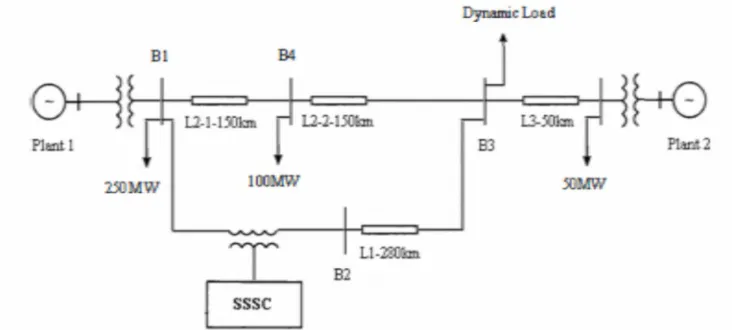
[image:4.612.119.494.224.397.2]Fig. 4 shows Two machine system in absence of SSSC which can be achieved using MATLAB software. The current &voltage waveforms are used to describe dynamic performance of SSSC. In the simulation model single SSSC have ability to control the flow of power in the transmission systems of 500 KV.
Figure 4. Two machine system in an absence of SSSC
[image:4.612.123.489.528.693.2]The system shown in Figure. 4 is combination of 4 buses viz. Bus B1, Bus B2, Bus B3 and Bus B4 connected in ring mode by three phase line. Above system consists of two machines and a dynamic load at bus No.3. The machine M1 and M2 are of 2100 MVA and 1400 MVA respectively. M1 includes 6 machines; all having 350 MVA rating each and machine M2 consist of 4 machines having same rating as that of 6 machines in M1. Dynamic load having rating of 2200 MW can be termed as a load center.The load absorbs reactive and active power. The buses are connected with line L1 of 280 Km, L2-1 and L2-2 with 150 Km each and L3 with length of 50 km. SSSC is introduced in Line 1 at Bus B2 with Unbalanced faults at bus B4. After the analysis, results are accumulated from MATLAB software. SSSC compliment the transient response of a system with regulating reactive and active powers.
Technology (IJRASET)
Figure 6. Simulink model with inclusion of SSSC
V. RESULTOF SIMULINKMODEL
The results of a Simulink model are taken into account by introducing unbalanced fault at B4 with inclusion of SSSC and in an absence of SSSC. i.e. Two conditions have been taken into account, i.e. 1) System with fault and in absence of SSSC and 2) System with Faults with inclusion of SSSC.
[image:5.612.45.523.385.523.2]A. CASE 1 :- L-L Fault In An Absence Of SSSC
[image:5.612.191.419.572.686.2]Figure 10. A Voltage at Bus No. 2 with inclusion of SSSC (L-L Fault) Figure 11. Active Power at Bus No.2 with inclusion of SSSC (L-L Fault)
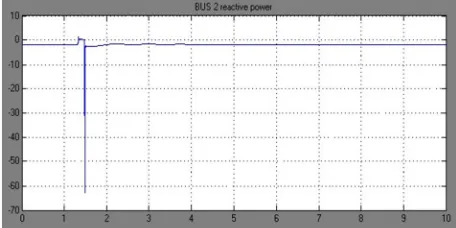
Figure 12.Reactive Power at Bus No.2 with inclusion of SSSC (L-L Fault )
[image:6.612.81.534.427.544.2]C. CASE 3 :- LL-G Fault In An Absence Of SSSC
Figure 13.A Voltage at Bus No.2 in an absence of SSSC (LL-G Fault) Figure 14.Active Power at Bus No.2 in an absence of SSSC(LL-G Fault)
[image:6.612.191.422.583.693.2]Technology (IJRASET)
[image:7.612.191.420.239.351.2]D. CASE 4 :- LL-G With Inclusion Of SSSC
Figure 16.A Voltage at BusNo.2 with inclusion of SSSC (LL-G Fault) Figure 17. Active Power at BusNo.2 with inclusion of SSSC (LL-G Fault)
Figure 18. Reactive Power at Bus No. 2 with inclusion of SSSC (LL-G Fault )
VI. CONCLUSION
After all the analysis, author concluded that the SSSC have ability to control the flow of power in the transmission line at any desired location. It has been observed that, SSSC which is equipped with VSC introduces a fast altering voltage in the line regardless of phase of the line current and its magnitude. Thus improving the ability of power flow in a system. After applying unsymmetrical faults such as L-L and LL-G fault at Bus No.4 and from obtained results of bus No.2 it can be concluded that SSSC has increased the maximum power flow when compared with a system in an absence with SSSC and system with inclusion of SSSC.
So the SSSC can be further combined with power oscillation damping controller (POD) for damping power swings so as to compliment transient stability.
VII. ACKNOWLEDGMENT
I am highly grateful thank to my guided Prof. Prasanna D Bharadwaj for his constant intellectual support in the form of his innovative ideas, comments and valuable guidance. I am also grateful to Dr. D.S. Bankar (Head of the Department) and Asst. Prof.Honmukhe (M.Tech Co-ordinator) for their guidance. We place on record my extreme indebtedness to them for providing us proper guidance at every step.
REFFERENCES
[1] R. Mohan and R. K. Varma, Thyristor-Based FACTS Controllers for Electrical Transmission Systems. Piscataway, NJ: IEEE Press, 2002
[2] N.G.Hingorani and L.Gyugyi, Understanding FACTS, Concepts and Technology of Flexible AC Transmission Systems. Piscataway, NJ: IEEE Press, 2000 [3] Sandeep Gupta ,R K Tripathi ,Voltage stability improvement in power system using FACTS controllers: State of the art review, IEEE Transactions on Power
system ,pp 1-8
[4] C. Udhaya Shankar, Dr. Rani Thottungal, S. Mythili, Voltage stability improvement And power oscillation damping Using static synchronous series Compensator (sssc) IEEE Sponsored 9th International Conference on Intelligent Systems and Control (ISCO)2015
[5] F. Wang, “Design of SSSC Damping Controller to Improve Power System Oscillation Stability, “0-7803-5546-6/99/$10.00 © 1999 IEEE