5
III
March 2017
Technology (IJRASET)
©IJRASET: All Rights are Reserved
831
Improved Methodology for Storage and Quick
Retrieval of Hard Files using 5s Principles
Ameya Deokar
1, Prakash Pantawane
21 Post Graduate Scholar, 2 Assistant Professor
Department of Production Engineering & Industrial Management, College of Engineering Pune (COEP), India
Abstract: Certain departments of large organizations have to maintain heavy amount of data in printed form. This includes project wise files, meeting reports, important project related documents etc. for each year since the inception of the company. It is a very tough task to maintain all these files, prevent them from damage over the years, avoiding filing of unimportant or obsolete information and more importantly, finding the exact file whenever it is required for reference. Similar problem was faced by the Purchasing Project Management Department of a leading vehicle manufacturing company in Pune to maintain its hard files. This paper talks about how the problem is addressed and solved by adopting a systematic approach and the resultant time savings by implementation of the 5-S principles, at the same time ensuring ergonomics and human comfort. It also talks about the time savings achieved through this new system.
Keywords: 5S Implementation, Colour coding, Hard Files, Quick retrieval, Ergonomics
I. INTRODUCTION
Whether it is a new business or an established organization running for many years, there will always be efficient time management only when the data of the office is well organized. In large organizations, employees spend 1.8 hours every day—9.3 hours per week, on average—searching and gathering information according to a survey by McKinsey [1]. The above said company is one of the leading automobile manufacturers in the world. It has around 4000 employees spread over 15 departments. This means that the amount of data generated by each department must be really huge. Large data results into large number of files, and if the right file is not found at the right location in minimum time, it will lead to a lot of wastage of time and resources and may also generate panic at times if the data in question is highly confidential. Hence it was essential to devise a system of organizing this data and setting up a process to find the required data accurately every time using a Master Directory based in Excel. Concepts of 5S have been used for the same including introduction of naming system; colour codes etc. and the improvements have been successfully quantified.
II. PROBLEMSTATEMENT
The Project Management department of a leading car manufacturing company in Pune looks after all its new projects for the Indian and some international markets. Every project involves a lot of documentation and paper work which results into a large amount of files and folders, and the department has to maintain all these files for future reference. Currently the department has its data divided into more than 150 files which if not maintained properly, results into a lot of mess and occupies large space. It was first needed to study the area and prepare a plan to Sort, Set in Order, Shine and Standardize the files and then to hand it over to the team members to sustain this system. The solution to this challenge is described further in this paper.
III. LITERATUREREVIEW
Technology (IJRASET)
©IJRASET: All Rights are Reserved
832
worker spends about 2.5 hours per day, or roughly 30% of the workday, searching for information….60% of company executives felt that time constraints and lack of understanding of how to find information were preventing their employees from finding the information they needed [4].
The 5S technique is a structured program to systematically achieve total organization cleanliness, and standardization in the workplace. The benefit of 5S technique is improvement in productivity, quality, health and safety [5], [6].
A. Terms of 5S are Described as
1) Seiri (Sort): The removal of all unwanted, unnecessary, and unrelated materials in the workplace.
2) Seiton (Set in Order): This step consists of putting everything in an assigned place so that it can be accessed or retrieved quickly as well as returned in that same place quickly.
3) Seiso (Shine/Clean): It is consists of cleaning up the workplace and giving it a 'shine'.
4) Seekers (Standardize): It defining the standards by which personnel must measure and maintain cleanliness.
5) Shinseki (Sustain): This last step is about 'Discipline.' It maintain orderliness and to practice the first 4 S as a way of life the introduction of the paper should explain the nature of the problem, previous work, purpose, and the contribution of the paper. The contents of each section may be provided to understand easily about the paper. [7]
IV. METHODOLOGY
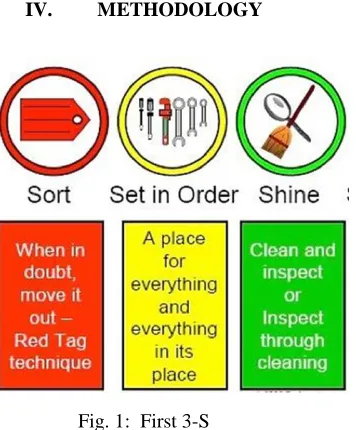
[image:3.612.234.412.284.499.2]A. Implementing the First 3-S
Fig. 1: First 3-S
1) Seiri: (Sort) This is the first stage of the 5S process. All files were sorted and segregated to begin with. The scattered files were brought together for sorting and segregation purpose.
2) Seiton: (Set in order) Unimportant data was scrapped in order to free some space and reduce data size. Also duplicate files or papers were targeted and eliminated.
3) Seiso: (Shine and Clean) Grouping and Sequencing of Similar files was done according to functionalities or based on data contained inside the files. E.g. Files of different sub-departments like Steering, Implementation and Model Year changes were grouped in separate areas.
B. Defining Storage Areas Inside the Department
[image:3.612.159.461.625.701.2]Technology (IJRASET)
©IJRASET: All Rights are Reserved
833
Areas were defined based on ease of use, size of area, number of files in each area etc. Also, ergonomics were considered keeping in mind the human movement and available workspace.
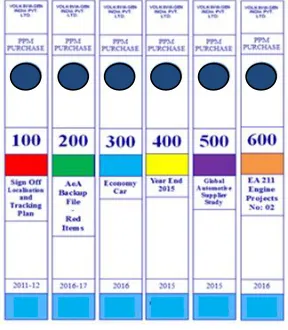
[image:4.612.82.531.157.329.2]C. Assigning Colour Codes to Each Area
Fig. 3: List of Colour codes in Areas
Colours were assigned in the above pattern to different shortlisted areas. Each file in an area will have its particular colour code on the label.
D. The File Type that Each Area will Contain was also Decided and Files were Sorted Accordingly
1) Area 1: Confidential Administration related files
2) Area 2: Implementation and Working files of PPM head
3) Area 3: Steering Activity related files 4) Area 4: Finance Controlling files
5) Area 5: General Department Files
6) Area 6: Technical Change Management files
E. Preparing File labels for each Area: (The 4th-S)
[image:4.612.234.378.517.682.2]Technology (IJRASET)
©IJRASET: All Rights are Reserved
834
F. SEIKETSU: (Standardize)
The most extensive phase of this activity was Standardizing Label formats and Preparing labels for each file according to Number Code and Color Code. Master list was prepared which is the key tool for using this new system.
G. Implementation Phase
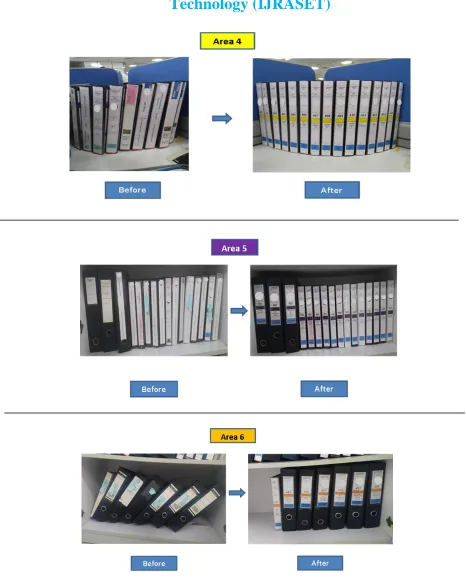
Files in each area were given new labels. This improved the appearance of the files and also made file retrieval very easy. Also, any file lying outside the area can now be quickly differentiated from the rest of the files due to its label color and returned to its original location.
Technology (IJRASET)
[image:6.612.56.522.64.643.2]©IJRASET: All Rights are Reserved
835
Fig. 5: Transformation of Files in All Areas
H. Preparing Master List of Files
Technology (IJRASET)
©IJRASET: All Rights are Reserved
836
TABLEISAMPLE OF MASTER LIST OF FILES
V. RESULTS
To measure the effectiveness of the 5S system, files names were picked out at random and team members were voluntarily asked to search for these files. Time required for searching these files was recorded. In the next step, same number of other files were searched by team members using the Master excel list and the files were retrieved based on the File number and color. Time was again recorded for this activity.
The comparative timings were listed down and analysed.
A. The Results are as Follows
TABLEIITIME MEASUREMENTS FOR OLD AND NEW SYSTEM
B. Calculations
Average (Old) = 235*/4 = 58.75 sec *(3:55min = 235sec)
Average (New) = 44/4 = 11 sec Thus,
Total time saved = ((58.75 - 11) / 58.75) x 100 = 81.27%
VI. CONCLUSION
Technology (IJRASET)
©IJRASET: All Rights are Reserved
837
which refers to sustaining the new system is very important and this is where most 5S systems fail. This task has been assigned to one of the team members who will look after maintenance and sustenance of the file retrieval system. Thus it can be concluded that the newly introduced 5S system is a success in many aspects.
VII. ACKNOWLEDGMENT
I would like to thank Mr Praveen Akarte, Mr. Preetish Patil, Mr. Rohan Deliwala and the entire team of PPM in supporting me to carry out this activity. We also take this opportunity to thank Mr. Vicky Sardar from COEP for his valuable inputs to this paper and Dr. M.D. Jaybhaye for his support in the process.
REFERENCES
[1] Michael Chui, James Manyika, The Social Economy: Unlocking value and productivity through social technology, McKinsey Global Institute, July 2012. [2] https://www.mindtools.com/pages/article/newHTE_85.htm
[3] M Files inc, Easy Document Management: A Guide to Benefits, Features, and Selection, 2011
[4] http://www.cottrillresearch.com/various-survey-statistics-workers-spend-too-much-time-searching-for-information
[5] Shahryar Sorooshian, Meysam Salimi, Shanthi Bavani, Hasti Aminattaheri, Experience of 5S Implementation, Journal of Applied Sciences Research, 8(7), 2012, 3855-3859.
[6] R.T. Salunkhe, G.S. Kamble, Prasad Malage, Inventory Control and Spare Part Management through 5S, KANBAN and Kaizen at ABC Industry, Journal of Mechanical and Civil Engineering (IOSR-JMCE), 43-47
[7] Vipulkumar C. Patel et al Int. Journal of Engineering Research and Applications ISSN : 2248-9622, Vol. 4, Issue 3( Version 1), March 2014, pp.774-779 [8] Shraddha Deshpande, Vipul Damle, Implementation of ‘5s’ Technique in a Manufacturing Organization: A Case Study, International Journal of Research in
Engineering and Technology, Volume: 04 Issue: 01, Jan-2015.
ABOUTTHEAUTHORS
Mr. Ameya Deokar
B.E. (Mechanical), Savitribai Phule Pune University
M.Tech (Project Management), College of Engineering Pune (COEP).
Dr. Prakash Pantawane
Assistant Professor, Dept of Production Engineering and Industrial Management, COEP. M.E. (Production)