Response
Thesis by
Lila Forte
In Partial Fulfillment of the Requirements for the degree of
Master of Science
CALIFORNIA INSTITUTE OF TECHNOLOGY
Pasadena, California
©2016
ACKNOWLEDGEMENTS
First and foremost, I would like to express my deepest gratitude to my advisor, Prof.
Tom Miller. His guidance and enthusiasm helped me to overcome many obstacles
during the past two years. I am grateful for all that I have learned from him, the
opportunities I was provided, and the support he has given me. I would also really
like to thank Prof. Justin Bois, not only for the intellectually stimulating conversa-tions and courses, but his tireless attention to his students’ learning and support of
their interests. Also, I would especially like to thank my main collaborator, Connie
Wang. Her support and mentorship were invaluable throughout this process. All the
work done for this thesis would not have been even close to possible without her
extremely patient and insightful guidance. I always enjoyed our conversations and
will miss our strolls and chats. Last, but not least I would like to thank my husband,
ABSTRACT
Developments in singe-cell analysis techniques allow simultaneous high-resolution
measurements of cellular component copy number and variation within a cell
pop-ulation. These data provide a probability distribution for all possible states of the
cell, as determined by the measured component copy number per cell. We have
developed a highly-flexible, theoretical statistical mechanical framework that uses single-cell cellular component data to model the evolution of the probability
distri-bution of those components in a cell in response to an external, physical or
molec-ular, perturbation. This framework uses Bayesian inference to compare potential
functional descriptions of how the perturbation couples to the system, and to
deter-mine the uncertainty in the parameter estimations given the data. We have applied
this methodology to study the impact of changes in oxygen partial pressure on the
behavior of glioblastoma multiform cancer cells. We find that oxygen
concentra-tion couples not only to individual proteins, but effects the underlying effective interactions between the studied proteins as well. The underlying effective interac-tions were found to couple linearly to the system, indicating a simple proportional
change in the protein network across oxygen concentrations. This description of
the system provides improved predictive capabilities for describing the probability
distribution of the measured cellular components across a wider range of
perturba-tion condiperturba-tions than previous methods. Addiperturba-tionally, we apply this methodology
to show how it could be used to predict effects in difficult experimental perturba-tion regimes, identifying undruggable regimes, as well as the result of knocking our
TABLE OF CONTENTS
Acknowledgements . . . iii
Abstract . . . iv
Table of Contents . . . v
List of Illustrations . . . vi
List of Tables . . . viii
Chapter I: Introduction . . . 1
1.1 New Directions Using New Data Collection Methods . . . 1
1.2 Overview . . . 2
1.3 Data: Hypoxia Effect in Cancer Cells . . . 3
Chapter II: Methodology . . . 5
2.1 Theory . . . 5
2.2 Calculations . . . 9
Chapter III: Application: Hypoxia Effect on Cancer Cells . . . 12
3.1 Selection of Perturbation Functional Coupling . . . 12
3.2 Comparison to Previous Analysis . . . 18
3.3 Predictions . . . 22
Chapter IV: Conclusions . . . 27
Bibliography . . . 30
Appendix A: Derivations using Grand Canonical Ensemble . . . 32
A.1 Partition Function . . . 32
A.2 HoEnsemble Statistics . . . 34
LIST OF ILLUSTRATIONS
Number Page
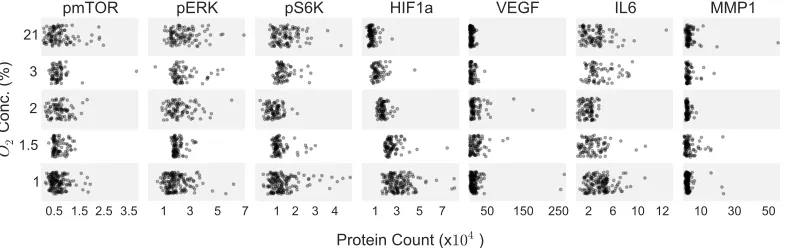
1.1 Measurements of single-cell protein data across tested oxygen
con-centration range. Each dot represents the copy number measured for
that protein in an individual cell. . . 4
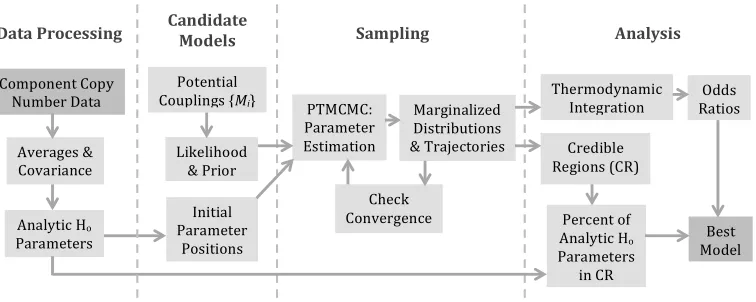
2.1 Workflow for the application of the proposed statistical mechanical
framework to extract from single cell data the best functional
cou-pling of a perturbation to the system. . . 11
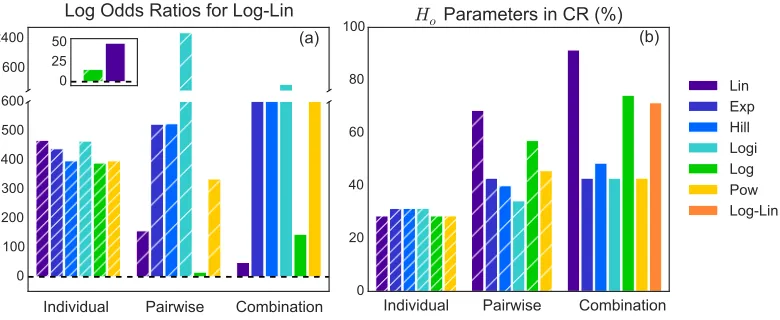
3.1 (a) Positive odds ratios (log shown) for Log-Lin model compared to
all other models indicates is is the most probable model. (b) Percent of analytic Hoparameters, using 21% oxygen as the reference state,
found in the predicted credible regions for those parameters for each
model, indicating that Lin-Lin contains the greatest amount of the
perturbation in the perturbation terms. . . 13
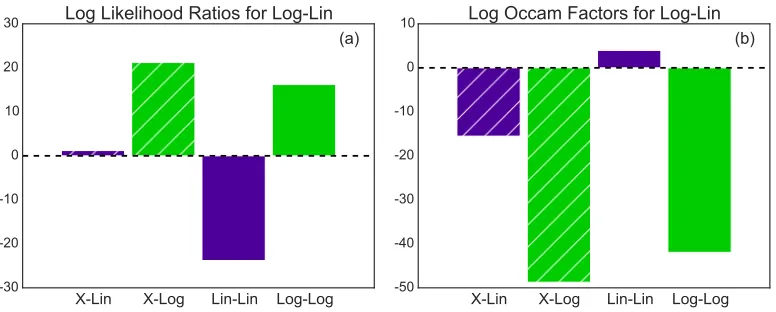
3.2 Estimated contributions to the odds ratio from (a) log likelihood
ra-tios and (b) the Occam factor for the top five models, all in reference
to the Log-Lin model (PLog−Lin/PMi) and calculated using the MAP
parameter values. . . 15
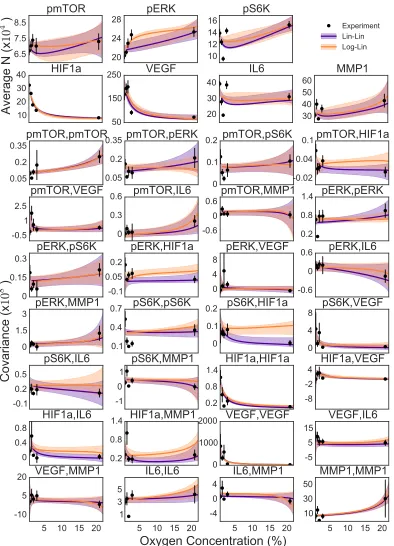
3.3 Fit of Lin-Lin and Log-Lin models to average and covariance in copy
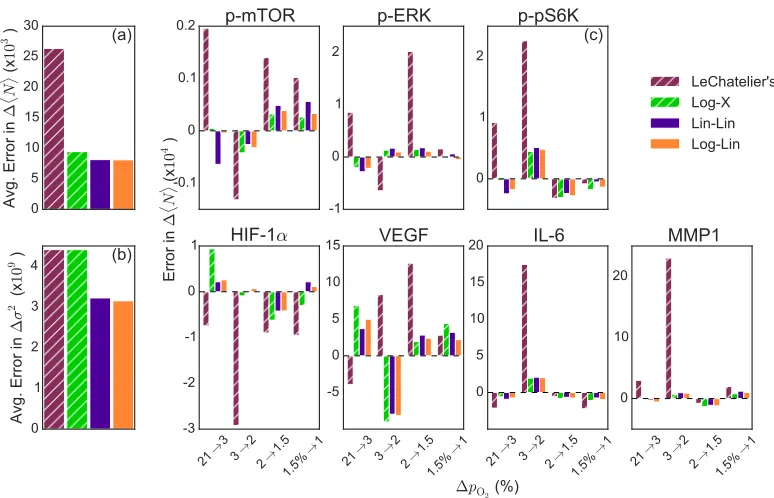
number. . . 17 3.4 Predictions from Log-X, Lin-Lin and Log-Lin models are compared
to quantitative Le Chatelier’s principle model. The average error per
model for predictions of the change in (a) average and (b) covariance
copy number due to a change in oxygen concentration compared to
experimental values. (c) Error per model for predictions in change
in average copy number for each protein. . . 19
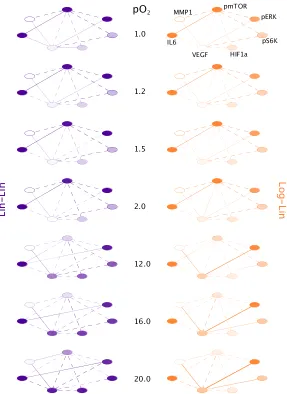
3.5 Protein networks for p-mTOR and VEGF over a range of oxygen
concentrations as predicted by the Log-Lin and Lin-Lin models. Widths
of connecting lines and circles represent strength of effective inter-action, circle fill represents strength of chemical potential. Dashed
3.6 Predictions of average and covariance in copy number with the
Lin-Lin and Log-Lin-Lin models over low oxygen concentrations. . . 23
3.7 Predictions from Log-Lin model showing effects of removing re-moving the effective interaction between pmTOR and pERK. . . 25 3.8 Predictions from Log-Lin model showing effects of knocking out
pmTOR. . . 26
B.1 Walker trajectories for 200 walkers are shown. The average value is
shown in red. Three of 42 parameters are shown for the Lin-X model. 39
LIST OF TABLES
Number Page
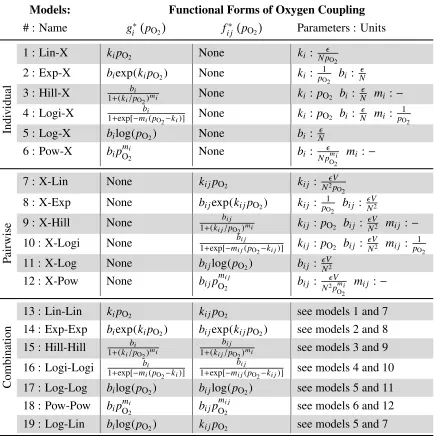
2.1 Proposed functional forms of oxygen coupling. . . 7
C h a p t e r 1
INTRODUCTION
1.1 New Directions Using New Data Collection Methods
With advances in quantitative single-cell analysis techniques, we now have the
abil-ity to observe the steady-state probabilabil-ity distribution for copy number of most cel-lular components (e.g. proteins, mRNAs, metabolites, etc.) under specific
condi-tions. This distribution contains information beyond population averages,
describ-ing the effective interactions between multiple cellular components, however the challenge is how to extract this information. The steady-state that can be obtained
is defined by nearly constant average concentration of a cellular component over
time after the application of a stimulus and given time to relax in those conditions.
Following a perturbation, such as the addition of a drug or changes in resources
available, cells may come to a different steady-state than before the stimulus was applied [1]. Novel technologies now exist that can measure simultaneous cellular component copy numbers to obtain the multi-dimensional steady state probability
distribution over a range of perturbation conditions [2].
Stochasticity in gene expression, due to intrinsic and extrinsic noise [3], gives rise
to fluctuations in protein levels and causes clonal populations of cells to exhibit
phenotypic variation at steady state [1, 4, 5]. The steady-state distribution of cellular
component copy number for an ensemble of genetically identical cells provides the
most probable copy numbers (average), as well as fluctuations in copy number for cells in the population. The noise in expression levels of cellular components, or
fluctuations in a population, have been associated with drug resistance, variation in
cell-to-cell response to external stress and cell differentiation [4, 6–8]. Therefore, a clear understanding of the steady-state copy number distribution would help to
predict when and what response may occur due to an external stimuli.
Master equation formulations, which use known parameters for rates of
produc-tion and diluproduc-tion due to cell division, have been used to predict the steady state
distribution for individual cellular components for a population of cells and then checked with single cell analysis at one set of experimental conditions [9–11]. An
inverted method can obtain parameters given a steady state distribution under one
Therefore, understanding how the steady state distribution is coupled to a
perturba-tion will give more informaperturba-tion on dynamics of the system in response to that
per-turbation. However, since it is often experimentally intractable to take single-cell measurements of every possible perturbation condition, we instead obtain
“snap-shots” under specific external conditions. The challenge is to extract from those few
measurements, how the steady-state distribution evolves as a function of a specific
perturbation, such as changing the concentration of a drug or steadily decreasing
cellular resources.
Specifically, we are interested in extracting from the few isolated experimental
mea-surements how the copy number in a cell, that is the probability distribution of the
number density, evolves as a perturbation is increased or decreased. In some fam-ilies of active matter systems, thermodynamic equilibrium approaches have been
used, taking a number density view of the system [12, 13]. Homogeneous steady
states have been seen in active matter systems to arise from the effective generation of long-range interactions in the system, even if local density variations are ignored
[14]. We therefore approach the system from a thermal equilibrium perspective,
where the “free energy” of the system is relative to the number density for each
cel-lular component in the cell. We are not concerned with the mechanistic or physical
interactions of the proteins, but instead how the effective interactions and funda-mental characteristics of the measured proteins, captured in the single cell data, evolve as a function of the perturbation.
1.2 Overview
We apply an equilibrium statistical mechanical framework to model the evolution of
the probability distribution of cellular components in a cell in response to an
exter-nal perturbation. We use the number density for each cellular component to define
the state of the cell. Each cellular component interacts with every other measured
cellular component with an associated interaction energy, providing an effective long-range interaction among the components. Additionally, the individual
proper-ties, that is the chemical potentials, for each cellular component determine the total
energetics for the cell. The stable, grand canonical statistical distribution for a pop-ulation of clonal cells describes the possible states of these cells in the poppop-ulation,
as determined by their volume, temperature and internal properties or interactions,
and contains information on the average and fluctuations of those cellular
compo-nents. We propose simple Hamiltonian forms that describe the functional coupling
ex-tract the best available parameterization using Bayesian inference. The functional
coupling can be utilized to predict properties of the effective protein interaction network as a function of the perturbation.
1.3 Data: Hypoxia Effect in Cancer Cells
We apply our methodology to a data set describing the effect of hypoxia on cancer cells. In the center of most tumors, particularly in solid organ cancers, hypoxic
conditions with oxygen partial pressures . 3% pO2 arise due to rapid cell growth,
constriction or leaking of blood vessels, increased interstitial pressure, or edema[15,
16]. The cancer cells in these hypoxic micro environments change their metabolism
through HIF and mTOR signaling pathways in order to survive [17]. Tumors with
hypoxic conditions can exhibit increased proliferation, aggression, and even a
de-crease in response to drug therapies[18, 19].
The molecular mechanisms in this system are well known, but the quantitative
ef-fects of oxygen on these signaling networks are less clear. Heathet. al. performed an experimental study of the mTOR and HIF signaling networks using single-cell
barcode chip (SCBC) techniques [19]. We apply our statistical mechanical
frame-work to their data set to investigate the effect of changes in the oxygen partial pres-sure on protein signaling networks in glioblastoma multiform (GBM) cancer cells.
The SCBC method is a microfluidics platform that quantifies a panel of proteins
from statistical numbers of single cells [2]. For this experiment, cells are loaded into chambers on a microchip, about 1 cell/microchamber. The cells on the chip are incubated at a specific oxygen concentration for 7 hr. The cells are then lysed, and
secreted and intracellular proteins are captured using an antibody mixture with
flu-orescent probes. Copy numbers for each protein are inferred from the fluorescence
intensity of each micro chamber. For this experiment, seven key functional proteins
in the HIF and mTOR signaling pathways were chosen for the panel and single-cell
data was collected at 21%, 3%, 2%, 1.5%, and 1% pO2. Under each oxygen
condi-tion, ~100 single cells were analyzed, providing protein copy number data per cell
0.5 1.5 2.5 3.5
21
3
2
1.5
1 O2
C
on
c.
(%
)
pmTOR
1 3 5 7
pERK
1 2 3 4
pS6K
1 3 5 7
Protein Count (x104)
HIF1a
50 150 250
VEGF
2 6 10 12
IL6
10 30 50
[image:12.612.112.505.76.200.2]MMP1
Figure 1.1: Measurements of single-cell protein data across tested oxygen
concen-tration range. Each dot represents the copy number measured for that protein in an
C h a p t e r 2
METHODOLOGY
2.1 Theory
We define a Hamiltonian for an n-component system, which is a function of the copy number, Ni, of each component, i and the perturbation, λ. We consider the
state of a cell can be fully described by the copy number of its components.
H({Ni}, λ) = Ho({Ni})+H1({Ni}, λ) (2.1)
The first term, Ho, is a reference state Hamiltonian that describes the system in
absence of the perturbation, while H1 contains the physics that describes how the
perturbation functionally couples to the system. With no prior knowledge as to the
functional form of H1, this methodology provides a framework in which to extract
this information from the data.
The reference state Hamiltonian for ann-component system is defined as
Ho({Ni}) = n
X
i,i≥j
αi jNiNj − n
X
i
µiNi (2.2)
where µi is the chemical potential for componentiandαi j is the effective pairwise
interaction between componentsiand j. Assuming a well mixed solution, such that the density of each cellular component, ρi, is uniform across the cell with a constant
volume,V,
Ho({ρi})= n
X
i,i≥j
ai jρiρjV − n
X
i
µiρiV (2.3)
whereai j = αi jV, such thatai j has units NV2 and µi has units
N, and is an energy
unit. The effective pairwise interaction parameters, {ai j}, describe the network of
protein interactions, but provide no information on mechanistic or physical
inter-actions. The parameters inHodescribe the fundamental interactions and potentials
for the set of cellular components under the reference state conditions.
The functional coupling of a physical external perturbation to the system,H1, such
as addition of a drug or changes in cellular resources, is defined as
H1({Ni}, λ) = n
X
i,i≥j
fi j(λ)
V NiNj−
n
X
i
where the perturbation terms, fi j(λ) andgi(λ), describe how the perturbation changes
the effective pairwise interactions for each pair of components and chemical poten-tials for each cellular component, respectively. Additionally, fi j(λ) andgi(λ) are
zero at the reference state conditions (λo), so that under the specified external
con-ditions,H({Ni}, λo)= Ho({Ni}). Due to the form of the Hamiltonian,H, the choice
of reference state conditions is mathematically arbitrary. Any choice ofλoprovides
identical information on the functional coupling to the perturbation, H1, the only
difference begging that the information on the fundamental interactions and poten-tials are for that chosen reference state, Ho.
We apply this framework to study the effects of hypoxic conditions on glioblastoma multiform cancer cells. We choose a set of candidate hamiltonians, {H1}, that
de-scribe possible simple functional couplings of oxygen concentration to the system
(Table 2.1). As the effective coupling of oxygen to these proteins is unknown, we begin with simple functions commonly seen in biological systems. Additionally,
we include three levels of coupling: individual, pairwise, and a combination of the
two. We define the reference state as normoxic conditions, 21% oxygen
concentra-tion such that the perturbaconcentra-tions is zero at p21, according to
gi(pO2) =gi∗(pO2)−gi∗(p21) (2.5)
fi j(pO2) = f
∗
i j(pO2)− f
∗
i j(p21) (2.6)
wheregi∗(pO2) and fi j∗(pO2) contain the functional coupling of oxygen
concentra-tion to the system, and gi∗(p21) and fi j∗(p21) have the same functional forms and
parameters asgi∗(pO2) and fi j∗(pO2), respectively, but are evaluated at only the
Models: Functional Forms of Oxygen Coupling
# : Name gi∗ pO2
fi j∗ pO2
Parameters : Units
1 : Lin-X kipO2 None ki : N p
O2
2 : Exp-X biexp(kipO2) None ki : p1
O2 bi :
N
3 : Hill-X bi
1+(ki/pO2)mi None ki : pO2 bi :
N mi:−
4 : Logi-X bi
1+exp[−mi(pO2−ki)] None ki : pO2 bi :
N mi:
1
pO2
Indi
vidual
5 : Log-X bilog(pO2) None bi : N
6 : Pow-X bipOmi
2 None bi :
N pmi
O2
mi :−
7 : X-Lin None ki jpO2 ki j : N2Vp O2
8 : X-Exp None bi jexp(ki jpO2) ki j : 1
pO2 bi j :
V N2
9 : X-Hill None 1+(k bi j
i j/pO2)mi ki j : pO2 bi j :
V
N2 mi j :−
10 : X-Logi None bi j
1+exp[−mi j(pO2−ki j)] ki j : pO2 bi j :
V N2 mi j :
1
pO2
P
airwise
11 : X-Log None bi jlog(pO2) bi j :
V N2
12 : X-Pow None bi jp mi j
O2 bi j :
V N2pmi
O2
mi j :−
13 : Lin-Lin kipO2 ki jpO2 see models 1 and 7
14 : Exp-Exp biexp(kipO2) bi jexp(ki jpO2) see models 2 and 8
15 : Hill-Hill bi
1+(ki/pO2)mi
bi j
1+(ki j/pO2)mi see models 3 and 9
16 : Logi-Logi bi
1+exp[−mi(pO2−ki)]
bi j
1+exp[−mi j(pO2−ki j)] see models 4 and 10
Combination 17 : Log-Log bilog(pO
2) bi jlog(pO2) see models 5 and 11
18 : Pow-Pow bipO2mi bi jp mi j
O2 see models 6 and 12
[image:15.612.91.525.71.507.2]19 : Log-Lin bilog(pO2) ki jpO2 see models 5 and 7
Table 2.1: Proposed functional forms of oxygen coupling.
The grand canonical partition function,Ξ, for ann-component system is defined as
Ξ(β,V,{µi},{ai j},{gi(λ)},{fi j(λ)}) =
∞
X
N1=0
∞
X
N2=0
. . . ∞
X
Nn=0
e−βH(λ,N1,N2,...,Nn) (2.7)
where β = 1/kBT, andkB is the Boltzmann constant. The discrete partition
func-tion is not analytically solvable, but we can approximate the partifunc-tion funcfunc-tion as a
continuous integral over all possiblen-component densities, which is exactly solv-able (see Appendix A.1 for full derivation of the partition function). The analytic
Ξ(β,V,{µi},{ai j},{gi(λ)},{fi j(λ)})= * ,
V√2π 2 +
-n
e12(M+G)T(A+F)
−1(M+G)
√
|A+F| (2.8)
where
(M+G)T = βV µ1+g1(λ) µ2+g2(λ) . . . µn+gn(λ)
A+F=2βV
* . . . . . . .
,
a11+ f11(λ) 12(a12+ f12(λ)) . . . 12(a1n+ f1n(λ))
1
2(a21+ f21(λ)) a22+ f22(λ) . . . 1
2(a2n+ f2n(λ))
... ... . . . ...
1
2(an1+ fn1(λ))
1
2(an2+ fn2(λ)) . . . ann+ fnn + / / / / / / /
-such that A+F is a symmetric matrix, for which (A+F)−1 and |A+F| are the inverse and determinant, respectively.
Importantly, the analytic partition function contains all of the information about
the statistical distribution for cellular component copy numbers. Two observable
thermodynamic properties describing the ensemble behavior, the average,hNii, and
fluctuations,h(δNi)(δNj)i, of the cellular component copy number, can be derived
from this partition function. Evaluation of the first and second derivatives of the
partition function, with respect to the conjugate thermodynamic quantity to particle
number,−β µ, provides predictions for the mean and covariance in cellular
compo-nent copy number
hNii=V
X
j
(µj+gj(λ))(ai j+ fi j(λ))−1 (2.9)
h(δNi)(δNj)i= σi j =
V
β(ai j + fi j(λ))−1 (2.10)
where (ai j+ fi j(λ))−1is an element of the inverseA+Fmatrix (see Appendix A.2
for then-component derivation). These equations show directly how the perturba-tion affects each observable moment of the steady state probability distribution.
Not only do Eq. 2.9 and Eq. 2.10 provide simple relations of the statistical
behav-iors and the perturbation, when no perturbation is applied, at the reference state,
hNii=V
X
j
µjai j−1 (2.11)
σi j =
V
βa−i j1 (2.12)
wherea−i j1is an element inA−1. There is a clear 1-to-1 mapping of experimentally observed statistics (i.e. hNiito parameter values (i.e. µi). These statistics, average
and covariance in cellular component copy number, can be easily measured with
single cell analysis techniques. Therefore, through inversion of Eq. 2.11 and Eq.
2.12, we derive the unique natural parameter values for the chosen reference state
from experimental data collected under those conditions
µi = β−1
X
j
hNjiσi j−1 (2.13)
aii =
V 2βσ
−1
ii (2.14)
ai j =
V βσ
−1
i j (2.15)
whereσ−i j1is an element of the inverse covariance matrix.
However, to fully understand the perturbation coupling we must obtain the
param-eters in the perturbation coupling terms, gi(λ) and fi j(λ). Due to the additional
parameters present in these terms, the full Hamiltonian system is underdetermined.
There is no unique analytical solutions for the parameters derived directly from
ex-perimental quantities as was conveniently possible with Ho. Therefore, we utilize
Bayesian inference to systematically obtain best fit parameters for each candidate
Hamiltonian form of coupling of the perturbation to the system, and extract from
the data the proper functional coupling of the perturbation to our system.
2.2 Calculations
From an experimental data set, D, containingn-component copy numbers from in-dividual cells over a range of perturbation conditions, we apply Bayesian inference
to acquire the most probable functional perturbation coupling and parameterization.
The probability of each candidate Hamiltonian (Table 2.1), or model, is evaluated
(PTMCMC) is used to efficiently sample the high-dimensional parameter sets for each model.
We use PTMCMC, for each model, Mi, to sample the posterior distribution
asso-ciated with the parameter set, γi, for model i, where γi contains {ai j}, {µi} and
any parameters contained in the coupling terms, {fi j(λ)} and {gi(λ)}. According
to Bayes’ theorem, the posterior distribution for the parameter set, P(γi|D,Mi), is
proportional to the likelihood, P(D|γi,Mi), times the prior probability, P(γi|Mi).
The likelihood, or the probability of the data given Mi, is defined by a Boltzmann
distribution
P(D|γi,Mi) =
1
Ξi(β,V, γi,Mi)
e−βHi(D) (2.16)
where Hi and Ξi are the Hamiltonian and partition function for modeli. For the
prior probability, each of them-parameters inγiis considered independent. We use
an uninformative, uniform prior for each individual parameter over a broad range
of values
P(γi|Mi) = m
Y
j=1
P(γi,j|Mi)= m
Y
j=1
1 γmax
i,j −γ min i,j
(2.17)
where γimax,j and γimin,j define the range allowed for parameter γi,j (see Appendix
B for full ranges of parameter values used for each model). For the sampling,
parameters are initialized within this range, and we use the data from the reference
state conditions and Eqs. 2.13-2.15 to find a reasonable parameter space to initialize
{ai j} and {µi}and any parameters in {fi j(λ)} and {gi(λ)} such that the change in {ai j}and{µi}is small to keep the values in physically reasonable ranges initially.
The EMCEE package [20, 21] is used to perform the PTMCMC calculations. Each
calculation is run with 20 temperatures, 2,000 walkers for 8,000-10,000 steps until
convergence is reached (see Appendix B for convergence criteria discussion). We
then obtain the most probable values (modes) and 95% credible regions for each
parameter estimate using the marginalized distribution for the lowest temperature
PTMCMC.
By sampling many temperatures, we are able to calculate the odds ratio,Oi j, which
we use to compare modelsi and j,
Oi j =
P(Mi|D)
P(Mj|D) =
P(Mi)P(D|Mi)
P(Mj)P(D|Mj) =
R
dγiP(γi|Mi)P(D|γi,Mi)
R
dγjP(γj|Mj)P(D|γj,Mj)
(2.18)
We assumea priorithat all models are equally likely, P(Mi) = P(Mj). This form
for each temperature,B, sampled in the PTMCMC we calculate
Zi(B)=
Z
dγiP(γi|Mi)[P(D|γi,Mi)]B (2.19)
Then we use thermodynamic integration to find
lnP(D|Mi) =ln Zi(1)=
Z 1
0
dBhln[P(D|γi,Mi)]iB (2.20)
According to Bayes’ theorem, the calculation of the odds ratio allows us to deter-mine which tested model is most probable given the experimental data. To provide
information on how close to an “ideal” model we are, that is have we tested enough
models, we propose a metric to quantify the amount of perturbation captured by
our perturbation terms, {gi(λ)} and {fi j(λ)}, for each model. For this calculation,
we check if the analytic reference state parameters found by solving Eqs. 2.13-2.15
for Ho are found within the predicted credible regions from Bayesian analysis for
those parameters. We assume that for an ideal model, where all of the perturbation
effects on copy number are captured by the perturbation terms, 100% of the ana-lytic parameters from Ho will fall into the predicted credible regions. Our entire
[image:19.612.121.499.440.591.2]workflow to determine the functional form of the perturbation coupling is shown in
Figure 2.1.
Data Processing Sampling Analysis
Component Copy Number Data
Averages & Covariance
Analytic Ho
Parameters
Potential Couplings {Mi}
Likelihood & Prior
PTMCMC: Parameter Estimation
Initial Parameter
Positions
Check Convergence
Thermodynamic Integration
Credible Regions (CR) Marginalized
Distributions & Trajectories
Odds Ratios
Percent of Analytic Ho
Parameters in CR
Best Model Candidate
Models
Figure 2.1: Workflow for the application of the proposed statistical mechanical
framework to extract from single cell data the best functional coupling of a
C h a p t e r 3
APPLICATION: HYPOXIA EFFECT ON CANCER CELLS
We utilize our statistical mechanical framework to analyze the effect of changing oxygen partial pressure on GBM cancer cells. We use this workflow to extract the
functional coupling of oxygen to the steady state distribution of copy number for
seven measured proteins from the single-cell data. This functional coupling can
then be used to make predict copy number distributions under varying conditions.
These predictions have several useful applications, including identification of un-druggable regimes or potential drug targets in complex protein networks.
3.1 Selection of Perturbation Functional Coupling
To determine the functional coupling of oxygen to the steady state probability
dis-tribution for the seven measured proteins in our data set, we define 19 candidate
Hamiltonians. We are interested in identifying the most simple coupling that can
describe the system, so our first six Hamiltonians only have couplings of oxygen
to individual proteins, i.e. gi(pO2) only (Table 2.1 : M1− M6). Biologically, this
indicates that there are a set of fundamental effective protein interactions, which remain unchanged due to changes in oxygen. These models have direct
connec-tions to a previous analysis done by Heath et. al using a quantitative Le Chatelier’s
model[19], but contain more information about the functional form of the coupling to the individual proteins. The next six models contain couplings to the effective interactions between pairs of proteins (fi j(pO2)) only (Table 2.1 : M7− M12). The
final seven models are a set of Hamiltonians that are combinations of the pairwise
and individual couplings (Table 2.1 : M13−M19). For all models, the reference state
chosen is at 21% pO2, since this is the concentration most typically used inin-vitro
studies.
The functional forms for these models were chosen for their simplicity or
similar-ity to common functional forms seen in biological systems. We analyze a simple
linear coupling indicating a constant proportional relationship between changes in
oxygen and protein concentration. Additionally we look at three functions,
expo-nential, logarithmic, and a general power function, indicating that the oxygen
indicate protein production or interactions may change at some threshold oxygen
concentration. To determine the probability of each of these functional couplings,
we analyze the odds ratios (only the odds ratios for the Log-Lin model are shown in Fig. 3.1a), and what percent of the perturbation is captured by each model using
our afore mentioned metic (Fig. 3.1b).
1600 2400
Individual Pairwise Combination (a)
Log Odds Ratios for Log-Lin
0 100 200 300 400 500 600
0 20 40 60 80 100
Individual Pairwise Combination (b) Ho
Parameters in CR (%)
Lin Exp Hill Logi Log Pow Log-Lin
[image:21.612.114.504.176.336.2]0 25 50
Figure 3.1: (a) Positive odds ratios (log shown) for Log-Lin model compared to
all other models indicates is is the most probable model. (b) Percent of analyticHo
parameters, using 21% oxygen as the reference state, found in the predicted credible
regions for those parameters for each model, indicating that Lin-Lin contains the greatest amount of the perturbation in the perturbation terms.
Overall, oxygen couplings to individual proteins only, that is with no effect on the protein interactions or network, have similar, low probabilities (Fig.3.1a) and
cap-ture the least of the perturbation (Fig.3.1b), irrespective of the functional form of the
coupling. This indicates that hypoxic conditions, or oxygen perturbations, affect not only the average copy number, but the fluctuations as well. Therefore, the effective protein interaction network is likely altered under varying oxygen conditions.
In general, two functional forms, logarithmic and linear oxygen coupling are
su-perior to the other switching, exponential or power functional couplings. This is
seen both when the coupling occurs in only a pairwise manner or in a
combina-tion of pairwise and individual protein couplings. These funccombina-tional forms, seen
in the X-Lin, X-Log, Lin-Lin, Log-Log, and Log-Lin models, are not only most
likely overall, but also capture the greatest amount of perturbation compared to all
models, all containing over 50% of the perturbation. Interestingly, at low oxygen
much of our data is in this low oxygen range, that is four out of the five
experimen-tal conditions were ≤ 3%pO2, all five of these models agree that the perturbation
effect is linear in low oxygen regimes.
According to the odds ratio, the Log-Linear (M19) model is most probable given
the fit and complexity of the models tested for this data (Fig.3.1a). The next best
two models are X-Log (M11) and Lin-Lin (M13), but are significantly (> e10) less
probable. However, our metric describing the percent of the perturbation captured
by a model (Fig 3.1b), indicates that the Lin-Lin model captures 91% of the
pertur-bation, while X-Log and Log-Lin only capture 54% and 71% of the perturpertur-bation,
respectively. This metric suggests that the Lin-Lin model best describes the
intrin-sic parameter set for the reference state, and may be close to an ideal model, which is in disagreement with the odds ratio.
Since the odds ratio is an unbiased metric, derived directly from Bayes’ theorem
with no approximations, the Log-Lin model is likely the best model we have tested.
However, the discrepancy that arises from the Lin-Lin model capturing over 20%
more of the perturbation than any other model, begs the question of what makes
the Log-Lin model so much more probable. Therefore, we examine the two
com-ponents that make up the odds ratio, the goodness of fit of the model to the data and the complexity of the model. The contributions of these two properties can be
estimated using the likelihood ratio and the Occam factor for each pair of models,
giving insight into the ordering of the odds ratios.
To estimates the posterior distribution we approximate the distribution as gaussian
and compare the relative hight and width of the distributions for each model. The
likelihood ratio compares the goodness of fit, or the height of the posterior, between
two models. The likelihood is the probability at the maximum a posteriori (MAP).
Using the most probable parameter set, the likelihood is calculated from our pa-rameter estimation (P(D|Mi, γiMAP)). The Occam factor penalizes more complex
models, those with more parameters, as well as models with less flexibility, that is
models having less parameter values consistent with a given model. The Occam
factor can be estimated by comparing the ratios of the widths of the priors to the
widths of the posterior distributions [24],
Occam Factor Mi Mj
!
= P({γ}|Mj) Qn
k=1C R(γk)i
P({γ}|Mi)Qnk=1C R(γk)j
(3.1)
reference since it is the most probable model overall. We only examine the top five
models in this analysis.
X-Lin X-Log Lin-Lin Log-Log
-30 -20 -10 0 10 20 30
(a)
Log Likelihood Ratios for Log-Lin
X-Lin X-Log Lin-Lin Log-Log
-50 -40 -30 -20 -10 0 10
[image:23.612.112.500.124.280.2](b)
Log Occam Factors for Log-Lin
Figure 3.2: Estimated contributions to the odds ratio from (a) log likelihood ratios
and (b) the Occam factor for the top five models, all in reference to the Log-Lin
model (PLog−Lin/PMi) and calculated using the MAP parameter values.
Investigation into the likelihood ratio indicates that the Lin-Lin model has a much
better fit (> e20) than the Log-Lin model, and that the X-Lin model has a nearly identical fit to the Log-Lin model. This agrees with the metic determining the per-cent of perturbation captured, indicating that metric is dependent on the fit of the
model. Lin-Lin being the best fit explains that this model likely has less of the
per-turbation overflow into the intrinsic parameter set for the reference state during the
parameter search, and why it has such a high percent of the perturbation captured
in the proper terms. Additionally, this analysis implies that the models with linear
functional coupling in the pairwise terms best fit this data set, indicating a linear
relation between oxygen concentration and effective protein interactions.
However, the Occam factor analysis illustrates that the Lin-Lin model is penalized
because it is more complex than the X-Lin and X-Log models, having seven more
parameters. Additionally, the Occam factors suggest that the logarithmic functional
form provides greater flexibility in the number of possible parameters that have the
same probability in the model, increasing the overall probability of the model, as
functions with this form have better Occam factors (Fig. 3.2b). It is also clear that
the X-Log model is the second most probable model overall, even though it has a
Lin-Lin or Log-Lin) and the increased flexibility due to the logarithmic functional
coupling.
Overall, the logarithmic terms seem to add flexibility, but decrease the fit of the
model. This may be due to there being some leveling offof copy number or fluc-tuations at higher oxygen concentrations. Even if the lower oxygen concentrations
seem to fit a more linear model, the high oxygen concentration copy numbers could
limit the number of parameters in a linear model that fit the data equally well.
Therefore, the Lin-Lin model, even though it has a high fit for this data set, would
be too inflexible and make poor predictions for further experiments. The greater
range of parameter values allowed by the logarithmic terms in the Log-Lin model
indicate that this model will likely make better predictions over a greater range of oxygen concentrations.
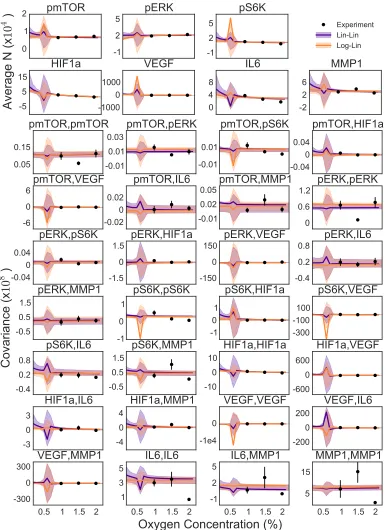
The relative fit and flexibility of these two models can also be compared visually
(Fig. 3.3). Although we see larger credible regions for the Log-Lin model,
indicat-ing greater flexibility but also an indication of a worse fit. Overall, the two models
are quite similar. Without more data it would be difficult to distinguish if the Lin-Lin model is overfit for this dataset, or if it actually is a more accurate representation
of natural functional coupling of oxygen to this system of proteins.
Biologically, the functional forms for both the top models, Lin-Lin and Log-Lin,
indicate that the oxygen causes a linear response in the effective protein interaction network. The results also show that the pairwise interactions changing is likely a
key aspect of the system’s response to a perturbation. Surprisingly, even though
the perturbation is linear in each effective protein pair interaction, the fluctuations and covariance change can be much more complex due to the many interacting
pro-teins (Fig. 3.3). There is however still some ambiguity about whether the chemical
potentials couple linearly or logarithmically to the oxygen concentration. More ex-perimentation would be useful to distinguish this coupling, particularly at a few
more oxygen concentrations, perhaps 10% and 80% pO2 to get a full range of
be-haviors. Due to this uncertainty, for the rest of the analysis, both the Lin-Lin and
6.5 7.5 8.5
pmTOR
20 24 28pERK
10 12 14 16pS6K
10 20 30 40A
ve
ra
ge
N
(x
10
4)
HIF1a
50 150 250VEGF
20 30 40IL6
30 40 50 60MMP1
Experiment Lin-Lin Log-Lin 0.05 0.2 0.35pmTOR,pmTOR
0.05 0.2 0.35pmTOR,pERK
0 0.1 0.2pmTOR,pS6K
-0.02 0.04 0.1pmTOR,HIF1a
-0.5 1 2.5pmTOR,VEGF
0 0.3 0.6pmTOR,IL6
-0.6 0 0.6pmTOR,MMP1
0.2 0.8 1.4pERK,pERK
0 0.15 0.3pERK,pS6K
-0.1 0.05 0.2pERK,HIF1a
0 4 8pERK,VEGF
-0.6 0 0.6pERK,IL6
0 1.5 3C
ov
ar
ia
nc
e
(x
10
8)
pERK,MMP1
0.1 0.4 0.7pS6K,pS6K
0 0.1 0.2pS6K,HIF1a
0 4 8pS6K,VEGF
-0.1 0.2 0.5pS6K,IL6
-1 0 1pS6K,MMP1
0.2 0.8 1.4HIF1a,HIF1a
-8 -2 4HIF1a,VEGF
0 0.4 0.8HIF1a,IL6
0.2 0.8 1.4HIF1a,MMP1
0 1000 2000VEGF,VEGF
-5 5 15VEGF,IL6
5 10 15 20 -10
5
20
VEGF,MMP1
5 10 15 20
Oxygen Concentration (%)
1 3 5
IL6,IL6
5 10 15 20 -4
0 4
IL6,MMP1
5 10 15 20 10
30 50
[image:25.612.111.505.70.616.2]MMP1,MMP1
Figure 3.3: Fit of Lin-Lin and Log-Lin models to average and covariance in copy
3.2 Comparison to Previous Analysis
We compare our framework and models to a previous analysis of this data, which
used a quantitative version of Le Chatelier’s principle[19]. The Le Chatelier’s
prin-ciple model relates the change in average copy number with a change in the
chem-ical potentials due to a change in the external conditions, but does not specify the
form of the change in chemical potentials over oxygen ranges. This model assumes
constant fluctuations (or covariance), which is analogous to our models with only
individual protein couplings (M1−M7). However, even with these simple models
we have the ability to identify the specific functional form of the perturbation,
un-like the Le Chatelier’s principle model, which means we can predict copy number
averages and covariances, where as the Le Chatelier’s principle can only predict a
change.
To analyze what information is gained by the addition of the functional form we
compare our most probable model from the first six models, Log-X, to Le
Chate-lier’s principle model. Additionally, to see what is lost by assuming the fluctuations are constant, and how that effects our predictive capabilities, we compare our best fitting models, Log-Lin and Lin-Lin, to the Le Chatelier’s principle model. Since
the Le Chatelier’s principle model can only predict changes in average copy
num-ber and predicts no changes in covariance, we analyze the error in these predictions
compared to experiment for each model overall (Fig 3.4a-b) and by protein (Fig
0 5 10 15 20 25 30
Avg. Error in
∆
N ® (x
10
3) (a)
0 1 2 3 4
Avg. Error in
∆
σ
2 (x
10
9) (b)
-0.1 0 0.1 0.2
p-mTOR
-1 0 1 2p-ERK
0 1 2 (c)p-pS6K
21→ 33→2
2→1.5
1.5% →1 -3 -2 -1 0 1 Error in ∆ N ® (x
10
4)
HIF-1
α
21→
3
3→2
2→1.5
1.5%
→1
∆pO2 (%) -5 0 5 10 15
VEGF
21→ 33→2
2→1.5
1.5% →1 0 5 10 15 20
IL-6
21→ 33→2
2→1.5
[image:27.612.115.502.69.318.2]1.5% →1 0 10 20
MMP1
LeChatelier's Log-X Lin-Lin Log-LinFigure 3.4: Predictions from Log-X, Lin-Lin and Log-Lin models are compared to quantitative Le Chatelier’s principle model. The average error per model for
predictions of the change in (a) average and (b) covariance copy number due to
a change in oxygen concentration compared to experimental values. (c) Error per
model for predictions in change in average copy number for each protein.
Overall, our top models are significantly more accurate, at least two times more so,
than the previous Le Chatelier’s principle model in predicting the change in average
copy number (Fig. 3.4a). Log-X, like Le Chatelier’s principle, assumes constant
effective protein interactions and therefore has constant covariance, so we see the same poor prediction in covariance change (Fig.3.4b). However, the Log-X
com-parison shows that just knowing the functional form provides increased predictive
capabilities for change in copy number. The functional form implies that the growth
rates of proteins may be effected by changes in oxygen concentration in a logarith-mic fashion. We again see that Lin-Lin and Log-Lin are similar, and both are more
accurate at fitting both, average and covariance, than models with no pairwise
cou-pling (Log-X or Le Chatelier’s). However, Log-Lin is actually better at predicting
changes in covariance than Lin-Lin, perhaps another indication of its being the most
probable model, and increasing the evidence that the individual protein growth rates are affected logarithmically by oxygen change.
makes poor predictions for some particular ranges in oxygen, particularly from 3%
to 2% pO2. Our models however, have more consistent error across all oxygen
changes, overall fitting the data more accurately, and increasing our confidence in more expansive predictive capabilities of the model. Additionally, by looking over
the individual proteins, some models, including Le Chatelier’s, do better, sometimes
significantly so, for one protein and very poorly for another. This could indicate
that mixed models, where each protein could have a different type of individual or pairwise functional form may provide even more actuate models.
The poor predictions using Le Chatelier’s principle model between 3% and 2%
pO2 were attributed to the oxygen concentration being a strong perturbation in this
regime, which was considered the cause for the disagreement with the theory[19]. Our model does not support this, and therefore see no reason to assume one
concen-tration is a stronger or weaker perturbation, but instead the effect seen is due to the functional coupling of the oxygen concentration to the system. Additionally, using
PCA analysis, the previous model indicated that a few proteins became decoupled
from the network. Specifically, VEGF seemed to be unpredictable between 2% and
1.5% pO2, perhaps decoupling from the rest of the network. There also seemed to
be a loss in mTOR signaling coordination, which lead to p-mTOR becoming
unre-sponsive to some drug treatments[19]. However, they were unable to specifically
Figure 3.5: Protein networks for p-mTOR and VEGF over a range of oxygen con-centrations as predicted by the Log-Lin and Lin-Lin models. Widths of
connect-ing lines and circles represent strength of effective interaction, circle fill represents strength of chemical potential. Dashed and solid lines represent inverse and positive
effective pairwise interactions, respectively.
Both of our best fit models indicate that VEGF does indeed become decoupled, and
then changes sign of interaction with p-ERK, HIF-1α, IL6 and itself, between 1%
and 2% pO2 (Fig. 3.5). Additionally, the chemical potential of VEGF also goes to
zero, though at 2% pO2 in the Lin-Lin model and 1% pO2 in the Log-Lin model.
The chemical potential gives us an indication of the natural flux in copy number,
and therefore, in this range there could be large fluctuations in the particle number
possible, which is in agreement with what the previous analysis saw for this protein.
However, unlike in the Le Chatelier’s principle model, p-mTOR does not seem to
have a loss in its signaling network between 1.5-2% pO2. There is a slight
weaken-ing of the interactions from p-mTOR to all other proteins as oxygen concentration
increases. However the protein network only becomes significantly different for mTOR at high oxygen concentrations (12-20 pO2), which is wherein-vitrostudies
are conducted. In order to test the validity of these predictions in the protein
signal-ing network, ssignal-ingle-cell data at more oxygen concentrations between 21% and 3%
would be useful.
From this analysis, we see that our framework provides a more specific picture
of system’s response to a perturbation. We are able to examine not just a change
in copy number, but also specific network and individual protein characteristics,
providing more insight into the biological response.
3.3 Predictions
Besides gaining information on the functional coupling of the perturbation to the
system, this framework can also make predictions outside of the measured
pertur-bation conditions or related to testable changes to the protein network, such as the
knocking out a protein or an interaction.
Predictions outside of the perturbation regimes measured experimentally could
iden-tify interesting and useful perturbation regimes, where there may be different be-haviors in average protein copy number or large changes in fluctuations. For the
hypoxic system, predictions can be made for extremely low and very high oxygen
0 1 2
pmTOR
-1 2 5pERK
-1 2 5pS6K
-5 5 15A
ve
ra
ge
N
(x
10
4)
HIF1a
-1000 0 1000VEGF
0 4 8IL6
-2 2 6MMP1
Experiment Lin-Lin Log-Lin 0.05 0.15pmTOR,pmTOR
-0.01 0.01 0.03pmTOR,pERK
-0.01 0.01pmTOR,pS6K
-0.04 0 0.04pmTOR,HIF1a
-6 0 6pmTOR,VEGF
-0.02 0 0.02pmTOR,IL6
-0.01 0.02 0.05pmTOR,MMP1
0 0.6 1.2pERK,pERK
-0.04 0 0.04pERK,pS6K
-1.5 0 1.5pERK,HIF1a
-150 0 150pERK,VEGF
-0.4 0.2 0.8pERK,IL6
-0.5 0.5 1.5C
ov
ar
ia
nc
e
(x
10
8)
pERK,MMP1
-1 0 1pS6K,pS6K
-1 0 1pS6K,HIF1a
-300 -100 100pS6K,VEGF
-0.4 0.2 0.8pS6K,IL6
-0.5 0.5 1.5pS6K,MMP1
-10 0 10HIF1a,HIF1a
-600 0 600HIF1a,VEGF
-3 0 3HIF1a,IL6
-4 0 4HIF1a,MMP1
-1e4 0VEGF,VEGF
-200 0 200VEGF,IL6
0.5 1 1.5 2 -300
0
300
VEGF,MMP1
0.5 1 1.5 2
Oxygen Concentration (%)
1 3 5
IL6,IL6
0.5 1 1.5 2 -1
2
5
IL6,MMP1
0.5 1 1.5 2 5
15
[image:31.612.116.502.71.601.2]MMP1,MMP1
Figure 3.6: Predictions of average and covariance in copy number with the Lin-Lin
and Log-Lin models over low oxygen concentrations.
At low oxygen concentrations, at about 0.6 pO2, we note a discontinuity in our
at-tributed to a singularity in the pairwise interaction matrix,A+F, causing the deter-minate of the pairwise interaction matrix to go to zero. This discontinuity is found
in six (M7,M11,M12,M13,M17 andM19) of the nineteen models. Three of those have
linear pairwise coupling to the oxygen concentration, and the discontinuity arises
between 0.6 and 0.62 pO2. Two of them are logarithmic in the pairwise coupling
terms and they both have two discontinuities, at about 0.45-0.5 and 0.84-0.87pO2.
This behavior could potentially be interesting, showing that the fluctuations in copy
number in this regime are large and indicate a kind of phase transition, as has been
proposed (although for slightly higher oxygen concentrations, about 1.5pO2) by
Heath et. al [19]. However, two checks would need to be made before this
con-clusion could be made. First, although we constrain the system to have bounded energetics by checking that the Hamiltonian has a minimum at each experimentally
tested oxygen concentration (see full description of the constraint in Appendix B),
we do not apply this constraint to all possible oxygen concentrations, in an attempt
to use minimal constraints. However, these limited constraints may not be enough
to get physically reasonable predictions over all oxygen concentrations. Therefore,
before moving on to additional experimentation, the second check on the validity of
this discontinuity, it is suggested to first apply this constraint in all oxygen regimes.
This could be implemented by checking that the roots of the determinate of the
A+F matrix fall outside of the possible oxygen concentration regimes (0-100% pO2).
This theoretical framework also provides a way to investigate the effect of chang-ing or removchang-ing interactions between proteins. This could be extremely useful in
determining how a drug that alters a single protein or protein interaction affects the complex protein network over a range of perturbation conditions. For example, in
0.3 0.5 0.7
pmTOR
1.4 2
2.6
pERK
1 1.2 1.4
pS6K
5 10 15 20 1
2 3
A
ve
ra
ge
N
(x
10
4
)
HIF1a
5 10 15 20 6
12
18
VEGF
5 10 15 20
Oxygen Concentration (%)
2.5 2.8 3.1
IL6
5 10 15 20 2.5
3.5 4.5
(A+F)pmTOR,pERK=0
MMP1
[image:33.612.118.499.74.215.2]Log-Lin Log-Lin with
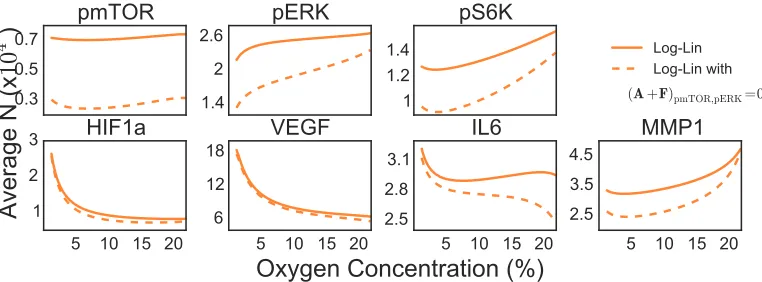
Figure 3.7: Predictions from Log-Lin model showing effects of removing removing the effective interaction between pmTOR and pERK.
To test this hypothesis we removed the effective interaction between p-mTOR and p-ERK while keeping the other interactions the same. For simplicity we only show
the effects of this on the average copy number, though this would effect the covari-ance values as well. Changing even one interaction causes significant changes to the
average copy number for some proteins (p-mTOR, p-ERK, p-S6K). This would be
a helpful tool in identifying if more or other drugs were needed to remove multiple interactions to cause the effect of interest, or to be sure to keep some interactions intact (say for some important functions in healthy cells).
Our best fit model also makes useful predictions about the effect of knocking out certain genes to render a protein dysfunctional [26, 27]. In many biological systems
it can be hard to predict the effect of stopping the production or function of a protein in a cell since most protein interactions are not well known and likely vary with cell
0 0.3 0.6
pmTOR
1.4 2
2.6
pERK
0.8 1.1 1.4
pS6K
5 10 15 20 1
2 3
A
ve
ra
ge
N
(x
10
4
)
HIF1a
5 10 15 20 6
12
18
VEGF
5 10 15 20
Oxygen Concentration (%)
2.2 2.6
3.2
IL6
5 10 15 20 2.5
3.5 4.5
hpmTORi=0
[image:34.612.121.500.72.210.2]MMP1
Log-Lin Log-Lin withFigure 3.8: Predictions from Log-Lin model showing effects of knocking out pm-TOR.
Here we knockout p-mTOR and as expected p-ERK and p-S6K are largely effected over all oxygen concentration ranges since these are known to be downstream
ef-fectors of p-mTOR. We also see some proteins, IL6 and MMP1, are affected at only one end of the oxygen concentration range which we would not have been able to
predict without this analysis due to the complex interactions of these proteins. This
reinforces the necessity of understanding the evolution of the steady-state distribu-tion, since some effects manifest only under certain perturbation conditions, which would be missed if only one particular steady state was examined.
These predictive capabilities could be extremely useful in understanding how to
effectively drug a protein network in cancer cells. Cancer cells have been shown to be very plastic, so changes in protein networks are frequent and not always lethal.
Similarly, drug sensitivity is dependent on the conditions that the cell is under, as
some cell states are more susceptible to a therapy than others. Describing how many cell states respond to the same perturbation could address this therapeutic challenge.
Specifically, our model can describe both how protein interaction networks evolve,
and which conditions have cell states most susceptible to a drug. Our framework
provides a way that would allow multiple knockouts or interactions to be tested,
C h a p t e r 4
CONCLUSIONS
Summary
We propose a simple theoretical statistical mechanical framework to model the
evo-lution of the probability distribution of cellular components in a cell in response to an external perturbation. We describe a methodology using Bayesian inference,
to extract the functional coupling of a perturbation to the system of interest from
single-cell experimental data. The flexibility of the framework allows the
appli-cation of this methodology to any system where simultaneous measurements of
single-cell cellular component data can be collected. Any number and type of
cel-lular components can be studied, from proteins, to mRNA, to small molecules, such
as metabolites. Even without describing the mechanistic bimolecular interactions,
the results of this approach extract many fundamental underlying characteristics of
the system. It provides a new way to assess and understand the state of the signal-ing network and individual proteins under the influence of a physical or molecular
perturbation.
The application of our framework to explore the effect of hypoxia in GBM cancer cells found that oxygen couples to the effective interactions between proteins, not just to individual proteins. The most probable coupling to the effective interactions was found to be linear, and the individual couplings were found to be either
logarith-mic or linear. These results indicate that the state of the protein interaction network changes linearly with the oxygen concentration, but that this can cause more
com-plex behavior in the fluctuations and average copy number in a cell. We show that
this methodology provides more accurate predictive capabilities than analyses like
the Le Chatelier’s principle method, along with a more detailed description of the
effect of the perturbation.
Future steps
We propose several future experiments that could be done to test the validity of our
approach and also suggest potential systems to investigate.
Further experiments and theoretical analysis can both strengthen and expand the
par-ticularly useful would be 0.1, 10 and 80pO2, could capture a broader range of cell
behaviors by surveying the full spectrum of possible oxygen concentrations. This
additional data could clarify whether the Lin-Lin model is overfitting the current data, or if the Log-Lin model is actually the best fit model. Also to investigate the
observed discontinuity in fluctuations and average copy number, we could change
the way in which we implement our constraints during parameter searches. If the
discontinuity is still observed, then experiments should be done in this low oxygen
concentration regime to check the validity of this unexpected prediction.
Addition-ally, in the raw data there are several outliers (see Fig. 1.1) and some tests with the
removal of these outliers would be a good robustness check.
To determine the need for a more complex model, we propose trying to add a the-oretical ‘extra’ protein for a calculation and remove one of the measured proteins
in another. By removing a protein we could investigate if the most probable
can-didate Hamiltonians order changes leading to a new coupling being predicted. If
a subset of proteins are better described by a different functional form, it may not be appropriate to presume all cell components have the same functional coupling to
the same perturbation. This could indicate that mixed models are perhaps necessary
and should be tested. Adding an ‘extra’ protein would help to identify if the subset
of cellular components experimentally chosen captures enough of the interactions
for this network. For example, it could indicate if some protein had a high influence on this system, we might find that this influence would then be captured in the extra
protein and would help to direct next experiments to include or find this molecule.
Since this theoretical framework is extremely flexible, it can easily be applied to
new systems. In particular, it would be ideal to find a data set for, or experimentally
test, a system that is fully contained (or as much as is possible in biology).
Analo-gous to new methodologies created to examine electronic structures, testing is done
on a well known, well studied and fully understood model systems. Ideally, finding a simple biological system in a cell, consisting of two or three cellular components
and having a well known functional coupling to a perturbation would be ideal.
Per-haps finding a simple two state switching system in which the proteins can be “on”
or “off” may be able to provide this. Additionally, using a more simple model or-ganism as well would be useful, perhapsE.coliwhere there are fewer factors at play and the system is more fully studied.
Once more standardized checks have been completed for the framework, larger
components at a time [2]. It would be interesting to investigate what useful
infor-mation can be provided from understanding how a larger system responds to a
per-turbation. Also, a specific system that this might be useful for, is testing the effects of drug conditions on cancer cells, particularly for finding useful drug
concentra-tions or combinaconcentra-tions by using the convenient predictive tools this methodology
BIBLIOGRAPHY
(1) Vogel, C.; Marcotte, E. M.Nat. Rev. Genet.2012,13, 227–232.
(2) Yu, J.; Zhou, J.; Sutherland, A.; Wei, W.; Shin, Y. S.; Xue, M.; Heath, J. R. Annu. Rev. Anal. Chem.2014,7, 275–95.
(3) Elowitz, M. B.; Levine, A. J.; Siggia, E. D.Science.2002,297, 1183–1186. (4) Maheshri, N.; Shea, E. K. O.Annu. Rev. Biophys. Biomol. Struct.2007, 36,
413–434.
(5) Hart, Y.; Reich-Zeliger, S.; Antebi, Y. E.; Zaretsky, I.; Mayo, A. E.; Alon, U.; Friedman, N.Cell2014,158, 1022–32.
(6) Brock, A.; Chang, H.; Huang, S.Nat. Rev. Genet.2009,10, 336–342. (7) Mettetal, J. T.; Muzzey, D.; Pedraza, J. M.; Ozbudak, E. M.; Oudenaarden,
A. V.Proc. Natl. Acad. Sci.2006,103, 7304–7309.
(8) Hallen, M.; Li, B.; Tanouchi, Y.; Tan, C.; West, M.; You, L. PLoS Comput. Biol.2011,7, 1–16.
(9) Friedman, N.; Cai, L.; Xie, X. S.Phys. Rev. Lett.2006,97, 1–4. (10) Cai, L.; Friedman, N.; Xie, X. S.Nat. Lett.2006,440, 358–362.
(11) Taniguchi, Y.; Choi, P. J.; Li, G.-w.; Chen, H.; Babu, M.; Hearn, J.; Emili, A.; Xie, X. S.Science2011,329, 533–539.
(12) Ocko, S. A.; Mahadevan, L.Phys. Rev. Lett.2015,114, 1–5.
(13) Marchetti, M. C.; Curie, M.; Curie, M. Rev. Mod. Phys. 2013, 85, 1143– 1189.
(14) Toner, J.Phys. Rev. Lett.2012,108, 1–5.
(15) Bertout, J. A.; Patel, S. A.; Simon, M. C.Nat. Rev. Cancer2008,8, 967–975. (16) Brown, J. M.; Wilson, W. R.Nat. Rev. Cancer2004,4, 437–447.
(17) Wouters, B. G.; Koritzinsky, M.Nat. Rev. Cancer2008,8, 851–864. (18) Harris, A. L.; Radcliffe, J.Nat. Rev. Cancer2002,2, 38–47.
(19) Wei, W.; Shi, Q.; Remacle, F.; Qin, L.; Shackelford, D. B.; Shin, Y. S.; Mis-chel, P. S.; Levine, R. D.; Heath, J. R. Proc. Natl. Acad. Sci. U. S. A. 2013, 110, 1352–60.
(20) Foreman-Mackey, D.; Hogg, D. W.; Lang, D.; Goodman, J. Publ. Astron. Soc. Pacific2013,125, 306–312.
(22) Goggans, P. M.; Chi, Y. InAIP Conf. Proc.2004; Vol. 707, pp 59–66. (23) Adler, M.; Mayo, A.; Alon, U.PLoS Comput. Biol.2014,10, 1–14.
(24) Sivia, D.; Skilling, J., Data Analysis: A Bayesian Tutorial, 2nd ed.; OUP Oxford: 2006, pp 79–84.
(25) Cloughesy, T. F. et al.PLos Med.2008,5, 139–151.
(26) Schulze, A.; Downward, J.Nat. Cell Biol. Technol. Rev.2001,3, 190–195. (27) Santiago, Y.; Chan, E.; Liu, P.-q.; Orlando, S.; Zhang, L.; Urnov, F. D.;
A p p e n d i x A
DERIVATIONS USING GRAND CANONICAL ENSEMBLE
This appendix shows the derivations for H = Hofor simplicity. However,
analo-gous derivations can be completed for the full Hamiltonian when a perturbation is
present, since the perturbation terms combined with the reference state terms can simply be thought of as forming ’new’ chemical potentials and effective interactions at each oxygen concentration.
A.1 Partition Function
1-Component System
Assuming cells are at a constant volume and temperature, but particle number
(cel-lular component count) fluctuates, the grand canonical ensemble can be used. The grand canonical partition function is given by
Ξo =X
N,E
e−βE+β µN (A.1)
A given microstate in the system is completely determined by the protein copy
number (N) and is weighted according to a Boltzmann distribution. The same
en-ergetics of a given microstate (N) obtained from two different volume and inverse temperature values are given as follows:
βi
Via i
N2+ βiµiN = β
j
Vja j
N2+ βjµjN (A.2)
By setting βi = ξ βj or Vi = ξVj, where ξ is an arbitrary scaling factor, and comparing each term in the above equation shows that the energetics of i and j microstates are equivalent to one another given appropriately rescaled parameters
(aand µ). Therefore volume and beta are redundant and their values are arbitrary.
The partition function can be written as as sum over all discrete particle numbers
since each state will have a different energy according to the particle number:
Ξo=
X
N
e−βH(N) (A.3)
The discrete partition function is not analytically solvable, however, we can
component densities
Ξo =V
Z ∞
0
dρe−βaρ2V+β µρV (A.4)
The exactly solvable Gaussian integral can be evaluated using the following form:
I =
Z ∞
−∞
e−12C x2+Dxdx (A.5)
where we complete the square as
−1
2C x
2+
Dx =−1
2C(x− D C)
2+ D2
2C (A.6)
WhenC =2a, D= µandx = ρ, the partition can be solved as
Ξo =V
Z ∞
0
dρeβV(−a(ρ−2µa)2+
µ2
4a) (A.7)
Ξo =V eβVµ
2 4a
Z ∞
0
dρe−βV aρ2 (A.8)
Ξo= V
2
r π
βV ae
βVµ2
4a (A.9)
n-Component System
With n cellular components, the partition function can be written by integrating over the density for each component.
Ξo =Vn
Z ∞
0
dρ1
Z ∞
0
dρ2. . .
Z ∞
0
dρneβV(− P
i,i<jai jρiρj+Piµiρi) (A.10)
As with the 1-component case, this exponential can be rewritten to complete the
square with the use of matrix form as
Ξo =Vn
Z ∞
0
dρ1
Z ∞
0
dρ2. . .
Z ∞
0
dρne−
1
2ρTAρ+MTρ (A.11)
whereρ=
* . . . . . . . , ρ1 ρ2 ... ρn + / / / / / / /
-,MT= βV µ1 µ2 . . . µn
andA=2βV
* . . . . . . . ,
a11 12a12 . . . 12a1n
1
2a21 a22 . . . 1
2a2n
... ... ... ...
1
2an1
1
2an2 . . . ann + / / / / / / /
This equation can be simplified by transforming ρ to another vector q with an
orthogonal matrixSwith a determinant of unity:
ρ=Sq (A.12)
The integral is now
Ξo=Vn
Z ∞
0
dq1
Z ∞
0
dq2. . .
Z ∞
0
dqne−
1 2qTS
−1ASq+MTSq
(A.13)
The matrixSis a diagonalizing matrix which means that
S−1AS=*. . .
,
d1 0 . . .
0 d2 . . .
... ... ... + / / /
-= D (A.14)
which transforms as
−1
2ρ
TAρ+MTρ→ −1
2q
TDq+MTSq (A.15)
The variables can now be separated, which expands to
−1
2(d1q
2
1+d2q22+. . .dnqn2)+ MαSα1q1+ MαSα2q2+. . .MαSαnqn (A.16)
where the summation of terms will be over the index α. The square can be com-pleted for eachqi term.
−1
2di(qi−
MαSαi
di
)2+ (MαSαi)
2
2di
(A.17)
Using the completed square the partition function can be evaluated as
Ξo= (
V 2)
n(2π)
n
2
|A|12
e12MTA
−1M
(A.18)
where|A|is the determinant of a A.
A.2 HoEnsemble Statistics
The average,hNi, and fluctuations,h(δN)2i, in cellular component copy number are calculated from the derivative of the partition function with respect to its conjugate
variable β µaccording to the following equations:
hNi= 1
β ∂lnΞ