GENETIC VARIATION I N THE CLOVER LEAFHOPPER'S ABIL-
ITY T O TRANSMIT POTATO YELLOW-DWARF VIRUS
L. M. BLACK
The Rockefeller Institute for Medical Researck, Princeton, New Jersey
Received September 18,1942
INTRODUCTION
TOREY (1932) discovered that individuals of Cicadulina mbila (Naude)
s
varied in ability to transmit maize-streak virus, Marmor maidis var.typicum H.
(HOLMES
1939). He was able to breed two races, an active race that could transmit the virus and a n inactive race that was unable to do so. His experiments indicated that ability to transmit was controlled by a single sex-linked 'dominant gene. Later, BENNETT and WALLACE (1938) showed that families of Eutettix tenellus (Baker) vary in their ability to transmit curly-top virus (Chlorogenus eutetticola H.) .It is the purpose of this paper to deal with the hereditary variation in trans- mission of potato yellow-dwarf virus, Marmor vastans H. var. vulgare Black (BLACK I 940) by individual leafhoppers of the species Aceratagallia sanguino-
lenta (Prov.). The different expressions of this genetic variability are in part elucidated, and it is shown that by selective breeding, races may be obtained that differ greatly in their infective ability. An abstract of this work has al- ready appeared (BLACK 1941).
MATERIALS A N D METHODS
Materials and methods of general application in the present work will be described here; any deviations in individual experiments will be dealt with under such experiments. Crimson clover (Trvolium incarnatum L.), reported earlier (BLACK 1938) as susceptible to the virus, was selected as a test plant. It shows distinctive symptoms when infected with yellow dwarf and has cer- tain advantages over potato (Solanum tuberosum L.) as a test plant in insect transmission studies. It is more readily grown from seed to obtain virus-free seedlings; the plants are better hosts for the leafhopper; the seedlings are readily accommodated in smaller cages and for a longer period. The crimson clover seed was sown in sand and the young seedlings transplanted individually to soil in +inch pots shortly after expansion of the unifoliate leaf. Sowings were timed so that seedlings with the first trifoliate leaf just beginning to un- fold were available when required for testing the infectivity of insects. Each seedling was covered by a celluloid cylinder having a cheesecloth top and a small hole cut in one side near the upper end. The insect to be tested was intro- duced through the hole and the aperture plugged with nonabsorbent cotton. The insects were in the nymphal stage when placed on their first test plants, and since they were tested individually, they were unable to mate and repro- duce when they reached the adult stage. Subsequent transfers were made by tilting the pot and cage a t about a 45' angle toward a good source of light, in-
ducing the insect to hop to the upper part of the cage, and substituting a new pot and seedling a t the bottom. With practice, transfers to fresh plants could be made rapidly in this manner. After the removal of the insect, each test plant was held for observation in the greenhouse for five weeks or longer.
The statistical significance of the data obtained was determined by extensive use of the fourfold table to ascertain the chi-square values. Yates’ correction was employed in all cases. From these values the probabilities were determined by referring to tables in FISHER (1936) or YULE (1922). Throughout the paper
the expression “odds x: I” indicates the probability that any difference is
not due to chance alone.
ACTIVE AND INACTIVE RACES
Sixty clover leafhopper nymphs that had fed for 1 2 days on infected crimson
clover were tested individually for their ability to transmit. Some infected several plants, while others infected none. This result suggested the possibility of obtaining active and inactive races of the clover leafhopper corresponding to those secured by STOREY for Cicadulina mbila. Insects transmitting the virus were bred among themselves in an attempt to obtain an active race, while those failing to transmit were also bred among themselves in an attempt to obtain an inactive race. Because of the life history of the insect and the latent period of infection in the plant, it was necessary to make the matings when about half of the results of the infectivity tests were available. Therefore, about four times as many matings were made as were actually needed, and each impregnated female was caged separately on a crimson clover plant in the acute stage of yellow dwarf. By the time the progeny was ready to be tested, all the results of the infectivity tests on the parents were available and it was then possible to select and test the best families and so to continue each line. I n general, among the individuals of the active race the male infecting most plants was mated with the corresponding female. Some males were used to impregnate as many as three females. Many brother to sister matings were made in producing the third, fourth, and fifth generations. However, debility due to inbreeding manifested itself in slower growth, infertility, early death, and lack of vigor. Such matings were therefore avoided in later generations. Nevertheless, debility due to inbreeding was a serious handicap, especially in the active race. When the two races were crossed, the increase in the number, vigor, longevity, and growth rate of the progeny was striking.
BLACK
were recorded a t each transfer so as to furnish a complete record of each insect. The incubation period in each infected clover plant was also recorded. Examples of the data sheets for a family of the active race and for one of the inactive race are presented in figure I. Presentation and analysis of some of the data on ecdyses and deaths of the insects and incubation period in the plant are reserved for another paper. The data analyzed in the present paper
Dates insects placed on successive test plants
Active race, generation 9, family 23.
6-29-39 7- 6-39 7-13-39 7-20-39 7-27-39 INSECT NO. b
SEX
INSECT NO.
, d O d d d 0 8 0 d d d d 8 0 ?
> I 2 3 4 5 6 7 8 9 1 0 1 1 1 2 1 3 1 4 1 5 I 2 3 4 5 6 7 8 g 1 0 1 1 1 2 1 3 1 4 1 5
8 0 a 3a 8 4o 3a 8 28 3o a a a
d a d 3 4 a 5 3 " p d d 3
3 3 3 2 3 2
2 4 2 5 3 2 3 3 2
2 2 2 1 3 3 1 2 4 2 d
Dates insects placed on successive test plants
6-29-39 a 3 8 a a 8 0 II 8 8 0 a 8 a a 0 7- 6-39 3
7-13-39 2
* 8
d
7-20-39 'd
7-27-39 d d d
are restricted to those insects which survived a t least the period during which they were confined to the first test plant. The data are also restricted to those plants from which the insects were removed alive. For comparisons involving sex it was necessary to eliminate also all data appertaining to insects that died as nymphs.
Members of the active selection fed on 3340 plants and infected 1845, or 55.24 percent, whereas members of the inactive race fed on 3762 and infected
204, or 5.42 percent. It is apparent from table I that in each generation there
TRANSMISSION BY LEAFHOPPERS
TABLE I
Genetic variation i n the ability of #he clover leafhopper to transmit potato yellow-dwarf z6rus.
203
ACTIVE RACE INACTIVE RACE
INSECTS PERCENTAGE INSECTS PERCENTAGE
GENERATION INPECTIVE OF INFECTIVE OF
INSECTS INFECTIVE INSECTS INFECTIVE
TESTED INSECTS TESTED INSECTS
I
2
3
4
5
6
7
8
9
Total
53 60
-
78 98
-
606
760
-
8 8 . 3
41 .o
77.2
6 5 . 0
94.6
79.1
91.3
75.5
79.6
79.7
2 7
60
-
4 44
-
20 -
103
I - 97
6
99
4
-
83 816
-
4 5 . 0
9 . 1
19.4
1 . 0
6 . I
3 . 9
1 6 . 5
2.0
2.0
1 0 . 2
cent of infective insects, while the inactive race contained only 2 percent.l
It is of interest to note that after this program of selective breeding the in- active race should still contain active individuals, for in the nine preceding generations all their direct ancestors had failed to transmit the virus. More- over, beginning with the breeding of the seventh generation i t was possible t o continue the inactive selection by mating only individuals from families, none of whose 15 members transmitted the virus. I n this connection it is worth noting that by the second generation the inactive selection was confined to the descendants of only four of the original insects. If multiple factors are involved in the ability to transmit, it might be that the breeding program as carried out produced the least active race possible from the recombination, without
1 In spite of the failure to isolate a race none of whose members would transmit, it is thought
mutation, of genes present in these four insects. Inclusion of additional insects might make possible the selection of an even less active race. Similar con- siderations may be involved in the failure to get IOO percent of the members of
the active race to transmit in spite of the fact that for nine generations all the ancestors of the race had transmitted the virus.
HYBRIDS BETWEEN THE T W O RACES
Hybrids between the two races were obtained by mating individuals belong- ing to the seventh and eighth generations. Tests of these hybrids were carried out a t the same time and under the same conditions as tests of the eighth and ninth generations, respectively. In the eighth generation, out of 104 hybrids tested, 22, or 21.2 percent, were infective, and in the ninth generation, out of 1 0 2 hybrids tested, 31, or 30.4 percent, were infective. I n each generation the
odds are greater than roo: I that the difference between the hybrids and either race is not due to chance alone. I t is clear that the hybrids are intermediate in their ability to transmit. The fact that the vigor of the hybrids was notice- ably greater than that of either race is considered good evidence that the differences in transmission by the active and inactive races and by the hybrids are not correlated with vigor.
SEX-LINKAGE
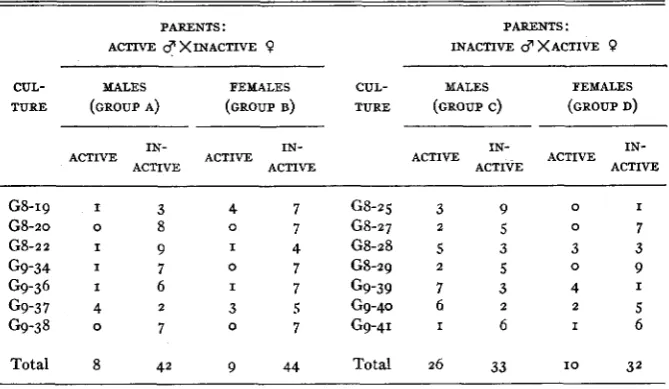
I n table 2 , the data on the infectivity of the hybrids of the eighth and ninth
generations are presented in detail. The outstanding feature of the table is the high proportion of infective males to noninfective males (26:33) resulting from
crosses between inactive males and active females. This proportion is signifi- cantly different (odds greater than 100: I) from the proportions in groups a or b or a+b+d (table 2). However, the odds are only 16:r that the differ-
TABLE 2
Active and inactive progeny of crosses between the two races of clover leafhop#ers.
PABENTS : PARENTS :
ACTIVE d X I N A C T I V E 0 INACTIVE ~ X A C T I V E 0
CUL- MALES FEMALES CUL- MALES FEMALES
TURE (GROUP A) (GROUP B) TURE (GROUP c) (GROUP D)
IN- IN-
ACTIVE ACTIVE
ACTIVE ACTIVE IN- IN-
ACTIVE ACTIVE ACTIVE ACTIVE
G8-19 G8-20 G8-22 G9-34 G9-36 G9-37 G9-38 Total
I 3
0 8
I 9
I 7
I 6
4 2
0 7
8 42
4 7
0 7
I 4
0 7
I 7
3 5
0 7
9 44
G8-25 G8-27 G8-28 G8-29 G9-40 G9-39 G9-41 Total
3 9
2 5
5 3
2 5
7 3
6 2
I 6
26 33
0 I
0 7
3 3
0 9
4 I
2 5
I 6
ence between the proportions in groups c and d is not due to chance and group d is the closest control on group c, since the insects in c and d were from the same families and within each family fed on the same source plants. Differences. between a, b, and d are not significant (odds I : I or less).
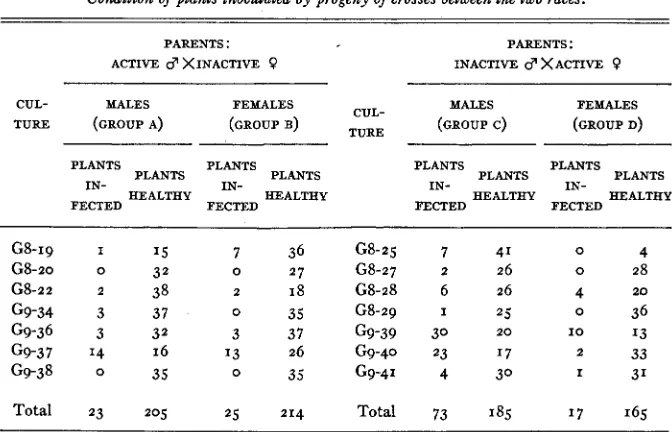
If we consider the data on numbers of plants infected by the hybrids (table 3), we find that in group c the proportion of plants infected to plants healthy is significantly different (odds greater than 100: I) from the proportions in groups a, b, or d. Differences between a, b, and d are not significant (odds less
TABLE 3
Condition of plants inoculated by progeny of crosses between the two races.
PARENTS : PARENTS :
ACTIVE d XINACTIVE 9 INACTIVE d XACTIVE 0
CUL- MALES FEMALES MALES FEMALES
TURE (GROUPA) (GROUP B) TURE (GROUP c) (GROUP D) CUL-
PLANTS PLANTS PLANTS PLANTS
IN- IN- IN- IN-
FECTED FECTED FECTED FECTED
PLANTS PLANTS PLANTS PLANTS
HEALTHY EEALTHY HEALTHY HEALTHY
G8-19 I 1 5
G8-20 o 32
G9-34 3 37 G9-36 3 32 (39-37 14 16 G9-38 o 35
G8-22 2 38
Total 23 205
7 36 G8-25 7 41 0 4
0 2 7 G8-27 2 26 0 28
2 I8 G8-28 6 26 4 2 0
0 35 G8-29 I 2 5 0 36
3 37 G9-39 30 20 I O I3 13 26 G9-40 23 '7 2 33
0 35 G9-41 4 30 I 31
2 5 214 Total 73 185 1 7 165
than I : I). I n view of these various comparisons, there seems to be good reason
for concluding that males produced by mating inactive males and active fe- males are significantly different, in regard to ability to transmit, from the fefnales produced by such crosses and from both males and females resulting from the reciprocal crosses. These results suggest that sex-linkage is involved in the ability to transmit or that an autosomal gene (or genes) with a maternal
(plasmatic) effect has a different degree of dominance in the two sexes. These two hypotheses will be discussed later.
PERCENTAGE O F INFECTIVE MALES AND FEMALES
I n table 4, data on the infective males and females in different population groups are presented. I n both races and in the hybrids between them there is a higher percentage of infective males than females. I n the active selection and in the population as a whole, the odds are greater than 20: I that this difference
206 L.
TABLE 4
Percentage of mele and female leafhoppers transmitting the potato yellowduarf virus.
ODDS THAT DIP-
PERCENTAGE OP FERENCE IS NOT
SEX INFECTIVE DUE TO CHANCE
INSECT TOTAL INFECTIVE
.GROUP INSECTS INSECTS
ALONE INSECTS
Male 352 285 81.0
Female 3 73 277 74.3
Active
Male 109
Female 95
Hybrids
Male 379
Female 397
Inactive
Male 840
865
All insects Female
34 I9 45 33 364 329 31.2 2 0 . 0
11.9 8.3
43.3 38.0
25: I
10: I
7: I
32:1
EFFICIENCY OF TRANSMISSION
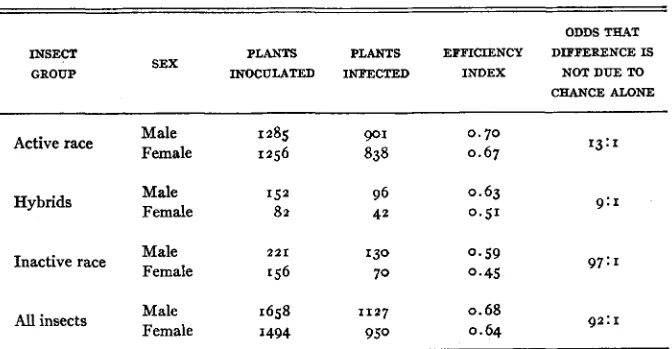
The number of plants infected divided by the number of plants on which infective insects were tested has been employed as a measure of the efficiency of transmission. For convenience, the resulting fraction has been termed the efficiency index. It should be emphasized here that noninfective insects and the plants on which they were tested do not enter into the calculation of the effi- ciency indices. For example, most of the members of the inactive race and the plants on which they were tested are not considered because most of the insects were noninfective. The efficiency index for the inactive race was derived from only the small fraction of insects in this race that were infective and the plants on which these infective insects were tested.
TABLE 5
E&iency of transmission of potato yellow-dwarf virus by male and female kafhoppws.
ODDS THAT
INSECT PLANTS PLANTS EFFICIENCY DIFFERENCE IS
GROUP INOCULATED INFECTED INDEX NOT DUE TO
CHANCE ALONE SEX
Male I 285
Female I 256
Active race
Hybrids Male
Female
Male Female Inactive race
1 5 2
82 221 156 901 838 96 42 0.70 0.67 0.63 0.51 0.59 0.45 13:' 9:1 0.68
1494 950 0.64 g2:1
Male 1658 1127
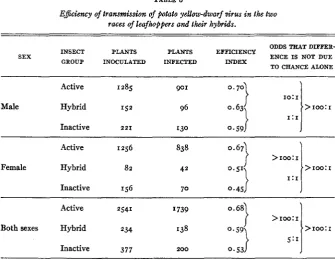
The efficiency indices for infective males and females (table 5 ) in the differ- ent population groups are consistently higher for the males. The difference is slight and is significant only in the inactive race and in the total population. I n table 6 the data are rearranged to show the differences in the efficiency among the infective members of the active and inactive races and the hybrids. Insects in the active race were significantly more efficient than insects of the same sex in the inactive race. In both sexes the efficiency of the hybrids fell between that of the two races. However, the only significant differences were
TABLE 6
E@iency of transmission of potato yellow-dwarf virus in the two
races of leafhoppers and their hybrids.
ODDS TEAT DIFFER- INSECT PLANTS PLANTS EFFICIENCY
GROUP INOCULATED INFECTED INDEX
SEX ENCE IS NOT DUE
TO CHANCE ALONE
Active 1285 90 I
Male Hybrid 152 96
Inactive 221 130
10:1
~~ ~~ ~ _ _ _ _ _ ~
Active 1256 838
Female Hybrid 82 42
>
roo: IInactive 156 t o 0.45
Active 2541 I739
Both sexes Hybrid 234 138
Inactive 377 200
>roo:r
>=greater than.
those between female hybrids and female members of the active race and between the totals for the active race and the hybrids. I n general, it appears that greater efficiency and a higher proportion of infective insects are cor- related whether the latter proportion is associated with the race or the sex.
DISCUSSION
BLACK
had the insects been transferred to additional plants, a few more might have been added to the infective class.
It is possible that an autosomal gene or genes in the homozygous condition might reduce the chances of an insect becoming infective to the low level existing in the inactive race, might reduce the efficiency of the few infective insects in this race, and, in the heterozygous condition, might exert an inter- mediate action both on the probability of an insect becoming infective and on efficiency. If in addition the gene, or genes, produced a maternal (plasmatic) effect on the egg cytoplasm with a different degree of dominance in the two sexes, all the data might be accounted for.
A simpler explanation must also be considered-namely, that the sex mechanism is the same as in Drosophila and that a single incompletely domi- nant gene affecting the tendency of an insect to transmit and the efficiency of transmission is located on the sex chromosome. Such an arrangement accounts for the proportion of infective insects among the hybrids of groups a, b, and d of table 2 being lower than that of group c. However, it does not account for the percentage (44.1 percent) of infective insects in group c being significantly less (odds greater than 100: I ) than the percentage (77.6 percent) of infective insects in the active race during the eighth and ninth generations. If the hypothesis under consideration were true, there should be no difference be- tween the insects in group c and those of the eighth and ninth generations of the active race. It is suggested that the difference may be due to other in- hibiting genes present on other chromosomes.
It is worth pointing out here that the active and inactive groups in hybrids between the active and inactive races of Aceratagallia sanguinolenta are differ- ent from the corresponding groups in Cicadulina mbila. I n A . sanguinolenta
group c (table 2) might be considered active and groups a, b, and d inactive. I n C. mbila (STOREY 1932) the group corresponding to a is inactive and the groups corresponding to b, c, and d are active.
SUMMARY
By selective breeding through ten generations, two races of clover leaf- hoppers have been obtained, one “active,” the other “inactive.” I n the last generation, 80 percent of the active race, 2 percent of the inactive race, and 30 percent of the hybrids proved infective when tested under the same con- ditions. Infective individuals appeared in every generation in the inactive race, even though all ancestors in preceding generations had failed to transmit the virus. Conversely, in every generation some individuals in the active race failed to transmit the virus, although all ancestors in preceding generations had transmitted.
The male infective insects were more efficient vectors than the female in- fective insects in both races and in the hybrids. However, such differences in efficiency were demonstrated to be significant only for the whole population and for the inactive race. Infective members of the active race were signifi- cantly more efficient vectors than infective individuals of the same sex belong- ing to the inactive race. The hybrids were intermediate in efficiency, but in most cases their position was not demonstrated to be significant.
Evidence was obtained indicating that the males resulting from crosses between inactive males and active females were more active than the females derived from such crosses and more active than the males and females resulting from reciprocal crosses. Two genetic hypotheses explaining these differences are discussed.
LITERATURE CITED
BENNETT, C. W., and H. E. WALLACE, 1938 tix tenellus. J. Agric. Res. 56: 31-51.
BLACK, L. M., 1938 Properties of the potato yellow-dwarf virus. Phytopathology 28: 863-874. 1940 Strains of potato yellow-dwarf virus. Amer. J. Bot. 27: 386-392.
1941 Hereditary variation in the ability of the clover leaf hopper to transmit potato yellow- dwarf virus. (Abstract) Phytopathology 31 : 3.
FISHER, R. A., 1936 Statistical methods for research workers. 339pp., Edinburgh: Oliver and Boyd.
HOLMES, F. O., 1939 Handbook of phytopathogenic viruses. 221 pp., Minneapolis: Burgess Pub-
lishing Co.
STOREY, H. H., 1932 The inheritance by an insect vector of the ability to transmit a plant virus.
Proc. Roy. Soc. London B, 112: 46-60.
YULE, G. U., 1922 An introduction to the theory of statistics. 415 pp., London: Charles Griffin and Co., Ltd.