@
TI MALAYAOn
Estimation
of Autoregressive
Conditional
Duration
(ACD) Models Based
on
Different
Error Distributions
By:
D. Pathmanathan,
K.H. Ng
and
s.
Peiris
(Paper presented at the
International Statistics Conference 2010
held on 8-9 January 2010 in Colombo, Sri Lanka)
Sri Lankan Journal oj Applied Statistics, Vol.I 0, 2009,p.25J~269
On Estimation of Autoregressive
Conditional Duration (ACD)
Models Based on Different ErrorDistributions
D. PATHMANATHAN, K.H. NG" AND S. PErRIs ....
University of Malaya, Kuala Lumpur, Malaysia
ABSTRACT
Autoregressive Conditional Duration (A CD) models playa central role in modelling high frequency financial data. The Maximum Likelihood (ML) and Quasi Maximum Likelihood (QML) methods are widely used in parameter estimation. This paper considers a semi parametric approach based on the theory of Estimating Function (EF) in estimation of A CD models. We use a number of popular distributions with positive supports for errors and estimate the parameter(s) using the both EF and . ML approaches. A simulation study is conducted to compare the peiformance oj the EF and the corresponding ML estimates for ACD(1.1), ACD(l,2) and ACD(2,l) models. It is shown that the EF approach provides comparable estimates with the ML estimates using a shorter computation time. Finally, both methods are applied to ~odel a real financial data set and provide empirical evidence to support the use EF approach in practice.
Keywords: Conditional duration, Estimating function, High Frequency data,
Maximum likelihood
INTRODUCTION
In
many financial modelling problems, we face with the problem of analyzing highfrequency data. A class of high frequency data models are originally appeared
as
"fixed-interval" models, where all transactions are recorded as the fixed time intervals. However, one main drawback of these models is that they do not take into
account the irregular spacing of the data. As a result, we may lose some useful
information if the transactions cluster differently within a fixed interval. To avoid such loss of information, Engle and Russell (1998) had proposed the class of models
called the autoregressive conditional duration (ACD) models. This class of models
adapts the AR and GARCH theory to study the dynamic structure of the adjusted
durations and can be used to analyze transaction data with irregular time intervals .
---Let Xj be the adjusted duration such thatx,
=
t, - 1,_1, where 1j is the time of the ithtransacti on and let
(I)
where Fi-l is the information set available at the (i-1)th trade. The basic ACD model is defined as
(2)
where Cj is a sequence of independently and identically distributed (iid)
non-negative random variable's with density f(.)and E(ci)
=
1 ands,
is independent ofF
i-l·From Equation (2) it is clear that a vast set of ACD model specifications can be defined by allowing different distributions for
e,
and specifications of If!i .A general class of ACD models generated from (2) is called
ACD (m,q),(m ~ 1,q ~0) and is given by
m q
III.
=
Ci)+ "'"'
a .x. .+ "'"'
b.,1//. .,'t'l L.... .I 1-.1 L.... /'1' 1-.1
i=i ;=1
(3)
r
where OJ> 0, aj,b.i > 0 and L(a; +b) <1, and r
=
max(m.q).;=1
This paper focuses on the parameter estimation of ACD models based on a number of different distribution with positive support for Cj. Engle and Russel (1998) used
Likelihood (QML) methods. If the parameters in the model are not well-estimated, then the model may not be adequate for describing the behavior of the data. The accuracy of forecasts may also affect by a "poor" model.
In their paper, Peiris et al., (2007) suggested the use of the estimating function (EF) approach to estimate the parameters in ACD models. Peiris (2008) shows a simulation result of the estimation of ACD models using estimating functions.
Since the error distribution of the model is not known in practice, this paper extends the work of Peiris et.al.(2007) and focuses on the estimating parameters of ACD models based on various possible error distributions. We assess the performance of EF and ML methods and compare the bias and the standard errors in each case. We consider four popular different non-negative distribution for ci including the
Exponential, Rayleigh, Lognormal and Gamma to model ACD structures. Results show that both methods are comparable in estimating the parameters of the ACD models but the EF method proves to be faster and efficient than the ML for estimating the parameters when the distribution is unknown.
With that view in mind the following section reviews the parameter estimation problem based on the ML and EF approaches.
ESTIMATION
This section considers the ML and EF approaches to estimate the parameters of ACD models as well as the parameters of the corresponding error distributions.
The ML approach
Let iO
=
max(m,q) and xn=
(xp".,xn)' for an ACD model, where n is the samplesize. The likelihood function for the durations is
n
L(xn
I
e,x
j)=
TIf(xjI
F;-I
,9)where 9 denotes the vector of model parameters, Xio =(Xj,···,xio) and
;n
I'»;
19)=
TIfe
Xi)·i=1
As the sample size n increases, the impact of the marginal probability density function (pdf),
ts»;
19) on the likelihood function diminishes. Thus, the marginal density can be ignored resulting in the conditional likelihood function as below:"
Lex"
19,
x;.)
=
TIfe
x; 1;;_1'9) .;:::;0+1
(4)
For some selected distributions of
s.,
the likelihood functions are as shown below:1. Standardized Exponential distribution: L(x
I
xio)=TI
{_l e-C~J}
/:::=10+1 Vlj
2. Standardized Rayleigh distribution: L(x
I
x
io)=[1 {~( \
JeN~
II
'-'0 ~1 Ijf,
J
4. Standardized Gamma distribution: L(x
I
=:
=
TI
J[
K'·_(!:i_JK-1
e-~:]_l1
..
Now we consider the theory of estimating functions (EF) as an alternative semi-parameter approach for semi-parameter estimation.
The Estimating Function Approach
Let {Yb Y2, ...
J
be a discrete stochastic process. We are interested of fitting asuitable model for a sample of size n from this process. Let
8
be a class of probability distributionsF
onR
/1 andB
=
B(F),
F
EGbe a vector of realparameters.
Let hi be a real valued function of Yr, Y2,' .. , Yi and
B
such thatEi-1,F[hi {Yl ,Y2," "Yi; f}(F)}]
=
0,Ci
=
1,2,···,n;F E8)and
EChihj)
=
0, (i:t: j), •where Ei-1,F C·) denotes the expectation holding the first i-1' values
Yl,Y2,",Yi-l fixed and Ei-1,F(.)=Ei-1, EO,F(.)=EF(.)=E(.)Cunconditional
mean).
Estimating Functions
Any real valued function g(.) of the random variates Yl, Y2"", Y/1 and the parameter
B,
that can be used to estimateB
is called an estimating function.If gC:) satisfies regularity conditions (i) the first and the second derivatives of g(.), g' C·) and gilC.)exist, and Cii)E[g2 (.)] is non-zero
and
then g(.) is called a regular unbiased estimating function.
*
Among all regular unbiased estimating functions g , g is said to be optimum if
(5)
{E[[a
CY
1,Y2"",Yn;e)])}2
ae
!3=!3(F)*
is minimized for all FEe at g
=
g .Then, we estimate
e
by solving the optimum estimating equation*
g (Yl, Y2 , ... , Yn ;e)
=
0 .Main Results
We restrict initially to estimating functions g of the form
n
g
=
'2:
h;a;-l1=1
where the functions h, are as defined before and a/-l is a function of the random variates Yl,Y2,",Y;-1 and the parameter
e
for all i=1,2,.. ·,n. We consider the class of linear estimating functionsL
generated by g. Note that g being linear inhi' the class L corresponds to linear functions in Gauss-Markov set-up for linear models.
Clearly,
E(g)
=
0,gEL.
Now we state the following theorem due to Godarnbe(l985):
Theorem
*
In
the class L of estimating functions g , the function g minimizing (5) is given by*
n*
g
=
Ih;a;_l ,i==1
where
[OhiJ
E.
1-*
/-
of}Qi-l
=
2'£,-l[h, ]
Notes:
*
1. The functiong is called the optimum estimating function.
2. Based on Godambe (1985), an optimal estimate of f} can be obtained by
*
solving the equation(s) g
=
O.See Thavaneswaran and Abraham (1988) and Grahramani and Thavaneswaran (2009) for theory and various applications of estimating functions.
Estimation of ACD (m,q) Using the EF Approach
Consider the ACD (m,q) model given by Equations (2) and (3). It is clear that the conditional distribution
where' [2i_1 is the information set available at time i-I and
u~
is the variance ofe.,
Let hi
=
Ifi - Xi' It is obvious that hi is an unbiased estimating function. Now, alinear unbiased estimating function is constructed such that
11
0== '\' h.a~
o ~ I I'
,;1
Ol/f,
where a~==
a,e
ande
is a parameter., 1jI,~V
Solving the following system of Equation (6) for
e
and the optimal set of estimates can be obtained:(6)
The following derivatives under the conditions of i-th order stationarity can be used:
•
•
aw, _
~
b Ol/f'-i---V!,-,+
~
j--obi ,;1.j='. obj
where k and 1 are respectively the subscripts of the parameter of interest for a and
b.
•
Itis easy to see that for ACD( 1,J ) model, we have
(7)
where
s
is the variance of £, .For example,
a) s ==.2 for standardized Exponential distribution
b)
s
=
i
for standardized Rayleigh distributionJ[
c) s
=
ea2 for standardized Lognormal distributiond)
s
=
K + 1 for standardized Gamma distribution KSIMULATION
This section considers a large scale simulation study in order to compare the performances of the MLE and EF approaches for an ACD(l,l) model based on a number of standardised distributions as mentioned above in (a) to (e). Let
e
be an estimator of parameter 8. Suppose that we simulate a series of length n and estimate respective parameters. Repeat these simulation and estimation steps Ntimes and calculate the following:
-
1
Ni) Mean,
e
=-~e
Nt;j'
ii) Estimated Bias = 8 -8
.. lati E' dB' (0/)
(I
Estimated BiasI)
ill) Absolute Re atrve stimate las /0
=
8 . .xl 00%iv) Estimated Standard Deviation (S.D) =
-1-f(e
_0)2N-l ;=J
v) Mean Squared Error, MSE(e) =
Elce -
8)2J
~ 2
=
Var(8)+
(bias). . . Estimated SD of EF
VI) Relative Efficiency
=
---Estimated SD of ML
For the Exponential ACD (EACD) case EACD(l, 1), EACD(2, J), EACD(l, 2) and EACD(2, 2) have been studied and the corresponding estimating results have been reported in Tables 1 to 4. It seems that the results obtained using the ML and EF methods are comparable. However, the EF method provides smaller estimated standard error in estimating the parameters
b
1 andb'2
for both EACDC1, 2) (in Tablel.:
3) and EACD(2, 2) (in Table 4) models. Although the absolute relative bias, the. means of
b
l andb
2 seem to be slightly better in ML estimates than the EF method,the computation time is relatively smaller in the EF approach. When the Mean Squared Error (MSE) is scrutinized for the case involving the EACD(1, 2) model,
e
)
.
.
the results for
b,
and b:. appear to be comparable. The MSE for OJ is slightly larger.
.
when EF is applied. The MSE computed for W , b, and h:. are smaller when the EF approach is utilized in estimating the parameters of the EACD(2, 2) model.
A similar conclusion can be drawn for Lognormal ACD (1,1) model, Rayleigh ACD (1, 1) model and Gamma ACD model(GACD(l, 1)) (Refer to Tables 5 to 7) the estimates of the parameters are somewhat comparable for both EF and ML methods. In general, the EF method's computation time is 5 times faster compared to the ML method.
Table 1: Estimated Results for Simulated Exponential ACD (1, 1) Series with 500
observations ((j)
=
0.20,a
l=
0.30, b. =0.60 and fill =0.50).to a) hI
ML
EF
MLEF
ML EFMean 0.2198 0.2205 0.2977 0.2949 0.5893 0.5905
Estimated Bias 0.0198 0.0205 -0.0023 -0.0051 -0.0107 -0.0095
Abs. Rel. Est. Bias 9.90% 10.25% 0.77% l.70% 1.78% 1.58%
Estimated S.D. 0.0715 0.0695 0.0527 0.0521 0.0686 0.0689
MSE 0.0055 0.0053 0.0028 0.0027 0.0048 0.0048
Relative Efficiency
I
1.0000I
0.9720 1.0000 0.9886 1.0000 1.0044Table 2: Estimated Results for Simulated Exponential ACD (2, 1) Series with 500 observations
t
to :;:0.10, aJ =0.20,a1 =0.30,bJ =OAO, Ifl =OAO and If 1=0.60).co aJ G2 bJ
ML EF ML EF ML EF ML EF
Mean 0.1082 0.1082 0.1961 0.1959 0.2953 0.2957 0.3928 0.3924
Estimated
0.0082 0.0082 -0.0039 -0.0041 -0.0047 -0.0043 -0.0072 -0.0076 Bias
Abs. Rel.
8.20% 8.20% 1.95% 2.05% 1.57% 1.43% 1.80% 1.90% Est. Bias
Estimated
0.0322 0.0321 0.0564 0.0563 0.0815 0.0817 0.0917 0.0913 S.D.
MSE 0.0011 0.0011 0.0032 0.0032 0.0067 0.0067 0.0085 0.0084
Relative
1.0000 0.9969 1.0000 0.9982 1.0000 1.0025 1.0000 0.9956 Efficiency
Table 3: Estimated Results for Simulated Exponential ACD (1, 2) Series with 500
observations (())=0.10,G] =0.20,bl
=
0.30,b2 =0.40,If] =0.40 and 1f2 =0.60)co
I
G]6
1b1
ML EF
I
ML EF ML EF ML EFMean 0.1249 0.1236 0.1924 0.1827 0.3516 0.4238 0.3281 0.2652
Estimated
0.0249 0.0236 _0.00761-0.0173 0.0516 0.1238 -0.0719
-0.1348 Bias
Abs. Rel.
24.90% 23.60% 3.80% 8.65% 17.20% 41.27% 17.98%
33.70% Est. Bias
Estimated
0.0817 0.1107 0.0552 0.0551 0.3245 0.3101 0.2870
0.2586 S.D.
MSE 0.0073 0.0128 0.0031 0.0033 0.1080 0.1115 0.0875 0.0850
Relative
1.0000 1.3550 1.0000 0.9982 1.0000 0.9556 1.0000
0.9010 Efficiency
Table 4: Estimated Results for Simulated Exponential ACD (2, 2) Series with 500 observations ((v=OAO,(l1 =O.lO,a:, =0.20,bl =O.20,b] =OAO,1f1 =0.50 and
It.']
=
0.50)OJ (ll
u]
bl b,ML EF ML EF ML EF ML EF ML EF
t\~m 0.4428 0.4192 0.OY33 0.0967 0.180710.1641 0.3161 0.3870 0.2938 0.2425
Esti "luted
0.0428 0.0192
-
- - -00359 0.1161 -0.1062BiOS 0.0067 0.0033 0.0193 0.1870 -01575
Abs. ReI.
10.70% 4.80% 6.70% 3.30% 9.65% 17.95% 58.05% 93.50% 26.55% 39.38% Est. Bas
Estirna ed
0.2064 0.1849 0.0524 0.0515 0.0831 0.0824 OA155 0.3593 0.3308 0.2817 S.D.
MSE 0.0444 0.0346 0.0028 0.0027 0.0073 0.0081 0.1861 0.1641 0.1207 0.1042
Relative.
1.0000 0.8958 1.0000 0.9828 1.0000 0.9916 1.0000 0.8647 1.0000 . 0.8516 . Efficiency
Table 5: Estimated Results for Simulated Rayleigh ACD (1, 1) Series with 500
observations (OJ = 0.05,a =0.30,bl = 0.60 and Ifl = 0.50)
OJ al bl
ML EF ML EF ML EF
Mean 0.0559 0.0555 0.2986 0.2966 0.5877 0.5912
Estimated Bias 0.0059 0.0055 -0.0014 -0.0034 -0.0123 -0.0088
Abs. Rel. Est. Bias 11.80% 11.00% 0.47% 1.13% 2.05% 1.47%
Estimated S.D. 0.0169 0.0171 0.0386 0.0403 0.0577 0.0589
MSE 0.0003 0.0003 0.0015 0.0016 0.0035 1 0.0035
Relative Efficiency 1.0000
I
1.0118 1.0000 1.0440 1.0000 1.0208Table 6: Estimated Results for Simulated Lognormal ACD (1, 1) Series with 500 observations (UJ
=
O.lO,a =0.20,bl=
0.70,0"=
1.50 and lfIl=
0.50)UJ QI b
l (J
ML EF ML EF ML EF ML EF
Mean 0.1151 0.1160 0.1985 0.1974 0.6855 0.6857 0.4983 0.4913
Estimated
I
0.0151 0.0160 -0.0015 -0.0026 -0.0145 -0.0143 -0.0017 -0.0087 . Bias
Abs. ReI. Est.
15.10% 16.00% 0.75% 1.30% 2.07% 2.04% 0.34% 1.74% Bias
Estimated
0.0401 0.0442 0.0372 0.0400 0.0637 0.0690 0.0157 0.0267 S.D.
MSE 0.0018 0.0022 0.0014 0.0016 0.0043 0.0050 0.0002 0.0008
Relative
1.0000 1.1022 1.0000 1.0753 l.0000 1.0832 1.0000 1.7006 Efficiency
Table 7: Estimated Results for Simulated Gamma ACD (1, 1) Series with 500
observations (UJ
=
0.05,a.
=
0.20,b, =0.70,K=
1.50 and IfII=
0.50)UJ aJ hJ
K
ML EF ML EF ML EF ML EF
Mean 0.0584 0.0590 0.2004 0.2010 0.6820 0.6797 1.5169 1.6055
Estimated
-
-0.0169
0.0084 0.0090 0.0004 0.0010 0.1055
Bias 0.0180 0.0203
Abs. Rel.
16.80% 18.00% 0.20% 0.50% 2.57% 2.90% 1.13% 7.03%
Est. Bias
Estimated
0.0230 0.0238 0.0420 0.0419 0.0721 0.0736 0.0881 0.2518
S.D.
MSE 0.0006 0.0006 0.0018 0.0018 0.0055 0.0058 0.0080 0.0745
Relative
1.0000 1.0348 1.0000 0.9976 1.0000 1.0208 1.0000 2.8581
Efficiency
APPLICATION OF ACD MODELS IN FINANCIAL DATA
As an analogy of duration models in financial data set, the transaction durations of IBM stock on five consecutive trading days from November 1 to November 7, 1990 was considered. This data was obtained from (Tsay,2002). We have 3534 observations where the positive transaction durations were focused on. In a nutshell, we employ 3534 positive adjusted durations. Figures 1 to 3 are respectively the series, the histogram of the series and the autocorrelation (ACF) of the series. Based on Figure 3, there exist some serial correlations in the adjusted durations.
500 1000 1500 2000 2500 3000 3500
secuence
Figure 1:Time plots of durations for
IBM
stock traded in the first five trading daysof November 1990: the adjusted series.
1000
3000
2000
1D 20 30 '0 '0
Adjusted series
c
-..
.;
~
'"
u,
o
<
.
'"
" 0
0 jill 11 I , I
'"
10
I II·
20 30
[image:17.450.7.444.18.566.2]Lag
Figure 3: ACF of the adjusted series
Based on the above analysis, we have fitted the ACD(l, 1) model from the distributions proposed earlier using both ML and EF methods for each of the distribution. Inall cases we have use If/]
=
1.0 as the initial value.The ACD(1, 1) model is represented by:
and
where
{cj}
is a sequence of independent and identical non-negative random variables with density f(.) and E(E:j)=
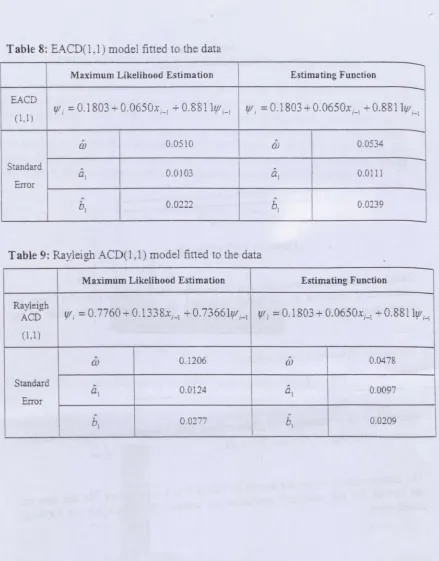
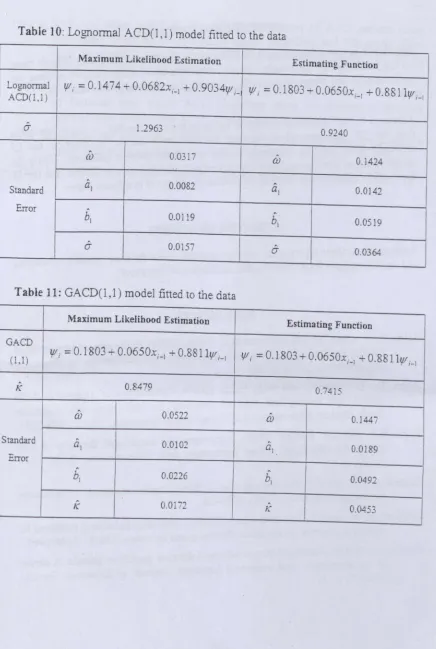
1.The corresponding results are shown in Tables 8 to 11. As before, for this data set, the results for the parameter estimates are comparable except for the Rayleigh distribution.
Table 8:EACD(l, 1) model fitted to the data
--Maximum Likelihood Estimation Estimating Function
EACD
If, =:0.1803
+
0.0650x'_1+
0.88111,11,_1 lfI, =:0.1803+
0.0650x'_1 + 0.88111fH(1,1)
-to 0.0510 co 0.0534
Standard
0.0103 0.0111
al al
Error
bl 0.0222 hi 0.0239
Table 9:Rayleigh ACD( 1,1) model fitted to the data
Maximum Likelihood Estimation Estimating Function
Rayleigh
lfI, =:0.7760
+
O.1338xi-J+
O.73661V/'_1 lfIi=
0.1803+
0.0650xi_1 +O.8811Ifi_1 ACD(1,1)
co 0.1206 U) 0.0478
Standard
0.0124
al al 0.0097
Error
b[
0.0277b
l 0.0209Table 10:
LognormalACD(l,
1) model fitted to the dataMaximum Likelihood Estimation Estimating Function
Lognormal If, =0.1474+0.0682x'_1 +0.90341f,_
If, =0.1803+0.0650x'_1 +0.88111f1'_1
ACD(l,l)
(J" 1.2963
0.9240
0) 0.0317
I
co 0.1424al 0.0082 a
l 0.0142
Standard
Error
bl 0.0119 b
l 0.0519
(J" . 0.0157
(J" 0.0364
Table
11:GACD(l,l)
model fitted to the dataMaximum Likelihood Estimation
Estimating Function
GACD
If, =0.1803+0.0650x'_1 +0.8-8111,ll'_1 1,lI, =0.1803+0.0650x'_1 +0.88111,ll'_1
(1,1)
K
I
0.8479 0.7415co 0.0522 0)
0.1447
Standard al
I
0.0102 al 0.0189Error
b. 0.0226 bl 0.0492
K 0.0172 K 0.0453
CONCLUDING REMARKS
This paper reviews the theory of ACD models and two estimations methods based on the MLE and EF approaches. Based on a simulation study we have noticed that both methods are comparable but the EF method is computationally efficient.
Although the EF approach is easy to apply in practice, the ML estimates are better than the EF estimates when the true distribution is known. In practice, the EF approach gives reliable estimates as the true distribution is unknown. Using the recent result of Grahramani and Thavaneswaran (2009) it can be shown that the EF approach is superior and this will be further investigated in a future paper.
ACKNOWLEDGEMENT
Authors thank three anonymous referees and the editor for their valuable comments and useful suggestions to improve the readability of this paper.
REFERENCES
Allen, D., F. Chan, M. McAleer and M.S. Peiris (2008). Finite sample properties of QMLE for the Log-ACD model: Application to Australian stocks. Journal of Econometrics, 147: 163-185.
Allen, D., D. Zdravetz and M.S. Peiris (2009). Comparison of alternative ACD models via density and interval forecasts: Evidence from the Australian
Stock Market. Mathematics and Computers in Simulation, 79(8): 2535-2555. Engle R.F. and lR. Russell (1998). Autoregressive conditional duration: A new
model for irregularly spaced transaction data. Econometrica, 66(5): 1127-1162.
Godambe, V.P. (1985). The foundations of finite sample estimation in Stochastic processes. Biometrika, 72(2): 419-428.
Grahramani, M. and A. Thavaneswaran (2009). Combining estimating functions for volatility. Journal of Statistical Planning and Inference, 139(4): 1449-1461. Pacurar, M. (2008). Autoregressive conditional duration models in finance: A survey
of the theoretical and empirical literature. Journal of Economic Surveys,
22(4): 711-751.
Peiris, M.S., D. Allen and K.H. Ng (2008). Estimation of ACD models using estimating functions: A simulation study. Modelling and Managing Ultra High Frequency Data: An International Conference (MMUHFDIC 2008),
13-141h Feb 2008, Perth, Australia.
Peiris, M.S., K.B. Ng and LB. Mohamed (2007). A review of recent developments of financial time series: ACD modelling using the estimating function approach. Sri Lankan Journal
0/Applied Statistics,
8: 1-17Thavaneswaran and Abraham (1988). Estimation of nonlinear time series models using estimating equations. Journal a/Time Series Analysis, 9: 99-108. Tsay, R.S. (2002). Analysis a/Financial Time Series. John Wiley & Inc., New York.