T h e v al u a ti o n t o ol u s e r g ui d e :
m o n e tizi n g C r a dl e t o C r a d l e ®
An k r a h , NA, M a n u , E, H a m m o n d , F, Gy a u , KAB, H i n g o r a n i, N a n d Woo d , P
T i t l e T h e v al u a ti o n t o ol u s e r g u i d e : m o n e tizi n g C r a d l e t o C r a d l e ®
A u t h o r s An k r a h , NA, M a n u , E, H a m m o n d , F, Gy a u , KAB, H i n g o r a n i, N a n d Woo d , P
Typ e M o n o g r a p h
U RL T hi s v e r si o n is a v ail a bl e a t :
h t t p :// u sir. s alfo r d . a c . u k /i d/ e p ri n t/ 5 0 6 5 5 /
P u b l i s h e d D a t e 2 0 1 4
U S IR is a d i gi t al c oll e c ti o n of t h e r e s e a r c h o u t p u t of t h e U n iv e r si ty of S alfo r d . W h e r e c o p y ri g h t p e r m i t s , f ull t e x t m a t e r i al h el d i n t h e r e p o si t o r y is m a d e f r e ely a v ail a bl e o nli n e a n d c a n b e r e a d , d o w nl o a d e d a n d c o pi e d fo r n o
n-c o m m e r n-ci al p r iv a t e s t u d y o r r e s e a r n-c h p u r p o s e s . Pl e a s e n-c h e n-c k t h e m a n u s n-c ri p t fo r a n y f u r t h e r c o p y ri g h t r e s t r i c ti o n s .
The ValuaTion Tool
user Guide
Monetizing Cradle to Cradle
®Author Dr Nii A. Ankrah
Co-authors Dr Emmanuel Manu;
Dr
Felix
Hammond;
Dr
Kwasi
Baffour-Awuah;
Neil
Hingorani;
Peter
Wood
Content
1 Background and terms of reference
3
2 Funding Cradle to Cradle® (C2C) inspired
business sites
7
3 Framework for C2C Investment Appraisal Tool
20
3.1 Developing the tool
37
3.2 Using the tool
43
4 C2C Value Indexing Tool
46
4.1 Validation
49
4.2 Conclusion
52
4.3 References
53
BaCkground and terMs of referenCe
This User Guide outlines the object, scope and expected deliverables from the Valuation Tool component of the Cradle to Cradle® C2C BIZZ project. It describes the compendium of subtools that have been developed comprising: i) overview of funding tools; ii) C2C investment appraisal tool; and iii) C2C value indexing tool. The underpinning methodologies, as well as their inherent strengths and limitations are also described. The C2C BIZZ project as a whole aims specifically to promote and enhance the implementation of C2C methods in business site development within North Western Europe (NWE) (PAD, p.14). It is intended to infuse C2C notions into conventional site development, restructuring and management.
The primary focus of the project is on planning, building and managing of business sites with C2C credentials (PAD, p.18) using sites in Lille Metropole (La Lainiere), London (London Sustainable Industries Park) and Luxemburg (Ecoparc
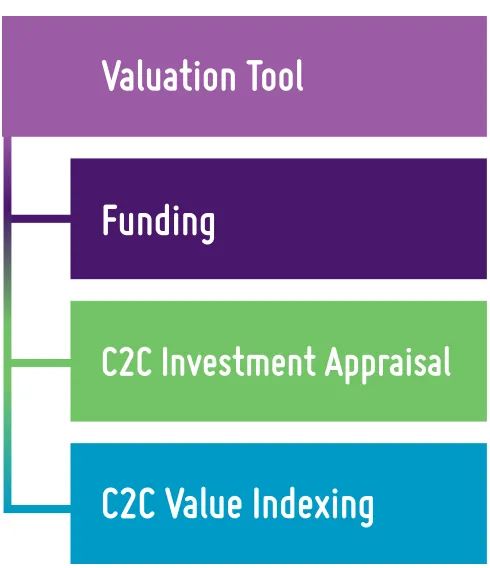
Windhof) as experimental fields. C2C BIZZ is not concerned with the internal operations and activities of occupiers or users of the developed site. Accordingly, the scope of the valuation tool is confined to the planning, building and management of C2C sites. The deliverable from this component is a compendium of subtools (see Figure 1 below) that may be used to analyse the financial performance of C2C credentials
This entire work is premised on the argument that the wider adoption of C2C principles within the built environment
What is Cradle to Cradle
®(C2C)
C2C is a circular waste free production system. As applied to spatial development, C2C can be defined as a business and design model distinguished by its aspiration to have a positive impact. It seeks to realize this through integration of biodiversity and diverse architectural and land use
designs into spatial developments. It utilizes environmentally enriching and healthy building products whose component parts are eventually cleanly separable into organic and inorganic materials in order that the organic materials may be reintroduced safely into a biological system, whilst the inorganic components are reconfigured or made available for use as new materials. It focuses on materials as a service and ensures that materials that retain some toxicity are returned safely into the technical cycle. It also ensures that every part of the development life cycle is dependent entirely on an
economically viable energy source that derives ultimately from the sun whilst protecting, cleansing and enriching the air and water supplies to the development.
Cradle to Cradle® (C2C) is offered as a desirable and more enlightened substitute for the current mode of wealth creation that will have positive effects on future resources security, the environment and health. C2C is at the moment still at the
C2C aims to supplant the ever failing linear production and site development system which currently dominates in the economies of the world. The central proposition of C2C is that, the continuing worldwide economic, environmental and health crises are foreseeable consequences of the widespread
embracing of the linear industrial and site development system across the world. Abandoning the linear model in favor of a C2C model, it is argued, holds better prospects for economic progress along with commendable environmental and health improvement. Though its methods may lead to outcomes that are compatible with the aspirations of
need for economic valuation tool
The need for a new valuation tool has to be understood in the context of the uniqueness of C2C credentials from other concepts such as sustainability as highlighted in the preceding section. The tool is justified on the grounds that the realization of the project’s aim of promoting the wider implementation of C2C within NWE real estate sector depends heavily on the private sector’s uptake of the concept, given its significance in the real estate investment market.
To encourage private sector uptake there is the need to overcome objections of the private sector to investments in sites with C2C credentials. This can be achieved by
supplying convincing evidence that developments with C2C credentials pay good dividend. It is a settled fact that financial incentives dictate the investments in which the private sector engages. Unless it can be objectively demonstrated that site developments with C2C credentials offer adequate economic rewards it cannot be expected that the private sector will be sufficiently receptive to the concept. As the old adage goes, ‘what gets measured gets done’.
[image:6.1024.524.769.317.601.2]The need for a device by which the C2C credentials of site development projects may be translated into financial values that investors, developers and business occupiers will understand is vital to the long term success of the project and the C2C concept as a whole. At the moment there is very little published work available that focuses specifically on site development.
Figure 1: The Valuation Tool Compendium
Funding
C2C Investment Appraisal
Valuation Tool
How the tool will help in decision-making
The main purpose of the valuation tool component of C2C BIZZ is to develop a methodology for evaluating the economic performance of Cradle to Cradle (C2C) features in the context of spatial development. This is intended to be a means for understanding the business merits of C2C in spatial developments. The valuation tool will also identify means of enhancing the strength of the business case and financial incentives for investing in sites with C2C credentials (PAD, p.38). In evaluating the economic performance of C2C, the differential effects of the various C2C features/factors in spatial developments must be taken into account.
The potential users of the tool are:
■
■
Decision-making bodies on all political and administrative levels involved in developing business parks.■
■
Owners and tenants (potential and actual) of plots or buildings in the park.The tool will help developers and planners of C2C inspired business areas to create a business case with due
consideration of the specific C2C aspects integrated in their development and their economic effects. Companies interested in settlement on the planned or yet to be
implemented C2C business area may use the instrument for the same reason.
funding Cradle to Cradle
®(C2C)
inspired Business sites
An important aspect of the valuation tool is the requirement for it to identify means of enhancing the strength of the business case. The business case for Cradle to Cradle® (C2C) design of business sites derives not only from the added value or positive impact that C2C offers (see subsequent sections), but is also very much dependent on the cost of integrating C2C. This is influenced in large measure by factors such as the funding structure and the attendant cost of investment capital.
The availability of investment capital and the cost of such capital are thus critical for realizing C2C in the built environment. There is a need for innovative finance options that are accessible to developers that intend to integrate C2C elements and processes into their development schemes, and a means of discriminating between these options.
It is in this regard that the valuation tool offers a taxonomy of finance instruments to guide decision-makers on the funding options they can leverage to reduce the cost of C2C integration and thus optimize their return.
The taxonomy thus addresses availability and infusion of funds and aims to be an instrument to provide a
decision-making framework for the selection of optimal funding sources and types.
There are numerous innovative finance instruments that can be used to secure investment for developments that demonstrate remarkable transition towards low carbon
This trend has also shifted to the private sector as financial institutions are increasingly beginning to make investment funds available for projects and ventures that mitigate against global climate change challenges – signaling a remarkable emergence of leadership in the finance sector (UNEP, 2014).
The growth in this trend amongst private sector financial organisations can also be linked to the growing issue of
Responsible Property Investment (RPI) as property investors and fund managers have become increasingly aware of the need to demonstrate their Corporate Social Responsibility (CSR) by investing in assets that are considered ‘green’ or sustainable – as part of their fiduciary responsibilities
(McNamara, 2011). Banks and insurance companies continue to develop innovative financial solutions that support green developments. The various funding mechanisms collated in this report are categorised under debt finance, equity
Table 1: Funding options for Cradle to Cradle C2C inspired developments
Equity finance
Debt Finance
Grants
Public-Private Partnerships (PPP) e.g. service provision - which could entail meeting C2C targets - by private sector with related investments through concession arrangements or Private Finance Initiatives (PFIs).
Private sector finance could be stimulated through community infrastructure levies.
Climate Bonds e.g. €600m of climate awareness bonds issued by the European Investment Bank (EIB) to raise funds for renewable energy and energy efficiency projects.
Green/Sustainable development Grants e.g. DEFRA’s Sustainable Development Fund (SDF) for up to 75% the total cost of projects.
Renewable energy projects funded by the European Regional Development Fund (ERDF)
Green Venture capital financing e.g. For piloting
unproven and untested C2C inspired technologies. Green Bondsgrew up to US$35.83bn by June 2014 and proceeds e.g. Green labelled bond market can only be allocated to green projects.
Environmental Funds e.g. DEFRA’s Environmental Action Fund to support biodiversity and climate change related projects.
EU LIFE Fund for bio-diversity projects.
Funds from environmental foundations to support bio-diversity and species preservation
Private equity and infrastructure funds e.g. Private equity fund managers investing into renewable energy infrastructure.
Carbon finance e.g. International finance
corporation (IFC) traded US$ 95bn worth of carbon credit between 2005-2010 to raise investment
Tax incentives and subsidies e.g. Tax breaks, tax credits
Equity finance
Debt Finance
Grants
Lease Financing e.g. Light leasing on ‘pay per lux’ basis between Philips and Rau Architects. Furniture leasing by C2C ExpoLab
Solar power purchase agreements e.g. Third party owns, operates and maintains solar PV system on a host customer’s site/roof.
Tax increment financing e.g. Property Assessed Clean Energy (PACE) financing
debt finance
Debt finance arrangements involve the borrowing of funds for use as investment capital with the view that future earnings from the investment would be used to pay back the debt with interest either by instalments or at a specified period. Mathews et al. (2010) have argued that private sector debt finance instruments would have to play a significant role in achieving renewable energy ambitions because publicly sourced finance remain inadequate. The different debt
finance instruments that have emerged as funding options for renewable energy and other sustainable developments are mainly green/sustainable loans, carbon finance and climate and green bonds.
Green/Sustainable Development Loans - The issuing of green/sustainable loans has particularly been Government driven. One of the numerous steps that Governments have taken towards the realisation of a low carbon economy has been to make available loans to municipalities and private sector developers that have demonstrated commitment towards the realisation of environmental sustainability, particularly through the promotion of renewable energy technologies. There are also development banks that make loans available at low interest rates for assets that meet high sustainability credentials.
For instance, the Green Investment Bank (GIB) in the UK has been established to provide loans for green/low carbon projects as a form of support to overcome market failures that constrain the flow of finance for such projects.
Carbon Finance - The establishment of carbon markets
where carbon finance can be raised by trading carbon credits can become a very important instrument for raising funding for low carbon projects. Under this funding mechanism, the verified emission reductions associated with a project can be used to generate financial assets (carbon credits) that are traded in different carbon markets, and the resulting finance (carbon finance) then used to pay for any incremental cost associated with ‘greening’ the asset. According to a World Bank Report in 2011 (World Bank, 2011), the International Finance Corporation (IFC) traded US$ 95bn worth of carbon credit between 2005 and 2010 to raise investment for low-emission projects.
Climate Bonds and Green Bond - A bond is a debt finance instrument that involves a ‘borrower’ who is given a loan at a fixed interest rate over a specified period of maturity. The period of maturity is often of a long-term nature e.g. 10-20 years and even beyond although shorter terms of maturity can exist. The benefit of holding bonds over a longer-term maturity period is to raise finance by making funds that require long-term return e.g. pension funds, available to the bond issuer (borrower).
This provides an opportunity for projects that require substantial initial investments but guaranteed paybacks over the longer period to be financed. Bonds can be issued by Governments (Government bonds), or by private sector organizations such as development banks or corporations (corporate bonds) although Governments can also act as guarantors for corporate bond issuers (Government backed bonds). There has been a remarkable growth in the green and carbon bond market where in this case, proceeds from issued bonds are committed to projects that demonstrate a transition towards low carbon technologies.
Between 2007 and 2009, climate awareness bonds were issued by the European Investment Bank (EIB) to the tune of €600 million so as to raise funds for renewable energy and energy efficiency projects. As of June 2014, a total of $502.63bn climate-themed bonds had been issued to finance transition to a low carbon economy. This includes $13.5bn for building and industry and $74.7bn for energy (Boulle et al., 2014). Also, of the climate-themed bonds, a total of $35.83bn is said to represent green labelled bonds and investment proceeds can only be allocated to green projects.
Bond repayments can also be tied to cash flows that are
generated from the projects that are financed rather than from the direct balance sheet of the bond issuer if it was specifically issued as a project bond. It has been predicted that the green bond market is also likely to grow by up to $100bn in 2015, although cautions have also been raised about the difficulty of ensuring that green bond proceeds are actually allocated to assets that provide real environmental value (Boulle et al., 2014). This is due to the current lack of standard guidelines that specify what exactly should qualify as ‘green’, raising the risk of misuse of green bond proceeds.
This is however an advantage in the case of C2C
Joint Development Agreements - Joint development agreements can take a variety of forms and often involve a land owner (private owner or municipality) entering an
agreement with a developer to build or provide the necessary infrastructure on the land without paying any upfront cost for the land. This often yields a win-win for the two parties as the developer does not have to raise any extra funds from their already constrained budget for the land whilst the land owner is able to get the land developed without having to provide any funds for the project.
The land owner would however retain a share of the
Source: Scott, L. (2014) Park 20|20, Amsterdam: Born to Be Recycled.
UR¬BANLAND - the magazine of the urban land institute, 05. Available at: http://urbanland. uli.org/sustainability/park-2020-amsterdam-born-recycled/ [Accessed 08/10/2014]
Panel 1 Use of Development Agreements at Park 20|20
Amsterdam city government offered Delta
Development Group a more connected site near the Hoofddorp rail station in an agreement that involved among other things a swap of land (old aircraft factory complex) originally earmarked for redevelopment into office space (which would have yielded 140,000 sqm excess supply of offices in the region), and an offer to build a better office scheme. Convinced by proposals, Amsterdam city government lowered the land cost upfront, with payment due when lease agreements came into place rather than when construction began. It also allowed Delta to use part of the land as security against financing. In exchange, Delta gave the city a share of the project profits beyond a set return hurdle.
Lease Financing - Leasing is a financing contract between a lessor and a lessee whereby the lessor provides an asset to the lessee and charges periodic payments. The lessee therefore does not have to pay any upfront cost for the asset and only pays for the service that the asset is providing. This financing model (service leasing) is linked to the product-as-service concept where periodic payments are made for the performance that is derived or service that is provided by the asset rather than investing upfront capital to own the asset.
Lease financing can provide opportunity for property
developers to integrate fixtures and fittings and renewable energy technologies without having to make any immediate upfront cost – a form of debt finance arrangement. The lessor could be a sustainable technology provider that is interested in promoting a new innovation, and hence could install the facility and provide maintenance services in exchange for agreed service charges/fees to be paid periodically by the lessee.
A typical example is the light leasing arrangement between RAU Architects and Philips (who had already been
working with EPEA) whereby RAU Architects “Pay per Lux” (approximately €0.01 per lux used) for the lighting performance (Cradle to Cradle islands, 2011). Another example is the furniture leasing by C2C ExpoLab.
Solar Power Purchase Agreements (SPPA) also operate on similar principles. This involves a private sector company that is prepared to finance the installation and maintenance of a solar energy system on a customer’s property at little or no cost, in exchange for proceeds generated from selling the power generated at a fixed rate that is usually lower than the conventional energy retail rate or any feed-in tariffs that accrues from the installed system. Thus the private company is able to make a return from the feed-in tariffs and income generated from the customer’s consumption from the solar installation during the duration of the agreement, which can typically be between 10-20 years. It is therefore envisaged by the private provider of the solar installation (investor) that earnings that accrue during the contract duration would be enough to pay for the initial investment in addition to any anticipated profits.
Tax Increment financing - This is a form of debt finance arrangement where a sustainable scheme is undertaken in an area or property (commercial or residential) without the need for beneficiaries to pay any upfront cost. Rather, the scheme or installation is undertaken with a loan provided by a government agency (local authority) – and sometimes backed by private loan finance from banks or other private investors - in exchange for incremental property tax payments over a specified period.
Tax increment financing (TIF) can also be used to attract financial investment from the private sector e.g. bank loans, partners engaged in different forms of PPP arrangements. Future growth in taxes within a TIF area is frozen for a
given period and any tax increments are used to pay over a specified period, the upfront costs infrastructure development and community regeneration cost plus any interest (Merk et al., 2012).
equity finance
In equity finance arrangements, the investment capital is obtained by relinquishing some ownership of the asset to the investor in exchange for money. This way, both risks and liabilities are shared between the owner and investor. The amount raised can then be invested into the asset without the need to repay this in the future, whilst any earnings are shared between the owner and investor.
A growing number of investors are becoming particularly becoming interested in providing funds for renewable energy projects and other green assets through private equity
opportunities. Private investment funds, pension funds etc. are being channelled through PPP arrangements, as well as through other private equity and venture capital investments towards the realisation of green projects and schemes. These equity investments are often driven by the potential cash flow returns that are anticipated from the projects in the future.
Public-Private Partnerships (PPPs) - These are
collaborative finance mechanisms that can be used to finance renewable energy and other sustainable projects. PPPs
have been categorised as either concessions and private finance initiatives (PFIs) based on the private sector partner’s remuneration arrangements (Merk et al., 2012).
Under concession arrangements, the private sector partner is reimbursed through revenues generated from operating the facility for a given period, hence they take on the demand risk of the facility. Under the PFI arrangements, the private sector partner is paid for delivering the facility or meeting particular performance targets of the partnership, with the public sector partner retaining the demand risk.
One of the most widely used PPPs for green projects in the Europe is the Energy Performance Contracting Partnerships (EPC) where the service provider undertakes energy
improvement programme for a beneficiary which is then paid for by the resulting reduction in energy consumption costs.
The UK Government’s Green Deal is a typical example of an EPC partnership. Funding through PFIs remain a viable option for pooling private sector finance into public development
schemes and can be employed as a funding option for C2C inspired regional and municipal developments. However this requires setting of C2C goals and ambitions as performance targets or service deliverables.
Other variants include Local Asset Backed Vehicles (LABV) which are also used to attract financial investment from the private sector partners engaged in different forms of PPP arrangements (Merk et al., 2012).
For PPPs to provide funding for sustainable or even C2C inspired projects, this would mean that C2C goals and ambitions would have to be framed into the service
Green Venture Capital Finance – Green venture capital
financing (aka ‘cleantech investing’) has been used to provide finance for high risk business ventures that would otherwise be unable to get financial backing from other sources due to the unpredictable nature of the venture. This source of financing has been used to fund small and medium-sized enterprise (SME) start-ups for many years and a typical example in Europe is the EIB’s European Investment Fund (EIF) that is used to provide risk finance for SME’s in Europe.
There are now venture capital firms that tend to focus on investing in the latest green/renewable energy technologies due to the recognition that such technologies may not be mature enough to attract funding from conventional sources. A typical example of such firms, which are also called ‘green venture capital’ firms is Emerald Technology Ventures,
which manages a venture capital portfolio of €340 million that is channeled into clean energy, water and materials technologies.
Private Equity and Infrastructure Funds - There are a growing number of private equity firms that specialize in providing equity investment for low-risk renewable energy infrastructure that employ commercially-proven generation technologies as well as demonstrate strong cash flow
generation capacity.
grants
The third category of potential funding options that can be used to raise capital for C2C projects are grants.
Green/Sustainable Development Grants - These grants often take the form of sustainable development funds, local authority grants, subsidies or even tax breaks for projects that integrate renewable energy, preserve local culture and tradition, and conserve or even improve local landscape and wildlife. The Department for the Environment, Food and Rural Affairs (DEFRA) in the UK for instance can fund up to 75% of the total cost of projects that meet these sustainability targets through their sustainable development grant.
The demonstrable evidence that C2C inspired developments provide with regards to the integration of renewable energy as well as achievement of social, cultural and conceptual diversity could be an attractive proposition for such grants.
Environmental Funds - Similar to the sustainable
development grants, there are also a range of environmental funds that provide financial support for projects that are
considered as beneficial to the natural environment. The Environmental Action Fund (EAF) for example has been set up in the UK to provide financial aid of up to £750,000 for a maximum period of 3 years for any projects that are
deemed to increase biodiversity generation. Given the level of ambition and positive contribution of C2C inspired projects to biodiversity creation in the area of the development, there is the potential for C2C schemes to access such funding.
fraMeWork for C2C investMent
appraisal tool
C2C from an area spatial development standpoint is supposed to drive the economic, social, cultural and
ecological activities of society to achieve good effects. One of the most plausible ways of gauging its impact is to estimate the extent of C2C’s market value upon its application to spatial development. However, valuation of C2C inspired spatial
developments could be an awkward task given the newness of the application of this design concept to existing spatial development valuation techniques.
The primary objective of this section is to discuss the
development of a suitable methodology and its translation into a C2C Investment Appraisal tool that is capable of generating the market value of C2C inspired spatial developments. This section presents the framework and some general guidelines for valuation of C2C spatial developments. It initially examines the concept of market value and its determinants after
which their connectedness with C2C is consider leading the selection of an appropriate valuation technique.
Concept of market value
Value is defined variously, but simply put it represents the benefit of an investment. Value will therefore mean different things to different stakeholders, and consequently it is
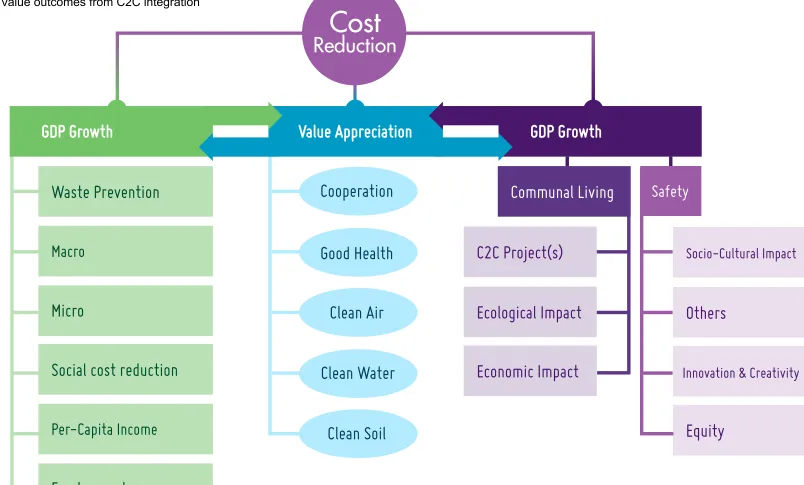
important to specify the perspective from which value is being assessed. Whilst a key purpose of site development is to enhance the economic value of the site through the application of capital, technology, skills and effort, making economic or market value a prime concern, it is also the case that site development offers value in various ways not all of which reflect in market value. Some of these are highlighted in Figure 2 below.
Generally “value or market value” can be viewed as the
As a European Union sponsored study/project perhaps the most authoritative market value definition to adopt is that of the European Group of Valuers’ Associations. The Associations (see TEGoVA, 2012) define market value of an asset as:
“The estimated amount for which the asset should
exchange on the valuation date between a willing
buyer and a willing seller in an arm’s length transaction
after proper marketing wherein the parties had
each acted knowledgeably, prudently and without
compulsion”
Within the property market, however, price is usually determined by a general set of factors.
These factors could be both micro and macro-economic wide
factors and include:
■
■
physical characteristics of spatial developments;■
■
location attributes;■
■
Financial traits; and■
■
Market economic conditions, which usually encapsulates the macro-economic level factors (see e.g. Dobson and Goddard, 1992; Fehriback et al., 1993; Lockwood and Rutherford, 1996).The above factors and their sub-elements are elaborated in significant detail in a separate document titled ‘Valuation Tool Project Report’ and therefore will not be repeated here. However the foregoing suggests therefore that the impact of C2C on the market value of spatial developments is
contingent upon its influence at the very least on this general set of price determinants.
That is, the extent to which it influences the demand or physical characteristics of the property will ultimately determine the value that C2C adds to the spatial
development. To gauge the extent of this influence, it is
positive impacts of C2C
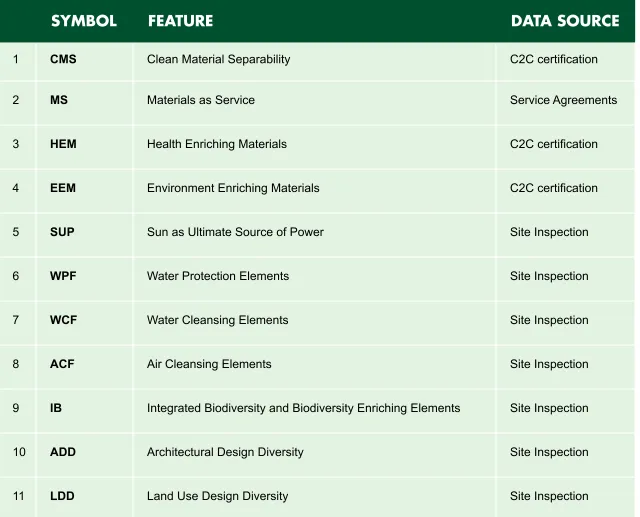
[image:23.1024.196.836.204.721.2]The positive impacts of C2C derive from its integration of several defined elements in the business site. From the C2C business sites definition, the principal features of a C2C site might include (but not limited to) those identified in Table 2 below.
Table 2: C2C Features and Evidence of Presence
symbol FeaTure daTa source
1 CMS Clean Material Separability C2C certification
2 MS Materials as Service Service Agreements
3 HEM Health Enriching Materials C2C certification
4 EEM Environment Enriching Materials C2C certification
5 SUP Sun as Ultimate Source of Power Site Inspection
6 WPF Water Protection Elements Site Inspection
7 WCF Water Cleansing Elements Site Inspection
8 ACF Air Cleansing Elements Site Inspection
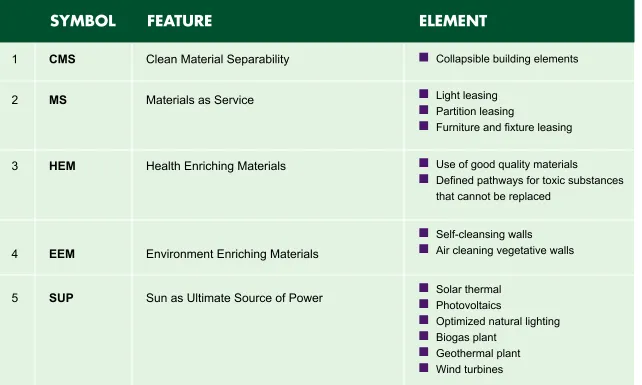
These features are broad categories. There are several innovative defined elements that may fall under each (Table 3). For a development to be considered to have that feature, it must in practice integrate or be fitted with at least one of the elements that fall under it. This is an assumption made for the purposes of advancing this tool. It is difficult to be exhaustive about the possible defined elements under each feature. Table 3 provides some indications of these.
Table 3: C2C Defined Elements
symbol FeaTure elemenT
1 CMS Clean Material Separability
■
■
Collapsible building elements2 MS Materials as Service
■
■
■
■
Light leasingPartition leasing
■
■
Furniture and fixture leasing3 HEM Health Enriching Materials
■
■
Use of good quality materials■
■
Defined pathways for toxic substances that cannot be replaced4 EEM Environment Enriching Materials
■
■
Self-cleansing walls■
■
Air cleaning vegetative walls5 SUP Sun as Ultimate Source of Power
■
■
■
■
Solar thermalPhotovoltaics■
■
Optimized natural lighting■
■
Biogas plant■
■
Geothermal plant■
6 WPF Water Protection Elements
■
■
Rainwater harvesting and storage system■
■
Integrated water recycling system7 WCF Water Cleansing Elements
■
■
Rainwater capturing and cleansingsystem
■
■
Integrated water recycling system with nutrient recycling■
■
Green walls8 ACF Air Cleansing Elements
■
■
Exposed Window Frames■
■
Indoor Plants■
■
Mould Inhibitors■
■
Green Walls■
■
HVAC Systems with C2C coating9 IB Integrated Biodiversity and Biodiversity Enriching Elements
■
■
Indoor and outdoor landscaping■
■
Aquaponics■
■
Fish ponds■
■
Grey water harvesting and treatment■
■
Incorporation of materials that ensure bio-digestion■
■
Living Walls, Balconies & Roofs10 ADD Architectural Design Diversity
■
■
Design amenable to diverse energy sources■
■
Design amenable to several water sources■
■
Aesthetically pleasing■
■
Easy accessibility of all areas to outdoors and fresh air■
■
Design amenable to diverse uses■
Waste Prevention
Macro
GDP Growth
Communal Living
C2C Project(s)
Ecological Impact
Economic Impact
Socio-Cultural Impact
Others
Innovation & Creativity
Equity
Safety
GDP Growth
Micro
Social cost reduction
Per-Capita Income
Cooperation
Good Health
Clean Air
Clean Water
Clean Soil
Value Appreciation
Cost
Reduction
With these factors in mind, the valuation or investment analysis process involves the analyst using the relevant sources as shown in Table 2 to establish which of these features and defined elements are present in the given development or building under analysis. The valuer will then work out by how much the existing factor is likely to
[image:26.1024.110.914.214.699.2]contribute to the value or returns (such as those shown in Figure 2).
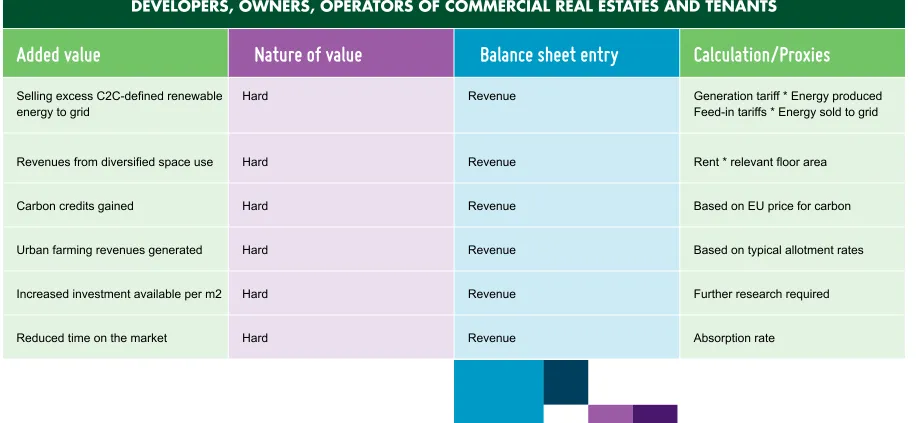
A thorough review of the concept of market value is provided in the ‘Valuation Tool Project Report’, and will not be reproduced here. However a point that will be emphasized is that the best measure of the performance of a C2C development is the extra value (in its various forms) gained by virtue of the C2C attributes present in the development. The extra value can be found in various places. For brevity, those relating only to the developer are classified in the table below. The added value for other stakeholders are set out in the ‘Guide to C2C Inspired Business Sites’ and in the ‘Valuation Tool Project Report’.
Table 4: Added value for C2C integration (Source: Adapted from Mulhall, et al., 2014)
deVelopers, owners, operaTors oF commercial real esTaTes and TenanTs
Added value
Nature of value
Balance sheet entry
Calculation/Proxies
Selling excess C2C-defined renewable
energy to grid Hard Revenue Generation tariff * Energy produced Feed-in tariffs * Energy sold to grid
Revenues from diversified space use Hard Revenue Rent * relevant floor area
Carbon credits gained Hard Revenue Based on EU price for carbon
Urban farming revenues generated Hard Revenue Based on typical allotment rates
Added value
Nature of value
Balance sheet entry
Calculation/Proxies
Increases in productivity Hard Revenue Based on productivity improvements
observed, absenteeism figures and staff retention estimates
Improved spacial productivity due to
after-hours use Hard Revenue Rent * relevant floor area
Improved access to subsidies & grants
for innovation Hard Revenue Case specific. Further research required
Residual value from C2C building
components and materials Hard Capital value Further research required (notional allowance incorporated)
Increase in capital value generated by
innovative landscaping Hard Capital value Further research required
Improved value of available space per
m2 Hard Capital value Based on improved capital value
Improvement in capital value due to
ability to attract high value tenants Hard Capital value Accommodated by yield adjustments to reflect covenant strength
Improved payback periods Hard Capital value Further research required
Sub-leasing has become very
attractive Soft Capital value Further research required
Added value
Nature of value
Balance sheet entry
Calculation/Proxies
Adaptability to future heating and
cooling requirements Soft Capital value Based on projected future energy prices
Readily adaptable to future
requirements (Future-proofing) Soft Capital value Further research required
Reduced risk from use of trusted
materials and products Soft Capital value Further research required
Opportunities to develop new
innovations Soft Capital value Further research required
Savings generated from leasing
equipment and systems Hard Capital savings Based on lease terms
Savings on renovation costs due to
ability to disassemble and re-use: Hard Capital savings Further research required. Notional allowance incorporated.
Collective purchasing savings Hard Capital savings Further research required
Added value
Nature of value
Balance sheet entry
Calculation/Proxies
Reduced absenteeism and staff
turnover Hard Capital savings Further research required
Savings in energy costs Hard Capital savings Based on energy reduction and
current tariffs
Savings in water costs Hard Capital savings Based on reduction in consumption
and current tariffs
Cost of waste collection and disposal Hard Capital savings Further research required
Reduced stress on municipal water
supply Hard Capital Savings Based on reduction in waste water and current waste treatment tariffs
The investments have guaranteed
energy security Soft Supply security Further research required
The investments have guaranteed
water security Soft Supply security Further research required
Attracting high quality tenants Soft Marketing Further research required
Projecting a positive image of
development Soft Marketing Further research required
Added value to occupants’ own
Quantifying value
To what extent can the value contributed by the defined elements be truly attributed to C2C and how should such value be measured? Whilst some can be directly attributed to particular C2C choices and investments e.g. Savings generated from leasing equipment and systems, others are somewhat rather nebulous making it difficult to trace the factor(s) that directly or indirectly led to the value generated, and how much they actually individually contributed to the value generated e.g. Sub-leasing has become very attractive.
The challenge that remains therefore is to find or develop methodologies that can overcome these difficulties and
provide a robust basis for justifying (or otherwise) investments in C2C elements in business site developments. This
challenge is confronted in the next phases of this work package.
Methodology
The calibration of the market value of C2C-spatial
developments and demonstration of change in value or price of spatial developments upon their incorporation of C2C
credentials requires the application of a robust methodology. The rationale is to show the extent to which C2C credentials appreciate or depreciate the market value of spatial
developments.
Consequently, while several valuation and appraisal methodologies exist, the choice of a methodology in any particular situation must be informed by these considerations and availability of requisite data. As such, it is pertinent to examine the appropriateness of these methodologies in the quest to develop a suitable framework for the valuation of C2C compliant developments.
Traditional valuation tools do not come equipped with the ability to price C2C products, as the C2C concept postdates many of these tools, they cannot readily be adopted to
appraise the financial implications of C2C business parks. Adjustments or extensions to these traditional tools are required to make them applicable to economic analysis of C2C business parks.
A detailed critical review of these methodologies, evaluating their suitability for addressing the valuation problem
confronting this project is provided in the full ‘Valuation Tool Project Report’ and is not reproduced here. Instead, the options reviewed are summarized in Table 5 below.
Table 5: Review of valuation methodologies
Valuation Methodologies
Key features
Suitability
Tradi
Tional
The Comparable Method Estimates value of spatial development through a process involving comparison. Requires
relatively homogeneous properties and good evidence of recent sales/rents of such properties
The Investment/Income Method Premised on reasoning that market value of a development is related to its income generating
capability. Economic rent of spatial development is capitalized at an appropriate yield to
determine market values of relevant spatial developments
The Accounts/Profits Method Used where profit is the basis for negotiating rent payable and draws on the trading, profit and
loss accounts of business entities.
The Development/Residual
Method Used to determine the latent value of land. Where it is difficult to come by evidence of sales or rents of similar properties, the method estimates the value of developable properties as the surplus of market value for proposed development after making allowance for all cost items and developer’s profit.
The Contractor’s/Cost Method Loosely equates cost of similar spatial developments to the value of the subject spatial development. Suitable for developments such as residential, factories and warehouse
properties, which do not earn income
a
d
V
anced/
r
eG
ression-based
m
eT
hods
Multiple regression (incldg
tHe investMent/inCoMe Capitalization MetHod
The investment method is premised on the reasoning that the market value of a spatial development is related to its income generating capability (Park and Park, 2004; Shapiro et al., 2013). It is used for spatial developments held for investment purpose and conceives ownership of spatial development as separate from occupation (Pagourttzi et al., 2003; Lorenz and Lϋtzkendorf, 2008).
The method among others uses the economic rent or possible economic rent of spatial development and appropriate yield to determine market values of relevant spatial developments. There are two variants of the method namely: the direct
capitalization approach and the discounted cash flow approach (DCF) (Hendriks, 2005; Bienert et al., 2011).
the direct Capitalization approach
The direct capitalization approach operates on the
presumption that the value of a spatial development is directly related to its periodic (preferably annual) potential future
incomes. The future periodic incomes are therefore capitalized at an appropriate yield over the current duration of the interest subsisting in the development at the present value. This
value then becomes the sale or capital value of the spatial development.
The methodology follows the steps outlined below:
■
■
Determination of the potential annual income (rent) of the spatial development based on comparable rents in the market;■
■
Determination of the potential annual operating expenses (out-goings) of the development;■
credentials on the risk profile of the investment should be reflected in the choice of an appropriate yield to arrive at the compounding factor. Covenant strength also needs to be considered;
■
■
Subtraction of the annual potential expenses from theannual potential income to arrive at the annual potential net income;
■
■
Multiply the annual potential net income by thecapitalization factor to arrive at the market value of the development.
There are situations where the subject spatial development may already be under an existing contractual arrangement. This means the existence of contract rent, which may not necessarily be the same as the market rent. As such, the contract rent prior to reversion of the development to the market rent should be factored into the value determination.
In applying this method to C2C inspired developments, the test is whether or not the C2C proxy factors or attributes increase or reduce the potential annual net income. If the attributes increase the potential annual net income of the development its market value will appreciate. Conversely, if they reduce it the market value will depreciate.
Therefore, the method as applied to C2C compliant
developments can be modelled as Equation 1:
Where:
Market value of spatial development with specific C2C credentials;
Annual net income;
Adjustment factor which is sensitive to the effect of specific C2C credentials on rental income of C2C development;
Potential rental income of the C2C development;
Adjustment factor, which influences the extent of potential annual operating expenses with the presence of C2C credentials;
Capitalisation factor; and
the discounted Cash flow approach
(dCf)The discounted cash flow approach is virtually the same as the direct capitalisation approach. The difference however is that
unlike the direct capitalisation approach where the potential annual rental income and operating expenses are assumed to be the same for the remaining years of the development, these may be different under DCF approach. Apart from that, in practice rather than to estimate the potential rental income and the operating expenses on a yearly basis, this is done for the first 10 years after which the development is assumed to be sold thereafter.
The process for estimating the market value under this
approach entails the following:
■
■
Estimation of the annual rental income (cash inflows) for the first 10 years;■
■
Estimation of the annual operating expenses (cash outflows) for the first 10 years;■
■
Estimation of the net cash flows from the first two steps;■
■
Discount the net cash flows at an appropriate discount rate to arrive at their present values;■
■
Estimation of the sale value of the development based on the potential rental income in the 11th year and at a yield that reflects that the development is 10 years older and also taking into account the influence of the C2C credentials on the risk profile of the investment;■
The DCF approach as applied to the valuation of spatial
development with C2C credentials can, thus, be modelled as
Equation 2:
Where:
Market value of spatial development with specific C2C credentials;
Summation of net cash flows of C2C spatial developments from year 1 to 10 discounted at their present values
Net cash flow in year 11;
Adjustment factor which is sensitive to the effect of specific C2C credentials on rental income of the spatial development;
Annual potential rental income of the spatial development
Adjustment factor, which influences the extent of potential annual operating expenses with the presence of C2C credentials;
Capitalisation factor that reflects that the development is 10
The Investment/Income Capitalisation method is said to be the most suitable approach for the valuation of green/sustainable (a related concept to C2C) developments especially those which are income producing (see Bienert et al., 2011p 52).
This is based on the argument that the method is the most transparent of all the methods since it allows examination of relevant aspects of the valuation exercise and offers opportunities for variation and modelling of key valuation indicators such as rental growth and operating expenses (Bowman and Wills, 2008; Bienert et al., 2011). Pitts and Jackson (2008) also conclude that since the investment method provides the logical framework for the valuation of commercial developments, it is the most plausible method to estimate the market value of green developments.
Even so, this method may still require extensive knowledge of the performance indices (profile) of relevant spatial
developing tHe tool
The above models (Equations 1 and 2) have been adapted for the development of the C2C Investment Appraisal Tool. The most important part of this C2C Investment Appraisal tool is the assumptions that are made which define the key attributes of the tool.
Assumption 1: The business case is site specific. The tool is therefore spreadsheet based to allow parameters to be adjusted to reflect the prevalent market conditions, different levels of perceived risk, level of C2C maturity in the property market, lease terms and site conditions.
Assumption 2: The tool seeks only to isolate the extra value generated by the integration of C2C elements and consequently assess the business case for any extra investment required in this integration of C2C elements.
Assumption 3: C2C elements can be integrated into the design of a building or site, and this may come at no extra cost or might require extra investment over and above what might be required in a non-C2C building or site. The extra cost of integrating C2C is therefore a parameter in the tool that can be adjusted by the user to reflect any impact that C2C
integration does not necessarily imply additional cost. Indeed there is anecdotal evidence to suggest that where the C2C vision is embraced and integrated right from the very outset of a scheme, the same budget can be used to deliver C2C solutions. In some instances schemes have been reported to deliver C2C solutions well within their budgets. However for the purposes of developing this tool, allowance is made in the tool for capturing any additional cost that might arise.
Assumption 4: There are different perspectives that need to be reflected in the assessment of the added value of
user perspective
Tenant’s Perspective
Taking an example of an office building and assume that the tenant is willing to pay €500 per sqm for his occupational costs.
This cost in a traditional (non C2C) building will be made up of 2
discreet items split as follows:
■
■
Rent - €325 per sq. m.■
■
Service costs - €175 per sqmAssuming that the rental offer is only made by the tenant after taking into account total occupational costs for the property, it can be argued that the tenant will have a budget ceiling of €500 per sqm. From this figure any service costs applicable will be subtracted before the tenant makes a rental offer on any new premises. Now presented with an opportunity to take occupation of a C2C-inspired building (assumed to be similar in size and situated on a parcel of land adjacent to the non-C2C property), the prospective tenant will look at both buildings with the same total occupational cost in mind. Indeed, where there is little/no experience of these types of buildings, a risk averse tenant may even consider budgeting
So, for example, the tenant in considering both buildings side by side may allow a budget of say €475 per sqm for total
occupational costs for the C2C-inspired building. However the difference in quality between the C2C building and the non-C2C building means that the tenant’s service costs in the non-C2C building would be substantially reduced from say €175 per sqm to €100 per sqm. For the tenant, this simplified analysis suggests a minimum saving of €25 per sqm potentially rising up to a maximum of €100 per sqm depending on the lease terms. This analysis does not even take into account all the other added value elements (benefits) that C2C gives the tenant (see ‘Added Values’ Table in ‘Guide to C2C Inspired Business Sites’). When all these are considered, even where demand for C2C properties grows pushing up rents, tenants should still, in theory, have sufficient margin to bid higher and still make a saving.
Owner Occupier’s Perspective
In order to illustrate the situation from the perspective of the owner occupier it is again necessary to consider a particular situation. Unlike the investment method which is profit
orientated, the owner occupier is not looking to make a profit from the acquisition of land, construction of a building and ultimate disposal.
The only two items that need to be considered are the land and the build cost.
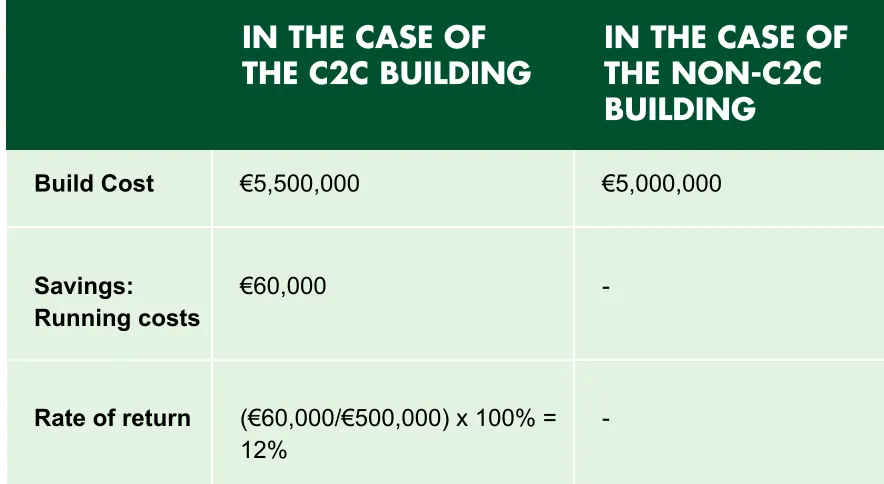
Consider a scenario whereby an owner occupier needs enough space to accommodate his staff in a single location which means he has to build two office buildings. He has an opportunity to build two office buildings on two identical sites which are adjacent to each other and are available from the landowner at exactly the same price.
As an experiment, the owner occupier decides to build one of the buildings as non-C2C and the other as a C2C building. Both buildings have the same gross internal area and have similar floor arrangements. As the land cost is the same for each building this can be ignored such that the only variable between the two buildings is now build cost.
By building two different buildings, the idea is that it enables the owner occupier to calculate if there is an argument
for spending the extra money (noting that C2C does not
[image:40.1024.520.962.293.535.2]necessarily imply extra cost) on building a C2C building. This is assessed by a simple calculation (Table 7).
Table 6: Example investment appraisal for owner occupier
in The case oF
The c2c buildinG in The case oF The non-c2c buildinG
Build Cost €5,500,000 €5,000,000
Savings:
Running costs €60,000
-Rate of return (€60,000/€500,000) x 100% =
12%
In order to do this, the owner occupier considers his
opportunity cost of capital. This is the return that the owner occupier requires when investing the company’s capital. Assume this figure is 8%.
If the rate of return calculation produces a result greater than 8% (in this example it is 12%) then this satisfies the owner occupier’s cost of capital. The result is that the owner occupier should invest the extra money on the C2C building to produce those savings.
Although the calculation is simple, it shows clearly whether there is an argument for the extra investment required to build a C2C building. That is whether the annual savings provide a return on the C2C investment that exceeds the owner occupier’s opportunity cost of capital.
Here also savings deriving from other sources like productivity improvement have not been factored in.
investment perspective
Property Developer’s Perspective
Using the same scenario as the tenant’s perspective but with different figures, and assuming both buildings are let to the same tenant, effective rent on a non-C2C building would be say €100,000 per annum. On a C2C-inspired building where energy savings from solar panels are in the order of €20,000 per annum, even though the developer may not be able to charge the full €120,000 rent because the tenant would want to see some advantage of taking a ‘risk’ in occupying the C2C building, the tenant’s effective rental bid for the C2C building might be likely to be in the order of €110,000 (i.e. a split
incentive arrangement).
Assuming an extra cost of €50,000 to integrate the solar
panels on a basic build cost (including land and other costs) of €1,000,000, a simple calculation shows that the C2C building yields a higher return than the non-C2C building as follows:
Rent
(C2C building)x 100% =
x 100% = 10.5%
Cost
(C2C building)1,050,000
110,000
Rent
(non-C2C building)x 100% =
x 100% = 10%
Cost
(non-C2C building)1,000,000
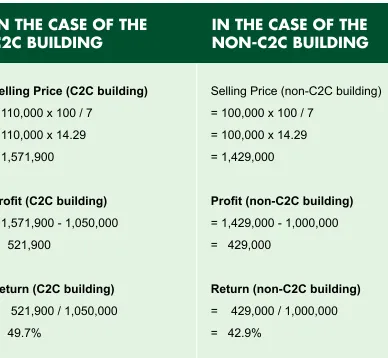
From Equation 1, using an investment yield of 7% from a comparable in the market (assuming same covenant strength for both buildings), the profit that crystallizes on the disposal of the building is as follows (Table 6).
Table 7: Example investment appraisal from Developer’s perspective
in The case oF The
c2c buildinG in The case oF The non-c2c buildinG
Selling Price (C2C building)
= 110,000 x 100 / 7 = 110,000 x 14.29 = 1,571,900
Profit (C2C building)
= 1,571,900 - 1,050,000 = 521,900
Return (C2C building)
= 521,900 / 1,050,000 = 49.7%
Selling Price (non-C2C building) = 100,000 x 100 / 7
= 100,000 x 14.29 = 1,429,000
Profit (non-C2C building)
= 1,429,000 - 1,000,000 = 429,000
Return (non-C2C building)
= 429,000 / 1,000,000 = 42.9%
From the above calculations an assessment can be made on
The Property Investor’s Perspective
Assume that the same property investor is willing to buy both C2C and non-C2C buildings (ignore any discounts) and considering each disposal as an entirely separate transaction, the property investor must take time to examine each of the two buildings.
In simple terms the investor will consider:
■
■
Covenant strength■
■
Lease terms■
■
Rent■
■
Building qualityReturning to Equation 1, the only items which will be different when undertaking the two investment valuations are rent and build quality as covenant strength and lease terms are identical.
Although it is arguable that the build quality in the C2C
It is therefore assumed that the property investor would not make a yield adjustment for the C2C building. This means that the only variable in the calculation of the selling price is rent. The C2C building generates more rent than the non-C2C
building and therefore the property investor would be willing to pay more money for it.
In reality, because quality is better and long-term performance will be better (also higher value at end of life), the covenant strength of C2C sites is likely to be even better than non-C2C sites. Yield is likely to be lower meaning that an even more persuasive business case exists.
The basic conclusions to be drawn from the above are that although the C2C buildings may be more expensive to build, they will generate more rent than a non-C2C building. As a result of generating more rent, the property developer will be able to sell them to property investors for more money than a similar non C2C building.
using tHe tool
To use the tool, data must be obtained from several sources and inputted into the tool to generate outputs that give some indication of the business case for implementation of C2C in business sites.
usable data sources
Data for this tool will emanate from:
■
■
Site surveys and development plans – relevant information will include size of site, building floor area, building footprint area, location, property type, system specifications.■
■
Operational records – relevant information will includeenergy consumption, water consumption, tariffs, productivity and staff absenteeism, staffing costs, turnover etc.
■
■
Macro-economic data – relevant information will include interest rates, retail price index (RPI), etc.■
■
Case study reviews of known C2C building projects(including C2C BIZZ Projects) – relevant data will include energy savings achieved, etc.
■
■
Research literature – relevant information may include churn rates, risk factors, etc.step-by step application
The procedure to be followed in applying the tool to a project is
detailed in the following steps:
■
■
Specify the characteristics of the site and nature of the transactions undertaken on the ‘Attributes of site’ worksheet.■
■
The ‘Data sheet’ is then used to collect parameters required to calculate cost and benefits that derive from integration of C2C defined elements■
■
Adjust parameters on the remaining (Investment Appraisal) sheets which summarise the added value and business case for a range of stakeholders and evaluate results.These sheets set out the Net Present Value (NPV), Internal Rate of Return (IRR), and Profitability Index resulting from the combination of defined elements integrated into the building or site. Undertake sensitivity checks.
■
■
It should be noted that in some cases, the added value cannot yet be monetised (further research required) and therefore needs to be articulated in qualitative terms.■
outcomes and limitations of the tool
The tool gives a detailed overview of current thinking for investing and valuing C2C site development projects and comments on it. In addition, it explains basic concepts around C2C site development valuation. Thus, it allows planners, developers, lenders and investors to become accustomed to the methods applied in practice for appraising C2C attributes in economic models. By using this ‘background information’ and analysing the shown examples, the target groups can determine the suitable valuation method and its crucial elements for their specific projects.
Based on the User Guide, which is a main part of the tool and contains the methodology, models and principles to be followed in establishing the value of C2C features in specific projects, a complete business case can be formulated.
Even though the tool provides a practical aid to C2C business decision-making by giving a method of economic assessment of C2C-relevant characteristics, it has substantial limitations. This section outlines the limitations of the tool. This is meant to avoid unrealistic expectations or economic assumptions. For example, conventional elements of an entrepreneurial risk (general price level, changes in personnel policy and
A significant limitation of the tool is its failure to monetize several of the items that fall under the added value heading. The evidence base for many of these items is non-existent or at best incomplete making quantification impossible at the present time. Some of the items are also quite subjective and depend completely on the subjective opinion of the
stakeholder concerned. Indeed, a further complication is that even for those quantifiable items, data for calculating costs and added value emanates from a wide range of sources, some reliable and others of questionable reliability. Clearly further research is required in this regard.
Data on C2C defined elements was also not readily available in the market to allow accurate determination of costs of
Some significant factors which impact on the business case have not yet been incorporated in the tool. For instance the funding strategy which has a significant impact on cost of capital, and by extension cost of integrating C2C, is not reflected in the tool. This is particularly because of the wide range of possibilities that can arise in terms of funding C2C-inspired projects. That gap notwithstanding, for particular projects the effects of financing strategy and attendant cost of capital needs to be modelled to provide an accurate assessment of the business case. Likewise the impact of legislation promoting higher environmental standards has not been fully modelled.
Except for the assumption that demand for C2C-inspired sites and buildings will grow, the tool does not also fully take into account the impact that ever more stringent environmental legislation could have on the cost and depreciation in value of non-C2C properties.
It should be pointed out critically that this project has focused entirely on the development of the methodology and tool rather than the development of a specific business case for C2C. Consequently, the figures in the tool are not entirely accurate in all cases. Therefore it is critically important that in applying this tool to a real-life situation, the figures in the tool are scrutinized carefully and where necessary more accurate figures inputted to ensure that accurate results are generated.
C2C value indexing tool
As discussed in the limitations section above, a significant weakness in the investment appraisal is its inability to adequately monetize some of the softer benefits of C2C
integration. There is no ready means of appraising the relative contribution to value of various C2C impacts, principally
because the application of C2C to the built environment is still at an early stage and the evidence base has not been built up yet. As the stock of C2C buildings and sites grow, there is a need to collect empirical data from users of such buildings and sites to model more accurately the value added by the softer benefits of C2C as perceived by users. This is particularly important as there is also a need to consider the proper allocation of funding to derive maximum benefit to both users and investors. This can only be achieved if it is well known what perceptions of value users have of the C2C defined elements.
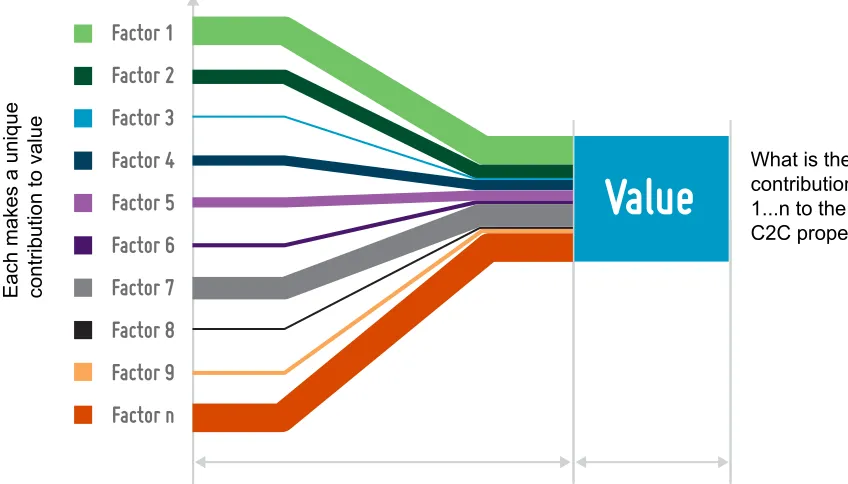
[image:47.1024.521.945.186.428.2]In this regard, the more advance valuation methodology of Paired data analysis can be utilised to build an index of value added by C2C elements. The conceptual model for this index is shown in Figure 3.
Figure 3: Conceptual model of C2C Value Indexing Tool
To help develop such an index, a C2C Value Indexing Tool has also been developed based on a pairwise comparison analytical technique for future use as the stock of C2C sites and buildings grows. This section presents a brief guide on the use of the C2C Value Indexing Tool. The tool enables the key economic elements of C2C-inspired buildings and sites to be compared in pairs with the view to judging which is regarded more important or most valuable. It thus works out
Factor 1 Factor 2 Factor 3 Factor 4 Factor 5 Factor 6 Factor 7 Factor 8 Factor 9 Factor n
Value
Conceptual model of Indexing tool