International Journal of Emerging Technology and Advanced Engineering
Website: www.ijetae.com (ISSN 2250-2459,ISO 9001:2008 Certified Journal, Volume 4, Issue 2, February 2014)
182
Single Objective Single Function Criteria for Selection of
Manufacturing Method
Girish R. Naik
1, Dr. V. A. Raikar
2, Dr. Poornima G. Naik
31
Associate Professor, Production Department, KIT’s College of EngineeringKolhapur,India
2Principal Govt. Engineering College Karwar, India
3Assistant Professor, Department of Computer Studies, SIBER, Kolhapur, India
Abstract—In order to improve the manufacturing cycle more than 110 manufacturing processes have been proposed. The objectives aimed at and the functions focused on by these processes vary. The process should be flexible enough to accommodate reasonable changes in design. This poses a great challenge to a manager in selection of effective and economical manufacturing process. Different organizations have different objectives and based on their specific requirement they deploy suitable process conforming to their objective. Based on their needs, the weights assigned to the objectives vary. Today’s business scenario is highly competitive, complex and dynamic in nature which demands strategic planning meeting the challenges of changing time. In this paper we have made an attempt to enable the end user a quick selection of appropriate manufacturing method based on a single objective and a single function. This is the extension of our earlier work focusing on a single objective. For this purpose a tool is developed which provides two different types of interfaces to an end user. One interface is GUI based which is user friendly and provides a simple drag and drop operation for the selection of manufacturing methods based on a single objective, function and a method classification. The second method is command-line interface enabling the end user to query the database using Manufacturing Query Language (MQL) designed by us. Parse tree is developed and text parsing is used for parsing the query. The query language is designed for the manufacturing domain and renders the end user free from the intricacies involved in SQL syntax involving filtering, joins etc. MQL currently comprises of few commands which can be queried by the end user for the selection of manufacturing methods based on a single objective, a single function and a method classification. It is subject to future enhancements. Our current work focuses on a single objective and single function. It is an idealistic scenario where a single objective and function define the section of manufacturing method. In real situations multi objective and multi function criteria is required for the purpose. Our future work involves modification of the tool and parser to take account of multiple objectives and functions.
Keywords – class method, formal grammar, manufacturing objective, manufacturing query language, parser
I. INTRODUCTION
Manufacturing methods include methods of many different types. Some of the methods are of a technological nature, while others are organizational and architectural, and yet others focus on information technology. Some are of a practical nature while others are of a philosophical nature. To assist managers in selecting the best method to achieve certain criteria, two mapping methods are available, one based on the objectives of the method and the other based on the functions that the methods may serve. Based on the maturity of the manufacturing company, a particular manufacturing method may focus on manufacturing hardware, auxiliary software support, production planning and control, next generation
production management, processing manufacturing
methods, commercial aspects, organization, advanced organizational manufacturing methods, design methods,
human factors in manufacturing, environmental
manufacturing methods, or cost and quality manufacturing methods. Giden Halevi has presented a review of manufacturing methods and their objectives [1]. The author has listed 110 published manufacturing methods which fall in 5 different classes based on their nature.
A.Mapping by method objectives
In this paper we consider the following objectives as proposed by Giden Halevi in selection of a particular manufacturing method.
Meeting delivery dates
Reduce production costs.
Rapid response to market demands
Reduce lead time
Progress towards zero defects
Progress towards zero inventory
Improve management knowledge and information
Marketing – market share
Improve and increase team work collaboration
Improve customer and supplier relationships
Improve procurement management and control\
International Journal of Emerging Technology and Advanced Engineering
Website: www.ijetae.com (ISSN 2250-2459,ISO 9001:2008 Certified Journal, Volume 4, Issue 2, February 2014)
183
Improve human resources management
Improve enterprise integration
Continuous improvement
Environmental production
The suitability of each method to a specific objective is graded according to the following grades.
a – Excellent for specific dedicated objective b – Very good
c – Good d – Fair
According to Gideon Halevi manufacturing methods are grouped into four categories according to the following main focus topics.
1.Focus on organization 2.Focus on product life cycle
3.Focus on performance measurement
4.Focus on management functions.
Each one of the above main topics is divided further into four detailed functions each [1]. This paper focuses on assisting managers to evaluate and select the most appropriate manufacturing method or methods for their needs. Several alternatives may be proposed, allowing the user to decide which one is more suitable under the circumstances. The user can select the method according to its type. The decision depends on the objectives and the functions considered, and on the grading given to each method. The objectives and grades can be manipulated by the end user. This is the extension of our earlier work focusing on single objective [2].
Objective Grading Table
The structure of the objective grading table is as follows. The objective grading table consists of 110 rows and 43 columns. The first column contains the method number. The second column contains the method initial for verification purposes. The third column contains the method classification. The following 16 columns refer to the 16 objectives. The last 24 columns display the grades assigned to the detailed functions. The blank cell indicates that the method in the corresponding row has nothing to do with the objective in the corresponding column.
Selecting the method using a single objective and a single function.
The procedure for selecting a manufacturing method using a single objective is as follows:
Select the column that represents the objective in objective grading table.
Scan the rows in this column for grades a or b.
Make an objective table that contains only the methods filtered in step 2.
Decide which class of method to use
Narrow down the table constructed in step 3 to those that correspond to the desired class.
Narrow down the table further to those corresponding
to the desired function.
Decide which of the proposed methods is preferred.
II. LITERATURE SURVEY
There exists a vast amount of literature on manufacturing process monitoring using both crisp and fuzzy logic approach [3,10] which focus mainly on software selection, technology selection and system project selection. Chenhui Shao et.al [11] have developed a novel algorithm for parameter tuning and feature selection. Quality monitoring is used for monitoring a quality of a manufacturing process. Multiple criteria decision making method is employed by R. V. Rao, T. S. Rajesh [12]. The authors have presented a decision making framework using a multiple criteria decision making method viz., Preference Ranking Organization Method for Enrichment Evaluations (PROMETHEE) which has been integrated with analytic hierarchy process (AHP) and the fuzzy logic. The framework enables the manager a software selection in manufacturing industries. Mohammad Akhshabi [13] has developed a Fuzzy Multi Criteria Model for Maintenance Policy which is used for the optimized decision making.
III. PROPOSED ALGORITHM
A. Pseudo Code
Function findMethodsInClass {
/* Create the objective grading table consisting of 110 rows representing manufacturing methods and 4-19 columns representing the various objectives and 20-43 columns represent the various functions */
for row=1 to 110 begin
for col = 4 to 19 begin
displayobjectivegrade(row,col); end if;
for col = 20 to 43 begin
International Journal of Emerging Technology and Advanced Engineering
Website: www.ijetae.com (ISSN 2250-2459,ISO 9001:2008 Certified Journal, Volume 4, Issue 2, February 2014)
184 end if;
/* The ijth element represents the grade given to the objective j for the manufacturing method i. If the objective or function is not applicable to the method under
consideration then the cell is left blank. */ /* Read the single objective to be met by the manufacturing method. */
Read O.
/* Read the class of function to b the be used for manufacturing method. */
Read F.
/* Remove from the filtered table all methods that have values „c‟ or „d‟ in the object column O */
n=0;
for row=1 to 110 begin
for col = 4 to 19 begin
if (col=O+3) then
if ele(row,col)=”a” or ele(row,col)=”b” then n=n+1;
displaygrade(row,col); end if;
end if; end;
/* n represents the number of filtered methods */ /* Read the class of the method to be used for manufacturing method */
Read C.
/* Remove from the filtered table all methods that have values other than C in the third column Method Classification */
nc=0;
for row=1 to n begin
for col = 4 to 19 begin
if (col=3 && val(col)=‟C‟) then nc=nc+1; displaygrade(row,col); end if; end; end;
/* nc represents the number of methods meeting the objective O and in class C */
/* Remove from the filtered table all methods that have values „c‟ or „d‟ in the function column F */
nf=0;
f1= integer part of F f2=decimal part of F for row=1 to nc begin
for col=20 to 43 begin
c=19+6*(f1-1)+f2;
if (col=c && (ele(row,col)=”a” || ele(row,col)=”b”)) displayfunctiongrade(row,col);
nf=nf+1; end if; end; end;
/* The function c=19+6*(f1-1)*f2 is used for mapping the function number to the corresponding column in the objective function grading table. For ex, for F=1.1, f1=f2=1 and c=20. Hence the grades of the function 1.1 are listed in the 20th column of the objective function grading table. Similaly, for F=4.6,f1=4 and f2=6 and c=43 */ /* nf represents the number of methods meeting the objective O and function F and in class C */ /* Print the filtered methods */
for row=1 to nf begin
Print MethodName; end;
}
B.Mathematical Formulation
Let the objective and the function to be met by the manufacturing method be represented by O and F, respectively.. Let T denote an objective grading table whose ijth element is given by
International Journal of Emerging Technology and Advanced Engineering
Website: www.ijetae.com (ISSN 2250-2459,ISO 9001:2008 Certified Journal, Volume 4, Issue 2, February 2014)
185 The filtered table has 110 rows each representing a manufacturing method and columns in the range 4-19 represent 16 objectives and the columns in the range 20-43 represent 6 subclasses of 4 functions to be met by the manufacturing method. The indices i and j represent a method number and the objective number of an element in the objective grading table.
Remove from the objective grading table, represented by equn(1) all the methods that contains the grade c or d in the column objective O. This results in a new filtered table denoted by T´ that contains only the methods with grades a or b in the column objective O. The ijthelement of this new table T´ is given by
aij= [ a|b] }, if j=O.
aij= [ a|b|c|d|] }, otherwise. (2)
The row index i is such that, mk<= i <= mp and
where, mk, mk+1, mk+2…….mp represent the method numbers meeting the required objective.
Let C be the class of method to use. Remove from the filtered table T´, represented by equn(2) all the methods that belong to the class other than C. This results in a new filtered table denoted by T ˝ that contains only the methods in the class C. The ijthelement of this new table T ˝ is given by
aij= [ a|b] }, if j=O.
aij= [ a|b|c|d|] }, otherwise. (3)
The row index i is such that, mn<= i <= mm and
where, mn, mn+1, mn+2…….mm represent the method numbers meeting the required objective and are in class C.
Let f1 and f2 represent the integer and decimal part of F, respectively. Remove from the objective function grading table, represented by equn(3) all the methods that contains the grade c or d in the column given by the index
[image:4.612.345.543.143.245.2]j=19+6*(f1-1)+f2. The function number is mapped to the column index using the one-to-one mapping represented in the Figure 1.
Figure 1. Mapping of Function No. to column Index
This results in a new filtered table denoted by TFinal that contains only the methods with grades a or b in the column objective O and the function F. The ijthelement of this new table T´ is given by
aij= [ a|b] }, if j=O and F.
aij= [ a|b|c|d|] }, otherwise. (4)
The row index i is such that, mx<= i <= my and
where, mx, mx+1, mx+2…….my represent the method numbers meeting the required objective and function. Manufacturing Query Language (MQL)
A Manufacturing Query Language is designed which enables the end user to query the database in a human language without worrying about tedious SQL syntax. No formal knowledge of SQL is desirable. It provides a layer on top of SQL to render the query language end user friendly. The architecture is depicted in Figure 2.
End User MQL
[image:4.612.371.518.489.539.2]SQL Physical Database
International Journal of Emerging Technology and Advanced Engineering
Website: www.ijetae.com (ISSN 2250-2459,ISO 9001:2008 Certified Journal, Volume 4, Issue 2, February 2014)
186 C.Parse Tree for the selection of the manufacturing
[image:5.612.66.286.159.587.2]method using single objective.
Figure 3. MQL Parse Tree
A concrete syntax tree or parse tree is designed to represent the syntactic structure of the string according to formal grammar. Parse tree is constructed in terms of the dependency relation of dependency grammars. The parser tree for parsing the query in MQL is shown in figure 3.
D.General syntax of ‘List’ MQL Command
A single MQL command viz., List is implemented at present which has the following syntax.
List All {Methods| Objectives |Classes} [Meeting
{Objective1|Objective2|…|Objective16} [AND
{Function1.1|Function1.2|…..|Function 4.6}] [in Class {M|P|S|T|X}]].
The following notations are used
{a|b|…} → One clause from the group of clauses separated by | must be selected.
[..] → The clause specified is optional The above semantics generates the following queries.
1. List All Methods
2. List All Objectives
3. List All Classes
4. List All Methods Meeting Objective<n> where <n> can take any value between 1 and 16.
5. List All Methods Meeting Objective<n> in Class<m>
where, n can take any value between 1 and 16 and m takes the values in the range 1 to 5. 6. List All Methods Meeting Objective<n>
AND Function<f>
7. List All Methods Meeting Objective<n> AND Function<f> in Class<m>
where <n> can take any value between 1 and 16 and f can take a value between 1.1 and 4.6. 8. List All Methods Meeting Objective<n>
AND Function<f> in Class<m>
International Journal of Emerging Technology and Advanced Engineering
Website: www.ijetae.com (ISSN 2250-2459,ISO 9001:2008 Certified Journal, Volume 4, Issue 2, February 2014)
187
IV. RESULTS AND ANALYSIS
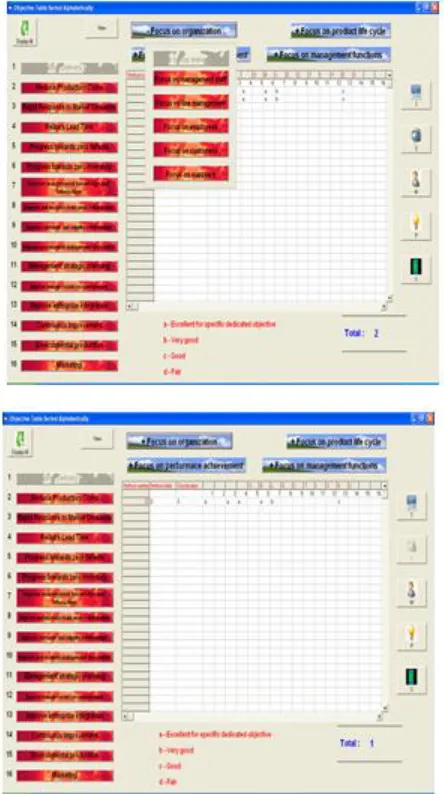
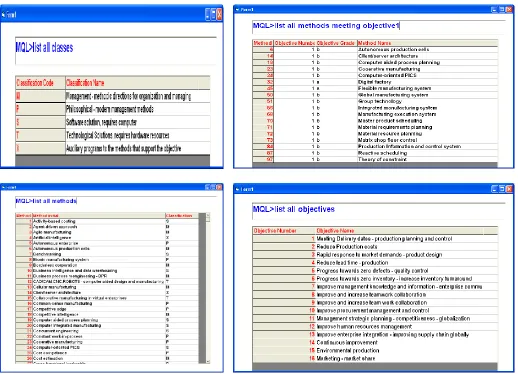
[image:6.612.328.550.138.535.2]The results presented above are implemented in VB with MS-Access as backend for storing method and objective details. The structure of the database is shown in the following figure 4. A Graphical User Interface (GUI) is presented to the end user to select one of the manufacturing methods from the available alternatives using simple drag and drop operations. All the 15 methods are listed on the left and 5 classes on the top of the grid as shown in the Figure 5(a). The user can drag and drop any required objective on to a grid to filter the methods aiming at that objective. Fig 5(b) shows a filtered list of methods meeting objective1, i.e. Meeting Delivery Dates. Out of 110 rows 19 rows are selected. Further, the user can drag -and-drop one of the five class methods to further narrow down the table showing the filtered methods in the selected class. This is depicted in fig 5(c) where out of 19 rows listed in fig 5(b), only 6 are selected. Fig 6(a)-6(h) show execution of MQL commands.
Figure 4. Structure of Database
[image:6.612.48.269.359.701.2] [image:6.612.49.265.365.491.2]International Journal of Emerging Technology and Advanced Engineering
Website: www.ijetae.com (ISSN 2250-2459,ISO 9001:2008 Certified Journal, Volume 4, Issue 2, February 2014)
International Journal of Emerging Technology and Advanced Engineering
Website: www.ijetae.com (ISSN 2250-2459,ISO 9001:2008 Certified Journal, Volume 4, Issue 2, February 2014)
189
Figure 6(a)-6(h) MQL Commands
V.CONCLUSION AND FUTURE WORK
This paper presents the design of a tool which assists the manager in selection of a manufacturing method based on a single objective. It provides two different types of interfaces, one based on a GUI and second one is a command line interface. A query language is developed to assist the manager to query a database in conventional language. A general syntax and a parse tree of a query language is presented. Our future work focuses on modification of the tool and the query language to incorporate multiple objectives \and functions. A Fuzzy Manufacturing Query Language can be designed to take account of uncertainties and vagueness in decision making. Fuzzy expert system may prove to be invaluable under such circumstances.
REFERENCES
[1] Gideon Halevi, Handbook of Production Management Methods,
Butterworth Heinemann publications, ISBN 0 7506 5088 5.
[2] Girish R. Naik, V.A.Raikar and Poornima G. Naik, International
Journal of Computer Science and Engineering (IJCSE), Vol. 3, Issue 2, Mar 2014, 35-46. ISSN(P) : 2278-9960;ISSN(E):2278-9979.
[3] L. Mikhailov and M. G. Singh, “Fuzzy analytic network process and
its application to the development of decision support systems,” IEEE Transactions on Systems, Man, and Cybernetics, Part C. Applications and Reviews, Vol. 33, No. 1, pp. 33–41, 2003.
[4] R. Santhanam and G. J. Kyparisis, “A multiple criteria decision
[image:8.612.47.565.136.510.2]International Journal of Emerging Technology and Advanced Engineering
Website: www.ijetae.com (ISSN 2250-2459,ISO 9001:2008 Certified Journal, Volume 4, Issue 2, February 2014)
190
[5] V. S. Lai, K. W. Bo, and W. Cheung, “Group decision making in a
multiple criteria environment: A case using the AHP in software selection,” European Journal of Op-erational Research, Vol. 137,
No. 1, pp. 34–144, 2002.C. C. Wei, C. F. Chien, and M. J. J. Wang,
“An AHP- based approach to ERP system selection,” International
Journal of Production Economics, Vol. 96, No. 1, pp. 47–62, 2005.
[6] J. P. Brans, B. Mareschal, and P. Vincke, “PROMETHEE: A new
family of outranking methods in multicriteria analysis,” Operational Research, Vol. 3, pp. 477–490. 1984.
[7] R. V. Rao, “Decision making in the manufacturing envi-ronment
using graph theory and fuzzy multiple attribute decision making methods,” Springer-Verlag, London, 2007.
[8] R. Santhanam and G. J. Kyparisis, “A multiple criteria decision
model for information system project selection,” Computers & Operations Research, Vol. 22, No. 8, pp. 807–818, 1995.
[9] Dhananjay R. Kalbande and G.T.Thampi, attribute and
Multi-criteria Decision Making Model for technology selection using fuzzy
logic, International Journal of Computing Science and
Communication Technologies, VOL. 2, NO. 1, July 2009. (ISSN 0974-3375)
[10] Journal of Micromechanics and Microengineering, Xuan F Zha and
H Du, Manufacturing process and material selection in concurrent collaborativedesign of MEMS devices, 13, 509–522, 2003.
[11] Chenhui Shaoa, , Kamran Paynabarb, Tae Hyung Kima, Jionghua
(Judy) Jinc, S. Jack Hua, J. Patrick Spicerd, Hui Wangd, Jeffrey A. Abelld, Feature selection for manufacturing process monitoring using cross-validation, Journal of Manufacturing Systems, Volume 32, Issue 4, October 2013, Pages 550–555
[12] R. V. Rao, T. S. Rajesh, Software Selection in Manufacturing
Industries Using a Fuzzy Multiple Criteria Decision Making Method, PROMETHEE, Intelligent Information Management, 2009, 1, 159-165, December 2009
[13] Mohammad Akhshabi, A New Fuzzy Multi Criteria Model for