r e s p o n s e s t o fo r e s t
fr a g m e n t a ti o n i n N e o t r o pi c al
b a t s
Ro c h a , R, F e r r e i r a , DF, Lo p e z-B a u c e ll s, A, F a r n e d a , F, C a r r e i r a s ,
JMB, P al m ei ri m , JM a n d M e y er, C FJ
h t t p :// dx. d oi.o r g / 1 0 . 1 1 1 1 / b t p . 1 2 4 7 4
T i t l e
D o e s s e x m a t t e r ? G e n d e r-s p e cific r e s p o n s e s t o fo r e s t
f r a g m e n t a ti o n in N e o t r o pi c al b a t s
A u t h o r s
Ro c h a , R, F e r r ei r a , DF, Lo p e z-B a u c ell s, A, F a r n e d a , F,
C a r r e i r a s , JMB, P al m ei ri m , JM a n d M e y er, C FJ
Typ e
Ar ticl e
U RL
T hi s v e r si o n is a v ail a bl e a t :
h t t p :// u sir. s alfo r d . a c . u k /i d/ e p ri n t/ 4 2 6 4 0 /
P u b l i s h e d D a t e
2 0 1 7
U S IR is a d i gi t al c oll e c ti o n of t h e r e s e a r c h o u t p u t of t h e U n iv e r si ty of S alfo r d .
W h e r e c o p y ri g h t p e r m i t s , f ull t e x t m a t e r i al h el d i n t h e r e p o si t o r y is m a d e
f r e ely a v ail a bl e o nli n e a n d c a n b e r e a d , d o w nl o a d e d a n d c o pi e d fo r n o
n-c o m m e r n-ci al p r iv a t e s t u d y o r r e s e a r n-c h p u r p o s e s . Pl e a s e n-c h e n-c k t h e m a n u s n-c ri p t
fo r a n y f u r t h e r c o p y ri g h t r e s t r i c ti o n s .
Does sex matter? Gender-specific responses to forest fragmentation in Neotropical
bats
Ricardo Rocha1,2,3,8,* , Diogo F. Ferreira1,2,* , Adria Lopez-Baucells 1,2,4,5 , Fabio Z. Farneda1,2,6, Joao M. B. Carreiras~ 7, Jorge M. Palmeirim1,2,andChristoph F. J. Meyer1,2,5
1Centre for Ecology, Evolution and Environmental Changes, Faculty of Sciences, University of Lisbon, 1749-016, Lisbon, Portugal
2Biological Dynamics of Forest Fragments Project, National Institute for Amazonian Research and Smithsonian Tropical Research Institute, 69011-970, Manaus, Brazil
3
Metapopulation Research Centre, Faculty of Biosciences, University of Helsinki, FI-00014, Helsinki, Finland
4Museum of Natural Sciences of Granollers, Granollers, Catalonia, 08402, Spain
5Ecosystems and Environment Research Centre (EERC), School of Environment and Life Sciences, University of Salford, M5 4WT, Salford, UK
6
Department of Ecology/PPGE, Federal University of Rio de Janeiro, Rio de Janeiro, 21941-902, Brazil
7National Centre for Earth Observation (NCEO), University of Sheffield, S3 7RH, Sheffield, UK
ABSTRACT
Understanding the consequences of habitat modification on wildlife communities is central to the development of conservation strate-gies. However, albeit male and female individuals of numerous species are known to exhibit differences in habitat use, sex-specific responses to habitat modification remain little explored. Here, we used a landscape-scale fragmentation experiment to assess, separately for males and females, the effects of fragmentation on the abundance of Carollia perspicillata and Rhinophylla pumilio, two widespread Neotropical frugivorous bats. We predicted that sex-specific responses would arise from higher energetic requirements from pregnancy and lactation in females. Analyses were conducted independently for each season, and we further investigated the joint responses to local and landscape-scale metrics of habitat quality, composition, and configuration. Although males and females responded similarly to a fragmentation gradient composed by continuous forest, fragment interiors, edges, and matrix habitats, we found marked differences between sexes in habitat use for at least one of the seasons. Whereas the sex ratio varied little in continuous forest and fragment interi-ors, females were found to be more abundant than males in edge and matrix habitats. This difference was more prominent in the dry season, the reproductive season of both species. For both species, abundance responses to local- and landscape-scale predictors differed between sexes and again, differences were more pronounced in the dry season. The results suggest considerable sex-mediated responses to forest disruption and degradation in tropical bats and complement our understanding of the impacts of fragmentation on tropical forest vertebrate communities.
Abstract in Portuguese is available with online material.
Key words: Amazon; edge effects; intraspecific variation; matrix; seasonality; secondary forest; sex differences; spatial scale; vegetation structure.
ARAPIDLY GROWING HUMAN POPULATION AND INCREASINGPER CAP-ITA CONSUMPTION ARE LEADING TO WIDESPREAD CONVERSION AND DEGRADATION OF NATURAL HABITATS, FURTHER EXACERBATING THE ALREADY PRECARIOUS STATUS OF THE PLANET’S ECOSYSTEMS(Newbold
et al. 2016). Habitat fragmentation and degradation rank among the most serious threats responsible for the current biodiversity crisis (Haddad et al. 2015, Barlow et al. 2016) and their impacts are of particular concern in the mega-diverse tropical forests, home to most of the planet’s terrestrial species (Malhiet al.2014).
Understanding species patterns of habitat use and how local habitat quality, as well as landscape composition and
configuration, interact to shape communities in fragmented land-scapes is paramount to framing effective conservation strategies (Villard & Metzger 2014). However, within the thriving fragmen-tation literature, intraspecific differences in species responses to local and landscape-scale characteristics have received little atten-tion. Among those, sex-specific responses have been particularly neglected, despite their overwhelming importance for the dynam-ics and long-term persistence of natural communities (Franket al.
2016).
Accounting for differences between sexes in the evaluation of animal responses to anthropogenic pressures is important as males and females may differ, sometimes greatly, in key features of their biology such as parental care (e.g., Lucass et al. 2016), anti-predator-behavior (e.g., Curlis et al. 2016), habitat selection (e.g., Penado et al. 2015), and physiological responses to stress
Received 5 January 2017; revision accepted 18 April 2017.
*Both authors have contributed equally.
8Corresponding author; e-mail: [email protected]
ª2017 The Authors.Biotropicapublished by Wiley Periodicals, Inc. on behalf of Association for Tropical Biology and Conservation. 1 This is an open access article under the terms of the Creative Commons Attribution License, which permits use,
distribution and reproduction in any medium, provided the original work is properly cited.
levels (e.g., Small & Schoech 2015). These dissimilarities can translate into differential susceptibility to fragmentation between sexes and consequently result in locally skewed sex ratios, poten-tially leading to greater extinction risks (Le Galliard et al. 2005, Melbourne & Hastings 2008).
Sexual dimorphism is rare among bats, the second most diverse mammalian order (Altringham 2011). However, gender-specific differences in attributes such as aggressiveness toward conspecifics (Ancillotto & Russo 2014), prey composition (Mata
et al.2016), and selection of roosting and foraging areas (Downs
et al. 2016, Istvanko et al. 2016) have been reported for numer-ous species of mostly temperate bats. Yet, notwithstanding some notable exceptions (e.g., Evelyn & Stiles 2003, Henry & Kalko 2007, Henryet al.2007, Franket al.2016, Orr et al.2016), differ-ences between sexes in their tropical counterparts remain largely unexplored. However, these differences should be commonplace as tropical bats must also balance their sex-specific energy requirements with the spatiotemporal variability of resources and the compositional and configurational heterogeneity of the land-scape (Cisneroset al.2015a, Ferreira et al.2017).
The reproductive phenology of many tropical bats is strongly correlated with environmental conditions and resource availability (Ramos Pereira et al. 2010, Durant et al. 2013). Still, despite timing their life cycle to match periods of peak food availability, female bats may be constrained by the elevated ener-getic requirements associated with pregnancy and lactation, which might force them to alter their foraging time budgets and limit their habitat use to the most resource-rich areas (Lintott et al.
2014). Although habitat quality might not be as critical to males and non-breeding females (Cryan et al. 2000, Senior et al. 2005, Henry & Kalko 2007), the former might be affected by higher intra-specific competition, leading to the displacement of poorly competitive same-sex juveniles from resource-rich habitats (Henry
et al.2007).
Tropical bats, like numerous other taxa, are affected by frag-mentation and habitat degradation (Meyer et al. 2016). Their responses have been found to be scale-sensitive, highly species-and ensemble-specific and to vary according to seasonal variation in resource abundance (Cisneros et al. 2015a, Arroyo-Rodrıguez
et al. 2016, Chambers et al. 2016, Mendes et al. 2016, Ferreira
et al.2017, Rochaet al.2017a). Matrix type and condition impose influential filters on their local assemblages (Mendenhall et al.
2014, Farneda et al. 2015, Rodrıguez-San Pedro & Simonetti 2015) and local-scale vegetation structure influences species’ occurrence and abundance by constraining flight and access to food resources (Marcienteet al.2015). However, no study has yet investigated how male and female bats differ in their responses to local and landscape-scale characteristics in fragmented landscapes.
Here, we investigated how the abundance of male and female bats of two of the most common Central Amazonian bats, Carollia perspicillata and Rhinophylla pumilio, differs along a disturbance gradient composed of continuous primary forest, fragment interiors, forest edges, and secondary forest matrix habi-tats. In addition, for both species, we examined how male and
female abundance is influenced by vegetation structure (local-scale variable) and, for five spatial scales (250, 500, 750, 1000, and 1500 m), by landscape composition and configuration. We hypothesized that sex ratio would change across the disturbance gradient due to the increased energetic demands of females associated with pregnancy and lactation, and we predicted that capture rate of female bats during the peak reproductive periods would be particularly high in secondary forest due to increased fruit availability. Due to the expectation that sex-specific differ-ences in habitat use reflect seasonal variation in resource availabil-ity, we conducted separate analyses for the wet and dry seasons. We anticipated that since reproduction imposes high fluctuations in energetic demands, female–male consistency in the responses ofC. perspicillata andR. pumilio to local and landscape-scale char-acteristics would vary between dry and wet seasons. Specifically, since the peak pregnancy period of both species in our study area occurs in the dry season (Bernard 2002), we predicted that females, due to higher energetic demands associated with preg-nancy, would respond more strongly to compositional metrics (and hence fruit availability) in the dry season, whereas males would present similar responses to local and landscape-scale attri-butes in both the dry and wet seasons.
METHODS
STUDY AREA.—Fieldwork took place at the Biological Dynamics
of Forest Fragments Project (BDFFP), a whole-ecosystem frag-mentation experiment located ~80 km north of Manaus (2°250S, 59°500W), Brazilian Amazon (Fig. S1) (Lauranceet al.2011). The landscape is characterized by a mosaic of continuous terra firme
forest and primary forest fragments surrounded by a matrix of secondary forest. Primary forest canopy is 30–37 m tall, with emergent trees up to 55 m (Lauranceet al.2011). Annual rainfall in the region ranges from 1900 to 3500 mm, with a wet season from November to June (precipitation can exceed 300/mo) and a dry season from July to November (precipitation below 100/mo). Flowering is concentrated in the transition between dry and wet seasons and fruiting peaks at the onset of the wet season (Hau-gaasen & Peres 2007, Bentos et al. 2014). Eleven experimental primary forest fragments categorized into size classes of 1, 10, and 100 ha were isolated in the early 1980s by clearing and, in some cases, also burning the surrounding forest. Fragment dis-tance from continuous forest ranges from 80 to 650 m, and each was re-isolated on three to four occasions prior to this study, most recently between 1999 and 2001 (Lauranceet al.2011). The matrix is composed by secondary forests in different successional stages (Carreiras et al. 2014) and is dominated mainly by Vismia
spp. andCecropiaspp. (Mesquitaet al.2015).
sampling scheme was adopted in continuous forest, whereby nine sites were sampled in the interior, three at the edge, and three in the secondary forest matrix, 100 m from the forest edge. Accordingly, a total of 39 sites were sampled. Distances between interior and edge sites of continuous forest and fragments were, respectively, 1118488 and 245 208 m (meanSD).
Bats were sampled during the dry (July to November 2011 and 2012; two visits each year) and wet seasons (February to June 2012 and 2013; two visits each year) using 14 ground-level mist nets (12 93 m, 16 mm mesh, ECOTONE, Poland) in continuous forest and fragment interiors and seven at edge and matrix sites. Mist netting was limited to days with no strong rain or wind, and, for each survey round, visits to the interior, edge, and matrix sites of continuous forest and forest fragments were kept as close apart as logistically feasible. Sampling started at dusk and nets was left open for 6 hours, being revised every
~20 min. Capture effort was 10,726 mist-net hours (mnh) in the wet season and 7924 mnh in the dry season (1 mnh equals one 12-m net open for 1 h). Bias in capture rates due to net shyness was avoided by spacing same-site surveys 3–4 weeks apart (Mar-ques et al. 2013). Species identification followed Lim and Engstrom (2001) and Gardner (2007) and taxonomy follows the latter. For each captured individual, age was determined by exam-ination of the extent of ossification in the epiphyses of the pha-langes and, in the case of adult females, the reproductive state was recorded by palpation (pregnant vs. non-pregnant) and evi-dence of hair loss around the mamma and milk (lactating vs.
non-lactating). All non-phyllostomid species other than Pteronotus parnellii are poorly sampled with mist nets (Kalko 1998) and were, therefore, excluded from the analyses. For the purpose of this article, we further restricted the analysis to the two species with more than 30 captured adult bats for each sex and season,
Carollia perspicillataandRhinophylla pumilio. Imperfect species detec-tion can introduce bias into estimates of species occurrence and abundance. We minimized any potential detectability-related biases by (1) focusing on these two abundant understory frugi-vores which are well-sampled with ground-level mist nets and have been shown to have high detection probabilities even with just two successive site visits (Meyer et al. 2011), and by (2) for-mally including season—an important detection covariate (cf. Meyeret al.2011)—in our analysis (see below).
FEMALE–MALE ABUNDANCE ACROSS THE INTERIOR-EDGE-MATRIX GRADIENT.—Differences in abundance between sexes, seasons
(dry and wet), and habitat types (interior, edge, and matrix) were assessed using generalized linear mixed-effects models (GLMMs). For each species, the number of captured individuals was used as response variable (Poisson distribution, log-link function) and sex, season, and habitat type were specified as fixed, interacting effects. Due to the high model complexity when implementing a three-way interaction, we decided to instead use two-way interac-tions between sex and habitat type for each season separately. Reflecting our nested sampling design and to account for poten-tial autocorrelation between sites within the same location, mod-els included a random term nesting ‘site’ within ‘location’ (the
latter referring to the six research camps at the BDFFP; Fig. S1). Each site’s total capture effort (log number of mnh) was incorpo-rated as a model offset. Significant effects were evaluated for each species via likelihood-ratio tests and multiple comparison tests with Tukey contrasts (adjusted Pvalues reported) in the R package‘multcomp’(Hothornet al.2014).
FEMALE–MALE RESPONSES TO LOCAL AND LANDSCAPE-SCALE VARIABLES.—Vegetation structure.—Vegetation structure was quanti-fied within three 100 m2 (5920 m) plots established 5 m from each side of the mist net transects. In each plot, the following variables were quantified: (1) diameter at breast height (dbh); (2) percent canopy cover; (3) number of woody stems (dbh<10 cm); (4) number of trees (dbh ≥10 cm); (5) number of palms; (6) number of lianas; (7) number of pioneer trees (generaVismiaand
Cecropia); (8) tree height; and (9) vertical foliage density. Since our interest was in the general structure of the vegetation and not in the particular contribution of any of the different vegetation vari-ables quantified, we submitted the vegetation variables to a prin-cipal components analysis (PCA). The score values for the first axis (PCA1—explaining 42% of the total variance and represent-ing a gradient from simpler vegetation structure, typical of sec-ondary forests [negative values] to more complex vegetation structure, typical of primary forest [positive values]) were subse-quently used as predictor variable for local vegetation structure (LVS). Details regarding the quantification of the vegetation vari-ables and PCA analysis are given in Rochaet al.(2017a).
LANDSCAPE COMPOSITION AND CONFIGURATION.—Landscape metrics
were obtained from a land cover map of the BDFFP landscape from 2011. The map was based on the analysis of a quasi-annual time series of Landsat Thematic Mapper data (30-m resolution) from the 1970s up to 2011 (Carreiras et al.2014). For this study, the map was classified into four land cover types, representing: (1) continuous primary forest; (2) early-stage secondary forest (≤5 yr); (3) intermediate-stage secondary forest (6–15 yr); and (4) advanced-stage secondary forest (≥16 yr) (see Carreiras et al.
2014 for classification details) (Fig. S2). Selection of metrics of landscape composition and configuration was based on previous analyses of bat–environment relationships (Meyer & Kalko 2008, Klingbeil & Willig 2009, 2010, Avila-Cabadilla et al. 2012, Cis-neros et al. 2015b, Arroyo-Rodrıguez et al. 2016, Rocha et al.
2017a), and metrics were computed for landscape buffers with radii of 250, 500, 750, 1000, and 1500 m surrounding each of the 39 sampling sites. These buffer sizes were chosen as they encompass the home ranges of different-sized bat species and at the same time minimize buffer overlap (Meyer & Kalko 2008). Apart from mean nearest neighbor distance (calculated using the software QGIS), the following metrics were calculated using the R package ‘SDMtools’ (Vanderwal et al. 2011) to represent: (A) landscape composition (primary forest cover [PFC], secondary forest cover—initial stage [SFC1], intermediate stage [SFC2], and advanced stage [SFC3]) and (B) landscape configuration (edge density [ED], patch density [PD], mean nearest neighbor distance [MNND], and mean shape index [MSI]). Following McGarigal
(2014), MNND was calculated as the mean of the shortest straight-line distance between the sampling site and each of its nearest neighbors of the same class. When a given buffer con-tained only one patch of primary forest, we calculated MNND as the distance between that patch and the nearest one in the next larger buffer. See Table S1 for detailed description of landscape metrics.
RELATIVE IMPORTANCE OF LOCAL AND LANDSCAPE PREDICTORS.— Independently for each sex and season, we examined the relative importance of local vegetation structure and landscape-scale met-rics in affecting species abundance at the five focal spatial scales using Poisson GLMMs. The number of captures at each site was used as response variable and, as above,‘site’nested within‘ loca-tion’was included as a random term, and log(effort) was included as an offset. Multicollinearity between predictor variables was investigated by calculating (1) variance inflation factors (VIF) and ii) pairwise Pearson correlations. ‘Severe’ collinearity is present when VIFs >10 (Neter et al. 1996); therefore, following Benchi-mol and Peres (2015), we considered variables with VIF≤6 suit-able to be included in the analyses. However, we found that variables with VIF <6 differed between spatial scales and the same was found for correlation values with the Pearsonr >0.6. We consequently dismissed these analyses as the selection of dis-tinct predictors for different buffer sizes would preclude mean-ingful comparisons between scales. As such, we opted to include all the predictor variables in our GLMMs. Although this can lead to some multicollinearity and consequently jeopardize statistical inference (Dormann et al.2013), we consider that each predictor represents a particular avenue of interaction between ecological mechanisms and bat abundances, and, consequently, omission of predictor variables at a given spatial scale could undermine the estimates of the relative importance for the remaining predictors (Smithet al.2009).
For each species, sex, and spatial scale, separate sets of can-didate models were chosen a priori, comprising plausible combi-nations of local vegetation structure and landscape predictors. The following models were considered (1) all predictors; (2) each predictor individually; (3) local vegetation structure and landscape composition predictors; (4) local vegetation structure and land-scape configuration predictors; (5) composition and configuration predictors; (6) composition predictors only; (7) configuration pre-dictors only; (8) secondary forest cover prepre-dictors only; (9) local vegetation structure and secondary forest cover predictors; (10) all predictors without secondary forest cover predictors; and (11) all predictors without primary forest cover predictor. GLMMs were fitted in the ‘lme4’ package in R (Bates 2010), and selection of the best-fit models was performed through Akaike’s informa-tion criterion corrected for small sample sizes (AICc). Model averaging, conducted in the ‘AICcmodavg’ package (Mazerolle 2016), was used to obtain parameter estimates for the predictors when multiple models had aΔAICc ≤2 (Burnham & Anderson 2002). Moran’sI tests were used to assess potential spatial auto-correlation of the residuals of our best-fit GLMMs. In addition, potential problems with overdispersion were evaluated based on
the appropriate v2 distribution of the ratio between the sum of squared Pearson residuals and the residual degrees of freedom (Bolker et al.2009). For these best-fit models, the relative impor-tance of each predictor was determined through hierarchical par-titioning analysis using the ‘hier.part’ package (Walsh et al. 2013), modified to include‘log(effort)’ as a model offset (Jeppssonet al.
2010). Following Benchimol and Peres (2015) and Rocha et al.
(2015), hierarchical partitioning analysis was conducted consider-ing only thefixed effects.
For each species and independently for each season, the consistency between predictor variables included in the best mod-els for each sex was calculated via a model consistency index (Gutzwiller & Barrow 2001). This was computed as the number of common predictors with the same direction of effect for each sex in each season, divided by the total number of predictors included in the best-fit models. High between-sex variation in species–environment relationship stands for low model consis-tency and vice versa.
All analyses were conducted in R v.3.1.3 software (R Devel-opment Core Team 2013).
RESULTS
We captured a total of 3431 adult bats representing 44 species (43 phyllostomids and 1 mormoopid, P. parnellii). Females com-prised nearly two thirds (2097, 61.1%) of all captures (Table S2). The female–male capture ratio averaged 1.42 (0.1, SD) across the different habitat categories for the wet season and 1.83 (0.08) for the dry season.
Carollia perspicillataandR. pumiliorepresented, respectively, 50 and 12.2 percent of all captures and were the only two species with more than 30 captures for each sex in the two seasons (Table S2). ForC. perspicillata, the female–male capture ratio aver-aged 1.32 (0.12, SD) for the wet season and 1.57 (0.37) for the dry season, whereas for R. pumiliothese figures were, respec-tively, 2.89 (0.95) and 1.4 (1.01). Carollia perspicillatadisplayed a peak in pregnancy at the middle of the dry season and a sec-ond, slightly lower peak in the wet season. However, R. pumilio
only exhibited a peak in pregnancy in the dry season. For both species, peaks in the capture of pregnant bats were followed by peaks in lactating females (Fig. 1 and Table S3).
SEX DIFFERENCES IN CAPTURE RATES ACROSS THE INTERIOR-EDGE -MATRIX GRADIENT.—Both species analyzed exhibited significant
effects for the interaction between sex and habitat type for the dry and wet seasons (Table S4). However, for C. perspicillata, the differences in the abundance of female and male bats were signif-icant only for the dry season based on multiple pairwise compar-isons (Fig. 2; Table S5). Female–male numbers varied especially in edge and matrix habitats, where females tended to outnumber males, with the difference being more pronounced in the dry than in the wet season.
than the capture rate of males in all habitats (Fig. 2). However, for R. pumilio, females outnumbered males in the matrix during the wet season and at both fragment edges and in the matrix in the dry season.
SEX DIFFERENCES IN RESPONSES TO LOCAL- AND LANDSCAPE-SCALE VARIABLES.—The relative importance of vegetation structure and
compositional and configurational landscape characteristics dif-fered between sexes for bothC. perspicillataandR. pumilio(Figs. 3 and 4; Tables S6 and S7). None of the GLMMs showed signs of overdispersion (Table S8) or yielded spatially autocorrelated resid-uals (Table S9), and for both species, model consistency was higher in the wet season (71.4% C. perspicillata; 16.7% R. pumilio) than in the dry season (22.2%C. perspicillata; 0%R. pumilio).
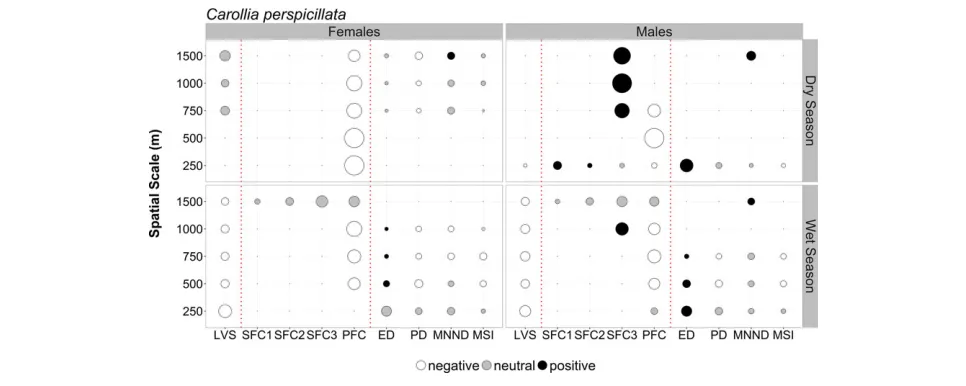
For C. perspicillata, female abundance in the dry season was nearly exclusively dictated by the amount of PFC, to which the response was negative across all scales. Configurational metrics had no influence at the smallest scales (250 and 500 m) and only patch density was shown to negatively affect abundance at the largest scales (≥750 m). For males during the dry season, the influence of vegetation structure and configurational metrics was almost negligible. They were less influenced by PFC, but instead responded more strongly to the amount of secondary forest cover, especially, at larger spatial scales (≥750 m) to SFC3. Dur-ing the wet season, females showed a negative response toward local vegetation structure across all scales and to PFC, patch den-sity and mean shape index at intermediate scales (500, 750, and 1000 m). For these scales, however, the responses to edge density were positive. During this season, male responses nearly mirrored those of females (Fig. 3).
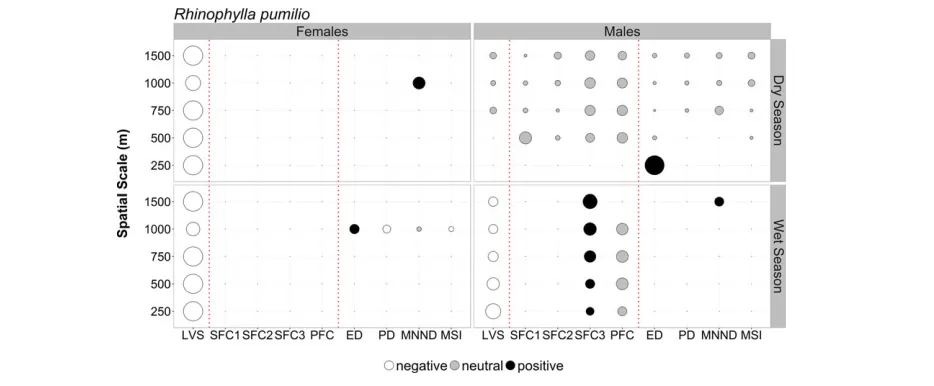
For R. pumilio, female abundance during the dry season was nearly exclusively related to local vegetation structure across all scales (negative association). By contrast, male responses were all neutral apart from edge density at the smallest scale, for which the response was positive. During the wet season, local vegetation structure was again the metric with more relevance for females, negatively influencing abundance across all scales. For males, local vegetation structure had also a negative influence, but its rele-vance slightly decreased with increasing scale. The opposite was true, albeit the direction of the effect was positive, for SFC3 for which there was an increase in predictor relevance from smaller to larger scales (Fig. 4).
DISCUSSION
Despite the relatively low structural contrast between the advanced secondary vegetation matrix and the adjacent continuous forest, bats at the BDFFP exhibit pronounced assem-blage- and ensemble-level responses to interior-edge-matrix frag-mentation gradients and local and landscape-scale attributes (Rocha et al.2017a). These responses reflect strong environmen-tal filters that selectively benefit species with specific functional traits associated with reduced fragmentation sensitivity (Farneda
[image:6.594.44.289.81.325.2]et al. 2015) and that are modulated by seasonal fluctuations in resource availability (Ferreira et al.2017). Here, we show that in
FIGURE 1. Female reproductive phenology ofCarollia perspicillataand Rhino-phylla pumilio. Proportions are based on the total number of pregnant or lactat-ing females per total number of adult females captured in each month between July 2011 and June 2013 (note that data are missing for December and January). Background colors: blue, wet season; red, dry season.
FIGURE 2. Variation in mean (95% CI) capture rate (bats/mnh) of males and femalesCarollia perspicillataandRhinophylla pumilioacross different habitat types in the BDFFP landscape in the dry and wet seasons. Significant differ-ences in capture rates between sexes are indicated as ***P<0.001,
**P<0.01, and*P<0.05.
[image:6.594.43.289.392.672.2]addition to being trait-mediated and season-modulated, responses of Neotropical bats to fragmentation are sex-specific. Even though our analysis was restricted to two of the locally most abundant frugivorous bat species in our study area,C. perspicillata
and R. pumilio, it is likely that our findings are more generally applicable to a wide range of species.
FEMALE–MALE RESPONSES TO THE INTERIOR-EDGE-MATRIX GRADIENT.—Capture rates of C. perspicillata, the most abundant
phyllostomid species at the BDFFP, were higher for females than males during the dry season at edges and matrix sites and, to a lesser extent, in continuous forest and fragment interiors. During the reproductive period, female bats face higher energetic demands than males (Barclay 1991), and for C. perspicillata, the most prominent pregnancy peak occurs during the dry season, whereas lactation peaks during the wet season (Bernard 2002, Durant et al. 2013). To compensate for increased energetic demands, females might forage preferentially in the most resource-rich areas (Barclay 1991, Encarnacß~ao et al. 2005), espe-cially in the dry season during which fruit availability is lower (Ramos Pereira et al. 2010). Similar to other studies across the species’distribution (e.g.,Melloet al.2004, Durantet al.2013), we have identified a second reproductive peak, of somewhat weaker intensity, in the wet season. Since this second peak takes place in the season of highest fruit availability (Ramos Pereiraet al.2010), it is unlikely to affect male–female ratios as much as the more pronounced reproductive peak in the dry season. Early succes-sional gap species of the genusPiper, the preferred food resource of C. perspicillata (Horsley et al. 2015) produce 2–10 times more fruits than shade tolerant or late successional forest species (Thies
& Kalko 2004). The greater proportion of females in edge and matrix habitats might, therefore, reflect a shift by pregnant females toward foraging in these areas of increased food availabil-ity. In addition, Cecropia and Vismia spp., whose fruits are also favored by C. perspicillata (Horsley et al. 2015), are abundant in the secondary forest matrix at the BDFFP (Bentos et al. 2008), further justifying the more accentuated female-biased sex ratios at edges and matrix sites.Piper, Cecropia, and Vismiafruits are nutri-tionally poor, and thus bats that rely on these genera must con-sume large fruit quantities to meet their dietary needs (Fleming 1986). Augmented capture rates of female C. perspicillata in late successional forest during the peak pregnancy period in the dry season might, therefore, reflect increased foraging movements associated with higher energetic demands and lower fruit avail-ability.
[image:7.594.55.538.79.272.2]Rhinophylla pumilio, similarly to C. perspicillata, belongs to the subfamily Carolliinae and is one of the most locally abundant bat species across the Amazon (Rinehart & Kunz 2006). The species’ diet is highly variable but consists primarily of small-seeded understory and mid-canopy fruits of several pioneer plants including Vismia,Piper, andCecropiaspp. (Rinehart & Kunz 2006, Horsley et al.2015). At the BDFFP, peak pregnancy occurs dur-ing the dry season (Bernard 2002, this study), and durdur-ing this season, the capture rate of females was nearly three times higher than for males atVismia andCecropia-dominated edge and matrix sites. In the matrix, the sex ratio was also female-biased during the wet season. This might relate to increased foraging move-ments into resource-rich secondary forest areas to compensate for the elevated energetic burden associated with pregnancy and milk production during the dry season.
MALE–FEMALE RESPONSES TO THE INFLUENCE OF LOCAL- AND LANDSCAPE-SCALE VARIABLES.—Females and males of bothC. perspi-cillata andR. pumilio demonstrated discernible differences in their response to local-scale vegetation structure and landscape compo-sition and configuration, as indicated by the results of model con-sistency between sexes. Similarity in male–female responses was lower for the dry season, the period of highest reproductive activ-ity for both species at the BDFFP (Bernard 2002, this study).
During the dry season, compositional metrics were the best predictors of both male and female responses of C. perspicillata. However, while the responses of females were characterized by a strong negative influence of PFC across all spatial scales, male responses to PFC were negative at smaller scales (≤500 m) but were then substituted by a positive response to SFC3 at larger scales. These results show that females clearly favor the pioneer-rich sec-ondary forests during the main reproductive period and that males, while equally favoring matrix habitats, tend to select areas close to late-stage successional forest. Telemetry observations from the Atlantic forest show thatC. perspicillata, while preferentially foraging in early successional forests, preferably roosts in later successional habitats (Trevelinet al.2013). Male preference for sites with higher cover of late-stage secondary forest might thus relate to increased chances of female encounters as they return to their roosts or to roost defense. The responses of male and femaleC. perspicillatato compositional metrics in the wet season were similar to those observed in the dry season, a pattern that might be explained by the second reproductive activity peak exhibited in this season.
Responses of femaleR. pumiliowere nearly exclusively related with local vegetation structure, whereby the association was con-sistently negative across all scales examined and during both the dry and wet seasons. Local vegetation structure as summarized by PCA1 (see Rocha et al. 2017a, Fig. S2 and Table S3) reflects a
gradient from simpler structural complexity of the vegetation, characteristic of secondary forest (greater density of Vismia spp. and Cecropia spp. trees and woody stems; negative values), to greater structural complexity, characteristic of primary forest sites (more closed canopy and greater density of trees; positive values). Consequently, a negative association with local vegetation struc-ture indicates that more cluttered habitats are avoided. This nega-tive association with local vegetation structure, although less marked, was also found for male bats in the wet season. Due to its small body size, R. pumilio (~9 g) incurs higher flight costs compared to larger fruit-eating bats (Speakman & Thomas 2003). Since flying in cluttered habitats is more energy demanding than flying in more open areas (Grodzinski et al. 2009), the elevated energetic costs associated with higher vegetation complexity might represent a particularly high burden for females during pregnancy and while nursing (dry season). During lactation, these energetic costs might be further amplified due to the transportation of their young since femaleR. pumiliooften transport their pups to tempo-rary night roosts across their foraging area (Henry & Kalko 2007). Notwithstanding the above-mentioned response of female
R. pumilio toward local vegetation structure in the dry season, a marked seasonal effect was observed in the response of male and female bats to local-scale characteristics. This seems to suggest that due to higher fruit availability during the wet season, both male and female bats do not need to travel long distances for foraging and consequently may respond predominantly to local-scale habitat features.
The results of this study align with previous findings from temperate areas, in which male and female bats differed in their responses to local and landscape-scale metrics of habitat quality, composition, and configuration in an urban setting (Lintott et al.
[image:8.594.71.538.79.272.2]2014). They also agree with several telemetry studies providing
FIGURE 4. Summary results of model averaging of the best-fit generalized linear mixed models (Akaike differences<2 from the best model) exploring the asso-ciation between local and landscape-scale predictors and the abundance of male and femaleRhinophylla pumilioatfive focal scales across the BDFFP. Symbol size is proportional to the variation explained by the respective predictor variable based on hierarchical partitioning. Color denotes the direction of the relationship: black=positive; white=negative; gray=neutral (based on the unconditional 95% CIs). Abbreviations: see legend to Fig. 3. See Tables S6 and S7 for additional modeling results.
evidence for gender-specific differences in habitat use in Neotropi-cal bats—e.g., preference of foraging areas closer to day roosts in males than females (Meyeret al.2005) or differential temporal dis-tribution of activity between sexes (Thieset al.2006). Yet, they con-trast with recent findings from humanized forest landscapes in Costa Rica for which no sex differences in habitat use were observed (Franket al.2016).
CONCLUSIONS
Our results suggest that, at least for some species, male and female bats respond to fragmentation in different ways and that responses to local- and landscape-scale attributes are sex- and season-specific. This has considerable implications for our under-standing of how tropical species adapt to human-induced habitat changes as modifications in population structure (sex ratio) can act to diminish or magnify the pervasive consequences of forest loss, fragmentation, and habitat deterioration.
ACKNOWLEDGMENTS
We thank the multitude of volunteers and field assistants that helped collecting data, the coordination team of the BDFFP and Paulo E.D. Bobrowiec for logistic support, LBA program of Micro-meteorology Group—INPA for providing the precipitation data, and Tobias Jeppsson for providing a modified version of the hier.-part function for the hierarchical hier.-partitioning analysis. Funding was provided by the Portuguese Foundation for Science and Technol-ogy to C.F.J.M. (PTDC/BIA-BIC/111184/2009), R.R. (SFRH/ BD/80488/2011), and A.L.-B. (PD/BD/52597/2014). F.Z.F. was supported by a CAPES fellowship and J.M.B.C was funded as part of NERC’s support of the National Centre for Earth Observation. This research was conducted under ICMBio permit (26877-2) and constitutes publication number 716 of the BDFFP technical series.
DATA AVAILABILITY
Data available from the Dryad Repository: https://doi.org/10. 5061/dryad.fs401 (Rochaet al.2017b).
SUPPORTING INFORMATION
Additional Supporting Information may be found online in the supporting information tab for this article:
FIGURE S1. Map of the Biological Dynamics of Forest Frag-ments Project (BDFFP).
FIGURE S2. Map of the different successional stages of sec-ondary forest at the BDFFP.
TABLE S1.Detailed description of landscape metrics used in the study. TABLE S2. Number of captures of adult bats for each bat species sampled.
TABLE S3. Number of male and female Carollia perspicillata and Rhinophylla pumilio captured each month.
TABLE S4. Likelihood-ratio tests investigating the influence of sex, habitat type, and season on abundance.
TABLE S5.Male and female abundance multiple pairwise comparisons. TABLE S6. Most parsimonious models investigating relationships between the abundance of male and female Carollia perspicillata and Rhino-phylla pumilio and local and landscape-scale attributes.
TABLE S7. Model averaging of the best-fit models of the relationship between the abundance of male and female Carollia perspicillata and Rhino-phylla pumilio and local and landscape-scale attributes.
TABLE S8.Estimate of overdispersion of the best-fit GLMMs. TABLE S9. Moran’s I test for the residuals of the most parsimonious models.
LITERATURE CITED
ALTRINGHAM, J. D. 2011. Bats: From evolution to conservation. Oxford
University Press, New York.
ANCILLOTTO, L.,AND D. RUSSO. 2014. Selective aggressiveness in European
free-tailed bats (Tadarida teniotis): influence of familiarity, age and sex. Naturwissenschaften 101: 221–228.
ARROYO-RODRIGUEZ, V., C. ROJAS, R. A. SALDANA~ -VAZQUEZ, AND K. E. STONER. 2016. Landscape composition is more important than land-scape configuration for phyllostomid bat assemblages in a fragmented biodiversity hotspot. Biol. Cons. 198: 84–92.
AVILA-CABADILLA, L. D., G. A. SANCHEZ-AZOFEIFA, K. E. STONER, M. Y. ALVAREZ-ANORVE, M. QUESADA,ANDC. A. PORTILLO-QUINTERO. 2012. Local and landscape factors determining occurrence of phyllostomid bats in tropical secondary forests. PLoS ONE 7: e35228.
BARCLAY, R. M. 1991. Population structure of temperate zone insectivorous bats in relation to foraging behaviour and energy demand. J. Anim. Ecol. 60: 165–178.
BARLOW, J., G. D. LENNOX, J. FERREIRA, E. BERENGUER, A. C. LEES, R. M.
NALLY, J. R. THOMSON, S. F. D. B. FERRAZ, J. LOUZADA, V. H. F. O LI-VEIRA, L. PARRY, R. RIBEIRODECASTROSOLAR, I. C. G. VIEIRA, L. E.
O. C. ARAG~AO, R. A. BEGOTTI, R. F. BRAGA, T. M. CARDOSO, R. C. de
OLIVEIRA Jr, C. M. SOUZA Jr, N. G. MOURA, S. S. NUNES, J. V. SIQUEIRA, R. PARDINI, J. M. SILVEIRA, F. Z. VAZ-DE-MELLO, R. C. S. VEIGA, A. VENTURIERI,ANDT. A. GARDNER. 2016. Anthropogenic dis-turbance in tropical forests can double biodiversity loss from defor-estation. Nature 535: 144–147.
BATES, D. M. 2010. lme4: Mixed-effects modeling with R. R package. BENCHIMOL, M., ANDC. A. PERES. 2015. Edge-mediated compositional and
functional decay of tree assemblages in Amazonian forest islands after 26 years of isolation. J. Ecol. 103: 408–420.
BENTOS, T. V., R. C. MESQUITA, J. L. CAMARGO,ANDG. B. WILLIAMSON. 2014. Seed and fruit tradeoffs–the economics of seed packaging in Amazon pioneers. Plant Ecol. Divers 7: 371–382.
BENTOS, T. V., R. C. MESQUITA,ANDG. B. WILLIAMSON. 2008. Reproductive
phenology of Central Amazon pioneer trees. Trop. Conserv. Sci. 1: 186–203.
BERNARD, E. 2002. Diet, activity and reproduction of bat species (Mammalia,
Chiroptera) in Central Amazonia, Brazil. Rev. Bras. Zool. 19: 173– 188.
BOLKER, B. M., M. E. BROOKS, C. J. CLARK, S. W. GEANGE, J. R. POULSEN, M. H. H. STEVENS, ANDJ. S. S. WHITE. 2009. Generalized linear mixed models: a practical guide for ecology and evolution. Trends Ecol. Evol. 24: 127–135.
BURNHAM, K. P.,ANDD. R. ANDERSON. 2002. Model selection and inference. Springer, New York, New York.
CHAMBERS, C. L., S. A. CUSHMAN, A. MEDINA-FITORIA, J. MARTINEZ-FONSECA, ANDM. CHAVEZ-VELASQUEZ . 2016. Influences of scale on bat habitat
relationships in a forested landscape in Nicaragua. Landsc. Ecol. 31: 1299–1318.
CISNEROS, L. M., M. E. FAGAN,ANDM. R. WILLIG. 2015a. Season-specific and guild-specific effects of anthropogenic landscape modification on metacommunity structure of tropical bats. J. Anim. Ecol. 84: 373– 385.
CISNEROS, L. M., M. E. FAGAN,ANDM. R. WILLIG. 2015b. Effects of human-modified landscapes on taxonomic, functional and phylogenetic dimensions of bat biodiversity. Divers. Distrib. 21: 523–533. CRYAN, P. M., M. A. BORGAN,ANDJ. S. ALTENBACH. 2000. Effect of elevation
on distribution of female bats in the Black Hills, South Dakota. J. Mammal. 81: 719–725.
CURLIS, J. D., D. C. MACKLEM, R. DAVIS,ANDC. L. COX. 2016. Sex-specific
antipredator response to auditory cues in the black spiny-tailed iguana. J. Zool. 299: 68–74.
DORMANN, C. F., J. ELITH, S. BACHER, C. BUCHMANN, G. CARL, G. CARRE, J. R.
G. MARQUEZ, B. GRUBER, B. LAFOURCADE, P. J. LEITAO~ , T. MUNKEM€ UL-€ LER, C. MCCLEAN, P. E. OSBORNE, B. REINEKING, B. SCHRODER€ , A. K.
SKIDMORE, D. ZURELL,ANDS. LAUTENBACH. 2013. Collinearity: a review of methods to deal with it and a simulation study evaluating their per-formance. Ecography 36: 027–046.
DOWNS, N. C., W. J. CRESSWELL, P. REASON, G. SUTTON, D. WELLS,AND S. WRAY. 2016. Sex-specific habitat preferences of foraging and commut-ing lesser horseshoe batsRhinolophus hipposideros(Borkhausen, 1797) in lowland England. Acta Chiropt. 18: 451–465.
DURANT, K. A., R. W. HALL, L. M. CISNEROS, R. M. HYLAND,ANDM. R. W IL-LIG. 2013. Reproductive phenologies of phyllostomid bats in Costa Rica. J. Mammal. 94: 1438–1448.
ENCARNACß~AO, J. A., U. KIERDORF, D. HOLWEG, U. JASNOCH,ANDV. WOLTERS. 2005. Sex-related differences in roost-site selection by Daubenton’s bats Myotis daubentonii during the nursery period. Mammal Rev. 35: 285–294.
EVELYN, M. J.,ANDD. A. STILES. 2003. Roosting Requirements of Two
Fru-givorous Bats (Sturnira lilium and Arbiteus intermedius) in Fragmented Neotropical Forest. Biotropica 35: 405–418.
FARNEDA, F. Z., R. ROCHA, A. LOPEZ -BAUCELLS, M. GROENENBERG, I. SILVA, J. M. PALMEIRIM, P. E. D. BOBROWIEC,ANDC. F. J. MEYER. 2015. Trait-related responses to habitat fragmentation in Amazonian bats. J. Appl. Ecol. 52: 1381–1391.
FERREIRA, D. F., R. ROCHA, A. LOPEZ -BAUCELLS, F. Z. FARNEDA, J. M. B C AR-REIRAS, J. M. PALMEIRIM,ANDC. F. J. MEYER. 2017. Season-modulated responses of Neotropical bats to forest fragmentation. Ecol. Evol. 7: 4059–4071.
FLEMING, T. H. 1986. Opportunism versus specialization: the evolution of feeding strategies in frugivorous bats.InA. Estrada, and T. H. Flem-ing (Eds.). Frugivores and seed dispersal, pp. 105–118. Springer Netherlands, Dordrecht, the Netherlands.
FRANK, H. K., C. D. MENDENHALL, S. D. JUDSON, G. C. DAILY, ANDE. A.
HADLY. 2016. Anthropogenic impacts on Costa Rican bat parasitism
are sex specific. Ecol. Evol. 6: 4898–4909.
GARDNER, A. 2007. Mammals of South America volume 1: Marsupials.
Xenar-thrans, shrews and bats. University of Chicago Press, Chicago. GRODZINSKI, U., O. SPIEGEL, C. KORINE,ANDM. W. HOLDERIED. 2009.
Con-text-dependent flight speed: evidence for energetically optimal flight speed in the batPipistrellus kuhlii? J. Anim. Ecol. 78: 540–548. GUTZWILLER, K. J.,ANDW. C. BARROW. 2001. Bird–landscape relations in the
Chihuahuan desert: coping with uncertainties about predictive models. Ecol. Appl. 11: 1517–1532.
HADDAD, N. M., L. A. BRUDVIG, J. CLOBERT, K. F. DAVIES, A. GONZALEZ, R. D. HOLT, T. E. LOVEJOY, J. O. SEXTON, M. P. AUSTIN, C. D. COLLINS, W. M. COOK, E. I. DAMSCHEN, R. M. EWERS, B. L. FOSTER, C. N. JENKINS, A. J. KING, W. F. LAURANCE, D. J. LEVEY, C. R. MARGULES, B. A. MELBOURNE, A. O. NICHOLLS, J. L. ORROCK, D.-X. SONG,ANDJ. R.
TOWNSHEND. 2015. Habitat fragmentation and its lasting impact on
Earth’s ecosystems. Sci. Adv. 1: e1500052.
HAUGAASEN, T.,ANDC. A. PERES. 2007. Vertebrate responses to fruit produc-tion in Amazonianflooded and unflooded forests. Biodivers. Conserv. 16: 4165–4190.
HENRY, M., J.-F. COSSON,ANDJ.-M. PONS. 2007. Abundance may be a mislead-ing indicator of fragmentation-sensitivity: the case offig-eating bats. Biol. Cons. 139: 462–467.
HENRY, M.,ANDE. K. V. KALKO. 2007. Foraging strategy and breeding con-straints of Rhinophylla pumilio (Phyllostomidae) in the Amazon low-lands. J. Mammal. 88: 81–93.
HORSLEY, T. W. B., J. E. BICKNELL, B. K. LIM,ANDL. K. AMMERMAN. 2015. Seed dispersal by frugivorous bats in Central Guyana and a descrip-tion of previously unknown plant-animal interacdescrip-tions. Acta Chiropt. 17: 331–336.
HOTHORN, T., F. BRETZ, P. WESTFALL, R. M. HEIBERGER,ANDA. S CHUETZEN-MEISTER. 2014. Multcomp: simultaneous inference in general
paramet-ric models. R package version: 1.3-2.
ISTVANKO, D. R., T. S. RISCH,AND V. ROLLAND. 2016. Sex-specific foraging
habits and roost characteristics ofNycticeius humeralisin north-central Arkansas. J. Mammal. 97: 1336–1344.
JEPPSSON, T., A. LINDHE, U. GARDENFORS€ ,ANDP. FORSLUND. 2010. The use of historical collections to estimate population trends: A case study using Swedish longhorn beetles (Coleoptera: Cerambycidae). Biol. Cons. 143: 1940–1950.
KALKO, E. 1998. Organisation and diversity of tropical bat communities through space and time. Zoology 101: 281–297.
KLINGBEIL, B. T.,ANDM. R. WILLIG. 2009. Guild-specific responses of bats to landscape composition and configuration in fragmented Amazonian rainforest. J. Appl. Ecol. 46: 203–213.
KLINGBEIL, B. T.,ANDM. R. WILLIG. 2010. Seasonal differences in population-, ensemble-and community-level responses of bats to landscape struc-ture in Amazonia. Oikos 119: 1654–1664.
LAURANCE, W. F., J. L. CAMARGO, R. C. LUIZ~AO, S. G. LAURANCE, S. L. PIMM,
E. M. BRUNA, P. C. STOUFFER, G. WILLIAMSON, J. BENITEZ-MALVIDO, ANDH. L. VASCONCELOS. 2011. The fate of Amazonian forest
frag-ments: a 32-year investigation. Biol. Cons. 144: 56–67.
Le GALLIARD, J.-F., P. S. FITZE, R. FERRIERE,ANDJ. CLOBERT. 2005. Sex ratio bias, male aggression, and population collapse in lizards. Proc. Natl Acad. Sci. USA 102: 18231–18236.
LIM, B. K.,ANDM. D. ENGSTROM. 2001. Species diversity of bats (Mammalia: Chiroptera) in Iwokrama Forest, Guyana, and the Guianan subregion: implications for conservation. Biodivers. Conserv. 10: 613–657. LINTOTT, P. R., N. BUNNEFELD, E. FUENTES-MONTEMAYOR, J. MINDERMAN, R. J.
MAYHEW, L. OLLEY, AND K. J. PARK. 2014. City life makes females fussy: sex differences in habitat use of temperate bats in urban areas. R. Soc. Open Sci. 1: 140200.
LUCASS, C., P. KORSTEN, M. EENS,ANDW. MULLER€ . 2016. Within-family par-ent–offspring co-adaptation in a wild bird: on static traits, beha-vioural reaction norms, and sex differences. Funct. Ecol. 30: 274– 282.
MALHI, Y., T. A. GARDNER, G. R. GOLDSMITH, M. R. SILMAN,ANDP. Z ELA-ZOWSKI. 2014. Tropical forests in the Anthropocene. Annu. Rev.
Envi-ron. Resour. 39: 125–159.
MARCIENTE, R., P. E. D. BOBROWIEC,ANDW. E. MAGNUSSON. 2015.
Ground-vegetation clutter affects phyllostomid bat assemblage structure in low-land Amazonian forest. PLoS ONE 10: e0129560.
MARQUES, J. T., M. J. RAMOS PEREIRA, T. A. MARQUES, C. D. SANTOS, J. S AN-TANA, P. BEJA,ANDJ. M. PALMEIRIM. 2013. Optimizing sampling design to deal with mist-net avoidance in Amazonian birds and bats. PLoS ONE 8: e74505.
MATA, V. A., F. AMORIM, M. F. V. CORLEY, G. F. MCCRACKEN, H. REBELO,AND
P. BEJA. 2016. Female dietary bias towards large migratory moths in the European free-tailed bat (Tadarida teniotis). Biol. Lett. 12: 20150988.
MAZEROLLE, M. J. 2016. AICcmodavg: model selection and multimodel
infer-ence based on (Q) AIC (c). R package version 2.0-4.
MCGARIGAL, K. 2014. FRAGSTATS help. Pieejams: http://www.umass.edu/la ndeco/research/fragstats/documents/fragstats. help, 4
MELBOURNE, B. A.,ANDA. HASTINGS. 2008. Extinction risk depends strongly on factors contributing to stochasticity. Nature 454: 100–103. MELLO, M. A. R., G. M. SCHITTINI, P. SELIG,ANDH. G. BERGALLO. 2004. A
test of the effects of climate and fruiting ofPiperspecies (Piperaceae) on reproductive patterns of the bat Carollia perspicillata (Phyllostomi-dae). Acta Chiropt. 6: 309–318.
MENDENHALL, C. D., D. S. KARP, C. F. MEYER, E. A. HADLY,ANDG. C. DAILY. 2014. Predicting biodiversity change and averting collapse in agricul-tural landscapes. Nature 509: 213–217.
MENDES, P., K. A. WITH, L. SIGNORELLI,ANDP. DEMARCOJr. 2016. The rela-tive importance of local versus landscape variables on site occupancy in bats of the Brazilian Cerrado. Landsc. Ecol. 32: 745. https://doi. org/10.1007/s10980-016-0483-6
MESQUITA, R. D. C. G., P. E. D. S. MASSOCA, C. C. JAKOVAC, T. V. BENTOS, ANDG. B. WILLIAMSON. 2015. Amazon rain forest succession:
stochas-ticity or land-use legacy? Bioscience 65: 849–861.
MEYER, C. F. J., L. M. S. AGUIAR, L. F. AGUIRRE, J. BAUMGARTEN, F. M. CLARKE, J.-F. COSSON, S. ESTRADAVILLEGAS, J. FAHR, D. FARIA, N. FUREY, M. HENRY, R. HODGKISON, R. K. B. JENKINS, K. G. JUNG, T. KINGSTON, T. H. KUNZ, M. C. MACSWINEYGONZALEZ, I. MOYA, B. P. PATTERSON, J.-M. PONS, P. A. RACEY, K. REX, E. M. SAMPAIO, S. SOLARI, K. E. STONER, C. C. VOIGT, D. von STADEN, C. D. WEISE,AND
E. K. V. KALKO. 2011. Accounting for detectability improves estimates of species richness in tropical bat surveys. J. Appl. Ecol. 48: 777–787. MEYER, C. F. J.,ANDE. K. V. KALKO. 2008. Assemblage-level responses of
phyllostomid bats to tropical forest fragmentation: land-bridge islands as a model system. J. Biogeogr. 35: 1711–1726.
MEYER, C. F. J., M. J. STRUEBIG,ANDM. R. WILLIG. 2016. Responses of
tropi-cal bats to habitat fragmentation, logging, and deforestation.InC. C. Voigt, and T. Kingston (Eds.). Bats in the Anthropocene: Conserva-tion of bats in a changing world, pp. 63–103. Springer International Publishing, Cham, Switzerland.
MEYER, C. F. J., M. WEINBEER,ANDE. K. V. KALKO. 2005. Home-range size
and spacing patterns ofMacrophyllum macrophyllum(Phyllostomidae) for-aging over water. J. Mammal. 86: 587–598.
NETER, J., M. H. KUTNER, C. J. NACHTSHEIM, AND W. WASSERMAN. 1996. Applied linear statistical models. Irwin, Chicago.
NEWBOLD, T., L. N. HUDSON, A. P. ARNELL, S. CONTU, A. De PALMA, S. F ER-RIER, S. L. L. HILL, A. J. HOSKINS, I. LYSENKO, H. R. P. PHILLIPS, V. J. BURTON, C. W. T. CHNG, S. EMERSON, D. GAO, G. PASK-HALE, J. H UT-TON, M. JUNG, K. SANCHEZ-ORTIZ, B. I. SIMMONS, S. WHITMEE, H. ZHANG, J. P. W. SCHARLEMANN, ANDA. PURVIS. 2016. Has land use pushed terrestrial biodiversity beyond the planetary boundary? A glo-bal assessment. Science 353: 288–291.
ORR, T. J., J. ORTEGA, R. A. MEDELLIN, C. D. SANCHEZ,ANDK. A. HAMMOND. 2016. Diet choice in frugivorous bats: gourmets or operational prag-matists? J. Mammal. 97: 1578–1588.
PENADO, A., R. ROCHA, M. SAMPAIO, V. GIL, B. M. CARREIRA,ANDR. REBELO.
2015. Where to“Rock”? Choice of retreat sites by a gecko in a semi-arid habitat. Acta Herpetol. 10: 47–54.
R Development Core Team. 2013. R: A language and environment for statis-tical computing. R foundation for statisstatis-tical computing, Vienna, Austria.
RAMOSPEREIRA, M. J., J. T. MARQUES,ANDJ. M. PALMEIRIM. 2010. Ecological responses of frugivorous bats to seasonalfluctuation in fruit availabil-ity in Amazonian forests. Biotropica 42: 680–687.
RINEHART, J. B.,ANDT. H. KUNZ. 2006. Rhinophylla pumilio. Mamm. Species 791: 1–5.
ROCHA, R., A. LOPEZ -BAUCELLS, F. Z. FARNEDA, M. GROENENBERG, P. E. D. BOBROWIEC, M. CABEZA, J. M. PALMEIRIM,ANDC. F. J. MEYER. 2017a. Consequences of a large-scale fragmentation experiment for Neotropi-cal bats: disentangling the relative importance of loNeotropi-cal and landscape-scale effects. Landsc. Ecol. 32: 31–45.
ROCHA, R., D. F. FERREIRA, A. LOPEZ -BAUCELLS, F. Z. FARNEDA, J. M. B. C AR-REIRAS, J. M. PALMEIRIM,ANDC. F. J. MEYER. 2017b. Data from: Does
sex matter? Gender-specific responses to forest fragmentation in Neotropical bats. Dryad Digital Repository. https://doi.org/10.5061/ dryad.fs401
ROCHA, R., T. VIRTANEN,ANDM. CABEZA. 2015. Bird assemblages in a
Mala-gasy forest-agricultural frontier: effects of habitat structure and forest cover. Trop. Conserv. Sci. 8: 681–710.
RODRIGUEZ-SANPEDRO, A.,ANDJ. A. SIMONETTI. 2015. The relative influence of forest loss and fragmentation on insectivorous bats: does the type of matrix matter? Landsc. Ecol. 30: 1561–1572.
SENIOR, P., R. K. BUTLIN,ANDJ. D. ALTRINGHAM. 2005. Sex and segregation in temperate bats. Proc. R. Soc. B 272: 2467–2473.
SMALL, T. W.,ANDS. J. SCHOECH. 2015. Sex differences in the long-term repeata-bility of the acute stress response in long-lived, free-living Florida scrub-jays (Aphelocoma coerulescens). J. Comp. Physiol. B. 185: 119–133. SMITH, A., N. KOPER, C. FRANCIS,ANDL. FAHRIG. 2009. Confronting
collinear-ity: comparing methods for disentangling the effects of habitat loss and fragmentation. Landsc. Ecol. 24: 1271–1285.
SPEAKMAN, J. R., AND D. W. THOMAS. 2003. Physiological ecology and
energetics of bats. In T. H. Kunz, and M. B. Fenton (Eds.). Bat ecology, pp. 430–490. University of Chicago Press, Chicago, Illinois.
THIES, W., AND E. K. V. KALKO. 2004. Phenology of Neotropical pepper
plants (Piperaceae) and their association with their main dispersers, two short-tailed fruit bats, Carollia perspicillata and C. castanea (Phyl-lostomidae). Oikos 104: 362–376.
THIES, W., E. K. V. KALKO,ANDH. U. SCHNITZLER. 2006. Influence of envi-ronment and resource availability on activity patterns of Carollia cas-tanea(Phyllostomidae) in Panama. J. Mammal. 87: 331–338.
TREVELIN, L. C., M. SILVEIRA, M. PORT-CARVALHO, D. H. HOMEM,ANDA. P. CRUZ-NETO. 2013. Use of space by frugivorous bats (Chiroptera: Phyl-lostomidae) in a restored Atlantic forest fragment in Brazil. Forest. Ecol. Manag. 291: 136–143.
VANDERWAL, J., L. FALCONI, S. JANUCHOWSKI, L. SHOO, C. STORLIE,ANDM. J. VANDERWAL. 2011. SDMTools. R package version 1.1-221.
VILLARD, M.-A.,ANDJ. P. METZGER. 2014. Beyond the fragmentation debate: a
conceptual model to predict when habitat configuration really matters. J. Appl. Ecol. 51: 309–318.
WALSH, C., R. MACNALLY,ANDM. C. WALSH. 2013. Hier.part: variance