Telethrone reconstructed; ongoing testing
toward a more natural situated display
O'Hare, JJ, Fairchild, AJ, Wolff, R and Roberts, DJ
Title
Telethrone reconstructed; ongoing testing toward a more natural situated
display
Authors
O'Hare, JJ, Fairchild, AJ, Wolff, R and Roberts, DJ
Type
Conference or Workshop Item
URL
This version is available at: http://usir.salford.ac.uk/id/eprint/42493/
Published Date
2017
USIR is a digital collection of the research output of the University of Salford. Where copyright
permits, full text material held in the repository is made freely available online and can be read,
downloaded and copied for noncommercial private study or research purposes. Please check the
manuscript for any further copyright restrictions.
Telethrone Reconstructed; ongoing testing toward a more
natural situated display.
John O’Harea,
Allen Fairchilda,
Robin Wolffb, and
David Roberts
a School of Computer Science and Engineering
University Of Salford, United Kingdom [email protected]
b Deutschen Zentrums für Luft- und Raumfahrt
Linder Höhe, 51147 Köln, Germany [email protected]
c School of Health Sciences
University Of Salford, United Kingdom [email protected]
Abstract
The concept of supporting ad-hoc or dynamic membership tele-present meetings through pulling up a chair is novel. In real world business situations, people pull up a chair after catching the eye of someone already seated. Telethrone is a situated display on a chair which allows multiple correct views of a remote collaborator. The system has been expanded to support informal meetings where chairs can be moved around. This is facilitated through the novel integration of a 3D reconstructed model of a person, with live viewpoint dependent rendering onto a retro-reflective surface. This removes the need for painstaking alignment of multiple cameras and projectors each time a chair is moved. A between subjects experiment tested accuracy of reconnected mutual gaze mediated by part of the system. Subjectively easier and harder situations are compared. Specifically best and worst cases, both in terms of orientation of eyes in the reconstructed head, and angle of observer gaze onto the display. Discussion compares results to experiments that used other systems to attempt to convey eye gaze by different techniques. This research builds toward a scalable system for ad-hoc business meetings; a paradigm poorly supported by current video conferencing. It is also applicable to supporting conversations between seated people in any scenario where seats might be moved, for example in interaction between client and therapist in tele-therapy.
Keywords: Tele-presence; situated display; gaze; retroreflective projection technology; non-verbal cues; multi-view
1
Introduction
participant onto a chair that reflects each render in a separate retro-projection
frustrum. The original Telethrone (O'Hare et al., 2016) was a chair covered in
a retro-reflective material onto which 2D video streams showing the remote
person from different perspectives were projected. The retroreflective material
allows viewers from each pulled up chair to have their own perspective view.
With chairs evenly distributed around the Telethrone, it should in principle also
be possible to support mutual awareness between a telepresent seated person
and a person walking past. withyou (Roberts et al., 2015, Fairchild 2016) was a
telepresence system that recreates a 3D CGI copy of a remote person that can
be viewed from any perspective but was derived from multiple discrete 2D
video streams. Before integration of withyou, the mona lisa effect meant that a
pulled chair would need to exactly align to a remote camera if mutual gaze were
to be supported. However, there are shortcomings of both the retro-reflected
material and of free-viewpoint video, that might impact on estimation of gaze.
Specifically, the retro-reflective material suffers image bleed between spatial
channels, and free-viewpoint video introduces artifacts. As one descrete step in
development we present an early prototype and pilot that test these combined
shortcomings do not prohibit reasonable gaze estimation.
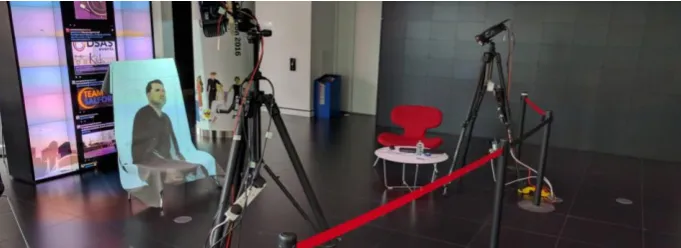
Figure 1: Experimental deployment in a semi-public space, testing elements of the system.
Example of potential utility
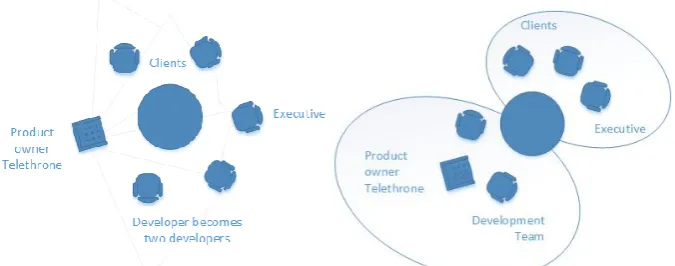
possible for the two developers to form a ‘huddle’ with the product owner. This meeting sub group can fork the conversation, while the clients and executive continue with other matters. The described Telethrone system with tracking of the chairs and 3D reconstruction of the associated viewpoints can support this evolution of a meeting.
Figure 2. A normal ad-hoc business meeting evolves over time and is supported by the Telethrone (square chair).
2
Literature review
Communicating both attention and appearance has been a long standing challenge to computer supported collaborative working
(Roberts et al., 2015)
. Telepresence solutions aimed at collaborative working have traditionally attempted to join remote spaces so that people in each can look into the other, seeing each other, at best, as if through a window(Roberts et al., 2015).
Immersive Collaborative Virtual Environments (ICVE) have been used to join remote spaces so that they coincide (Roberts et al., 2003), and free-viewpoint video has been combined with immersive projection technology to allow people to move around spaces, seemingly together (Roberts et al., 2015). In ICVE’s people in each space can have the appearance and feeling of moving around the other, however, true identity and facial expression are hard to communicate without restricting movement(Roberts et al., 2015).
Situated displays have attempted to give the impression of placing people within each other’s room by contextualising the display, or engineering it such that the background of the remote setting is omitted (Oyekoya, Steptoe, & Steed, 2012). In approaches to date, situated displays and capture equipment cannot be moved without painstaking alignment of cameras and projectors across the two spaces.
2003). An everyday application of such material is high visibility jackets. They have previously been researched by Tachi for mutual tele-existence (Tachi et al., 2004). In their system the motion of users is mirrored by a tele-operated robot to which a retro-reflected view of the remote user's head is projected (from the head of the onlooking user). Krum et al describe the REFLCT system (Krum et al., 2012) which uses large retro-reflective surfaces to “provide[s] users with a personal, perspective correct view of virtual elements that can be used to present social interactions with virtual humans”. They also use helmet mounted projectors and describe a military training application in a large volume which allows faithful transmission of attention and gestures from the virtual to the real. They also briefly describe augmenting a facial mannequin by projecting onto retro-reflective projection technology (RPT) adhered to the surface. Importantly the material negates much of the effect of surface normals thereby presenting even light reflection regardless of deformations in the surface. They also point out that the optical characteristics of the material maintain polarisation and so could support passive stereoscopy. Room2room from Microsoft labs (Benko, 2016) demonstrates the utility of projecting onto furniture. The system uses a Kinect 2.5D camera to capture a remote participant, and an overhead projector combined with a Kinect to projection map a viewpoint correct image of the tele-present person onto a complex surface such as a chair. However, this is a single static view-point. The literature does not explicitly engage with the potential for inviting passing parties to join a conversation. Additionally, there is poor support for dynamic shifts in seating within a meeting. The original Telethrone (O’Hare, et al, 2016) was a situated display with fixed positions at both locations. It was thus similar to SphereAvatar (Pan & Steed, 2012) and Gaze Preserving Situated Multi-View Telepresence System (Pan & Steed, 2014). In the paper it was argued that projection of a person onto furniture was likely to be less odd (or perhaps uncanny) and more familiar than seeing a head in a jar as with SphereAvatar, or a person in a tube as in Telehuman (Kim et al., 2012). The original Telethrone was tested with two spatially distinct moving images projected from live IP based video feeds but found the results for eye gaze reconnection inconclusive (O’Hare et al, 2016). ‘withyou’ is an experimental capture and playback system which uses the octave multimodal suite (Roberts et al., 2015). This system uses shape-from-silhouette reconstruction (Duckworth & Roberts, 2012) to send a full 3D video polygonal hull to another rendering location. Previous tests on the system suggested that the capture and playback made it possible to judge the eye gaze of the reconstructed subjects to within limits which underpin social interaction (Roberts et al,. 2013). It was developed onward for a mixed reality system with multiple sites collaborating on shared data (Fairchild et al., 2016).
3
Methods
feasibility of components of the system. This is an iterative step towards a complete system with multiple mobile chairs facing a Telethrone.
3.1The Telethrone System
The new Telethrone concept moves toward simple support for social space deployments, engaging attention outside of the meeting group. Dynamic group membership might involve both someone walking toward or past and or pulling up a chair. The technology approach was to combine the earlier Telethrone situated display and withyou telepresence system. By doing so virtual cameras join the sets of real cameras and real projectors, removing the need for the two to have the same spatial arrangement. Viewpoint is rendered according to position of onlooker. This means tracking someone walking past, or tracking a seat that is moved up.
Further refinements of the withyou capture system have been undertaken for integration with Telethone. Better projection gives higher effective pixel density across the board. Vertical and horizontal resolution is around twice that previously available for the face and eyes throughout the capture and display pipeline. A new texturing technique is also employed which picks and applies the best texture for the viewpoint. Additionally, the texturing camera is at eye level, which distortion demonstrated in (Roberts et al., 2015). The Telethrone image generator reconstructs a visual hull then the appropriate textures are selected and blended depending on the viewing angle supplied by the Vicon optical tracking system and associated VRPN software network transmission.
3.2Experiment
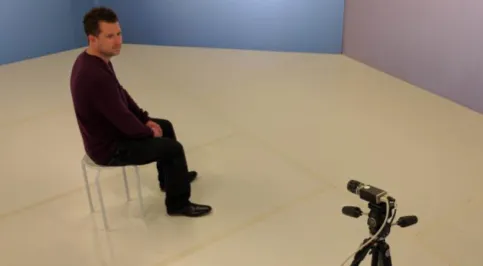
[image:7.595.163.405.507.640.2]The captured subject in Figure 3 was asked to focus their attention away from their body centreline to marked points in the octave either 45 degrees to their right (best case condition) or 66.5 degrees to their right (worst case condition). This seemingly over accurate angle was chosen at it is a clearly seen location in the geometry of the capture system and was selected as the maximum one might expect to deviate from the body centreline in social conversation.
Figure 3: Capture of the subject in the octave system.
characteristics of the Chromatte cloth provides a firm foundation for further investigation. The captured model was played back through the two projectors seen in Figure 1. The furthest projector was set to display a static frame of the reconstructed subject with them appearing to look directly at the projector, which would be a seat in the full Telethrone system. This provides an image on the surface which scatters 5% of incident light in all directions. This ghostly overlay is visible as an overlay on the other projected images (O’Hare et al, 2016). Walking participants are head tracked as they try to align to the eye gaze of a static reconstructed model that continuously adjusts for their head position. This is similar to methods employed in “Estimating the gaze of a virtuality human” (Roberts at al, 2013) and Telehuman (Kim et al., 2012).
3.2.1 Hypotheses
H1: that the ability of the experimental participants to judge the gaze direction of the reconstructed avatar is statistically similar to comparable experiments in literature in a best case experimental condition. Eyes are rendered in the centre of the head and directed toward the centre of the retro-reflected light cone. No discernible crosstalk from the second projector is visible in this condition.
H2: that the ability of the experimental participants to judge the gaze direction of the reconstructed avatar is significantly worse than the best case condition in a ‘worst case’ experimental condition. Head, body and eyes are all unaligned with respect to one another and the attention is directed to the edge of the retro-reflected light cone ensuring that cross talk occurs between the projectors.
3.2.2 Variables
The independent variable is how much the confederate deviates their view from their body centreline, alongside how central to the retro-reflected light cone their deflected view is.
In the best case condition the capture gaze, eyes and head are aligned. The reconstructed eye vector is central to the cone of reflected light from the Telethrone surface resulting in a clear image.
In the worst case condition the capture is combined head and eye gaze with the reconstructed eye vector to the edge of the cone of reflected light from the Telethrone surface. This increases the effect of the crosstalk.
The dependent variable is the angle offset from the correct simulated view vector which the participants settle on during the experiment.
3.2.3 Participants
n = 39 participants were recruited for a between subjects experiment with two conditions from Social VR 2016 workshop at MediaCityUK in Salford in line with ethical approval CST 15/03. The first 19 subjects performed the best case condition, while 21 subsequent attendees performed the worst case scenario.
3.2.4 Scope
This tests the readiness of the reconstruction for the broader Telethrone system. The utilisation of a static model, streamed from disk ensures repeatability.
3.2.5 Procedure
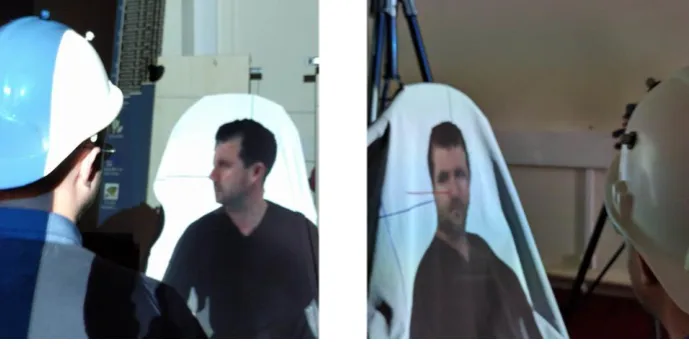
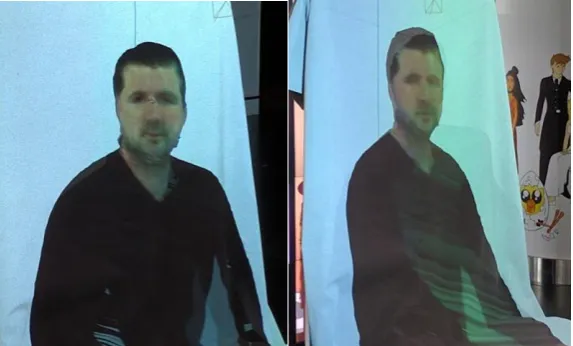
[image:9.595.125.470.289.461.2]Each participant wore a tracked hat which presented their location to the renderer and the logging system. They were instructed to stand between the two projectors facing the Telethrone. In this location they were presented with a blend of two spatially distinct views onto the Chromatte cloth. They were requested to walk slowly along a line demarked by a barrier (shown in Figure 1). This took them into the projection frustum of the projector displaying the reconstructed and tracked image, which was continuously rendered as perspective correct based upon the VRPN tracking data. The effect was that the participants gradually felt that they are walking more into the head and eye gaze of the projected subject.
Figure 4: Participant wearing the tracked hat, front view (LHS) and looking to the
right (RHS). When they were satisfied that they were in the correct position, they signalled to the experimenter who immediately stopped the data logging to record their position.
4
Findings
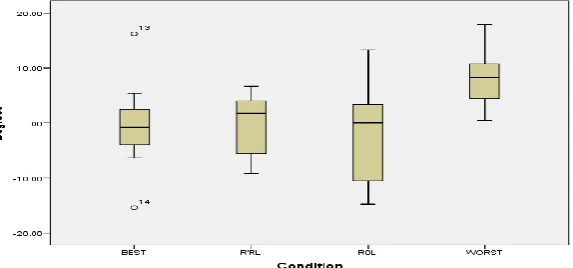
For the best case condition n=18 the deviation from correct angle is Mdn=0.78 M= -0.50 StDev=6.28 Q1=-4.00 Q3= 2.46. Shapiro-Wilk significance of 0.087 suggests that the data is normally distributed. For the worst case n=21 the deviation from correct angle is Mdn=8.27 M=7.74 StDev=4.48 Q1=3.78 Q3=10.86. Shapiro-Wilk significance of 0.419 indicates that the data is normally distributed.
Figure 5: Accuracy of the two conditions compared as a box plot. In the best case condition the median accuracy is very close while worst case consistently undershoots the target.
Figure 6: The walking tracks of the 18 participants in 6a and the 21 participants in 6b trying to resolve the gaze deflected 45 and 66.5 degrees from the vertical axis respectively. Participants started on the right hand side and stopped at the dots to the left. Axes are meters. The positions for the worst case condition are all short of the line.
(a) Best case condition (b) Worst case condition
[image:10.595.126.413.473.646.2]5
Discussion and Conclusion
[image:11.595.138.425.248.382.2]All statistics were performed in SPSS comparing within the experiment and against the most similar experiments, Telehuman (Kim et al., 2012) and “Evaluating the gaze of a virtuality human” (Roberts et al., 2013). Differences in the final positions shown in Figures 6a and 6b is potentially explained by the additional difficulty in resolving the eye component of the model. All subjects stopped short of the correct position. Roberts et al used an earlier version of the free viewpoint reconstruction system and projection into an immersive environment.
Figure 8, Comparing to “Estimating the gaze of a virtuality human”.
position is an outlier seen on the far left hand side of Figure 12a. He made three passes through the correct eye vector. It is interesting that he was the tallest participant with the tracking data showing him to be approximately 15cm taller than the mean height of 1.55m for the group. While height might be a factor subject 13, the other outlier visible as a dark spot in the centre of Figure 12a, was close to the mean height at 1.50m The novel contribution of the paper is the presentation of an updated version of the Telethrone system, with tracked 3D video augmenting the spatial segmentation, as well as an experiment which builds toward a deployable system. In the experimental results the best case scenario compares well against “Estimating the gaze of a virtuality human” in the similar R0L condition, and against Telehuman in the ‘Look at’ condition. This satisfies H1 and clears the way for further integration with the Telethrone prototype and a behavioural test with multiple participants. In particular it is suspected that the better texturing approach gave higher accuracy and smaller inter quartile ranges over previous experiments. The worst case scenario satisfies the H2 assertion that the accuracy would be compromised with deflected eye gaze and cross talk. While this data demonstrates less accuracy it is by no means a broken system for the support of directional gaze. Given the properties of the retro-reflective material, the approach is locally scalable with up to 5 onlookers limited by the optical characteristics of the material (only 5 spatial segments are provided). Up to 6 Telethrones per site (6 connected sites of all Telethrones) are theoretically possible provided that multiple tracked and positioned avatars can be projected from a suitable high resolution projector taking in all seats from each Telethrone. Telethrone appears to support small ad-hoc group meetings with dynamic participation and sub groups within a group. The simplicity of the system, its affordability, flexibility, and scalability seem to be appropriate for high traffic social spaces which is a less researched application for telepresence displays.
6
References
Bock, S.W., Dicke, P. and Thier, P., 2008. How precise is gaze following in humans?. Vision research, 48(7), pp.946-957.
Colburn, A., Cohen, M.F. and Drucker, S., 2000. The role of eye gaze in avatar mediated conversational interfaces. Sketches and Applications, Siggraph'00.
Duckworth, T. and Roberts, D.J., 2014. Parallel processing for real-time 3D reconstruction from video streams. Journal of real-time image processing, 9(3), pp.427-445. Ekman, P., 1993. Facial expression and emotion. American psychologist, 48(4), p.384. Fagel, S., Bailly, G., Elisei, F. and Lelong, A., 2010, October. On the importance of eye gaze in
a face-to-face collaborative task. In Proceedings of the 3rd international workshop on Affective interaction in natural environments (pp. 81-86). ACM.
Fairchild, A.J., Campion, S.P., García, A.S., Wolff, R., Fernando, T. and Roberts, D.J., 2016. A mixed reality telepresence system for collaborative space operation. IEEE Transactions on Circuits and Systems for Video Technology.
Goodwin, C., 2000. Action and embodiment within situated human interaction. Journal of pragmatics, 32(10), pp.1489-1522.
Grau, O., Thomas, G.A., Hilton, A., Kilner, J. and Starck, J., 2007, May. A robust free-viewpoint video system for sport scenes. In 3DTV Conference, 2007 (pp. 1-4). IEEE. Kim, K., Bolton, J., Girouard, A., Cooperstock, J. and Vertegaal, R., 2012, May. TeleHuman:
effects of 3d perspective on gaze and pose estimation with a life-size cylindrical telepresence pod. In Proceedings of the SIGCHI Human factors (pp. 2531-2540). ACM. Krauss, R.M., Chen, Y. and Chawla, P., 1996. Nonverbal behavior and nonverbal
communication: What do conversational hand gestures tell us?. Advances in experimental social psychology, 28, pp.389-450.
Lee, M.K. and Takayama, L., 2011, May. Now, I have a body: Uses and social norms for mobile remote presence in the workplace. In Proceedings of the SIGCHI Conference on Human Factors in Computing Systems (pp. 33-42). ACM.
Loomis, J.M., Kelly, J.W., Pusch, M., Bailenson, J.N. and Beall, A.C., 2008. Psychophysics of perceiving eye-gaze and head direction with peripheral vision: Implications for the dynamics of eye-gaze behavior. Perception, 37(9), pp.1443-1457.
Maimone, A. and Fuchs, H., 2011, October. Encumbrance-free telepresence system with real-time 3D capture and display using commodity depth cameras. In Mixed and Augmented Reality (ISMAR), 2011 10th IEEE International Symposium on (pp. 137-146). IEEE. Nguyen, D.T. and Canny, J., 2007, April. Multiview: improving trust in group video
conferencing through spatial faithfulness. In Proceedings of the SIGCHI conference on Human factors in computing systems (pp. 1465-1474). ACM.
Nguyen, D.T. and Canny, J., 2009, April. More than face-to-face: empathy effects of video framing. In Proceedings of the SIGCHI Conference on Human Factors in Computing Systems (pp. 423-432). ACM.
O’Hare, J., Bendall, R. C. A., Rae, J., Thomas, G., Weir, B., & Roberts, D. J. 2016 Is This Seat Taken? Behavioural Analysis of the Telethrone: A Novel Situated Telepresence Display. The Eurographics Association.
Otsuka, K., Takemae, Y. and Yamato, J., 2005, October. A probabilistic inference of multiparty-conversation structure based on Markov-switching models of gaze patterns, head directions, and utterances. In Proceedings of the 7th international conference on Multimodal interfaces (pp. 191-198). ACM.
Oyekoya, O., Steptoe, W. and Steed, A., 2012, May. SphereAvatar: a situated display to represent a remote collaborator. In Proceedings of the SIGCHI Conference on Human Factors in Computing Systems (pp. 2551-2560). ACM.
Pan, Y. and Steed, A., 2012, October. Preserving gaze direction in teleconferencing using a camera array and a spherical display. In 3DTV-Conference: The True Vision-Capture, Transmission and Display of 3D Video (3DTV-CON), 2012 (pp. 1-4). IEEE.
Pan, Y., Steptoe, W., & Steed, A. (2014). Comparing flat and spherical displays in a trust scenario in avatar-mediated interaction.
Pejsa, T., Kantor, J., Benko, H., Ofek, E. and Wilson, A., 2016, February. Room2Room: Enabling life-size telepresence in a projected augmented reality environment.
In Proceedings of the 19th ACM Conference on Computer-Supported Cooperative Work & Social Computing (pp. 1716-1725). ACM.
Roberts, A mixed reality telepresence system for collaborative space operation. Roberts, D., Wolff, R., Otto, O. and Steed, A., 2003. Constructing a Gazebo: supporting
teamwork in a tightly coupled, distributed task in virtual reality. Presence, 12(6), pp.644-657.
Roberts, D., Duckworth, T., Moore, C., Wolff, R., & O’Hare, J. (2009). Comparing the end to end latency of an immersive collaborative environment and a video conference. Roberts, D. J., Fairchild, A. J., Campion, S. P., O’Hare, J., Moore, C. M., Aspin, R, Tecchia, F.
(2015). withyou—an experimental end-to-end telepresence system using video-based reconstruction. Selected Topics in Signal Processing, IEEE Journal of , 9(3), 562–574. Roberts, D. J., Rae, J., Duckworth, T. W., Moore, C. M., & Aspin, R. (2013). Estimating the
gaze of a virtuality human.
Steptoe, W., Wolff, R., Murgia, A., Guimaraes, E., Rae, J., Sharkey, P. Steed, A. (2008). Eye-tracking for avatar eye-gaze and interactional analysis in immersive collaborative virtual environments.
Symons, L. A., Lee, K., Cedrone, C. C., & Nishimura, M. (2004). What are you looking at? Acuity for triadic eye gaze. In (Vol. 131, pp. 451–69).
Tachi, S. (2003). Telexistence and retro-reflective projection technology (rpt).
Tachi, S. Kawakami, N. Inami, M. & Zaitsu, Y. (2000( Mutual telexistence system using retro-reflective projection technology International Journal of Humanoid Robotics
Vertegaal, R., Veer, G. V. D., & Vons, H. Effects of gaze on multiparty mediated communication..
Vertegaal, R., Slagter, R., Van der Veer, G. and Nijholt, A., 2001, March. Eye gaze patterns in conversations: there is more to conversational agents than meets the eyes. In Proceedings of the SIGCHI conference on Human factors in computing systems (pp. 301-308). ACM.
Vishwanath, D., Girshick, A. R., & Banks, M. S. (2005). Why pictures look right when viewed from the wrong place. In (Vol. 8, pp. 1401–1410). Nature Publishing Group.