CLI N G O - a t e a c hi n g a n d
l e a r ni n g r e s o u r c e t o i m p r o v e
c a r e pl a n n i n g
Ryl a n c e , R a n d G r a h a m , P
h t t p :// dx. d oi.o r g / 1 0 . 7 7 4 8 / m h p . 2 0 1 7 . e 1 1 3 4
T i t l e
CLI N G O - a t e a c hi n g a n d l e a r n i n g r e s o u r c e t o i m p r o v e
c a r e pl a n n i n g
A u t h o r s
Ryl a n c e , R a n d G r a h a m , P
Typ e
Ar ticl e
U RL
T hi s v e r si o n is a v ail a bl e a t :
h t t p :// u sir. s alfo r d . a c . u k /i d/ e p ri n t/ 4 1 4 6 1 /
P u b l i s h e d D a t e
2 0 1 7
U S IR is a d i gi t al c oll e c ti o n of t h e r e s e a r c h o u t p u t of t h e U n iv e r si ty of S alfo r d .
W h e r e c o p y ri g h t p e r m i t s , f ull t e x t m a t e r i al h el d i n t h e r e p o si t o r y is m a d e
f r e ely a v ail a bl e o nli n e a n d c a n b e r e a d , d o w nl o a d e d a n d c o pi e d fo r n o
n-c o m m e r n-ci al p r iv a t e s t u d y o r r e s e a r n-c h p u r p o s e s . Pl e a s e n-c h e n-c k t h e m a n u s n-c ri p t
fo r a n y f u r t h e r c o p y ri g h t r e s t r i c ti o n s .
Mental Health Practice
Utilising CLINGO as a teaching and learning resource as a means to improving care
planning. An evaluation
--Manuscript
Draft--Manuscript Number: MHP1134R1
Article Type: Article - if in doubt use this one
Full Title: Utilising CLINGO as a teaching and learning resource as a means to improving care planning. An evaluation
Corresponding Author: Rebecca Rylance, BA (hons), MSc Liverpool John Moores University Liverpool, UNITED KINGDOM
Other Authors: Graham Peter, BSc
Abstract: Clinical language has arguably evolved as a result of clinical expertise, professional grouping and an NHS that is riddled with clichés and jargon (Duffy, 2010). The game 'health cliché bingo' (CLINGO) was developed by the authors following a research project 'Does the practice of care planning live up to the theory for mental health student nurses?' (Rylance & Grahame, 2014) and in response to professional and legislative requirements (NMC, 2010 & DH, 2008).
Essentially a bingo-style game, CLINGO can be played individually or as a group. Each CLINGO card contains a different clinical cliché on it and each participant(s) is assigned a CLINGO card. The facilitator will then randomly select a cliché. If the same cliché appears on the CLINGO card it can be checked off. As soon as a 'full house' is achieved, each clinical cliché is then discussed by the participants. It is the role of the facilitator to assist the group to find a more person-centred alternative. Central to the learning experience is the notion of teamwork and reflection. The utility of games as a teaching and learning resource is accepted within the educational literature (Blakely et al., 2009 & Gibson & Douglas 2013).
Keywords: Care planning; Clichés and jargon; educational games
Additional Information:
Question Response
Please confirm that you have read and agree to our Publisher's Agreement that is available here
Yes
Have you submitted this manuscript elsewhere?
No
Has this manuscript already been published?
No
Do you have copyright for all the images, graphics and figures included with your submission?
Don't know
What is the word count of your document including references but excluding the abstract?
1732
What is the word count of your document excluding both references and the abstract?
1352
Author Comments: We are not aware of any restrictions on using 'bingo -style' cards
1 Utilising CLINGO as a teaching and learning resource as a means to improving care planning
Abstract:
Clinical language has arguably evolved as a result of clinical expertise, professional grouping and an
NHS that is riddled with clichés and jargon (Duffy, 2010). The game 'health cliché bingo' (CLINGO)
was developed by the authors following a research project ‘Does the practice of care planning live up
to the theory for mental health student nurses?' (Rylance & Grahame, 2014) and in response to
professional and legislative requirements (NMC, 2010 & DH, 2008).
Essentially a game of chance, health cliché bingo (CLINGO) can be played individually or as a group.
Each CLINGO card contains a different clinical cliché on it and each participant(s) is assigned a
CLINGO card. The facilitator will then randomly select a cliché. If the same cliché appears on the
CLINGO card it can be checked off. As soon as a 'full house' is achieved, each clinical cliché is then
discussed by the participants. It is the role of the facilitator to assist the group to find a more
person-centred alternative. Central to the learning experience is the notion of teamwork and reflection. The
utility of games as a teaching and learning resource is accepted within the educational literature
(Blakely et al., 2009 & Gibson & Douglas 2013).
Background:
The Care Programme Approach (CPA) (DH, 1990 and DH, 2008) promotes person-centred care
planning which involves mental health service users, their families and their carers’ in all aspects of
the process (Marston & Weinstein, 2013). This is supported through the Recovery Approach, which
proposes a shift from the traditional care planning practice of problem identification (often without
any service user input), to service users defining their own strengths, goals and aspirations in their
own words (Shepherd, Boardman & Slade, 2008). Central to this notion of person-centeredness, is
the idea of a shared language (Duffy, 2010). Despite this, as part of clinical socialisation, each
professional group appears to have developed its own language (Neary, 2013). Clinical language has
arguably evolved as a result of clinical expertise, professional grouping and invariably an NHS culture
that is riddled with jargon and increasingly loaded with acronyms (Duffy, 2010). Often such language
makes life easier for clinicians, but sometimes its meaning is far from clear to those outside the
organisation including other health professionals, service users, carers and students. Thus, it can be
argued that the utility of ‘professional language’ or medical jargon can seriously compromise the
service user-health professional relationship as well as the professional-professional relationship
(Bowers, Brennan, Winship & Theodoridou, 2009).
Manuscript Click here to download Manuscript MHP1134 Utilising
2 It is a fundamental requirement of Pre-registration Nurse Education that the recording of clinical
information is clear, meaningful and jargon-free (NMC, 2010a, 2010b) This is not a new concept; the
NMC standards for record keeping (NMC, 2009) stipulate that good record keeping should reflect
the core values of individuality and partnership and involve the service user and their carer where
possible. Indeed Barret et al (2009) posit that care planning and documentation is a fundamental
clinical skill; no different from administering an injection or giving a bed bath.
Our initial study (Rylance & Graham, 2014); a qualitative descriptive study, informed by a
phenomenological approach was designed to examine the perceptions of a group of mental health
student nurses (from a range of community and ward clinical mental health placements) and their
observations and perceptions of practice in relation to care planning. Our study revealed key themes
around service user care plans being 'problem focused' and not 'solution or Recovery focused' as
they should be in a contemporary mental health service.
A follow up analysis of the data revealed a subsequent theme cluster around the ‘professional
language’ that exists amongst mental health professionals that consists largely of jargon, clichés and
generic terminology. The study found that a ‘copy and paste’ culture was endemic across the clinical
areas with students citing examples of staff asking for a copy of the ‘schizophrenia care plan’. Of
interest, the students acknowledged that a care plan should be collaborative, person-centred and
use service user language. However, they commented that by doing so, it would look unprofessional
to other agencies.
The findings from the study suggests that a dichotomy exists between the service users own
expression of their mental health issues and how that is then translated by the health professionals.
The use of clinical clichés and what the authors describe as ‘professional snobbery’ seemed
commonplace in the practice areas.
To understand this phenomenon further, the authors undertook a series of educational events on
care planning, during which health professionals were invited to catalogue their own professional
terminologies. The sessions took place in a variety of practice areas with a range of health and allied
professionals. The authors subsequently examined the ‘clinical clichés’ and developed the teaching
and learning resource CLINGO. CLINGO aspires to raise awareness of the previously mentioned
‘professional translation service’ that dominates the clinical care plans and hopes to engage the
3 is envisaged that the resource will serve to challenge the seemingly useless clichés that appear in
care plans and in doing so will promote the aims of the CPA and ultimately embed the Recovery
Approach along with person centred care.
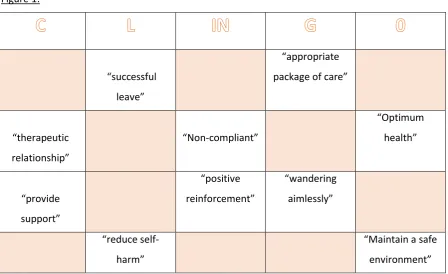
CLINGO is essentially a bingo-style game that can be utilised with teams of health professionals,
students and or service users. Typically, a game of CLINGO is supported by a brief key note session,
which is underpinned by legislative and professional best practice guidance.
A game of CLINO will last for half a day (depending on group size) and can be delivered by a person
skilled in guided facilitation and reflective practice.
[image:5.595.71.520.342.616.2]See example (Figure 1):
Figure 1:
“successful
leave”
“appropriate
package of care”
“therapeutic
relationship”
“Non-compliant”
“Optimum
health”
“provide
support”
“positive
reinforcement”
“wandering
aimlessly”
“reduce
self-harm”
“Maintain a safe
environment”
Each CLINGO card will have randomly allotted clinical clichés on it. Participants are assigned to teams
with each team having one CLINGO card. Each team would generally consist of between 4 -6 players
(depending on size of group). The facilitator will then randomly draw from a pack of cards, each one
containing a clinical cliché (extracted from the catalogue). If the cliché is on the teams CLINGO card
it can be marked off. As soon as team achieves a ‘full house’ each clinical cliché is then discussed in
4 Initial evaluation
The evaluation of educational games in higher education is not easy and has generally relied on
studies of leisure based games (de Fritas & Oliver, 2006). That said, CLINGO has been subjected to an
initial unstructured evaluation with two separate mental health student cohorts.
47 Participants were asked to feedback their learning experience of a game of CLINGO and what
they gained from the experience that would inform their care planning practice. The narratives are
summarised below:
My learning experience
Good reflective exercise
I don’t feel stupid anymore
CLINGO is a good learning tool
Makes you think about documentation and how it should be person-centred
Great debate
Highlighted the irrelevance of some of the terminologies and ridiculous jargon
Fun way to learn – an eye opener!
Reminds me of my accountabilities as a nurse
Should teach to qualified staff
How has this informed my practice?
I will challenge my mentor when she says I’m writing too much
I’ve realised that a lot of stuff I write is not suitable
I need to think more about how I describe what I see
I need to avoid clichés
It going to be hard, as my mentor uses all the jargon
I feel more confident in my ability to write a collaborative care plan with a service
user
Ask more questions
Discussion:
The initial feedback is interesting and suggests that CLINGO promotes personal reflective in a
nonthreatening and fun way. Indeed, central to the learning experience is the notion of teamwork
and reflection. Furthermore, there is a suggestion from the narratives that the students feel more
confident both in terms of writing collaborative care plans and being able to challenge poor practice.
5 session; a perception that has been borne out in previous studies. Clearly, a further systematic
evaluation is required.
The utility of games as a valuable teaching and learning resource is well accepted within the wider
educational literature (Bochennek et al., 2007, Blakely et al., 2009 & Gibson & Douglas 2013) and
seemingly adult learners prefer education that is relevant and reflects practice (Foord, 2009).
Furthermore, game-based learning has been shown to be effective in the Higher Education
environment (Ariffin & Sulaiman, 2013).
Initial finding suggest that CLINGO offers a novel way of meeting the learning needs of students,
promotes personal reflection and enhances the students learning experience. By utilising the team
discussions, it may be possible to advance care planning practice and develop a language within the
care plans that is jargon free, meaningful and truly person-centred.
Limitations:
The temptation to offer an alternative ‘person centred’ template has been avoided by the authors as
doing so would arguably lead to new jargon or more generic terminologies.
The authors acknowledge that the evaluation presently lacks any scientific rigour; but rather some
6 References:
Ariffin, M.M. & Sulaiman, S. (2013) Evaluating game-based learning (GBL) effectiveness in Higher Education (HE), International conference on advanced computer science applications and
technologies pp 485-489
Barret, D., Wilson, B. and Woollands, A. (2009) Care Planning; A guide for nurses. Pearson Education Limited: Essex.
Blakely, G., Skirton, H., Cooper, S., Allum, P., Nelmes, P., 2009. Educational gaming in health sciences: a systematic review. Journal of Advanced Nursing 65 (2), 259–269
Bochennek, K., Wittekindt, B., Zimmermann, S.Y., Klingebiel, T. (2007) More than mere games: a review of card and board games for medical education. Medical Teacher 29 (9), 941–948
Bower, L. Brennan, G. Winship, G. Theodoridou, C. (2009). Communication skills for nurses and others spending time with people who are very mentally ill. London: City University
Colaizzi, P.F. (1978) Psychological research as a phenomenologist Views in R.S Valle & M King (Eds) Existential phenomenological Alternatives for Psychology (pp 48-71) New York: Oxford University Press
Department of Health (2008) Refocusing the care programme approach: Policy and positive practice guidance. London: HMSO
Department of Health (1990). Care Programme Approach. Circular HC(90)23/LASSL(90)11. London: HMSO
Duffy, S. (2010). Personalisation in mental health. Yorkshire & Humber: Centre for welfare reform
Foord, L., 2009. Research for the Adult Learner. In: Lowenstein, A.J., Foord, L., Romano, C.J. (Eds.), Teaching Strategies for Health Education and Health Promotion. Jones & Bartlett
Gibson, V. & Douglas, M. (2013) Criticality: The experience of developing an interactive educational tool based on board games. Nurse Education Today 33, 1612 -1616
Kolb D.A. (1984) 'Experiential Learning experience as a source of learning and development', New Jersey: Prentice Hall
Marston, D & Weinstein, J (2013). Holistic care planning for recovery in Care Planning in Mental health: Promoting recovery. 2nd edition. (ED) Hall, A. Wren, M. Kirby, S. Chichester: Wiley
Neary, M (2013). Veiwpoint: 10 jargon phrases used for my autistic son. Posted 24th July 2013.
Available at www.bbc.co.uk/news/blogs-ouch-23423541 [Accessed 14th January 2014]
NMC (2009) Record keeping: Guidance for nurses and midwives. London: NMC
7 NMC (2010b). Standards for pre-registration nursing education. London: NMC