Object-Based Radio: E↵ects On
Production and Audience
Experience
Anthony W P Churnside
School of Computing, Science & Engineering
The University of Salford, Salford, UK
Contents
Declaration 10
Acknowledgements 12
Abstract 13
1 Introduction 15
1.1 Thesis Structure . . . 15
1.2 Context . . . 16
1.3 Aims . . . 17
2 Literature Review 18 2.1 State of the Art. . . 18
2.1.1 Channel-Based . . . 18
2.1.2 Scene-Based . . . 19
2.1.3 Object-Based . . . 19
2.2 Object-Based Metadata Formats . . . 19
2.3 Object-Based Audio Sound Scene Creation . . . 21
2.3.1 Panning . . . 22
2.3.2 Binaural . . . 22
2.3.3 Wave Field Synthesis. . . 22
2.3.4 Hybrid Methods and Commercially Available Production Systems . 23 2.4 Traditional Capture . . . 23
2.5 Object Capture . . . 24
2.6 Object Derivation . . . 24
2.7 Reverberation . . . 25
2.7.1 Computer Games Production . . . 26
2.7.2 HTML5 Audio . . . 26
2.8 Object Audio Use in the Broadcast Industry . . . 26
2.10 Definitions. . . 27
2.10.1 Physical vs Perceptual . . . 28
2.10.2 Intended Application. . . 29
2.10.3 Perception of Sound . . . 30
2.11 Sound Taxonomies . . . 31
2.11.1 Computer Game Audio . . . 31
2.11.2 Soundscapes . . . 32
2.11.3 Foreground and Background . . . 33
2.12 Listening Modes . . . 34
2.13 Assessing Experience . . . 36
2.13.1 Subjective Testing . . . 36
2.13.2 Quality of Experience . . . 37
2.13.3 Qualitative Testing Methods . . . 37
2.13.4 Analysing Engagement. . . 37
2.14 Conclusion . . . 38
3 Study 1: Live Football 39 3.1 Introduction. . . 39
3.2 Implementation . . . 40
3.2.1 Production . . . 40
3.2.2 Distribution . . . 40
3.2.3 Consumption . . . 41
3.2.4 Experimental Limitation Critique. . . 42
3.3 Interaction Analysis . . . 43
3.4 Listener Feedback . . . 47
3.4.1 Social Listening . . . 50
3.5 Discussion and Summary . . . 51
4 Study 2: Audio Object Classification 54 4.1 Introduction. . . 54
4.2 Context . . . 54
4.3 Approach . . . 55
4.3.1 Choice of Content . . . 55
4.3.2 Production System Choice. . . 56
4.4 Speech Based Content . . . 56
4.4.1 Production . . . 56
4.4.2 Audio Object Analysis . . . 60
4.4.3 Function and Importance . . . 68
4.4.4 Conclusions and Discussion . . . 72
4.5 Non-Speech Based Content . . . 74
4.5.2 Analysis . . . 75
4.5.3 Importance . . . 80
4.5.4 Conclusions and Discussion . . . 80
4.6 Background vs Foreground Listening Test . . . 81
4.6.1 Figure Ground Problem Space . . . 82
4.6.2 Method . . . 82
4.6.3 Additional 9.0 Production . . . 84
4.6.4 Clips . . . 85
4.6.5 Test Environment . . . 87
4.6.6 Subjects . . . 90
4.6.7 Instructions . . . 90
4.7 Results. . . 90
4.8 Discussion and Summary . . . 95
5 Study 3: Location Based Drama 101 5.1 Introduction. . . 101
5.2 Context . . . 101
5.3 Perceptive Media . . . 102
5.4 Narrative Adaptation . . . 102
5.5 Production Workflow. . . 103
5.6 Design Process . . . 104
5.7 Technology Constraining the Writer . . . 104
5.8 The Writer Constraining Technology . . . 105
5.9 Production Process . . . 105
5.9.1 Clean Capture . . . 106
5.9.2 Rendering . . . 106
5.9.3 Robot Voice . . . 106
5.9.4 Variables . . . 107
5.9.5 Sound E↵ects . . . 107
5.10 Architecture . . . 108
5.11 Control Panel . . . 108
5.12 Listening Test . . . 109
5.12.1 Methodology . . . 110
5.12.2 Demographics. . . 111
5.12.3 Results . . . 113
5.12.4 Enhancing Engagement . . . 125
5.12.5 Perceptive Media and Product Placement . . . 127
5.12.6 Use of Personal Information . . . 129
5.12.7 Wider E↵ects of Perceptive Media . . . 135
5.12.8 Social Listening. . . 135
6 Discussion 139
6.1 Production . . . 139
6.1.1 Spatial Mixing of Audio Objects . . . 139
6.1.2 Listening Models Based on Function . . . 140
6.1.3 Working Towards a More Than a Single Vision . . . 142
6.1.4 Constraining the Range of Intended Experiences . . . 144
6.2 Experience . . . 144
6.2.1 Foreground vs Background Preferences . . . 144
6.2.2 Personalised, Not Interactive . . . 145
6.2.3 Audience Awareness . . . 146
6.2.4 Filter Bubbles . . . 146
6.2.5 Personal Data. . . 147
6.2.6 Advertising . . . 147
6.3 A Missing Definition . . . 148
6.3.1 What is Not an Object? . . . 148
6.3.2 Towards a Audio Object Definition . . . 149
6.3.3 Applying this to Non-linear Content . . . 151
7 Conclusions 152 7.1 Further Work . . . 154
References 156 Appendices 165 A Appendices Relating to the Football Study in Chapter 3 166 A.1 Questions Used for Online Study . . . 166
B Appendices Relating to the Foreground vs Background Study in Chapter 4 169 B.1 Production Script. . . 169
List of Figures
1.1 Broadcasting stages . . . 17
2.1 A block diagram for object-based audio distribution . . . 27
2.2 Di↵erent ways of considering objects . . . 29
2.3 Framework for describing games audio [55]. . . 32
3.1 Left, crowd noise microphone. Right, radio receivers.1 . . . . 41
3.2 A high level system diagram for the Radio 5 Live experiment . . . 42
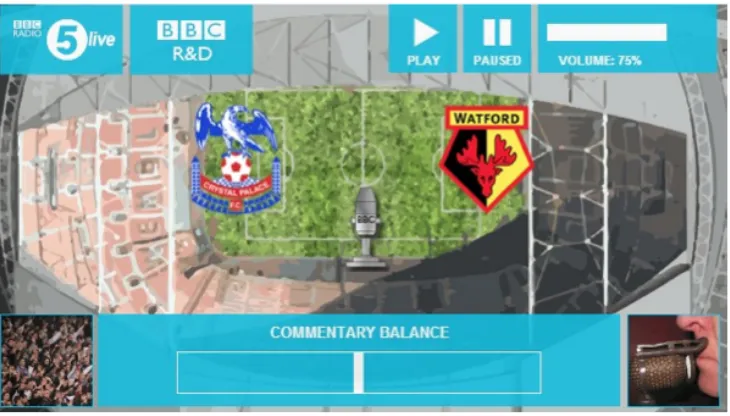
3.3 The football experiment user interface.2 . . . 43
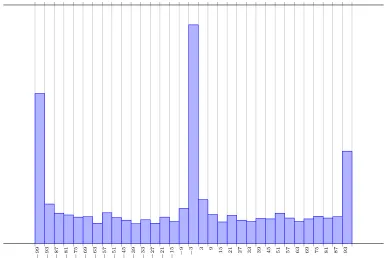
3.4 A histogram showing how listeners adjusted balance over time.3 . . . . 44
3.5 Histogram for final choices of the crowd/commentary mix (where 0 is equal commentary and crowd, +/-100 is maximum commentary/crowd)4 . . . 45
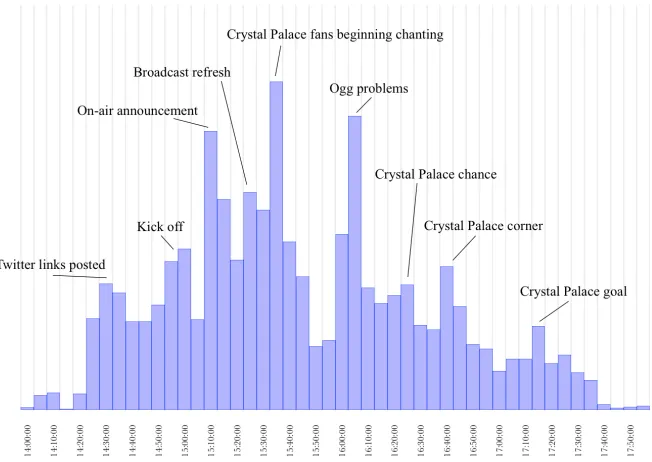
3.6 Graph showing total activity contextualised with broadcast and stadium events.5 . . . . 46
3.7 A graph showing user interactivity with time, normalised to their joining the broadcast.6 . . . . 47
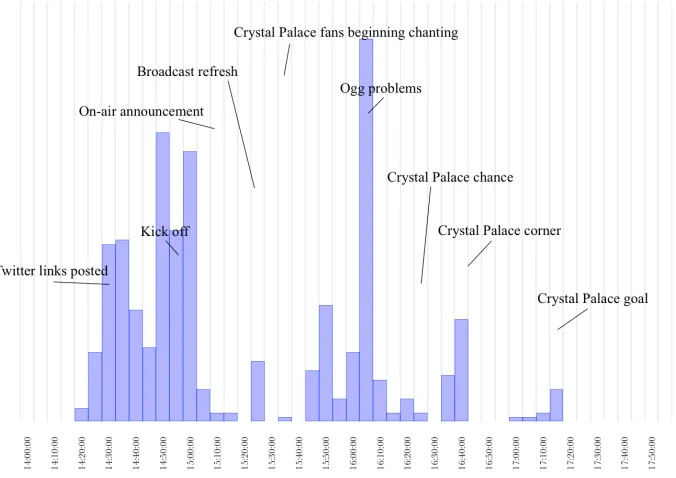
3.8 Commentary changes after first 5 minutes of user activity removed.7 . . . . 48
3.9 Commentary changes after first 10 minutes of user activity removed.8 . . . 49
3.10 Impact of being able to control the commentary/crowd mix.9 . . . 50
3.11 Impact of being able to choose ends.10 . . . . 50
3.12 Compared to traditional radio.11 . . . 51
3.13 Feedback supporting commentary boost on social media . . . 51
3.14 Feedback supporting crowd boost on social media . . . 51
3.15 General feedback on social media . . . 52
3.16 Non-object-based benefits of the football trial . . . 52
4.1 MPAS dead area. . . 57
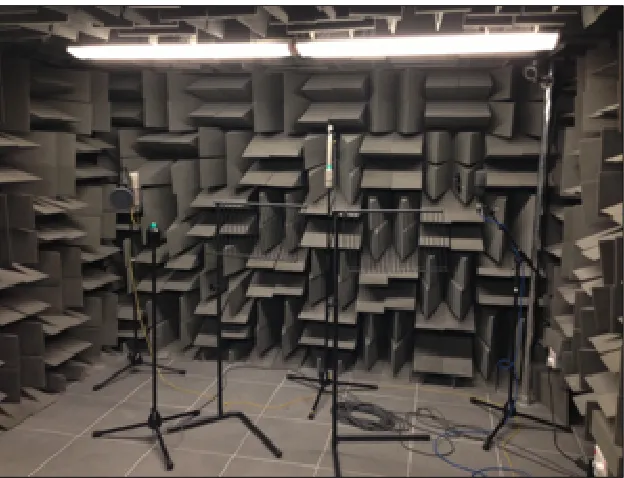
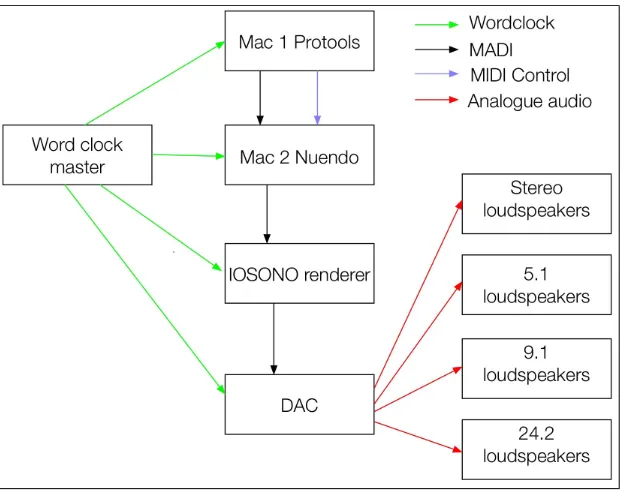
4.2 The mixing setup for “Pinocchio” showing (left to right) the Production Assistant, a visitor, the Sound Designer, the Producer (at the back) and me. 58 4.3 Block diagram for the mixing setup for “Pinocchio”. . . 59
4.5 Foreground vs background user interface . . . 83
4.6 Loudspeaker layouts for the listening test. . . 88
4.7 The listening test set up, with curtain to obscure the loudspeaker placement. One of the expert listeners standing aside of the rear right loudspeaker . . . 89
4.8 Boxplot showing foreground vs background mix set by participants for music content for di↵erent genres. . . 93
4.9 Boxplot showing foreground vs background mix set by participants for music content for di↵erent systems. . . 94
4.10 Boxplot showing foreground vs background mix set by participants for speech content for di↵erent genres. . . 94
4.11 Boxplot showing foreground vs background mix set by participants for speech content for di↵erent systems. . . 95
4.12 Histogram for foreground vs background preference for speech, values in dB represent relative foreground vs background mix. . . 96
4.13 Histogram for foreground vs background preference for music, values in dB represent relative foreground vs background mix. . . 97
4.14 Foreground or background mix preferences for speech for di↵erent age ranges. 98
5.1 Workflow diagram, top: traditional workflow, bottom: object-based workflow.104
5.2 Recording environment. 12 . . . 107
5.3 High level system diagram for “Breaking Out”. 13 . . . 109
5.4 The “Breaking Out” control panel, made unavailable during the experiment.14110
5.5 “Breaking Out” online listener locations.15. . . 112
5.6 Online survey results reflecting how the robotic voice a↵ected the enjoyment of the drama.16 . . . 114
5.7 The “Breaking Out” visual design, visible throughout the drama, this con-tains no interactive elements.17 . . . 115
5.8 Online survey results reflecting how much participants liked the overall ex-perience of listening to “Breaking Out” with personalised content.18 . . . . 117
5.9 Online survey results reflecting how much participants liked the overall ex-perience of listening to “Breaking Out” without personalised content.19 . . 117
5.10 Online participants who noticed the localised content were 15% more likely to recommend a personalised audio drama to a friend (a chi-square test revealed p <0.02).20 . . . 119
5.11 The majority of personalised references in “Breaking Out” were either cat-egorised as ‘very local’ or ‘moderately local’.21 . . . 119
5.12 Nearly 75% of online participants who listened to “Breaking Out” with personalised references reported liking the plot.22 . . . 120
5.14 42% of online participants, who recognised all of the local references, liked
the references a lot.24. . . 124
5.15 Online participants, who recognised some of the references, did not like the use of references as strongly as those that recognised all of the references.25 124 5.16 82% of the online audience reported personalised content made them more engaged with “Breaking Out”.26 . . . 126
5.17 There was a mixed response to how participants felt about the main charac-ter. In this case the personalised content did not bring the audience closer to the character. 27 . . . 128
5.18 75% of the online participants reported that the personalised content made them feel closer to the setting of “Breaking Out”.28 . . . 128
5.19 Most participants would be happy to make some level of e↵ort to access a broadcast using perceptive media.29 . . . 134
5.20 Audience fears expressed on social media. . . 136
5.21 Comments on social media about personal data usage . . . 136
5.22 Comments on social media about advertising applications . . . 136
5.23 Comments on social media about e↵ects on creative process . . . 136
List of Tables
2.1 Physical and perceptual descriptions of sound objects . . . 29
2.2 Gestalt object perception . . . 31
2.3 Four listening modes according to Schae↵er [66] . . . 34
2.4 Huron’s six activating systems. . . 35
2.5 Turri’s listening mode hierarchy . . . 36
2.6 Common computer games perception testing . . . 37
3.1 Crowd/commentary mix with time (where 0 is equal commentary and crowd, +/-1 is maximum commentary/crowd) . . . 44
4.1 Audible sounds . . . 62
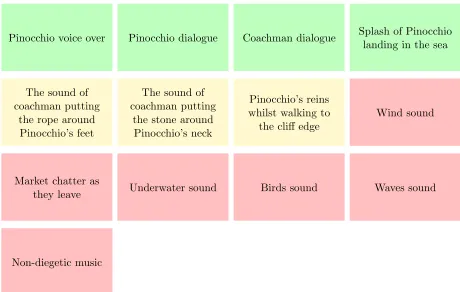
4.2 Three categories: text (green), spot e↵ects (yellow) and atmospheres (red) . 64 4.3 Two categories: foreground (green) and background (red) . . . 65
4.4 Five categories: speech (red), other e↵ects (blue), spot e↵ects (yellow), at-mospheres (pink) and music (red). . . 66
4.5 Three categories: speech (green), spot e↵ects (yellow) and atmospheres (red) 67 4.6 Two categories: foreground (green) and background (red) . . . 68
4.7 Importance left: Sound Designer, right: Producer. Arranged in order of importance of individual sound . . . 69
4.8 Function of the sounds, according to the Producer and Sound Designer. . . 71
4.9 Function of the sounds, according to the Producer and Sound Designer linked to the foreground and background categorisation. . . 72
4.10 Five groupings . . . 76
4.11 Two groupings . . . 77
4.12 Three groupings . . . 78
4.13 Alternate two groupings . . . 79
4.14 Importance . . . 80
4.15 Listening test clips . . . 87
4.16 Loudspeaker use table . . . 89
4.18 Statistical summary of foreground vs background mix preference data for
speech . . . 92
4.19 Statistical summary of foreground vs background mix preference data for music . . . 93
5.1 Data sources . . . 103
5.2 Audio object formats . . . 108
5.3 Respondent listening habits.30 . . . 112
Declaration
This thesis is a presentation of the author’s own work. The work described in chapters3
and 5was collaborative in nature and the roles of contributors are detailed below.
Collaborative Work
For the work in chapter 3 the author acted as supervisor for Dr Mark Mann during Dr
Mann’s traineeship at BBC R&D. The author conceived the experience and created the prototype audio player which was provided to Dr Mann. Under the supervision of the author, Dr Mann created the final audio player which allowed audio streams to be bal-anced and captured all user interaction with the player. The user interface design for the
football study shown in figure 3.3 was designed by Ms Jasmine Cox. The audio streams
which delivered the football experience were set up by Mr Matthew Paradis and Mr Andy
Armstrong. In chapter 5 the concept of Perceptive Media was co-invented by the author
and Mr Ian Forrester. The HTML5 audio player used in “Breaking Out” in chapter5 was
created by Happy Worm. The relationship with Happy Worm was managed by Mr For-rester, while the author defined the technical requirements and system architecture. The
online survey questions for study in chapter5 were written by the author in collaboration
with Mr Forrester. The focus groups in chapter 5 were conducted by Dr Maxine Glancy
based on the online survey questions, and the focus group responses quoted and analysed in this thesis were collected by Dr Glancy.
Previous Publications
Elements of this work have been published previously in journal and conference papers written or co-written by the author. Parts of the work in the literature review (chapter
2) formed the basis of “Emerging Technology Trends in Spatial Audio,” [1] a summary of
The work in chapter 3 was included in “Object-Based Audio Applied to Football
Broad-casts: The 5 live Football Experiment,” [2] a paper published in 2013 by Association for
Computing Machinery. The work in chapter 5 was published in “The Creation of a
Per-ceptive Audio Drama,” [3] and presented at the New European Media Summit in 2012.
Finally, concepts and conclusions discussed in chapter6and7were included by the author
in his contribution to “Object-based Broadcasting - Curation, Responsiveness and User
Experience,” [4] a paper published in 2014 by the International Broadcasting Convention.
Data and Copyright
Acknowledgements
I would like to thank supervisor Professor Trevor Cox and co-supervisor Dr Ben Shirley for their support, guidance and encouragement over the last four years.
I would also like to express gratitude to Dr Mark Mann, Andrew Bonney, Matthew Paradis
and Andy Armstrong for their contribution to the football study in chapter3.
I would like to thank Steve Brooke, Nadia Mollinari, Linda Marshall Griffiths and the rest
of the cast for their roles in creating the object-based radio drama “Pinocchio” in chapter
4. I would also like to thank Tom Parnell and Stephen Rinker for their time creating audio
mixes for the foreground vs background study in chapter4.
I also would like to acknowledge Ian Forrester, Dr Maxine Glancy, Sharon Sephton, Henry Swindell and Sarah Glenister for their roles in the creation of object-based radio drama
“Breaking Out” in chapter5.
I would also like to thank, BBC R&D, BBC Radio Drama, BBC Radio 4, BBC Radio 5 Live for allowing me to experiment with their content and audiences.
Abstract
This thesis analyses the benefits of using object-based audio as a production and delivery format in order to enable new audience experiences. This is achieved though a series of
case studies, each focusing on a di↵erent user experience enabled by the use of object-based
audio. Each study considers the impact of using object-based audio on the creative process, production workflow and audience experience.
The first study analyses the audience’s use of the ability to personalise the mix of a live football match. It demonstrates that there was not a single audio mix favoured by all, and the ability to change the mix was valued by the audience. While listeners did adjust the mix initially, they tended to leave it at that setting and did not interact much once they made their initial selection. While there were three favoured mixes, over 50% of listeners
did not choose one of these three mixes, indicating that only o↵ering three options would
not satisfy everyone.
Modes of listening model the ways listeners deconstruct complex sound scenes into
fore-ground and backfore-ground categories ascribing di↵erent salience to foreground and
back-ground sounds. The second study uses this model to inform a series of card sorting exercises which result in similar foreground and background categories. However, rather than being
unimportant, background sounds were present to convey ancillary information or to a↵ect
emotional responses and foreground sounds to expose plot or story events. This study demonstrated that this grouping was a meaningful categorisation for broadcast sound and
evaluated how beneficial allowing di↵erent foreground and background audio mixes would
be for audiences. It contains analysis of audio objects in the context of foreground and background sounds based on the opinions of the content creators. It also includes
sub-jective testing of audience preferences for di↵erent mixes of foreground verses background
audio levels across five di↵erent genres and four di↵erent loudspeaker layouts. It shows that
The final study goes beyond tailoring audio levels, balances and loudspeaker layouts and analyses the benefit to audiences of being able to adapt the story of a drama in order to set it in a location that is familiar to the listener. It shows that being able to set a radio drama in the location where the listening is taking place improves audience’s enjoyment of the programme. 75% of listeners who experienced the tailored version of the drama reported liking the story, compared with 65% of listeners who experienced a non-tailored version.
The three studies also analyse the impact of object-based content creation on production workflows by documenting the challenges faced and discussing possible solutions. For ex-ample, providing writers with constraints when they are designing dynamic content and allowing sound designers time to develop trust in the technology when mixing content for multiple loudspeaker layouts.
1
Introduction
The concept of audio objects has been applied in the computer games industry in order to enable interaction, however it is a relatively novel concept in a professional broadcasting environment. Audio objects are beginning to be adopted into film production workflows
for delivery to cinemas with systems like Dolby Atmos [5], DTS MDA [6], and IOSONO [7].
The primary application of these systems, and perhaps the most thoroughly researched aspect of future audio formats is the potential to provide spatial audio and 3D sound. There is a large body of research concerned with 3D sound recording, production and re-production. There is also a body of research that attempts to quantify benefits of delivering surround sound with height, although there is still much debate around how to quantify the benefits of delivering 3D surround sound. Consumer take-up of surround sound systems has been minimal, perhaps demonstrating that there is currently limited interest from au-diences in hearing any form of surround sound beyond basic two channel stereo. This work analyses the benefits to using object-based audio beyond delivering spatial audio, and aims to understand the impact of the use of audio objects on the creative process, production workflow and audience experience.
1.1
Thesis Structure
This thesis is structured in three sections, the introduction and theory in chapters1and2,
a series of three studies in chapters3 to5, and the discussion and conclusion in chapters6
and 7. For each of the studies content has been created by professional BBC content
experience of the content is assessed and analysed using a variety of methodologies. The content for each study is listed below.
• Study 1 in chapter 3 contains analysis of the production and reception of a live
football match from Wembley stadium, where audiences were allowed to control the crowd vs commentary mix and the home vs away crowd levels.
• Study 2 in chapter4 contains a analysis of the production of a radio drama
“Pinoc-chio” and music recording of “Everything Everything”, followed by a laboratory ex-periment to test listener’s foreground vs background preference levels across a number of genres and playback systems.
• Study 3 in chapter 5 contains analysis of the production of an object-based radio
drama “Breaking Out” which dynamically sets itself in the location where it is being experienced. Followed by an analysis of the audience reception of the content and attitude towards it.
1.2
Context
Audio broadcasting workflows can be split roughly into four stages; capture, production,
distribution and reproduction (these are shown in figure1.1). Workflows of specific genres
can be broken down di↵erently, for example radio drama has to be written, but all radio
workflows can be modelled using these stages. Until now it is the final stage, the repro-duction system, that has defined the capture, prorepro-duction and distribution stages. When
producing 5.1 [9] surround audio content it is the ITU definition of the speaker positions
that defines the whole production and mixing process; the programme is referred to as a “5.1 production”. As audiences become more diverse, consumer electronics prices drop, and as consumer choice increases these listening conditions are diversifying. Consumer technol-ogy now allows CPU intensive processes like ambisonic decoding and binaural rendering to be performed in real-time. Although there is a trend towards increasing the number of
channels, for example NHK’s 22.2 surround sound [8] the channel paradigm carries with it
a number of potential drawbacks, identified below.
• Inflexible loudspeaker positions. The loudspeaker locations define the whole
broad-casting workflow and placing loudspeakers in locations other than those recommended will spatially distort the sound scene.
• Incompatibility between formats with di↵erent numbers of channels. Monophonic,
Figure 1.1: Broadcasting stages
when converting between formats.
• Inflexible data usage. While it might be sensible to represent a full orchestra
us-ing 22.2 channels, representus-ing a sus-ingle news reader in this way would be highly
bandwidth inefficient.
• Limited ability to personalise content. For a listener with hearing difficulties who
wishes the background music or sound e↵ects to be quieter in the mix compared to
the dialogue, a channel-based system lacks the flexibility to grant that wish.
• No clear way to deal with interactive content. Channel-based systems o↵er no obvious
way for the user to interact with and explore audio scenes.
The use of audio objects for broadcasting content could address some of the points listed above. This work is concerned with developing the understanding of what an audio object is (from the point of view of both content producer and audience member), how this method of content production can allow new audience experiences and new forms of content, and
whether these new experiences o↵er any improvement to current linear content experiences.
1.3
Aims
The aims of this thesis fall in to three general areas.
• Object-based content creation - Analyse the impact of using audio objects for content
creation compared with existing traditional production workflows.
• Object-based content experience - Develop a series of test methods for assessing any
benefits to listeners of using audio objects.
• Audio object definition - To understand how content producers view audio objects,
2
Literature Review
2.1
State of the Art
High Definition Television began broadcasting 5.1 surround sound in 2006. Although 5.1 channels are the highest number of channels currently being broadcast in the UK, there have been some experimental 22.2 channel IP broadcasts. 22.2 channels is a standard
pro-posed by Japanese broadcaster NHK [8].
Industry debates currently centre around three approaches to representing an audio scene.
• Channel-Based
• Scene-Based
• Object-Based
Each is a di↵erent approach and comes with advantages and disadvantages described below.
2.1.1 Channel-Based
Channel-based audio consists of discrete streams of audio data, each associated with a loud-speaker of a given position relative to the listener. Channel-based content requires a specific
loudspeaker layout, and di↵erent loudspeaker layouts are often incompatible. Layouts in
pa-rameter of di↵erent sounds within a scene, such as temporal or spatial position, or loudness.
2.1.2 Scene-Based
Ambisonics and Higher Order Ambisonics are the key examples of a scene based approach to representing sound. Ambisonics was a technology developed in the 1970s. First order
ambisonics uses four channels of audio data to represent a full 360 soundfield [10]. Original
four channel (first order) Ambisonics has since been extended to include higher spheri-cal harmonics which are demonstrated to provide more accurate lospheri-calisation at a cost of
computational complexity and bandwidth [11]. A scene-based approach does not require a
specific loudspeaker layout, but due to the dependancy between signals still has the
inabil-ity to independently control relative loudness of di↵erent sounds within a scene. However,
certain Ambisonic transformations are possible, for example rotating the whole soundfield.
2.1.3 Object-Based
An object-based approach represents the scene as a set of independent sounds. Each of these sounds is accompanied by a set of metadata which contains descriptive data, such as level and position, to enable a renderer to reproduce the scene. This approach has the drawback of requiring some computational complexity on the part of the playback system
in order to perform the rendering, but o↵ers advantages of being free of a specified
loud-speaker layout and being able to independently control di↵erent elements within a piece of
content.
2.2
Object-Based Metadata Formats
A number of technical solutions for describing object-based audio scenes exist. These for-mats contain metadata that describe physical attributes of an accompanying audio signal.
Di↵erent formats o↵er di↵erent capabilities due to the di↵erent physical attributes
repre-sented by the format. What follows is a brief critique of commonly used formats.
Virtual Reality Modelling Language (VRML) [12] allows the representation of virtual
with VRML treats audio objects as sources. Perhaps the best known object-based format is MPEG-4. MPEG-4 includes a standard for object-based multimedia streaming and
sup-ports audio components. MPEG-4 uses Audio BIFS [13], (Audio Binary Format for Scene
Description). Audio BIFS is similar to VRML, but extends the functionality. Although the MPEG-4 standard is widely used the BIFS is rarely implemented, the stamp “MPEG-4” mainly being associated with audio and video data compression standards and
compatibil-ity. Carouso [14], is a project that uses the MPEG-4 standard to deliver object-based media
to allow real time interaction with 3D audio using Wave Field Synthesis. The project took a technical approach to audio object definitions basing the scene descriptions on physical signifiers rather than perceptual or experiential aspects of the sound. What is considered the biggest success of MPEG-4 is also considered its biggest failure; its complexity. More
recently, MPEG-H Audio Open International Standard ISO/IEC23008-3 [15] published a
standard which supports audio objects specifically to allow personalisation of audio content.
Fascinate [16] was an EU project that used a combination of Higher Order Ambisonics
and audio objects to render audio scenes using ambisonics. This allowed real time spatial repositioning of audio scenes using transformations such as rotation and zoom. The project used a very high resolution panoramic video which was croppable using pan-scan techniques and the audio was rendered to match the visual cropping, panning and digital zooming. This research was driven by interaction around a visual display, therefore audio objects tended to be associated with visual objects within the scene, for example a football match was recorded and the noise from the football was treated as a separate audio object to
that of the crowd. Another sports application discussed further in section2.8 used SAOC
(Spatial Audio Object Coding) [17]. SAOC is designed to carry parameterised audio
ob-jects in a backwards compatible stream. SAOC consists of a stereo stream and side-data to allow extraction of the audio objects. The approach to SAOC has been applied to MPEG
Surround [18], a coding solution adopted by World DMB, to stream 5.1 surround sound
over a backwards compatible stereo stream with a small amount of extra data to represent the additional signals. SAOC allows the user to adjust parameters such as volume and location of audio objects. This technology has been demonstrated for applications such as karaoke.
A number of other XML metadata based approaches such as SMIL (Synchronised
Multi-media Integration Language) [19] exist which attempt to create a standard to allow users
to create multimedia presentations. The Audio Scene Description Format [20] is a format
for the storage and exchange of static, dynamic and interactive spatial audio content. This is an XML based format similar to SMIL but is dedicated to audio. Most recently, BWAV
(Broadcast Wave Format) also o↵ers the ability to contain audio objects and in January
2014 the European Broadcasting Union included support for audio objects in the BWAV
represent audio objects with positions in space. While the work in this research paper contributed to the defining of this standard, the format is limited to linear content as the time variable within the audio definition model is linear, audio object start and lengths/end times are static and non-variable, unlike the positional metadata.
EDLs (Edit Decision Lists) and project files for DAWs (Digital Audio Workstations) such as Nuendo, Logic and Pro Tools carry similar metadata to the formats considered above. There are also a number of exchange formats for DAWs such as AES32 and OMF for transferring audio projects between digital audio workstations. These formats are channel-based rather than object-channel-based and represent audio as a set of channel strips with associated production metadata. The production metadata would include routing and panning infor-mation, but these formats are intended as production rather than distribution or playback formats. There are also bespoke audio computer game formats, but there is little published about these as they are the property of computer games studios who tend to be protective of their intellectual property.
The formats described in this section support dynamic three dimensional audio positioning to various degrees, however, all these metadata formats for the representation of audio as objects or assets are born from technical discussions and specifications, there is little work conducted to form specification and understanding on the basis of desired audience experi-ence. The parameters described by these formats tend to be founded on physical or signal level objects rather than perceptual characteristics (this is discussed further in section
2.10.1). The fact these formats focus on physical rather than perceptual attributes may be because the use of metadata to render the audio is primarily a physical and functional pro-cess, for example use for VBAP rules. While the use of a perceptual level objects in these formats might help producers and sound designers in constructing and manipulating sound experiences, it would also further abstract the data from rendering process which might explain why these formats seem to concern themselves with physical attributes rather than perceptual models. Also the systems tend to be designed by engineers rather than content producers or storytellers. This work demonstrates the need for an object definition based on the audience experience as desired by the producer of the content.
2.3
Object-Based Audio Sound Scene Creation
The largest body of research relating to object-based audio is around the rendering of
objects using panning [22], binaural [23], ambisonic [10] and wave front reconstruction
arrays to assess the impact of playback array on foreground vs background mix preference. A combination of technologies were used to create the examples for the other two studies, what follows is an overview of the available approaches that was written to allow informed and justifiable decisions to be made during the production process.
2.3.1 Panning
Vector Base Amplitude Panning (VBAP) [22] is the most commonly used form of
pair-wise panning [24]. Sine and tangent laws are examples of basic pairwise panning laws
[25]. These types of panning can exhibit the undesired characteristic of virtual sources
appearing to come from the loudspeaker located nearest to the listener. [26]. Some of the
current industry solutions use this approach, for example Dolby’s Atmos and DTS’s MDA player. Standard pairwise or vector base panning of audio objects is probably the simplest of production methods, however it allows only relative placement of audio objects, azimuth and elevation, but not distance. Distance can however be implied using relative level and mixing reverberation.
2.3.2 Binaural
Binaural sound is aimed at headphone listening. Binaural rendering takes binaural cues
such as inter-aural level, time and frequency di↵erences represented by head related
trans-fer functions (HRTFs) to create the perception that sound is coming from a point in space.
This can be performed in real time using HRTF data [23] and head tracking. A common
approach to rendering binaural is to use virtual loudspeaker and room binaural impulse responses convolved with loudspeaker signals. Binaural sound would typically be listened to using headphones because the convolution processes described results in signals that need to be presented directly at the ear canal. Binaural is often used as an experimental rendering method because it is quick and simple to set up a pair of headphones and a laptop. However, unless content is produced specifically to be played back on headphones, binaural adds an extra layer of processing and margin of error to the rendering process
which can negatively e↵ect results and is more difficult to defend as an experiment method.
2.3.3 Wave Field Synthesis
Wave field synthesis (WFS) is based on Huygens’ Principle [27], which states a waveform
a large number of closely packed loudspeakers it is theoretically possible to create any
wavefront. Daniel [11] discusses WFS and its limitations due to loudspeaker numbers are
mathematically demonstrated. The biggest drawback of WFS is that for a physically ac-curate reconstruction of a wavefront a very large number of closely packed loudspeakers is required.
2.3.4 Hybrid Methods and Commercially Available Production Systems
Recently, a number of hybrid methods of audio rendering have been made commercially available. IOSONO have a rendering system which primarily targets cinemas and live performance venues. This system is based on Wave Field Synthesis, however it has been
optimised to work with fewer loudspeakers [7]. Dolby have recently announced Dolby
AT-MOS [5]. Details of the how the system works are limited, but it is driven by a combination
of channel-based audio (5.1 and 7.1) for beds and atmospheres, and discrete audio objects which are rendered to the loudspeaker array using panning at the point of playback. While Dolby does not provide explicit guidelines for what sounds should be beds or atmospheres (and therefore treated as channel based) it is likely that it was Dolby’s recognition of es-tablished surround sound recording and production tools and techniques which resulted in their continued use of a legacy channel based format as the foundation of Dolby AT-MOS. SRS labs have recently announced what they term Multi Dimensional Audio (MDA)
which takes an object-based approach [6], describing audio objects using metadata. The
Soundscape Render [28] is an open source framework for the real-time rendering of audio
spatially, using rendering methods such as Wave Field Synthesis, Vector Base Amplitude Panning, Ambisonic panning and Binaural Synthesis. The SSR uses Audio Scene
Descrip-tion Format [20] in order to represent the soundscenes.
2.4
Traditional Capture
Traditional radio production follows one of two approaches. The first is to treat the per-formance like it is a piece of theatre; the actors perform with each other around a stereo
microphone and alongside them there is a foley artist who creates the sound e↵ects live.
These sound e↵ects are often captured on a separate microphone and the recording is
mixed live to a stereo file. Often recorded music is played in live which results in a record-ing that does not need much editrecord-ing after the production.The second approach is more similar to Hollywood film production, initially dialogue is recorded clean, around a stereo
sound [29]. The second approach is more similar to the production workflow likely to be needed for object audio based radio drama production.
2.5
Object Capture
In order to remain as independent as possible audio objects should be captured as cleanly as possible. Existing object-based production workflows are aimed at the US movie in-dustry and are designed around Hollywood workflows. These typically include a lot of studio and vocal booth ADR (automated dialogue replacement) which results in clean au-dio objects. However, television and raau-dio broadcast production budgets tend not to cover the additional expense of the ADR processes. There is limited published research into methods for capturing audio objects in the context of broadcasting workflows and more is required if object-based production is to be commercially successful in the broadcasting
industry. There is a European project called S3A [30] which has been set up to further
un-derstanding of object based workflows in a broadcasting content, but it is yet to publishing findings relating to this work. One aim of this thesis is to increase knowledge of the impact of using audio objects for content creation of which clean object capture is an integral part.
2.6
Object Derivation
There has been research into deriving objects (clean signals) from both soundfield
record-ings and other traditional formats like mono and stereo [31]. While the need to separate
signals comprised of a number of captured sounds into discrete objects is clear, an in-depth review of existing approaches to this is beyond the scope of this thesis. However, the ideas and applications explored by this thesis could be supported by source separation research, so references are included here for completeness. The most salient factor here is the clas-sification or segmentation of sounds within a signal in order to extract them, rather than the functions and methods used to segment sounds from a mixed signal using independent
component analysis. There have been studies [32] which attempt to segment audio content
2.7
Reverberation
There is a notable lack of literature when it comes to reverberation for object-based audio. Industry tools are also very limited. Commercially available object-based systems achieve reverberation using a pragmatic approach. A common approach is to treat clean sounds with commercially available multichannel reverberation algorithms and treat those signals as a series of objects spatially distributed around the listener. Some of these algorithms
treat early reflections and di↵use tails separately. Traditional approaches to reverberation,
such as convolution, the use of tapped delay lines or filters tend to be implemented with
specific speaker locations in mind, and therefore can su↵er the same limitations of channel
based production formats being tied to the reproduction system as described in section
2.1.1.
Physical modelling of an acoustic space would allow a more physically accurate reproduc-tion of reverberareproduc-tion in 3D space compared with the signal processing methods described above. This can be performed using techniques such as the image/source method or ray tracing, but this is computationally expensive potentially requiring millions of operations
every second [33]. In addition, for accurate modelling, acoustic characteristics of the space
such as di↵usion and di↵raction should also be modelled. This can be achieved using
techniques like vector based scattering [34], but this all adds to the computational
ex-pense. However, the need to create di↵use reverberation that is physically accurate, rather
than perceptually pleasant for broadcasting applications is questionable. For example, BBC engineers mixing the Proms use artificial reverberation to enhance the audio mix and are less concerned with recreating an accurate sound of the Royal Albert Hall than they are with making a well balanced and pleasant sound. Some computer games use reasonably advanced reverberation models, for example, at a recent visit to Codemasters they demonstrated the production workflow for “Formula 1 2014.” The production team used a reverberation model that included directional early reflections (from the audience seating area). The cars sounds were constructed from independent audio objects to allow the sound of the car to reflect its condition, for example the sound of a damaged exhaust
would use a di↵erent audio object compared to that of a healthy exhaust.
IRCAM has developed the Spatialisateur project [35], its goal is to create a virtual
acous-tics processor which allows content creators to control the di↵usion of sounds in a real
2.7.1 Computer Games Production
Computer games creators treat certain audio as objects to allow interaction [36] with
sound-scapes. These computer games tend to take an empirical approach to object-based audio. A scientific approach to audio objects is not critical for most computer gamers. Computer
game audio workflows are complicated and involve a combination of o✏ine audio
pro-duction and asset preparation and delivery to a computer programmer who is developing the game. Modern game development allows for interactive mixing, that is mixing audio
while the game is being played, using specialist software tools [37]. In the past few years
there have been software suites created that are designed to deal with the workflow
compli-cation faced, Wwise for example [38] aims to provide a solution to the whole audio pipeline.
2.7.2 HTML5 Audio
In the past few years the web audio API [39] has been developed through the w3c. This
standardises audio playback and processing by enabling the browser to use javascript to
bu↵er, schedule, trigger, and process online audio in the client browser. This browser based
technology allows flexibility and the universal nature of supported web browsers allows the development of experimental audio experiences that can be distributed to a large audience for testing.
2.8
Object Audio Use in the Broadcast Industry
Despite the fact that audio objects are already widely used in the gaming industry there seems to be a lack of understanding of object-based audio in the broadcasting world. Cer-tain broadcasters have taken small steps towards object-based audio, for example Absolute
Radio have began to treat radio advertisements as separate objects [40], so people
listen-ing online hear their own targeted advertisements between songs while receivlisten-ing the same radio programme as everyone else listening. Alongside this Capital Radio have recently
introduced the ability for listeners to skip music tracks [41]. The BBC conducted the
Net-Mix experiment [42] with Fraunho↵er which streamed a live tenis match with commentary
and pitch/crowd sounds as two separate objects allowing the audience to create their own mix. There were a small number of participants in this study due the fact a bespoke piece of software needed to be downloaded and installed, but results suggested a bifurcation in
audience preference for court vs commentary mix [43]. This experiment used an MPEG4
Figure 2.1: A block diagram for object-based audio distribution
2.9
Broadcasting Workflow Applications
There are standardisation discussions continuing at the EBU and ITU for common ex-change formats to allow the sharing of content using flexible formats that support tradi-tional channel-based content as well as object-based content. This work will contain design and analysis of some of the first experiments of broadcasting object-based audio. Figure
2.1shows a possible broadcasting workflow for an object-based system.
2.10
Definitions
While terms like “audio object” appear in the literature, a common understanding of the
definition of an audio object is not yet formalised. Soundscape literature [44] has
human’s auditory system to extract and identify a perceptually independent unit from a complex acoustic environment based on the spectral, temporal and spatial characteristics of the sound. An audio object is not the same as an auditory object, auditory objects only exist with the human auditory system, however audio objects music exist in reality in order for constructed sound scenes to be created, distributed and re-created for the experience of an audience. A recent workshop run at the Audio Engineering Society Convention 133 discussed the practicalities of a move towards an object-based production and distribu-tion system. Presentadistribu-tions from Dolby, DTS and France Telecom all acknowledged the
di↵erences between traditionally, physically/mathematically and perceptually motivated
approaches to sound scene representation, each suggesting di↵erent approaches in order
to provide a practical solution to object-based production workflows. From these di↵ering
opinions a technical definition of an audio object can be summarised as an audio signal with accompanying, time dependent metadata. This technical definition is fairly concise, however from an editorial perspective there are many questions unresolved. For a content creator, when producing an experience it is not clear which sounds should be independent audio objects. This problem of definition can be linked to the audience perception and the
intended audience experience, and is discussed further in section 2.10.2and 2.10.3.
2.10.1 Physical vs Perceptual
Soundscape and Neuroscience literature considers auditory objects as fully perceptual phe-nomena. The practical implementations of object based production and representation systems described in this chapter consider audio objects as having purely physical or acous-tical characteristics. Whether audio objects are directly related to acousacous-tical or perceptual objects in the audio scene is also unclear. A common assumption, and conceptually simple starting point, is to consider audio objects to be acoustic sources. This approach, routed in the physical, would decompose a sound scene into the acoustic sources that exist in that space. This is uncomplicated when dealing with a limited number of point sources in anechoic conditions. However, in reality sources rarely exist in anechoic conditions, nor are they truly point sources. To proceed compromises need to be made, these compromises
are often justified as perceptually acceptable by engineers. Table 2.1 lists some physical
parameters and gives a perceptual equivalent.
Figure 2.2 is a mind map of some potential audio object parameters, or ways in which
audio objects might be conceived. In addition to the physical (objective) and perceptual
(subjective) parameters some additional parameters identified in soundscape research [44],
[48] have been included. There is also an “other” node. This is to take account of audio
param-Physical Perceptual
Level Loudness
Position (x, y, z) Direction and distance
Source type (point, line, complex) Size and shape
Table 2.1: Physical and perceptual descriptions of sound objects
Figure 2.2: Di↵erent ways of considering objects
eters that are, or maybe will be in the future, important to the creative production process.
2.10.2 Intended Application
2.10.3 Perception of Sound
The field of auditory attention is well researched [45] and contains many ideas that will be
relevant to this work. Auditory attention considers the psychoacoustic interpretation of
soundscapes in the physical, cognitive and a↵ective domains. Such research will be
impor-tant when considering audio objects as either ‘foreground’ or ‘background’ [49] sounds and
when trying to assess the audience benefit of taking an object-based approach over a tra-ditional channel-based production. Visual attention is considered “top-down” or
“bottom-up”, driven by the viewer or by some factor out of the viewers control, respectively[45].
The application of this theory to designed sound scenes is not trivial. Scenes are designed to direct the listener’s attention towards what the creator considers to be important to the experience. In this context ‘foreground’ sounds would be those considered important, using a salience based approach rather than basing categorising on proximity or loudness.
There have been a number of important papers on auditory objects which consider
audi-tory objects as subjective, having been identified by the listener from acoustic events [46].
However, these concepts have not been applied to designed and constructed soundscapes.
There have be studies which specifically consider the reproduction of soundscapes [47],
these are based on realistic reproduction of soundscapes, not the production of designed and constructed scenes of the kind created for radio.
The human auditory system has the capability to focus on particular sounds of interest
in a sound scene (and therefore block out other audible sound) [50]. This phenomenon
is know as The Cocktail Party E↵ect [51]. The ability to di↵erentiate between di↵erent
speech signals coming from the same location (for example one loudspeaker) still exists, although it is more challenging for the listener compared with spatial distributed signals
[52]. Therefore it could be hypothesised that the correct background/foreground balance is
more critical for audio systems with fewer loudspeakers. Literature states that increasing the spatial distribution of speech and noise sources only slightly improved the intelligibility
of speech against noise [53]. However, the literature concerning speech and noise
primar-ily considers intelligibility measures rather than quality of experience or listener preference.
To understand the perception of an audio object it is helpful look at the literature relating
to visual perception. Gestalt Psychology [54] concerns the mental organisation of perceived
stimuli, and is most closely linked to visual perception. Table2.2shows the auditory
ana-logue of the visual interpretation.
With the intended application in mind it should be possible to use the theory shown in
Term Visual Auditory
Proximity Visual stimuli that appear
close together in space are grouped
Sounds that arrive from a sim-ilar location are grouped
Similarity Similar shaped stimuli are
grouped
Similar timbre and pitched events are grouped
Continuity Visual stimuli that follow a
regular spatial pattern
Sound which follow a regular pitch pattern are grouped
Closure Boarders are filled in to make
shapes where plausible
Interrupted sounds are per-ceived as continuous where plausible
Simplicity Common shapes are perceived
as objects
Sounds with simple harmonic relationships are grouped
Common fate Visual stimuli that move
to-gether are grouped toto-gether
Auditory stimuli with sim-ilar rhythmic patterns are grouped
Table 2.2: Gestalt object perception
perceptual audio objects.
2.11
Sound Taxonomies
2.11.1 Computer Game Audio
van Tol proposes a framework for interpreting computer games audio [55]. Figure 2.3
presents a two dimensional framework for describing audio within games, grouping sound
in one of four categories; Zone, E↵ect, A↵ect and Interface. Interface describes non-diegetic
sounds that are linked to the player’s actions. E↵ect is a category for describing sounds
from the game world that result from actions and events in the world of the computer game. Both these categories could be considered foreground categories. Zone describes diegetic
sounds associated with the place in which the action is occurring. A↵ect is a category for
Figure 2.3: Framework for describing games audio [55]
2.11.2 Soundscapes
In recent years there has been research conducted into human perception of soundscapes. There have been a number of models proposed for people’s perception of soundscapes. Common sound categories that have been found useful in the literature include ‘sound’
and ‘noise’, and similar to that ‘foreground’ and ‘background’ [56]. Schafer [59] outlines a
classification of sound types below.
• Natural sounds (birds, wind)
• Human sounds (laughing, talking)
• Sounds and society (music, )
• Mechanical sounds (machines, cars)
• Quiet and silence (room tone)
• Sounds as indicators (clock, alarm)
can heard, and ‘amorphous sequences’ where individual sounds cannot be distinguished
[57]. Another common categorisation of sounds within soundscapes was ‘natural’, ‘human’
and ‘mechanical’ [58].
Much of the soundscape research is aimed at understanding people’s perception of real soundscapes and involve tasks such as asking listeners to rate how ‘annoying’ or ‘pleasant’ a sound is. The aim of much of the research is to build understanding of the impact of the built environment on the sonic experience, in the knowledge that the nature of a noise can be as significant as the level of that noise to a listener’s annoyance.
Two key di↵erentiating factors between the soundscape and games research are the
con-cepts of diegesis and interactivity. The first highlights the di↵erence between naturally
occurring and constructed soundscapes. The second on the di↵erence between interaction
and non-interaction with a scene. Diegesis is a concept that does not apply to natural soundscapes, as all the sounds within a natural soundscape are by their nature diegetic. Constructed sounds scenes often augment an experience by adding music or narration which exist outside of the world of the experience. The computer games research also includes the assumption of interactivity, which is never the case for soundscape research and not often the case for radio content. The assumption of the need for interaction within the
model described in figure 2.3limits its application to non-interactive audio content.
2.11.3 Foreground and Background
The terms foreground and background are primarily associated with visual perception, referring to the proximity of visual stimulus, foreground being physically or perceptually closer to the subject than background. These terms are now commonly used as classifica-tions by sound designers and audiences. In 2011 there was a major study into the cause
of intelligibility problems on television [60]. It found intelligibility problems caused by
background noise and background music accounted for a quarter of the complaints at 13% & 11% respectively. The other issues identified were problems with the speech itself, for example foreign accents, mumbled speech or speaking too quickly. Related to this there
has been some research into the e↵ect of background sound on the audibility of speech for
hearing impaired listeners [61]. This work demonstrated the transmission of foreground
and background elements of a sports event as separate audio streams which were dynam-ically rendered at the receiving end in real-time. Foreground and background categories
rarely feature in music research with the exception of musical source separation [62] where
Rumsey [63] proposed a framework which grouped sound into three categories: ‘individual sources’, ‘ensemble sources’ and ‘attributes relating to the environment’. Ensemble sources being a group of individual sources which are perceived by the listener as a single source, due partly to their spatial proximity to each other. Ensemble source width is identified as a key parameter and its existence disallows a single ensemble source to come from two separate locations. This is probably a fair assumption in non-constructed soundscapes, but sound designers often create spatially separate ‘ensemble sources’, for example double
tracking [64] guitars of vocals and panning them hard left and right. Rumsey’s
categorisa-tion of sound aligns with work of the QESTRAL project [65] where auditory streams that
could be perceived as objects by the listener were considered foreground, and background streams were sounds that could not be identified as a single object. The QESTRAL fore-ground and backfore-ground streams were created using noise signals from a single location for foreground or decorrelated noise from multiple simultaneous locations for background. These object categorisations are founded on spatial attributes, focusing on the importance of proximity rather than other Gestalt parameters identified in table tab:gestalt.
2.12
Listening Modes
Schae↵er [66] theorised there were four listening modes. This are shown in table2.3. The
´ecouter listening sense captures the attention of the listener for example attention being drawn to a noise connoting danger. Entendre is selective listening, the subject can hear a sound’s characteristics without directing enough of their attention to infer any meaning. Ou¨ır refers to peripheral listening, sensing the world around without drawing a listener’s direct attention. During comprendre listening the subject attaches an emotional meaning to the sound. While this is relatively early work (1966), it is of interest because Schaefer came to this theories from the perspective of sound creator, and how he thought listeners engaged with content he created.
Abstract Concrete
Objective Comprendre Ecouter´
Subjective Entendre Ou¨ır
Table 2.3: Four listening modes according to Schae↵er [66]
Schae↵er’s listening theories have been built upon in the literature and consolidated by
about the source or cause of the sound. Semantic listening is listening for meaning, for example listening to speech. Reduced listening is the focused listening to a sound’s physical characteristics without engaging in causal (thinking about the cause) or semantic (thinking
about the meaning). Huron [68] has suggested six listening modes motivated by emotion
which are shown in table 2.4. The usefulness of these listening modes to sound designers
and audiences has not been tested in practice.
Name Response
Reflexive Sudden Physiological
Denotative Identification of the
source
Connotative Physical and passively
learned meanings
Associative Arbitrary learned
asso-ciations
Empathic Perception of the
source’s state of mind
Critical Reflected listening
Table 2.4: Huron’s six activating systems
A paper by Turri [69] suggests a hierarchical model shown in table 2.5. It is possible to
map these against some of the previously established models, in fact some of the eight listening modes proposed by Turri are the same as previous theories. A focus group was conducted as part of this research the focus groups were not conducted to explore these ideas and the theory was applied to comments made in the focus groups post-hoc.
There is listening model research that categorises background foreground listening modes
[70] based on listener attention. This listening model can be linked to classification of
background and foreground sounds. This link is made in the literature [71], as is the fact
that listener attention, and therefore the foreground vs background classification of a sound is dependent on the listening context. There have been other listening modes suggested
by the literature. Gaver [72] suggests two listening modes: everyday listening (listening
for information) and musical listening (attention on sonic characteristics). Raimbault [73]
suggests a di↵erent two categories of listening: holistic (listening to the whole soundscape)
Type Mode Response
Pre-conscious Reflexive Sudden physiological
Connotative Non-contextual meaning
Source-orientated Causal Cause of the sound
Empathetic Emotional associations
Context-orientated Functional Purpose of the sound
Semantic Contextual meaning
Critical Reflective meaning
Quality-orientated Reduced Physical qualities
Table 2.5: Turri’s listening mode hierarchy
While some of these listening models have proven useful for sound designers and the anal-ysis of sound scenes, they tend not to be founded on experimental activity or directly supported by empirical evidence.
2.13
Assessing Experience
A key part of this thesis will involve assessing new audience experiences to judge whether the new experience that has been enabled by using audio objects is improved compared with the non-object-based traditional/reference experience. There are a number of recog-nised methods for assessing audience perception that are discussed in the literature. This section gives an overview of them.
2.13.1 Subjective Testing
Traditional audio testing is well defined in recommendations such as MUSHRA ITU-R
rec-ommendation BS.1534-1 [74] and Recommendation ITU-R BS.1116-1 [75]. These clearly
2.13.2 Quality of Experience
Quality of Experience (QoE) is more often becoming used to represent a measurement of the user’s perception of an experience. The QoE is not a physical measurement, but a concept which takes a holistic view of multiple elements of the user’s perception of an
experience [76]. This concept takes a more holistic view compared to approaches described
in section2.13.1, aiming to understand the user experience, taking into account wider
con-texts [77].
2.13.3 Qualitative Testing Methods
Psychology o↵ers a number of methods for assessing perceptions of multimedia content [78].
Commonly used approaches include focus groups, retrospective surveys, beta testing and usability testing. Many of these approaches have arisen from testing of computer games.
Method Approach
Focus Groups Typically 3-12 consumers who
discuss experience together
Retrospective Surveys Consumers are asked to
self-report responses to questions
Beta Testing Beta testers normally
volun-teer to look for technical prob-lems with an experience
Usability Testing Consumer behaviour is
ob-served whilst using the con-tent under test
Table 2.6: Common computer games perception testing
2.13.4 Analysing Engagement
The paper “Measuring Narrative Engagement” [79] aims to assess the engagement of an
episode of linear television. The paper defines a set of dimensions to allow the measurement of narrative engagement:
• Understanding Narrative
• Narrative Presence
• Emotional Engagement
While these could be useful metrics when designing experiments, it is still unclear whether these narrative dimensions can equate or map to quality of experience.
There have also been number of studies which attempt to measure engagement using
phys-iological means, such as EEG scans [80], perspiration [81] and muscle movements (smiles
or frowns) [82]. Many of these approaches are fairly new fields of research and more work is
needed to determine how e↵ectively this physiological data can be gathered and interpreted.
2.14
Conclusion
3
Study 1: Live Football
3.1
Introduction
Traditional broadcasting is a compromise. There is a tacit assumption that the sound mix that is broadcast meets with the approval of the majority of listeners and that audience preference of the mix is evenly distributed around the broadcast mix. A potential outcome of object-based audio is that not all of the audience need to experience the same audio mix. There have been previous investigations into object-based audio experiences, for example
Netmix [42], which allowed the audience to control the background/foreground mix of a
tennis match. To allow audiences this level of control broadcasters need to produce a set of common assets (text, pictures, sound and video) together with metadata to determine how these assets are rendered in response to the type of device asking to present them. The Netmix experiment used proprietary technology to deliver the commentary and back-ground audio signals separately in order to give the listener control of the balance between
the two [43]. The number of responses to the NetMix trial was fairly low. These numbers
were limited, due in part to the requirement that audiences downloaded and installed a bespoke player for the experience.
This study extends the functionality of NetMix to allow listeners to control the balance of the crowd/commentary mix and choose the relative loudness of the home and away crowds.
The experiment for this study was conducted on Monday 27th May 2013 during the
En-glish Football League Championship Play-o↵ Final between Crystal Palace and Watford
from Wembley Stadium, London. The experiment enabled the interaction by broadcasting three live streams over IP, with one pair of stereo microphones pointing at the Crystal Palace fans, one pair pointing at the Watford fans and a mono feed from the commentary
the streams, enabling the listener to alter the relative balance between all three streams. The aim of this study was to determine the demand for such an object-based experience, to understand how listeners used the interface and how they responded to events during the broadcast.
3.2
Implementation
The live radio broadcast chain can be divided crudely into three parts; production, distri-bution and consumption. The following sections describe the methodologies followed for each part of the broadcasting workflow.
3.2.1 Production
Four microphones were used to pick up the crowd noise; each acted as a left or right channel for one end of the stadium. Practicalities of the football stadium layout and infrastructure at the location determined the physical placement of the microphones. A compromise be-tween being too close (with a risk of bad language being broadcast) and too distant (a lack
of presence leading to difficulty in di↵erentiating between stadium ends) was achieved by
positioning the microphones near the corner flags, just in front of the advertising hoardings, pointing at the crowd. These requirements had a direct influence on the audio objects used
to create the scene which is discussed further in chapter 6. A radio transmitter attached
to each of the four Sennheiser shotgun 416 broadcast microphones transmitted the
micro-phone signals to radio receivers at the Radio 5 live commentary box as shown in Figure3.1.
A computer and sound card converted the three audio signals into three 128 kbps AAC encoded streams which were sent back to the BBC control room over IP. The two streams for the crowd noise were stereo and a third stream for the commentary (which was captured from a lavalier microphone) was mono. AAC was chosen due to its superior sound quality to MP3 and is a compression format that is commonly used by the BBC for streaming audio content of this type.
3.2.2 Distribution
Figure 3.1: Left, crowd noise microphone. Right, radio receivers.1
for all major web-browsers on all major operating systems. The streams were distributed by an Icecast server and the number of concurrent streams was initially limited to 3000 (or 1000 listeners) in order to manage bandwidth use and therefore cost. This was extended to 12000 (3 x 4000 listeners) during the course of the trial in order to cope with unexpected
demand on the service. Figure3.2shows a high level systems diagram for the experiment.
3.2.3 Consumption
The user interface was designed to be as simple and intuitive as possible. There were design constraints imposed by Radio 5 Live which coloured the usage data. The result is shown
in Figure 3.3. Listeners were able to mix between one end of the stadium and the other,
with the left side 100% Crystal Palace and the right 100% Watford. The audience could control the mix by dragging a microphone icon over a plan view of the stadium. Only the position of the mouse on the left-right/x axis was used to determine the desired balance. Listeners were also able to change the balance between the commentary and the crowd. Audiences were allowed to control the balance using a simple drag bar at the bottom of the interface. At the extremes, either commentary or crowd would be 9dB above the other. Listeners were also able to stop, start and control the overall volume on the interface. All audience interaction with the interface was logged. The position of the microphone was logged every 500 ms. The position of the commentary balance bar was logged when the mouse was released after dragging.