A webbased teaching/learning
environment to support collaborative
knowledge construction in design
Kocaturk, T
Title
A webbased teaching/learning environment to support collaborative
knowledge construction in design
Authors
Kocaturk, T
Type
Article
URL
This version is available at: http://usir.salford.ac.uk/18067/
Published Date
2010
USIR is a digital collection of the research output of the University of Salford. Where copyright
permits, full text material held in the repository is made freely available online and can be read,
downloaded and copied for noncommercial private study or research purposes. Please check the
manuscript for any further copyright restrictions.
www.itcon.org - Journal of Information Technology in Construction - ISSN 1874-4753
A WEB-BASED TEACHING/LEARNING ENVIRONMENT TO
SUPPORT COLLABORATIVE KNOWLEDGE CONSTRUCTION IN
DESIGN
PUBLISHED: June 2010 at http://www.itcon.org/2010/21
EDITORS: Obonyo E A and Issa R R A
Tuba Kocaturk
School of the Built Environment, University of Salford, UK [email protected]
SUMMARY: A web-based application has been developed as part of a recently completed research which proposed a conceptual framework to collect, analyze and compare different design experiences and to construct structured representations of the emerging knowledge in digital architectural design. The paper introduces the theoretical and practical development of this application as a teaching/learning environment which has significantly contributed to the development and testing of the ideas developed throughout the research. Later in the paper, the application of BLIP in two experimental (design) workshops is reported and evaluated according to the extent to which the application facilitates generation, modification and utilization of design knowledge.
KEYWORDS: digital design education; design teaching/learning; web-based environment; design knowledge modelling; design re-use
REFERENCE: Kocaturk T (2010) A web-based teaching/learning environment to support collaborative knowledge construction in design, Special Issue Advanced Digital Technologies for Built Environment Education and Learning, Journal of Information Technology in Construction (ITcon), Vol. 15, pg. 271-290, http://www.itcon.org/2010/21
COPYRIGHT: © 2010 The authors. This is an open access article distributed under the terms of the Creative Commons Attribution 3.0 unported (http://creativecommons.org/licenses/by/3.0/), which
permits unrestricted use, distribution, and reproduction in any medium, provided the original work is properly cited.
1. INTRODUCTION
This paper will introduce the theoretical and practical development of a web-based knowledge environment (BLIP - Blob Inventory Project) which has been developed as part of a recently completed research project. The research project aimed at formalizing a framework for a conceptual understanding of the emergent and cross-disciplinary knowledge content of digital free-form design. Rather than giving a complete description of the overall research, this paper will focus on and describe how an educational medium – a design studio – has significantly contributed to the development and testing of the ideas developed throughout this research and the development of a prototype (BLIP) to aid the explication of interdisciplinary knowledge content of digital free-form architectural design. BLIP is initially developed as an interactive database and a web-based virtual environment to support the construction of collaborative knowledge and has been developed and extensively used in an educational context. It proposes a conceptual framework to collect, analyze and compare different design experiences and to construct structured representations of concepts and their relationships. Later in the chapter, the application of BLIP in two experimental workshops is reported and evaluated. The criteria to evaluate the effectiveness of BLIP is defined as the capability of the system to extend the user’s ability to utilize design knowledge, modify existing knowledge and to generate new knowledge.
The use of experimental design workshops fit well into the inductive and theory discovery approach of the grounded theory as the methodology adopted for this particular research. This approach facilitated the generation of theories with regard to the contextual and processual elements of the specific domain of knowledge under study. One of the objectives of the teaching method applied throughout the research has been the involvement of the students in the actual creation of knowledge. Such an approach challenges the more common “product oriented” approach in architectural design education where students are implicitly guided and taught with an understanding that design knowledge is encoded within the geometric artefacts (Mitchell 1990). We contradicted this view of knowledge and propagated a rather process oriented view – knowledge as a collaborative and social construct - which we claim as the key to the understanding of digital architectural design and its associated knowledge.
1.1 Theories on the Formalization of Knowledge
Earlier studies have developed differing perspectives on the formalization of design knowledge and its use as a means for design learning. Logan discusses the necessity of formalization of design knowledge models for providing tools for further research (Logan 1985). He refers to the structure of relationships in design activity and claims that design research should focus on understanding these relationships, rather than solving problems. Akin introduces the formalization of knowledge as a system that explicates the behaviour of the problem solver during the design process (Akin 1986), which can also be used in design education for the study of uncertainty. Landsdown defines design as a transformation of an object from an initial, incomplete state to a final complete one (Landsdown 1986). Since the transformation is brought by the application of knowledge, he sees design as an information processing concept, and he stresses the need to focus to formalize this transformation process. In this respect, what makes each design unique is in part determined by how the designer(s) bring different items of knowledge together in varying contexts. Oxman and Oxman (1990) propose a structured multi-level model of architectural knowledge and stress the need to provide meaningful relationships between levels, proposing a formalism which represents the linkages between concepts (R. E. Oxman & Oxman 1990).
1.2 A Review of Intelligent Support for Design
Intelligent support for design includes modelling of designer activity, the representation of designer knowledge, and the construction of systems that produce designs or systems to assist designers (Brown 1992). Knowledge Based Systems rely on the extraction of generalizable and useful characteristics of the information and its classification in a manner that is retrievable as well as applicable in similar future design situations. Knowledge representation is considered as a prior condition to the development of knowledge support tools (Brodie et al. 1984). Both case-based, knowledge-based, expert and similar other systems rely on the explicit symbolic representation of knowledge. These systems have mainly gone in two parallel directions in the support they provide for designers. First, is the “automated design systems”; also called intelligent CAD (MacCallum 1990), whose aim is full or partial automation of the design process; while the role of the human designer is to give the initial requirements, evaluate solutions and build prototypes. The second is the “design support systems” that aimes at assisting human designers in their tasks by recalling past cases (Watson & Perera 1997), critiquing and navigating (Fischer 1992), reasoning and consistency maintenance (Smithers et al. 1990; Tang 1997). A design knowledge support system, unlike a CAD system, does not actually design anything, instead, it attempts to support the designer during the exploration of possible designs that could eventually help them to reflect on their design decisions, become familiar with the problem structures and possible solutions, and to share their design knowledge. While the former approach provides a design memory with facilities that automatically retrieve or adapt previous cases, the latter provides a memory for indexing and retrieval of previous cases. In both approaches there is a strong need to develop a formal representation of the design experiences. In the following sections, we will report on the development of a web-based system (InDeS) which is based on the general principles of design support systems.
The extent of knowledge we intend to represent covers a broad spectrum of information necessary for the overall design and realization process, facilitating the exploration of collaborative knowledge in digital free-form design. It is anticipated that through communication and collaboration domain knowledge could be shared by all participants of the design team and contribute to the collective creation of collaborative knowledge. In this context, knowledge is explained as the meaningfully organized accumulation of information through experience, communication or inference (Zack 1999). The following sections will introduce the theoretical development and implementation of a computational environment (BLIP) which proposes a framework to formalize the cross-disciplinary knowledge elements in free-form design.
2. THE BLIP PROJECT
BLIP has originally been developed as a database, a computational environment to guide the users (researchers and students) to collect, analyze, identify and construct structured representations of collaborative design concepts and their relationships in digital free-form design context. It proposes a knowledge framework to categorize the cross-disciplinary knowledge content of the domain under study. It has been developed as a working prototype and has been extensively experimented in the context of a design studio. Consequently, it has been continuously updated with new data entry.
2.1 The Need for Identification of the Digital Free-Form Design Knowledge
elements and construction methods, which constitutes the general design knowledge of a designer. Nonetheless, in the domain of Free-Form design, the emerging digital processes extends and adds to the existing design knowledge with the definition of new tasks, concepts, organizational structures and dependencies between the cross-disciplinary processes. Therefore, it is essential, first, to identify, classify and redefine the evolving concepts and feedback loops in an interdisciplinary context.
In the following sections, rather than a complete and detailed description of the BLIP project, which would go beyond the intention of this paper, we will give an overview of the system according to the extent to which it has contributed to the development of a new contextual framework for knowledge elicitation. This contribution is based on the application of its proposed knowledge framework and its basic representational formalism in two design workshops which resulted with the identification of the essential requirements for an improved representational framework for the domain under study.
2.2 Highlighting the General Features of Design Support Systems
Various approaches and systems have been reviewed in the general domain of architectural design which provide knowledge support in the design process. Indexing is crucial in determining how the system will be used, how the cases will be retrieved, and provides a reasoning process to use the knowledge in the system by remembering the cases with common attributes to assist the user in comparing those cases with the problem at hand. The organizational structure of the memory contributes to the capability of accessing relevant knowledge (R. E. Oxman & Oxman 1990). Accordingly, a common issue in organizing design cases is the need to predetermine the features (abstract concepts) to serve as indices for efficient access to cases (Maher & Garza 1997) and to direct the users’ attention to the related material (Domeshek & Kolodner 1992). A slightly different approach to memory organization is creating a memory structure as an associative network of stories related to these high-level concepts, resulting in a semantic net which provides the basis for indexing. In such schemes, instead of indexing the complete designs, every design story is indexed independently (R.E. Oxman 1994).
Representation of a specific case knowledge is another important issue. In the systems reviewed, it has been observed that case-knowledge is represented either as complete representation of the entire case or in the form of knowledge chunks (also called design stories) comprising graphical, textual or numerical information. Memory organization will also affect the retrieval of domain specific knowledge. For example, in typological models, instances and higher level generalizations are linked hierarchically from general (type) to specific (case), whereas, in precedent-based systems, they are linked cross-contextually which enables access to the generalized knowledge in a conceptual network. The identification of the relevant features for the system is to a greater degree dependent on the knowledge content and will certainly affect the structure and organization of the memory and the representation scheme in relation to the context that is represented. In this respect, the scope of the domain and design stages addressed in BLIP has been very influential in the evolution of its cognitive model:
• The scope and the domain
The scope can be defined as to capture emerging design knowledge related to formal, structural and manufacturing related aspects of complex shaped building created in the context of digital architectural design. Domain knowledge is also related to the design, engineering and manufacturing processes specific to the formal properties of the artefact in question. These processes are interdisciplinary in nature, and define the main contextual framework of the focus.
• The design stages addressed
2.3 A Cross-disciplinary Framework for Knowledge Construction
The investigation of the emerging knowledge and the development of a framework to represent this knowledge have been based on a semantic investigation of the knowledge content. The semantic investigation aims to explain various interrelations that form the knowledge content, and facilitates the identification, capture and evaluation of various design methods, techniques, tools in relation to specific design tasks.
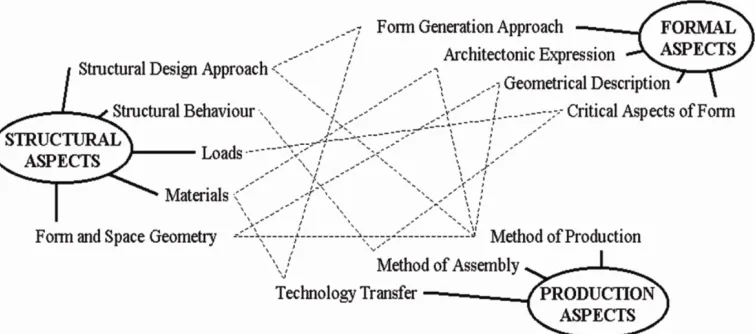
A conceptual framework has been proposed to construct representations of domain knowledge according to 3 cross-disciplinary and generic aspects of design: Formal Aspects, Structural Aspects and Production Aspects. The framework is used to discover and organize the knowledge elements under each category and their cross-disciplinary interactions. This representational scheme does not, however, aim to propagate a division of roles, but it rather intends to stress the concept of transformation to be able to compare the conventional understanding of domain roles and tasks with that of free-form design. Such an approach is supported by various cognitive psychologists who postulate that learning is a process that new knowledge is added to an existing knowledge web/network by creating associations to existing knowledge (Anderson 1985). Thus, it has been anticipated that building the categorization of emerging tasks, processes and concepts according to these three aspects could also hold a key for the identification of new interdependencies among design activities across disciplines (Figure 1).
This could further clarify the changing roles of stakeholders and the degree of roles that different stakeholders play in problem formulation, solution and in the overall creative act. In this framework, Formal Aspects refer to the tasks, processes, tools and techniques used for the generation and development of the architectural form, as well as the tectonic and geometric qualities of form. Structural Aspects refer to the tasks, processes, tools and techniques that are used for the development of the structural system and components. And finally, Production Aspects refers to the manufacturing techniques, processes, methods and tools used to produce the architectonic elements of the skin and the structure. In summary, the database proposes a qualitative framework in order to capture the free-form design process by showing its elements and their relationships.
FIG 1: Interdependencies among cross-disciplinary decision activities. The relationships are indicative rather than final
However, it is important to note that the knowledge elements of any design domain are rarely generic, but rather dependent on the domain to which they apply. Among the domain dependent types of knowledge we aimed to identify:
Knowledge related to domain terminologies
Knowledge related to the formal characteristics of the artefact.
Knowledge related to the representation of artefact (geometrical and non-geometrical properties) Knowledge related to processes (from design generation to production)
[image:6.595.75.453.436.603.2]2.4 Constructing the Framework
A data structure has been developed composed of 3 aspects (formal, structural, production) and their related features under each. The features are determined by a heuristic process of examination of the free-form design context (literature review) as well as extensive case study analyses of built examples. Among an infinite number of features that could have been selected to define the characteristics of each category, we have targeted and determined a number of those according to the degree of change that has been observed to occur most in their understanding and practice, as well as according to the degree of influence they have on the two other aspects. For example, Generation of Form, or Method of Production are two generic features of any design process. Both of these processes are included in the data structure because how these processes are practiced, and the techniques/tools used to perform these processes have greatly changed in the context free-form design. Similarly, while new approaches to form generation have been observed to have an enormous influence on the design of structural systems to support these surfaces; various methods of forming processes are observed to change the properties of materials they are applied to.
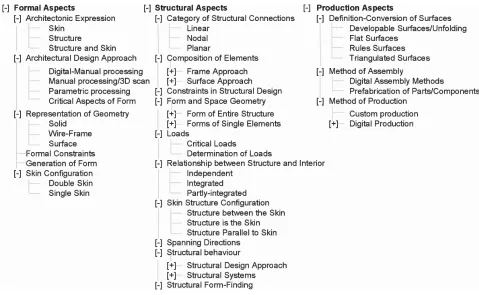
The generation and identification of features and their sub-features have been an iterative process, rather than a priori. They have been inductively derived from the study of the phenomenon they represent under each category. The features are generated through an analytical process of making comparisons to highlight the similarities and differences that is used to produce lower degree features. Features are organized to have first and/or second degree sub-features. While the features at the upper levels are characterized by context-independent and generic terms, the sub-features at the lower levels are characterized by more specific terms revealing the context-specific vocabulary of free-form design, extracted through the analyses of cases and various other sources of literature. This has led to the organization of the features in a hierarchical structure, as illustrated in Figure 2. The process of constructing and updating the features has been a collaborative process between the authors of the BLIP project and the students under the supervision of the authors1.
1 It is important to note that the process of constructing and updating the features has been based on a process of
FIG 2: The hierarchical organization of the features under each category
2.5 Data Representation
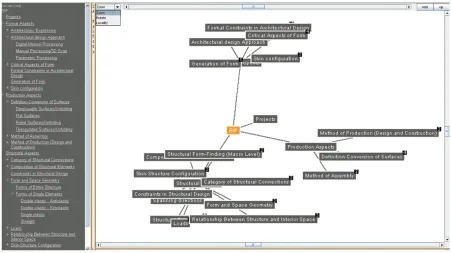
The system provides an extensible and flexible outline by allowing the addition of new features and sub-features as new concepts are discovered. The features and sub-features are organized both in a hierarchical tree-structure and a keyword network (fig. 3). While the hierarchical structure provides the general outline and the classes of the knowledge content, the keyword network represents the semantic relationships between the features within and across categories. Both the keyword network and the tree-structure provide an outline for organizing and categorizing information while providing a structure to relate new contributions in the system (Kocaturk et al. 2003). The tree-structure also serves as an access point into the system.
FIG 3: The hierarchical tree structure and the keyword network
Documents contain information chunks (case-specific or general information represented textually, graphically or a combination of both) which exemplify and/or describe in what way the features are interrelated. This aspect complies with the initial aim of the system which tries to discover and document those inter-relationships. The keyword network depicts the semantic structure for this document structure, in which each document is assigned to one or more keywords from the keyword network. Documents provide data, information and knowledge elements specific to the feature(s) they are associated with. Documents that are associated with one keyword are referred as “feature documents”, whereas documents that are associated with two or more features are referred as “link documents”. Link documents exemplify how the associated features are brought together and how they mutually inform one another in a specific situation.
2.6 Data Entry and Document Organization
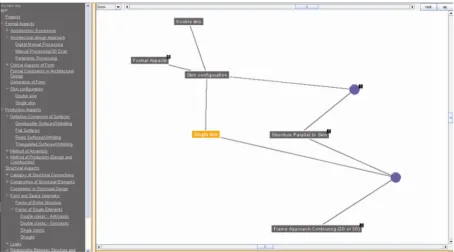
FIG 4: Link documents attached to the semantic structure
As can be seen from the figure, the user who searches, for instance, the single skin feature will not only have access to the documents associated only with this feature, but will also be able to see other features that were previously associated with this feature via document entry (as depicted with the circular points in figure 4, which connect two or more features). It can also be seen that any feature can be associated with any other feature or sub-feature at any level. To summarize, the keyword network and the semantic structure provide the authors with a structure to categorize and to relate their contributions to other documents in the system. Therefore, the keyword network defines the context for the organization of documents. As this relational structure becomes denser, the system is anticipated to provide better support for searching and browsing the information space, unrestricted by the original boundaries of the contributions (or projects) (Kocaturk and Tuncer 2004). In this organization of keywords and documents, various kinds of document relationships can be distinguished. Documents are grouped under projects. By assigning keywords (architect, project name, etc.) to documents, documents that share the same keywords are implicitly related. The documents are further related with the features they share within the keyword network. The distinction between semantic (keyword network) and the syntactic (document structure) structures ensures the extensibility and flexibility of the overall representation, because the semantics can be easily altered at any time without requiring an adaptation of the syntactic structure (Tuncer et al. 2002). The database is designed to be used for extensive cross-referencing and interactive searches in order to capture and share information and knowledge.
2.7 User Interface
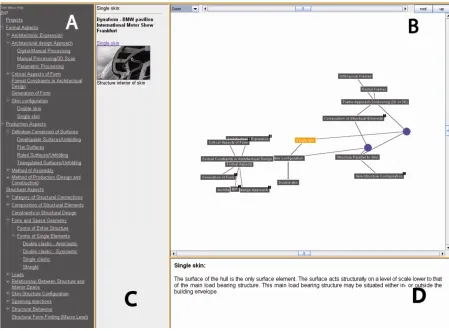
FIG 5: A Screen-shot of the interface; Frames: A) aspects and features, B) relationships, C) documents, D) content
[image:11.595.71.520.68.399.2]FIG 6: Screen-shot of the Interface displaying the “link document” content
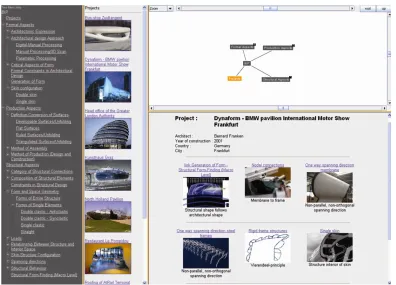
FIG 7: Screen-shot of the Interface displaying the project list and the documents indexed under a project
[image:12.595.70.466.393.678.2]links between the features are also designed to store documents containing project specific information as well as general domain knowledge. The database is automatically updated with feedback and serves as an interactive medium to discover new relations among existing and new features
3. THE DESIGN WORKSHOPS
The following section will describe the application of BLIP in two collaborative design workshops conducted with two separate groups of master’s level students. Each workshop comprised of an extensive study of the free-form design context (based on case studies) followed by a collaborative free-free-form design assignment. The criteria to evaluate the effectiveness of BLIP for efficient knowledge capture, construction and re-use is defined as the capability of the system to extend the user’s ability to utilize design knowledge, modify existing knowledge and to generate new knowledge. In order to do this, we have included the two crucial elements of learning throughout the both workshops: analysis and design. While analysis is viewed as an effort to rationalize and explicate the knowledge embedded in past designs, the design process can be viewed as the acquisition and utilization of knowledge. As described by Duffy (1997); while learning by design helps to maintain experiential knowledge, the activity of analysis, which includes “abstraction and generalization”, extend the utilization capabilities of knowledge in a re-use process (Duffy 1997).
3.1 The Workshop Set-up
Both workshops started with case study analyses followed by a design assignment. In order to have the students acquainted with the design context, they were first asked to analyze precedent design and production processes and then to extract knowledge from these analyses to store in BLIP, by adding new links and features into the system where necessary. The significance of case-based learning is that it links theory and application to real or possible circumstances (Barnes et al. 1994). The knowledge identified in the case studies were formalized, reshaped and reorganized and integrated into BLIP, encouraging the students to generalize and abstract ideas that are explicit in particular situations, and later to use them in analogous situations in their design assignment.
The experimental setting for both workshops complies with the two philosophical models of experiential learning as described by Kolb and Piaget. Kolb’s emphasis is on the experience, followed by reflection (Kolb 1984), which in turn is assimilated into a theory where new hypotheses are tested in new situations. Piaget focuses on knowledge and the ability of its assimilation (Piaget 1971). This assimilation is related to the students’ cognitive schemata which is influential for the acquisition and utilization of knowledge. In both workshops, although all students who took part in the design experiments were Master’s level students, each student had a different level of experience and familiarity with the design context. Since the students, as novice designers, are known to have less experience in clustering of concepts, generalizations and abstractions, they have been provided assistance on these aspects. The set-up of the workshop and the design assignments were also optimized on this particular aspect by the following arrangements:
The role divisions between collaborating students intended to scale down the individual tasks to manageable quantities and help them to focus more on the aspect of exploring multiple alternatives rather than one single solution. As a final product they were asked to generate various conceptual solutions and compare them rather than one single solution worked out in detail They were asked to generate conceptual solutions at different levels of abstraction in a collaborative setting, thus encouraging them to develop a “parallel lines of thinking” (Lawson 1997). They were asked to define their design solutions in relation to the problems they have formulated, thus encouraging them to make generalizations of the possible problem structures of the domain.
3.2 The First Design Workshop
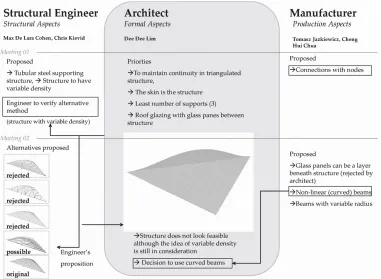
the formal aspects, a ‘structural engineer’ for the structural aspects and a ‘manufacturer’ for the production aspects. Part of the assignment, in addition to the design task, was to create a memory map of their collaborative design decision process, the rationale behind their problem formulations, and the justification of their particular choice among the design alternatives/solutions that were collaboratively generated (Figure 8).
FIG 8: The students’ representation of their collaboration process
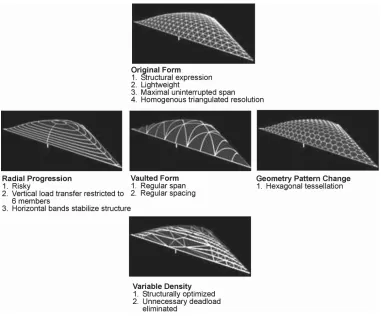
FIG 9: Various structural form alternatives in relation to the architectural and manufacturing constraints
3.3 The Second Design Workshop
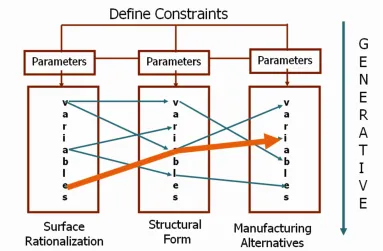
The second workshop was conducted with a new group of master students with a slightly different level of design experience and familiarity with the context. After the case study analyses and getting acquainted with the design context and terminology, the students were given a double-curved 3D geometry and were asked to develop the surface into cladding components combined with a free-form supporting structure. Different from the first workshop, they were given two initial constraints to start with. Firstly, they were not allowed to make major changes in the given geometry. And secondly, all of the surface cladding components and the elements of the structural system should be developable. Additionally, rather than dividing the group as architect, structural engineer and the manufacturer, we defined each of their individual tasks separately so that we would not be limiting their course of action (if necessary) across the domains. Each student was given one of the following tasks:
1) Division of the surface into curved, developable cladding components,
2) Creating possible configurations of structural framing, composed of curved developable elements,
3) Exploring available cutting and forming technologies for structural parts and components (in this case steel).
one highly compatible path, satisfying all mutual constraints (the thick arrow in Figure 10), was selected as a potential solution (Figure 11).
FIG. 10: Proposed working scheme for the second workshop
The other variables, together with the knowledge they retain were stored in BLIP. The abandoned design alternatives and their partial solutions were also stored in BLIP for future reference. It has been observed that in this particular experiment the students were more innovative and creative not only in terms of the variety of design solutions, but also the methods and strategies they have invented to deal with particular constraints and dependencies between tasks.
3.4 Comparing the Workshops Based On Student Performances
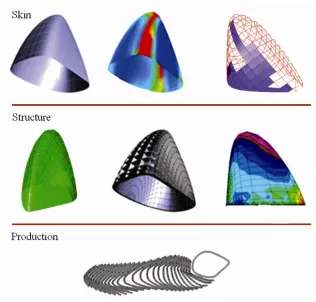
FIG 11: Compatible solutions selected for the cladding patterns, the structural configuration and the laser cut structural elements
These changes in the workshop set-up have been observed to increase the student performances, promote beneficial cognitive processes and consequently increase their knowledge acquisition and utilization. In the first workshop, throughout their design process the students were more focused on problem solving rather than trying to identify the dependencies between concepts at a more abstract level. The only dependency type they interpreted between concepts across domains was constraints (Table 1).
TABLE 1: Comparisons of the workshops based on student performance
Workshop 1 Workshop2
Knowledge Integration and Collaboration
Pragmatic Explorative
Problem Solving Problem Finding Solution Oriented Process Oriented Design Approach
Constraints Satisfaction Strategy/Method Development Knowledge Generated Specific Generalizable
[image:17.595.72.525.512.648.2]The second group, on the other hand, has been observed to perform better in abstract thinking and generating generalizable knowledge content which could be stored and re-used. Moreover, their creativity was oriented more towards making associations between concepts to define problems and generating alternative strategies and concepts. In this respect, while the first group generated more alternative products, the second group was more productive regarding the development of alternative strategies and approaches. We have also observed clear differences between the two workshops regarding how collaboration took place in each. In the first workshop, the students interpreted collaborative design as an activity that was the result of a continuous attempt to develop the easiest path along a chain of constraints across cross-disciplinary tasks. In the second workshop, alternatively, collaboration has been interpreted as first; to construct a shared conception of various dependency types between cross-disciplinary tasks, and then; to explore these varying degrees of dependencies during their individual creative design and integrating others’ viewpoints in the generation of design alternatives.
3.5 Generalizable Results of the Two Workshops
In both workshops, students utilized and generated different types of knowledge. These different types of knowledge were iteratively utilized and generated during both problem solving and problem formulation clarifying why and how a solution was generated in a specific way or how a problem was formulated that led to the final solution. For example, how to divide a double curved surface into individual and developable cladding components is a strategic knowledge, while the maximum thickness allowable for a steel plate in CNC cutting is a factual knowledge. Currently, different knowledge types cannot be differentiated in BLIP. Therefore, the structuring and representation of knowledge should be enhanced in order to capture and differentiate different knowledge types that are used in problem formulations and solutions.
It has also been observed that the current database is lacking the ability to represent varying dependency types between concepts (features). During design, various links between the same features can be created based on how the problems and solutions are formulated. These linkages reflect different viewpoints of the designers on the evolution of the artefact for the construction of a collective understanding of the domain. This collective understanding reveals one of the essential aspects of collaborative design process which is to represent and manage the interactions among the individuals’ unique perspectives and viewpoints (Lu & Udwadia 2000). For example; a specific manufacturing technique will pose certain constraints on the allowable thickness and curvature of a building component. If the available manufacturing technique is influencing the decisions concerning the geometrical properties of this component, or if the desired formal qualities are influencing the choice of a specific manufacturing technique (or a combination of a few) could both lead to a creative product or a process in different ways, based on the choices made. Creativity, in this respect, may be linked to the ability of creating innovative links in both problem formulations and solutions in new and unexpected ways. Therefore, in order to support the creativity; the organization and structuring of knowledge should be able to support the identification and capture of different links and relationships between concepts which could allow the users to modify them and apply them in new contexts. During their design processes the students had discovered various new concepts (features) and their associated knowledge which were difficult to place under one of the 3 categories of BLIP.
These concepts have been observed to be mainly procedural and operational in nature displaying the following characteristics:
• emerged across the boundaries of the three disciplines (design, structural design and production)
• highly multi-dimensional and interactive
• facilitate the creation of new internal processes and social interactions specific to the domain
• requires the engagement of stakeholders at various levels and are highly influential for the evolution of
the artefact.
to understand the emerging knowledge elements and organizational roles in comparison to an existing understanding. However, it also proved to impose a certain way of thinking, lacking the contextual understanding of the domain under study. This approach has been observed to hinder creativity in the first assignment. In the second assignment, it has been observed that defining design tasks, not specific to a certain discipline but rather specific to the context, independent of the solver, each design participant tried to develop a solution for the given situation, and develop alternatives for its execution. This approach proved to encourage collaboration, development of a shared knowledge and understanding among the design participants which also contributes to the collective creativity of the team members. Therefore, instead of categorizing and labelling the concepts (features) according to disciplinary classes, it has proved to be more useful to categorize them in relation to the specific problems they attempt to solve (or create), revealing the unique knowledge content of the domain. We claim that such a categorization would also reflect the collaborative and integrative nature of the free-form design processes and could serve to construct a shared understanding of the domain knowledge.
Different than the analysis of designs, the actual design is a non-linear process of knowledge exchange whereby shared meanings are created between the members of the design team. The design workshops provided the students with an understanding of the dynamics of teamwork and group learning which generates a shared understanding and collaborative knowledge. Consequently, we distinguish collaborative knowledge from the individual creation of knowledge, which is constructed through the interaction of multiple actors, embodies the dynamic elements of knowledge that would be difficult to generate by an individual (Lee 2004). This view propagates a rather process oriented view of knowledge which is seen as a key to the generation and understanding of collaborative design knowledge.
4. CONCLUSION - EVOLUTION OF A NEW FRAMEWORK
The observations we obtained from these workshops have considerably contributed to the further development of ideas in our research. At the very least, the workshops provided a medium to:
1) Further identify the additional knowledge content (features) constituting the free-form design domain and describing them by their relationship to other concepts (gained through direct design experience)
2) Test and evaluate the effectiveness of the proposed framework for efficient knowledge capture, construction and re-use
3) Evaluate the existing organization and structure of knowledge in BLIP to the extent to which it supports and contributes to creative and collaborative design.
4) Recognize particular cognitive aspects of design required for knowledge acquisition and for the construction of useful knowledge structures.
We conclude that in order to explicate the emerging knowledge content of freeform design, we need to focus on its creation process. Therefore, we require a more extended framework which reflects the collaborative, situated, and emergent characteristics of the domain knowledge, and which can facilitate the discovery of emergent interactions between its context specific concepts (e.g. tasks, processes). Based on the observations and findings of the previous section, the initial a priori framework has been extended and categories have been re-defined. Consequently, we have identified 5 general categories where collaboration has been observed to occur most frequently among the stakeholders and which have been identified as the main sources of the emerging knowledge associated with the change in the design practice:
• Form finding approaches and formal characteristics • Rationalization of the Structure and the Skin
• Representation and Exchange of Design Information • Materialization of the Supporting Structure and its Elements
This framework has been used to identify, compare and evaluate different design experiences in different projects (case studies), and to identify the concepts emerging under each category together with their context specific interactions. This has facilitated a deeper understanding as to “how” and “why” design knowledge had developed into the final artefact in each specific case.
Acknowledgements
BLIP is a project developed as a joint work by three researchers (Tuba Kocatürk, Bige Tuncer, Martijn Veltkamp). Bige Tuncer’s research provided a flexible and extensible framework for knowledge modelling that acts as the backbone of the information structure of BLIP. Tuba Kocatürk’s and Martijn Veltkamp’s research provided the main context and the related knowledge content for the application which contributed to the cross-disciplinary richness of the knowledge content due to the separate research foci and cross-disciplinary background of the two researchers. The author would also like to thank Joost Beintema for his contribution to the programming of BLIP throughout the first prototype development.
REFERENCES
Akin, Ö., 1986. Psychology of architectural design, Pion, London.
Anderson, J. R., 1985. Cognitive psychology and its implications, 2nd edn, W.H. Freeman, New York.
Barnes, L. B., Christensen, C. R. & Hansen, A. J., 1994. Teaching and the case method : text, cases, and readings, 3rd edn, Harvard Business School Press, Boston, Mass.
Baron, J. B. & Steinberg, R. J. (eds.), 1987. Teaching Thinking Skills:Theories and Practice, Freeman, New York.
Duffy, A. H. B., 1997. 'The "What"and "How" of learning in design', Expert, IEEE [see also IEEE Intelligent Systems and Their Applications], vol. 12, no. 3, p. 71.
Kocaturk, T. & Tuncer, B., 2004. 'Modelling Collaborative Conceptual Design in the Digital Age', Third International Workshop on Construction Information Technology in Education, ed. A Dikbas, ITU Press, Istanbul, Turkey, pp. 149-163.
Kocaturk, T., Tuncer, B. & Veltkamp, M., 2003. 'Exploration of Interrelationships Between Digital Design and Production Processes of Free-Form Complex Surfaces in a Web-based Database', Digital Design: Research and Practice, Proceedings of the 10th International Conference on Computer Aided Architectural Design Futures, eds. M-L. Chiu, J-Y Tsou, T. Kvan, M Morozumi & T-S Jeng, Kluwer Academic, Dordrecht, The Netherlands, pp. 445-454.
Kolb, D. A., 1984. Experiential learning: experience as the source of learning and development, Prentice-Hall, Englewood Cliffs, N.J.
Landsdown, J., 1986. 'Requirements for Knowledge Based Systems in Design', Proceedings of the Computer-Aided Architectural Design Futures, ed. A Pipes, London: Butterworths, Delft, The Netherlands, pp. 120-128.
Lawson, B., 1980. How Designers Think, Architectural Press; Eastview Editions, N.J.
Lawson, B., 1997. How designers think : the design process demystified, Completely rev. 3rd edn, Architectural Press, Oxford ; Boston.
Logan, B. S., 1985. 'Representing the Structure of Design Problems', Proceedings of the Computer-Aided Architectural Design Futures, ed. A Pipes, London: Butterworths, pp. 158-170.
Lu, S. C.-Y. & Udwadia, F., 2000. Conflict Management in Collaborative Engineering Design, Online Research Report, University of Southern California, School of Engineering, November 2000.
Mitchell, W. J., 1990. The logic of architecture : design, computation, and cognition, MIT Press, Cambridge, Mass.
Oxman, R. E. & Oxman, R., 1990. 'Computability of Architectural Knowledge', in M McCullough, WJ Mitchell & P Purcell (eds), The Electronic design studio : architectural knowledge and media in the computer era, MIT Press, Cambridge, Mass., pp. 171-187.
Piaget, J., 1971. Psychology and epistemology, Grossman, New York,