Martin Wu
*
and Jonathan A Eisen
*†‡
Addresses: *Genome Center, University of California, One Shields Avenue, Davis, CA 95616, USA. †Section of Evolution and Ecology, College of
Biological Sciences, University of California, One Shields Avenue, Davis, CA 95616, USA. ‡Department of Medical Microbiology and
Immunology, School of Medicine, University of California, One Shields Avenue, Davis, CA 95616, USA.
Correspondence: Martin Wu. Email: [email protected]
© 2008 Wu and Eisen; licensee BioMed Central Ltd.
This is an open access article distributed under the terms of the Creative Commons Attribution License (http://creativecommons.org/licenses/by/2.0), which permits unrestricted use, distribution, and reproduction in any medium, provided the original work is properly cited.
AMPHORA for phylogenomic analysis
<p>An automated pipeline for phylogenomic analysis (AMPHORA) is presented that overcomes existing limits to large-scale protein phy-logenetic inference.</p>
Abstract
The explosive growth of genomic data provides an opportunity to make increased use of protein markers for phylogenetic inference. We have developed an automated pipeline for phylogenomic analysis (AMPHORA) that overcomes the existing bottlenecks limiting large-scale protein phylogenetic inference. We demonstrated its high throughput capabilities and high quality results by constructing a genome tree of 578 bacterial species and by assigning phylotypes to 18,607 protein markers identified in metagenomic data collected from the Sargasso Sea.
Background
Since the 1970s the use of small subunit (SSU) rRNA (SSU rRNA) sequences has revolutionized microbial classification, systematics, and ecology. The SSU rRNA gene has become the most sequenced gene, with hundreds of thousands of its sequences now deposited in public databases. It has become the current 'gold standard' in microbial diversity studies, and for good reasons. For one, it is present in all microbial organ-isms. For another, the gene sequence is highly conserved at both ends. This enables one to obtain nearly full-length SSU rRNA gene sequences by polymerase chain reaction amplifi-cation using 'universal' primers and without having to isolate and culture the organism in question. Until very recently, the vast majority of microbes were identified and classified only by recovering and sequencing their SSU rRNA genes. This single sequence of approximately 1.5 kilobases is often the only information we have about the organism from which it came - the only way we know that it exists in the natural environment.
Although the SSU rRNA gene has been extremely valuable for phylogenetic studies, it has its limitations. For example, it has
been well documented that evolutionarily distant SSU rRNA genes that are similar in nucleotide composition have been consistently - but nevertheless incorrectly - placed close together in phylogenetic trees [1,2,1]. Furthermore, inferring the phylogeny of organisms from any single gene carries some risks and must be corroborated by the use of other phyloge-netic markers. Many researchers turned to protein encoding genes such as EF-Tu, rpoB, recA, and HSP70 [3]. Because protein sequences are conserved at the amino acid level instead of at the nucleotide level, phylogenetic analyses of protein sequences are in general less prone to the nucleotide compositional bias seen in SSU rRNA [2,4-6]. In addition, the less constrained variation at the third codon position allows these genes to be used in studies of more closely related organisms. However, because of difficulties in cloning protein encoding genes from diverse species, SSU rRNA remained the gold standard.
The situation changed with the advent of genomic sequenc-ing. Each complete genome sequence brings with it the sequences for all protein encoding genes in that organism. Now, not only can one build gene trees based on a favorite Published: 13 October 2008
Genome Biology 2008, 9:R151 (doi:10.1186/gb-2008-9-10-r151)
Received: 12 August 2008 Revised: 26 September 2008 Accepted: 13 October 2008 The electronic version of this article is the complete one and can be
protein encoding gene, but also one has the option to concate-nate multiple gene sequences to construct trees on the 'genome level'. Possessing more phylogenetic signals, such 'genome trees' or 'super-matrix trees' are less susceptible to the stochastic errors than those built from a single gene [7]. Recent studies attempting to reconstruct the tree of life have demonstrated the power of this approach [8,9] (for review [10]). Likewise, genome trees have also been used success-fully to reassess the phylogenetic positions of individual spe-cies [11,12]. It is worth pointing out, however, that the genome trees are still susceptible to systematic errors caused by compositional biases, unrealistic evolutionary models, and inadequate taxonomic sampling [7,13,14].
Despite its demonstrated usefulness, phylogenetic inference based on protein markers has been limited in application, mainly because of the formidable technical difficulties inher-ent in this approach. Typically, molecular phylogenetic infer-ence involves three steps: retrieval of homologous sequinfer-ences, creation of multiple sequence alignments, and phylogenetic tree construction. Because only characters of common ances-try can be used to infer the evolutionary history, the most crit-ical step is sequence alignment, in which sequences are overlaid horizontally on each other in such a way that, ideally, each column in the alignment would only contain homolo-gous characters (amino acids or nucleotides). To ensure this positional homology, the alignments must be curated - a process that evaluates the probable homology of each column or position in the alignments.
Positions for which the assignment of homology is uncertain are then excluded from further analysis by masking [15]. Judicious masking increases the signal-to-noise ratio and often improves the discriminatory power of the phylogenetic methods [16]. Unfortunately, curation requires skilled man-ual intervention, thus making it impractical to process suita-bly the massive amount of genome sequence data now available. Frequently, masking is simply ignored. Automated masking to remove alignment positions that contain gaps or that have a low degree of conservation has not been satisfac-tory. For example, using these criteria and given a set of ad hoc parameters such as the minimum block length, GBLOCKS automatically selects conserved blocks from mul-tiple sequence alignments for phylogenetic analysis. How-ever, trees constructed using GBLOCKS-treated alignments have been found to have dramatically weaker support, possi-bly because of excessive removal of informative sites by the program [17]. In addition, although many programs are avail-able to automate the creation of multiple sequence align-ments, their use for the de novo alignment of a large protein family is still fairly time consuming.
To overcome these problems, we have developed an auto-mated pipeline for building concatenated genome trees using multiple protein markers, thus making this powerful method applicable on a larger scale. Our pipeline can rapidly and
accurately generate highly reproducible multiple sequence alignments for a set of selected phylogenetic markers. More importantly, unlike previous automated methods [9] it can mask the alignments with quality equivalent to that of cura-tion by humans.
The same pipeline can also be applied to metagenomic data analyses. In metagenomics or environmental genomics, nat-ural populations of microbes are collected from the environ-ment; their DNAs are cloned and directly sequenced. One fundamental goal of metagenomics is to determine who is present in the community and what they are doing. Phyloge-netic analysis of markers present in these collected samples can be very informative in revealing who is there. If the marker happens to be part of a larger assembled sequence fragment, then the entire fragment can be anchored by that marker to a specific taxonomic clade. In this way, environ-mental shotgun sequences can be sorted into taxon-specific 'bins' in silico, thereby allowing us to determine who is doing what.
The most striking finding to date from this approach was the discovery of a proteorhodopsin gene in bacteria, a homolog of the bacteriorhodopsin gene previously found only in some archaea. In this case, the gene could be anchored within the bacteria because it was found to be associated with a bacterial SSU rRNA gene [18]. However, because the SSU rRNA gene constitutes only a tiny fraction of any genome, the probability that any given sequence fragment can be anchored to a spe-cific taxonomic clade by using this one gene is small. Thus, phylotyping of metagenomic data can greatly benefit from the use of alternative phylogenetic markers such as the multiple protein markers described below.
In this paper, we introduce AMPHORA (a pipeline for Auto-Mated PHylogenOmic infeRence) and demonstrate two sig-nificant applications: building a genome tree from 578 complete bacterial genomes that are available at the time of the study and identifying bacterial phylotypes from metagen-omic data collected from the Sargasso Sea.
Results and discussion
The AMPHORA pipelineIntroduction
be used for phylogenetic analyses of single genes or whole genomes.
Protein phylogenetic marker database
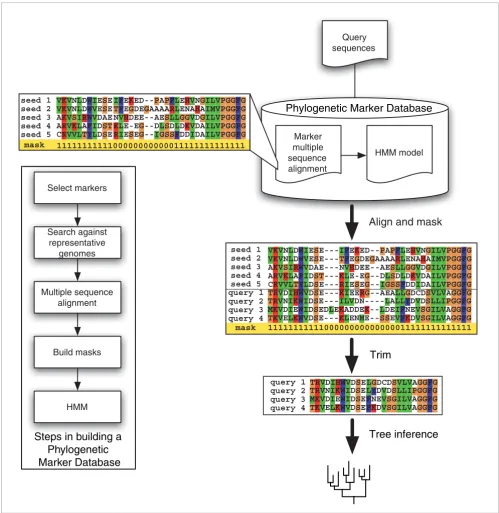
The core of AMPHORA is a protein phylogenetic marker database that contains curated protein sequence alignments with trimming masks and corresponding profile hidden Markov models (HMMs). Thirty-one protein encoding
[image:3.612.55.554.87.599.2]A flowchart illustrating the major components of AMPHORA
Figure 1
A flowchart illustrating the major components of AMPHORA. The marker protein sequences from representative genomes are retrieved, aligned, and masked. Profile hidden Markov models (HMMs) are then built from those 'seed' alignments. New sequences of interest are rapidly and accurately aligned to the trusted seed alignments through HMMs. Predefined masks embedded within the 'seed' alignment are then applied to trim off regions of ambiguity before phylogenetic inference. Alignment columns marked with '1' or '0' were included or excluded, respectively, during further phylogenetic analysis.
i
i seed 1
seed 2 seed 3 seed 4 seed 5
mask 1111111111100000000000011111111111111
VKVNLDWIESE VKVNLDWVESE AKVSIRWVDAE ARVKLAFIDST CRVVLTYLDSE
IFEKED--PAPFLEHVNGILVPGGFG TFEGDEGAAAARLENAHAIMVPGGFG NVHDEE--AESLLGGVDGILVPGGFG KLE-EG--DLSDLDKVDAILVPGGFG RIESEG--IGSSFDDIDAILVPGGFG
i
i Marker
multiple sequence alignment
HMM model Query
sequences
Align and mask
query 2 query 3 query 4
TRVNIKWIDSELYDVDSLLIPGGFG MKVDIEWIDSEFNEVSGILVAGGFG TKVELKWVDSEFKDVSGILVAGGFG TRVDIHWVDSELGDCDSVLVAGGFG query 1
query 2
mask 1111111111100000000000000011111111111111
query 3 query 4
TRVNIKWIDSE---ILVDN----LALLYDVDSLLIPGGFG MKVDIEWIDSEDLEKADDEK--LDEIFNEVSGILVAGGFG TKVELKWVDSE---KLENME--SSEVFKDVSGILVAGGFG VKVNLDWIESE---IFEKED--PAPFLEHVNGILVPGGFG VKVNLDWVESE---TFEGDEGAAAARLENAHAIMVPGGFG AKVSIRWVDAE---NVHDEE--AESLLGGVDGILVPGGFG ARVKLAFIDST---KLE-EG--DLSDLDKVDAILVPGGFG CRVVLTYLDSE---RIESEG--IGSSFDDIDAILVPGGFG TRVDIHWVDSE---KIEERG--AEALLGDCDSVLVAGGFG seed 1
seed 2 seed 3 seed 4 seed 5 query 1
Trim
Tree inference
Phylogenetic Marker Database
Steps in building a
Phylogenetic
Marker Database
S
Steps iin b
b i
uild
ldiing a
Select markers
Search against representative
genomes
Multiple sequence alignment
phylogenetic marker genes (dnaG, frr, infC, nusA, pgk, pyrG,
rplA, rplB, rplC, rplD, rplE, rplF, rplK, rplL, rplM, rplN,
rplP, rplS, rplT, rpmA, rpoB, rpsB, rpsC, rpsE, rpsI, rpsJ,
rpsK, rpsM, rpsS, smpB, and tsf) from representatives of complete bacterial genomes were individually aligned using CLUSTALW. The alignments were curated and trimming masks were added manually by visually inspecting the align-ments. We selected these proteins because they are univer-sally distributed in bacteria; the vast majority of them exist as single copy genes within each genome; and they are house-keeping genes that are involved in information processing (replication, transcription, and translation) or central metab-olism, and thus are thought to be relatively recalcitrant to lat-eral gene transfer [19].
High quality and highly reproducible sequence alignments
Molecular phylogenetic inference assumes common ancestry, or homology, for every single column of a multiple sequence alignment. When this assumption is violated, phylogenetic signal can be obscured by noise. It has been shown that align-ment quality can have greater impact on the final tree than does the tree building method employed [20]. Therefore, pre-paring high quality sequence alignments is a most critical part of any molecular phylogenetic analysis. This preparation typ-ically involves careful but tedious manual editing and trim-ming of the generated alignments, and thus remains the greatest challenge to automation. When scaling up this proc-ess, the trimming step is often simply ignored. Automated trimming based on the number of gaps in each column or each column's conservation score can be used to select con-served blocks, but this still is not satisfactory when a high quality tree is required [17].
We overcame this problem by taking advantage of a unique feature of profile HMM-based multiple sequence alignments. When using HMMs to align sequences, new sequences can be mapped back, residue by residue, onto the 'seed' alignment from which that HMM originated. When the seed alignment includes an accurate human curated mask, the newly gener-ated alignments can be automatically trimmed accordingly, thus producing high quality alignments without requiring further human intervention. In addition, the HMM model is the only variable in this automated alignment and trimming. When the same model is used, the alignments generated thereby are completely additive and reproducible, thus ena-bling meaningful comparison of the results from different phylogenetic studies or different researchers.
Speed
Another big advantage of using an HMM-based approach is speed. For example, AMPHORA needs only 0.5 minutes on an average desktop computer (Intel Pentium CPU 3.2 GHz) to align 340 sequences of the rpoB family. In comparison, the same job takes de novo pair-wise alignment methods such as CLUSTALW and MUSCLE 120 and 12 minutes, respectively. This is because our HMM-based method aligns sequences by
comparing them only once each to the HMM model. As a result, the computational cost increases linearly with the number of sequences to be aligned. In contrast, the computa-tional cost of a pair-wise alignment approach increases poly-nomially and can soon become prohibitively expensive.
Application I: Bacterial genome trees
Constructing a 'genome' tree
We downloaded 578 complete bacterial genomes available at the time of our study from the National Center for Biotechnol-ogy Information (NCBI) RefSeq collections (Additional data file 1). Protein marker sequences for 31 proteins were retrieved, aligned, trimmed, and concatenated as described in the Materials and methods section (see below). This resulted in a mega-alignment of 5,591 good amino acid positions (col-umns) by 578 species (rows). A maximum likelihood genome tree was constructed from this mega-alignment (Additional data file 2). A bootstrapped maximum likelihood genome tree of 310 representatives is shown in Figure 2.
As with trees built from SSU rRNA data, all of the major bac-terial phyla are well separated into their own monophyletic groups, even though the relationships among some of them remain unclear. Strikingly, unlike the SSU rRNA tree, the bushy area (intermediate levels) of our tree is highly resolved. In the γ-proteobacteria, for example, the nodes separating taxa into different orders, families, and genera receive gener-ally excellent bootstrapping support, whereas uncertainty is high in the corresponding regions of the SSU rRNA tree (Additional data file 3). Highly robust organismal phyloge-nies of γ-proteobacteria and α-proteobacteria have been inferred previously using hundreds of commonly shared genes [21,22] and are congruent to our genome tree. This reflects the much-reduced stochastic noise present in the con-catenated protein sequences compared with that of a single, slowly evolving SSU rRNA gene. This uncertainty in the SSU rRNA tree the backbone of modern microbial systematics -often prevents microbial taxonomists from placing new spe-cies or genera within higher taxa, particularly at these inter-mediate levels [23]. When such assignments were nevertheless made for these problematic taxa, inconsistency was introduced into the taxonomic nomenclature. For exam-ple, taxa assigned to the orders Alteromondales,
Pseudomon-adales, and Oceanospirillales in Bergey's Taxonomic Outline
of Prokaryotes [23] are intermingled and paraphyletic in our genome tree. It is our view that the taxonomy needs to be revisited and possibly revised in such cases.
Genome-based microbial taxonomy
genomes have been sequenced, however, a hybrid approach may be most fruitful. A genome tree built from sequenced genomes can be used as a scaffold; species for which we lack
full genome sequences can be placed by comparing their SSU rRNA sequences with those of sequenced species.
An unrooted maximum likelihood bacterial genome tree
Figure 2
An unrooted maximum likelihood bacterial genome tree. The tree was constructed from concatenated protein sequence alignments derived from 31 housekeeping genes. All major phyla are separated into their monophyletic groups and are highlighted by color. The branches with bootstrap support of over 80 (out of 100 replicates) are indicated with black dots. Although the relationships among the phyla are not strongly supported, those below the phylum level show very respectable support. The radial tree was generated using iTOL [42].
Thermus thermophilus HB8 Deinococcus geotherm
alis D SM
11300 Deinococcus radiodurans R1Petrotoga mobilis SJ95
Thermotoga maritima MSB8Thermotoga lettingae TMO Thermosipho melanesiensis BI429 Fervidobacterium nodosum Rt17 B1
Aquifex aeolicus VF5 Rubrobacter xylanophilus DSM 9941
Tropheryma whipplei TW08 27
Bifidobacterium
adolescentis A
TC C 15703 N
ocardioides sp JS
614
Propionibacterium acnes KPA171202Kineococcus radiotolerans SRS30216
Renibacterium salmoninarum ATCC 33209
Arthrobacter aurescens TC1
Arthrobacter sp FB24 Clavibacter m
ichiganensis Leifsonia xyli subsp xyli str C
TCB 07 Streptomyces avermitilis MA 4680Acidothermus cellulolyticus 11B
Thermobifida fusca YXFrankia sp EAN1pecFrankia alni ACN14a Frankia sp CcI3 Salinispora tropica CNB 440
Salinispora arenicola CNS 205 Saccharopolyspora erythraea NRRL 2338
Rhodococcus sp RHA1 Nocardia farcinica IFM 10152 Mycobacterium smegmatis str MC2 155 Mycobacterium avium subsp paratuberculosis K 10
C orynebacterium
jeikeium
K411 Corynebacterium diphtheriae NCTC 13129
Corynebacterium
efficiens YS 314 Herpetosiphon aurantiacus ATCC 23779
Roseiflexus castenholzii DSM 13941
Chloroflexus aurantiacus J 10 fl
Dehalococcoides sp CBDB1 G loeobacter violaceus P
CC 7421 Synechococcus sp JA 2 3B a 2 13
Thermosynechococcus elongatus BP 1
Acaryochloris marina MBIC11017 Anabaena variabilis ATCC 29413
Nostoc sp PCC 7120 Trichodesmium erythraeum IMS101 Microcystis aeruginosa NIES 843
Synechocystis sp PCC 6803 Synechococcus elongatus PCC 6301Prochlorococcus marinus str MIT 9515
Prochlorococcus marinus subsp pastoris str CCMP1986
Prochlorococcus marinus str MIT 9211 Prochlorococcus marinus subsp m arinus str CCM P1375
Prochlorococcus marinus str NATL1A Synechococcus sp RCC307Prochlorococcus marinus str MIT 9303Prochlorococcus marinus str MIT 9313Synechococcus sp WH 7803Synechococcus sp CC9311Synechococcus sp CC9605Synechococcus sp CC9902Synechococcus sp WH 8102 Carboxydothermus hydrogenoformans Z 2901Pelotomaculum thermopropionicum SIDesulfotomaculum reducens MI 1 Moorella thermoacetica ATCC 39073Desulfitobacterium hafniense Y51 Sym
biobacteriu m therm
ophilum IA M 14863
Syntrophomonas wolfei subsp wolfei str Goettingen
Thermoanaerobacter sp X514Thermoanaerobacter tengcongensis MB4 Caldicellulosiruptor saccharolyticus DSM 8903
Clostridium thermocellum ATCC 27405 Clostridium perfringens SM101Clostridium
beijerinckii N CIM
B 8052
Clostridium novyi NT
Clostridium acetobutylicum ATCC 824Clostridium tetani E88Clostridium botulinum A str ATCC 19397
Clostridium kluyveri DSM 555 Clostridium difficile 630Alkaliphilus oremlandii OhILAsAlkaliphilus metalliredigens QYMF
Clostridium phytofermentans ISDg
Fusobacterium nucleatum subsp nucleatum ATCC 25586
Geobacillus kaustophilus HTA426 Bacillus subtilis subsp subtilis str 168
Bacillus weihenstephanensis KBAB4 Bacillus halodurans C 125
Bacillus clausii KSM K16 Oceanobacillus iheyensis H
TE831
Staphylococcus aureus subsp aureus USA300 Listeria inn
ocua Clip112 62
Enterococcus faecalis V583 Streptococcus gordonii str Challis substr CH1
Lactococcus lactis subsp lactis Il1403 Lactobacillus sakei subsp sakei 23K
Lactobacillus casei ATCC 334 Lactobacillus delbrueckii ATCC BAA 365
Lactobacillus helveticus DPC 4571 Lactobacillus johnsonii NCC 533 Lactobacillus salivarius subsp salivarius UCC118
Lactobacillus plantarum WCFS1 Lactobacillus brevis ATCC 367 Pediococcus pentosaceus ATCC 25745 Lactobacillus reuteri F275 Leuconostoc mesenteroides ATCC 8293 O enococcus oeni P
SU 1 Acholeplasma laidlawii PG 8AAster yellows witches broom phytoplasma AYWB
Mesoplasma florum L1Mycoplasm a capricolum
subsp capricolu m A
TCC 27343
Mycoplasma hyopneumoniae 7448Mycoplasma mobile 163K Mycoplasma pulmonis UAB CTIPMycoplasm
a synoviae 53
Mycoplasm a agalactiae PG
2
Mycoplasma penetrans HF 2 Ureaplasma parvum serovar 3 str ATCC 700970Mycoplasma gallisepticum R
Mycoplasma pneumoniae M129Mycoplasma genitalium G37
Rhodopirellula baltica SH 1
Candidatus Protochlamydia amoebophila UWE25 Chlamydia trachomatis A HAR 13 Chlamydophila abortus S26 3 Chlamydophila pneumoniae J138 Leptospira borgpetersenii JB197 Borrelia garinii PBi Treponema denticola ATCC 35405 Treponema pallidum subsp pallidum str Nichols Chlorobium tepidum TLS Chlorobium phaeobacteroides DSM 266
Pelodictyon luteolum DSM 273 Prosthecochloris vibrioformis DSM 265 Chlorobium chlorochromatii CaD3
Salinibacter ruber DSM 13855 Cytophaga hutchinsonii ATCC 33406 Bacteroides fragilis NCTC 9343 Parabacteroides distasonis ATCC 8503 Porphyromonas gingivalis W83
Gramella forsetii KT0803 Flavobacterium johnsoniae UW101 Flavobacterium psychrophilum JIP02 86
C andidatus S ulcia m
uelleri G WSS
Acidobacteria bacterium Ellin345
Solibacter usitatus Ellin6076
Anaeromyxobacter dehalogenans 2CP C Anaeromyxobacter sp Fw109 5
Myxococcus xanthus DK 1622Sorangium cellulosum So ce 56 Bdellovibrio bacteriovorus HD100
P elob acte r carbinolicu s D SM 2380 Geobacter uraniireducens Rf4 Geobacter metallireducens GS 15 Geobacter sulfurreducens PCA
Pelobacter propionicus DSM 2379
Syntrophus aciditrophicus SB Syntrophobacter fumaroxidans MPOB Desulfococcus oleovorans Hxd3 Desulfotalea psychrophila LSv54 Lawsonia intracellularis PHE MN1 00 Desulfovibrio vulgaris subsp vulgaris str Hildenborough Desulfovibrio vulgaris subsp vulgaris DP4
Desulfovibrio desulfuricans G20
N itratiruptor sp SB
155 2 Campylobacter hominis ATCC BAA 381 Campylobacter jejuni RM1221 Campylobacter jejuni subsp jejuni 81116 Campylobacter fetus subsp fetus 82 40 Campylobacter curvus 525 92 Campylobacter concisus 13826
Sulfurovum sp NBC37 1 Arcobacter butzleri RM4018
Sulfurim
onas denitrificans D
SM 1251 W
olinella succinogenes D
SM 1740
Helicobacter acinonychis str Sheeba
Magnetococcus sp MC 1
Magnetospirillum magneticum AMB 1 Rhodospirillum rubrum ATCC 11170 Acidiphilium cryptum JF 5 Granulibacter bethesdensis CGDNIH1 Gluconacetobacter diazotrophicus PAl 5 G luconobacter oxydans 621H Sphingomonas wittichii RW1 Zymomonas mobilis subsp mobilis ZM4 Sphingopyxis alaskensis RB2256 Novosphingobium arom
aticivorans DSM 12444 Erythrobacter litoralis HTCC2594
Parvibaculum lavamentivorans DS 1
Azorhizobium caulinodans ORS 571 Xanthobacter autotrophicus Py2
Methylobacterium extorquens PA1
Rhodopseudomonas palustris CGA009
Bradyrhizobium sp BTAi1 Bradyrhizobium sp ORS278
Nitrobacter hamburgensis X14 Sinorhizobium
m edicae W
SM419
Rhizobium leguminosarum bv viciae 3841 Agrobacterium tumefaciens str C58 Mesorhizobium sp BNC1
Mesorhizobium loti MAFF303099 Ochrobactrum anthropi ATCC 49188
Brucella melitensis biovar Abortus 2308 Bartonella bacilliformis KC583 Bartonella tribocorum CIP 105476 Bartonella henselae str Houston 1
Bartonella quintana str Toulouse
Maricaulis maris MCS10 Caulobacter crescentus CB15 Hyphomonas neptunium ATCC 15444 Paracoccus denitrificans PD1222 Rhodobacter sphaeroides 2 4 1 Dinoroseobacter shibae DFL 12
Jannaschia sp CCS1
Roseobacter denitrificans OCh 114 Silicibacter sp TM1040
Silicibacter pomeroyi DSS 3
Candidatus Pelagibacter ubique HTCC1062 R
ickettsia bellii O
SU 85 389 Rickettsia prowazekii str Madrid EOrientia tsutsugamushi Boryong W olb ach ia end osym bio nt of D
rosophila m
elan ogaste
r Wolbachia endosymbiont strain TRS of Brugia malayi Ehrlichia ruminantium str Welgevonden Ehrlichia canis str Jake Ehrlichia chaffeensis str Arkansas Anaplasm
a m arginale str St M
aries Anaplasma phagocytophilum HZ
Neorickettsia sennetsu str Miyayama
Chrom obacte rium violace um A TC C 1247 2
Neisseria gonorrhoeae FA 1090
Thiobacillus denitrificans ATCC 25259
Methylobacillus flagellatus KT
Nitrosospira m ultiformis ATCC 25196
Nitrosomonas europaea ATCC 19718
Nitrosomonas eutropha C91
Dechloromonas aromatica RCB
Azoarcus sp BH72
Azoarcus sp EbN1 Bordetella petrii
Janthinobacterium sp Marseille Herminiimonas arsenicoxydans Burkholderia xenovorans LB
400
Ralstonia solanacearum GMI1000
Polynucleobacter sp QLW P1DMWA 1 Methylibium petroleiphilum PM1 Rhodoferax ferrireducens T
118
Polarom onas sp JS
666
Polaromonas naphthalenivorans CJ2 Verminephrobacter eiseniae EF01 2 Acidovorax avenae subsp citrulli AAC00 1
Acidovorax sp JS42 Delftia acidovorans SPH 1 Methylococcus capsulatus str Bath Dichelobacter nodosus VCS1703A Nitrosococcus oceani ATCC 19707
Alkalilim nicola ehrlichei M
LHE 1
Halorhodospira halophila S L1
Xanthomonas campestris pv vesicatoria str 85 10 Xylella fastidiosa Temecula1 L egion
ella pn eumophila str C
orby
Coxiella burnetii RSA 493
Francisella tularensis subsp novicida U112 Thiomicrospira crunogena XCL 2
Candidatus Ruthia magnifica
Candidatus Vesicomyosocius okutanii HA P seudom
onas stutzeri A1501 Saccharophagus degradans 2 40
Marinobacter aquaeolei VT8 Hahella chejuensis KCTC 2396 Chromohalobacter salexigens DSM 3043
M arinomonas sp MWYL1
Alcanivorax borkumensis SK2 Acinetobacter sp ADP1 Acinetobacter baumannii ATCC 17978 Psychrobacter sp PRwf 1 Psychrobacter arcticus 273 4 Pseudoalteromonas atlantica T6c
Idiomarina loihiensis L2TR Pseudoalteromonas haloplanktis TAC125 Colwellia psychrerythraea 34H Shewanella pealeana ATCC 700345 Psychrom onas ingrahamii 37 Aeromonas hydrophila ATCC 7966 Aeromonas salmonicida subsp A449Photobacterium profundum SS9
Vibrio fischeri ES114 Actinobacillus pleuropneumoniae L20Haemophilus ducreyi 35000HP Pasteurella multocida str Pm70 Haemophilus somnus 129PT Haemophilus influenzae PittEE Mannheimia succiniciproducens MBEL55EActinobacillus succinogenes 130Z Photorhabdus luminescens TTO1Yersinia enterocolitica 8081 Serratia proteamaculans 568 Erwinia carotovora SCRI1043 Escherichia coli O157 H7 str Sakai
Sodalis glossinidius str morsitans Baumannia cicadellinicola
Candidatus Blochmannia pennsylvanicusCandidatus Blochmannia floridanus Wigglesworthia glossinidia endosymbiont Buchnera aphidicola str Sg Schizaphis graminum Buchnera aphidicola str APS Acyrthosiphon pisumBuchnera aphidicola str Bp Baizongia pistaciae B uchnera aphidicola
Average rate of protein evolution in bacterial genomes
The average rates of protein evolution are proportional to the branch lengths of our genome tree. The branch length varies widely among different lineages. For example, as has been previously reported, bacteria that have adopted an intracellu-lar lifestyle have, in general, evolved more rapidly [24], with
Wigglesworthia glossinidia (the endosymbiont of Glossina
brevipalpis) and Neorickettsia sennetsu str. Miyayama
evolving at the fastest pace. The slowest rates are found in a group of spore forming bacteria such as Carboxydothermus
hydrogenoformans, Moorella thermoacetica, Clostridium
spp., and Bacillus spp. These slow rates are of particular interest because it has been suggested that they might be related to the longer generation times for organisms that spend a significant fraction of their time as dormant spores. Our data for spore forming bacteria are consistent with that hypothesis and differ strikingly from the findings of a recent study [25], which identified no generation time effect in these organisms.
Application II: metagenomic phylotyping
Reanalysis of the phylotypes reported in the Sargasso Sea
We used our automated pipeline to reanalyze the environ-mental shotgun sequencing data collected from the Sargasso Sea and phylotyped in a previous study [26]. The approxi-mately 1.1 million predicted genes yielded a total of 18,607 genes that corresponded to our 31 protein markers and that were long enough for phylogenetic analysis. Figure 3 illus-trates the distribution of each of the 31 protein markers among the major phylotypes. Our analysis identifies the α -proteobacteria as the most abundant group, because more than half of the marker sequences were assigned to this group. Notably, the various individual protein markers present remarkably consistent microbial diversity profiles, thus suggesting that results for different markers may be additive.
It was noted that SSU rRNA gives significantly different esti-mates of microbial composition than those by protein mark-ers [26]. This is believed to be caused by large variations in rRNA gene copy numbers among different species. The pro-tein markers used in our study are nearly all single-copy genes and thus should, theoretically, give a more accurate estimation of the microbial composition. One factor affecting our analysis is that the peptides are based on assemblies rather than sequence reads. Therefore, our method will underestimate those organisms that have deep coverage in assemblies. This is one major reason why depth of coverage should be provided with metagenomics assemblies and annotation.
Members of the α-proteobacterial SAR11 clade are the most dominant micro-organisms in the Sargasso Sea [27]. At the time of the Sargasso Sea metagenomics study, there were no complete genome sequences available for members of the SAR11 clade, and thus many of the SAR11 sequences could not
be anchored. The genome of one SAR11 member, namely
Candidatus Pelagibacter ubique, was subsequently
sequenced, which allows for much finer phylotyping now. In our phylotyping analyses, 8,656 marker sequences (46.5% of the total) form outgroups to only P. ubique. We have assigned them to the SAR11 clade because their closest neighbor in the tree is P. ubique and their dominance in the population is consistent with previous quantitative estimations by fluores-ence in situ hybridization that, on average, members of the SAR11 clade account for one-third of the ocean surface bacte-rioplankton communities [27].
Strategically located reference genomes
The use of metagenomics to phylotype communities has been limited by the lack of sequenced genomes from many taxo-nomic groups. To help fill some of these gaps, we sequenced representatives of several phyla for which genome sequences were not previously available. For example, we recently sequenced the genomes of Dictyoglomus thermophilum and
Thermomicrobium roseum as part of a US National Science
Foundation (NSF) funded 'Tree of life' project (Eisen JA and coworkers, unpublished data). To demonstrate the usefulness of these additional genomes for improved phylotyping, we analyzed metagenomic data from a Yellowstone hot spring community. From the 8,341 Sanger sequence reads obtained, we identified 59 reads that match the marker sequences present in our database. For 20 of these reads, their closest neighbors by phylogenetic analysis are D. thermophilum or T.
roseum (ten reads each), thus demonstrating the usefulness
of these genomes for phylotyping their close relatives in the Yellowstone community (see Additional data file 4 for one such example). This highlights the need to increase taxo-nomic sampling by selecting bacteria for sequencing based on their phylogenetic positions.
Selecting reference sequences
For best phylotyping results, the more reference sequences the better. Therefore, theoretically, the greater number of marker sequences identifiable from a more comprehensive database such as the NCBI nonredundant protein sequence (nr) database would be preferable to the lesser number obtainable from complete genomes. However, taxonomic sampling bias of the reference sequences has a great impact on the resulting phylotype assignments (see below). To be able to make meaningful comparisons among the results obtained using different markers, the taxonomic sampling must be controlled. In this regard, a complete genome data-base, in which every marker was sampled equally, would be preferable to the NCBI nr database, in which each marker was sampled to a different extent.
sequences are not conserved at the nucleotide level [29]. As a result, the nr database does not actually contain many more protein marker sequences that can be used as references than those available from complete genome sequences.
Comparison of phylogeny-based and similarity-based phylotyping
Although our phylogeny-based phylotyping is fully auto-mated, it still requires many more steps than, and is slower than, similarity based phylotyping methods such as a MEGAN [30]. Is it worth the trouble? Similarity based phylo-typing works by searching a query sequence against a refer-ence database such as NCBI nr and deriving taxonomic information from the best matches or 'hits'. When species that are closely related to the query sequence exist in the ref-erence database, similarity-based phylotyping can work well. However, if the reference database is a biased sample or if it contains no closely related species to the query, then the top hits returned could be misleading [31]. Furthermore, similar-ity-based methods require an arbitrary similarity cut-off
value to define the top hits. Because individual bacterial genomes and proteins can evolve at very different rates, a uni-versal cut-off that works under all conditions does not exist. As a result, the final results can be very subjective.
In contrast, our tree-based bracketing algorithm places the query sequence within the context of a phylogenetic tree and only assigns it to a taxonomic level if that level has adequate sampling (see Materials and methods [below] for details of the algorithm). With the well sampled species
Prochlorococ-cus marinus, for example, our method can distinguish closely
related organisms and make taxonomic identifications at the species level. Our reanalysis of the Sargasso Sea data placed 672 sequences (3.6% of the total) within a P. marinus clade. On the other hand, for sparsely sampled clades such as
Aquifex, assignments will be made only at the phylum level.
Thus, our phylogeny-based analysis is less susceptible to data sampling bias than a similarity based approach, and it makes
[image:7.612.54.554.87.453.2]Major phylotypes identified in Sargasso Sea metagenomic data
Figure 3
Major phylotypes identified in Sargasso Sea metagenomic data. The metagenomic data previously obtained from the Sargasso Sea was reanalyzed using AMPHORA and the 31 protein phylogenetic markers. The microbial diversity profiles obtained from individual markers are remarkably consistent. The breakdown of the phylotyping assignments by markers and major taxonomic groups is listed in Additional data file 5.
0 0.1 0.2 0.3 0.4 0.5 0.6 0.7 0.8
AlphaproteobacteriaBetaproteobacteria
GammaproteobacteriaDeltaproteobacteriaEpsilonproteobacteria
Unclassified proteobacteria
BacteroidetesChlamydiaeCyanobacteriaAcidobacteriaThermotogaeFusobacteriaActinobacteria
Aquificae
PlanctomycetesSpirochaetes
FirmicutesChloroflexiChlorobi
Unclassified bacteria
dnaG frr infC nusA pgk pyrG rplA rplB rplC rplD rplE rplF rplK rplL rplM rplN rplP rplS rplT rpmA rpoB rpsB rpsC rpsE rpsI rpsJ rpsK rpsM rpsS smpB tsf
Relativ
e ab
sequence assignments only at the taxonomic levels that are supported by the available data.
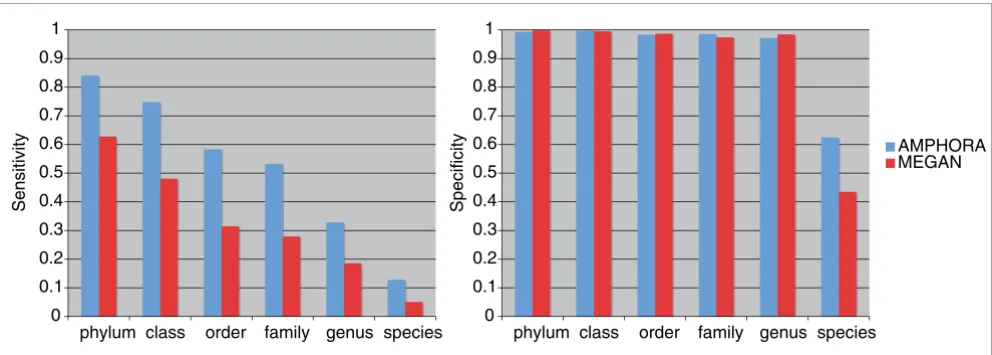
To compare quantitatively the performance of the phylogeny based and the similarity based phylotyping, we carried out a simulation study. We determined the sensitivity and specifi-city of the taxonomic assignments made by AMPHORA and MEGAN using 3,088 simulated shotgun sequences of 31 phy-logenetic marker genes identified from 100 known bacterial genomes as benchmarks. The 100 genomes were chosen in such a way that maximizes their representation of the phylo-genetic diversity and thus decreases the impact of the data sampling bias of current genome sequencing efforts on our results. Figure 4 compares the sensitivity and specificity of the phylotyping assignments at the phylum, class, order, fam-ily, and genus level using AMPHORA and MEGAN. The gen-eral trend toward decreasing sensitivity seen in the figure from the phylum to the species level simply reflects the fact that the amount of reference data available for taxonomic assignment is decreasing. However, AMPHORA significantly outperformed MEGAN in sensitivity at all taxonomic ranks. Both methods performed extremely well in specificity at all levels (>0.97) except at the species level, where AMPHORA (0.63) outperformed MEGAN (0.43) by a large margin.
Future issues
Additional markers
We are in the process of adding more proteins to our initial database of 31 markers, including the commonly used protein markers RecA, HSP70, and EF-Tu. Ideally, a probability based method that evaluates the positional homology of the multiple sequence alignment could be developed to automate fully the process of masking. Major expansion will also require systematic assessment of many other protein families for their suitability as phylogenetic markers. For
metagen-omic phylotyping, the marker genes do not have to be single-copy or universal, but they must have been reasonably well sampled, have sufficient phylogenetic signal, and not be fre-quently exchanged between distantly related lineages. Until we learn more about the extent of lateral gene transfer in nat-ural microbial communities, we caution against using every protein sequence collected in metagenomics studies for microbial diversity study.
More reference genomes
We have shown that adding representatives of novel phyla can facilitate metagenomic phylotyping. More reference genomes are needed for optimal performance. Although the sequencing of thousands of microbial genomes is underway, the organisms chosen are a biased sample and thus are not truly representative of the total microbial diversity. We see a need to select microbes systematically for sequencing based mainly on their phylogenetic positions, thus maximizing their value for comparative genomics and phylogenomic studies.
Conclusion
Currently, SSU rRNA is still the most powerful phylogenetic marker because of the number of sequences available and the scope of taxonomic coverage. However, the imminent arrival of thousands of microbial genome sequences will vastly expand the amount of data available for alternative protein phylogenetic markers, thus presenting us with both a chal-lenge and an opportunity. We have developed AMPHORA, a fully automated method for phylogenetic inference using multiple protein markers. AMPHORA offers speed, reliabil-ity, and high quality analyses. By eliminating the need for time consuming manual curation of sequence alignments, it removes one of the tightest bottlenecks in large-scale protein phylogenetic inference. We demonstrated its usefulness for
[image:8.612.57.553.88.265.2]Comparison of the phylotyping performance by AMPHORA and MEGAN
Figure 4
Comparison of the phylotyping performance by AMPHORA and MEGAN. The sensitivity and specificity of the phylotyping methods were measured across taxonomic ranks using simulated Sanger shotgun sequences of 31 genes from 100 representative bacterial genomes. The figure shows that AMPHORA significantly outperforms MEGAN in sensitivity without sacrificing specificity.
0 0.1 0.2 0.3 0.4 0.5 0.6 0.7 0.8 0.9 1
phylum class order family genus species 0 0.1 0.2 0.3 0.4 0.5 0.6 0.7 0.8 0.9 1
phylum class order family genus species
AMPHORA MEGAN
automating both the construction of genome trees and the assignment of phylotypes to environmental metagenomic data. We believe such a phylogenomic approach will be valuable in helping us to make sense of rapidly accumulating microbial genomic data.
Materials and methods
Protein phylogenetic marker database
For each marker, we first identified their protein sequences from representative bacterial genomes. The amino acid sequences were aligned using CLUSTALW [32] and then manually edited and masked using the GDE package [33]. The mask is a text string of '1' and '0', where reliably aligned columns were labeled '1' and ambiguous columns were labeled '0'. Next, we used HMMer [34] to make local profile HMMs from these 'seed' alignments (Figure 1).
Automated sequence alignment and trimming
Subsequent steps are carried out by a Perl script joining mul-tiple automated processes (Figure 1). First, HMMer effi-ciently aligns the query amino acid sequences onto the trusted and fixed seed alignments. The Perl script then reads the masks embedded in the seed alignments and automati-cally trims the query alignments accordingly.
Bacterial genome tree construction
Homologs of each of the 31 phylogenetic marker genes were identified from the 578 complete bacterial genomes by BLASTP searches (using marker sequences of Escherichia
coli as query sequences and a cut-off E-value of 0.1) followed
by HMMer searches (cut-off E-value 1 × e-10). The
corre-sponding protein sequences were retrieved, aligned, and trimmed as described above, and then concatenated by spe-cies into a mega-alignment. A maximum likelihood tree was then constructed from the mega-alignment using PHYML [35]. The model selected based on the likelihood ratio test was the WAG model of amino acid substitution with γ-distributed rate variation (five categories) and a proportion of invariable sites. The shape of the γ-distribution and the proportion of the invariable sites were estimated by the program.
To speed up bootstrapping analyses, very closely related taxa were removed from the original mega-alignment, which left us with 310 taxa. Maximum likelihood trees were made from 100 bootstrapped replicates of this reduced dataset using PHYML with the same parameters described above.
With very few exceptions, the marker genes are single-copy genes in all of the bacterial genomes analyzed. In those rare cases in which two or more homologs were identified within a single species, a tree-guided approach was used to resolve the redundancy. If the redundancy resulted from a species-spe-cific duplication event, then one homolog was randomly cho-sen as the reprecho-sentative. In all other cases, to avoid potential complications such as lateral gene transfer, we excluded that
marker and treated it as 'missing' in that particular genome. It has been shown that as long as there is sufficient data, a few 'holes' in the dataset will not compromise the resulting tree [36].
Phylotyping by phylogenetic analyses (AMPHORA)
The protein markers used to construct the bacterial genome tree (see above) and the resultant genome tree were used as the reference sequences and the reference tree for phylotyp-ing metagenomic data from the Sargasso Sea or the simulated sequences described below. Each marker sequence identified from the metagenomic data or simulated sequences was indi-vidually aligned to its corresponding reference sequences and trimmed using the method described above. Then it was inserted into the reference tree using a maximum parsimony method of RAXML [37], constraining the topology of the tree to that of the genome tree. This tree construction procedure was extremely fast, and 100 bootstrap replicates were run for each query sequence to assess the confidence of the branching orders. The trees were rooted arbitrarily using Deinococcus
radiodurans as the outgroup. Tree branch lengths were
cal-culated using the neighbor joining algorithm with a fixed tree topology.
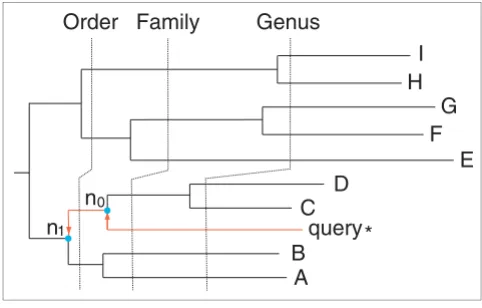
A tree-based bracketing algorithm was then employed to assign a phylotype to the query sequence (Figure 5), as fol-lows. Starting from the immediate ancestor n0 of the query sequence and moving toward the root of the tree, the first internal node n1 whose bootstrap support exceeded a cut-off (for example, 70%) was identified. The common NCBI taxon-omy t1 that was shared by all descendants of the node n1 rep-resented the most conservative taxonomic prediction for the query sequence. Using the branch length information, finer scale phylotyping was carried out by comparing the normal-ized branch length from n0 to n1 with these between taxo-nomic ranks that had been tallied from the bacterial genome tree. Based on this comparison, a taxonomic rank below or equal to t1 was assigned to the node n0. The taxonomy of the sister node of the query at this rank was then assigned to the query. All tree branch lengths were normalized by dividing them by the lengths of the root-to-tip branches of their partic-ular lineages. This was done to make the tree more clock-like, and therefore the branch lengths would be much more informative in inferring the time of evolution. In the simula-tion study, the query sequence itself was removed from the reference dataset before the analyses.
Phylotyping by similarity-based analyses (MEGAN)
chosen to match the one used in a similar phylotyping simu-lation study described in the original MEGAN report [30]. All other parameters of MEGAN were set as default values except that the min-support (the minimum number of sequence reads that must be assigned to a taxon) is set to 1, because in our simulation study each query sequence was assigned a phylotype independently.
Phylotyping simulation study
To assess the performance of the phylotyping methods, a sim-ulation study was carried out. One hundred representative genomes maximizing the phylogenetic diversity of the 578 complete bacterial genomes were selected using the genome tree and an algorithm described in the report by Steel [38]. From each of the 31 phylogenetic marker genes identified from the 100 bacterial genomes, a DNA sequence fragment of 300 to 900 base pairs in length was randomly chosen, which resulted in a total of 3,088 simulated shotgun sequences that were used as benchmark query sequences in phylotyping (some markers are missing in some of the genomes). By com-paring the predicted taxa with the known taxa, the sensitivity and specificity of phylotyping methods were calculated as described in the report by Krause and coworkers [39]. Briefly, for a taxon i, let Pi be the number of query sequences from i,
TPi be the number of sequences that are correctly assigned to
i, and FPi be the number of sequences that are incorrectly assigned to i. The sensitivity TPi/Pi measures the proportion of query sequences that are correctly classified. The specifi-city TPi/(TPi + FPi) measures the reliability of the phylotyping assignments.
SSU rRNA tree construction
SSU rDNA sequences were extracted from complete genomes, aligned, and trimmed using an online tool MyRDP [40]. When multiple copies of SSU rRNA genes were present within a single genome, one representative was randomly chosen. Maximum likelihood tree was constructed using PHYML [35], applying the GTR model of substitution, with a
γ-distribution (α estimated by the program) of rates of five categories of variable sites and a proportion of invariable sites (proportion estimated by the program).
Availability
The AMPHORA package and the simulation study data can be downloaded from [41].
Abbreviations
AMPHORA: AutoMated PHylogenOmic infeRence; HMM: hidden Markov model; NCBI: National Center for Biotech-nology Information; nr: nonredundant protein sequence; SSU: small subunit NSF: US National Science Foundation.
Authors' contributions
MW designed the study, developed the method, and per-formed the analyses. JAE advised on method design and test-ing. MW and JAE wrote the paper.
Additional data files
The following additional data are available with the online version of this paper. Additional data file 1 is a table listing the 578 complete bacterial genomes downloaded from the NCBI RefSeq database for this study. Additional data file 2 is a fig-ure of a maximum likelihood genome tree of 578 bacterial species; major taxonomic groups are highlighted by color. Additional data file 3 provides a figure that compares γ -pro-teobacterial phylogenetic trees made from a super-matrix of 31 protein phylogenetic markers and from the SSU rDNA; bootstrap support values are shown along their correspond-ing branches. Additional data file 4 is a figure of a maximum likelihood tree of rpoB; adding a novel genome (
Thermomi-crobium roseum) to the reference tree helped anchor a
sequence read (ZAVAM73TF) from a Yellowstone hotspring metagenomic study. Additional data file 5 is a table listing phylotypes breakdown of the Sargasso Sea metagenomic sequence data by phylogenetic markers and major taxonomic groups.
Additional data file 1
578 complete bacterial genomes downloaded from the NCBI Ref-Seq database
Presented is a table listing the 578 complete bacterial genomes downloaded from the NCBI RefSeq database for this study. Click here for file
Additional data file 2
Maximum likelihood genome tree of 578 bacterial species Presented is a figure of a maximum likelihood genome tree of 578 bacterial species. Major taxonomic groups are highlighted by color. Click here for file
Additional data file 3
Comparison of γ-proteobacterial phylogenetic trees
Presented is a figure that compares γ-proteobacterial phylogenetic trees made from a super-matrix of 31 protein phylogenetic markers (A) and from the SSU rDNA (B). Bootstrap support values are shown along their corresponding branches.
Click here for file Additional data file 4
Maximum likelihood tree of rpoB
Presented is a figure of a maximum likelihood tree of rpoB. Adding a novel genome (Thermomicrobium roseum) to the reference tree helped anchor a sequence read (ZAVAM73TF) from a Yellowstone hotspring metagenomic study.
Click here for file Additional data file 5
Phylotypes breakdown of the Sargasso Sea metagenomic sequence data
Presented is a table listing phylotypes breakdown of the Sargasso Sea metagenomic sequence data by phylogenetic markers and major taxonomic groups.
Click here for file
Acknowledgements
The initial development of this work was supported in part by NSF grant DEB-0228651 to JAE. The final development and testing was funded by the Gordon and Betty Moore Foundation (grant #1660 to JAE).
[image:10.612.54.295.88.242.2]A tree based bracketing algorithm for phylotyping a query sequence
Figure 5
A tree based bracketing algorithm for phylotyping a query sequence. To assign a phylotype to the query sequence, its immediate ancestor n0 and the first internal node n1 with ≥70% bootstrapping support were identified. The known descendant leaf nodes of n1, namely A through D, are used to infer the taxonomy of the query, in conjunction with the normalized branch length information. The dashed timelines delimiting various taxonomic ranks were inferred from a clock that had been calibrated from the bacterial genome tree.
query
D
E
F
G
H
I
C
B
A
*
n0
n1
References
1. Woese CR, Achenbach L, Rouviere P, Mandelco L: Archaeal phyl-ogeny: reexamination of the phylogenetic position of Archae-oglobus fulgidus in light of certain composition-induced artifacts. Syst Appl Microbiol 1991, 14:364-371.
2. Hasegawa M, Hashimoto T: Ribosomal RNA trees misleading? Nature 1993, 361:23.
3. Ludwig W, Klenk H-P: Overview: A phylogenetic backbone and taxonomic framework for procaryotic systematics. In Bergey's Manual of Systematic BacteriologyVolume 1. 2nd edition. Edited by: Boone DR, Castenholz RW, Garrity GM. New York, NY: Springer-Verlag; 2000:49-65.
4. Loomis WF, Smith DW: Molecular phylogeny of Dictyostelium discoideum by protein sequence comparison. Proc Natl Acad Sci USA 1990, 87:9093-9097.
5. Lockhart PJ, Howe CJ, Bryant DA, Beanland TJ, Larkum AW: Substi-tutional bias confounds inference of cyanelle origins from sequence data. J Mol Evol 1992, 34:153-162.
6. Baldauf SL, Roger AJ, Wenk-Siefert I, Doolittle WF: A kingdom-level phylogeny of eukaryotes based on combined protein data. Science 2000, 290:972-977.
7. Jeffroy O, Brinkmann H, Delsuc F, Philippe H: Phylogenomics: the beginning of incongruence? Trends Genet 2006, 22:225-231. 8. Brown JR, Douady CJ, Italia MJ, Marshall WE, Stanhope MJ:
Univer-sal trees based on large combined protein sequence data sets. Nat Genet 2001, 28:281-285.
9. Ciccarelli FD, Doerks T, von Mering C, Creevey CJ, Snel B, Bork P: Toward automatic reconstruction of a highly resolved tree of life. Science 2006, 311:1283-1287.
10. Delsuc F, Brinkmann H, Philippe H: Phylogenomics and the reconstruction of the tree of life. Nat Rev Genet 2005, 6:361-375. 11. Wu M, Ren Q, Durkin AS, Daugherty SC, Brinkac LM, Dodson RJ, Madupu R, Sullivan SA, Kolonay JF, Haft DH, Nelson WC, Tallon LJ, Jones KM, Ulrich LE, Gonzalez JM, Zhulin IB, Robb FT, Eisen JA: Life in hot carbon monoxide: the complete genome sequence of Carboxydothermus hydrogenoformans Z-2901. PLoS Genet 2005, 1:e65.
12. Badger JH, Eisen JA, Ward NL: Genomic analysis of Hyphomonas neptunium contradicts 16S rRNA gene-based phylogenetic analysis: implications for the taxonomy of the orders 'Rhodo-bacterales' and Caulobacterales. Int J Syst Evol Microbiol 2005, 55:1021-1026.
13. Brocchieri L: Phylogenetic inferences from molecular sequences: review and critique. Theor Popul Biol 2001, 59:27-40. 14. Foster PG, Hickey DA: Compositional bias may affect both DNA-based and protein-based phylogenetic reconstructions. J Mol Evol 1999, 48:284-290.
15. Gatesy J, DeSalle R, Wheeler W: Alignment-ambiguous nucle-otide sites and the exclusion of systematic data. Mol Phylogenet Evol 1993, 2:152-157.
16. Eisen JA: Phylogenomics: improving functional predictions for uncharacterized genes by evolutionary analysis. Genome Res 1998, 8:163-167.
17. Castresana J: Selection of conserved blocks from multiple alignments for their use in phylogenetic analysis. Mol Biol Evol 2000, 17:540-552.
18. Béjà O, Aravind L, Koonin EV, Suzuki MT, Hadd A, Nguyen LP, Jovanovich SB, Gates CM, Feldman RA, Spudich JL, Spudich EN, DeLong EF: Bacterial rhodopsin: evidence for a new type of phototrophy in the sea. Science 2000, 289:1902-1906.
19. Jain R, Rivera MC, Lake JA: Horizontal gene transfer among genomes: the complexity hypothesis. Proc Natl Acad Sci USA 1999, 96:3801-3806.
20. Morrison DA, Ellis JT: Effects of nucleotide sequence alignment on phylogeny estimation: a case study of 18S rDNAs of apicomplexa. Mol Biol Evol 1997, 14:428-441.
21. Williams KP, Sobral BW, Dickerman AW: A robust species tree for the alphaproteobacteria. J Bacteriol 2007, 189:4578-4586. 22. Lerat E, Daubin V, Moran NA: From gene trees to organismal
phylogeny in prokaryotes: the case of the gamma-proteo-bacteria. PLoS Biol 2003, 1:E19.
23. Taxonomic outline of the prokaryotes. [http://141.150.157.80/ bergeysoutline/main.htm]
24. Moran NA: Accelerated evolution and Muller's rachet in endosymbiotic bacteria. Proc Natl Acad Sci USA 1996, 93:2873-2878.
25. Maughan H: Rates of molecular evolution in bacteria are
rela-tively constant despite spore dormancy. Evolution 2007, 61:280-288.
26. Venter JC, Remington K, Heidelberg JF, Halpern AL, Rusch D, Eisen JA, Wu D, Paulsen I, Nelson KE, Nelson W, Fouts DE, Levy S, Knap AH, Lomas MW, Nealson K, White O, Peterson J, Hoffman J, Parsons R, Baden-Tillson H, Pfannkoch C, Rogers YH, Smith HO: Environ-mental genome shotgun sequencing of the Sargasso Sea. Sci-ence 2004, 304:66-74.
27. Morris RM, Rappe MS, Connon SA, Vergin KL, Siebold WA, Carlson CA, Giovannoni SJ: SAR11 clade dominates ocean surface bac-terioplankton communities. Nature 2002, 420:806-810. 28. Kasai H, Watanabe K, Gasteiger E, Bairoch A, Isono K, Yamamoto S,
Harayama S: Construction of the gyrB database for the identi-fication and classiidenti-fication of bacteria. Genome Inform Ser Work-shop Genome Inform 1998, 9:13-21.
29. Santos SR, Ochman H: Identification and phylogenetic sorting of bacterial lineages with universally conserved genes and proteins. Environ Microbiol 2004, 6:754-759.
30. Huson DH, Auch AF, Qi J, Schuster SC: MEGAN analysis of metagenomic data. Genome Res 2007, 17:377-386.
31. Koski LB, Golding GB: The closest BLAST hit is often not the nearest neighbor. J Mol Evol 2001, 52:540-542.
32. Thompson JD, Higgins DG, Gibson TJ: CLUSTAL W: improving the sensitivity of progressive multiple sequence alignment through sequence weighting, position-specific gap penalties and weight matrix choice. Nucleic Acids Res 1994, 22:4673-4680. 33. Smith SW, Overbeek R, Woese CR, Gilbert W, Gillevet PM: The genetic data environment: an expandable GUI for multiple sequence analysis. Comput Appl Biosci 1994, 10:671-675. 34. Eddy SR: Profile hidden Markov models. Bioinformatics 1998,
14:755-763.
35. Guindon S, Gascuel O: A simple, fast, and accurate algorithm to estimate large phylogenies by maximum likelihood. Syst Biol 2003, 52:696-704.
36. Wiens JJ: Missing data, incomplete taxa, and phylogenetic accuracy. Syst Biol 2003, 52:528-538.
37. Stamatakis A: RAxML-VI-HPC: maximum likelihood-based phylogenetic analyses with thousands of taxa and mixed models. Bioinformatics 2006, 22:2688-2690.
38. Steel M: Phylogenetic diversity and the greedy algorithm. Syst Biol 2005, 54:527-529.
39. Krause L, Diaz NN, Goesmann A, Kelley S, Nattkemper TW, Rohwer F, Edwards RA, Stoye J: Phylogenetic classification of short envi-ronmental DNA fragments. Nucleic Acids Res 2008, 36:2230-2239.
40. Cole JR, Chai B, Farris RJ, Wang Q, Kulam SA, McGarrell DM, Garrity GM, Tiedje JM: The Ribosomal Database Project (RDP-II): sequences and tools for high-throughput rRNA analysis. Nucleic Acids Res 2005, 33:D294-D296.
41. AMPHORA [http://bobcat.genomecenter.ucdavis.edu/ AMPHORA]