International Journal of Emerging Technology and Advanced Engineering
Website: www.ijetae.com (ISSN 2250-2459, ISO 9001:2008 Certified Journal, Volume 5, Issue 2, February 2015)
129
Curvelet Based Efficient Image Compression Technique by
Spiht with PSO
S. R. Sannasi Chakravarthy
1, S. A. Subhasakthe
21,2
Assistant Professor, Dept of ECE, Bannari Amman Institute of Technology, India
Abstract – In recent years, Curvelet Transform is the most preferred technique for image compression. It is proposed that an efficient and fast image compression scheme based on all level curvelet coefficients with SPIHT (Set Partitioning in Hierarchical Trees).After many passes of coding with SPIHT, it degrades the coding performance.There was a need of a transform that handles two dimensional singularities along the curves sparsely. This gives the origin of new multi-resolution curvelet transform. The designed curvelet techniques are used to represent the edges and to handle two dimensional singularities along curves sparsely. Now the selected all level curvelet coefficients information is applied with SPIHT encoding. Then this output is stored as a bit stream.In addition, PSO (Particle Swarm Optimization) helps to reasonably allocate bits between source coding and channel coding across bit streams.Then SPIHT decoding has been applied and inverse curvelet transform has been taken to reconstruct the image. Different images with different sizes have been tested in the experiment and the results are listed.
Keywords --Image compression; Curvelet Coefficients; Wavelet Transform; SPIHT; PSO;
I. INTRODUCTION
Growing traffic of multimedia contents over wireless networks calls for new tools that, even at low bit rates, provide a good representation of images and video. In recent years this has led to new compression standards, such as the wavelet based JPEG which improves upon JPEG especially at low bit rates. Nonetheless, the performance is still far from theoretical compression bounds, also because of the limited efficiency of current transforms. Non Linear
Approximation error (NLA) [1] is minimized by obtaining a sparse representation of data and wavelet is known not to be optimal under this point of view.
In the past some years, wavelet transform is widely used in the field of image compression and has established its effectiveness because of the well-localized property of its coefficients in both space and frequency domains.
Different wavelet-based encoding schemes have been developed i.e. EZW [4], SPECK [5], and SPIHT [6] etc, each of which exploits the multi-scale nature of wavelet transform and has proven their significance to improve performance.
In recent years, there has been intense research on new transforms that overcome wavelet limits in representing image curves. This paper presents an image compression scheme based on curvelet coefficients with all levels using SPIHT algorithm and run length encoding.
The rest of the paper structure is as follows. Section II, III and IV discuss the theoretical basis of Curvelets, SPIHT and respectively. Then, Section V describes the proposed image compression scheme that is the integration of all level Digital Curvelet Transform, SPIHT, PSO. This is followed by a discussion of the compression results.
II.CURVELET TRANSFORM (CT)
A new multi-resolution transform was developed by Candés and Donoho in 1999 known as curvelet transform as a result of motivation to take away the drawbacks associated with wavelet transform. The curvelet transform is a multistate directional transform that allows an almost optimal non-adaptive sparse representation of objects with edges. Curvelets can be interpreted as a grouping of nearby wavelet basis functions into linear structures so that they can capture the smooth discontinuity curve more efficiently. More efficient in capturing the geometry and the concise (sparse) representation.The transform that is a two-dimensional anisotropic waveletextension, designed fullyfor representing the edges and other singularities along curves much more efficiently than traditional wavelet transforms. Although Curvelets is an extension of wavelets but there exist correspondence between curvelet and wavelet sub-bands.
The formal rule which denotes correspondence between curvelet sub-band (Cs) and wavelet sub-band (Ws) is
International Journal of Emerging Technology and Advanced Engineering
Website: www.ijetae.com (ISSN 2250-2459, ISO 9001:2008 Certified Journal, Volume 5, Issue 2, February 2015)
130
And this gives rise to new multi-resolution curvelet transform, but these also oriented at a variety of directions and so represent edge discontinuities and other singularities well than wavelet transform.Curvelet transform is a special member of the multi-scale geometric transforms [15, 16, 17]. It is a transform with multi-scale pyramid with many directions at each point. Curvelets is good over wavelets in following cases:
i) Optimally sparse representation of objects with edges. ii) Optimal reconstruction in severely disturbed imaging
problems
iii)Reasonable representation of wave propagators in an image; Curvelets are initially introduced by Candes and Donoho.
Suppose we have a function f which has a discontinuity across a curve, and which is smooth otherwise, and consider approximating f from the best m−terms in the Fourier
expansion. The squared error of such an m-term
Expansion obeys:
In a wavelet expansion, we have
Where fŵ denotes the approximation from m best wavelet
coefficients.
In a curvelet expansion, we have the equation of
is the approximation from the best of m Curvelet
coefficients.
III. THE SPIHT ENCODING
SPIHT method is not only a simple extension of traditional method for image compression but it also produces good quality images. Moreover, it provides a fully embedded code file, code to exact bit rate and is completely adaptive [8]. SPIHT originally used wavelets and due to its support for multi-resolution encoding/decoding, which is also applicable to curvelet transform.
The SPIHT scheme employs an iterative partitioning or splitting of sets or groups of pixels (or transform coefficients), in which the tested set is divided when the maximum magnitude within it exceeds a certain threshold. When the set passes the test and hence divided, this division is so important or else it is said to be insignificant.
Insignificant sets are repeatedly tested at successively lowered thresholds until isolated significant pixels are identified. The results of these so-called significance tests describe the path taken by the coder to code the source samples or coefficients of the image. Since the binary outcomes of these tests are put into the bit stream as a „0‟ or „1‟the execution path at the decoder can be replicate of the encoderat the destination.
Below is the SPIHT algorithm presented in steps:
A. Initialization:
Compute N
Where is the wavelet coefficient at position (m, n).
Set the initial threshold
B. Sorting pass:
Identify wavelet coefficients with output their respective signs and positions.
C. Refinement pass:
Output the b th bit of the significant wavelet coefficients
with , which have been identified already in the previous passes.
D. Increase b by one, divide the threshold value by 2 and goto Step 2.
IV. PARTICAL SWARM OPTIMIZATION (PSO)
International Journal of Emerging Technology and Advanced Engineering
Website: www.ijetae.com (ISSN 2250-2459, ISO 9001:2008 Certified Journal, Volume 5, Issue 2, February 2015)
131
A. For each particle i = 1, ..., S do:
First, start to initialize the particle's position with a uniformly distributed random vector: xi ~ U(blo, bup), where blo and bup are the lower and upper boundaries of the search-space.
Then update the current position of the particle to best known position as of (pi ← xi)
If (f(pi) <f(g)) update the swarm's best known
position: g ← pi
vi ~ U(-|bup-blo|, |bup-blo|) : the particle's velocity is initialized
B. Until a termination criterion is met (e.g. number of iterations performed, or adequate fitness reached), repeat:
For each particle i = 1, ..., S do: Pick random numbers: rp, rg ~ U(0,1)
Update the particle's velocity: vi ← ω vi + φprp (pi
-xi) + φgrg (g-xi)
Update the particle's position: xi ← xi + vi
If (f(xi) <f(pi)) do:
Then the particle's best known position is updated as (pi ← xi)
If (f(pi) <f(g)) update the swarm's best known
position: g ← pi Now g holds the best found
solution.
V. PROPOSED SCHEME
[image:3.612.344.546.148.274.2]The new approach is actually an integration of FDCT with SPIHT algorithm and PSO. The block diagram in Fig. 2 depicts the methodological detail of the encoding and decoding process of proposed approach. In the proposed method, curvelet transform of an image is obtained and the level 1,2 and 3 curvelet coefficient information are selected. Then, it has been applied with SPIHT encoding with PSO.
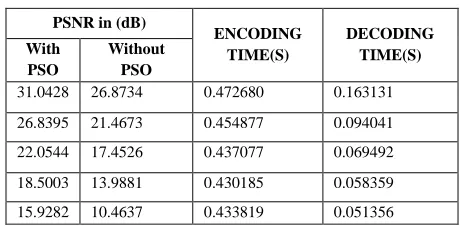
TABLE 1.
[image:3.612.60.290.579.692.2]PSNR values with PSO and without PSO& CR=40
Fig 1.Proposed Method by SPIHT Encoding With PSO
As in the above figure, the test image is applied with Curvelet Transform. Then all the coefficients of Curvelet Transform make use of SPIHT encoding to convert them into bit streams. Now PSO is used to reasonably allocate bits between source coding and channel coding across bit streams. Finally the test image is recovered by applying SPIHT decoding and Inverse Curvelet Transform.
VI. PROPOSED ALGORITHM
Step 1: Initialize PSO parameters:-
Fitness Function (Expected CR and PSNR)
Iteration Count
Global Best (usually a High Value)
Step 2: Acquire On Test Image.
Step 3:Randomly Assign Curvelet Transform co-efficient and memorize it.
Step 4: Apply curvelet transform in the Test Image
Step 5:Apply SPIHT Encoding on the transformed image
Step 6:Calculate the Bit stream compression ratio and reconstructed ratio of the Encoded Image
Step 7: Memorize the statistical results as local best
Step 8:Compare local and global best. If local prediction is better than the global prediction update global with local best values
Step 9: STOP: Either if iteration limits is reached. If the global best reaches its fitness value.
Step10: REPEAT Step 3. STOP: Memorize the Curvelet co-efficient as final output prediction.
PSNR in (dB)
ENCODING TIME(S)
DECODING TIME(S) With
PSO
Without PSO
31.0428 26.8734 0.472680 0.163131
26.8395 21.4673 0.454877 0.094041
22.0544 17.4526 0.437077 0.069492
18.5003 13.9881 0.430185 0.058359
International Journal of Emerging Technology and Advanced Engineering
Website: www.ijetae.com (ISSN 2250-2459, ISO 9001:2008 Certified Journal, Volume 5, Issue 2, February 2015)
132
First Initialize the PSO parameters (i.e.)., fitness function, iteration count and global best value. The test Image is applied randomly assigns Curvelet transform coefficients and memorizes it. Then apply SPIHT encoding on the transformed image.A. Experimental results using PSO
Minimum gray scale standard test images like Microchip image and Rice of size 512 x 512, and 256 X 256 havebeen taken from World Wide Web forexperiments and comparisons. The software, MATLABis utilized for the implementation of proposed method and the results have been obtained. Different quality metric values i.e. Compression Ratio (CR) and PSNR measure are tabulated in the table 1 and bar chart. The original images, Curvelet transformed images and reconstructed images are showed in figure 2 and 3.
Fig2. PSNR values between with PSO & without PSO
Original Image With PSO Without PSO
Original Image With PSO Without PSO Fig3. Compressed Microchip &Rice Images using PSO
VII. CONCLUSION
The wavelet transform has the inability to represent edge discontinuities along curves. Also, it provides compression with high complexity. For overcome that, a new multi-resolution curvelet transform is used. This curvelet transform represent the edge discontinuities very well and also, it provides compression with very less coefficients. Then the SPIHT encoding is used to convert these coefficients into bit streams. PSO helps to reasonably allocate bits between source coding and channel coding across bit streams.In future, these bit streams are applied with SPIHT Encoding with PSO for further reduction of bit streams. And finally the test image is recovered by applying SPIHT Encoding and inverse curvelet transform.
REFERENCES
[1] A.Cohen, I.Daubechies, O.G.Guleryuz and M.T.Orchard,“ On the
importance of combining Wavelet-Based Nonlinear Approximation With Coding Strategies” IEEE Trans. Inform theory, vol. 48, no. 7, (Jul 2002) 1895- 1921.
[2] D.L.Donoho, M.Vetterli, R.A.DeVore and I.Daubechies “Data
Compression and Harmonic Analysis,” IEEE Trans. Inform Theory, vol. 44, no. 6, (Oct. 1998) 2435-2476.
[3] M. Vetterli and J. Kovacevic, “Wavelets and Sub-band Coding,”
Prentice Hall Signal Processing Series. Prentice Hall, Englewood Cliffs, New Jersey, 1995.
[4] J. M. Shapiro, “Embedded image coding using zerotrees of wavelet
coefficients,” IEEE Trans. Signal Processing, 41(1993).
[5] W. Pearlman, “SPIHT,”www.cipr.rpi.edu/research/spiht/
ew_codes/spiht@jpeg2k_c97.pdf
[6] Said and W. A. Pearlman, “A new fast and efficient image codec
based on Set Partitioning In Hierarchical Trees,” IEEE Trans. Circuits Syst. Video Technol., 6(1996) 243- 250.
[7] J.L. Starck, E. J. Candès, and D. L. Donoho, “The Curvelet transform
for image de-noising,” IEEE Transactions on Image processing,, 11(6)(2002) 670 – 684.
[8] M.S.Joshi,R.R.Manthalkar and Y.V.Joshi,” Image compression using
curvelet, Ridgelet and wavelet transform, a comparative study”, ICGST GVIP, ISSN 1687-398X, Volume(8), Oct 2008.
[9] E. J. Cand`es and D. L. Donoho. New tight frames of curvelets and optimal representations of objects with piecewise - C2 singularities. Comm. on Pure and Appl. Math. 57 (2004), 219 – 266
[10] E.J. Candes, L.Demanet, D.L.Donoho, L.Ying,” Fast Discrete
Curvelet Transforms, “Stanford University Press Notes, July 2005.
[11] Candμes, E. and Donoho, D. (1999) Curvelets. Manuscript.
[12] J.L. Starck, E. J. Candès, and D. L. Donoho, “The Curvelet transform
for image denoising,” IEEE Transactions on Image processing,, 11(6)(2002) 670 –684
[13] Subhasis Saha , “Image Compression from DCT to Wavelets: A
Review”, The ACM Student Magazine.
[14] Sayood, Khalid (2000),” Introduction to Data Compression”, Second
edition Morgan Kaufmann.
0 10 20 30 40
1 2 3 4 5
With PSO P
S N R
(
d B
)
International Journal of Emerging Technology and Advanced Engineering
Website: www.ijetae.com (ISSN 2250-2459, ISO 9001:2008 Certified Journal, Volume 5, Issue 2, February 2015)
133
[15] J. M. Shapiro, “Embedded image coding using zerotrees of wavelet
coefficients,” IEEE Trans. Signal Processing, 41(1993) 3445 - 3462.
[16] A .Cohen, I.Daubechies, O.G.Guleryuz and M.T.Orchard,“ On the
importance of combining Wavelet-Based Nonlinear Approximation With Coding Strategies” IEEE Trans. Inform theory, vol. 48, no. 7, (Jul 2002) 1895 - 1921.
[17] W. A. Pearlman, A. Islam, N. Nagaraj, and A. Said “Efficient, Low -