International Journal of Emerging Technology and Advanced Engineering
Website: www.ijetae.com (ISSN 2250-2459, ISO 9001:2008 Certified Journal, Volume 9, Issue 3, March 2019)
37
An Efficient Approach for Image Compression using HAAR
Wavelet Transform
Ragini Dubey
1, Prof. Nitesh Kumar
2 1MTech Scholar, 2Assistant Professor, ECE Department, Sagar Institute of Research Technology & Science, Bhopal (M.P.), India
Abstract—Image compression is an essential image handling assignment. Medical imaging is on the simplest technique for observation the patient health condition. CT or magnetic resonance imaging medical imaging produce digital kind of physical body photos. There exists a desire for compression of those pictures for storage and communication functions. Current compression schemes offer a really high compression rate with a substantial loss of quality. In medication, it's necessary to possess high image quality in region of interest, i.e. diagnostically necessary regions. This work discusses an efficient model of lossless compression in region of interest with high compression rate, lossy compression in different regions. In medical image once some portion of image is to be selected, and then ROI is chosen with the assistance of discrete cosine transform. It’s used with the ROI method to compress the medical image to get rid of the interference result.
Keywords—PSNR, MSE, Haar Wavelet Transform, Discrete Cosine Transform, Region of Interest.
I. INTRODUCTION
Image compression is limiting the size in bytes of a designs document while not mortifying the standard of the image to an unsuitable level. The decrease in record measure allows additionally pictures to be stored amid a given amount of circle or memory zone. It moreover limits the time requested for pictures to be exchange over the web or downloaded through sites. There are numerous different procedures amid which image documents might be packed. For web use, the 2 most broad packed realistic image game plans are the JPEG plot and furthermore the GIF conspire. The JPEG strategy is extra generally utilized for images, while the GIF technique is typically utilized for line craftsmanship and next pictures amid which geometric shapes are moderately ordinary.
Different routes for compression include the utilization of fractals and wavelets. These methods haven't increased boundless acknowledgment for usage on the web as of this composition. In any case, every methodology gives guarantee since they create higher compression proportions as correlation with that of the JPEG or GIF systems for a couple of sorts of pictures. Another most recent system that will in time substitute the GIF course of action is that the PNG definition.
Compressing an image is altogether unique in relation to the compression crude twofold data. Obviously, general compression programs are frequently used to pack pictures; anyway the yield is less as that of the ideal. Moreover, some of the better information inside the image might be surrendered for saving a little extra transfer speed or storage room. This moreover implies lossy compression strategies might be utilized amid this field.
[image:1.612.338.548.328.429.2]
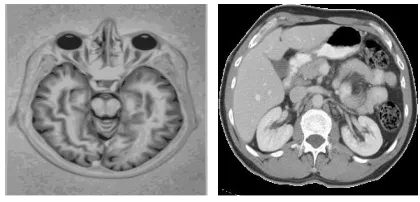
Figure 1: MRI image of brain and CT image of abdomen
International Journal of Emerging Technology and Advanced Engineering
Website: www.ijetae.com (ISSN 2250-2459, ISO 9001:2008 Certified Journal, Volume 9, Issue 3, March 2019)
38 Image compression tends to the issue of diminishing the measure of data required to speak to a computerized image. It is a procedure expected to yield a conservative portrayal of an image, in this manner lessening the image stockpiling transmission prerequisites. Each image will have excess data. Excess means the duplication of data in the image. It is possible that it might rehash pixel over the image or example, which is rehashed all the more as often as possible in the image.
II. LITERATURE SURVEY
Khushpreet KaurMain et. al [1] ―Image Compression using HAAR Wavelet Change and Discrete Cosine Change" Medical imaging incorporates a decent effect on the diagnosing of sickness and careful planning. The imaging gadgets still produce a great deal of data per understanding, typically goliath imaging. These Data need future stockpiling and conservative transmission in this way there's a necessity to pack medical pictures.
Deepak.S.Thomas,et. al [2] "Medical Image Compression Dependent on Mechanized return for money invested Determination for Telemedicine Application" present answers for temperate locale based generally compression for expanding the compression quantitative connection with less mean square blunder at least time interim upheld brisk discrete curvelet change with versatile number juggling mystery composing. They same this task vigorously utilized for compression medical pictures to transmit for telemedicine application. To weaken the information misfortune, number juggling entropy mystery composing was utilized adequately. it'll be expanded by consolidating bit mystery composing for press the optional area and this productive methodology was expanded the nuclear number 24 and scale back the learning misfortune.
Neha S. Korde et. al [3] "Wavelet Based Medical Image Compression For Telemedicine Application", displayed the compression method on medical attractive reverberation imaging and CT pictures. Right off the bat, they recover the image into dim level. In this manner channel the information pictures then segmental the image to locate return for capital invested half and foundation half.
In last, they utilized unmistakable trigonometric capacity redesign and entire number swell compression procedure, and found that mean sq. mistake decreases misuse swell compression system. They also made reference to the shifted types of swell philosophy.
B. Brindha et. al [4], "Locale Based Lossless Compression for Computerized Images in Telemedicine Application" proposes an extremely practical and low quality compression strategy for Advanced Imaging and Correspondences in drug (DICOM) pictures.
Principle advantages of District based generally cryptography method is misused in their paper. return for capital invested a piece of the image is known by physically in and joined with consequence of whole number wavelet change (IWT) that is useful to recreate the primary image, reversibly with wanted quality. the general compression strategy prevails in a tasteful level for image transmission in limited data measure over a telemedicine application abuse discrete cosine change (DCT) procedure. Gaurav Vijayvargiya et. al [5] "An Overview: Different Strategies of Image Compression", This paper presents changed methods of image compression. These are as yet a troublesome errand for the analysts and academicians. There are primarily 2 sorts of image compression methods exist. correlation the execution of compression procedure is troublesome except if indistinguishable data sets and execution measures are utilized. A portion of these methods are acquired useful for specific applications like security innovations. When investigation of all systems it's discovered that lossless compression strategies are best over the lossy compression procedures. Lossy gives a higher compression proportion than lossless.
III. PROBLEM FORMULATION
Medical imaging is one of the best techniques for monitoring the person’s health condition which is used widely nowadays. Also some of diseases can be detected using medical imaging methods. One of the problems that physicians encounter with it to store the medical images. This storage occupy more area for storing images long time as there is need to keep the record of numerous patients. So there is need to compress the image to be resolved in a variety of medical images, including radiography, magnetic resonance (MR), mammography, and ultrasound images, X-Rays, Brain MRI, CT images and so on.
IV. PROPOSED SYSTEM
International Journal of Emerging Technology and Advanced Engineering
Website: www.ijetae.com (ISSN 2250-2459, ISO 9001:2008 Certified Journal, Volume 9, Issue 3, March 2019)
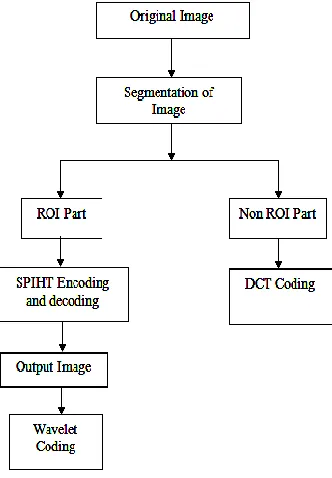
[image:3.612.90.256.189.428.2]39 Lossy coding procedure such as DCT (Discrete Cosine Transform) is subjected to non ROI part. The ROI Part which is of clinical interest is coded by DWT technique. Wavelet method is utilized for proper rebuild of ROI Part.
Figure 2: Block Diagram of Proposed System
Algorithm for Region growing procedure contains of the following steps.
1. Divide the image into 16×16 blocks. Calculate initial seed points as follows.
2. For every block, I Measure threshold T as average of maximum and minimum intensity.
3. Repeat Steps (4) to (6) till T converges.
4. Group pixels of each block into two groups, G1 and G2, where G1 has pixels whose intensity value is larger than T and G2 has pixels whose intensity value is less than T.
5. Measure Mean (_1 and _2) and Specific Deviation ( _1 and _2) of G1 and G2 respectively.
6. Re-estimate T, such that T = 0.5 * [(_1 and _2) + (_1 and _2)] and go to step 4.
7. Measure total variance (TV) and mean variance (MV)
8. Measure Seed Threshold, TS = TV + MV
9. Determine pixels with Ts < T and choose them as starting candidate seed points.
10.After selecting seed point, measure intensity difference among seed point and its neighborhood pixels.
11.Examine the neighboring pixels and join them to the region if they are same to the seed point.
12.Continue steps 10 and 11 until no more pixels can be added.
V.SIMULATION RESULTS
In medical domain the high quality image data is maintained with the help of highly efficient servers across the network. There are some areas of medicine where it is sufficient to maintain high image quality only for diagnostically important regions, for example, tumor region of the brain MRI. In this project applied the algorithm in the test image ―ROI and NROI part of the medical image‖ as shown in below Table-.1 illustrates compressed image quality with different coefficient factor and PSNR, MSE, CR and BPP is calculated.
International Journal of Emerging Technology and Advanced Engineering
Website: www.ijetae.com (ISSN 2250-2459, ISO 9001:2008 Certified Journal, Volume 9, Issue 3, March 2019)
[image:4.612.60.278.135.313.2]40 Figure 4 Reconstructed image with blocking effect in Haar Wavelet
method
[image:4.612.331.556.176.308.2]Figure 4 shows the reconstructed image with horizontal, vertical and diagonal details. This image we get by applied haar wavelet transform in the input image.
Figure.5 Compress image
[image:4.612.329.557.381.518.2]The figure 5 shows the compressed image. We applied the DCT then we get the DCT compress image.
Figure 6 output compression image
The figure 6 shows the output compression image. In this input image preprocessing then we get the received output image after compression.
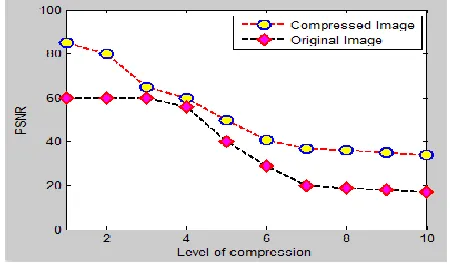
Figure 7 Graph of PSNR vs Level of compression
[image:4.612.60.278.382.526.2]The figure 7 shows graphical representation of peak signal to noise ratio and level of compression. So it is clear from graph compressed image has higher PSNR rather than original image.
Figure 8 Graph of compression ratio vs Level of compression
[image:4.612.55.282.560.703.2]The figure 8 shows graphical representation of compression ratio and level of compression. So it is clear from graph compressed image has higher compression ratio.
Table 1 Comparison table
Parameter Base paper Proposed
PSNR 49.869 65.01
MSE 0.6702 0.2050
[image:4.612.332.557.597.697.2]International Journal of Emerging Technology and Advanced Engineering
Website: www.ijetae.com (ISSN 2250-2459, ISO 9001:2008 Certified Journal, Volume 9, Issue 3, March 2019)
41
V. CONCLUSION
In this paper it has developed a procedure for line dependent wavelet transforms. It is pointed out that this s transform can be subjected to the encoder or the decoder and that it can hold compressed data. It is provided an analysis for the condition in which both encoder and decoder are similar in terms of memory requirement and complexity. We explained highly scalable spilt coding algorithm that can work accompanied by a very low memory in set with the line-dependent transform, and demonstrated that its behavior can be competitive accompanied by a state of the art image coders, at a fraction of their memory utilization. To the best of our knowledge, our work is the first to introduce a complete execution of a low memory wavelet image coder. It's another important advantage by creating a wavelet coder attractive both in terms of speed and memory requirements.
REFERENCES
[1] Khushpreet Karun, Sheenam Malhotra ―Image Compression using HAAR Wavelet Transform and Discrete Cosine Transform‖, International Journal of Computer Applications (0975 – 8887) Volume 125 – No.11, September 2017.
[2] DS Thomas, M Moorthi, R Muthalagu, ―Medical image compression based on automated ROI selection for telemedicine application‖, Int. J. Eng. Comput. Sci, 2014.
[3] Neha S. Korde, Dr. A. A. Gurjar, ―Wavelet Based Medical Image Compression for Telemedicine Application‖, American Journal of Engineering Research (AJER) 2014.
[4] B Brindha, G Raghuraman - Communications and Signal, ―Region Based Lossless Compression for Digital Images in Telemedicine Application‖, Communications and Signal Processing (ICCSP), 2013.
[5] Gaurav Vijayvargiya Dr. Sanjay Silakari Dr.Rajeev Pandey ―A Survey: Various Techniques of Image Compression‖ (IJCSIS) International Journal of Computer Science and Information Security,Vol. 11, No. 10, October 2013.
[6] Vishal Tamrakar, Mr. Chandrashekhar Kamargaonkar, Dr. Monisha Sharma ―A Noval Medical Image Analysis and Compression Using Efficient Wavelet Transform‖ International Journal of Computer Science Trends and Technology (IJCST) – Volume 4 Issue 3, May, - Jun 2016.
[7] Rushabh R. Shah, Dr. Priyanka Sharma ―Performance Analysis Of Region Of Interest Based Compression Method For Medical Images‖ Fourth International Conference on Advanced Computing & Communication Technologies 2014.
[8] Jagadish H. Pujar, Lohit M. Kadlaskar ―A new lossless method of image compression and decompression using huffman coding techniques,‖ Journal of Theoretical and Applied Information Technology, www.jatit.org, Page No.18-22.
[9] Maneesha Gupta, Dr.Amit Kumar Garg ―Analysis Of Image Compression Algorithm Using DCT,‖ International Journal of Engineering Research and Applications (IJERA), ISSN No. 2248-9622, Issue No.1, Vol.2, Page No. 515-521, Jan-Feb 2012.
[10] Navjot Kaur, Preeti Singh ―A New Method of Image Compression Using Improved SPIHT and MFHWT,‖ International Journal Latest Research in Science and Technology ISSN:2278-5299, Issue No.2, Vol.1, Page No.124-126, July-Aug (2012).
[11] Dalvir Kaur, Kamaljit Kaur ―Huffman Based LZW Lossless Image Compression Using Retinex Algorithm,‖ International Journal of Advanced Research in Computer and Communication Engineering, ISSN: 2319-5940, Issue No.8, Vol. 2, Page No. 3145-3151, Aug 2013.
[12] Lavanya. M, M. Suresh Kumar ―intelligent compression of medical images Based on multi ROI,‖ International Journal of Emerging Technology and Advanced Engineering, ISSN: 2250-2459, Issue No.1, Vol. 3, Page No. 490- 493, Jan 2013.
[13] Vikrant Singh Thakur, Shubhrata Gupta1, Kavita Thakur‖ Hybrid WPT-BDCT transform for high-quality image compression‖ IET Image Processing 2017
[14] Ruslan Kozhemiakin, Vladimir Lukin, Benoit Vozel‖ Image Quality Prediction for DCT-based Compression‖ 2017 IEEE