International Journal of Emerging Technology and Advanced Engineering
Website: www.ijetae.com (ISSN 2250-2459,ISO 9001:2008 Certified Journal, Volume 4, Issue 6, June 2014)
125
Anomaly Extraction Using Efficient-Web Miner Algorithm
Gargi Joshi
1, Prof. Anupkumar Bongale
2Dept of Computer Engg, Dr.D.Y Patil College of Engineering, Ambi, Pune, University of Pune, India
Abstract— Today network security, uptime and performance of network are important and serious issues in computer network. Anomaly is deviation from normal behaviour affecting network security. Anomaly Extraction is identification of unusual flow from network, which is need of network operator. Anomaly extraction aims to automatically find the inconsistencies in large set of data observed during an anomalous time interval. Extracted anomalies will be important for root cause analysis, network forensics, attack mitigation and anomaly modelling. We use meta data provided by several histogram based detectors to identify suspicious flows, and then apply association rule mining to find and summarize anomalous flows. Frequent pattern mining techniques namely Apriori All Algorithm and Efficient-Web Miner Algorithm will be used to generate the set of association rules applied on metadata. Using network traffic log data, algorithms effectively finds the flow associated with the anomalous event(s). Efficient-Web Miner Algorithm triggers a very small number of false positives. Efficient- Web Miner has much better performance in terms of time and space complexity than Apriori Algorithm for large data sets This anomaly extraction method significantly reduces the time needed for analyzing alarms, making anomaly detection systems more practical, simple and realistic
Keywords—Anomaly Extraction, Association rule mining, data mining, detection algorithms, Efficient-Web Miner Algorithm, histogram cloning Apriori All Algorithm.
I. INTRODUCTION
Anomaly detection techniques are the last line of defence when other approaches fail to detect security threats. Anomaly detection techniques have been extensively studied since they pose a number of interesting research problems, involving statistics, modelling, and efficient data structures. Nevertheless, they have not yet gained widespread adaptation, as number of challenges, like reducing the number of false positives or simplifying training and calibration, remain to be solved.
An anomaly detection system provides meta-data relevant to narrow down the set of candidate anomalous flows. For example, histogram bins generated using Histogram based detection technique [4] [5] [6] [7], indicates affected range of IP addresses or port numbers. Such meta-data can be used to restrict the candidate anomalous flows to affected network node.
To extract anomalous flows, one could build a model describing normal flow characteristics and use the model for identifies deviating flows. However, building such a microscopic model is very challenging due to the wide variability of network flow characteristics. Similarly, one could compare flows during an interval with flows from normal or past intervals and search for deviations, like new flows that were not previously observed or flows with significant increase/decrease in their volume[8][9]. Such kind of approaches essentially performs anomaly detection at the level of individual flows and could be used to identify anomalous flows.
[image:1.612.323.564.550.663.2]Proposed system aims to identify an anomaly from the network traffic. We aim to find the flows associated with the event(s) that triggered an observed anomaly. Beginning with network traffic data logs observation for time interval t proposed solution then applies histogram detection techniques for anomaly detection. Upon detection of anomaly, we build the clones of histogram detector and find suspicious flows. We then filter this data to eliminate large fraction of normal flows. A summary report of frequent item-sets from the set of suspicious flows is generated by applying association rule mining techniques. System uses apriori all and efficient-web miner algorithm for anomaly detection. Comparative study shows that the proposed efficient-web miner algorithm works better than standard association rule mining algorithms i.e. apriori in terms of space and time by reducing the number of database scans and candidate set pruning is reduced in stages.
International Journal of Emerging Technology and Advanced Engineering
Website: www.ijetae.com (ISSN 2250-2459,ISO 9001:2008 Certified Journal, Volume 4, Issue 6, June 2014)
126
II. LITERATURE SURVEY
F, Silveira and Diot [3] introduced a tool called URCA that searches for anomalous flows by iteratively eliminating subsets of normal flows. URCA also classifies the type of a detected anomaly. Nevertheless, it requires to repeatedly evaluating an anomaly detector on different flow subsets, which can be costly. Compared to this work, we simply computing frequent item-sets on pre filtered flows is sufficient to identify anomalous flows. An easy way to comply with the conference paper formatting requirements is to use this document as a template and simply type your text into it.
Dewaele et al.[11] use sketches to create multiple random projections of a traffic trace, then model the marginal’s of the sub traces using Gamma laws and identify deviations in the parameters of the models as anomalies. In addition, their method finds possible anomalous source or destination IP addresses by taking the intersection of the addresses hashing into anomalous sub traces. Compared to this work, we introduce and validate techniques to address the more challenging problem of finding anomalous flows rather than IP addresses.
Lakhina et al.[12] Use SNMP data to detect network-wide volume anomalies and to pinpoint the origin-destination (OD) flow along which an anomaly existed. In contrast, our approach takes as input a large number of flow records, e.g., standard 5-tuple flows, and extracts anomalous flows. An OD flow may include millions of both normal and anomalous 5- tuple flows and, therefore, can form the input to our methodology.
Li et al. [5], use sketches to randomly aggregate flows as an alternative to OD aggregation. The authors show that random aggregation can detect more anomalies than OD aggregation in the PCA subspace anomaly detection method. In addition, the authors discuss how their method can be used for anomaly extraction. However, the work and evaluation focus primarily on anomaly detection.
Lee and Stolfo [13] show how association rules can be used to extract interesting intrusion patterns from system calls and tcp dump logs.
Vaarandi [14] introduces a tool called LogHound that provides an optimized implementation of Apriori and demonstrates how LogHound can be used to summarize traffic flow records. Yoshida et al.[15] also use frequent item-set mining to identify interesting events in traces from the MAWI traffic archive.
Li and Deng [16] outline a variant of the Eclat frequent item-set mining algorithm that operates in a sliding window fashion and evaluate it using traffic flow traces from a Chinese university.
Chandola and Kumar [17] describe heuristics for finding a minimal set of frequent item-sets that summarizes a large set of flows.
Mahoney and Chan [18] use association rule mining to find rare events that are suspected to represent anomalies in packet payload data. They evaluate their method on the 1999 DARPA/Lincoln Laboratory traces. Their approach targets edge networks where mining rare events is possible. In massive backbone data, however, this approach is less promising. Another application of rule mining i edge networks is eXpose, which learns fine-grained communication rules by exploiting the temporal correlation between flows within very short time windows. Compared to these studies, association rule mining can be combined with anomaly detection to effectively extract anomalous flows. Hierarchical heavy-hitter detection methods [19] [7] group traffic into hierarchical clusters of high resource consumption and focus primarily on optimizing computational performance for summarizing normal traffic. For example, they have been used to identify clusters of Web servers in hosting farms. Hierarchical heavy- hitter detection is similar to frequent item-set mining in that both approaches find different forms of multidimensional heavy hitters. Compared to these studies, intelligently combining multidimensional heavy-hitters with anomaly detection enables us to extract anomalous flows. In addition, frequent item-set mining scales to higher dimensions much better than existing hierarchical heavy-hitter detection methods. Finally, substantial work has focused on dimensionality reduction for anomaly detection in backbone network. These papers investigate techniques and appropriate metrics for detecting traffic anomalies, but do not focus on the anomaly extraction problem which we are addressing in this project.
International Journal of Emerging Technology and Advanced Engineering
Website: www.ijetae.com (ISSN 2250-2459,ISO 9001:2008 Certified Journal, Volume 4, Issue 6, June 2014)
127 E-Web Miner is the proposed web mining algorithm that removes the flaws of Improved Apriori All algorithm and improve upon the time complexity of the earlier Apriori All algorithm. It provides an improved candidate set pruning as well. In fact, it has been shown successfully that it mines correct result of candidate set where as the Improved Apriori All algorithm fails to deliver the correct result. The algorithm has been designed independent of Apriori All algorithm. In this paper authors work shows that when Improved Apriori All Algorithm fail to deliver the desired result, the proposed algorithm of web mining in web log analysis presents a cost effective valid result having reduced candidate set pruning of correct order. So in this way the authors proved that E- Web miner is proved to be more time effective than other algorithm which provides a strong base to our comparison.
III. METHODOLOGY
A. Module Information:
1) Module 1: Design of the Graphical User Interface (GUI) for our system with client and server.
2) Module 2: Build histogram detector to observe the traffic on the network and detect anomalies.
3) Module 3: Find suspicious flows from the network traffic that causes anomaly in the network.
4) Module 4: Implement Apriori All and Efficient-Web Miner algorithm to find frequent item sets.
B. Assumption and Dependencies:
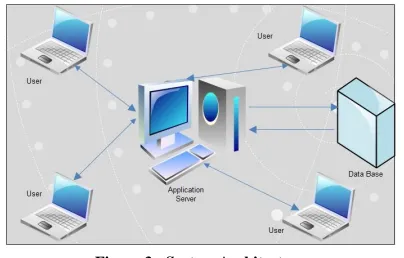
Here, we form a network between n number of computers or laptops. Our system will depend on the multiple machines connected with each other in the local area network. We are assuming server as a router in our system which observes and keep logs of all the traffic in the network. We will form network traffic for certain interval of time only. We require minimum 4 machines for better results but can be scaled further for additional ones based on requirement.
Proposed system contains three different phases – • Histogram Detector
• Histogram Cloning and Voting • Association Rule Mining
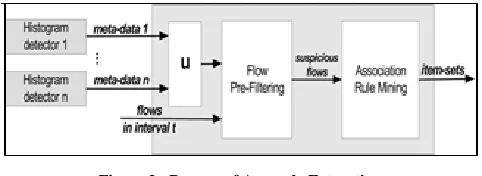
Histogram detector will observe the network traffic and alert the system upon anomaly detection. Histogram cloning assures the anomaly detection and finds the suspicious flows from network traffic.
Finally association rule mining algorithm i.e. Efficient-Web Miner Algorithm finds the frequent item sets.
[image:3.612.324.565.174.262.2]
Figure 2: Process of Anomaly Extraction
1. Flow Pre-filtering: Filtering usually eliminate large fraction of normal flows from network data captured during time interval t. Filtering thus results into reduction of workable dataset and improves association rule mining algorithm by removing flows that result in false-positive item-sets.
2. Frequent Item Set Mining: Here, we apply the first step of association rule mining, i.e., we find frequent item-sets to extract suspicious flows from a large set of network data flows observed during a time interval t. The standard algorithm for discovering frequent item-sets is the Apriori algorithm. We are using Efficient-Web Mining Algorithm. Efficient-Web Mining is simple and it provides an improved candidate set pruning. It has better time complexity than Apriori algorithm. Due to these advantages it overcomes the drawbacks and loop holes of Apriori Algorithm.
3. Histogram based Detection: We build a histogram-based
detector for our evaluation that uses the Kullback–Leibler (KL) distance to detect anomalies [7] [10]. Each histogram detector monitors a flow feature distribution, like the distribution of source ports or destination IP addresses. We assume histogram-based detectors that correspond to n different traffic features and have each m histogram bins.
International Journal of Emerging Technology and Advanced Engineering
Website: www.ijetae.com (ISSN 2250-2459,ISO 9001:2008 Certified Journal, Volume 4, Issue 6, June 2014)
[image:4.612.68.270.134.263.2]128
Figure 3: System Architecture
C. Process Summary:
1. Form network between computers or laptops LAN connection may be wired/wireless.
2. One of the systems will be the server and router which will monitor the network traffic, monitoring program logs the network traffic information in a flat file/ database and the others are designated as clients for network communication.
3. Data is exchanged between the clients and server in the form of network packets
4. Following tuples and parameters are considered as an input to the system along with network traffic log data {Source IP, Destination IP, Source Port Number, Destination Port Number, Number of Packets sent}. 5. Histogram detector will observe network for certain
interval of time t.
6. On anomaly detection form clones of histogram and find suspicious flows in network.
7. Apply Apriori All and Efficient-Web miner algorithm
to the set of suspicious flows with some predefined threshold value set by the administrator
satisfying the minimum support indicating normal behavior of the node.
8. Find frequent item sets from the set of suspicious flows which will be the IP address of the misbehaving node. 9. Compare the experimental results obtained by both the
algorithms in order to establish the algorithmic proof.
D. Mathematical Model
1. U is main set of users (ATM Holders) like u1,u2, u3…. So U = {u1, u2, u3…….} 2. A is main set of Administrators
like a1, a2,a3…. So A = {a1, a2, a3…….} 3. C is the main set of histogram clones
like c1, c2, c3.... So C = {c1, c2, c3...} 4. Identify the processes as P.
P = {Set of processes} i.e. P = {P1, P2, P3……}
5. If (anomaly is detected in the network) Then
P1 = {e1, e2, e3, e4}, Where
{e1=i|i is to build c number of clones}
{e2=j|j is to find anomalous bins from histogram} {e3=k|k is to filter suspicious data}
{e4=l|l is to find frequent item sets from given suspicious data}
6. Else
P1 = {e1, e2}, Where
{e1=i|i is to observe traffic during time interval t} {e2=j|j is to check whether anomaly detects or not}
E. The Apriori All Algorithm
The algorithm happens to be a modification of Apriori Algorithm [Dunham, 2003]. The modification allows to put the data in correct order by using User ID and time-stamp sort. The major difference between Apriori and Apriori All is that Apriori All makes use of full join for candidate sets. In case of Apriori, it is only forth joined. Thus, Apriori All is more appropriate for log data mining rather than Apriori. Apriori is found suitable for web log mining. The sorting of candidate sets identifies the sequential patterns that are complete reference sequence for a user across various transactions. It is iterative in the senses that first scan finds large 1-itemset. Initially, a frequent 1-itemset is the same as a frequent 1-sequence. The subsequent scan divulges more candidate sets from this larger item set of the previous scan and it may be counted for reference. The counting indicates support. The Apriori Algorithm can work on bunch of input parameters at one pass but this increases the number of database scans and candidate set pruning due to which performance degrades as complexity increases.
In order to remove the mentioned loop holes of Apriori Algorithm we introduce and propose the Efficient Web Miner Algorithm with a different view and methodology.
Input-
Log data file having n number of records in the form of {Source IP, Destination IP, Source Port#, Destination Port#, Number of Packets}
Support/ threshold value indicating normal behaviour of node
Output-
International Journal of Emerging Technology and Advanced Engineering
Website: www.ijetae.com (ISSN 2250-2459,ISO 9001:2008 Certified Journal, Volume 4, Issue 6, June 2014)
129 Algorithm -
1. Ck: Candidate item set of size k 2. Lk : frequent item set of size k 3. L1 = {frequent items}; 4. For (k = 1; Lk !=Ø; k++) 5. Do begin
6. Ck+1 = candidates generated from Lk; 7. For each transaction t in database do
Increment the count of all candidates in Ck+1 that are contained in t
8. Lk+1 = candidates in Ck+1 with minimum support
9. End
10. Return UkLk
F. Proposed Efficient-Web Miner Algorithm
E-Web Miner is the proposed web mining algorithm that removes the flaws of Improved Apriori All algorithm and improve upon the time complexity of the earlier Aprioriall algorithm. It provides an improved candidate set pruning as well. In fact, it has been shown successfully that it mines correct result of candidate set whereas the Improved Apriori All algorithm fails to deliver the correct result. The algorithm has been designed independent of Apriori All algorithm
E Web Miner algorithm is built to work upon a single input parameter at one pass as proposed by Mahendra Pratap Yadav[2] but over here we are proposing the same algorithm with a different view by making it able to work for multiple input parameters by considering a single parameter at one go this can be done by adding the self-learnability to the algorithm as it can learn from past knowledge from the database which is exactly contrast with the classic Apriori Algorithm which can work on bunch of parameters at an instance and do not have learnability this factor makes the E Web Miner algorithm to outstand the Apriori Algorithm by providing more accuracy, scalability, flexibility, learnability and better performance in terms of complexity than the Apriori Algorithm.
Input-
Log data file having n number of records each following below format {Source IP, Number of Packets}
Log data base repository
Support/ threshold value indicating normal behaviour of node set by the administrator.
Output-
IP address of the misbehaving node is extracted as the anomalous node in the network.
Algorithm-
1. Arrange the packet data set of users in increasing order.
2. Store all web packet data set of user in string array A. 3. Frequency =0, MAX=0;
4. FOR i=1 to n FOR j=0 to (n-1) IF substring (A[i], A[j])
Frequency=frequency+1; END IF
5. B[i] =Frequency; END FOR
6. IF Max <= Frequency Max=Frequency; END IF
END FOR
7. Find all position in Array B where value is equal to Max and select the corresponding substring from A.
8. Produce output of all substrings with their position which is the desired output.
G. Algorithm Execution Steps
1. Run server monitoring window to record network traffic. 2. From this monitored data prepare input data set i.e. -
{Source IP, Number of Packets}
3. Run E-Web Miner Algorithm on the input data set of Step 2 and the log data base repository.
4. Outcome of above step is partial output i.e. – Potentially misbehaving node.
5. Use support/confidence threshold values on outcome of step 4 to get Malicious misbehaving node IP address.
IV. RESULTS AND DISCUSSION
A. Data Set:
Given the number of item-sets we find frequent subsets which are common to at least a minimum numbers of item-sets. Our item-set consists of 5-tuples, namely {Source IP address, Destination IP address, Source Port, Destination Port, #Packets}.
Input:
1. { traffic log data} 2. Log database repository
3. Support/ threshold value indicating normal behavior of node set by the administrator.
B. Result Set:
International Journal of Emerging Technology and Advanced Engineering
Website: www.ijetae.com (ISSN 2250-2459,ISO 9001:2008 Certified Journal, Volume 4, Issue 6, June 2014)
130 Output:
1. {Frequent Item Sets}
2. IP address of the misbehaving node is extracted as the anomalous node in the network
Success: {if anomaly is detected} Failure: {if anomaly not detected}
V. COMPARISON WITH EXISTING SYSTEM
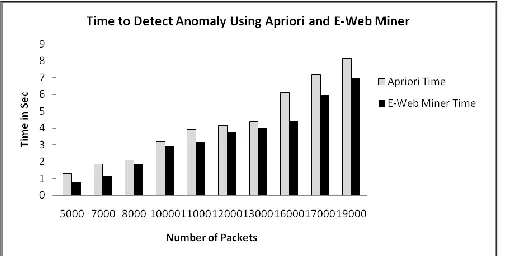
In order to make comparative study of proposed E-Web Miner Algorithm and Apriori All Algorithm, both the algorithms are run over a number of experimental transaction sets. Result records the execution time among the proposed E Web Miner algorithm and the Apriori All algorithm.
Table 1
Time to detect anomaly Vs Number of Packets Sent in the network simulation results
Sr No
Number of Packets
Apriori Time
E-Web Miner
Time
Performance Improvement
%
1 5000 1.32 0.785 40.53
2 7000 1.851 1.147 38.03
3 8000 2.104 1.845 12.31
4 10000 3.214 2.951 8.18
5 11000 3.938 3.153 19.93
6 12000 4.17 3.759 9.86
7 13000 4.385 3.986 9.10
8 16000 6.129 4.391 28.36
9 17000 7.161 5.971 16.62
10 19000 8.124 6.971 14.19
[image:6.612.322.577.365.492.2]The above results clearly show that proposed E Web Miner Algorithm performs better than the Apriori All Algorithm which is indicated by the performance graph-.
Figure 4 Anomaly detection time comparison graph
The main objective of this study is to reduce the number of elements in every candidate set without any repetition. Below are the findings of this comparison -
1. The algorithm provides more accurate results with better performance with respect to time complexity. This proves it that proposed algorithm is better against the classic Apriori All Algorithm as candidate set pruning is reduced in steps and number of database scans are reduced which proves E Web Miner to be more effective.
2. The proposed algorithm is self learnable. It uses a log repository built over a period. This repository is used to match the results of real time mined logs to identify anomaly. Also real time network logs are preserved in this repository. Hence algorithm keeps on learning at every instance.
3. For all the above transaction sets proposed Efficient Web Miner Algorithm shows a noticeable average performance improvement of 19.71%.
Figure 5 Performance graph of proposed E Web Miner Algorithm
4. Due to better efficiency of E-Web miner algorithm, it is proved to be scalable in comparison with Apriori All algorithm.
VI. CONCLUSION
The proposed methodology is very useful for finding suspicious network data flows. Anomalies so detected help in anomaly mitigation, network forensics and anomaly modelling.
[image:6.612.48.301.552.680.2]International Journal of Emerging Technology and Advanced Engineering
Website: www.ijetae.com (ISSN 2250-2459,ISO 9001:2008 Certified Journal, Volume 4, Issue 6, June 2014)
131 It proves that Efficient-Web Mining algorithm is simple and provides better space and time complexity than Apriori is scalable flexible provide accurate results These advantages of Efficient-Web Mining Algorithm are mainly because of reduction in data set scans and improved candidate set pruning thus removing loop holes of Apriori Algorithm. E Web miner can deal with single input parameter at one time this scope of the algorithm is further extended to work on multiple input parameters, self-learnability is introduced as it can learn from past knowledge all these additional features enhance the beauty and scope of the algorithm. Among all these the latest technology used is E-Web miner. But in the E-web miner[2], although it has reduced the problem of candidate set generation by providing an improved candidate set pruning but still it cannot remove this problem completely which has again further scope of research and improvement Possible future extension exists in optimizing the scalability and efficiency of frequent item set mining for dealing with huge data, mining on top k item sets, mining on multilevel and multidimensional or quantitative features of for network traffic monitoring.
Acknowlgement
This work was supported by Prof. Anupkumar Bongale, Department of Computer Engineering, Dr. D.Y.Patil College of Engineering Ambi, Pune.
REFERENCES
[1] D. Brauckhoff, X. Dimitropoulos, A. Wagner, and K Salamatian,
―Anomaly extraction in backbone networks using association rules,‖in Proc.IEEE ACM TRANSACTION ON NETWORKING, VOL.20. NO 6, DECEMBER 2012.
[2] M. Yadav,P. Keserwani, S. Samaddar ―An efficient web mining
algorithm for web log analysis: E Web Miner‖ RAIT 2012.
[3] F. Silveira and C. Diot, ―URCA: Pulling out anomalies by their root
causes,‖ in Proc. IEEE INFOCOM, Mar. 2010, pp. 1-9.
[4] A. Kind, M. P. Stoecklin, and X. Dimitropoulos, ―Histogram-based
traffic anomaly detection,‖ IEEE Trans. Netw. Service Manage., vol. 6, no. 2, pp. 110-121, Jun. 2009.
[5] M. P. Stoecklin, J.-Y. L. Boudec, and A. Kind, ―A two-layered
anomaly detection technique based on multi-modal flow behavior models,‖ in Proc. 9th PAM, 2008, Lecture Notes in Computer Science, pp. 212-221.
[6] X. Li, F. Bian, M. Crovella, C. Diot, R. Govindan, G.
Iannaccone,and A. Lakhina, ―Detection and identification of network anomaliesusing sketch subspaces,‖ in Proc. 6th ACM SIGCOMM IMC, 2006,pp. 147 -152.
[7] K. H. Ramah, K. Salamatian, and F. Kamoun, ―Scan surveillance in
Internet networks,‖ in Proc. Netw., 2009, pp. 614-625
[8] B. Krishnamurthy, S. Sen, Y. Zhang, and Y. Chen, ―Sketch-based
change detection: Methods, evaluation, and applications,‖ in Proc. 3rdACM SIGCOMM IMC, 2003, pp. 234-247.
[9] G. Cormode and S. Muthukrishnan, ―What’s new: Finding
significant differences in network data streams,‖ IEEE/ACM Trans. Netw., vol. 13, no. 6, pp. 1219-1232, Dec. 2005.
[10] Y. Gu, A. McCallum, and D. Towsley, ―Detecting anomalies in
network traffic using maximum entropy estimation,‖ in Proc. 5th ACM SIGCOMM IMC, 2005, pp. 32-32.
[11] G. Dewaele, K. Fukuda, P. Borgnat, P. Abry, and K.
Cho,―Extractinghidden anomalies using sketch and non Gaussian multi resolution statistical detection procedures,‖ in Proc. LSAD, 2007, pp. 145-152.
[12] A. Lakhina, M. Crovella, and C. Diot,―Diagnosing network-wide
traffic anomalies,‖ in Proc. ACM SIGCOMM, 2004, pp. 219-230. [13] W. Lee and S. J. Stolfo, ―Data mining approaches for intrusion
detection,‖ in Proc. 7th USENIX Security Symp., 1998, vol. 7, p. 6.
[14] R. Vaarandi, ―Mining event logs with SLCT and LogHound,‖ in
Proc.IEEE NOMS, Apr. 2008, pp. 1071-1074.
[15] K. Yoshida, Y. Shomura, and Y. Watanabe ―Visualizing
networkstatus,‖ in Proc. Int. Conf. Mach. Learning Cybern., Aug. 2007, vol.4, pp. 2094-2099.
[16] X. Li and Z.-H. Deng, ―Mining frequent patterns from network
flowsfor monitoring network,‖ Expert Syst. Appl. vol. 37, no. 12, pp.8850-8860, 2010.
[17] ] V. Chandola and V. Kumar, ―Summarization—Compressing data
intoan informative representation,‖ Knowl. Inf. Syst., vol. 12, pp. 355-378,2007.
[18] M. V.Mahoney and P. K. Chan, ―Learning rules for anomaly
detection of hostile network traffic,‖ in Proc. 3rd IEEE ICDM, 2003, pp.601-6
[19] G. Cormode and S. Muthukrishnan, ―An improved data stream sum-