0095-1137/05/$08.00⫹0 doi:10.1128/JCM.43.9.4815–4819.2005
Copyright © 2005, American Society for Microbiology. All Rights Reserved.
Coding and Noncoding Genomic Regions of
Entamoeba histolytica
Have Significantly Different Rates of Sequence Polymorphisms:
Implications for Epidemiological Studies
Dhruva Bhattacharya,
1Rashidul Haque,
2and Upinder Singh
1,3*
Department of Microbiology and Immunology1and Department of Internal Medicine, Division of Infectious Diseases,3
Stanford University School of Medicine, Stanford, California 94305-5124, and Centre for Health and Population Research, International Centre for Diarrhoeal Disease Research,
Bangladesh, Dhaka, Bangladesh2
Received 2 June 2005/Accepted 24 June 2005
To evaluate genetic variability amongEntamoeba histolyticastrains, we sequenced 9,077 bp from each of 14 isolates. The polymorphism rates from coding and noncoding regions were significantly different (0.07% and 0.37%, respectively), indicating that these regions are subject to different selection pressures. Additionally, single nucleotide polymorphisms (SNPs) potentially associated with specific clinical outcomes were identified.
A minority (⬃10%) of individuals infected withEntamoeba
histolyticadevelop clinical symptoms (5). Whether this is due to
variations in parasite genotypes is unknown. Based almost ex-clusively on analysis of highly repetitive loci, significant genetic diversity amongE. histolyticaisolates has been reported (1, 7, 8, 20–22). Since highly repetitive regions are prone to incorporating polymorphisms due to DNA slippage, analysis of these loci may overestimate population diversity in a species (15). Analyses of nonrepetitive loci have revealed very limited polymorphisms (3, 6). There is no definitive correlation between genotypes of E.
histolyticastrains and their clinical manifestations; however, three
studies preliminarily indicated that genotypic patterns may be predictive of a clinical outcome (1, 16, 18). To get an improved
perspective of genetic variability in nonrepetitive genomic re-gions, we sequenced 9,077 bp (6,621 bp coding and 2,456 bp noncoding) from each of 14E. histolyticaisolates.
Genetic diversity amongE. histolyticaisolates.FourE.
his-tolyticalaboratory strains and 10 clinical isolates were studied
(Table 1). Laboratory and clinical isolates were cultivated un-der axenic and xenic conditions, respectively (9, 16). EachE.
histolyticaisolate was characterized by PCR amplification and
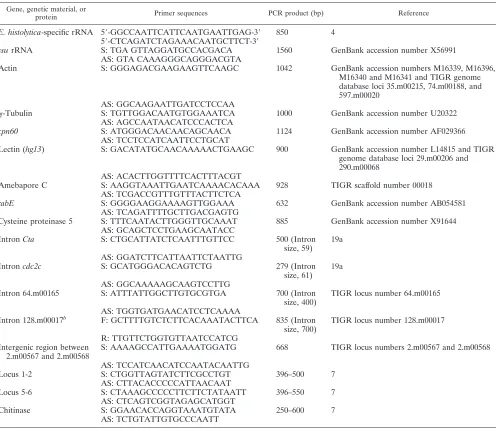
sequencing of 13 genetic loci (4) (Table 2). PCRs contained 0.05 g (phenol-chloroform) to 0.5 g (GenomiPhi DNA) template DNA, 20 pmol of each primer, 1.5 mM MgCl2, 10
mM of each deoxynucleoside triphosphate, and 0.5l ofTaq
[image:1.585.44.540.470.617.2]DNA polymerase and were cycled as follows: 95°C for 5 min;
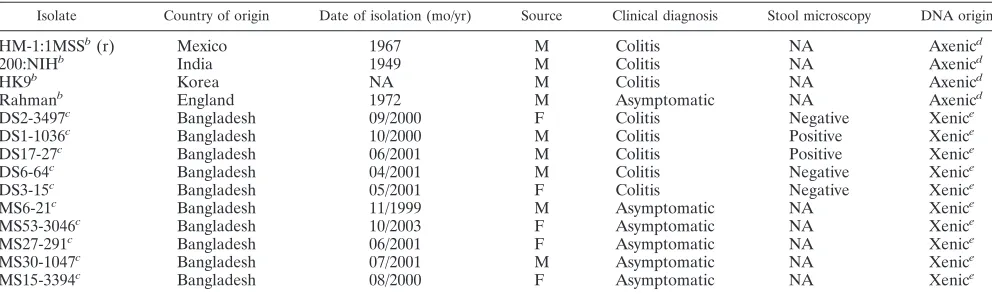
TABLE 1. A summary of theEntamoeba histolyticaisolates analyzeda
Isolate Country of origin Date of isolation (mo/yr) Source Clinical diagnosis Stool microscopy DNA origin
HM-1:1MSSb(r) Mexico 1967 M Colitis NA Axenicd
200:NIHb India 1949 M Colitis NA Axenicd
HK9b Korea NA M Colitis NA Axenicd
Rahmanb England 1972 M Asymptomatic NA Axenicd
DS2-3497c Bangladesh 09/2000 F Colitis Negative Xenice
DS1-1036c Bangladesh 10/2000 M Colitis Positive Xenice
DS17-27c Bangladesh 06/2001 M Colitis Positive Xenice
DS6-64c Bangladesh 04/2001 M Colitis Negative Xenice
DS3-15c Bangladesh 05/2001 F Colitis Negative Xenice
MS6-21c Bangladesh 11/1999 M Asymptomatic NA Xenice
MS53-3046c Bangladesh 10/2003 F Asymptomatic NA Xenice
MS27-291c Bangladesh 06/2001 F Asymptomatic NA Xenice
MS30-1047c Bangladesh 07/2001 M Asymptomatic NA Xenice
MS15-3394c Bangladesh 08/2000 F Asymptomatic NA Xenice
a
(r), reference strain; NA, not available; M, male; F, female. ATCC accession numbers: HM-1:IMSS, 30459; 200:NIH, 30458; HK9, 30015; Rahman, 30886.
b
Confirmed by PCR analysis of the rRNA episome, strain-specific gene, and PCR and restriction fragment length polymorphism of the serine-richE. histolytica protein (4).
c
Positive for anE. histolytica-specific fragment of the rRNA gene (4).
d
Genomic DNA isolated following standard protocols (9,16).
e
Genomic DNA amplified using GenomiPhi DNA amplification (Amersham Biosciences) prior to PCR analysis.
* Corresponding author. Mailing address: Department of Medicine, Division of Infectious Diseases, S-143 Grant Building, 300 Pasteur Drive, Stanford, CA 94305. Phone: (650) 723-4045. Fax: (650) 724-3892. E-mail: [email protected].
4815
on May 15, 2020 by guest
http://jcm.asm.org/
35 cycles of 95°C for 1 min, 60°C for 1 min, and 72°C for 2 min; 72°C for 10 min; and a 4°C soak. PCR products were se-quenced in their entirety, and sequences were aligned using CLUSTALW (www2.ebi.ac.uk/clustalw). For single-copy genes, sequences from GenBank and the The Institute for Genomic Research (TIGR)E. histolytica(strain HM-1:IMSS) database (http://www.tigr.org/tdb/e2k1/eha1/) were the reference se-quences (Table 2). For lectin and actin, which are each en-coded by multicopy genes, a master template sequence was constructed (see Table 2), and single nucleotide polymor-phisms (SNPs) identified in the genome sequence were con-sidered inherent to the gene and not further noted.
We analyzed coding regions from housekeeping genes (ssu
rRNA,cpn60, and genes encoding actin and ␥-tubulin) and virulence genes (lectin [hgl3], the gene encoding amebapore C,
rabE, and the gene encoding cysteine proteinase 5), since they
[image:2.585.45.541.79.510.2]may be subject to variable selection pressures. Two genes (en-coding actin and lectin) are in multiple copies in the genome; the rest are single-copy genes. For the noncoding loci, introns and intergenic and/or promoter regions were analyzed; introns should have essentially no constraint against divergence, whereas intergenic and/or promoter regions may be under some selection pressures (11). We also amplified three morphic loci from each strain which showed significant poly-morphisms (Table 3). We sequenced locus 1-2 and locus 5-6 for the laboratory strains, and, despite having identical ampli-cons, the strains were genetically unique (insertions and dele-tions of tandem repeat sequences and SNPs) (data not shown). Similar results with repetitive loci have been previously re-ported with amplicon sizes underestimating sequence diversity (7, 21); therefore, sequence analysis of these regions was not performed for the clinical isolates.
TABLE 2. The genes, primer sequences, and size of the PCR product utilized for the study are listeda
Gene, genetic material, or
protein Primer sequences PCR product (bp) Reference
E. histolytica-specific rRNA 5⬘-GGCCAATTCATTCAATGAATTGAG-3⬘ 850 4 5⬘-CTCAGATCTAGAAACAATGCTTCT-3⬘
ssurRNA S: TGA GTTAGGATGCCACGACA 1560 GenBank accession number X56991
AS: GTA CAAAGGGCAGGGACGTA
Actin S: GGGAGACGAAGAAGTTCAAGC 1042 GenBank accession numbers M16339, M16396,
M16340 and M16341 and TIGR genome database loci 35.m00215, 74.m00188, and 597.m00020
AS: GGCAAGAATTGATCCTCCAA
␥-Tubulin S: TGTTGGACAATGTGGAAATCA 1000 GenBank accession number U20322
AS: AGCCAATAACATCCCACTCA
cpn60 S: ATGGGACAACAACAGCAACA 1124 GenBank accession number AF029366
AS: TCCTCCATCAATTCCTGCAT
Lectin (hg13) S: GACATATGCAACAAAAACTGAAGC 900 GenBank accession number L14815 and TIGR genome database loci 29.m00206 and 290.m00068
AS: ACACTTGGTTTTCACTTTACGT
Amebapore C S: AAGGTAAATTGAATCAAAACACAAA 928 TIGR scaffold number 00018 AS: TCGACCGTTTGTTTACTTCTCA
rabE S: GGGGAAGGAAAAGTTGGAAA 632 GenBank accession number AB054581
AS: TCAGATTTTGCTTGACGAGTG
Cysteine proteinase 5 S: TTTCAATACTTGGGTTGCAAAT 885 GenBank accession number X91644 AS: GCAGCTCCTGAAGCAATACC
IntronCta S: CTGCATTATCTCAATTTGTTCC 500 (Intron
size, 59) 19a
AS: GGATCTTCATTAATTCTAATTG
Introncdc2c S: GCATGGGACACAGTCTG 279 (Intron
size, 61) 19a
AS: GGCAAAAAGCAAGTCCTTG
Intron 64.m00165 S: ATTTATTGGCTTGTGCGTGA 700 (Intron size, 400)
TIGR locus number 64.m00165
AS: TGGTGATGAACATCCTCAAAA
Intron 128.m00017b F: GCTTTTGTCTCTTCACAAATACTTCA 835 (Intron
size, 700)
TIGR locus number 128.m00017
R: TTGTTCTGGTGTTAATCCATCG Intergenic region between
2.m00567 and 2.m00568
S: AAAAGCCATTGAAAATGGATG 668 TIGR locus numbers 2.m00567 and 2.m00568
AS: TCCATCAACATCCAATACAATTG
Locus 1-2 S: CTGGTTAGTATCTTCGCCTGT 396–500 7
AS: CTTACACCCCCATTAACAAT
Locus 5-6 S: CTAAAGCCCCCTTCTTCTATAATT 396–550 7
AS: CTCAGTCGGTAGAGCATGGT
Chitinase S: GGAACACCAGGTAAATGTATA 250–600 7
AS: TCTGTATTGTGCCCAATT
aS, sense; AS, antisense; F, forward; R, reverse.
bIntron confirmed by Northern blot analysis (Ryan C. MacFarlane, personal communication).
on May 15, 2020 by guest
http://jcm.asm.org/
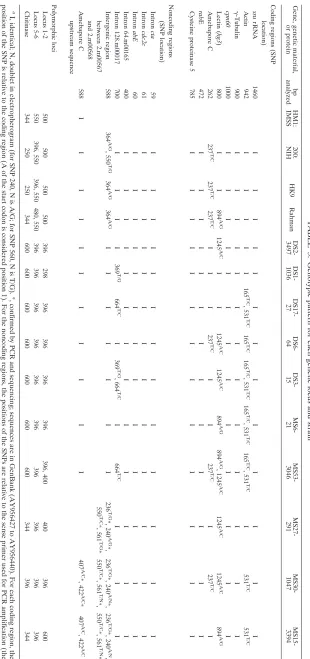
TABLE 3. Genotypic pattern for each genetic locus and strain a Gene, genetic material, or protein bp analyzed HM1: IMSS 200: NIH HK9 Rahman DS2-3497 DS1-1036 DS17-27 DS6-64 DS3-15 MS6-21 MS53-3046 MS27-291 MS30-1047 MS15-3394 Coding regions (SNP location) ssu rRNA 1460 I I I I I I I I I I I I I Actin 942 I I I I I 165 T/C , 531 T/C 165 T/C 165 T/C , 531 T/C 165 T/C , 531 T/C 165 T/C , 531 T/C I 531 T/C 531 T/C ␥ -Tubulin 900 I I I I I I I I I I I I I cpn60 1000 I I I I I I I I I I I I I Lectin ( hg3 ) 800 I I 894 A/G 1245 A/C I I 1245 A/C 1245 A/C 894 A/G 894 A/G , 1245 A/C 1245 A/C 1245 A/C 894 A/G Amebapore C 262 237 T/C 237 T/C 237 T/C I I I 237 T/C I I 237 T/C I 237 T/C I rab E 472 I I I I I I I I I I I I I Cysteine proteinase 5 785 I I I I I I I I I I I I I Noncoding regions (SNP location) Intron cta 59 I I I I I I I I I I I I I Intron cdc2c 61 I I I I I I I I I I I I I Intron abE 60 I I I I I I I I I I I I I Intron 64.m00165 400 I I I I I I I I I I I I I Intron 128.m00017 700 I I I I 369 T/G 664 T/C I 369 T/G , 664 T/C I 664 T/C II I Intergenic region between 2.m00567 and 2.m00568 588 364 A/G , 550 T/G 364 A/G 364 A/G I I I I I I I 236 T/G *, 240 A/G *, 550 T/C *, 561 T/G * 236 T/G *, 240 A/N *, 550 T/C *, 561 T/N *, 236 T/G *, 240 A/N , 550 T/C *, 561 T/N * Amebapore C upstream sequence 588 I I I I I I I I I I I 407 A/C *, 422 A/C * 407 A/C , 422 A/C Polymorphic loci Locus 1-2 500 500 500 500 396 298 396 396 396 396 396, 400 400 396 600 Locus 5-6 550 396, 550 396, 550 480, 550 396 396 396 396 396 396 396 396 396 396 Chitinase 344 250 250 344 600 600 600 600 600 600 600 344 396 344 a I, identical; N, doublet in electropherogram (for SNP 240, N is A/G; for SNP 560, N is T/G). *, confirmed by PCR and sequencing; sequences are in GenBank (A Y956427 to AY956440). For each coding region, the position of the SNP is relative to the coding region (A of the start codon is considered position 1). For the noncoding regions, the positions of the SNPs are relative to the sense primer used for PCR amplification (the first nucleotide in the sense primer is considered position 1).
on May 15, 2020 by guest
http://jcm.asm.org/
[image:3.585.143.453.65.724.2]In the nonrepetitive genetic loci analyzed, 14 SNPs were identified: 5 within coding regions and 9 in noncoding regions (Table 3). The actin and lectin genes (both multicopy genes) showed the maximum polymorphisms, with four of the five SNPs occurring in these two genetic loci. The limited sequence variability in the coding regions we studied concurs with a recent comparative genomic hybridization analysis, where these genes were highly conserved among the strains tested (20). All SNPs in the coding regions were synonymous. This is incongruous with reports for Mycobacterium tuberculosis, where analysis of coding regions from seven housekeeping genes (8,318 bp of sequence) revealed 101 SNPs, of which only 36 were synonymous (2). Similarly, inPlasmodium falciparum, of the 48 SNPs detected in antigenic locusmspI, only 7 were synonymous (17). Whether these differences between our ob-servations and others are due to technical (limited amount of sequence data, types of genes analyzed) or biological (codon bias, differential selection pressure) reasons is not clear at present. We searched the GenBank database for sequences of nonrepetitive coding regions fromE. histolyticastrains other than HM-1:IMSS. Of the approximately eight sequences iden-tified (X84009, X83685, X79134, X79133, X83685, AY870660, AY460178, X82198), only the latter three have significant matches in the TIGR E. histolytica database, and only one (X82198) had an SNP that was synonymous. Further sequenc-ing may be useful to clarify this issue. It is likely that each point mutation occurred just once in the phylogenetic history of the species. Since SNP markers are evolutionarily stable and un-likely to mutate again to either a novel or ancestral state, they are useful for evolutionary analyses (2).
Using data from all genes studied, we identified 14 genotypic patterns among the 14 isolates. However, the types of poly-morphisms we identified in nonrepetitive genomic regions were significantly different from those in highly repetitive re-gions. Sequence divergence in our study was limited to SNPs, in contrast to sequence analysis of repetitive regions, in which differences between isolates are largely due to copy numbers of 12- to 16-bp tandemly repeated regions (7). The underlying structure of the DNA influences replication errors, and DNA slippage can result in changes in the number of repeat regions, leading to a large degree of variability in repetitive loci (15). For phylogenetic analysis, nucleotide sequences for the six genetic loci with SNPs were combined and used to generate a dendrogram, which distinguished three of the asymptomatic isolates from the others (Fig. 1). Two asymptomatic isolates (MS26-21 and MS53-3046) clustered with the samples from diarrheal stools. Whether this indicates that these two isolates have unrecognized virulence potential remains to be investi-gated. Among the clinical isolates, there were six SNPs asso-ciated exclusively with isolates from asymptomatically infected individuals (the 894 SNP in the lectin gene; the 236, 240, and 561 SNPs in the intergenic region between 2.m00567 and 2.m00568; and the 407 and 422 SNPs in the upstream region of amebapore C) (Table 3). Additionally, there was one SNP (369 in the 128.m00017 intron) that in the clinical isolates was iden-tified only in samples from diarrheal stools. However, using a two-sided Fischer exact test using Stata/SE 7.0 (Stata Corpo-ration Texas), only the lectin 894 SNP was statistically signifi-cant in its association (P⫽0.015).
Significant variability in polymorphisms between coding
and noncoding regions. The occurrences of SNPs between coding and noncoding regions (0.07% and 0.37%, respectively) were statistically significantly different (P⫽0.0039) (as calcu-lated above). A number of factors could influence this obser-vation. First, SNPs are more common in microsatellite repeats; however, this was not a factor in our observation, as the SNPs in noncoding regions were not in microsatellite repeats. Sec-ond, codon bias restricts the extent of genetic variability that can occur in coding regions, especially in AT-rich organisms such asE. histolytica(12). A functional constraint in the coding regions was seen in our analysis, as all SNPs represented syn-onymous changes. Of the nine SNPs in the noncoding regions, seven were identified exclusively in clinical isolates, suggesting continued selection and evolutionary pressures. Noncoding re-gions are often targeted for population-based investigation because they represent rapidly evolving sequences, as they are subject to reduced selective constraints compared to coding regions (10, 11). Our results corroborate previous studies, where E. histolytica isolates differing at the locus encoding chitinase or serine-richE. histolyticaprotein were identical at rRNA internally transcribed spacer regions and intergenic se-quences between superoxide dismutase and actin 3 genes (6, 13). Similar epidemiological studies ofPlasmodium falciparum
have revealed paradoxical results in population structures partly due to the reliance of some studies exclusively on highly polymorphic genes (14, 15) versus data from housekeeping genes or introns (19). The overall data indicate that noncoding regions may be better gauges to assess evolutionary trends in
E. histolytica.
Long-term tissue culture does not significantly change the nonrepetitive genetic regions.TheE. histolyticaisolates stud-ied have been subjected to variable culture conditions from long-term (⬎30 years) axenic culture to short-term (1 to 3 years) xenic culture (Table 1). The different conditions did not significantly change the genetic composition of nonrepetitive regions. Overall, 4,617 bp and 580 bp of coding and noncoding regions, respectively, did not change among any of the isolates tested (a total of 72,758 bp). Additionally, the presence of SNPs at identical positions (237 in amebapore C and 894 and
FIG. 1. Dendrogram created using concatemeric nucleotide se-quences for 10 clinicalE. histolyticaisolates for the six genetic loci with SNPs. The dendrogram was generated using a Mega 2.2 program (dMEGA2; Molecular Evolutionary Genetics Analysis Software; Ari-zona State University) (http://www.megasoftware.net/) using a maxi-mum parsimony matrix algorithm and bootstrap values to estimate confidence intervals.
on May 15, 2020 by guest
http://jcm.asm.org/
1245 in the lectin gene) in both laboratory and clinical samples indicate thatE. histolyticaisolates have remained phylogeneti-cally conserved during long-term tissue culture (Table 3). Fur-thermore, axenization did not trigger significant changes in the genes studied.
We propose that studies of noncoding, nonrepetitive regions might be the most informative for future population-based studies to develop an improved evolutionary and phylogenetic framework forE. histolytica.
Nucleotide sequence accession numbers.The sequences de-scribed in this work have been submitted to GenBank under the nucleotide sequence accession numbers AY956427 to AY956440.
This work was supported by a Stanford University Dean’s fellowship for D.B. and grants from the NIAID (AI-053724 and AI-063470) to U.S. R.H. is an International Research Scholar of the HHMI and is also supported by a grant from the NIAID (AI-43596).
We gratefully acknowledge the help of Tomoyoshi Nozaki for crit-ical reading of the manuscript, Sebastian Gagneux for statistcrit-ical help, and all members of our laboratory, especially Jason A. Hackney for helpful suggestions and discussions.
REFERENCES
1.Ayeh-Kumi, P. F., I. M. Ali, L. A. Lockhart, C. A. Gilchrist, W. A. Petri, Jr.,
and R. Haque. 2001. Entamoeba histolytica: genetic diversity of clinical
isolates from Bangladesh as demonstrated by polymorphisms in the serine-rich gene. Exp. Parasitol.99:80–88.
2.Baker, L., T. Brown, M. C. Maiden, and F. Drobniewski.2004. Silent
nucle-otide polymorphisms and a phylogeny for Mycobacterium tuberculosis. Emerg. Infect. Dis.10:1568–1577.
3.Beck, D. L., M. Tanyuksel, A. J. Mackey, R. Haque, N. Trapaidze, W. R.
Pearson, B. Loftus, and W. A. Petri.2002. Entamoeba histolytica: sequence
conservation of the Gal/GalNAc lectin from clinical isolates. Exp. Parasitol.
101:157–163.
4.Clark, C. G., and L. S. Diamond.1993. Entamoeba histolytica: a method for
isolate identification. Exp. Parasitol.77:450–455.
5.Gathiram, V., and T. F. Jackson.1985. Frequency distribution of Entamoeba
histolytica zymodemes in a rural South African population. Lanceti:719– 721.
6.Ghosh, S., M. Frisardi, L. Ramirez-Avila, S. Descoteaux, K. Sturm-Ramirez,
O. A. Newton-Sanchez, J. I. Santos-Preciado, C. Ganguly, A. Lohia, S. Reed,
and J. Samuelson.2000. Molecular epidemiology ofEntamoebaspp.:
evi-dence of a bottleneck (demographic sweep) and transcontinental spread of diploid parasites. J. Clin. Microbiol.38:3815–3821.
7.Haghighi, A., S. Kobayashi, T. Takeuchi, G. Masuda, and T. Nozaki.2002.
Remarkable genetic polymorphism amongEntamoeba histolytica isolates from a limited geographic area. J. Clin. Microbiol.40:4081–4090.
8.Haghighi, A., S. Kobayashi, T. Takeuchi, N. Thammapalerd, and T. Nozaki.
2003. Geographic diversity among genotypes ofEntamoeba histolyticafield isolates. J. Clin. Microbiol.41:3748–3756.
9.Haque, R., I. K. Ali, S. Akther, and W. A. Petri, Jr.1998. Comparison of
PCR, isoenzyme analysis, and antigen detection for diagnosis ofEntamoeba
histolyticainfection. J. Clin. Microbiol.36:449–452.
10.Lehmann, T., C. R. Blackston, S. F. Parmley, J. S. Remington, and J. P.
Dubey.2000. Strain typing of Toxoplasma gondii: comparison of
antigen-coding and housekeeping genes. J. Parasitol.86:960–971.
11.Li, W.1997. Molecular evolution. Sinauer Associates, Sunderland, Mass.
12.Loftus, B., I. Anderson, R. Davies, U. C. Alsmark, J. Samuelson, P. Amedeo,
P. Roncaglia, M. Berriman, R. P. Hirt, B. J. Mann, T. Nozaki, B. Suh, M. Pop, M. Duchene, J. Ackers, E. Tannich, M. Leippe, M. Hofer, I. Bruchhaus, U. Willhoeft, A. Bhattacharya, T. Chillingworth, C. Churcher, Z. Hance, B. Harris, D. Harris, K. Jagels, S. Moule, K. Mungall, D. Ormond, R. Squares, S. Whitehead, M. A. Quail, E. Rabbinowitsch, H. Norbertczak, C. Price, Z. Wang, N. Guillen, C. Gilchrist, S. E. Stroup, S. Bhattacharya, A. Lohia, P. G. Foster, T. Sicheritz-Ponten, C. Weber, U. Singh, C. Mukherjee, N. M. El-Sayed, W. A. Petri, Jr., C. G. Clark, T. M. Embley, B. Barrell, C. M. Fraser,
and N. Hall.2005. The genome of the protist parasite Entamoeba histolytica.
Nature433:865–868.
13.Newton-Sanchez, O. A., K. Sturm-Ramirez, J. L. Romero-Zamora, J. I.
Santos-Preciado, and J. Samuelson.1997. High rate of occult infection with
Entamoeba histolytica among non-dysenteric Mexican children. Arch. Med. Res.28:311–313.
14.Rich, S. M., and F. J. Ayala.2000. Population structure and recent evolution
of Plasmodium falciparum. Proc. Natl. Acad. Sci. USA97:6994–7001.
15.Rich, S. M., R. R. Hudson, and F. J. Ayala.1997. Plasmodium falciparum
antigenic diversity: evidence of clonal population structure. Proc. Natl. Acad. Sci. USA94:13040–13045.
16.Shah, P. H., R. C. MacFarlane, D. Bhattacharya, J. C. Matese, J. Demeter,
S. E. Stroup, and U. Singh.2005. Comparative genomic hybridizations of
Entamoeba strains reveal unique genetic fingerprints that correlate with
virulence. Eukaryot. Cell4:504–515.
17.Tanabe, K., N. Sakihama, and A. Kaneko.2004. Stable SNPs in malaria
antigen genes in isolated populations. Science303:493.
18.Valle, P. R., M. B. Souza, E. M. Pires, E. F. Silva, and M. A. Gomes.2000.
Arbitrarily primed PCR fingerprinting of RNA and DNA in Entamoeba histolytica. Rev. Inst. Med. Trop. Sao Paulo42:249–253.
19.Volkman, S. K., A. E. Barry, E. J. Lyons, K. M. Nielsen, S. M. Thomas, M.
Choi, S. S. Thakore, K. P. Day, D. F. Wirth, and D. L. Hartl.2001. Recent
origin of Plasmodium falciparum from a single progenitor. Science293:482– 484.
19a.Wilihoeft, U., E. Campos-Gongora, S. Touzni, I. Bruchhaus, and E. Tannich.
2001. Introns ofEntamoeba histolyticaandEntamoeba dispar.Protist152:
149–156.
20.Zaki, M., and C. G. Clark.2001. Isolation and characterization of
polymor-phic DNA fromEntamoeba histolytica. J. Clin. Microbiol.39:897–905.
21.Zaki, M., S. G. Reddy, T. F. Jackson, J. I. Ravdin, and C. G. Clark.2003.
Genotyping of Entamoeba species in South Africa: diversity, stability, and transmission patterns within families. J. Infect. Dis.187:1860–1869.
22.Zaki, M., J. J. Verweij, and C. G. Clark.2003. Entamoeba histolytica: direct
PCR-based typing of strains using faecal DNA. Exp. Parasitol.104:77–80.