http://www.scirp.org/journal/tel ISSN Online: 2162-2086 ISSN Print: 2162-2078
DOI: 10.4236/tel.2016.65110 October 20, 2016
A Theory on Origin of Speculative Bubbles and
Public Debt Accumulation
Masayuki Otaki
Institute of Social Sciences, University of Tokyo, Tokyo, Japan
Abstract
I define a speculative bubble as the phenomenon in which zero expected return assets possess positive economic values. The limited liability principle matters in such a case. Individual investors prefer higher risk and higher return assets under limited liability, and they become incautious about the downside risk. Accordingly, even the zero expected return assets have a positive market value. However, we must note that some substantial amount of government subsidies should be introduced into the market to penetrate the limited liability principle. As circulating such assets implies the prevalence of economy-wide zero-sum game, if we presume the limited liability principle, additional provision of an official subsidy is unavoidable to finance the private positive gains. This finding implies that the precariousness of whether a spe-culative bubble emerges vitally depends on the fiscal discipline of a government. Whenever investors foresee a government’s forbearing policy, they invest in riskier zero-sum assets, and there emerges a more violent speculative bubble. In such a case, a huge amount of public debt is accumulated as a result of the government’s aids. I negate not only the Ricardian equivalence theorem under non-altruistic individuals but also the Lerner’s assertion that alleges the issuance of a public debt to be irrele-vant to the future resource allocation. Therefore, speculative bubbles genetically dis-tort the intergenerational resource allocation, and hence, intergenerational ethic on the macroeconomic policy should be urgently established.
Keywords
Speculative Bubbles, Limited Liability, Moral Hazard, Public Debt, Intergenerational Ethic
1. Introduction
There is a serious drawback in the popular speculative bubble theory, which originates
How to cite this paper: Otaki, M. (2016) A Theory on Origin of Speculative Bubbles and Public Debt Accumulation. Theoretical Eco- nomics Letters, 6, 1169-1179.
http://dx.doi.org/10.4236/tel.2016.65110 Received: September 27, 2016
Accepted: October 17, 2016 Published: October 20, 2016 Copyright © 2016 by author and Scientific Research Publishing Inc. This work is licensed under the Creative Commons Attribution International License (CC BY 4.0).
1170
from Blanchard and Watson [1]. In such a model, the rate of return from a bubbly asset is equal to the rate of interest. As historical evidences show, the rate of return for a bubbly asset is far beyond such a level. This paper provides the reason why the bubbly asset explodes so rapidly.
I define a speculative bubble as a phenomenon where a valueless asset possesses a positive market value. The limited liability with imperfect information plays a crucial role. Using the partial equilibrium framework developed by Stiglitz and Weiss [2], one can show that when an asset has a non-zero probability of strictly positive return, the price of such an asset becomes positive owing to the limited liability principle even though the expected return is zero. As the monetary authority is assumed to be less in-formative than investors, the authority cannot assess the riskiness of the investor’s asset sufficiently. Mathematically, this is an application of Jensen’s inequality.
It is also worthy to note that when one evaluates the riskiness of assets by the second- order stochastic dominance (i.e., mean preserving spread), lenders prefer riskier assets. Intuitively, the probability density function of a second-order stochastic dominated as-set is “fat tailed’’ when compared with the original asas-set, and thus, the probability of extremely high and low returns becomes significant. The limited liability principle cuts off the downside risk. Consequently, a higher risk and higher return asset fascinates in-vestors even though the expected return of the asset is zero and valueless for risk averse agents. This paper regards this process as the origin and explosion of speculative bubbles. The point to be emphasized here is that huge costs are involved in penetrating the limited liability principle. Whenever the expected return is zero, the transaction of such an asset can be regarded as a zero-sum game played within an overall economy. Accor-dingly, many investors are defeated in this bet and pay their losses that amount to their capital loss. However, defeated investors get rid of excess payment beyond their wealth due to the limited liability principle; thus, a government is eventually encountered by the total amount of capital loss of the overall economy. In Japan, the government ex-penditure, which aims at the depreciation of non-performing debts and reviving the construction and real estate industry, soared up to about 50 trillion yen after the bust of the bubble in the 1990s. A huge amount of money is generated by the new and provoc-ative issuance of public debt. Thus, speculprovoc-ative bubbles are always terminated by anni-hilating fiscal discipline.
One must note that individuals who live during the bubble era (even after the bust of bubble) enjoy a higher utility compared with generations before and after such a calam-ity. This is partly because the average high private return of assets enriches investors and partly because the issued public debt requires additional aggregate saving that re-sults in stimulating the business via the multiplier effect. In reality, Japan maintained its economic prosperity until 1997 (the bust of the bubble is estimated to have happened in 1991)1.
1Japanese GDP in 1990 (the year that the bubble culminated) was 450 trillion yen. Before the Asian financial
1171
The above discussion implies that speculative bubbles never emerge without distort-ing intergenerational resource allocation. As Otaki [3] proves in the overlappdistort-ing-gen- erations (OLG) model without altruistic individual, the issuance of public debt becomes the future generation’s burden in the sense that the issuance lowers the welfare of the descendant when compared with the generation born before the bubble. To summarize, prudential regulations to financial intermediaries and sound fiscal discipline are indis-pensable measures for hindering speculative bubbles and making an economy sustaina-ble.
The rest of the paper is organized as follows. Section 2 provides an OLG model that contains a bubbly asset. In Section 3, a comparative statics is conducted, exhibiting that a soft-budget government tends to cause speculative bubbles. Section 4 contains brief concluding remarks.
2. The Model
2.1. Individuals
Based on the models developed by Otaki [4] and [5], a two-period OLG model with a bubbly asset has been constructed. The utility function of individual i, Ui, is
(
)
( )
1 1
1
1 1
1
1
, , , 1 ,
m
i it it it it it
j
U u c c c c j
η η
δ λ η
− −
− −
+
=
≡ − ⋅ ≡ <
∑
(1)where u is a linear homogenous and strictly concave function, which represents the utility obtained by the lifetime consumption. λ denotes the disutility of labor. δit is
a definition function whose value takes unity when the individual is employed and zero when unemployed. There are a large number of individuals, n, to uphold the law of large numbers.
The labor market equilibrium is assumed to be interior in the sense that some indi-viduals are always unemployed in the equilibrium. There are m kinds of goods. For simplicity, marginal labor productivity is assumed to be unity in the overall economy and a commodity is monopolistically produced by the corresponding firm.
Fiat money is the only transaction and value hoarding medium. However, money in this context means the widely defined liquidity, which includes public debt. As the present world economy is facing the historical low interest era, for the purpose of sim-plicity, we neglect the interest payment for public debt.
In addition to the widely defined liquidity, ahead of all other economic decisions, there is an investment opportunity for risky assets whose expected net return is zero. Let the return of this asset be denoted by xθ. The ex-post rate of return for this asset,
θ
ξ , is written as:
[
]
max x , 0 ,
θ θ
ξ ≡ (2)
1172
then the equation
( )
( )
1 1 d 1 2 2 d 2, ,
x x
xFθ xθ xθ xFθ xθ xθ x x
− ≥ − ∀ ≤
∫
∫
(3)holds. F x
( )
θ denotes the cumulative distribution function (CDF) of xθ. Equalityholds only when x=x. The interval
[
−x x,]
is the domain of xθ. It is assumed thatthere is no mass in CDF and the expected return without the limited liability principle is zero. This leads us to the following equation:
( )
d 0, .x
x
x−
∫
− F xθ xθ = ∀θ (4)In addition, an elementary calculus leads us to
1 1 .
E ξθ >E ξθ (5)
This is the property that Stiglitz and Weiss [2] induce.
The lifetime budget constraint after the revelation of the value of xθ becomes
( )
1 111 1
1
, ,
m t t it t it it it it t i t t it t
j
p j
p c p c w p p p
m
η η
θ
δ π ξ τ
− −
+ +
=
+ ≤ + + − ≡
∑
(6)where πit refers to the nominal profits, which individual i receives.
The corresponding indirect utility function Iit is
(
1)
, ,
it it it t i t
it it
t t
w p
I
p p
θ
δ π ξ δ λ
+
+ +
≡ −
Ψ (7)
where Ψ is a linear homogenous function. Since it is assumed that the equilibrium of the labor market is interior in the sense that some individuals are always unemployed, the equilibrium condition requires that there is no gain by being employed. According-ly, from Equation (7), the equilibrium nominal wage becomes
(
, 1)
.t t t
w = Ψλ p p+ (8)
Meanwhile, since the indirect utility function is a linear function of ξi tθ , the choice
of bubbly asset is separable from other economic decisions; and hence, all individuals invest in the riskiest bubbly asset as far as admissible. This is apparent from inequality (5). If an economy consists of innumerable individuals and the law of large number is upheld, the average private return from such an asset is
( )
0 d ,
x
x−
∫
F xθ xθwhere θ denotes the admissibly riskier asset. Whenever θ is risky enough, from inequality (5), one must note that the average rate of return of the bubbly asset exceeds that of the alternative investment opportunity: money.
From Equation (4), the following relationship is obtained:
( )
0( )
0 d d .
x
x
x F xθ xθ F xθ xθ
−
−
∫
=∫
(9)1173
bubbly asset is essentially equal to participating in a zero-sum game.
What is important in this vein is that a subsidy from the government is necessary to sustain the limited liability principle. As evident in Equation (9), substantial individuals lose money beyond their payment ability. Therefore, once the capital gain of lucky in-dividuals is actualized, this incurs the subsidy to the government for compensating the unpayable capital loss even though time elapses before performing such a rescue for lost investors in reality. Purchasing non-performing debts emerged from the specula-tive bubble is a typical example. It is assumed that such expenditure is entirely financed by the issuance of new money.
Lastly, as the lifetime utility function is assumed to be linear homogenous, one ob-tains the following aggregate consumption function, c, of young individual:
( )
1( )
, t , t , 0, 0 1,
t t
r t
Y p
c c y y c c
p p
ρ ρ + ′
≡ ≡ ≡ > < ⋅ < (10)
where Yt and yt are nominal real aggregate incomes.
2.2. Firms
Firm j faces the following demand function, Dj:
( )
, ,
t t
jt jt jt
t t
p j Y
D y y
p mp
η −
≡ ⋅ ≡
(11)
where yjt is the real aggregate income per firm. Accordingly, the profit-maximization
condition leads us to
( )
1.1 t t
W p j
η−
=
− (12)
Substituting Equation (8) into Equation (12) and aggregating both sides of Equation (12) on j, I obtain
(
)
( )
11 1
, 1
1, .
1 t t t
p p
p λ ρ η
λ η
− +
−
Ψ −
= ⇔ Ψ =
− (13)
Equation (13) is vital for the theory. The equilibrium inflation rate (or the inverse of the rate of return of the widely defined liquidity) is determined by Equation (13) unre-lated to the nominal stock of the widely defined liquidity. This implies that an equili-brium path of the price level can be unaffected by the monetary condition in an econ-omy. Thus, the liquidity becomes non-neutral even though there is no stickiness in prices and the nominal wage. Equation (13) enables us to analyze the macroeconomic implication of speculative bubbles.
2.3. The Government
The budget constraint of the government is denoted as
1
,
t t
t t
t
L L g p
τ + − − = (14)
1174
revenue of the government, which consists of the real tax revenue τt and the real is-
suance of the new widely liquidity t t 1
t
L L p
−
−
. The right-hand side is the real govern-
ment expenditure toward the infrastructure that is indispensable to sustain the econo-my. It is assumed that government expenditure for each commodity will follow the same pattern as that of the individual.
2.4. Market Equilibrium
There are three markets in this model: the goods market, the liquidity market, and the labor market. The two former markets are not independent from the budget constraints of the young generation (6) and the government’s budget constraint (14). The aggregate goods market achieves the equilibrium when
( )
( )
( )
( )
1
, ,
nt
nt nt nt nt
nt
nt nt nt nt nt nt
t
l
y c y E g
L
y c y E l l
p
θ
θ
ρ τ ξ
ρ
ρ τ ξ τ
−
= − + + +
⇔ = − + + + ≡ (15)
where subscript n means that the variables are measured by per capita term.
Policy variables are the real tax per capita, τnt, and the real liquidity per capita, lnt.
The endogenous variables are, the real income per capita, ynt, and the inflation rate,
ρ. The structural equations are Equations (13) and (15). Thus, the model is completely closed.
3. Comparative Statics
3.1. Monetary-Fiscal Policy and Speculative Bubbles
This subsection deals with how the tightness of monetary-fiscal policy affects the se-riousness of speculative bubbles. It is evident from the discussion in Section 2.1 that the real widely defined liquidity per capita, lnt, must exceed the average debt per capita
emerging from the bust of the bubble:
( )
0( )
d
t x t t
E
ξ
θ ≡∫
− F xθ xθ . For simplicity, it isassumed that the following relationship is upheld in the provision of the widely defined liquidity:
( )
1, .,
, 0
1 1 nt
nt t
nt i n
l
l l E l const
l
l l i
θ
ξ ρ
ρ
−
+
− = + =
= = ∀ ≠
−
(16)
Equation (16) implies that the additional widely defined liquidity per capita is en-tirely included in the compensation for the busted bubble at period t and redeemed within the subsequent period. To put it differently, whenever individuals rationally ex-pect that the monetary authority adopts a more forbearing policy, they speculate a riskier zero-sum asset (they choose an asset that takes a higher value of θ ).
1175
( )
( )
( )
, .nt i nt i nt i t i nt t i n
y + =c ρ y + −τ + +χ+E ξθ +τ +χ+E ξθ + ∀l i (17)
t i
χ+ takes the value unity if i = 0, and zero otherwise.
Differentiating both sides of Equation (17), the following result is obtained:
( )
( )
( )
d
d 1
1 .
d 1 d
nt E
y
c c
θ
ξ
ρ
θ
= −ρ
+ θ
(18)Equation (18) implies that there emerge two expansionary effects by more compro-mising policy of the monetary authority: one is the direct effect that enriches the dis-posable income by raising the average rate of return for the bubbly asset. This effect appears in the second term in the bracket of Equation (18), the magnitude of which is equal to the value of the multiplier of tax reduction,
( )
( )
1
c c
ρ ρ
− . The other is the indirect
effect, which comes from the expansion of the widely defined liquidity provided for the compensation for the busted bubble. The magnitude of this effect is the pure multiplier,
( )
1
1−c ρ , as is evident from the first term in the bracket of Equation (18).
Thus, while the debt incurred by the bust of bubble piles up in conjunction with the compromised and accommodative monetary policy, such a policy possesses an explo-sive power to upturn the business. This ephemeral temptation urges people to boost the bubble, which results in leaving the burden for the future generation as discussed in the next subsection.
3.2. Speculative Bubbles as a Burden for the Future Generation
This subsection considers the intergenerational economic consequence of speculative bubbles. It is assumed that the bubble boosts and busts during period t and the eco-nomic welfare is compared with that of the aftermath of the bubble (the welfare of gen-eration t+1). As a reference point, let the welfare of the pre-bubble generation t−1
be calculated as well.
For simplicity, it is assumed τt−1= =τt 0. From Equation (17), the equilibrium
in-come per capita of generation t−1, ynt−1 becomes
( )
1 .
1 n nt
l y
c ρ
− = − (19)
Similarly, ynt,ynt+1 becomes
( )
( )
( )
( )
( )
1 1 1
1
, 1
, .
1
n nt
n
nt nt nt
l c E
y
c
E l
y
c
θ
θ
ρ ξ
ρ
ξ
τ τ
ρ ρ
+ + +
+ + =
−
− = =
−
(20)
1176
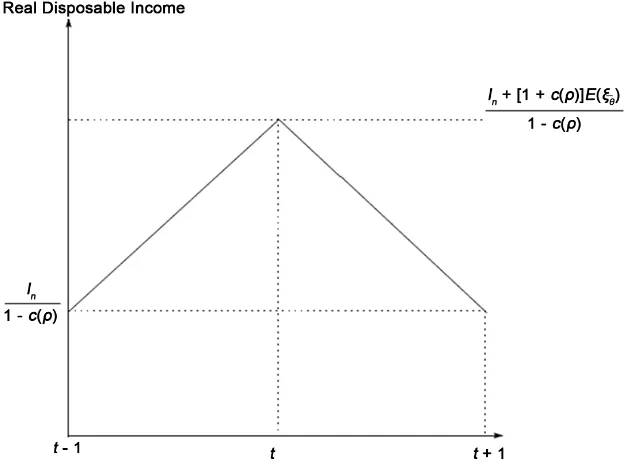
Figure 1. Speculative bubble and real disposable income.
However, this never means that there is no burden for the future generation, which stems from the speculative bubble in the current period. Using the indirect utility func-tion (7), the equilibrium utility of an individual, who belongs to generafunc-tion t+i, is
rewritten as
( )
1
, 1, nt i nt i t i
y
IU η τ
ρ
−
+ +
+
− =
Ψ (21)
where 1
nt i
y
η−
+ is the income accrued from profits (note that there is no welfare gain from working because the nominal wage stacks at the nominal reservation wage in the imperfect employment equilibrium).
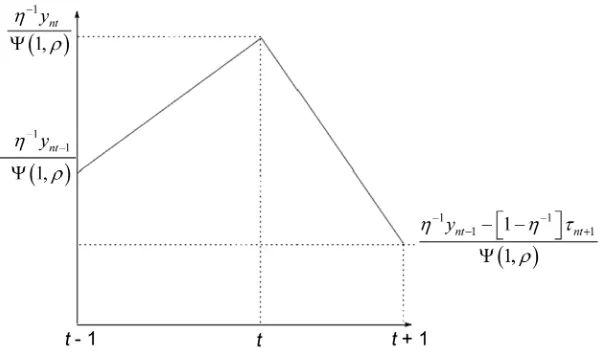
Figure 2 illustrates the lifetime utility level of each generation. Thus, a speculative bubble becomes a burden for the future generation in the sense that individual’s well-being is lowered compared with those in the pre-bubble generation t−1 even though
their disposable income is at the same level. Equation (21) can be transformed as
( )
[
]
( )
( )
1 1 1 1
1
1 1 1 1 1
1 1
1
1 1
.
1, 1, 1,
nt nt nt nt nt
nt nt t
y y
y
IU η τ η τ η τ η η τ
ρ ρ ρ
− − − −
−
+ + + − +
+ +
+
− − − − −
−
= = =
Ψ Ψ Ψ (22)
The second term in the numerator of Equation (22) reveals the reason why such a burden is generated. As 1
1−η− corresponds to the ratio of income distribution to
la-bor, the second term represents that unfortunate generation t+1 is forced to work
harder than generation t−1 despite the disposable income remaining in the same
1177
Figure 2. Speculative bubble and economic welfare.
the redemption of the excess widely defined liquidity. Consequently, they are obliged to provide more works without rewards. Meanwhile, such a burden is heavier when the monetary policy is more compromised and the current generation anticipates that they are permitted to invest in riskier assets. This statement is ascertained by Equation (20).
3.3. Precariousness of Repeated Bubble: Importance of
Intergenerational Ethic
As discussed in the previous subsection, the redemption of the liquidity issued for off-setting the loss of the bubbly asset lowers the welfare of the subsequent generation eventually. Moreover, a speculative bubble brings about ephemeral prosperity to the current generation. Accordingly, the monetary authority dislikes the redemption and prefers to cause a speculative bubble once again. As such, once a compromised mone-tary policy is settled, speculative bubble is caused successively. This implies that a huge amount of the widely defined liquidity is injected into an economy incessantly.
One must note that there is an upper limit in the volume of circulating liquidity to keep public confidence on its value in terms of goods. Let us assume that the economy reaches the critical point by successive bubbles, in which people start to hold the quan-tity theoretic rational expectations. Such expectations imply that people disbelieve the intrinsic value of money despite they continue using money2. Let the equilibrium price
function be denoted as
2Let 1 0 0
0
n
l p
κ− ≡ be denoted as the initial position before the quantity theoretic expectation prevails. Since the
quantity theory of money is a rational belief, which regards that there is a fixed parity between goods and the liquidity, 1
0
κ− might be far larger than κ−1 when the disbelief in the intrinsic value of money begins to
prevail. Accordingly, once such an expectation is generated, the current price level jumps drastically in the following way: individuals anticipate the jump of the price level, and thus they try to purchase goods in ex-change of money. However, since all individual take the same action, the rise of the price level or the depreci-ation of the nominal value of the widely defined liquidity (i.e., the price of public debt) makes 1
0 κ−
lower to
1 0 κ−
1178
.
t t
p =κL (23)
It is shown that the monetary authority cannot issue the widely defined liquidity any more under Equation (23). The proof is elementary. The following arbitrage is consi-dered. A young individual sells additional unit goods at price p0
(
=κL0)
in exchange for the liquidity, and repurchases the goods by the obtained liquidity. Since the beha-vior of individual is identical, all others take the same behabeha-vior if profitable. Let us as-sume that the current liquidity supply increases from L0 to[
1+γ]
L0. Then, it is evi-dent from Equation (23) that the current price increases by 1+γ . The benefit fromsuch arbitration is
0
1
1 1
1 1 1 0, if 0.
1
p
p ρ γ γ
− = − = − < >
+
(24)
Accordingly, no additional issuance is possible once people hold the quantity theo-retic rational expectation. This implies that whenever individuals disbelieve the intrin-sic value of money owing to the excessive issuance, the government substantively reaches bankruptcy if the tax collection ability is insufficient. This is an appalling con-sequence of irresponsible sequential speculative bubbles. The discretionary aggregate monetary policy will be ineffective until the confidence on the intrinsic value of money recovers and the quantity theoretic expectation disperses even if it takes a long time.
This discussion suggests the importance of establishing the intergenerational ethic on the monetary-fiscal policy. To avoid the explosive accumulation of the liquidity, the government must pledge to the tight monetary-fiscal discipline that never permit the compensation of the loss of speculative bubbles. If such a discipline is established, every individual correctly realizes the true risk of the bubbly asset, thereby knowing the fact that its private and social return is zero. This is the only way to prevent the emergence of speculative bubbles.
4. Concluding Remarks
This study explored the origin of speculative bubbles and analyzed the economic con-sequences. The obtained results are as follows. First, a feverish bubble, whose rate of return exceeds the rate of interest, originates from the limited liability principle under asymmetric information. In other words, a feverish bubble is a kind of moral hazardous behavior, which is implicitly endorsed by the pecuniary compensation of a government to defeated investors.
1179
Lastly, when the widely defined liquidity accumulates into a huge amount by the in-cessant bubbles, individuals start to disbelieve the intrinsic value of money, and as a result, the quantity theoretic rational expectation prevails. When such an expectation is generated, the government is unable to issue additional liquidity. This is because indi-viduals never accept the liquidity, the value of which evidently depreciates under the quantity theoretic rational expectation. This exhausts the revenue resource of the gov-ernment unless it has sufficient levying ability and endangers the supply of infrastruc-ture, which is the foundation of the economy.
Acknowledgements
I am grateful for participants of the seminar at Research Institute of Capital Formation at Development Bank of Japan. This study is supported by MEXT/JSPS KAKENHI Grant Number 60183761.
References
[1] Blanchard, O.J. and Watson, M.W. (1982) Bubbles, Rational Expectations, and Financial Markets. NBER Working Paper, No-w945.
[2] Stiglitz, J.E. and Weiss, A. (1981) Credit Rationing in Markets with Imperfect Information.
American Economic Review, 71, 393-410.
[3] Otaki, M. (2015) Public Debt as a Burden on the Future Generation: A Keynesian Ap-proach. Theoretical Economics Letters, 5, 651-658.
[4] Otaki, M. (2007) The Dynamically Extended Keynesian Cross and the Welfare-Improving Fiscal Policy. Economics Letters, 96, 23-29. http://dx.doi.org/10.1016/j.econlet.2006.12.005 [5] Otaki, M. (2015) Keynesian Economics and Price Theory: Re-Orientation of a Theory of
Monetary Economy. Springer, Tokyo.
[6] Lerner, A.P. (1944) The Economics of Control: Principles of Welfare Economics. Macmil-lan, New York.
Submit or recommend next manuscript to SCIRP and we will provide best service for you:
Accepting pre-submission inquiries through Email, Facebook, LinkedIn, Twitter, etc. A wide selection of journals (inclusive of 9 subjects, more than 200 journals)
Providing 24-hour high-quality service User-friendly online submission system Fair and swift peer-review system
Efficient typesetting and proofreading procedure
Display of the result of downloads and visits, as well as the number of cited articles Maximum dissemination of your research work
Submit your manuscript at: http://papersubmission.scirp.org/