http://www.scirp.org/journal/cs ISSN Online: 2153-1293
ISSN Print: 2153-1285
Design of Soft Computing Based Optimal PI
Controller for Greenhouse System
A. Manonmani1, T. Thyagarajan2, S. Sutha2, V. Gayathri2
1Department of Electronics and Instrumentation Engineering, Saveetha Engineering College, Chennai, India 2Department of Instrumentation Engineering, MIT Campus, Anna University, Chennai, India
Abstract
Greenhouse system (GHS) is the worldwide fastest growing phenomenon in agricul-tural sector. Greenhouse models are essential for improving control efficiencies. The Relative Gain Analysis (RGA) reveals that the GHS control is complex due to 1) high nonlinear interactions between the biological subsystem and the physical subsystem and 2) strong coupling between the process variables such as temperature and hu-midity. In this paper, a decoupled linear cooling model has been developed using a feedback-feed forward linearization technique. Further, based on the model devel-oped Internal Model Control (IMC) based Proportional Integrator (PI) controller parameters are optimized using Genetic Algorithm (GA) and Particle Swarm Opti-mization (PSO) to achieve minimum Integral Square Error (ISE). The closed loop control is carried out using the above control schemes for set-point change and dis-turbance rejection. Finally, closed loop servo and servo-regulatory responses of GHS are compared quantitatively as well as qualitatively. The results implicate that IMC based PI controller using PSO provides better performance than the IMC based PI controller using GA. Also, it is observed that the disturbance introduced in one loop will not affect the other loop due to feedback-feed forward linearization and de-coupling. Such a control scheme used for GHS would result in better yield in pro-duction of crops such as tomato, lettuce and broccoli.
Keywords
Greenhouse System, Feedback-Feed Forward Linearization and Decoupling, IMC Based PI Controller, Genetic Algorithm, Particle Swarm Optimization, Nonlinear System
1. Introduction
The GHS consists of highly coupled subsystems: the greenhouse climate and the greenhouse crop. The greenhouse control problem is to create a favorable environment
How to cite this paper: Manonmani, A., Thyagarajan, T., Sutha, S. and Gayathri, V. (2016) Design of Soft Computing Based Optimal PI Controller for Greenhouse Sys-tem. Circuits and Systems, 7, 3431-3447.
http://dx.doi.org/10.4236/cs.2016.711292 Received: May 6, 2016
Accepted: May 18, 2016 Published: September 6, 2016 Copyright © 2016 by authors and Scientific Research Publishing Inc. This work is licensed under the Creative Commons Attribution International License (CC BY 4.0).
http://creativecommons.org/licenses/by/4.0/
for the crop in order to reach predetermined results for high yield, high quality and low costs. It is very difficult to control the GHS in practice, due to the complexity of the greenhouse environments such as high non-linearity, strong coupling between Mul-ti-Input Multi-Output (MIMO) systems.
There are several models available for the GHS. Some of them use white box (first principle model) [1][2] and others use black box model [3]-[5]. The best benchmark climate model is presented by Albright et al. [1] for controlling the temperature and humidity. A model based on feedback-feed forward compensation technique used for linearization, decoupling and disturbance compensation is presented in [1][2]. Multi-ob- jective optimization of greenhouse system using evolutionary algorithm is given in [6].
In this paper, a model of nonlinear thermodynamic laws between numerous system variables affecting the greenhouse climate is formulated and a feedback-feed forward approach to system linearization and decoupling is done. A conventional IMC based PI controller is designed based on the model. The IMC-PI controller parameters are opti-mized using Genetic Algorithm (GA) and Particle Swarm Optimization (PSO). The performance measures are compared for servo and servo-regulatory systems.
This paper is organized as follows: Section 2 briefs about a greenhouse system model. The control schemes are explained in Section 3 followed by closed loop analysis in Sec-tion 4. SecSec-tion 5 gives details about the quantitative comparison. Finally, conclusions are presented in Section 6.
2. Greenhouse System Model
2.1. Description of Greenhouse Model
The three models for the greenhouse system include: cooling model, heating model and ventilating model. Ventilation is one of the most important components for a success-ful greenhouse. If there is no proper ventilation, greenhouses and their plants become prone to problems. The main purpose of ventilation is to regulate the temperature at the optimum level, to ensure movement of air and also to ensure the supply of fresh air for photosynthesis and plant respiration. Heating model is essential, when the inside temperature of the greenhouse is very low during winter climate and at night time. Whereas, cooling model is required when the outside temperature is very high which may affect the plants during the summer mode at day time. The functional block dia-gram of GHS is shown in Figure 1.
A simple greenhouse heating-cooling-ventilating model can be obtained (as given in Equation (1)) by considering the diff erential equations, which govern sensible and la-tent heat, as well as water balances on the interior volume [5][6]:
( )
( )
( )
( )
( )
( )
( )
( )
( )
(
( )
( )
)
( )
( )
( )
( )
( )
(
)
( )
( )
d 1 dd 1 1
, d
,
R
in heater i fog in out
p T T p T
R
in fog i in in out
H H H
i
i in T in
V t UA
T t Q t S t Q t T t T t
t C V V C V
V t
H t Q t E S t H t H t H t
t V V V
S t
E S t H t H t
where
Tin/Tout: Indoor/outdoor temperature (˚C)
Hin/Hout: Interior/exterior humidity (g[H2O/kg[dry air])
Qheater: Heat provide by the greenhouse heater (W)
Qfog: Water capacity of fog system (g/s)
VR: Ventilation rate (m3/s)
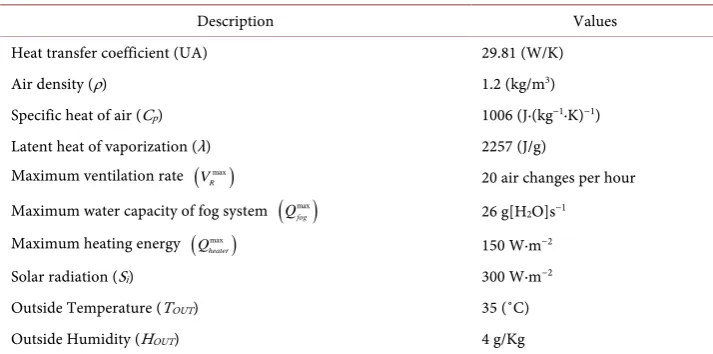
The greenhouse system model parameters are shown in the Table 1.
In general, the operating conditions of the ventilation/cooling process are rather dominated by solar radiation alone (i.e. β =T 0), hence βTHin
( )
t can be neglected.Suppose that C0=ρC Vp T, α α λ′ =
(
VH)
,max
fog
Q
λ λ′ = and max
H fog
V′ =V Q . The
con-trol variables can be normalized as follows: max ,%
R R R
V =V V , Qfog,%=Qfog Qmaxfog and
max ,%
heater heater heater
[image:3.595.194.548.262.474.2]Q =Q Q .
Figure 1. Block diagram representing greenhouse system.
Table 1. Greenhouse system model parameters.
Description Values
Heat transfer coefficient (UA) 29.81 (W/K)
Air density (ρ) 1.2 (kg/m3)
Specific heat of air (Cp) 1006 (J∙(kg−1∙K)−1)
Latent heat of vaporization (λ) 2257 (J/g) Maximum ventilation rate
(
max)
R
V 20 air changes per hour
Maximum water capacity of fog system
( )
maxfog
Q 26 g[H2O]s−1
Maximum heating energy
(
max)
heater
Q 150 W∙m−2
Solar radiation (Si) 300 W∙m−2
Outside Temperature (TOUT) 35 (˚C)
[image:3.595.193.550.526.703.2]In summer mode operation, Qheater is set to zero. The climate model provided have
two variables to be regulated, namely the indoor air temperature (Tin) and the humidity
ratio (Hin), through the process of ventilation VR,%(t) and fogging QR,%(t). After
norma-lizing the control variables, the differential equation for cooling model for greenhouse system is re-written as given in Equation (2)
( )
( )
( )
( )
( )
( )
( )
( )
( )
( )
( )
,% %, 0 0 %, ,% d 1 . d d . d Rin i fog in out
v
fog R
in i in out
v
V t UA
T t S t Q t T t T t
t C t C
Q t V t
H t S H t H t
t V t
λ α = − − + − = + − − ′ ′ ′ (2)
In order to express the GHS in state-space form, the inside temperature and absolute humidity are defined as the dynamic state variables, x1(t) and x2(t), respectively; the
ventilation rate and the water capacity of the fog system as the control (actuator) va-riables, u1(t) and u2(t), respectively; the intercepted solar radiant energy, the outside
temperature, and the outside absolute humidity as the disturbances, vi(t), i = 1, 2, 3. The
Equation (2) can alternatively be written in the following state-space form:
( )
( )
( ) ( )
( )
( )
( )
( ) ( )
1 1 1 1 2 1 2 1 2
0 0 0 0
1 1 1
v v
UA UA
x t x t x t u t u t v t v t u t v t
C t C C C t
λ
= − − − ′ + + +
(3)
( )
( ) ( )
( )
( )
( ) ( )
2 2 1 2 1 1 3
1 1 1
v v
x t x t u t u t v t u t v t
t V α t
= − + + ′ +
′
(4)
Relative Gain Array Analysis
From the state-space form the values of A, B and C is given by:
0 0 1 0 v UA C A t − = − 1 2 0 2 3 1 1
1 1 1
v v
v v
x v
t t C
B
x v
t t V
λ − + − = − + ′ ′ 1 0 0 1 C=
0.7764 0.2236
0.2236 0.7764
Λ =
In this case relative gains are positive values. If 0 < λ11 < 1, then an interactions exists.
From the interaction analysis it is found that y1 is paired withu1 and y2 is paired withu2
GHS. The feedback-feed forward linearization technique is used for decoupling is dis-cussed in the subsequent section.
2.2. Feedback-Feed Forward Linearization and Decoupling
One method for linearization and decoupling for systems with external disturbances is presented in [2] [3] which is based on the feedback-feed forward linearization tech-nique proposed by Isidori [4]. In the particular case of GHS model expressed in Equa-tions (3) and (4), the feedback-feed forward linearization and decoupling procedure described above is followed and compensator is designed. The compensator that deliv-ers the process input control variables u(u1, u2), has the form given in Equations (5) and
(6).
( )
1 1 2 1 1 1 2
0 0 0 0 0
1 1 1 1 1
ˆ ˆ
UA UA
u x v v u v u Q t
V C V C V C V C C
λ λ α − − + − + ′ ′ ′ =
′ ′ ′ ′ (5)
(
)
( )
2 3 2 1 2 1 1 2 1 1 2
0 0 0
1 1 1 1 1
ˆ ˆ
v v v v
UA UA
u v x x v v u v x v u Q t
t t C C C t t α
− + − + + − + ′ − =
(6)
where Q(t) must be anon-zero quantity.
( )
2 1 3 20
1 1 1 1 1
v v v v
Q t v x v x
V t t C t t
λ − + − ′ =
′ (7)
where,
1
ˆ
u → temperature change;
2
ˆ
u → humidity change.
The transfer functions derived from the linearized and decoupled GHS are as given in Equations (8) and (9)
11 5.5988 1 13.7 G s =
+ (8)
22 5.574 1 6.068 G s =
+ (9)
3. Design of IMC Based PI Controller
3.1. Conventional IMC-PI Controller
In the Internal Model Control (IMC) formulation, the controller, q(s), is based directly on that part of the process transfer function which can be inverted. The IMC formula-tion generally results in only one tuning parameter, the closed loop time constant (λ, the IMC filter factor). The PI tuning parameters are then becomes a function of this closed-loop time constant. The selection of the closed-loop time constant is directly re-lated to the robustness (sensitivity to model error) of the closed-loop system.
The feedback controller gc
( )
s contains the internal model gp( )
s and internalmodel, gp
( )
s and internal model controller, q(s) as given in Equation (10).( )
( ) ( )
( )
1 c p q s g sg s q s
= −
For a given first-order process in Equation (10), the values of the PI tuning parame-ters are obtained using Equations (11), (12).
( )
1 p p p K g s s τ =+ (10)
p c p K K τ λ
= (11)
1
C P
I
I P I
K K
K τ
τ τ τ
=
= (12)
The desired value for λ is defined as a trade-off between performance and robustness and its optimum value is obtained using genetic algorithm. The objective function con-sidered here is Integral Square Error (ISE) and the decision variables obtained is λ, filter factor.
[image:6.595.191.556.395.460.2]The controller parameter values for IMC-PI are calculated by using trial and error method and the parameter values are tabulated in Table 2.
Table 2. Controller parameter values for IMC-PI controller.
Controller KC KI
Temperature 0.8862 0.0987
Humidity 0.9452 0.1176
3.2. IMC-PI Using GA
Although PI parameters obtained using conventional method gives a good response, it is not satisfactory. In order to meet the desired specification PI controller parameters are tuned using optimization technique [7][8] namely Genetic Algorithm (GA). The various steps involved in the GA based optimization of PI controller are listed below.
Step 1: Choose the string length, population size, probability of crossover, probability of mutation and number of generation.
Step 2: Initialize the population size Kc and KI..
Step 3: Carry out selection operation. Check for acceptance criteria, if satisfied stop otherwise goto next step (Step 4).
Step 4: Perform crossover operation. Check for acceptance criteria, if satisfied stop otherwise goto next step (Step 5).
Step 5: Perform mutation operation. Check for acceptance criteria, if satisfied stop otherwise goto next step (Step 3).
Table 3. GA parameters used for tuning GA based IMC-PI scheme.
Parameters Values
Population size 10
Number of generations 20
Probability of crossover 0.99
Probability of mutation 0.01
Selection procedure Ranking
Crossover type Single point crossover
Objective function ISE
The desired PI parameters, around an operating point, are generated in random as the initial population. Each of these PI settings is applied to the system and the fitness of each chromosome is calculated. From that, the chromosomes with the best fit value are taken to the next iteration whereas the chromosomes with the worst fit are dis-carded and are replaced with new chromosomes derived from the mutation and cros-sover of best parent chromosomes. The function of the croscros-sover operator is to gener-ate new or “child” chromosomes from two “parent” chromosomes by combining the information extracted from the parents. Mutation operates individually on each indi-vidual by probilistically perturbing each bit string. This process repeats until the desired performance index is met with.
The objective function considered here is Integral Square Error (ISE) and the deci-sion variables obtained are PI controller parameters namely KC and KI. The controller
parameter values, thus obtained, for IMC-PI using GA are tabulated in Table 4.
Table 4. PI controller parameter values for IMC-PI using GA (λ = 0.1107).
Controller KC KI
Temperature 1.6133 0.0877
Humidity 1.6205 0.2671
The IMC-PI parameters obtained using GA based optimization technique. This is re-flected in the value of λ obtained using GA based optimization algorithm gives a good response but the reduction in error is minimum. In order to further minimize the error the PI parameter is tuned using an optimization technique namely Particle Swarm Op-timization (PSO).
3.3. Design of IMC-PI Using PSO
[image:7.595.192.554.480.535.2](velocity of X axis) and vy (velocity of Y axis). Each of these PI settings is applied to the
system; the velocity and position are calculated. From that, the best values are taken and the agent position is realized by the position and velocity information. The objec-tive function considered here is Integral Square Error (ISE). To implement the PSO al-gorithm the values to the variables of the PSO alal-gorithm is given by sampling number N = 12, the local attractors and global attractors C1 = 2, C2 = 2, [9]. The steps involved
in PSO based optimization are listed below.
Step 1: Initialize the population of particles with random positions and velocities. Step 2: For each particle, evaluate the fitness.
Step 3: Compare the particles current fitness (Xi) with the particle best fitness (Pi). If
current is the best then set Pi fitness equal to current values and set Pi location equal to
current location otherwise go to step 4.
Step 4: Compare the fitness of the particle (Pi) with the population overall best Pg. If
the current value of particle fitness is better than Pg, then Pg fitness equal to current
value otherwise go to step 5.
Step 5: Change the velocity and position using the Equation (13).
Vi (new) = WiVi + C1 rand (Pi − Xi) + C2 rand (Pg − Xi) (13)
Step 6: Repeat step 2, 3 & 4 till we get the best fitness.
[image:8.595.191.555.414.475.2]The controller parameter values for IMC-PI controller using PSO are tabulated in
Table 5.
Table 5. IMC-PI controller parameters obtained using PSO.
Controller KC KI
Temperature 1.6099 0.0297
Humidity 1.6097 0.0189
4. Closed Loop Analysis
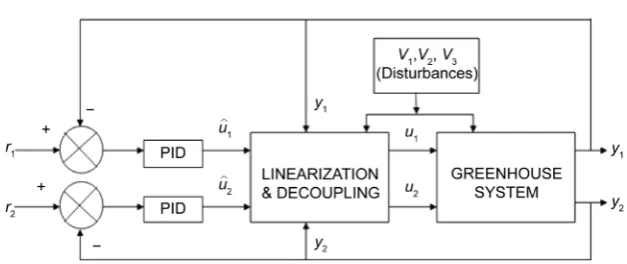
The closed loop control strategy for Greenhouse system is shown in Figure 2. The GHS is a multivariable system. The inputs to GHS are ventilation rate (r1) and water capacity
of fog system (r2). The external disturbance include: solar radiation (V1), outside
tem-perature (V2) and outside humidity (V3). The outputs from the GHS are: inside
Figure 2. Closed loop control strategy for greenhouse system.
4.1. Servo Operation
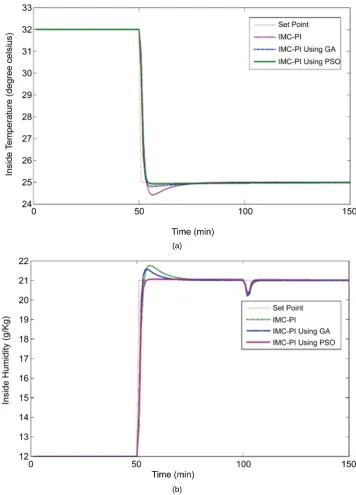
The GHS output responses namely the inside temperature and inside humidity ob-tained using three different control schemes for the linearized and decoupled of the greenhouse are shown in Figure 3(a) and Figure 3(b) respectively.
(a)
(b)
Figure 3. Comparison of closed loop performance of here types of IMC-PI controllers for servo
[image:9.595.223.531.300.676.2]From Figure 3(a) and Figure 3(b), it is observed that the performance of the IMC- PI controller tuned using PSO is better. This is reflected in the value of λ that is com-puted using the PSO-based optimization algorithm.
Control Signals
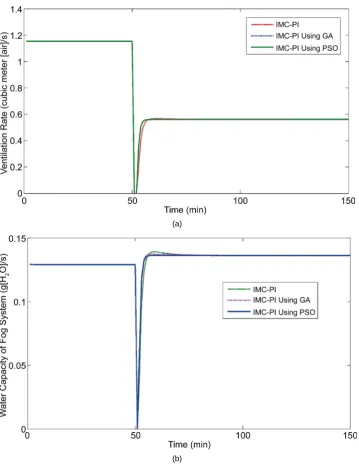
The corresponding variation in control signals namely the ventilation rate and water capacity of the fog system, for the linearized and decoupled model of the GHS are shown in Figure 4(a) and Figure 4(b), respectively. It is observed that the variation in the manipulated variable is smooth.
(a)
[image:10.595.195.555.210.678.2](b)
Figure 4. Corresponding variations in control signal for servo operations. (a) Variation of
It is observed that the variation in the manipulated variable is smooth.
4.2. Regulatory Operation
4.2.1. For Disturbance in Temperature Loop
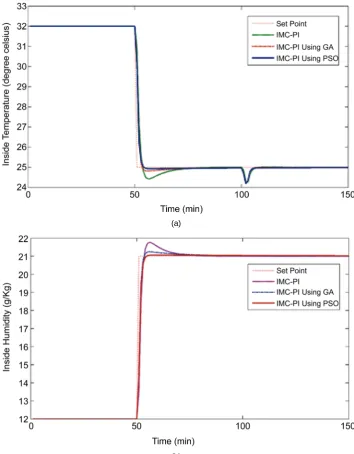
Regulatory responses for the three types of IMC-PI controllers are obtained by provid-ing a load change of 5% at time t = 100 minutes on the temperature loop, and the varia-tions observed in temperature and humidity are shown in Figure 5(a) and Figure 5(b), respectively.
(a)
[image:11.595.196.551.201.656.2](b)
Figure 5. Comparison of closed loop performances of 3 types of IMC-PI controller’s regulatory
It is observed that the performance of the IMC-PI controller tuned using PSO is bet-ter. This is reflected in the value of λ that is computed using the PSO-based optimiza-tion algorithm.
4.2.2. Control Signals (for Disturbance in Temperature Loop)
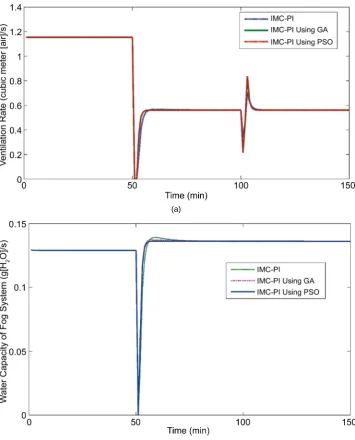
The corresponding variations in control signals, namely, the ventilation rate and water capacity of the fog system, for the linearized and decoupled model of GHS for a distur-bance in the temperature loop at time t = 100 minutes are shown in Figure 6(a) and
Figure 6(b), respectively.
(a)
(b)
Figure 6. Corresponding variation in control signal for regulatory operation (for disturbance in
[image:12.595.196.552.212.653.2]It is observed that the variation in the manipulated variable is smooth.
4.2.3. For Disturbance in Humidity Loop
Regulatory responses for the three types of IMC-PI controllers are obtained by provid-ing a load change of 5% at time t = 100 minutes on the humidity loop and the varia-tions are shown in Figure 7(a) and Figure 7(b) respectively.
(a)
[image:13.595.195.552.166.662.2](b)
Figure 7. Comparison of closed loop performances of 3 types of IMC-PI controller’s regulatory
It is observed that the IMC-PI controller tuned using PSO has the minimum over-shoot.
4.2.4. Control Signals (for Disturbance in Humidity Loop)
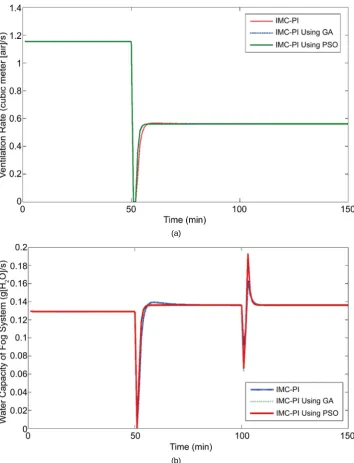
The corresponding variations in the control signals, namely, the ventilation rate and water capacity of the fog system, for the linearized and decoupled model of GHS for a disturbance in the humidity loop at time t = 100 minutes is shown in Figure 8(a) and
Figure 8(b), respectively.
(a)
(b)
Figure 8. Corresponding variation in control signal for regulatory operation (for disturbance in
[image:14.595.196.551.196.660.2]It is observed that the variation in the manipulated variable is smooth.
5. Quantitative Comparison
The performance measures for IMC-PI controller, IMC-PI tuned using Genetic Algo-rithm (GA) and IMC-PI tuned using Particle Swarm Optimization (PSO) for linearized and decoupled model of GHS are carried out using the Integral Absolute Error (IAE) and the Integral Square Error (ISE) as given in Equations (14) and (15) respectively.
( )
0 d
IAE=
∫
∞e t t (14)( )
20 d
ISE=
∫
∞e t t (15)The performance measures obtained for servo and regulatory operation (for distur-bance in temperature loop and for disturdistur-bance in humidity loop) are tabulated in
[image:15.595.193.555.327.427.2]Tables 6-11 respectively. From tables it is observed that the error is minimum for the IMC-PI tuned using PSO when compared to IMC-PI using GA and conventional PI.
Table 6. Comparison of performance measures for servo response for Temperature.
Performance Criterion Temperature
IMC-PI IMC-PI Using GA IMC-PI Using PSO
IAE 12.87 8.692 8.484
ISE 28.71 20.3 15.19
Overshoot (%) 2.29 0.756 0.54
[image:15.595.194.555.464.558.2]Settling time (min) 40 38 35
Table 7. Comparison of performance measures for servo response for Humidity.
Performance Criterion Humidity
IMC-PI IMC-PI Using GA IMC-PI Using PSO
IAE 15.42 11.16 10.23
ISE 44.83 32.56 30.85
Overshoot (%) 3.66 2.726 2.24
[image:15.595.194.556.608.702.2]Settling time (min) 30 29 27
Table 8. Comparison of performance measures for regulatory response for Temperature (for
disturbance in temperature loop).
Performance Criterion Temperature
IMC-PI IMC-PI Using GA IMC-PI Using PSO
IAE 14.91 10 9.754
ISE 29.76 21.14 20.29
Overshoot (%) 2.9 3.2 2.8
Table 9. Comparison of performance measures for regulatory response for Humidity (for dis-turbance in temperature loop).
Performance Criterion Humidity
IMC-PI IMC-PI Using GA IMC-PI Using PSO
IAE 15.42 10.46 9.63
ISE 44.83 32.81 29.48
Overshoot (%) 3.66 2.726 2.34
[image:16.595.192.555.255.358.2]Settling time (min) 32 28 24
Table 10. Comparison of performance measures for regulatory response for Temperature (for
disturbance in humidity loop).
Performance Criterion Temperature
IMC-PI IMC-PI Using GA IMC-PI Using PSO
IAE 12.86 8.484 7.692
ISE 28.71 20.46 19.3
Overshoot (%) 2.29 0.75 0.52
Settling time (min) 26 24.6 23.2
Table 11. Comparison of performance measures for regulatory response for Humidity (for
dis-turbance in humidity loop).
Performance Criterion Humidity
IMC-PI IMC-PI Using GA IMC-PI Using PSO
IAE 17.46 11.36 10.56
ISE 45.87 34.66 32.63
Overshoot (%) 3.67 2.73 2.24
Settling time (min) 24.5 23.2 20.6
From these closed loop simulation studies, it is seen that IMC-PI controller tuned using Particle Swarm Optimization (PSO) gives better performance than IMC-PI con-troller using Genetic Algorithm (GA) and IMC-PI concon-troller.
6. Conclusion
[image:16.595.194.554.403.510.2]GHS would result in better yield in the production of crops such as tomato, lettuce and broccoli.
References
[1] Albright, L.D., Gates, R.S., Arvanitis, K.G. and Drysdale, A. (2001) Environmental Control for Plants on Earth and in Space. IEEE Control System Magazine, 21, 28-47.
http://dx.doi.org/10.1109/37.954518
[2] Pasgianos, G.D., Arvanitis, K.G., Polycarpou, P. and Sigrimis, N. (2003) A Nonlinear Feed-back Technique for Greenhouse Environmental Control. Computers and Electronics in Agriculture, 40, 153-177. http://dx.doi.org/10.1016/S0168-1699(03)00018-8
[3] Fourati, F. and Chtourou, M. (2007) A Greenhouse Control with Feed-Forward and Recur-rent Neural Networks. Simulation Modelling Practice and Theory, 15, 1016-1028. http://dx.doi.org/10.1109/37.954518
[4] He, F. and Ma, C. (2010) Modeling Greenhouse Air Humidity by Means of Artificial Neural Network and Principal Component Analysis. Computers and Electronics in Agriculture, 71S, S19-S23. http://dx.doi.org/10.1016/j.compag.2009.07.011
[5] Trejo-Perea, M., Herrera-Ruiz, G., Rios-Moreno, J., Miranda, R.C. and Rivas-Arazia, E. (2009) Greenhouse Energy Consumption Prediction Using Neural Networks Models. In-ternational Journal of Agriculture and Biology, 11, 1-6.
[6] Hu, H.G., Xu, L.H., Wei, R.H. and Zhu, B.K. (2011) Multi-Objective Optimization for Greenhouse Environment Using Evolutionary Algorithms. Sensors, 11, 5792-5807. http://dx.doi.org/10.3390/s110605792
[7] Cao, Y.J. and Wu, Q.H. (1999) Teaching Genetic Algorithm Using Matlab. International Journal of Electrical Engineering, 36, 139-153. http://dx.doi.org/10.7227/IJEEE.36.2.4 [8] Liu, W.K. and Juang, J.G. (2004) Application of Genetic Algorithm Based on System
Per-formance Index on PID Controller. Proceedings of the Ninth Conference on Artificial In-telligence and Application.
[9] Hasni, A. and Taibi, R. (2011) Optimization of Greenhouse Climate Model Parameters Us-ing Particle Swarm Optimization and Genetic Algorithms. Energy Procedia, 6, 371-380. http://dx.doi.org/10.1016/j.egypro.2011.05.043
Submit or recommend next manuscript to SCIRP and we will provide best service for you:
Accepting pre-submission inquiries through Email, Facebook, LinkedIn, Twitter, etc. A wide selection of journals (inclusive of 9 subjects, more than 200 journals)
Providing 24-hour high-quality service User-friendly online submission system Fair and swift peer-review system
Efficient typesetting and proofreading procedure
Display of the result of downloads and visits, as well as the number of cited articles Maximum dissemination of your research work