http://www.scirp.org/journal/sn ISSN Online: 2169-3323 ISSN Print: 2169-3285
#Occupywallstreet: An Analysis of Twitter
Usage during a Protest Movement
Zuoming Wang, Kara Caskey
Department of Communication Studies, University of North Texas, Denton, TX, USA
Abstract
In 2011, the Occupy Wall Street movement made history as one of the largest gras-sroots protest events in the United States. Members made frequent use of social me-dia tools, like Twitter, to share information and mobilize participants. This study uses content analysis to examine the way that Twitter is used to incite, organize, and perpetuate protest movements. 1500 tweets in total were coded for content and lin-guistic features to provide insight into how Twitter is used to achieve different goals surrounding protest movements, the tonality of the tweets, and the purpose of dis-tributed messages. Our findings indicate that Twitter is a tool primarily used for sharing objective, logistical information, along with opinions, to create a unified community and mobilize individuals to participate in a physical space of protest.
Keywords
Content Analysis, Discursive Resistance Online, Occupy Wall Street, Twitter, Social Media, Community Formation
1. Literature Review
Occupy Wall Street may be one of the most talked about protest movements in recent US history. The New York Times has even dedicated a section of its website to the
movement, compiling all relevant information to the movement in one place [1]. The
protest started on September 17, 2011 and organizers continue to plan protests as
re-cently as May 1, 2012 [2]. It began as a group of activists inspired by the protests in
Egypt and Tunisia, as well as a call to arms by the Canadian magazine, Adbusters. In a blog written on July 13, 2011, authors called for “20,000 people [to] flood into lower Manhattan, set up tents, kitchens, peaceful barricades and occupy Wall Street for a few
months” [3]. Beginning with 1,000 protestors in New York City, the movement has
How to cite this paper: Wang, Z.M. and Caskey, K. (2016) #Occupywallstreet: An Analysis of Twitter Usage during a Protest Movement. Social Networking, 5, 101-117.
http://dx.doi.org/10.4236/sn.2016.54011
Received: September 15, 2016 Accepted: October 23, 2016 Published: October 27, 2016
Copyright © 2016 by authors and Scientific Research Publishing Inc. This work is licensed under the Creative Commons Attribution International License (CC BY 4.0).
spread across the globe, uniting with the slogan, “We are the 99%” (“What is Occupy”, 2011). Their complaints are against the wealthiest one percent, representing banks, fi-nancial firms, and others. The goal was to protest “corporate greed, social inequality and the corrosive power of major banks and multinational corporations over the dem-ocratic process” [1].
Using the title of the Adbusters blog, “#Occupy wall street”, supporters and critics of the movement began using that hashtag to share information and opinions about the movement with their networks. Reuters and Social Flow, a social media tracking com-pany, began following the use of the hashtag on Twitter and found little usage prior to
the day before the protest, September 16, 2011 [4]. Anonymous, an online community
of hackers, also threw their support behind the movement and created a video that was posted on Adbusters on August 23, 2011. Clearly, the internet and social media were crucial in the start of this protest movement, as well as the way it was maintained and ultimately turned into a mainstream media topic.
Though protests have been happening for centuries, Twitter has changed the way that protests come together, and also impacted the people involved with them. When
talking about the Iranian protests, Grossman [5] explained, “Twitter didn’t start the
protests in Iran, nor did it make them possible. But there’s no question that it has em-boldened the protesters, reinforced their conviction that they are not alone and engaged populations outside Iran in an emotional, immediate way that was never possible be-fore.” (para. 9). This perspective is what makes social media so compelling for commu-nication scholars, and positions us as uniquely qualified to provide insight into how so-cial media functions to engage citizens in protests. We can also provide information to assist policy makers and the public, because while Twitter can be used to encourage democratic participation, it can also be used to spread misinformation or to track and
silence dissenters [5]. Through the examination of tools like Twitter, we can illuminate
how information is shared, the way individuals connect via social media, and the end results of those efforts.
Studying social media is also valuable way to analyze our society and culture as a
whole. Ruben and Stewart [6] wrote about mediated communication as a “cultural
mirror, combining with the messages of face-to-face communication to provide a menu and an agenda of concerns, issues, values, personalities, images, and themes that occupy a central role in the symbolic environment to which individuals must adapt” (p. 340). Examining the communication within Twitter provides us with a mirror to examine the ways people organize and share information, especially in regards to new technologies and protest movements.
However, most current literature regarding social media and protests focuses on
lo-cations outside of the US, such as Egypt [7] [8] and Romania and the UK [9]. Other
work focuses on analysis by looking at how the news talks about Twitter use, rather
than looking at the way Twitter is actually used [10]. This study seeks to expand our
be used to inform policy makers and the general public alike about the way social media
impacts society as a whole [11].
1.1. Social Media and Protest Movements
Twitter is an asynchronous social media site which allows users to create a profile page and then update with messages via the main website, mobile internet devices, and text
messages [12]. The messages are automatically posted and visible on the public Twitter
web page. Currently, there are more than 140 million active users who tweet 340
mil-lion tweets per day [13]. As Murthy [12] noted, it is not clear how many tweets actually
get read each day, but “people are sending tweets and consider it to be meaningful for them” (p. 781). While tweets are limited to 140 characters, users can take advantage of other applications or websites which shorten hyperlinks, embed photos into messages,
or link to longer posts hosted on other websites [14]. Messages can be linked to one
another through the use of a hash sign, also called a “hashtag”. This links all messages into a searchable list, where individuals can visit the main Twitter page and search for a
hashtag—like #occupy wall street—to find all tweets containing that tag [12].
Users can create a live feed of tweets by “following” other members on Twitters. Each time that user submits a new tweet, it shows up on that users feed instantly, and can be
simply read, “retweeted” (i.e. sent out to their own network of followers), or responded
to in a direct tweet (i.e. still public, but targeting that user by username). This allows
members to create a network of people to receive information from, or submit infor-mation to. The collection of tweets on a user’s profile is also called a “microblog”,
de-scribed as a blog that contains short rather than long messages [15]. Previous studies on
microblogs have shown that users feel a sense of community due to the frequent
up-dates and virtual presence of other users [16].
1.2. Social Media and Information Sharing
Murthy [12] discussed research on Twitter and its use by citizen journalists in breaking
news or spreading information. Murthy’s [12] argument is that Twitter can be used by
citizens to both disseminate information and also document newsworthy events with photographs and video. For example, when US Airways flight 1549 crashed, a Midtown Ferry passenger had taken a picture and uploaded it to Twitter before it was even
cov-ered by news agents [12]. Murthy also discussed the 2008 Mumbai bombing and the
way that Twitter users gave eyewitness accounts and started a trending hashtag, #mumbai, that generated so much traffic that the Indian government requested Twitter
to stop updating the feed for fear that the terrorists were using it to organize [12]. The
blend of instantaneous updates, concise messages, and the ability to incorporate photo-graphs makes Twitter an ideal method for disseminating information to mass numbers of people quickly and efficiently.
tweets, her study was based upon news stories published in the mass media, blogs, or
other types of journals [10]. In all three cases, Ems [10] found that Twitter was used to
“organize protests, get information to media outlets about the protests, or to avoid
po-lice in the streets during protests” (para. 9). Erickson [17] called this type of
informa-tion “citizen microbroadcasting”, which involved sending relevant, locainforma-tion-specific information to followers (p. 1200). Typically, the user would report on events as they
were occurring and combine that with personal, opinion related commentary [17]. In
order to examine some of these issues using first hand data from tweets about Occupy Wall Street, we proposed the following research questions:
RQ 1: a) What percentage of the tweets contain logistical information?
RQ 2: a) What percentage of the tweets contain public outreach? b) What is the most common form of public outreach?
RQ 3: a) What is the most common type of general information shared? b) What percentage of the tweets contain information about police activity? c) What percentage of the tweets contain eye witness accounts?
Papacharissi and Oliveira [7] examined Twitter usage during the Egypt protests in
January 2011, generating a concept of “affective news streams” (p. 279). This describes the way that news is constructed through a collaborative effort of Twitter users, uniting experience with opinion and observation to anticipate future events and frame them
[7]. Papacharissi and Oliveira [7] argued that “affective attachments create feelings of
community that may either reflexively drive a movement, and/or capture users in a state of engaged passivity” (p. 280). To evaluate the presence of affective news stream within the Occupy Wall Street movement, we proposed the following questions:
RQ 4: a) What percentage of the tweets include opinion sharing? b) What is the pri-mary opinion shared overall?
RQ 5: a) What is the most common opinion expressed in tweets regarding the event? b) Regarding the participants?
1.3. Discursive Resistance Online
Wood and Smith [18] define discursive resistance as “a process through which text,
oral, nonverbal communication, and other forms of meaning-making are employed to imagine alternatives to dominant power structures” (p. 180). The internet can be
viewed as a space for imagining such alternatives. As examined in Fahmi’s [8] research,
activists “[use] the Internet as a work space, social centre [sic] and project workshop so that virtual and physical spaces are experienced almost as a single space of communica-tion” (p. 90). Activists take information created and spread online as a way to navigate
and construct street protests [8]. This can also be examined as an issue of place/space.
Place is defined as a defining force that works to “formalize, authorize, and make per-manent the processes through which dominant interests maintain their influence” (p. 181) [18]. In contrast, space is the localized response where individuals find meaning
and identity in places [18]. This is similar to Habermas’s [19] concept of the public
pro-test can be “spaces of freedom”, as can sites of local propro-test, like Wall Street [8].
This concept of created space is related to two types of rhetoric that can be found in online dissent: agonistic rhetoric and utopian rhetoric. Agonistic rhetoric aims to
“produce or invoke ritualized conflict with an established order” (p. 184) [18]. This
type of confrontation is based upon the idea of placing blame on others for perceived
wrongs, which can eventually lead to a changed state [18]. Utopian rhetoric invokes an
“ideal form of interaction” that cannot exist and is inaccessible (p. 185) [18]. Internet
protest movements may be seen as utopian because the spaces created are not physical
locations [18]. They exist in an online space that does not exist outside of the online
realm, and must utilize components such as absurdity, community, and social order to
invoke the ideal state [18]. Agonistic rhetoric promotes pushing back against
estab-lished order, which could be enacted through the movement of dissention from an on-line medium to a physical space of protest.
In addition to creating spaces of freedom, Twitter users could be evaluated as com-munities coordinated through social media. There are two main types of comcom-munities: intentional, or people who join together for a specific reason who are unified by lan-guage, location, or culture, and ad hoc, or people who form a spontaneous community
in response to a crisis or threat [18]. The Occupy Wall Street protest could be seen as a
blend of these two types of community. First, the members using the corresponding hashtag are intentionally joining a group of people who feel similarly about the econo-my and government, and could be united by a particular type of language as it comes to talking about the event. Second, the members are responding to the existing economic crisis by accusing Wall Street and the government of greed and corruption. RQ 1 al-ready addresses the place/space issue, so to examine the issues of dissent and commu-nity formation, we proposed the following research questions:
RQ 6: What are the most common linguistic features in the tweets? RQ 7: What is the most common theme in the tweets?
2. Method
2.1. Content Analysis
Content analysis is a “systematic, step-by-step procedure used to answer research
ques-tions and test hypotheses” (p. 239) [20]. The purpose of this approach is to “identify,
enumerate, and analyze occurrences of specific messages and message characteristics
embedded in texts” (p. 236) [20]. Krippendorf [21] described four reasons to use
con-tent analysis over other methodologies: first, it is unobtrusive because of the focus on existing texts; second, it is unstructured material that is categorized; third, it is ex-amined in context; and fourth, it can handle large amounts of data. It is a five step process: sampling texts, choosing features to code, developing categories, training cod-ers, and analyzing data (p. 239) [20].
2.2. Sampling Process
organiza-tional efforts that would be focused on the initiation of the protest, tweet samples were pulled from September 16, 17, and 18. These three dates were chosen to analyze pre- event, day-of, and day-after tweets of the event. Twitter does not authorize release of large amounts of raw data, so researchers utilized a software tool to pull tweets by date and search term. The hash tag #occupy wall street was used to identify related tweets. This hash tag was chosen because it was used as the official hash tag by event organizers and participants. The last 500 tweets of each selected date were chosen for analysis, yielding a total number of 1500 tweets.
2.3. Selecting Unit of Analysis
Each tweet was examined as its own unit of analysis. While some tweets contained mul-tiple phrases, the short length of 140 characters made it difficult to break the tweets into smaller phrasings. Also, not all tweets contained multiple words. Some consisted only of hyperlinks, hash tags, or other single words. However, due to the fact that each tweet referred to a particular event and we were seeking the meaning users were attaching to
that event, these could be defined as referential units [22].
2.4. Category Development
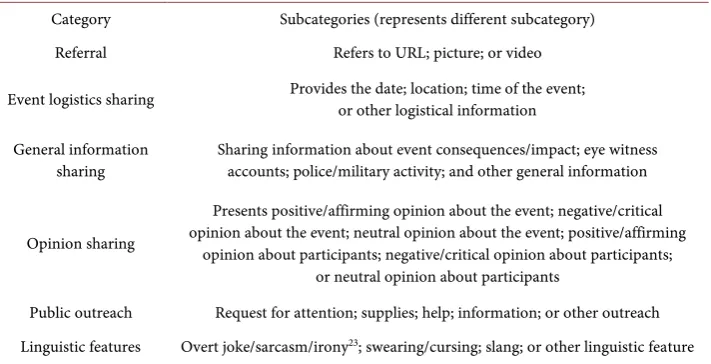
The primary researcher developed the list of categories for the code book using the re-search questions as a guideline. As the coding proceeded, coders tracked any findings that fell into the “other” category in order to add additional ones, but no significant ad-ditions were found. The referral category focused on tweets that referenced outside
in-formation. This took the form of urls/hyperlinks1, pictures2, or videos3. Tweets coded as
sharing event logistics were those providing the date4, location5, time6, or other
logistic-al information, like restaurant or bathroom locations7. General information sharing
in-cluded information related to the protest, but not to logistical information. Tweets
coded for this contained things like event consequences8, eye witness accounts9, police
or military activity10, and other types of general information11. Opinion sharing referred
1Example: @SchoolerLA “RT @anonops: Schedule for #OccupyWallStreet #Sep17>> http://t.co/w8CoaQhM” 2Example: @jmsjckmn “Good luck tomorrow, here’s a poster to help get the message across.
#occupy-wallstreet #sept17 #usdor @lupefiasco http://t.co/l63Zwn8k”
3Example: @Abe93s “RT @AntiSec_: Think Different. http://t.co/skfcpNbO #rebels #occupywallstreet
#cra-zyones #genius”
4Example: @CDXXb3ll “RT @OperationLeakS: #OccupyWallStreet is this Saturday #Sep17 and WallStreet
will never be the same. We are #Anonymous. We are the People ...”
5Example: @superbranch “RT @HotLiberalBitch: Tomorrow Wall Street will belong to the people.
#occupy-wallstreet http://t.co/PNB8YFV7”
6Example: @AnonymousTx “AnonOps Communications: Schedule for #OccupyWallStreet #Sep17
http://t.co/YyV667ND”
7Example: @littlelisa8 “@anonops: Call (877) 881-3020 for Help & Directions for #OccupyWallStreet #Sep17 RT” 8Example: @sly_3 “Arrests During Test Run for #OccupyWallStreet
http://t.co/ZlTQXH2Z/ via @huffingtonpost”
9Example: @superbranch “RT @jeffrae: I see a few people on my train with sleeping bags...I think they are
#occupywallstreet folks. This thing is real! FTW”.
10Example: @WIProud “MT @sonyazink: #signs all ovr: nypd security cameras in ths area|b/c big brother cn
never have enough eyes on us;) #occupywallstreet”
11Example: @strawprophet “RT @YourAnonNews: The Hipster’s Guide To The Revolution:
to any opinion expressed within the tweet. This was divided into two topics, opinions
about the event12 and opinions about participants13. Tweets with public outreach were
those that targeted followers or media and celebrity figures for attention (usually in the
request for retweets)14, supplies (such as food or camping equipment)15, help (like rides
to the event)16, information17, or other types of outreach18. Lastly, linguistic features
in-cluded things like joke/sarcasm/irony19, swearing/cursing20, slang21, or other linguistic
features22. For more detail, see Table 1.
[image:7.595.198.554.220.402.2]In addition to doing a referential unit analysis, researchers also conducted a thematic
Table 1. Tweet classification categories.
Category Subcategories (represents different subcategory)
Referral Refers to URL; picture; or video
Event logistics sharing Provides the date; location; time of the event; or other logistical information
General information
sharing Sharing information about event consequences/impact; eye witness accounts; police/military activity; and other general information
Opinion sharing
Presents positive/affirming opinion about the event; negative/critical opinion about the event; neutral opinion about the event; positive/affirming
opinion about participants; negative/critical opinion about participants; or neutral opinion about participants
Public outreach Request for attention; supplies; help; information; or other outreach Linguistic features Overt joke/sarcasm/irony23; swearing/cursing; slang; or other linguistic feature
12Example: @CDXXb3ll “RT @OperationLeakS: #OccupyWallStreet is this Saturday #Sep17 and WallStreet
will never be the same. We are #Anonymous. We are the People ...”
13Example: @wenders1022 “I’ve been to PTA meeting of 10 where nothing can get done. Do the
#occupy-wallstreet crowd really think they can strategize with bullhorns?”
14Example: @littlelisa8 “@partygnome: @SenatorSanders Can you give a shout-out to #OccupyWallStreet?”RT 15Example: @AnonyOps “Any bands want to bring equipment to wallstreet? We’re going to need some jams.
#occupywallstreet”
16Example: @outrage_molly “I am on-board! RT @TeacherWarrior: #occupywallstreet can we send
food/pizza to protesters like we did in WI??”
17Example: @mmmousiebrown “how yall feeling about this #occupywallstreet thing?”
18Example: @jbrady77 “RT @LupeFiasco: Can’t make it 2 NYC? Show ur support 4 #occupywallstreet
2morrow by making a sign, bumper sticker, tshirt, henna tattoo ...”
19Example: @wenders1022 “I hope the #occupywallstreet crowd isn’t using Twitter to organize, considering
Twitter is a corporation & therefore evil.”
20Example: @Hippy4Humanity “RT @sonyazink: that #gov that claims to represent me can
#kissmylilywhi-teass ;) #occupywallstreet #hunnyhug”
21Example: @littlelisa8 “#OccupyWallStreet I’m getting some foul American hate tweets from Americans!! U
don’t scare me n u certainly won’t stop me!”
22Example: @AnonPanama “MAÑANA POR LA NOCHE TOMAREMOS WALL STREET #Occupywallstreet
medios esten atentos... @tvnpanama @Telemetro @IvanDonosotv @mariapiazubieta”
23After going through the coding test, the research team opted to collapse two subcategories together: overt
unit analysis. The primary researcher developed themes using the research questions, and expanded the list as the coding team identified additional thematic content. The final list included 11 themes: expressing anger towards the “system,” expressing anger toward business/corporation, expressing anger toward the government, mobilizing by requesting for more participation, mobilizing by negative statements of non-partici- pants, expressing well-wishes to the participants, objective, praise of the event, comedic, critical, and other.
Expressing anger towards the “system” included any anger towards the structure of
society24. Expressing anger towards business/corporation was similar, but with anger
aimed at the economy or large businesses25. Expressing anger towards the government
included political parties, politicians in specific, police, or the military26. When coding
for mobilization through the request for participation, coders focused on direct
re-quests for participation27 or subtle appeals for people to come join the event. Coders
also included reminders about the event or sharing the schedule with positive affirma-tion of the event. With mobilizing through negative statements of non-participants, coders looked for passive-aggressive requests for participation, typically by insulting or
making derogatory statements about people who did not, or would not, participate28.
Expressing well-wishes involved encouragement towards the participants, or wishing
them well in their endeavors29. Objective tweets were those that were typically strictly
relaying information or referring to outside sources, like news stories30. Praise of the
event meant that the tweet included praise of the event itself31. Comedic tweets were
those that talked about the event or participants in a comedic way, including pop
cul-ture references32. Critical tweets were ones that expressed criticism of the event or
par-ticipants33. Lastly, tweets classified as "other" were those that did not fit any other
cate-gory34.
24Example: @USDayofRage “Billions of dollars. One objective. Co-opt elections and tax payer dollars for their
gain. #usdor #sept17 #occupywallstreet”
25Example: @whatzaname “RT @BABYDIABOLICAL: We Are The 99% that will no longer tolerate the greed
and corruption of the 1%. #OccupyWallstreet bit.ly/o8XPqy”
26Example: @Hippy4Humanity “RT @sonyazink: that #gov that claims to represent me can
#kissmylilywhi-teass ;) #occupywallstreet #hunnyhug”
27Example: @littlelisa8 “RT @partygnome: Fellow citizens of the world!! Find your voice and use it. Show
your support for #OccupyWallStreet.”
28Example: @MrGlasco “#AnnoyingThingsPeopleSay ‘I’m ready for a change!!’ ...while taking no action --
#occupywallstreet”
29Example: @greenthumbnails “really proud of the people standing up for freedom this weekend. thanks :)
#occupywallstreet #etc”
30Example: @SongofSongs1_2 “US Day of Rage has 6 Protests in United States on #Sept17
http://t.co/udrNK6fM #occupywallstreet #usdor #occupywallstreet (@USDayofRage)”
31Example: @Deprogrammer9 “RT @AnonNCarolina2: Remember, remember the 17th of September when
Americans #OccupyWallStreet”
32Example: @ExJon “I can’t get to Wall Street for the #DayOfRage, so I’ll just stomp around my house
growl-ing, ‘I’M SO ANNNGGGRRRYYY!’ #OccupyWallStreet”
33Example: @wenders1022 “I hope the #occupywallstreet crowd isn’t using Twitter to organize, considering
Twitter is a corporation & therefore evil.”
34Example: @ReverendManny “@sonyazink I’m deeply honored by your hugz! #wehugtheplanet #solidarity
2.5. Coder Training
The primary researcher conducted two training sessions with the coding team. During the first session, the team reviewed the codebook, sample tweets, and coded five sam-ples together. Each team member was then given 20 tweets to code independently for assessing intercoder reliability. The primary researcher compiled the information and conducted a second training wherein differences were discussed and refinements for the codebook suggested. The team added a few rules and clarified some of the catego-ries for coding, and repeated the process until the intercoder reliability achieved 0.91.
2.6. Analysis
Researchers split the 1500 tweets between a team of five coders. Coders used a coding handbook to analyze tweets based on the categories detailed previously. As researchers worked through the coding project, rules and suggestions were created to further ena-ble consistency amongst the team. Coders utilized Microsoft Excel to compile the in-formation, which was later input to SPSS for statistical analysis. The majority of the categories were not mutually exclusive, as tweets could contain multiple features and were examined for the presence of any of the variables of interest. The mutually exclu-sive categories included: originality (original content versus retweet), targeting (di-rected at another user or non-di(di-rected), the major category headings (as a function of total tweets), and the overall theme of the tweet. The subcategories beneath the major category headings were not mutually exclusive. Of the 1500 tweets coded, 3 contained a foreign language and were thus eliminated from examination to prevent inaccurate translations, resulting in 1497 total tweets coded.
3. Results
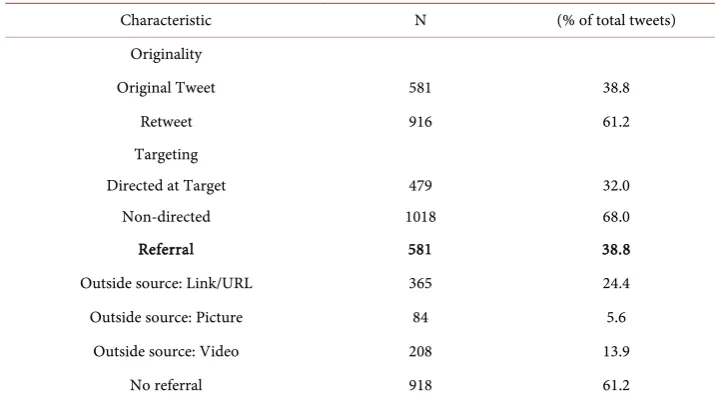
To provide an overview of the data, we examined general categorical information to capture some detailed information about the format of the tweets. We examined the originality of tweets, comparing original content to those that are retweeted from other users. The results showed that most tweets (61.2%) were retweeted messages, indicated that most users re-sent messages that others had written, rather than creating their own messages. A second category examined was that of targeting, where a user sends a di-rected tweet to another user using their screen name, or if it is just sent out to their fol-lowers as an open message. The majority of messages (68%) in this category were non- directed messages, meaning that they were sent out as open targeting. Lastly, we ex-amined the referrals made within the tweets, specifically looking for weblinks, videos, or pictures. Some tweets in this category contained multiple referrals, so the counts are not mutually exclusive. In total, 581 tweets (38.8%) contained some type of referral. The primary type of referral contained a URL or hyperlink to another website (24.4%),
fol-lowed by referrals to videos (13.9%). For more details, see Table 2.
Information Sharing and Public Outreach
Table 2. General tweet characteristics.
Characteristic N (% of total tweets)
Originality
Original Tweet 581 38.8
Retweet 916 61.2
Targeting
Directed at Target 479 32.0
Non-directed 1018 68.0
Referral 581 38.8
Outside source: Link/URL 365 24.4
Outside source: Picture 84 5.6
Outside source: Video 208 13.9
No referral 918 61.2
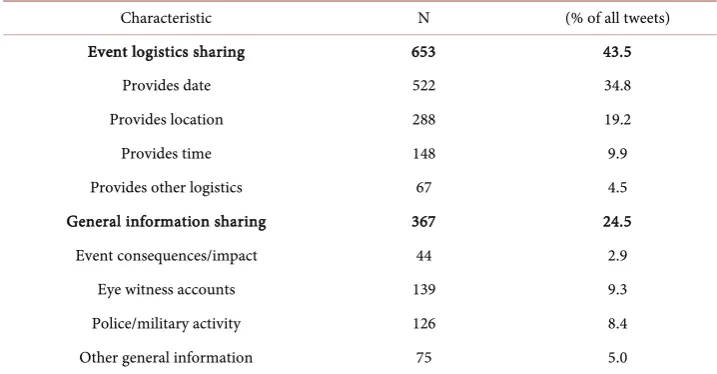
tweets for several logistical information features. The features coded were date, loca-tion, time, and other, which included things like restaurant/hotel/bathroom locations and hashtags to follow for key information. Coders also examined the general informa-tion shared in the tweet, which included informainforma-tion about event consequences or im-pact, eye witness accounts, police and military activity, and other information like the reasons for the event or tools to use for sharing information with other participants. First, the primary researcher compared the different types of information sharing to see which was more prevalent: logistical information or general information. In answer to research question one, 43.5% of all tweets contained logistical information, which was
consisted with the findings discussed by Ems [10].
To answer the third research question about general information sharing, 24.5% of all tweets were found to have those features. The highest percentage (9.3%) of tweets contained eye witness accounts of events as they were unfolding during the protest. The second highest (8.4%) were tweets detailing police activity. This is consistent with
Erickson’s [17] findings about citizen microbroadcasting, due to the eye witness
ac-counts and related commentary to the event. Ems’s [10] research indicated that the
third highest theme in Twitter usage during protests was to share information about police activities. Our data indicated that only 8.4% of the tweets contained information about police or military activity, which means it is ranked fifth out of eight related
cat-egories with information sharing. For more information, see Table 3.
Table 3. Information sharing.
Characteristic N (% of all tweets)
Event logistics sharing 653 43.5
Provides date 522 34.8
Provides location 288 19.2
Provides time 148 9.9
Provides other logistics 67 4.5
General information sharing 367 24.5
Event consequences/impact 44 2.9
Eye witness accounts 139 9.3
Police/military activity 126 8.4
Other general information 75 5.0
public outreach. The highest percentage (10.6%) of tweets contained requests for addi-tional attention. This included tweets requesting that followers resend a message, or with tweets that targeted mainstream media personalities or other celebrities, asking for them to pay attention to the event and send information to their own networks. See
Table 4.
To evaluate the presence of affective news stream, coders examined the presence of opinions in each tweet. In addition to examining the existence of an opinion, coders differentiated between opinions about the event and about the participants. This sub-category was mutually exclusive. The results indicated that just over one-third (38.2%) of all tweets include some type of opinion sharing. The primary opinion shared amongst Twitter users was positive about the event (22.9%), followed by a positive opi-nion of event participants (7.3%). The results suggested that the majority of users who tweeted about Occupy Wall Street were supporters and not critics of the movement. See
Table 5.
Twitter users have an imagined audience that impacts the word choice and linguistic
markers of their tweets [14]. This is also a characteristic of community, in which
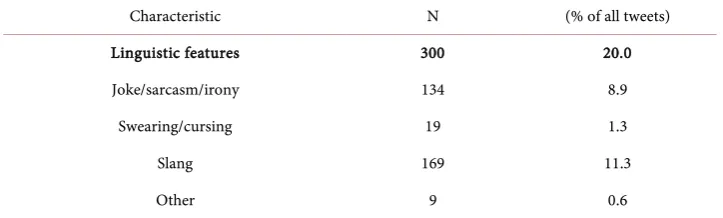
mem-bers have a language to unite memmem-bers of that community. To examine the linguistic features in the tweets, coders examined messages for humor (jokes, sarcasm, and iro-ny), swearing/cursing, slang, and other markers. Slang included improper words or “text talk”, abbreviated acronyms that aid in staying within the 140 character limit. For example, “ty” stands for “thank you.” In total, 20% of the tweets contained some type of linguistic feature. The most common linguistic feature was slang (11.3%), followed by humor (8.9%). These results indicated that there is a specific lingo that is used in
Twit-ter as part of the community. For more detail, see Table 6.
Table 4. Public outreach.
Characteristic N (% of all tweets)
Public outreach 243 16.2
Request for attention 159 10.6
Request for supplies 20 1.3
Request for help 11 .7
Request for information 25 1.7
[image:12.595.196.554.242.379.2]Other outreach 44 2.9
Table 5. Opinion sharing.
Characteristic N (% of all tweets)
Opinion sharing 572 38.2
Positive/affirming of event 343 22.9
Negative/critical of event 40 2.7
Neutral of event 17 1.1
Positive/affirming of participants 109 7.3
Negative/critical of participants 56 3.7
Neutral of participants 8 0.5
Table 6. Linguistic features.
Characteristic N (% of all tweets)
Linguistic features 300 20.0
Joke/sarcasm/irony 134 8.9
Swearing/cursing 19 1.3
Slang 169 11.3
Other 9 0.6
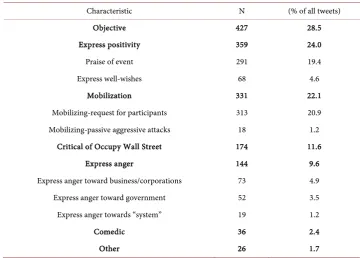
the efforts to dissent or create spaces of freedom. After comparing the information, the primary researcher combined similar themes to produce more comprehensive data, and eliminated themes that were not relevant to the study, like the “other” theme. In the end, the most common theme among the tweets was the objective theme (28.5%). This represented references to news stories, factual information, or other tweets that did not have any obvious opinion within the content. This indicated that the twitter users dis-cussing the Occupy Wall Street primarily used it as a way to disseminate information, and less as a platform for opinions. The second most common theme was that of ex-pressing positivity (24%), which would include positive opinions of the event and its
participants, followed closely by mobilization (22.1%). See Table 7 for more
[image:12.595.194.556.411.520.2]Table 7. Theme of the tweet.
Characteristic N (% of all tweets)
Objective 427 28.5
Express positivity 359 24.0
Praise of event 291 19.4
Express well-wishes 68 4.6
Mobilization 331 22.1
Mobilizing-request for participants 313 20.9
Mobilizing-passive aggressive attacks 18 1.2
Critical of Occupy Wall Street 174 11.6
Express anger 144 9.6
Express anger toward business/corporations 73 4.9
Express anger toward government 52 3.5
Express anger towards “system” 19 1.2
Comedic 36 2.4
Other 26 1.7
4. Discussion
The findings of this study expand existing literature on social media usage in protest movements by providing an analysis of the actual tweets versus news about the tweets, and by examining a large protest movement in the United States that was largely
de-signed and orchestrated through online social media. Erickson [17] and Ems [10] both
discussed the importance of sharing information through microbroadcasting and geo-graphic distribution, and these findings corroborate those results while pointing out some salient differences. With almost half of all of the tweets using the #Occupy-wallstreet tag containing logistical information, it is clear that Twitter was used as an organizational tool to share information and coordinate efforts.
Ems [10] found three popular trends in twitter data when analyzing the news stories
organized may encourage different types of information to be shared.
One of the unique aspects of Twitter is the ability to engage with other users, celebri-ties, and mass media personalities. This enables users to target messages at individuals deemed influential, who can disperse information or provide additional resources. In our findings about public outreach, seeking attention accounted for 10.6% of all tweets, and was by far the highest type of outreach within that category. Users sent tweets to individuals like Oprah, CNN News, Conan O’Brien, and other media personalities with pleas for retweets, media attention, and financial support. Whether this tactic is effec-tive or not, clearly these users view these individuals as an imagined audience,
regard-less of the actual attention paid to those tweets [14]. The results of this study indicate
that Twitter can be used as a tool to send information, but also a tool to solicit atten-tion, assistance, and support for a movement.
Opinion sharing is certainly an important feature of using Twitter during a social protest, though this study did show some interesting results in terms of the main opi-nions expressed on the hashtag. While tweets are public and accessible by anyone, the primary opinions expressed using this hashtag were those supporting the movement it-self. Of the 572 tweets with opinions, only 96 (16.8%) of them were critical of the event or the participants. While there is this presence, the vast majority of opinions expressed are in support of the protest and its participants. When combined with the theme anal-ysis, these results indicate that individuals who disagree with the movement are not nearly as active as those who are supportive, at least in using the organized hashtag.
This could be tied to the idea of affective news stream [7]. This study finds that opinion
sharing is a high percentage of the overall tweets (38.2%). Most people express the same type of opinion, which correlates with what affective news stream says about creating community, and thus framing an issue in a particular way.
Another feature of community presence is a cohesive linguistic similarity, with re-sults showing 20% of all tweets containing linguistic markers, and slang being the lead-ing element of that. In addition to common llead-inguistic features, this community also showed a high number of retweeted messages. Due to the majority (61%) of the mes-sages being recycled content, this indicates that users identified with things other people were posting, and reutilized them in their own network of followers. Rather than crafting their own messages, they rely on fellow community members for content to share with their followers.
In addition to having a strong community element, the Occupy Wall Street move-ment could be seen as an attempt to move utopian rhetoric into a rhetoric enacting ac-tual change by creating a physical space in which to defy existing power structures. Through the creation of a community of followers who are in agreement with one another, as seen in the high positive opinions expressed via Twitter, the protestors shift from an online medium that may be incapable of establishing a physical dissent to one located in a particular space. They enact a form more similar to agonistic rhetoric,
wherein they construct “ritualized conflict with an established order” (p. 184) [18].
information needed to participate in the event, along with the 22.1% of tweets aimed at mobilizing participants.
Overall, the results of this study support some findings in previous studies, but also show some unique features that may be tied to the type of protest movement itself. Our findings indicate that Twitter is a tool primarily used for sharing objective, logistical information, along with opinions, to create a unified community and mobilize individ-uals to participate in a physical space of protest.
5. Limitations
Some limitations of this study are associated with the internet medium. First of all, the information provided in the tweets cannot be guaranteed to be accurate. As Goolsby
[23] found, tweets can be “misleading, incorrect, or even fraudulent” (cited in Murthy
[12]). There are also no guarantees that the individuals posting are who they say they
are, nor that they are doing what they say they are doing. Without contacting each user individually, it is impossible to know if they acted on the things that were tweeted. Another limitation is the date rang and sample of 500 tweets of each day. Future re-search should look at a longer time span, and a larger sample of tweets. Also, the choice of the hashtag could unintentionally exclude tweets that were related to the Occupy Wall Street movement. While we used the official hash tag, there is always the risk of missing relevant data when utilizing online social media.
6. Future Research
The usage of social media in protest movements is an expanding field, and one with rich amounts of data and research opportunity. Future research should explore more information about the effectiveness of using social media in the engagement of civic participation. It is difficult to track whether users who tweet about protests actually participate in the movement itself. It would be valuable to see if the way that Twitter is used is actually successful in generating more participation, identification, or involve-ment in the protest.
Other forms of social media should also be examined. With the advancement in smart phone technology, people have greater ease and mobile access to the internet and social media tools. With the shift in access moving from laptops to smart phones, issues of community development and imagined audiences may be shifting. Future research
should explore these areas in more detail. As Tufekci and Wilson [24] note, research on
social movements should also look at the contextual information when researching protests. Each protest takes place within a particular time and political setting, which is
an equally important aspect of community as that generated on the internet [24].
Supported
This research was supported by a grant from Villanova University’s Waterhouse Family Institute for the Study of Communication and Society.
References
[1] Occupy Movement (Occupy Wall Street). New York Times, 2 May 2012.
http://topics.nytimes.com/top/reference/timestopics/organizations/o/occupy_wall_street/in
dex.html
[2] Newman, A. and Moynihan, C. (2012) At May Day Demonstrations, Traffic Jams and Ar-rests. The New York Times, 1 May 2012.
http://www.nytimes.com/2012/05/02/nyregion/may-day-demonstrations-lead-to-clashes-a
nd-arrests.html?_r=1&ref=occupywallstreet
[3] Adbusters. #Occupywallstreet: A Shift in Revolutionary Tactics. 13 July 2011.
http://www.commondreams.org/views/2011/07/16/occupywallstreet-shift-revolutionary-tac tics
[4] Ladhani, N. (2011) Occupy Social Media. Social Policy, 41, 83.
http://www.socialpolicy.org/
[5] Grossman, L. (2009) Iran Protests: Twitter, the Medium of the Movement. Time.
http://www.time.com/time/world/article/0,8599,1905125,00.html
[6] Ruben, B.D. and Stewart, L.P. (2006) Communication and Human Behavior. 5th Edition, Pearson Education, Boston.
[7] Papacharissi, Z. and Oliveira, M.F. (2012) Affective News and Networked Publics: The Rhythms of News Storytelling on #egypt. Journal of Communication,62,266-282.
http://dx.doi.org/10.1111/j.1460-2466.2012.01630.x
[8] Fahmi, W.S. (2009) Bloggers’ Street Movement and the Right to the City: (Re)claiming Cairo’s Real and Virtual “Spaces of Freedom”. Environment and Urbanization,21,89-107.
http://dx.doi.org/10.1177/0956247809103006
[9] Mercea, D. (2011) Digital Prefigurative Participation: The Entwinement of Online Com-munication and Offline Participation in Protest Events. New Media Society,14, 153-169.
http://dx.doi.org/10.1177/1461444811429103
[10] Ems, L. (2009) Twitter Use in Iranian, Moldovan and G-20 Summit Protests Presents New Challenges for Governments. CHI 2010 Workshop on Microblogging: What and How Can
We Learn from It?
[11] Howard, P.N. and Parks, M.R. (2012) Social Media and Political Change: Capacity, Con-straint, and Consequences. Journal of Communication,62, 359-362.
http://dx.doi.org/10.1111/j.1460-2466.2012.01626.x
[12] Murthy, D. (2011) Twitter: Microphone for the Masses. Media Culture Society,33,779-789.
http://dx.doi.org/10.1177/0163443711404744
[13] Twitter (2012) Twitter Turns Six. http://blog.twitter.com/2012/03/twitter-turns-six.html [14] Marwick, A.E. and Boyd, D. (2011) I Tweet Honestly, I Tweet Passionately: Twitter Users,
Context Collapse, and the Imagined Audience. New Media & Society,13, 114-133.
http://dx.doi.org/10.1177/1461444810365313
[15] Java, A., Xiaodan, S., Finin, T. and Tseng, B. (2007) Why We Twitter: Understanding Mi-croblogging Usage and Communities. Proceedings of the 9th WebKDD and 1st SNA-KDD
http://dx.doi.org/10.1145/1348549.1348556
[16] Ebner, M. and Schiefner, M. (2008) Microblogging—More than Fun? In: Sanchez, I.A. and Isaias, P., Eds., Proceedings of IADIS Mobile Learning Conference 2008,155-159.
http://lamp.tu-graz.ac.at/~i203/ebner/publication/08_mobillearn.pdf
[17] Erickson, I. (2010) Geography and Community: New Forms of Interaction among People and Places. American Behavioral Scientist,53, 1194-1207.
http://dx.doi.org/10.1177/0002764209356250
[18] Wood, A.F. and Smith, M.J. (2005) Online Communication: Linking Technology, Identity, and Culture. 2nd Edition, Lawrence Erlbaum Associates, Mahwah.
[19] Habermas, J. (1989) The Structural Transformation of the Public Sphere: An Inquiry into a Category of Bourgeois Society (T. Burger, Trans.). MIT Press, Boston (Original Work Pub-lished 1962).
[20] Frey, L.R., Botan, C.H. and Kreps, G.L. (2000) Investigating Communication: An Introduc-tion to Research Methods. 2nd EdiIntroduc-tion, Allyn and Bacon, Boston.
[21] Krippendorf, K. (1980) Content Analysis: An Introduction to Its Methodology. Sage, New-bury Park.
[22] Holsti, O. (1969) Content Analysis for the Social Sciences and Humanities. Addison-Wesley Publisher.
[23] Goolsby, R. (2009) Lifting Elephants: Twitter and Blogging in Global Perspective. Social
Computing and Behavioral Modeling. Springer US, 1-6.
[24] Tufekci, Z. and Wilson, C. (2012) Social Media and the Decision to Participate in Political Protest: Observations from Tahrir Square. Journal of Communication,62, 363-379.
http://dx.doi.org/10.1111/j.1460-2466.2012.01629.x
Submit or recommend next manuscript to SCIRP and we will provide best service for you:
Accepting pre-submission inquiries through Email, Facebook, LinkedIn, Twitter, etc. A wide selection of journals (inclusive of 9 subjects, more than 200 journals)
Providing 24-hour high-quality service User-friendly online submission system Fair and swift peer-review system
Efficient typesetting and proofreading procedure
Display of the result of downloads and visits, as well as the number of cited articles Maximum dissemination of your research work
Submit your manuscript at: http://papersubmission.scirp.org/