ScholarWorks @ Georgia State University
ScholarWorks @ Georgia State University
Middle-Secondary Education and Instructional Technology Dissertations
Department of Middle-Secondary Education and Instructional Technology (no new uploads as of Jan. 2015) Summer 8-18-2010
Semiosis of Self: Meaning Making in a High School Spanish for
Semiosis of Self: Meaning Making in a High School Spanish for
Native Speakers Class
Native Speakers Class
Tammy G. Frederick
Georgia State University
Follow this and additional works at: https://scholarworks.gsu.edu/msit_diss Part of the Education Commons
Recommended Citation Recommended Citation
Frederick, Tammy G., "Semiosis of Self: Meaning Making in a High School Spanish for Native Speakers Class." Dissertation, Georgia State University, 2010.
https://scholarworks.gsu.edu/msit_diss/64
This Dissertation is brought to you for free and open access by the Department of Middle-Secondary Education and Instructional Technology (no new uploads as of Jan. 2015) at ScholarWorks @ Georgia State University. It has been accepted for inclusion in Middle-Secondary Education and Instructional Technology Dissertations by an authorized administrator of ScholarWorks @ Georgia State University. For more information, please contact
ACCEPTANCE
This dissertation, SEMIOSIS OF SELF: MEANING MAKING IN A HIGH SCHOOL SPANISH FOR NATIVE SPEAKERS CLASS, by TAMMY GENNELL FREDERICK, was prepared under the direction of the candidate‟s Dissertation Advisory Committee. It is accepted by the committee members in partial fulfillment of the requirements for the degree Doctor of Philosophy in the College of Education, Georgia State University.
The Dissertation Advisory Committee and the student‟s Department Chair, as representatives of the faculty, certify that this dissertation has met all standards of excellence and scholarship as determined by the faculty. The Dean of the College of Education concurs.
________________________ _________________________
Peggy Albers, Ph.D. Amy Seely Flint, Ph.D.
Committee Chair Committee Member
________________________ __________________________
Mary Ariail, Ph.D. Jennifer Esposito, Ph.D.
Committee Member Committee Member
________________________ Date
________________________ Dana L. Fox, Ph.D.
Chair, Department of Middle-Secondary Education and Instructional Technology
________________________ R. W. Kamphaus, Ph.D.
AUTHOR‟S STATEMENT
By presenting this dissertation as a partial fulfillment of the requirements for the
advanced degree from Georgia State University, I agree that the library of Georgia State University shall make it available for inspection and circulation in accordance with its regulations governing materials of this type. I agree that permission to quote, to copy from, or to publish from this dissertation may be granted by the professor under whose direction it was written, by the College of Education‟s director of graduate studies and research, or by me. Such quoting, copying, or publishing must be solely for scholarly purposes and will not involve financial gain. It is understood that any copying from or publication of this dissertation which involves potential financial gain will not be allowed without my written permission.
NOTICE TO BORROWERS
All dissertations deposited in the Georgia State University library must be used in
accordance with the stipulations prescribed by the author in the preceding statement. The author of this dissertation is:
Tammy Gennell Frederick 5270 Alexanders Lake Rd. SW
Stockbridge, GA 30281 The director of this dissertation is:
Dr. Peggy Albers
Department of Middle-Secondary and Instructional Technology College of Education
VITA
Tammy Gennell Frederick ADDRESS: 5270 Alexanders Lake Rd. SW
Stockbridge, GA 30281
EDUCATION: Ph.D. 2010 Georgia State University Teaching and Learning
Concentration: Language and Literacy M.Ed. 2000 Georgia State University
Reading Instruction
B.B.A. 1990 Georgia State University Finance
PROFESSIONAL EXPERIENCE:
8/93- current PROFESSIONAL EDUCATOR. Landings Public Schools (pseudonym); Experience teaching k-8 as math, language
arts/reading, social studies content specialist, ESOL teacher, Early Intervention Specialist, Reading Specialist, and Academic Coach. 1/10-5/10 PART-TIME INSTRUCTOR. Department of Early Childhood
Education, College of Education, Georgia State University, Atlanta, GA.
06/05-05/09 GRADUATE RESEARCH ASSISTANT. Department of Middle and Secondary Education and Instructional Technology, Language and Literacy Division, College of Education, Georgia State
University, Atlanta, GA.
6/07-12/07 GRADUATE TEACHING ASSISTANT. Department of Middle and Secondary Education and Instructional Technology, Language and Literacy Division, College of Education, Georgia State
University, Atlanta, GA. HONORS, AWARDS, AND DISTINCTIONS:
2008 Outstanding Doctoral Student Award for Research in Language and Literacy, Department of Middle-Secondary Education and Instructional Technology, Language and Literacy Division, College of Education, Georgia State University, Atlanta, GA.
PUBLICATIONS:
Albers, P., Frederick, T., & Cowan, K. (2010). Romancing the shown: A study of visual (and gendered) conversations in the visual texts of 5th grade students. 59th
Yearbook of the National Reading Conference.
Albers, P., & Frederick, T. (2009). Literacy (re)marks: A study of seven teachers‟ visual texts across time. 58th Yearbook of the National Reading Conference.
Albers, P., Frederick, T., & Cowan, K. (2009). Features of gender: An analysis of the visual texts of third grade children. Journal of Early Childhood Literacy, 9 (2), 234-260. Frederick, T. (2007). Reading the image to read their world: A teacher‟s story. In P.
Albers Finding the Artist Within: Creating and Reading Visual Texts in the English Language Arts Classroom, (pp. 153-154), NY: International Reading Association.
PRESENTATIONS:
Frederick, T. (2010). Visual discourse analysis of Spanish heritage language students‟ multiliterate identities: New and future spaces in applied linguistics research. American Association of Applied Linguistics Annual Conference, Atlanta, GA. Frederick, T. (2009). Visual discourse analysis of Spanish heritage language students‟
multiliterate practices and subjectivities: New and future spaces in literacy research. National Reading Conference, Albuquerque, NM.
Frederick, T. (2009). Visual meaning making in a Spanish heritage language class. First Triennial Conference on Latino Education and Immigrant Integration, University of Georgia, Athens, GA.
Frederick, T. (2009). Composing and reading visual texts in the language classroom. Teachers of English to Speakers of Other Languages, Annual Convention, Denver CO.
Albers, P., Frederick, T., & Cowan P. (2009). Features of gender: A schematic analysis of children‟s visual texts. National Reading Conference, Albuquerque, NM.
NATIVE SPEAKERS CLASS by
Tammy Gennell Frederick
Located in social semiotics (Hodge & Kress, 1988), theories of identity (Goffman, 1959; Holland, Lachicotte, Skinner, & Cain, 1998), and third space (Gutierrez,
Baquedano, & Turner, 1997; Rowe & Leander, 2005), this dissertation presents the findings from a year long, field-based qualitative study with a high school class of nine Spanish for Native Speakers (SNS) students and their teacher. The study used an arts-infused multimodal curriculum exploring Spanish language texts and cultures from around the world. The following questions guided this study: (a) What factors were considered as the teacher and the researcher co-planned this arts-infused multimodal curriculum, and how did the consideration of those factors shape the curriculum?, (b) How did students enrolled in this SNS class negotiate meaning and identity as they worked within this class?, and (c) What discourses around students‟ meaning making practices and identities emerged within their visual texts over time and across texts?
Participants worked through understandings of self; and 5) Personally relevant discourses emerged within individual and group texts. The study suggested that heritage language courses like this one can teach more than language. Such courses deserve attention as havens where students‟ complex meaning making of themselves, their worlds, and their
SEMIOSIS OF SELF: MEANING MAKING IN A HIGH SCHOOL SPANISH FOR NATIVE SPEAKERS CLASS
by
Tammy Gennell Frederick
A Dissertation
Presented in Partial Fulfillment of Requirements for the Degree of
Doctor of Philosophy in
Teaching and Learning in
the Department of Middle Secondary Instruction and Instructional Technology in
the College of Education Georgia State University
Copyright by Tammy G. Frederick
ii
ACKNOWLEDGEMENTS
I would like to thank Esperanza and the SNS students of Landings High School who graciously invited me into their lives and worlds and who allowed me to make meaning with them for a year. Without their cooperation, this dissertation would not have been possible.
To my dissertation chair, Dr. Peggy Albers, I owe my understandings of semiotics and visual discourse analysis. With her guidance and with the many opportunities she provided me from the very beginning of my doctoral program, I see life from the unique systems of meaning that all sign systems offer. I would also like to give my warmest thanks to her for offering her friendship in only the way that a mentor can by listening, questioning, talking, and laughing through it all.
I extend special gratitude to my committee members who each guided my work from their specialty areas: Dr. Amy Flint, her work in critical literacy, Dr. Mary Ariail, her work in identity theory, and Dr. Jennifer Esposito, her work in qualitative research methods. With your support, my journey was rich and meaningful, and this work more robust.
Many thanks and appreciation is also given to special colleagues and friends. To Dr. Gertrude Tinker Sachs, who supported my work in its later stages, I thank you for encouraging me in all of the special ways you did. To Jayoung and Terry, I thank you for supporting me and always understanding where I was coming from.
To my brother, Joey, thank you for being my technology support in the wee hours of the morning.
To my parents, Joe and Carol, I give special thanks as you have always
unconditionally loved me and believed in me. By instilling in me a strong work ethic, the importance of education, and understandings of sacrifice, I was able to endure the joys and hardships of bringing this dissertation to its fruition.
And finally, to my husband, Errol, I give thanks for being there through it all. You were my rock and my refuge. You celebrated my successes; you wiped away my tears of disappointment and frustration; and you, too, believed in me and loved me
iii
TABLE OF CONTENTS
Page
List of Tables ...v
List of Figures……….vi
List of Abbreviations and Acronyms………...x
Chapter 1 INTRODUCTION ...……1
Background to the Study ...……5
Overview of the Study ...……12
Significance of the Study ...……13
Theoretical Framework ...……14
Definitions of Key Terms and Concepts ...……29
2 LITERATURE REVIEW ...……31
Exploring Multiple Sign Systems in English Literacy Classes ...……32
Cognitive Requirements Necessary to Respond in Visual Formats ..……47
Spanish for Native Speakers Instruction ...……57
Further Exploration ...……61
3 METHODOLOGY ...……63
Methodological Orientation ...……65
Entering and Establishing My Role in the Field ...……66
Context of the Study ...……72
Participants ...……75
Collecting Data ...……77
Procedures ...……78
Data Management ...……87
Data Analysis ...……88
Confidentiality and Ethics...……102
Trustworthiness ...……103
Writing Up the Study ...……106
4 FINDINGS: THE SHAPING OF AN ARTS-INFUSED MULTIMODAL SPANISH FOR NATIVE SPEAKERS CURRICULUM...……107
iv
Curriculum ...……116
5 FINDINGS: NEGOTIATING MEANING AND IDENTITY IN AN
ARTS-INFUSED MULTIMODAL SPANISH FOR NATIVE
SPEAKERS CLASS ...……154 Actual Participation in and Creation of Visual and Multimodal Texts Shaped the Classroom Community ...……156 Negotiating and Making Meaning Occurred through the Flexible Use of Sign Systems ...……177 Students Worked through Understandings of Self...……200 Personally Relevant Discourses Emerged in Visual Texts ...……222
6 RE-IMAGINING SPANISH FOR NATIVE SPEAKERS
v
LIST OF TABLES
Page Table
1 Timeline for Study ...……71
2 SNS Participant Summary ...……77
3 Lluvia‟s Dualistic Notions of Self ...……89
4 Students‟ Processes ...……96
5 Visual Conversations of Personal and Class Murals ...……98
6 Codes for Category 16 “Visual Conversation” from Esperanza‟s Data ...101
7 Overview of Units of Study and Related Projects ...……110
8 Overview of Art/Multimodal Engagements during Units of Study ...……157
9 Typical Class Seating Arrangement...……168
vi Figure
1 Fabiola‟s personal mural ...……1
2 Miguel working on final draft of class mural ...……31
3 Second Draft of Class Mural [sketched by Miguel] ...……63
4 Rosa‟s Picassoesque Text ...……83
5 Fabiola‟s personal mural ...……85
6 Lluvia‟s initial visual representation of self ...……90
7 Basic Areas of Canvas ...……90
8 Vertical Directionality ...……91
9 Horizontal Directionality ...……91
10 Visual Discourse Analysis of Lluvia‟s surrealism text ...……93
11 Lluvia‟s surrealism text...……94
12 Lluvia‟s personal mural ...……99
13 First draft of class mural ...……107
14 Side 1 of Esperanza‟s Pyramid Sculpture ...……116
15 Side 2 of Esperanza‟s Pyramid Sculpture ...……116
16 Side 3 of Esperanza‟s Pyramid Sculpture ...……116
17 Side 4 of Esperanza‟s Pyramid Sculpture ...……116
vii
19 Pastry‟s surreal text ...……154
20 Chapter 5 Overview ...……155
21 Section Overview: Actual Participation in and creation of visual and multimodal texts shaped the classroom community ...……156
22 Natalia‟s initial visual text of self ...……161
23 Natalia‟s personal mural ...……161
24 Natalia‟s sculpture ...……161
25 Marely‟s initial visual text of self ...……163
26 Marely‟s sculpture ...……163
27 Pastry‟s surrealism text ...……164
28 Pastry‟s personal mural ...……164
29 Pastry‟s Tools of a Woman multimodal text...……164
30 Rosa‟s sculpture ...……166
31 Rosa‟s Mafalda cartoon text ...……167
32 Fabiola‟s initial visual text of self ...……169
33 Fabiola‟s first sculpture...……169
34 Fabiola‟s mask ...……169
35 Fabiola‟s Picassoesque text...……171
36 Lluvia‟s personal mural ...……172
37 Completed class mural ...……173
viii
40 Nanette‟s Picassoesque text ...……191
41 Section Overview: Working through Understandings of Self ...……200
42 Lluvia‟s realism text ...……202
43 Lluvia‟s initial visual representation of self ...……203
44 Lluvia‟s Picassoesque text [top layer] ...……203
45 Lluvia‟s Picassoesque text [bottom layer] ...……203
46 Lluvia‟s surrealism text...……203
47 Lluvia‟s sculpture...……205
48 Lluvia‟s mask ...……205
49 Miguel‟s surrealism text ...……206
50 Miguel‟s Picassoesque text [top half] ...……207
51 Miguel‟s first sculpture ...……207
52 Miguel‟s mask ...……207
53 Nanette‟s personal mural ...……210
54 Nanette‟s sculpture...……211
55 Nanette‟s mask ...……211
56 Marely‟s surrealism text ...……214
57 Pastry‟s Picassoesque text...……215
ix
59 Pastry‟s sculpture ...……215
60 Natalia‟s surrealism text ...……217
61 Natalia‟s Picassoesque text ...……217
62 Miguel‟s Tools of a Man multimodal text ...……219
63 Miguel‟s initial visual representation of self ...……219
64 Miguel‟s Mafalda cartoon character ...……219
65 Miguel‟s Picassoesque text ...……219
66 Section Overview: Personally relevant discourses ...……222
67 Miguel‟s Picassoesque text ...……223
68 Miguel‟s second sculpture ...……224
69 Nanette‟s Picassoesque text ...……228
70 Nanette‟s sculpture...……228
71 Nanette‟s mask ...……228
72 Marely‟s sculpture ...……229
73 Marely‟s realism ...……229
74 Marely‟s Mafalda comic strip ...……229
75 Natalia‟s personal mural ...……230
76 Tammy‟s collage ...……233
x ECA Effective Center of Attention EL English learners
ELA English Language Arts
ESOL English to Speakers of Other Languages DOE Department of Education
HL Heritage Language
1
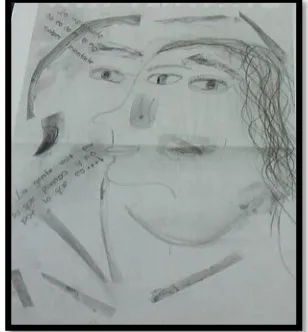
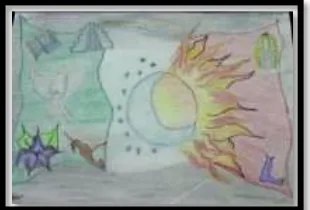
Figure 1 Fabiola's personal mural CHAPTER ONE
INTRODUCTION
“It will be weird because I‟ll be in a class, like I have all advanced classes, and there will be no Hispanic people in there. So, I‟ll be there by myself, and they‟ll call on me, and they‟ll be like “Answer this question.” And I know how to answer it, but I know how to answer it in Spanish and not in English [laughing]. I can‟t translate it. And so I just start talking in
Spanish, and they‟re like, “What in the world are you saying?” And I try to explain it, but it‟s hard to explain it to someone who doesn‟t know Spanish than to somebody who knows Spanish and English….They start laughing at me. They‟re like “Fabiola, we‟re in America.” I‟m like “I don‟t care. I‟m in Mexico in my world.” –Fabiola, 10th grade SNS student
as you transact with her text? What sense do you make of Fabiola‟s world? What sense
do you make of your own world through the intertextual nature of meaning making and your engagement with this text?
This is the story of nine Spanish for Native Speakers (SNS) students, their teacher, and my own as we journeyed together for a year making and negotiating meaning in multiple communication systems, exploring complex issues related to our cultures, languages, and identities. The image you see here, Figure 1, is one of over 100 visual texts (Albers, 2007b) created over the 2008-2009 academic year, and one that helped me understand the academic, social, and emotional nature and needs of this SNS class, needs that may be similar to those in classes like this one across the nation. I use the term “visual texts” rather than the commonly used ELA (English Language Arts) term “artworks” to describe texts that are created in ELA classes using visual media
(paint, collage, drawing, clay, photographs, and so on). Questions as the ones posed in the opening are ones that I asked myself as I worked to understand the discourses that were present in the images created as part of meaning and identity negotiation which occurred in this SNS class.
Fabiola, a bilingual SNS student, in the opening offered a small glimpse into the complexity involved as she negotiated meaning with monolinguals of dominant
3
English” and that she couldn‟t “translate” her answer. As a result, she opted to just state
the answer in Spanish knowing that her classmates would not understand her. She continued to indicate how she “tried to explain it” but “it‟s hard to explain it to someone who doesn‟t know Spanish than to somebody who knows Spanish and English.” Her classmates laughed at her and informed her that “we‟re in America.” However, she told them that she “was in Mexico in her world.” Fabiola is positioned to speak only English
by her classmates, which she tried to do. However, Fabiola also positioned herself as a bilingual speaker of English and Spanish and as someone who, while residing physically in the U.S., has strong emotional and linguistic ties to Mexico. This positioning was the result of the politics around language and identity that has existed for centuries in this nation.
system-language, teachers of multilingual learners must critically examine how their curriculum and pedagogical approaches promote or inhibit the academic and personal development of the students they teach (Schwarzer & Petrón, 2005).
Though many teachers of bilingual learners and English learners are beginning to reflect on their practices by exploring the use of culturally relevant pedagogy and
multimodal literacy with their students (Carger, 2004; Freeman, Freeman, & Mercuri 2001; Gay, 2000; Godina, 2003; Ladson-Billings & Gilborn, 2004; Short, 2000;
5
negotiation of identity in a SNS class, thereby transcending traditional notions of language and literacy instruction and learning.
Background to the Study Achievement Gap
As closing the achievement gap of minority students continues to be a national priority, Latinos, in particular, are an increasing concern due to their rapid rate of growth in this country (Colombi & Roca, 2003; Lynch, 2003; Carreira, 2003) along with their high drop-out rates (U. S. Census Bureau, 2006; National Center for Educational Statistics, 2007), or as many Latino education scholars and researchers (Antrop-González, 2006; Portes, 2009; Valenzuela, 2009) term “push-out” rates. The United States Census Bureau (2006) released a statement in 2005 indicating that the total
minority population equaled 98 million people, one-third of the total 296.4 million people in the U. S. Of the 98 million, 42.7 million were Latinos or Hispanics. They were the fastest growing group in the U.S. From July 1, 2004 to July 1, 2005, Hispanics made up nearly half of the national population growth with an increase of 1.3 million. Of this 1.3 million, 800,000 were born in the U.S. and 500,000 were immigrants.
variety of reasons for the high push-out rates and achievement gaps for diverse students including discrimination, linguistic differences, cultural differences, schooling
inequalities and student perceptions about schooling (Au & Mason, 1981; D‟Amato, 1987; Kozol, 1991; Moll & Diaz, 1985; Nieto, 2002; Ogbu, 1981; Portes, 2009; Strickland & Ascher, 1992; Valenzuela, 1999, 2009).
Latino/Hispanics as a Complex Ethnic Group
Within the Latino/Hispanic subgroup, Spanish and English language and literacy proficiency levels, cultures, language variations, academic experiences, personal
experiences, social experiences, historical experiences, and socioeconomic levels vary widely (Carreira, 2003). For example, where one Latino student may have been born in the U.S. to fourth generation Americans of Cuban descent who speak Spanish casually but do not read or write it formally, another Latino student may have been born in Mexico and immigrated to the U.S. at the age of thirteen with no English. In both cases, students may claim Spanish as an ancestral or heritage language, but each has varying degrees of knowledge of the language in addition to speaking different varieties of the language (Valdés, 2001). In the latter example, the student from Mexico may have had schooling in a rural area or in a large urban center, may come from a wealthy family or an impoverished one. Depending on the varying situations, the knowledge of Spanish may be colloquial or formal. Both students in the original example could be participants in a SNS class.
Need for Re-Conceptualizing Literacy Curriculum
7
1970, 1994; Greene, 1995) and become critically literate human beings through the reading, writing, and interpreting of a range of texts (New London Group, 1996). To be literate means to be able to negotiate meaning with others in one‟s context or situation
and to understand the political and ideological implications associated with the use of language and literacy in different contexts (Gee, 1990; Street, 1984). In addition, needing redefinition is the concept of text to include anything that carries two or more signs and constitutes a message (Hodge & Kress, 1988). Under this semiotic definition, texts can include any of the following: advertising billboards, T-shirts, videogames, films, manga, tattoos, gestures, PowerPoint presentations, student artworks, etc. (Albers, 2007a, 2007b; Berghoff, 1995; Gee, 2003; Hodge & Kress, 1988; Mackey, 2002; Kress & van Leeuwen, 2006). More importantly, one‟s concept of text has to expand from the notion of one single inscribed product, or media, with a beginning and ending to “an intertextual constellation” (Lemke, 2005, p. n/a) where we are allowed to socially, culturally, and
experientially make, link, and extend meaning across media.
Thus, rather than be limited by the traditional notions associated with the term “literacy,” we “enter the field of possibility” (Greene, 1995, p. 111) by adopting a
semiotic meaning-making model. In a semiotic meaning-making model, we present, take a stance, and integrate meanings in our messages all at the same time. We make sense of our world this way as we draw on cultural conventions, contexts, genres, and intertextual connections to do this (Aiello & Thurlow, 2006; Albers 2007b; Albers & Frederick, 2009, Albers, Frederick, & K. Cowan, 2009, in press; P. Cowan, 1999, 2005; Hodge & Kress, 1988; Lemke, 2005).
If culturally and linguistically diverse students are to gain access to the discourse of power (the language of technology, visual media, and multiliteracies) that now exists globally, approaches that teach them how to use the cueing systems (pragmatic, syntactic, graphic, semantic, tactile) unique to multiple modes of communication, especially the visual must be used. Rather than thinking about “writing” as message in words on a page, educators should think about “composing” messages using multiple semiotic systems such as the visual arts, dance, drama, music, graphic design, and in the media of hypertext, podcasts, PowerPoint, the body, video, etc. (Albers, 2006). By embracing these multiliteracies within heritage language (HL) curriculums such as the SNS curriculum, students may empower themselves to communicate with confidence their ideas in multiple formats and across communities to which they belong.
9
participating in these multiple formats and modes of expression outside of the school context (Carreira, 2003); therefore, we must begin to think in new ways about how heritage language courses, and SNS courses in particular, are developed (Lynch, 2003).
Creating learning environments that promote multiple paths to meaning and knowledge construction is critical to providing possibilities for transformative education for Latino students. In some studies of English language arts classes and ESOL classes, bilingual students‟ success was reported when learning environments incorporated multimodalities and incorporated the visual arts as tools of thought (Carger, 2004; Gay; 2000; Igoa, 1995, 1997). However, limited research exists exploring such approaches in heritage language courses, or SNS courses in particular.
Need for Re-conceptualizing Curriculum for Bilingual Learners
The aim of language and literacy education for bilingual students in the U.S. predominantly has been to teach English as a way of acculturating and assimilating minority language students into the dominant society (Crawford, 1991, 1999; Delgado-Gaitán & Trueba, 1999). However, there has been a recent call to recognize students‟ heritage languages as cultural, economic, and linguistic resources which have been a catalyst for offering courses designed to teach students their heritage languages (Colombi & Roca, 2003; Leeman, 2005; Moll & Gonzalez, 2001; Peale, 1991; Potowski &
Carreira, 2004; Schwarzer & Petrón, 2005; Valdés, Fishman, Chavéz, & Pérez, 2006). Heritage languages are languages that individuals claim as their ancestral language, and these languages are linked to identity whether an individual is proficient (able to
widely spoken language in the United States, is also the language most often offered in heritage language courses (Colombi & Roca, 2003; Roca, 1997). For students who are native speakers, courses may be designed specifically for them and are typically referred to as Spanish for Native Speakers (SNS) courses.
SNS courses for such students are often taught from a foreign language framework rather than from a language arts framework (Potowski & Carreira, 2004, Roca, 1997). Teaching Spanish from a foreign language framework implies that the learner has little or no prior knowledge of the language, culture, or history of Spanish. Typically, language is taught through memorization, a focus on conjugations, grammar, etc. Teaching from a foreign language framework is considered a weakness in SNS courses and programs as they primarily focus on the linguistic needs of the student at the expense of developing the needs of the whole child. In their review of the literature and within their own qualitative study, Schwarzer and Petrón (2005) noted that “there appears to be a need for more extensive heritage language programs as well as a need for the development of curriculum guidelines and teacher training” (p. 569). With regard to the present study, Spanish for Native Speakers (SNS) was a heritage language course
constructed from a humanities framework which acknowledged the students‟ background knowledge in Spanish, the cultures, the language/dialects, and the histories and
experiences they brought with them to the learning situation. A focus in this course was given to meaning making and critically engaging with multiple modes of expression. My Interest in SNS Courses
11
courses three years ago. Many of my middle school ELs were placed in these courses once they moved to the high school, and I wondered why they simply were not placed in mainstream Spanish courses if the goal was to improve their formal Spanish language skills.
One bilingual Latina EL teacher, Esperanza (pseudonym), who had been a colleague of mine for many years, was recruited to teach two SNS courses- one that focused on Spanish grammar and one that focused on Spanish literature for native
speakers of Spanish exclusively. During informal conversations with Esperanza, I learned that she had not had access to a formal published curriculum to support the SNS courses she taught, and therefore, had to develop her own curriculum. However, by the time this study began, the state department of education had issued standards and a framework for this course. Nevertheless, she continued to struggle to develop meaningful curriculum in part due to the limited access to materials, another critique of heritage language programs (Lynch, 2003). As a literacy specialist and the former EL teacher of many of Esperanza‟s students, she asked me for support and ideas in developing strong engagements that addressed the needs of her SNSs.
Esperanza‟s need for a more thoughtful and concrete curriculum became more
their knowledge of students‟ experiences to foster effort, achievement, action, and
self-determination.
Over the past few years, Esperanza and I had talked about lessons that would be more engaging and meaningful for her students. She expressed often the desire to create a curriculum that would have a transforming effect on her students whom she said
struggled to see the relevance of a high school education in their lives. We discussed the possibilities of an arts-infused curriculum. From our conversations and my previous successful experiences incorporating the visual arts as a significant communication system in my own EL classes as well as experience analyzing the content and thoughts that underpin visual texts (Albers & Frederick, 2009), I began to wonder how we could collaborate to create a transformative experience for her students.
As I began exploring possibilities for such a curriculum and for this study, I also theoretically contemplated how the intersections of social semiotics, identity work, and third space theories would inform my work in this potential site of study. I will present the theoretical framework and define key terms and concepts used in the study after providing an overview of the study.
Overview of the Study
The primary purpose of this study was to understand how SNS students negotiated meaning and identity within an arts-infused multimodal SNS curriculum where the use of multiple communication (sign) systems was encouraged. Further, this study also examined the discourses that emerged within students‟ visual texts over time
13
and across the year (Albers, 2007a, 2007b; Albers & Frederick, 2009; Albers, Frederick & Cowan, 2009, in press; Rowsell & Pahl, 2007).
Research questions guiding this study were the following: (1) What factors were considered as the teacher and the researcher co-planned this arts-infused multimodal curriculum, and how did the consideration of those factors shape the curriculum?; (2) How did students enrolled in this SNS class make and negotiate meaning and identity as they worked within this arts-infused multimodal SNS curriculum?, and (3) What
discourses around students‟ meaning making practices and identities emerged within their
visual texts over time and across texts?
Participants in this study were nine multi-age, multi-grade level Latino high school students enrolled in a SNS course and their teacher. Data collection occurred during the 2008-2009 academic year. Data included audio-taped and written documents from collaborative curriculum planning sessions, initial questionnaires, interviews with participants, informal conversations with participants, selected audio and videotaped class discussions, student participant journals and work samples, photographs, teacher participant journal, researcher journal and fieldnotes, and member checks. Data were analyzed using the constant comparative method to determine categories and themes (Bogdan & Biklen, 2003) in addition to visual discourse analysis (Aiello & Thurlow, 2006; Albers, 2007b; Albers & Frederick, 2009; Albers, Frederick, & Cowan, 2009, in press; Albers & Murphy, 2000; Bang, 2000; Kress & van Leeuwen, 2006).
Significance of the Study
negotiation within a SNS course is significant and relevant to literacy and language education because the visual arts may offer significant ways of representing and
communicating thought, knowledge, and self, and may offer possibilities for educators to more fully understand and help their bilingual learners. While I was able to locate
research on the use of multiple sign systems in English Language Arts classes (Albers, 2006; Siegel, 2006; Whitin, 2006) and in French foreign language courses (Kern & Schultz, 2005), I did not find any that specifically addressed this topic with SNS students as participants. Furthermore, Potowski and Carreira (2004) explained that many SNS courses are taught from a foreign language framework, and therefore, they do not
adequately meet the needs of SNS students. As such, this study fills a gap in the literature by examining how a SNS class taught from a humanities framework utilizing an arts-infused multimodal curriculum provided multiple paths to meaning making.
Theoretical Framework
15
Critical Pedagogy
Critical pedagogy is most often linked to Paulo Freire (1970, 1994) who
envisioned literacy as a path to liberation for the illiterate peasants of Brazil. Out of this vision and experience, The Pedagogy of the Oppressed (1970) was born. Later, Freire revisited this 1970 work and explored the need for hope within such pedagogy. The result was Pedagogy of Hope (Freire, 1994). Freire insisted that, “hope, as an ontological need, demands an anchoring in practice. As an ontological need, hope needs practice in order to become historical concreteness. . . . Without a minimum of hope, we cannot so much as start the struggle” (1994, p. 9). I grounded my own work for this study on his insistence
on hope.
Other educational philosophers and theorists have taken up Freire‟s work and
continue to elaborate on it. For me, the importance of education is its liberating potential. Giroux and McLaren (1991) explained:
Fundamental to the principles that inform critical pedagogy is the conviction that schooling for self- and social empowerment is ethically prior to questions of epistemology or to a mastery of technical or social skills that are primarily tied to the logic of the marketplace (p. 153-154, italics in original).
Importantly, Giroux and McLaren (1991) posed the following question: “How does one redefine the purpose of public schooling and rethink the role of teaching and learning in emancipatory terms?” (p. 156). Giroux and McLaren challenged critical educators to move beyond “a language of critique to a language of possibility” (p. 156). I
undertook this study as a partial response to this challenge in the hope (from the Freirian sense) that the participants as co-collaborators would find means for transforming their lived realities by gaining access to the power and potential that multiple literacies promise.
Theories of Identity
Theories of identity evolved from the work of sociocultural theorists whose ideas originated with anthropology, psychology, sociology, cultural studies, literary studies and education (Holland, Lachicotte, Skinner, & Cain, 1998). Debate on identity ranges from the essentialist theorizing of anthropologists such as Margaret Mead who believe that identity is stable and “internally homogeneous” to postmodern theorizing that negates
identity as a meaningful construct altogether (Moya, 2000). The construct of identity is widely studied in education with foci on general identity theory, identity and narrative, identity and race, identity and response to literature, identity and class, and identity and gender/sexual diversity (Beach, Thein, & Parks, 2007).
17
and to a degree Goffman‟s (1959) theory of the presentation of self in everyday life. The
tenets of these theories of identity include the following:
1. Identities are subjective and particular, and as such we need to interact with them and understand them rather than “to transcend or subvert” them (Moya, 2000, p. 17);
2. Identities are plural, multiple and may be referred to as selves or subjectivities (Holland et al., 1998; Moya, 2000);
3. Identities are constructed through the relationship between social, cultural, and historical location and experience. Our interpretations of our experiences are continuously being refined as we are involved in daily practice, activity, and performance of ourselves with others (Goffman, 1959; Holland et al., 1998, Moya, 2000);
4. Knowledge is generated as we live and act in the world and depends on our cognitive, historical, and social locations (Moya, 2000, p. 18);
5. Individual agency comes before and provides a sound foundation for collective agency (Moya, 2000, p. 19);
6. Subjectivities shift as we are positioned by the discourses in which we participate (Holland et al., 1998, p. 26).
Rowsell and Pahl‟s (2007) “Sedimented Identities in Texts: Instances of Practice.” I will briefly explain the first two and how they helped me theoretically frame this interpretive study. I will present the third text as a potential bridge between theories of identity and social semiotics as a way of understanding the use of visual texts in the SNS class.
Identities are negotiated through the relationship between social, cultural, and historical location and experience. Humans‟ interpretations of their experiences are continuously being refined as they make meaning in daily practice, activity, and during the performance of ourselves with others. Goffman (1959) in The Presentation of Self in Everyday Life employed the metaphor of theatrical performance to explore how
19
Goffman‟s idea of performance of selves can be applied to a SNS class where
students may be asked to respond in multiple modes such as an essay, a visual artwork, a poster, a PowerPoint, a play, etc. When students are involved in those kinds of activities, they make choices based on how they wish others to see them. In visual texts, the
textmakers may use techniques such as gaze or vectors to attempt to control the viewer by directing where the viewer attends to the canvas. If painting, one may vary
brushstrokes to convey more or less detail, etc. If the learner works in a group and is seeking affiliation with the group, she may choose to use similar techniques or themes in her own visual texts (Albers, Frederick & Cowan, in press). In these ways, Goffman‟s idea of performance can be translated into the performance that surrounds the creation of any text, especially visual texts, in the SNS class.
Identities are plural, multiple and may be referred to as selves or subjectivities. Holland et al. (1998) provided a framework within which to situate the performance of visual texts as representations of selves. Visual texts created within language classrooms are created in what they call a figured world, which is similar to Goffman‟s (1959)
theater metaphor. They based their theory of “identity in practice” on the works of Bakhtin (1981), Bordieu (1985), Vygotsky (1978), and on the findings from their own ethnographic studies from around the world. Identity is formed in process; it is
create in and through their participation. People come to figured worlds by invitation of others, become involved stakeholders in these worlds, and form understandings of themselves through their participation. The members of these worlds create the figures which shape and determine the meanings associated with their roles and participation. Positionality is the second context of identities in practice and is determined by power. Hierarchies are formed based on the prestige given to markers such as gender, beauty, race, wealth, language, etc. as determined by the members of the figured worlds and is often related to the context of a larger figured world in which it is contained. Third, space of authoring refers to the world that we must all face and answer. Authorship involves calling on the resources one has (social discourses, voices, histories, etc.) to respond to others within the given time and context. Holland et al. calls this "the art of
improvisation" (p. 272), and it makes human agency possible. The fourth context of identities in practice is the making of worlds. As members interact and begin to take new directions in their interactions and imagine new possibilities for their lives either
individually or collectively, they may form new figured worlds. Therefore, identities are constantly being formed and reformed as the self moves fluidly between worlds.
Several researchers in the field of literacy education have utilized this concept of figured worlds or examined positionality within the literacy classroom to better
21
the classroom. So, if teachers convey the message that stick figures are fine because they themselves feel they cannot draw, then learners read that narrative, internalize it, and may appropriate it to their own artworks. They may then become positioned and/or position themselves through such discourses as artists or non-artists. Either way, when visual texts are offered as significant ways to communicate together with other communication systems such as written texts, then multiple spaces for authoring become available. Educators must learn how to enter those worlds and how to read and compose in them. Finally, as learners move in and out of the worlds of home, school, web spaces, etc., they bring to their visual texts integrations, understandings, and even possibly resistances to those worlds. The visual text becomes a space for figuring, imagining, and re-conceptualizing their worlds.
Visual texts have a grammar and design and serve ideational and functional purposes in ways similar to yet different from written text (Albers, 2007a, 2007b). To fully understand the messages communicated, one has to have a more comprehensive analytic framework so as to be able to move beyond a psychological or aesthetic reading of the visual. For this reason, I will present and consider the potential that social
semiotics offers as a theoretical lens for reading and understanding the discourses present in visual texts created in the SNS class.
Social Semiotics
communication studies. Literacy studies using social semiotics or semiotics as a frame are few in number and often explore either a single communication system such as drama (Medina & Campano, 2006), the visual arts (Albers, 1996, 1997, 2007a, 2007b), or two or more sign systems such as drama, dance, movement or visual language and art (Berghoff, 1995; Sipe, 1998). Most often literacy studies that consider multiple sign systems are referred to as multimodal (Hull & Nelson, 2005; Jewitt & Kress, 2003).
Mainstream semiotics offers a frame for studying communication as a whole, but the theory has been criticized for its emphasis on structures and codes and ignoring the social practices that support and drive them (Hodge & Kress, 1988). By placing the study of signs within the realm of the sociocultural, sociopolitical landscape, social semiotics becomes a more powerful theory and lens for understanding how meaning and
communication happen. Social semiotics offers the researcher a critical lens from which to view meaning-making. The major tenets of social semiotics as propounded by Hodge and Kress (1988) include the following:
1. Communication is a process;
2. Humans use material resources to produce and reproduce meaning;
3. Meaning has to be studied in relation to actual people and things in society; 4. Meaning is negotiated in the material world with others whose views, motives,
and goals vary and as such is often ambiguous.
23
1986; Jewitt & Kress, 2003; Kress & van Leeuwen, 2006). Each semiotic system (written language, visual language, drama, etc.) serves to express an individual‟s inner world and to enable her to interact with others in unique ways as each system offers “differing media, structure, and appeal and have developed in different areas of human experience and thought” (Berghoff, 1994, p. 201).
Humans use material resources to produce and reproduce meaning, and meaning has to be studied in relation to actual people and things in society. People use those material resources available to them in their unique environments (Jewitt & Kress, 2003). These resources are signs. Signs act both as the carrier of meaning (the signifier) and as the concept or meaning intended (signifieds) (Hodge & Kress, 1988). The degree of interest and importance the sign-maker attaches to the carrier and concept at a particular moment influences what is chosen and is then represented in a form that will most faithfully express the intended meaning of the sign-maker (Jewitt & Kress, 2003).
Multimodal theory (Jewitt & Kress, 2003) explains the set of resources within a given sign-system and how those resources (modes) are used to express meaning. A multimodal approach implies that language is not the only meaning mode or message carrier and others such as the visual mode are equally significant in its meaning making potential. Every mode is limited by the extent that meaning can be represented through its use. Since some modes are better able to convey certain aspects of meaning, it is
important for people to have various modes to draw upon to communicate the messages, depending on the social and cultural contexts at the time of meaning representation. Some of these modes may include speech, image, or gesture (Jewitt & Kress, 2003).
Visual Discourse Analysis
Visual Discourse Analysis (VDA) is both a theory and a framework located in social semiotics. This approach draws on discourse analysis (Gee, 2003) and grammar of visual design (Kress & van Leeuwen, 2006) and provides a framework for analysis of learners‟ visual texts (often pictures) (Albers, 2007b). VDA use four principles to guide analysis:
1. “Visual language is reflexive” (Albers, 2007b, p. 85). Visual texts and written texts are used intertextually in literacy classrooms where each text influences the interpretation of the other. As a result, visual text makers may represent and reflect the environment simultaneously;
25
3. “Language is composed of many different social languages” (Albers, 2007b, p. 85). As a result, visual texts reflect those languages. Our positions as expert or learner influence how we can convey our messages visually;
4. Visual texts can be analyzed structurally, semantically, artistically, tactilely, and visually.
Most importantly, VDA offers a critical lens to view the beliefs, ideologies, and power structures internal to the text-maker and also those created within the context of the classroom or school.
Visual texts may be structurally analyzed along six dimensions: 1) underpinning systems, or the cueing systems, 2) disciplinary knowledge such as space and composition elements, 3) intertextuality amongst communication systems and other personally
meaningful texts, 4) conversations surrounding what constitutes visual texts and the place of visual texts in schools, 5) social acceptability of styles, techniques, and materials, and 6) apparent discourses which the text-maker identifies (Albers, 2007b, p. 87). These six dimensions represent the multiple layers of meaning that are interwoven in a visual text. By structurally reading a visual text across all six dimensions, a thorough and reliable reading can take place.
context and reflected in the visual text to the ideologies of groups within the classroom or school environment, from individual constructions of selves to group constructions of figured worlds.
Framing this interpretive study with theories of social semiotics in conjunction with theories of identity, deeper understandings may be gained. Hodge and Kress (1988) addressed this concern as well by suggesting that for those who view a museum piece without the disciplinary knowledge of history, religion, politics, or art, their readings or interpretations may yield a reading which is not consistent with the text‟s creation in a given historic, political, social, cultural, religious context. As we read students‟ visual
texts, our readings will be influenced by our own beliefs, experiences, and knowledge of ourselves and our knowledge of the students (Albers, 2007b).
Sedimented Identities in Texts
My purpose in studying visual texts in literacy classrooms is to gain an
27
the text. As the interest or identities of practice become located in the visual text, a sort of history of the text-maker is being documented. The visual texts when collected over time become traces of the text-maker‟s development as a literate individual and as a social individual.
The benefit of considering the concept of sedimented identities in texts is that it allows the viewer of the text to understand the classroom or school site where the text is created and the preferences that develop in those contexts and how they are carried over into her text-making processes. Rowsell and Pahl‟s (2007) work also raises two essential questions: How does text-making change the space, and how does the space change the making? While the latter is often addressed, the former is not. Examining how text-making changes the space of the classroom provides another angle from which to view visual texts and their significance in language and literacy classrooms. As children are involved in the creation of texts, the very act of composing, creating, and making choices is an enactment of identities in practice and possibly in transformation.
By using and understanding theories of identity to better inform my readings and interpretations gained from a social semiotic lens (Rowsell & Pahl, 2007), I was better equipped to create a sound design for investigating visual texts within language and literacy classrooms. As each of these theories reciprocally inform the other, more nuanced interpretations of my findings were possible and a more significant, credible study produced.
Third Space Theory
interactions in the SNS class, theoretical concepts of third space help to locate hybridized occurrences of meaning making within the space of a SNS course being held in the space of an English to Speakers of Other Languages (ESOL) classroom where the official and unofficial curriculums of each course and space mix to create a unique third space of learning and interactions. Cultural studies, cultural geography, and general education studies (Rowe & Leander, 2005) have led the way in theorizing third space. Although there are a limited number of literacy studies in which third space is explored (Dyson, 1997; Gutierrez, Baquedano, & Turner, 1997; Leander, 2002; Rowe & Leander, 2005; Sheehy, 2002), the Arts Education Partnership (2005) have also explored the concept of third space which is relevant to this study and is described in more detail below. The major tenets of third space theory are listed below:
1. Third space represents a place for the coming together and remixing of binaries (Bhabha, 1994; Moje, et al., 2004; Soja, 1996);
2. Hybridity is essential for third space (Moje et al., 2004);
3. Third space represents “borderlands” (Anzaldúa, 1987; Wilson, 2000) or “in-between space” (Bhabha, 1994);
4. Third spaces represent sites of tension, struggle, and contestation (Bhabha, 1994; Sheehy, 2002; Soja, 1996; Wilson, 2000);
5. Third space has the potential for transformation (Gutierrez et al., 1997; Gutierrez et al., 2000).
Specifically, I draw from Gutierrez, Baquedano-Lopez and Tejeda‟s (2000) conceptualization of third space “in which alternative and competing discourses and
29
learning” (p. 286-287). According to Gutierrez et al., “learning contexts are immanently
hybrid, that is, polycontextual, multivoiced, and multiscripted. Thus conflict, tension, and diversity are intrinsic to learning spaces.” (p. 287). Key to understanding third space is
the concept of activity system defined as: “social practice(s) that includes the norms, values, division of labor, the goals of community, and its participants‟ enduring
dispositions toward the social practice” (Gutierrez et al., 2000, p. 287). In the context of
this SNS course, there exists:
purposeful use of hybridity and diversity[which]stimulates the
transformation of activities into robust contexts of development. Diversity here not only includes racial, ethnic, socioeconomic, and linguistic
diversity, but also diversity in the meditational tools, roles, and the activity systems themselves…Hybridity and diversity serve as the building blocks of Third Spaces. (Gutierrez et al., 2000, p. 287)
For the researchers at the Arts Education Partnership (2005), third space means all of the above with the added emphasis on the community building involved when all members of a class or group gather around artworks created for the purpose of building meaning and understanding of one another. Similarly, for the purpose of the current study, the community building that surrounded the creation of visual texts deepened the awareness and understanding of each unique contributor to the figured world of the SNS class.
Definitions of Key Terms and Concepts
I use the term “visual texts” (Albers, 2007b, Albers, Frederick, & Cowan, 2009, in press) to denote texts created in the SNS class using art rather than the more common “artworks,” because the term artwork suggests a knowledge and experience of fine art,
Heritage languages are languages that individuals claim as their ancestral language, and these languages are linked to cultural, linguistic, and historical identities (Fishman, 2001; Schwarzer & Petrón, 2005; Valdés, 2001, 2003; Wiley, 2001). SNS courses are heritage language courses developed specifically for heritage speakers of Spanish. For the purpose of this study, the two terms heritage languages and Spanish for Native Speakers may be interchanged.
Student-generated texts include oral discourse (conversations, videodrama, etc.), written texts (essays, blogs, emails, etc.), and visual texts (artwork, posters, etc.) or any semiotic text which contains two or more of these texts (PowerPoint presentations, videos, etc.).
Semiotic resources refer to the materials in one‟s environment that can be used to
make meaning with others (Kress & van Leeuwen, 2006).
Although different connotations are usually associated with the terms “identities,” “subjectivities,” and “selves” as described in the theoretical framework section, for the
purpose of this study, they will be used interchangeably.
31
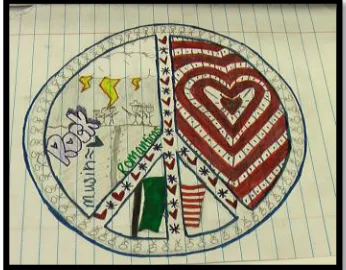
Figure 2 Miguel working on final draft of class mural CHAPTER TWO
LITERATURE REVIEW
“What of the vulgar limitations of language?” (Castillo, 1994, p. 165)
According to Viadero (2005), the National Latino Education Research Agenda Project became interested in increasing research efforts in the area of the arts and achievement for Latino students because evidence indicated that schools with large Latino populations enjoyed higher achievement when they emphasized the arts. Harste (2000; 2003), a renowned advocate of the arts and inquiry-based curriculum, insisted that a good language arts program should provide opportunities for students to explore
tools of thoughts. Although Harste was referring to an English language arts program, the same could be argued for a Spanish language arts program, especially as viewed in a SNS course, the focus of this study. Keeping these assertions in mind, I present in this chapter the relevant literature to support my undertaking of this study and to provide a backdrop against which to place this study.
First, I begin by exploring empirical studies detailing the use of multiple sign systems in English literacy classes. Secondly, I explore empirical studies that detail the cognitive requirements necessary to respond in visual formats such as drawing (a form of visual response often used in literacy classes which is typically viewed from an aesthetic stance); and thirdly, I explore the tangentially related topic of Spanish heritage language courses as it relates to the context of the study. Finally, I discuss the gap that currently exists in the literature with regard to this study and how this study attempted to fill that gap.
Exploring Multiple Sign Systems in English Literacy Classes
Much of the research on semiotics in the K-12 classroom focuses on the positive results that occur in all students‟ learning when given the opportunity to learn in multiple
modes (Albers, 2006; Carger, 2004; Igoa, 1997; Shreefter, 2001; Styles & Arzipe, 2001; Walsh, 2000, 2003). I want to distinguish between what I call arts-based studies and studies with a semiotic framework. The literature mainly focused on arts-based
33
developed through the knowledge that multiple sign systems carry parts of meanings, and all parts must be considered when reading, composing and interpreting texts. I first discuss arts-based literacy studies, and follow with semiotically-framed studies that have been conducted in English literacy classes.
Arts-based literacy studies
In many arts-based literacy studies, researchers examined how the use of the visual arts, the performing arts, and music influenced the development of reading, writing, and speaking (Carger, 2004). In the arts-based studies I found, there were three themes: visual art as a catalyst for speaking and writing, visual art as a discipline used to encourage reading, writing, and speaking, and visual art used in picture books to
encourage critical thinking. In these studies, the visual arts were not used by the teacher or researcher for better understanding the meaning making processes of the student participants or for understanding their identities. Rather, they were used as activities to help students produce thought in the dominant modes of written and oral language.
In many arts-based studies with English learners or bilingual learners, visual art was explored as a catalyst for increased oral conversation and writing in the target language, English. One such example was Carger‟s (2004) four month qualitative study of literature circles which involved the reading of culturally relevant picture books and the creating of artworks surrounding those readings with small groups of bilingual learners. She analyzed student responses for 17 read-alouds and categorized 1841 spontaneous student responses into 12 types: artistic response activity
comments/inquiries, exclamations, metalinguistic comments, instructional suggestions, book connections, and social/political comments. She found that when students could “talk and think through and with art” (p. 284) they were able to apply their culture and
personal life to their surroundings by tapping into funds of knowledge. She also found that they often used their second language to participate in authentic conversations about the readings (books) or the art techniques being used in a meaning-making process.
Similarly, a qualitative study conducted by Short, Kauffman, and Khan (2000) investigated students who were encouraged to explore their responses to literature first in art. The researchers found that conversations about the books were richer and more focused. The student participants in the study explained that art allowed them to better able to express ideas and emotions, learn more about the context and characters, and to make connections to the characters lives in the books. Short et al. suggested that the use of multiple sign systems be employed throughout a unitof study rather than at the end of the unit, as is often the case. The process of accessing literacy in multiple signs was as important as the final product in multiple signs.
Other researchers have examined how studying art influenced literacy
development across disciplines and gender. In one such study, Piro (2002) described how students in his classroom used judgmental, descriptive, and interpretive language to analyze visual images and how this skill enhanced literacy learning. In another qualitative study using art slides to explore children‟s constructive processes, Frei (1999) found that
art images freed children to make meanings beyond those of literal interpretation. Because art as a text is whole, children could use a variety of strategies and prior
35
illuminate the strategies and processes children use when engaged with print or non-print text. The degree to which children employ specific strategies may be attributable to the symbols they see in nonprint text” (1999, p. 390).
Saurino (2004) studied art and expressive language skills of ESL students. They viewed, discussed, and wrote about digital photographs of interesting artworks they had taken on a fieldtrip to a museum. She called this process Digital Language Experience Approach (DLEA), and concluded that DLEA advanced the students‟ writing, speaking, listening, and reading skills.
Taken together, these studies (Carger, 2004; Frei, 1999; Piro, 2002; Saurino, 2004; Short, Kauffman, & Khan, 2000) indicated that incorporating the visual arts within English language arts class had positive effects on literacy development by providing multiple means of mediating thought.
Many of the studies investigating the use of art in language arts classrooms focused on picture books and the reading of art within this genre (Carger, 2004; Styles & Arzipe, 2001; Walsh, 2000; Wolfenbarger & Sipe, 2007). Walsh (2000) conducted a study that examined how first and second grade students responded orally to two narrative picture books, specifically the beginning reading behavior of young second language learners compared to native speakers. Reader-related variables were compared with reading behavior and analyzed quantitatively and qualitatively. Text-related
variables were used to examine the oral responses to picture books. Walsh (2000) found that “Children‟s multi-varied responses demonstrate the activation of a range of cognitive
pictures offered support for conceptual understanding while the text offered support for language development.
Styles and Arzipe(2001) conducted in-depth semi-structured interviews with 84 students in seven U. K. schools to determine how children interpreted the artwork of Anthony Browne‟s (1992) picture book Zoo. After individual interviews, the children
participated in focus groups. Children also drew a picture in response to the text. Transcripts and interviews were analyzed qualitatively and coded. One of the key findings was that “children who were not experienced readers of print could make deep
and insightful interpretations of visual texts” (p. 266). Therefore, levels of complex thought were not tied specifically to the dominant mode of print-based language.
These studies (Carger, 2004; Styles & Arzipe, 2001; Walsh, 2000; Wolfenbarger & Sipe, 2007) support the notion that reading and literate practices refer to not only written texts, but visual texts as well. Learners who could read and respond in a variety of modes and sign systems had opportunities to extend their own thinking and move from functional literacy to critical literacy. These findings are relevant to the current study; the current study sought to understand how students respond in multiple sign systems and how they responded to multiple sign systems as they considered their own visual work and the visual work of others.
37
language only. The studies below exemplified this theme and supported the value of an approach using multiple sign systems in a SNS course, such as the one in this study.
Igoa‟s (1995) ethnographic work with immigrant children found a symbiotic
relationship between the development of written and oral language skills and visual arts skills. Art allowed her ESL students to contextualize their personal experiences and express their inner lives:
Through art, immigrant children can communicate in more expressive and expansive ways than their oral and written language skills permit. The artwork lets the teacher become a keen observer of the children‟s aural silence and an active “listener” for what the child has to say through his or her drawings and paintings” (p. 9).
Igoa recognized that art is a conduit for the children‟s voices.
Shreefter‟s (2001) six-week ethnographic study, using the theme of border
crossing and art with migrant youth to create their autobiographies, revealed that working in the sign system of visual arts pushed students to more critical thought and writing about the many barriers they experience daily. After students completed schematic drawings, they chose one to explore in collage. Shreefter explained that the act of choosing colors, textures, and symbols for their collages occupied the youths in making art and was a “catalyst for finding dimension, meaning, and complexity for the narratives that they would write to accompany their collages” (p. A2). The students created books
reveal what the students are able to express through art and what the teacher can learn from the students‟ creations of semiotic texts.
Like Igoa (1995) and Shreefter (2001), Millard and Marsh (2001) discovered much about the sociocultural development of their students through their process of creating visual texts in relation to written texts. They reported that the art making process and the art created were different for boys and girls. Boys verbalized while they drew, painted from personal choice, accompanied their work with action, and made noises and running commentaries while working. Girls, on the other hand, drew children, houses, and flowers that were used repetitively, regardless of the text they were writing. Also, girls tended to view art as decoration. Despite gender differences in the kinds of art produced, all the children preferred to draw before they had to write; it aided thinking during the writing process. Millard and Marsh (2001) advised that students need time to think about content, and options other than writing as a means of expressing thought.
The studies that explore the theme of writing the self through multimodal texts demonstrate that when multiple sign systems are used in literacy classes, the visual texts created are usually created first and then used as catalysts for written texts. Although the researchers gleaned insight into students‟ lives and understandings of social structures,
the visual texts were not read as stand-alone texts nor were they read with an informed eye, and therefore, the potential that these texts had as visual narratives were ignored. Semiotically Framed Studies
![Figure 3 Second draft of class mural [sketched by Miguel]](https://thumb-us.123doks.com/thumbv2/123dok_us/9132724.988058/82.612.118.534.226.463/figure-second-draft-class-mural-sketched-miguel.webp)