ScholarWorks @ Georgia State University
ScholarWorks @ Georgia State University
Computer Science Dissertations Department of Computer Science
Summer 8-16-2010
Enhanced Web Search Engines with Query-Concept Bipartite
Enhanced Web Search Engines with Query-Concept Bipartite
Graphs
Graphs
Yan Chen
Georgia State University
Follow this and additional works at: https://scholarworks.gsu.edu/cs_diss
Part of the Computer Sciences Commons
Recommended Citation Recommended Citation
Chen, Yan, "Enhanced Web Search Engines with Query-Concept Bipartite Graphs." Dissertation, Georgia State University, 2010.
https://scholarworks.gsu.edu/cs_diss/54
This Dissertation is brought to you for free and open access by the Department of Computer Science at
by
YAN CHEN
Under the Direction of Yanqing Zhang
ABSTRACT
With rapid growth of information on the Web, Web search engines have gained great momentum for
exploiting valuable Web resources. Although keywords-based Web search engines provide relevant
search results in response to users’ queries, future enhancement is still needed. Three important issues
include (1) search results can be diverse because ambiguous keywords in queries can be interpreted to
different meanings; (2) indentifying keywords in long queries is difficult for search engines; and (3)
generating query-specific Web page summaries is desirable for Web search results’ previews. Based on
clickthrough data, this thesis proposes a query-concept bipartite graph for representing queries’
relations, and applies the queries’ relations to applications such as (1) personalized query suggestions,
(2) long queries Web searches and (3) query-specific Web page summarization. Experimental results
show that query-concept bipartite graphs are useful for performance improvement for the three
applications.
by
YAN CHEN
A Dissertation Submitted in Partial Fulfillment of the Requirement for the Degree of
Doctor of Philosophy
in the College of Arts and Sciences
Georgia State University
Copyright by Yan Chen
by
YAN CHEN
Committee Chair: Yanqing Zhang
Committee: Anu Bourgeois
Vijay Vaishnavi
Ying Zhu
Electronic Version Approved:
Office of Graduate Studies
College of Arts and Sciences
Georgia State University
ACKNOWLEDGEMENTS
I sincerely appreciate my advisor, Dr. Yanqing Zhang, for his keen guidance and advice in my
research and the defense of this dissertation. His enthusiasm and support make me a better researcher.
As an excellent advisor, he is also such a nice person who would like to help students as much as he can.
I would also like to extend my sincere appreciation to Drs. Anu Bourgeois, Vijay Vaishnavi, and
Ying Zhu for their invaluable feedback and comments to refine the dissertation.
Above all, I am thankful to my wife Jinxia He for her love, patience, and endless support. Finally,
this work is dedicated with deepest love to my parents, Mr. Y.M. Chen and Mrs. H.M. He to whom I
TABLE OF CONTENTS
ACKNOWLEDGEMENTS IV
LIST OF TABLES VIII
LIST OF FIGURES IX
CHAPTER 1 INTRODUCTION 1
1.1 Problem Definitions 2
1.1.1 Incomplete query Web searches 2
1.1.2 Long query Web searches 3
1.1.3 Web Search Previews 4
1.2 Strategy for research problems 5
1.3 Challenges 6
1.4 Organizations of the Thesis 7
CHAPTER 2 RELATED WORK 8
2.1 Related Work for Exploring Queries’ relations 8
2.2 Related Work for Incomplete Query Web Searches 9
2.3 Related Work for Long Query Web Searches 10
2.4 Related Work for Web search previews 12
CHAPTER 3 CONSTRUCTING QUERY-CONCEPT BIPARTITE GRAPHS FOR EXPLORING QUERIES’
RELATIONS 15
3.1 Query-URL Bipartite Graphs 15
3.2 Query-Concept Bipartite Graph 16
3.3 Comparisons of Query-URL Bipartite Graphs and Query-Concept Bipartite Graphs 18
CHAPTER 4 QUERIES-CONCEPTS BIPARTITE MODEL FOR PERSONALIZED QUERY SUGGESTION 20
4.1 Methods 20
4.1.2 Calculating the concepts’ relations 21
4.1.3 Constructing concept relation trees 24
4.1.4 Calculating the queries’ relations 32
4.1.5 Dynamically updating the weights of query-concept 34
4.2 Experiments 35
4.2.1 Data collection 35
4.2.2 Evaluation of extracting and clustering concepts 36
4.2.3 Evaluation of query suggestion 38
4.3 Discussion 41
CHAPTER 5 QUERIES-CONCEPTS BIPARTITE GRAPH FOR LONG QUERY REFORMULATIONS 43
5.1 Methods 43
5.1.1 Substituting a long query by relevant short queries 43
5.1.2 Web pages results refinement 48
5.2 Experiments 49
5.2.1 Data collection 49
5.2.2 Experiment design 50
5.2.3 Experiment results 51
5.3 Discussion 54
CHAPTER 6 QUERIES-CONCEPTS BIPARTITE GRAPH FOR QUERY-SPECIFIC WEB PAGE SUMMARIZATION 56
6.1 Methods 56
6.1.1 Retrieving query-related context terms from the target Web page 57
6.1.2 Retrieving relevant queries as labels to uncover query-related contents 58
6.1.3 Constructing summaries based on labels 65
6.2 Experiments 67
6.2.2 Comparative approaches and evaluation metrics 69
6.2.3 Label Extraction Evaluation 70
6.2.4 Evaluation for query-related topics identification 72
6.2.5 Web Page Summarization Evaluation 73
6.3 Discussion 76
CHAPTER 7 CONCLUSION AND FUTURE WORK 78
7.1 Conclusion 78
7.2 Future Works 78
LIST OF TABLES
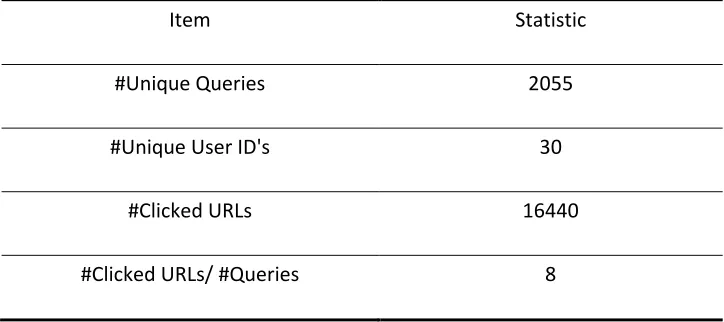
Table 4.1 The statistic of the data sets 36
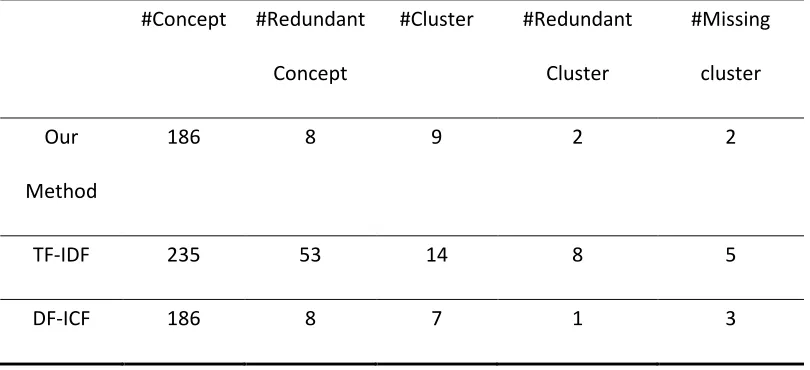
Table 4.2 The concepts extraction and clustering performance by our method, TF-IDF and DF-ICF 37
Table 4.3 The suggestion performance by our method, adjacency, query-url and query-concept 40
Table 5.1 Comparison of different methods by P@10 and MAP on test set 1 53
LIST OF FIGURES
Figure 3.1 Two queries refer to different contents of one Web page 16
Figure 3.2 A Queries- Concept bipartite graph 18
Figure 4.1 The architecture of a personalized query suggestion agent 21
Figure 4.2 A part of WordNet Is-A hierarchy 22
Figure 4.3 Concept relation trees for “java” 26
Figure 4.4 Updating one CRT based on the altered concepts’ relation 29
Figure 4.5 Connected CRTs based on overlapping concepts 31
Figure 4.6 Queries – CRTs bipartite graphs 33
Figure 4.7 The redundant and missing clusters created by our method, TF-IDF and DF-ICF 38
Figure 4.8 The F-Values performed by our method, adjacency, query-url and query-concept 41
Figure 5.1 A short queries-long query features bipartite graph 46
Figure 5.2 A process of constructing clusters of short queries 47
Figure 5.3 Comparison of different methods by P@10 on Test Set 2 53
Figure 5.4 Comparison of different methods by MAP on Test Set 2 53
Figure 6.1 A Contexts-Context Terms-Labels tripartite graph 60
Figure 6.2 A process of constructing label clusters 63
Figure 6.3 An example of retrieving relevant queries as labels of the query “Windows 7” related content
in Web page “Windows 7” 64
Figure 6.5 F-measure values of query-related topics identification for two clustering approaches 73
Figure 6.6 Overall summarization performances on DAT1 and DAT2 75
Figure 6.7 ROUGE-1 values for IS and IS+GS summarization on DAT1 and DAT2 75
Chapter 1 INTRODUCTION
With the exponential growth rate of online data, Web search engines play key roles in retrieving
millions of Web documents from the Internet in response to users’ queries. Before keyword-based
search engines were invented, Internet users might browse Web index sites like Yahoo Indexes for
searching their desired information. Because the Web index sites are generally created by human
editors and only cover a small portion of Web pages on the Internet, users may not be able to obtain
their desired information although the information exists on the Internet. The current keywords-based
Web search engines apply the Web Crawler technology to automatically collect and index billion of Web
pages so that much more Web pages can be found by Web search engines than by Web index sites. For
example, Google indexed almost 8 billion Web pages in 2004 and one trillion pages in 2008 [19].
Because of their simple interfaces and powerful searching abilities, search engines became very popular
for internet users. As reported by Daniels, over 90% of web users use search engines to transverse the
Web [13]. Currently, search engines are widely used in Web page searches, literature searches, news
searches, E-commerce, and online advertisement.
Although Web search engines provide relevant information in response to users’ queries, users
often experience difficulties in inspecting thousands of search results, spending time for determining
relevant results, and summarizing their desired information from inconsistent designed complex pages.
Thus, many challenges remain to be solved, which include (1) making searching more accurate and
efficient, and (2) discovering, understanding, and summarizing useful knowledge from the search results.
The goal of this thesis is to provide users with accurate, effective and personalized results by
understanding users’ information needs and relevant online text information.
This thesis attempts to solve three research problems, incomplete query Web searches, long
query Web searches, and Web search previews. The thesis proposes a new method to explore search
sections of the Chapter one, the research topics in this thesis are introduced first. Then, the common
strategy used for solving the three research problems is presented. Third, the challenges for the
research topics in this thesis are discussed, followed by the organization of the thesis.
1.1 Problem Definitions
In this section, three research topics, incomplete query Web searches, long query Web searches,
and Web search previews, are introduced respectively. The reasons that they degrade search engine
performance are discussed. The general approaches for solving these research problems are presented.
1.1.1 Incomplete query Web searches
Based on the Garrett’s conclusions [17], Web searches can be generally divided into two types:
Recovery-based search and Discovery-based search. A Recovery-based search is a process of looking for
existing online resources. Users know what they need to retrieve from the Internet and they may
immediately recognize relevant results returned by search engines. For example, users may want to
know the current weather of Atlanta and input “Atlanta weather” to retrieve relevant information.
Different from Recovery-based search, a Discovery-based search is a process of exploiting valuable
online resources. In other words, users do not have a clear idea of what they want to retrieve online, so
they may use descriptive terms to express their information needs and hope to get some clues through
the search results. For example, a computer scientist is interested in current hot research topics under
cloud computing area. Thus, the scientist may submit a query “cloud computing hot research topics” to
Web search engines and get several research topics about cloud computing. Then, the scientist may
select on topic he/she is interested in, such as “cloud computing security.” Thus, a query used for
Discovery-based search can be considered as an incomplete query since the query does not have intact
searching requirement.
Another reason that may result in incomplete queries is that users may have clear searching
queries depends on users’ domain knowledge. If users search in unfamiliar domains, they may use
vague or inaccurate terms to specify their requirements and result in a huge number of irrelevant
search results [14]. In order to avoid incorrect terminology in queries and irrelevant search results,
users may construct queries using a very few keywords only, and then clarify their requirements and
refine queries based on the initial searching results.
Because searching incomplete queries may result in diverse results, users have to identify the
results meeting their information needs. Therefore, understanding users’ information needs on
incomplete queries and providing accurate search results became an important research topic for Web
search engines.
Providing relevant keywords for the current query based on past search history and asking users
to select appropriate keywords to expand queries is an effective way for handling incomplete queries.
Formulation of complete queries helps users elicit their search requirements so that search engines may
better understand users’ information needs. This strategy not only provides appropriate terminology
where users do not have enough domain knowledge, but also helps users exploit their interested areas.
For example, for one query “car”, car owners may be more interested in “car insurance” or “car
maintenance” but car dealers may be more interested in “car trader.” Thus, providing appropriate
keywords to different users based on their searching history is necessary for helping them elicit their
search requirements. In this thesis, we proposed personalized query suggestion approach to assist users
in completing their queries.
1.1.2 Long query Web searches
Although the typical length of search queries are only two to four terms [46], long queries, as an
important query type among the searches on the Web, play a crucial role in many information search
applications, such as literature searches, news searches, or searches in environments where queries are
the most relevant information, like articles, news or Web pages, to the contents of long queries.
Although long queries are more convenient to express complex and specific information needs than the
keyword-based queries, current commercial search engines, in general, perform worse with long
queries than with short ones. The major reason is that most search engines respond to a user’s query by
using the Bag-of-Words model [59], which assumes queries and Web documents are composed of
individual words neither related nor ordered. However, for long natural language queries, tokens are
ordered words and phrases with underlying semantic relationships. Thus, a lack of sufficient natural
language parsing causes search engines not to understand semantic queries [29]. Also, since traditional
search engines treat all terms from the users’ inputs equally, they lose focus on the key concepts that
have the most impact on the retrieval results [3]. Thus, noise or redundant terms will further degrade
the effectiveness of long query Web searches if searching all query terms equally [28]. Users may
frequently experience the needs to convert their long natural language queries into a few adequate
terms for retrieving precise search results, which increases users’ burdens.
Choosing a few important words from the original query as the new query is the most common
way for improving long query Web searches. Then, search engines may retrieve the most relevant Web
pages based on the keywords of the original query and thus avoid irrelevant results. In this thesis, the
relevancies of long queries and short queries from browsing history are explored and appropriate short
queries that represent the meanings of long queries are selected as substitutions. This approach
improves the performance and effectiveness of long query Web searches because search engines may
easily identify keywords from the short query substitutions.
1.1.3 Web Search Previews
Because current Web search engines return a large number of search results in response to a
query, the query-specific snippets that provide searchers previews of document contents have played
preview search results’ contents and determine a subset of results meeting their information needs.
However, because Web search engines generate snippets by extracting query-related short fragments
of texts from Web pages, it is difficult for snippets to provide users clear and comprehensive views of
search results’ contents [57]. Thus, given a specific query, generating query-specific natural language
summaries of result pages that aims to minimize users’ cognitive loads of accessing Web pages has
become an important research topic for Web search engines.
The basic function of query-specific Web page summary is to reveal the major query-related
contents for a target Web page and to help a user selecting appropriate pages for their information
needs. This thesis proposes a query-specific Web page summarization approach using appropriate
queries from browser history to represent the query-related contents in the target Web page.
1.2 Strategy for research problems
Providing incomplete queries with relevant queries from browsing history as suggestions is an
effective approach to explore users’ information needs. Thus, analyzing relevance between a given
query and queries from the history is an important step for query suggestion. As discussed in section 1.1,
we also apply queries’ relations to improve performance of long query Web searches and Web search
previews. Thus, exploring queries’ relations is one step for all three applications in this thesis.
Determining queries relevance is a difficult task in the information retrieval area. One reason is
that search queries usually contain very few words and traditional text similarity measures cannot use
the number of overlap words to determine their relevance [33]. Based on traditional text similarity
measures, if queries do not contain any common terms, their relevance scores would be very low
although they may express the same meaning. For example, “WTO” and “World Trading Organization”
are semantically equivalent, but they do not contain common words. Conversely, although two queries
may contain the same terms, they may represent different meanings. For example, “computer mouse”
meanings. However, traditional text similarity analysis would suggest that these two queries are very
similar because they contain one common term “mouse.”
This thesis proposes a query-concept bipartite graph for measuring queries’ relations.
Compared to the text similarity analysis, this method explores queries’ exact meanings through their
subsequently clicked Web pages and determines their relevance based on their meanings. Therefore,
our approach may measure query relevance more precisely than the text similarity analysis.
1.3 Challenges
Currently, most commercial search engine companies have adopted a lot of innovative
algorithms to improve the performance of Web search engines. Also, a lot of academic researchers
have proposed diverse approaches to optimize search engines. Different from Web search engineers
from commercial companies, academic researchers usually lack enough research data, such as a huge
number of searching logs, to verify their approach’s performance. Although a few organizations, such as
Document Understanding Conference1 (DUC), have published a number of research data, like queries
and descriptions of information needs, it is still not enough to evaluate search engine performance for
retrieving billions of Web pages. Because the performance of search engines should be determined by
users, researchers have to gather enough people to evaluate the quality of search results by their
approach. However, since the evaluation is subjective and depends on users’ knowledge and interests,
we may get different evaluation results from different users. To evaluate quality of query-specific Web
page summaries, we have to ask evaluators to manually create summaries for Web pages. Because
different users may construct different query-specific summaries, the evaluation results may vary. In
conclusion, we have following challenges in the data collection and evaluation steps.
Difficult to obtain commercial search engine logs to evaluate algorithm performance.
Difficult to obtain objective results from users to evaluate qualities of Web searches and
query-specific Web page summaries.
1.4 Organizations of the Thesis
Chapter 2 surveys related work on exploring queries’ relations and relevant work in incomplete
query Web searches, long query Web searches, and query-specific Web page summarization. Chapter 3
presents the query-concept bipartite graphs for exploiting queries’ relations. Chapters 4-6 introduce the
algorithms that apply the query-concept bipartite graphs for personalized query suggestions, long query
reformulation, and query-specific Web page summarization, respectively. Finally, Chapter 7 concludes
Chapter 2 RELATED WORK
In this section, the relevant works for exploring queries’ relations are introduced first. Because
this thesis apply queries’ relations for solving three research problems, incomplete query Web searches,
long query Web searches, and Web search previews, the related works for these topics are also
introduced. For each research problem, the strength and weakness of related works are discussed.
2.1 Related Work for Exploring Queries’ relations
As discussed in the section 1.2, exploring queries’ relations is a difficult task because queries
usually consist of a few words and traditional methods cannot accurately evaluate queries’ relations
based on very limited contexts. To expand search queries’ contexts, Metzler et al. [33] retrieved titles
and snippets of top two hundred search results for a given query as its information supplement. Then,
they proposed several measures including lexical matching to calculate queries’ relations based on their
expanded contexts. Sahami and Heilman [40] proposed an approach to expand queries’ contexts by
collecting keywords from top search results in response to queries. Then, they applied cosine measures
to calculate relations of expanded queries. Because these two approaches expand queries’ contexts
with relevant words, using lexical matching based methods to evaluate queries’ relations is possible.
However, top search results may not be always relevant to queries. Without users’ justifications on
results, irrelevant words may be added into queries’ contexts and thus original queries’ meanings may
be obviated. Because users may select relevant results for queries, the exact meanings of queries may
be discovered through their subsequently clicked Web pages. This thesis proposes a method to explore
queries’ relations based on their exact meanings, so accurate queries’ relations can be obtained.
Fonseca et al. [15] proposed an association rules-based query relevance evaluation approach.
They assumed that Web search queries within the same session had association relations. Thus, the
queries’ relations can be determined based on the frequency that the queries occurred in the same
different sessions. Gabrilovich and Markovitch [16] applied external sources, such as Wikipedia, to
evaluate queries’ relations. They represented queries as weighted vectors of Wikipedia-based concepts
and then applied cosine similarities to evaluate queries’ relations.
2.2 Related Work for Incomplete Query Web Searches
Classifying Web search results in response to incomplete queries is a well-known method for
improving performance on incomplete query Web searches. Kules et al. [27] proposed a features-based
Web search results clustering approach that classified search results into appropriate categories based
on their titles, snippets, and URLs. Wen et al. [55] proposed a Web search results clustering algorithm
that used both clicked pages’ co-occurrence frequencies and similarities of the pages’ contents for
classifying Web pages. Their methods considered two queries are related only if they contained similar
terms or they resulted in the same Web pages clicked. Xue et al. [58] proposed a domain-based Web
documents classification approach. Based on domains for a given document, this approach first
obtained its category, and then focused the classification efforts on the selected category. Thus, this
approach minimized the number of categories and thus improved the classification performance. The
above relevant works have shown that classifying search results is a widely used approach for
incomplete query Web searches. However, since the hierarchy is predefined, it may be too coarse and
may not contain a category that best represents user’s personal interests. For example, if a user inputs
a query “car”, he or she may be interested in “car rental” or “car accident” category, but not in “car
vehicle” category.
Extending incomplete queries based on relevant terms is another effective way for incomplete
query Web searches. Carpineto et al. [6] presented a Query Expansion method that assigned scores to
candidate expansion terms based on information theory. Then, terms with high scores were selected
and queries were re-written according to the selected terms. Crabtree et al. [11] proposed a
query, and selected appropriate identified terms for expanding original query. Cui et al. [12] proposed a
framework that identified correlations between query terms and document terms by analyzing query
logs. These correlations were then used to select high-quality expansion terms for new queries.
Although above approaches expanded semantically related terms to the queries, they did not consider
users’ preferences, so different users may get the same query extensions although they had different
interests.
2.3 Related Work for Long Query Web Searches
Query reduction is a technique that eliminates noisy and redundant terms, and uses underlying
retrieving models to extract key concepts from long queries. Formulating a shorter query from the
original long query has been proven to lead to significant improvements in Web search applications [28].
Also, searching key concepts from long queries may result in adequate search results since searching
long queries has a higher chance of retrieving fewer search results. Kumaran and Allan [28] proposed a
query iterative reduction technique that used a small subset of concepts or entities from the original
query to substitute the original query and let users determine the most appropriate combinations of
term subsets. Their method obtains significant performance improvement on TREC queries. However,
this technique is difficult to be implemented due to the exponential number of options that need to be
analyzed. Also, this method makes users’ burdens heavier. Later on, Kumaran and Allan [29] proposed a
selective interactive query reduction approach that determined appropriate query reductions based on
users’ implicit feedback. The approach reduces users’ time and efforts for interacting with the query
reductions. Shapiro and Taksa [43] proposed a method that extracted intersecting terms from the long
queries as sub-queries and merged the results from searching those sub-queries. Zukerman et al. [60]
used decision graphs to identify the noisy attributes of query terms such as syntactic, paraphrase-based
and frequency-based attributes from TREC queries, and remove terms with these attributes in long
concepts in long queries is still a challenge task because of its heavy reliance on corpus statistics.
Moreover, since query reduction techniques removes context from the original query, it leads to lose
specificity of the original query and to seek more diverse information than the original query.
Query segmentation is a technique that segments queries into concepts, and thus search
engines retrieve Web documents based on the concepts but not tokens [18]. Jones et al. [26] proposed
a mutual information based approach to determine segmentation breaks between pairs of tokens. Tan
and Peng [48] proposed an unsupervised machine learning approach to discover queries’ underlying
concepts based on a generative language model, and used expectation-maximization (EM) algorithm to
estimate the model’s parameters. Also, they incorporated Wikipedia to enhance the unsupervised
machine learning. Since their approach identifies key concepts of queries, it greatly improves the
retrieval performance for long queries. However, since the query segmentation method treats all query
concepts equally and loses focus on the key concepts, it degrades the effectiveness of long query Web
searches.
Jones et al [28] proposed a query substitution approach that generated a modified query based
on past similar queries or phrases, and replaced the original query by the modified query. They built a
machine learning model to select the appropriate query candidates based on their features related to
the original query and human judgments. Bonchi et al. [4] proposed a query decomposition approach
that generated queries whose union of search results roughly matched the results of the original query.
They first instantiated the query decomposition problem to the set cover problem, and then applied
agglomerative clustering algorithm and dynamic programming to solve the problem. However, their
approaches only deal with keywords based short query substitution. Also, replacing one query by
relevant queries may lose contexts in the original query, so their approaches may obtain several
2.4 Related Work for Web search previews
Several summarization approaches that extract sentences containing query terms for
constructing query-specific summaries have been proposed. White et al. [57] proposed a sentence
scoring scheme through sentences locations in paragraphs, their semantic relations with other
sentences, and the proportions of query terms they contain. A number of the highly-scored sentences
were chosen to compose the summary. Wei et al. [54] used the mutual reinforcement chains between
documents, sentences and terms to select the most representative sentences, and used the
query-sentence similarity to measure the affinity between the pair of texts. Otterbacher [35] constructed a
graph representation of sentences based on intra-sentences cosine similarity. Then, based on
query-sentence lexical similarity, they identified the query-sentences most likely related to the query. Finally, they
recursively retrieved relevant sentences based on the sentence connections on the graph. Although the
above methods used different approaches to construct query-specific summaries, all of them
attempted to collect salient sentences related to specific queries from the target Web pages as the
summaries. We may conclude that these approaches are proposed based on the following two
hypotheses.
H'1: Sentences that are similar to other sentences in contexts convey important information of
Web pages.
H'2: Sentences that contain a number of query terms are more likely to convey the information
related to the query.
Based on hypotheses H'1 and H'2,although we may retrieve sentences containing the major
query-related contents of the Web pages, we may also collect several sentences conveying not
important or even noisy information since the above hypotheses cannot distinguish the sentences
containing query-related topics from the sentences containing common terms that co-occur frequently
and do not minimize searcher’s cognitive load to identify their desired Web pages. Occasionally, the
query-related topics may even not occur in target Web pages but require summarizers to underline
scatter query-related information and paraphrase them with new sentences. However, the extractive
summarization methods do not have such capabilities to analyze and understand the target Web pages’
contents and to paraphrase them.
In order to automatically identify query-related topics and contents in target Web pages, Lin
and Hovy [31] constructed a topic knowledge base from a predefined corpus and then recognized
query-related topics based on the knowledge base during the processes of summarization. However,
constructing such a huge knowledge base or corpus that contains any query-related topics is difficult. To
identify target Web pages’ topics easier, researchers studied clickthrough data and attempted to
construct generic Web page summaries based on relations of search queries and their subsequently
clicked Web pages.
The previous works [21, 41, 44] indicated that search queries could be used as semantic labels
to describe the contents of the subsequently clicked Web pages. Thus, they proposed a query-based
text-summarization framework that identified the queries leading to click the target page as labels of its
query-related contents and then extracted sentences containing the labels from the page as summaries.
Based on Beeferman and Berger’s report [2], the probability for two queries lead to one common Web
page clicking is less than 10-4. Thus, the above approaches may not retrieve enough queries from the
clickthrough data to uncover the major contents of target pages. Also, their approaches cannot
construct high-quality query-specific summaries since the queries from the clickthrough data may
uncover the major contents for the page but may not uncover contents related to one specific query.
Svore et al. [47] suggested that news query terms or Wikipedia entities are strong signals of
user interests so that sentences containing them should be good candidates for news summaries. They
constructing news article summaries. Hu et al. [22, 23] considered comments contributed by readers
providing valuable information to better understand the Web document. They proposed frameworks to
extract sentences from Web pages that best represent the topics discussed among its comments.
Boydell and Smyth [5] proposed a Web pages summarization technique that used social bookmarking or
search queries as basis for summary construction. For a given Web page, they first identified a set of
queries that led to the selection of that page among search engine result lists. Second, they submitted
the queries to a search engine and collected the query-sensitive snippets from the result sets. Third,
they constructed the given Web page’s summaries by selecting and combining the snippets obtained in
the second step. The above approaches used search queries or other resource as labels of important
contents of Web pages for generic Web page summarization, and their experiment results showed
significant improvements compared with summarizers without using those labels. However, they did
not use these labels in query-specific Web page summarization.
Wang et al. [53] suggested that two documents about one common topic have mutual influence
and they would provide information to each other, so they proposed a framework to use mutual
information from documents within one appropriate cluster context for collaborative document
summarizations. Similar to their strategies, our approach attempts to retrieve queries whose
subsequently clicked Web pages containing similar contents as the contents of the target Web page,
Chapter 3 CONSTRUCTING QUERY-CONCEPT BIPARTITE GRAPHS FOR EXPLORING QUERIES’
RELATIONS
This chapter introduces Query-Concept bipartite graphs to investigate queries’ relations. In
section 3.1, a well-known model for evaluating queries’ relevance is introduced, and its strength and
weakness are discussed. Section 3.2 introduces the detailed steps to construct Query-Concept bipartite
graphs. Two models are compared in section 3.3.
3.1 Query-URL Bipartite Graphs
The clickthrough data that contain users’ queries and subsequently clicked URLs are rich
resources to investigate queries’ relations. Beeferman and Berger [2] believed that two queries were
relevant if they resulted in clicking same Web pages. They constructed the Query-URL bipartite graphs
to describe the relations of queries and their subsequently clicked URLs. For a given query and its URLs,
the queries connected by the same URLs were considered as relevant queries. One major problem for
the Query-URL model is that the number of common clicks on URLs for different queries is very limited.
In a large clickthrough dataset from a commercial search engine, it was reported that the chance for
two random queries to have a common click was less than 10-4 [2]. Therefore, it is very difficult to find
the relevant queries for a given query based on the Query-URL bipartite graphs. Another problem with
the Query-URL bipartite graphs is that although two queries may lead to same URLs, they may still be
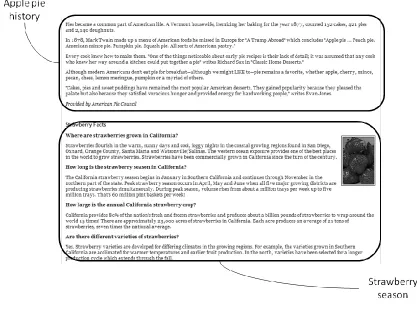
irrelevant because they may refer to totally different contents of the Web document. For example, in
Figure 3.1, two queries “apple pie history” and “strawberry season” lead to click the same Web page2
“Food day”, but these queries cannot be guaranteed to be relevant because they refer to different
Figure 3.1 Two queries refer to different contents of one Web page
3.2 Query-Concept Bipartite Graph
The Query-Concept Bipartite Graph model is useful to analyze queries’ relations even if they do
not result in same Web pages. For two given queries, their subsequently clicked Web pages may reveal
their exact meanings. If the queries’ subsequently clicked Web pages contain very similar contents, the
queries are considered to be relevant. We propose the following steps to construct Query-Concept
Bipartite Graphs to investigate queries’ relations.
A user browses several search results returned by the search engines and locates the
information matching his/her query. We assume that if the browsing period for one Web page is long
enough, that page may contain the information related to the query. Therefore, the following equation
RQD(q, di) is proposed for measuring the relevance scores of one Web page diwith the query q.
1 1 1 ( ) ( , ) ( ) m j i j
i n m
j i i j
period d RQD q d
period d
(3.1)In the above equation, m means that the user clicks the Web page dim times, and the period of
jth visiting is periodj(di); n is the total number of clicking Web pages for that query, and the divisor of the
equation is the total visiting period of the clicked Web pages for that query.
After the relations between queries and Web pages are calculated, Web pages that have top
relevance scores with the query are selected as the user’s favourite Web pages. Then, context terms
around the query from the selected Web pages are extracted to express the contents of the Web pages.
Based on the assumption that if a keyword or a phrase appears frequently around the query in the
user’s clicking web pages, it should be an important concept related to the query. The equation RQC(q,
ci) is proposed to measure the relation between a particular concept ci and the query q.
1
( , )
( ,
)
( )
k
m
i k d i
k
RQC q c
RQD q d
f
c
(3.2)In the above equation, RQD(q, dk) is the relation between the query q and document dk
containing concept ci; fdk (ci) is the occurrence frequency of the concept ci in the document dk; m
indicates the number of clicked Web pages containing the concept ci.
After obtaining the relations between concepts and queries, the concepts that have top
relevance scores with the given query are extracted to represent the users’ favourite information. For
example, for the query “java”, based on the user’s clickthrough data, the related concepts are extracted
from Web pages, such as “programming language”, “software”, “code”, “compiler”, “technology”,
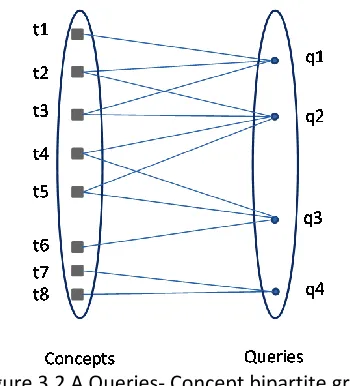
Fig. 3.2 shows a queries- Concept bipartite graph, where squares represent Concepts and
rounds represent queries. For any two queries in the bipartite graph, we may speculate their relations
based on the common number of context terms they connect.
Figure 3.2 A Queries- Concept bipartite graph
3.3 Comparisons of Query-URL Bipartite Graphs and Query-Concept Bipartite Graphs
Both Query-URL bipartite graphs and Query-Concept bipartite graphs are used to investigate
clickthrough data for speculating queries’ relations. These two models assume that users may select
query-related search results from results returned by search engines, and queries’ relations can be
determined by queries’ subsequently clicked results.
As discussed in section 3.1, although two queries may lead to one common Web page clicked,
they may be still irrelevant since one Web page may contains multiple topics and the queries are
related to different topics in that page. The Query- Concept model retrieves query-related concepts
from queries’ subsequently clicked Web pages, so the concepts may indicate the query-related contents
of the clicked Web pages. Two queries having same concepts from their pages are more likely relevant
than two queries resulting in clicking same URLs. Thus, Query-Concept bipartite graphs may get more
accurate queries’ relations than Query-URL bipartite graphs. Also, the probability that two queries result
[image:30.612.216.391.149.342.2]for a given query than the Query-URL model. In summary, compared with Query-URL bipartite graphs,
Query-Concept graphs have following advantages:
The Query-Concept bipartite graphs explore more precise queries’ relations than the Query-URL
graphs because the latter model ignores clicked pages’ contents.
The Query-Concept graphs get more relevant queries for a given query than the Query-URL
graphs because the probability of two queries having the same concepts in their subsequently
Chapter 4 QUERIES-CONCEPTS BIPARTITE MODEL FOR PERSONALIZED QUERY SUGGESTION
Query suggestion is a way to extend queries to allow search engines to better speculate exact
meanings of incomplete queries. This chapter proposes an approach that uses the Query-Concept
bipartite graphs and Concept Relation Trees for personalized query suggestion.
4.1 Methods
This section introduces steps to generate personalized query suggestions for incomplete queries.
In step 1, the clickthrough data that contain users’ queries and corresponding clicked URLs are analyzed,
query-related concepts are extracted, and a Query-Concept bipartite graph is constructed. In step 2,
based on concept semantic relations and co-occurrence frequencies, the extracted concepts are
clustered, and then Concept Relation Trees (CRT) can be constructed. CRTs are tree-structure concept
clusters in which concepts are represented as leaves and any two concepts’ relation is demonstrated as
the weight of their lowest common ancestor.If queries are connected by CRTs, their relations can be
calculated based on the relations of Query-Concept and Concept-Concept obtained in the first two steps.
In step 3, queries that have strong relationships with the given query are retrieved as suggestions. In
step 4, weights of Query-Concept and concepts’ relations in the CRTs are updated based on the users’
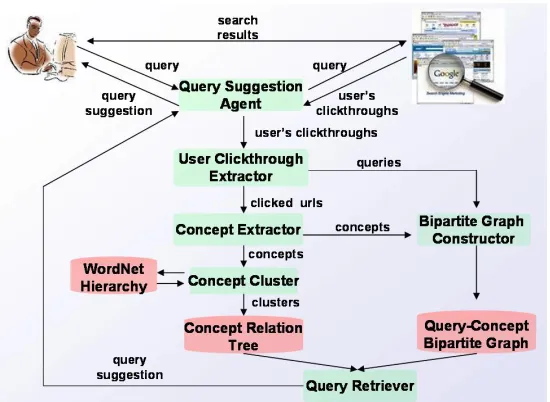
recent queries and clicked URLs. The architecture of the personalized query suggestion agent is shown
Figure 4.1 The architecture of a personalized query suggestion agent
4.1.1 Constructing queries-concept bipartite graphs
Based on the approaches introduced in section 3.2, all clicked Web pages for a given query are
collected and Query-Web page relations are calculated based on equation 3.1. Then, Web pages owning
top query relevance scores are selected. Second, the concepts from those Web pages are extracted
based on equation 3.2. Thus, we are able to construct a Queries-Concept bipartite graph as shown in
Figure 3.2.
4.1.2 Calculating the concepts’ relations
After the concepts are extracted from the Web pages, these concepts are divided into different
concept sets, and each concept set represents a cluster of closely-related concepts. To construct
clusters of extracted concepts, the following equation RCC(ci, cj) is used to calculate the relationship
between concept ci and concept cj.
1
( ,
)
(
( ,
)
( ,
))
2
i j i j i j
Based on the above equation, two concepts’ relation RCC(ci, cj) is determined by the concepts’
semantic relation SR(ci, cj) and the co-occurrence frequency CO(ci, cj). In the following parts, the
methods to calculate the concepts’ semantic relations and co-occurrence frequencies are introduced.
WordNet is a large lexical database in English, developed under the direction of George A. Miller
[34]. Synonymous words are grouped together into synonym sets, called synsets. Each synset
represents a single distinct sense or concept. Each WordNet sense is associated with a tree structure in
the WordNet Is-A hierarchy. The nodes in these tree structures are WordNet hyponyms, each of which
has a unique identifier in WordNet. Therefore, each sense can be related to unique hyponyms in the
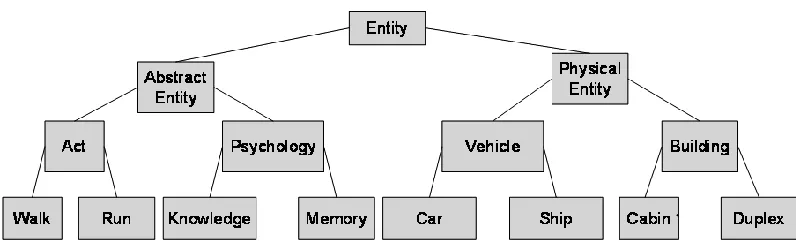
tree structure. In the Is-A hierarchy tree, each child node is an instance of the parent node, like “car” is
instance of “vehicle”, and “vehicle” is instance of “physical entity.” A part of WordNet Is-A Hierarchy is
[image:34.612.106.504.382.507.2]shown in the figure 4.2.
Figure 4.2 A part of WordNet Is-A hierarchy
The semantic similarity between concepts can be estimated by the information content (IC) [39].
The information content of a concept x is defined as
IC x
( )
log p x
( ( ))
, (4.2)where p(x) is the frequency of encountering an instance of concept x. The frequency of
encountering a concept includes the frequency of encountering all its subordinate concepts since the
Is-A tree is defined as 1, for any concept node c in that tree, its p(x) can be calculated by the equation:
nc/na, where nc represents the number of descendants of that concept node c, and na represents the
number of all nodes in the tree. Therefore, the information content of a concept is -log(nc/na). Then, by
applying the Jaccard similarity coefficient [49], we propose the following equation SR(ci, cj) to calculate
any two concepts’ relation,
|
|
( , )
| (
) (
) (
) |
p a i j cj p cia a a
n
-log
n
SR c c
n
n
n
-log
-log
-log
n
n
n
. (4.3)In the above equation, np is the number of descendants of the lowest common ancestors of ci
and cj; nci is the number of descendants of the concept ci; ncj is the number of descendants of concept cj;
na represents the number of all nodes in the tree.
Based on the above equation, we may estimate that, in Figure 4.1, concepts “car” and “ship”
have higher semantic relation than the concepts “car” and “cabin” because the lowest common
ancestor of “car” and “ship”, “vehicle”, contains fewer concepts than the lowest common ancestor
“physical entity” of “car” and “cabin”, although “car” and “cabin” have the same number of children
nodes as the concept “car” and “ship.”
The following equation CO(ci, cj) is used to calculate the frequency of co-occurrences of
concepts ci and cj.
( ,
)
2
(
)
( )
( )
i j
i j
i j
f c
c
CO c c
f c
f c
(4.4)In the equation CO(ci, cj),f(ci ∩ cj) is the frequency of the Web pages containing both concepts ci
4.1.3 Constructing concept relation trees
After concepts are extracted based on frequencies of occurring in the users’ selected Web
pages, concepts with high co-occurrence frequencies and similar semantic relations are grouped
together. Based on the concepts’ relation equation RCC(ci, cj), an agglomerative clustering algorithm is
developed to construct concept clusters, each of which contains closely-related concepts. Section 4.1.1
extracts relevant concepts for queries. Then, the queries connected by the concepts in same clusters
should have strong relationships, and one query of them may be considered as one suggestion of
another.
Before presenting Algorithm 4.1, the term “pseudo-concept”, a node grouped by the concepts
and representing the union of set concepts, is introduced.
In Algorithm 4.1, concepts are grouped together if their relation is larger than a threshold value
δ2. The initial value of δ2in Algorithm 4.1 is set as 0.3, and it can be adjusted later. Based on Algorithm
4.1, the extracted concepts are clustered, and CRTs can be constructed. The CRTs are tree-structure
concept clusters in which concepts are represented as leaves, and any two concepts’ relation is
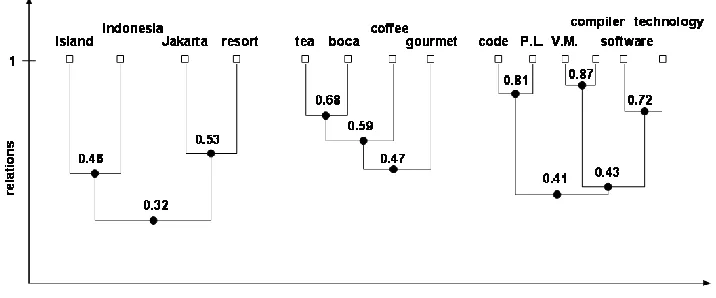
demonstrated as the weight of their lowest common ancestor. For the previous “Java” example, after
the concepts related to the query “java” are extracted and their relations are calculated, based on
Algorithm 4.1, following three CRTs are created as shown in Figure 4.3. The square nodes represent the
concepts, and the round nodes represent the pseudo-concepts. The nodes’ weights indicate the
relations between concepts. For any two concepts nodes in a CRT, their relation is demonstrated as
their lowest common ancestor’s weight. For example, the relation of “island” and “resort” is 0.32. Once
the CRTs are constructed, they are saved into users’ profiles, which can be used as knowledge for
ALGORITHM 4.1 Constructing CRTs
INPUT:
The extracted concepts, concepts’ co-occurrence frequencies and semantic relations
OUTPUT:
Several CRTs, each of which is a concept cluster containing closely-related concepts
BEGIN
Step 1: Based on the equation RCC(ci, cj), calculate the relations for all possible pairs of extracted
concepts. The matrix of the concepts’ relations M is created.
Step 2: Merge a and b, which are disjoint concepts, pseudo-concepts or one concept and another
pseudo-concept, and they have the highest concepts’ relation. Then, create a pseudo-concept t to
represent the union of set a and b.
Step 3: Calculate the relations between that pseudo-concept t with other disjoint concepts and
pseudo-concepts. The relation r between t and another concept or pseudo-concept t' is the highest
concepts’ relation between the concepts from t and t'. Then, assign r to the relations between any
concepts from t and t'. Next, update the corresponding concepts’ relations in the matrix M.
Step 4: Repeat Steps 2 and 3 until all the relations between any concepts or pseudo-concepts are
smaller than a threshold value δ2, or all concepts are grouped into one pseudo-concept.
Figure 4.3 Concept relation trees for “java”
For the concepts related to a single query, we can create multiple CRTs, each of which contains
closely-related concepts. Also, we may construct separate CRTs related to queries if their concepts are
completely unrelated. However, if the CRTs for different queries contain the same concepts, we may
need to merge the CRTs together to indicate their relations. Thus, the following approaches are
proposed to solve this problem.
If concepts related to the query q1are a sub set of concepts related to query q2, we only need to
construct CRTs for q2. However, we still need to calculate the concepts’ relations for q1 based on the
equation RCC(ci, cj) and use these relations to update concepts’ relations of the CRTs for q2. The updated
relation for q2 is the average value of the old relation for q2 and corresponding concepts’ relation for q1.
For the above “java” example, we construct three CRTs and one of them contains the concept “tea”,
“boca”, “coffee”, and “gourmet.” Then, we have another query “Starbucks”, and the concepts extracted
from the users’ clicking Web pages are “coffee” and “boca.” In that situation, we do not need to create
separate CRTs for the “Starbucks”, but just calculate the relation for “coffee” and “boca” based on the
equation RCC(ci, cj), and use that relation to update the “coffee” and “boca” relation in the CRT of
“java.” After the concepts’ relations are updated, the structure of the CRTs needs to be updated to keep
than the concepts with higher common ancestors. Therefore, we propose Algorithm 4.2 to update CRT’s
structures based on altered concepts’ relations.
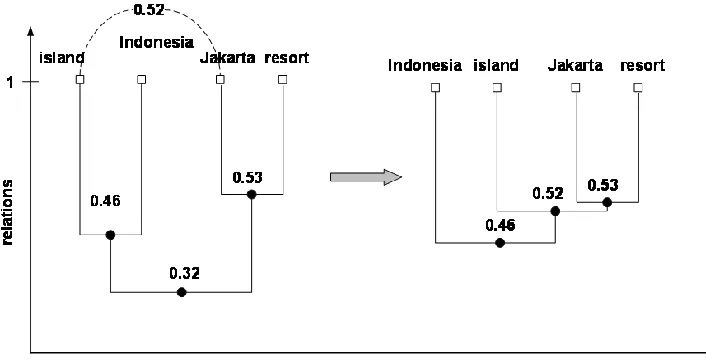
Based on Algorithm 4.2, if one altered weight is larger than the old weight, their CRT structure is
updated, and the concepts’ leaves are adjusted closer. For the example shown in Figure 4.4, the
updated relation between concepts “island” and “Jakarta” is 0.52, which is larger than the their
previous relation 0.32 and the relation of “island” and “Indonesia.” Thus, we need to break the
connection between “island” and “Indonesia”, and connect the “island” with the pair of “Jakarta” and
“resort” first because they have larger weights. Then, “Indonesia” is connected with the newly created
node that contains “island”, “Jakarta” and “resort.” After CRT is updated, “island” and “Jakarta” have a
lower common ancestor than the concepts “Indonesia” and “Jakarta.”
ALGORITHM 4.2 Updating CRT based on altered concepts’ relations
INPUT:
The old CRT with altered concepts’ relations
OUTPUT:
An updated CRT with new concepts’ relations and updated structure
BEGIN
Step 1: Store the concept pairs with altered relations in an array T. Then, rank the altered concepts’
relations decreasingly.
Step 2: Select one concept pair (ci, cj) that has the highest altered relation in the T. Compare the
altered relation of concepts (ci, cj) with their old relations. If the altered relation is higher than their
old relation, go to step 3; otherwise, remove (ci, cj) with their concepts’ relation in the T. If no more
Step 3: Compare the altered relation of concepts (ci, cj) with the weights of ci’s parent p 1
(ci) and cj’s
parent p1 (cj). (The weight of p 1
(ci) is the concepts’ relation between ci with its nearest neighbour
concept.) If the altered relation of concepts (ci, cj)is smaller than the weights of p1 (ci) and p1 (cj),
then compare the altered relation with the weights of p1 (p1 (ci)) and p 1
(p1 (cj)), or p 2
(ci) and p 2
(cj).
Repeat this step until the altered relation of concepts (ci, cj) is larger than the weight of p i
(ci) or p i
(cj), or both.
Step 4: If the altered relation of concepts (ci, cj) is larger than the weight of p i
(cj) but smaller than
the weight of pi (ci), break the connection between the children nodes of p i
(cj). Then, merge p i
(ci)
and the child nodes of pi-1 (cj). The weight for the new created connection is the altered relation of
concepts (ci, cj). If the altered relation of concepts (ci, cj) is larger than the weights of p i
(ci) and p i
(cj),
break the connection between the children nodes of pi (ci) and p i
(cj).Then, merge p i-1
(ci) and p i-1
(cj).The weight for the new created connection is the altered relation of concepts (ci, cj).
Step 5: Merge the nodes whose connection are broken in step 4 and the new created nodes. Then,
remove (ci, cj) with their concepts’ relation in the array T. If no more concept pairs in T, then end the
algorithm; otherwise, go to step 2.
Figure 4.4 Updating one CRT based on the altered concepts’ relation
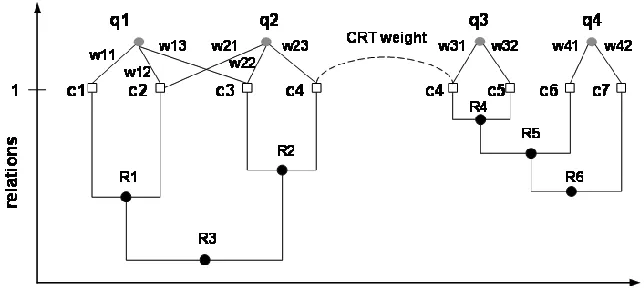
If the CRTs related to the queries q1 and q2 contain overlapping concepts, their CRTs are
connected by linking the overlapping concepts. If two CRTs contain lots of overlapping concepts, the
CRTs should have strong relationship, so the weight between them should be large; conversely, the
weight between them should be small. Thus, the following equation RTT(CRT1, CRT2) is proposed to
calculate the weight between CRTs, in which n(CRT1∩CRT2) represents the number of concepts
occurring in the both CRTs and n(CRT1)+n(CRT2)represents the total number of the concepts occurring in
CRT1 and CRT2. After the weight between CRTs calculated, Algorithm 4.3 is proposed to connect the
overlapping concepts occurring in both CRTs.
1 2
1 2
1 2
2
(
)
(
,
)
(
)
(
)
n CRT
CRT
RTT CRT CRT
n CRT
n CRT
(4.5)ALGORITHM 4.3 Connecting CRTs
INPUT:
CRT1and CRT2
OUTPUT:
BEGIN
Step 1: Based on the CRTs relation equation RTT(CRT1, CRT2), calculate the similarity between CRT1
and CRT2.
Step 2: Connect CRT1 and CRT2 by linking the concepts occurring in both of them. Then, assign the
similarity of CRT1 and CRT2 to the linkages’ weights.
END ALGORITHM 4.3.
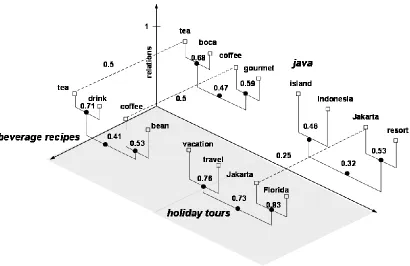
Given three queries “java”, “holiday tours” and “beverage recipes”, we may construct following
CRTs as shown in Figure 4.5. “Java” is associated with two CRTs, (“tea”, “boca”, “coffee”, and
“gourmet”) and (“island”, “Indonesia”, “Jakarta”, and “resort”). “Beverage recipes” is associated with
the CRT that contains concepts “tea”, “drink”, “coffee” and “bean.” “Holiday tours” is associated with
the CRT that contains concepts “vacation”, “travel”, “Jakarta”, and “Florida.” For the above four CRTs,
several concepts occur in more than one CRT such as “tea”, “coffee” and “Jakarta”, so the CRTs can be
connected by linking the overlapping concepts “tea”, “coffee” and “Jakarta”. Then, assign the CRTs’
Figure 4.5 Connected CRTs based on overlapping concepts
After CRTs are connected, the equations are needed to calculate concepts’ relations in the same
CRT and in connected CRTs. If ci and cj are in the same CRT, only one path exists between them, so their
relation d(ci, cj) is their concepts’ relation obtained from Algorithm 4.1. If ci and cj are in two connected
CRTs CRT1 and CRT2, and L connections exist between CRTs, ci and cj may have L possible concepts’
relations because one path between them may result in one concepts’ relation. In order to calculate L
possible concepts’ relations between ci and cj, we have to find L concepts {sc1, sc2, …, scL} occurring in
both CRTs. Then, the following equation CW(ci, cj) is proposed to calculate the relation of concepts ci
and cj in the different CRTs.
1 2
1
(
,
)
( ,
)
( ( ,
)
(
,
))
2
L
i j i k k j
k
RTT CRT CRT
CW c c
d c sc
d sc c
L
(4.6)In the above equation, sckrepresents one concept occurring in both CRT1 and CRT2; d(ci, sck)
represents the concepts’ relation of concept ci and sck obtained in algorithm 4.1; L indicates the number
Based on the above equation, one relation of ci and cj is the arithmetic average of d(ci, sck) and d(sck, cj)
multiplies the weight between CRT1 and CRT2. The relation CW(ci, cj) of concepts ci and cj in two
connected CRTs is an average value of all possible relations between ci and cj.
For example, in Figure 4.5, the relation of concepts “drink” and “boca” can be calculated by
applying the equation CW(ci, cj). Two concepts “tea” and “coffee” occur in the both CRTs, so two paths
boca” and “drink-coffee-boca” exist between “drink” and “boca.” For the path
“drink-tea-boca”, the relation between “drink” and “boca” should be RTT(CRT1, CRT2) multiplying the average of
d(drink, tea) and d(tea, boca). As shown in Figure 4.5, the value of RTT(CRT1, CRT2) is 0.5, d(drink, tea)
0.71 and d(boca, tea) 0.68. Then, for the path “drink-tea-boca”, the relation of “drink” and “boca” is
0.5*(0.71+0.68)/2. Similarly, for the other path “drink-coffee-boca”, the relation of “drink” and “boca”
is 0.5*(0.41+0.47)/2. The relation CW(drink, boca) is the average relations for the paths
“drink-tea-boca” and “drink-coffee-boca.”
4.1.4 Calculating the queries’ relations
Based on the relations between queries and concepts, and relations between concepts and
concepts obtained from previous steps, queries’ relations can be calculated. If two queries have strong
relationship, one of them can be a suggestion for the other. The following two strategies are proposed
Figure 4.6 Queries – CRTs bipartite graphs
Strategy 4.1. Two queries qi, qj are considered to be relevant if most of concepts related to qi
have strong relationships with most of concepts related to qj.
Given two concept sets Ci and Cj related to the queries qi and qj, respectively, the following
three equations RQQ1(qi, qj), AvgQC(qi, Ci), and AvgCC(Ci, Cj) are proposed to calculate the relations
between qi and qj.
1
1( , ) ( ( , ) ( , ) ( , ))
3
i j i i i j j j
RQQ q q AvgQC q C AvgCC C C AvgQC q C (4.7)
1 1
1
(
,
)
(
,
)
n m
i j i h j k
h k
AvgCC C C
CW c
c
mn
(4.8)1
1
( , ) ( , )
m
i i i k
k
AvgQC q C RQC q c
m
(4.9)In the equation RQQ1(qi, qj), AvgQC(qi, Ci) represents the average relations between qi andthe
concept set Ci, and AvgCC(Ci, Cj) represents the average relations between concept sets Ci and Cj.
In the equation AvgCC(Ci, Cj), cih represents one concept in the concept set Ci and cjk represents
one concept in the concept set Cj; CW (cih, cjk)represents the relation between concept cih and concept
cjk. If Ci contains n concepts and Cj contains m concepts, there are m multiplying n combinations of