2018 International Conference on Modeling, Simulation and Analysis (ICMSA 2018) ISBN: 978-1-60595-544-5
A New Approach for Train Driver Tracking in Real Time
Ming-yu WANG, Si-le WANG, Li-ping CHEN, Xiang-yang CHEN,
Zhen-chao CUI, Wen-zhu YANG
*School of Cyber Security and Computer, Hebei University, Baoding, China
*Corresponding author
Keywords: Train driver tracking, Long-term tracking, Correlation filters, High-confidence model update strategy.
Abstract. Find the main driver in the train cab and keep tracking him is the primary step for driver activity analysis in real time. But long-term robust human tracking is still a challenging task due to many practical factors. Most template-based tracking algorithms of templates often fail when encountering occlusion, pose variation and motion blur. In this paper, we propose a real-time algorithm based on correlation filters for long-term human tracking. To restore the false model caused by occlusion, we construct a conditional target re-detection mechanism. We adopted a high-confidence model update strategy to ensure the correct detection and avoid model drift problem. The experimental results indicate that the proposed algorithm is robust and accurate to variations in pose and heavy occlusion while runs at speed in real-time.
Introduction
Standardized operation is an import measure to ensure the safety of train running. Video monitoring is the state-of-the-art technology to analyses and record the activity of the train driver. Find the main driver in the train cab and keep tracking him is the primary step for driver activity analysis in real time. But long-term robust human tracking is still a challenging work due to many practical factors. Recently, using a correlation filter for training template are a successful representation for object tracking. It has long been a topic that attracts much research due to its great advantage of the high speed and acceptable accuracy. The widespread adoption of correlation-filter-based trackers is pertinent in the tasks of automated surveillance, motion-based recognition and traffic monitoring. We have applied correlation filters to Gaussian kernels regression, obtaining pertinent trackers that run at hundreds of FPS and can be implemented with only a few lines of code. Therefore, numerous efficient algorithms about correlation filters have been proposed for robust object tracking.
The core technology of the correlation filtering algorithm is to give unlimited amounts of negative samples and the use of appropriate image features. The number of training samples determines the speed of the algorithm. Consequently, for choosing appropriate image features of the algorithm determines the performance of the tracking applications. Therefore, many improvement algorithms are based on the above two points, for example, adding multi-scale transformed samples [4] or characterizing images with multi-channel features [9]. Despite these algorithms in terms of speed and accuracy has much improved in, they ignore the fundamental challenge of tracking algorithm – occlusion and template drift for long-term tracking [4]. In this paper, we propose sample feature points on each spatial scale in each frame and track them using a state-of-the-art kernelized correlation filters algorithm. For long-term visual tracking, we train the detection module that re-detects the target in case of tracking failure. In the model update strategy, we adopt the high-confidence selection to ensure the correct detection and avoid model drift problem, the high-confidence parameter reflects the accuracy of tracking results. The development of these methods prompts us to improve the discriminative ability of correlation-filter-based tracking algorithm and remain its running speed in real-time.
This paper is organized as follows. Section 2 presents our tracking representation with correlation filters and adjustable model update strategy. The experimental setup and the datasets are described in sections 3. Section 4 concludes the paper.
Tracking Components
In this section, we describe classical correlation filters for image patches trained at different translations, and work out the impact on kernel regression, such as Gaussian kernels. Then, we propose a re-detection mechanism for recovering tracking error in each frame. And we also employ a high-confidence model update strategy to measure the proper completion of the tracking task in each tracking step. We will show a natural underlying connection to classical correlation filters. The experiment we demonstrate will evaluate the more robust algorithm we proposed in Sections 4.
Correlation Filter Based Tracking
In signal processing, correlation is a measure of similarity of two series as a function of the displacement of one relative to the other. Since it has applications a comparing model, and can achieve good performance that is close to other excellent tracking methods, such as FCT [10]. For continuous functions f and g, the correlation is defined as:
(𝑓 ⋆ 𝑔)(τ) ≝ ∫∞ 𝑓∗(𝑡)g(𝑡 + 𝜏)𝑑𝑡
−∞ . (1)
where 𝑓∗ denotes the complex conjugate of 𝑓, and τ is the displacement, also known as lag, although a positive value of τ actually means that g(𝑡 + 𝜏) leads 𝑓(𝑡).
In the field of tracking, correlation filter is used to compare the similarity of two adjacent frames of image. We need to compute a filtering template so that it gets the most response when it acts on the tracking target. From this point on, tracking and filter training work together. The target is tracked by correlating the filter over a search window in next frame; the location corresponding to the maximum value in the correlation output indicates the new position of the target.
Based on this previous thought, we need to find a filter ℎ that produces the maximum response on the target. Then write the formula is as shown in Eq.2:
𝑔 = ℎ ⋆ 𝑓. (2)
computing the forward and inverse FFTs is 𝑂(𝑃log 𝑃) where 𝑃 is the number of pixels in the tracking window. Simply, we have it:
𝐻∗ =𝐺
𝐹. (3)
However, in practical application, because of the change of the appearance of the target and other factors, we need to consider numbers of the target images as a reference to improve the robustness of the model. Then we have the objective function of Eq.4:
min𝐻∗∑𝑚𝑖=1|𝐻∗𝐹𝑖 − 𝐺𝑖|2. (4) According to the Convolution Theorem, operations in the frequency domain are the operation of elemental, so we can solve each element 𝐻𝑤,𝑣∗ in 𝐻∗ separately. Training is conducted in the Fourier domain to take advantage of the simple element-wise relationship between the input and the output. We define upper case variables 𝐹𝑖, 𝐺𝑖 and the filter 𝐻∗ to be the Fourier transform of their
element-wise then Eq.4 can become:
min𝐻𝑤,𝑣∗ ∑ |𝐻𝑤,𝑣
∗ 𝐹
𝑤,𝑣,𝑖− 𝐺𝑤,𝑣,𝑖| 2
.
𝑚
𝑖=1 (5)
Then, the partial W.R.T. 𝐻𝑤,𝑣∗ is solved by setting equal to zero, while treating 𝐻
𝑤,𝑣as an
independent variable [14]. By solving for 𝐻∗ a closed form expression for the filter is found:
𝐻∗ = ∑ 𝐹𝑤,𝑣,𝑖𝐺𝑤,𝑣,𝑖 ∗ 𝑚
𝑖=1
∑𝑚𝑖=1𝐹𝑤,𝑣,𝑖𝐹𝑤,𝑣,𝑖∗
. (6)
Regression
The above part is to use the previous frame tracking results to train the relevant image filter. The optimization function consists of the simplest least-squares and regular terms in convex optimization, which is the most commonly used ridge regression method. There is a closed-form solution from the minimizer, which is given by, as shown in the following equation:
𝑤 = (𝑋𝑇𝑋 +λI)−1𝑋𝑇𝑦 (7)
where H represents conjugate transpose and λ is a regularization parameter that is used to control training overfitting. To reduce the computational complexity of the algorithm, the KCF algorithm [3] assumed that the new samples generated by the cyclic shift based on the basic target template can approximately replace the samples sampled around it. Assuming there is a generating vector
1 2
[ , ,..., n]
x x x x referring to it as the base sample. Then, model one-dimensional translations of this vector by a cyclic shift operator [12], which is the permutation matrix. We’ll produce a new vector 𝑥′, x Px[ , ,x x xn 1 2,...,xn1] for a 2D image.
Due to the cyclic property, we can model one-dimensional translations of the generating vector x by a cyclic shift operator, which has several intriguing properties [13] that all circulant matrices are made diagonal by the Discrete Fourier Transform (DFT). This can be indicated by
𝑋 = 𝐹𝑑𝑖𝑎𝑔(𝒙̂)𝐹𝐻 (8)
where 𝐹 is a constant matrix that does not rely on x, and 𝒙̂ denotes the DFT of the generating vector, 𝒙
̂ = ℱ(𝑥). Employing the cyclic property to simplify the linear regression in Eq.13, when the training
data is comprised of cyclic shifts. Replacing Eq.8 in it,
𝑋H𝑋 = 𝐹𝑑𝑖𝑎𝑔(𝒙̂∗)𝐹𝐻𝐹𝑑𝑖𝑎𝑔(𝒙̂)𝐹𝐻= 𝐹𝑑𝑖𝑎𝑔(𝒙̂∗⨀𝒙̂)𝐹𝐻 (9)
Directly using the original formula Eq.9 in the complex domain into the Ridge regression parameters calculated, and since for any vector 𝐹𝒛 = 𝒛̂, we can get:
𝒘̂ = 𝒙̂⨀𝒚̂
For typical data sizes, this reduces storage and computation by several orders of magnitude. To make the training process further simplified, we take the solution to the kernelized version of Ridge Regression is given by
𝛼̂ = 𝒚̂
𝑘
̂𝑿𝑿+𝜆 (11) where 𝑘̂𝑿𝑿is the Gaussian kernel of the kernel matrix and again a hat ˆ denotes the DFT of a vector.
Target Re-detection and High-confidence Update
During the tracking and model updating phase, we will discuss the impact of template updating on training results, especially for the practical application of long-term problems. The KCF algorithm mentioned above, most of them are used to update the linear interpolation method. This method preserves the filter model of the target frame in the previous frame and also adds the newest appearance to the model in time. However, when tracking deviations, Eq.11 will introduce the wrong target apparent information into the model. As a result, the tracking error accumulates continuously, resulting in an increase of errors introduced in subsequent frames, eventually resulting in tracking failure and drift.
In this item, we will investigate the effect of the template updating on the detection phase, especially in long-term tracking of the practical application. Linear interpolation has been a part of most methods based on correlation filters in the template updating step. Despite it shown remarkable performance and high FPS rate in short-term tracking, we find that the correct tracking time is limited for practical applications. Applying our previously mentioned filters as KCF tracking on the short-term to the actual video, we find that the accuracy of these trackers is far less accurate than its working on the short-term for a long time passed.
The reason is obvious. First, each tracker has limitation for different tracking conditions, such as CT on the poor performance of fast movement. Even in its most ideal conditions, the testing results of running step of each tracker also have some errors. Those errors will gradually accumulate with the passage of tracking time, eventually losing our tracking target. Second, from the traditional CF algorithm update formula (Eq.6), it lacks a simple measurement for tracking error information and the retention of historical information. This leads to Eq.11 introducing incorrect tracking information into the model we trained when the tracking object undergo significant appearance variation due to be deformed and obstructed by fast motion.
This is what we mentioned at the beginning, tracker needs a re-detection strategy to address those problems of long-term visual tracking. The results from the tracker provide training data to update the detector, and the detector re-initializes the tracker when it fails. Getting the lost target back, clearing the information of tracking error, so as to track assignment down properly. In addition, we need to set two measurements to compute the accuracy of the current tracker, which can combat with tracking problems of deformation, abrupt motion, heavy occlusion or out-of-view.
It is important that the tracking algorithm needs a mechanism which can measure the proper completion of the tracking task in each tracking step. Otherwise, the training model may not be known if the object target was lost. In fact, in most tracking algorithms, each algorithm actually provides its own tracking mechanism for training measurement: (i) Generative tracking algorithms typically Bhattacharyya coefficient function which similarity can be used as a measure of accuracy in tracking. The result of this calculation can reflect the similarity between the current tracking target and the previous frame, so we can estimate the performance of the tracker. (ii) For discriminative algorithms, the maximum response of the discriminator denotes the confidence of the classification of the training sample, that is, the maximum response can be used as the indicator to determine the confidence of tracking results. Recently, they made appearance as the correlation filter, which have the classifier is a ridge regression. The classifier response can of course be used as the tracking confidence index of the related filter class algorithm.
The training data from the tracker provide to update the detector, and the detector to reinitialize the tracker when it fails. This mechanism is shown to perform well for long-term tracking.
Differently from prior work, we produce two thresholds based on correlation filters to measure the precise of the position of tracking target. When a new frame comes out, the response map on all cyclic transform of the target 𝑦 = 𝑓(𝑥; 𝑤) is obtained by
𝐹(𝑥, 𝑦; 𝑤) = ℱ−1(𝜓̂𝑥0∗ ⊙ 𝑤̂) = ℱ−1(𝒌̂𝜓𝑥0𝜓𝑦0 ⊙ 𝑥̂). (12)
where 𝒌̂ is the kernel matrix which represent the solution to the kernelized version of Ridge Regression, and 𝑥̂ is a vector of the regression function. The localization of the target is estimated on the highest peak of the response map which is determined as the detection of tracking in every frame. To remove the boundary discontinuities of the response map, the extracted feature channels of the target is weighted by a cosine window. The first criteria to explore a high-confidence feedback mechanism is the maximum response score 𝐹𝑚𝑎𝑥 of the response map 𝐹(𝑥, 𝑦; 𝑤). When the 𝐹𝑚𝑎𝑥 of
the current frame is less than the threshold we set as 𝒯𝑎, it means that the object is occluded or
missing. Then we will call the detection module to redetect the areas centre among these response maps. It is notable that the results of the redetect are not simply adopted for the tracker, only when the second maximum response score was 1.5 times larger than the first one. Otherwise, the tracker can be identified as the target occlusion and confusion to model drift. At this point, we need to extract the information from the historical model and do not update the position of tracking target. Since this information remains temporally stable and useful to discriminate the target from the background. We will increase the range of padding of searching window to find the target frame by frame, until the response of the target between the target box of the history information and the search box of current frame is greater than 𝒯𝑎. Therefore, the new position of target is updated by searching for the location of the maximal value of 𝐹𝑚𝑎𝑥 ≥ 𝒯𝑎.
The second one is a novel criterion called average peak-to-correlation energy (APCE) measure which is defined as
𝐴𝑃𝐶𝐸 = |𝐹𝑚𝑎𝑥−𝐹𝑚𝑖𝑛|2
𝑚𝑒𝑎𝑛(∑(𝐹𝑤,ℎ−𝐹𝑚𝑖𝑛)2). (13) where 𝐹𝑚𝑖𝑛, 𝐹𝑚𝑎𝑥 and 𝐹𝑤,ℎ designate the minimum, maximum and the 𝑤-th row ℎ-th column elements of 𝐹(𝑠, 𝑦; 𝑤). APCE indicates the fluctuated degree of response maps and the confidence level of the detected targets. We use a pre-defined threshold 𝒯𝑡 of the current frame, and the tracking
result in the current frame is considered to be high-confidence if 𝐴𝑃𝐶𝐸 ≥ 𝒯𝑡. Then the correlation tracking model will be updated online at a fixed learning rate parameter 𝜇 as
𝒙
̂𝑡= (1 − 𝜇)𝒙̂𝑡−1+ 𝜇𝒙̂𝑡. (14)
where t is the index of the current frame. Under occluded circumstance, the proposed high-confidence update strategy will choose not to update the model in this frame, then the tracking model won’t be corrupted and the target can be tracked successfully in the subsequent frames. Otherwise, the target will be missed and the response peak will finally fade away.
Experimental Results
A personal computer with Intel Core i7 CPU and 4 GB SDRAM was chosen as the test environment and Windows 7 was selected as the operation system. Matlab 7.0 was used to implement and validate the algorithm. Videos collected from train cab in real working environment were used as testing data sets.
Parameter Settings
the function of train (Eq.11) is set to λ = 10−4. The Spatial bandwidth of Gaussian kernel 𝜎 is set to
𝜎 =√𝑚𝑛
10 , which n and m refer to the width and height of the target, measured in feature cells. The
learning rate 𝜇 in Eq.14 is set to 0.01. For each new frame, there are several thresholds for tracking and detecting. We set the first threshold 𝒯𝑎 = 0.25 to feed back the tracking status and activate re-detection mechanism, and set a higher threshold 𝒯𝑡 = 0.5 to determine to update the target model. We use the same parameter values for all the sequences.
Tracking Results
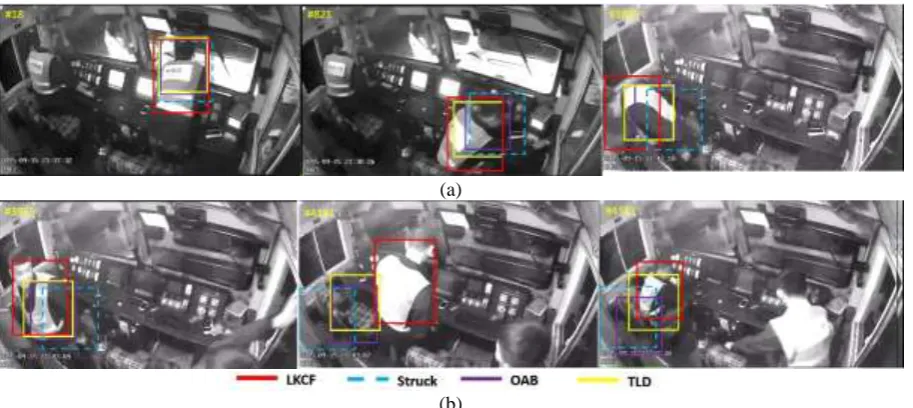
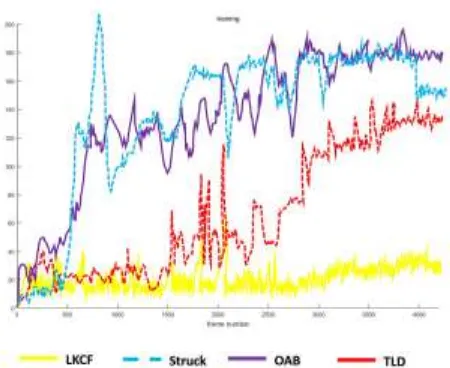
Initially we evaluate the LKCF with comparisons to 3 state-of-the-art trackers from several other systems [5, 6, 7] on an engineering video (4378 frames) from an application. Realtime feedback makes it easy to test small changes to the tracker configuration and to perform qualitative analyses of the tracker performance for various targets and tracking conditions. All the methods are evaluated on gray scale images following the protocol of the benchmark study to ensure a fair comparison. We report the results of the Train driver sequence were shown in Fig.1, and compare the failure rate using the center location error in Fig.2. to indicate the effective tracking length of our proposed algorithm.
We can see in Fig.1, most of the contrasted discriminative methods depend on single feature (via feature selection such as online AdaBoost method (OAB) [6]) or strong classifiers (SVM classifier such as Struck (Struck) method [5], and Tracking-Learning-Detection (TLD) [7]) for target tracking. The OAB and Struck methods do not perform well on this sequence as these methods use single features which are less effective for large scale pose variations. All those trackers showed significant drift when the target undergoing heavy pose variation (#3845) and does not re-detect targets in the case of tracking failure. Although, the TLD tracker is able to re-detect target objects which is similar to our proposed method in the case of losing the target. It does not follow targets in #3965 accurately due to the unconstrained false target re-detection. However, our method (LKCF) tracker is not having drift even in the background noise scene (#4181) when the TLD having lost the target. The LKCF successfully completed until the end of the sequence. Fig.2 shows that the OAB method failed near frame 520 for our testing video and struck failed near frame 640 which both perform well in short-term sequences. The TLD method tracking length is longer than those because it maintains a detector during tracking. In those comparisons our method was able to maintain tracks against existing trackers. Note that our tracker drifts in the 1780th and 2000th frames separately due to large scale pose variations, but manages to re-detect the targets subsequently in a short period.
(a)
[image:6.595.72.529.520.724.2](b)
Figure 2. Comparison of failure rate using the centre location error with 3 state-of-the-art trackers.
Summary
This paper introduced an approach based on correlation filters for long-term tracking. Overall, there are three reasons can explain the proposed LKCF tracker performs well on most challenging sequences, which are indicated as followed. First, the robust representation of HOG features is learned for our temporal context regressor which hold more effective in estimating the translation of target objects. Second, we construct a constraint target re-detection mechanism to restore the false model. Moreover, to avoid model drift introduced by heavy occlusion, a high-confidence model update strategy is proposed to ensure the correct detection. Numerous experimental evaluation on challenging benchmark sequences demonstrate that the proposed LKCF performs well against most state-of-the-art methods in terms of efficiency, accuracy and robustness.
As the experiment shows, although our proposed algorithm improves the tracking performance observably, it still has room of training time for further improvement although it can barely achieve real-time for applications. Furthermore, we will also explore more robust features to describe the target objects and extend the tracker to estimate changes in scale.
Acknowledgements
This work was supported by the Natural Science Foundation of Hebei Provence [grant numbers: F2015201033, F2017201069], the foundation of H3C [grant number: 2017A20004]. The authors also thank Information Technology Centre of Hebei University for providing the high-performance computing platform.
Reference
[1] Edelson R A, Krolik J H. The Discrete Correlation Function: a New Method for Analyzing Unevenly Sampled Variability Data[C]// Active Galactic Nuclei. Active Galactic Nuclei, 1989.
[2] Bolme D S, Beveridge J R, Draper B A, et al. Visual object tracking using adaptive correlation filters [J]. 2010, 119(5):2544-2550.
[3] Henriques J F, Rui C, Martins P, et al. High-Speed Tracking with Kernelized Correlation Filters [J]. IEEE Transactions on Pattern Analysis & Machine Intelligence, 2015, 37(3):583-596.
[4] Ma C, Yang X, Zhang C, et al. Long-term correlation tracking[C]// Computer Vision and Pattern Recognition. IEEE, 2015:5388-5396.
[6] Grabner H, Grabner M, Bischof H. Real-Time Tracking via On-line Boosting[C]// British Machine Vision Conference 2006, Edinburgh, UK, September. DBLP, 2013:47-56.
[7] Kalal Z, Mikolajczyk K, Matas J. Tracking-Learning-Detection. [J]. IEEE Transactions on Pattern Analysis & Machine Intelligence, 2012, 34(7):1409.
[8] Kristan M, Leonardis A, Matas J, et al. The Visual Object Tracking VOT2016 Challenge Results [M]// Computer Vision–ECCV 2016 Workshops. Springer International Publishing, 2016:191-217.
[9] Danelljan M, Khan F S, Felsberg M, et al. Adaptive Color Attributes for Real-Time Visual Tracking[C]// IEEE Conference on Computer Vision and Pattern Recognition. IEEE Computer Society, 2014:1090-1097.
[10] Zhang K, Zhang L, Yang M H. Fast Compressive Tracking [J]. IEEE Transactions on Pattern Analysis & Machine Intelligence, 2014, 36(10):2002.
[11] Press W H, Teukolsky S A, Vetterling W T, et al. Numerical Recipes in C: The Art of Scientific Computing[J]. IEEE Concurrency, 2010, 6(4):79-79.
[12] Henriques J F, Rui C, Martins P, et al. Exploiting the Circulant Structure of Tracking-by-Detection with Kernels [J]. Lecture Notes in Computer Science, 2012, 7575(1):702-715.