2018 International Conference on Modeling, Simulation and Optimization (MSO 2018) ISBN: 978-1-60595-542-1
Optimization of Multi-target Scheduling Based on Hybrid Ant Colony
Algorithm in Receiving-departure Line
Yue-hai WANG, Jian-lin ZHU
*, Yang YANG and Yong-zheng YAN
North China University of Technology, Beijing, China *Corresponding author
Keywords: Receiving-Departure line scheduling, Multi-Objective optimization, Hybrid ant colony
algorithm, Adaptive method.
Abstract. Aiming at the difference of the different optimization target weights in receiving-departure line, the comprehensive optimization model of the optimization target weight was proposed. Firstly, the exponential multiplication of each optimized target value was used as the comprehensive optimization target, by adjusting the target exponent weight to affect the scheduling results. Then, the adaptive pheromone updating method and the adaptive pheromone total method were used to improve the performance of the algorithm based on the hybrid ant colony algorithm. It was verified by the Lanzhou station that the Model and Algorithm can adjust the multi-objective optimization weights in the scheduling results by adjusting the exponential parameters of each optimization target.
Introduction
The dispatching of the railway station is a kind of comprehensive dispatching optimization problem for the distribution of the train to the receiving-departure line and the arrangement of the appropriate access road. As a kind of NP scheduling problem [1], the complexity of the constraint and the scale of the problem make it difficult to obtain the optimal solution by the traditional method. The present research mainly uses the artificial intelligence method to obtain the relative optimal scheduling result to improve train operation efficiency of railway section stations.
As discussed in [2], the train receiving-departure line scheduling model is discussed in detail, and the ant algorithm is proposed with the total waiting time as the optimization goal. Paper [3] to the receiving-departure line and other throat routes using equalization as the goal, comprehensive time and resource consumption proposed 0-1 planning method. The paper [4] puts forward the 0-1 programming model by taking the train weight as the first layer and utilization ratio of receiving-departure line as the second layer optimization goal. In the paper [5], aiming at the goal of multi-objective optimization, the optimization target is established by the product of each target value.
However, the layout of different section stations, the surrounding environment, traffic flow and so on are very different. How to give a general method to adjust the weight of each influencing factor, which make the result meet different requirements with the balance of punctuality rate and costs in different periods. It increases the flexibility and versatility of the scheduling method.
Problem Description
The receiving-departure line is the railway station for connecting trains and other operations of the exclusive stock channel. According to the receiving-departure line, it can be divided into freight train receiving-departure line, train receiving-departure line and mixed passenger and freight receiving-departure line; Railway station to the receiving-departure line scheduling problem, according to the nature of the operation can be divided into train approach (access to the route, starting the route, through the route) and shunting route.
To receiving-departure line scheduling plan should ensure capacity of receiving-departure train at station, avoid train waiting for a receiving track, ensure that the train running on scheduled time, reduce traffic and job scheduling. The optimization of the dispatching of the receiving-departure line is mainly to optimize the train route sequence and the corresponding arrival route of the train route.
Multi-Objective Optimization Model
For different section stations, according to the corresponding train diagram and other data, we can build the corresponding receiving-departure line scheduling optimization model [3]. Set the number of train stations in the day to m, the train in accordance with the running time sequence has arrived, with the number i said the train, and its set is TR{1, 2,3, , , , } i m ,Li is the length of the train i, assuming that the number of receiving-departure lines is n, denoted by the number j, then the set of the lines is RO{1, 2,3, , , , } j n , andLjis the length of the receiving-departure line j.
in j
IN is the number of receiving route connected to the line j, the numbering of the receiving route is indicated by a, then the receiving routes connected to the line j is set to
{1, 2,3, , , , in}
j j
IN a IN . out
j
OUT is the number of departure routes connected to the receiving-departure line j, and the serial number of the departure route is indicated by b, the set of departure routes corresponding to j is {1, 2,3, , , , out}
j j
OUT b OUT .Set the 0-1 planning formula
for xij(train i take line j), yija(train i in j chose receiving route a), yijb(train i in line j chose departure route b), to indicate the train behavior.
Use b i
t to indicate the time when train i starts to occupy the line, e i
t means the time of train i leave the line, train occupancy line time e b
i i i
t t t ; With ab i
t to indicatethe start time of train i at receiving route a, ae
i
t said the end time of train i in the receiving route a, its occupancy time a ae ab
i i i
t t t ; bb i t indicates the start time of train i occupied the departure route b, and be
i
t indicates the end time of train i in the departure route b, its occupation time b be bb
i i i
t t t . For the above time, can be given according to the train operation chart.
Model Establishment
1) receiving-departure line balance: The balance of the receiving-departure line can be measured by the standard deviation of train occupancy on receiving-departure line.
21
min 1/ ij /
j RO i TR
f n x m n
(1) 2) Time Optimal: The length of the train's occupancy time to the receiving-departure line can be expressed by the average occupancy of the receiving-departure line.
2
min =1/m ( a b)
i i i
i TR
f t t t
the priority setting may be quite different. Therefore, a normalized mapping method is proposed to reduce the influence of the priority difference on the algorithm.
ln( 1)
x a b
v v x v . (3) Where xindicates the corresponding type of train docking station priority, vx is the priority after remapping, va and vb can adjust the value appropriately.
4) Multi-target scheduling Model: For the above different optimization objectives, different weights can be used to represent the different optimal target ratios, and thus it becomes a single objective optimization model.
1
min ( ) 1/ [( a b) ]
i i i xij
i TR
f f m t t t v
. (4) Where vxij is the priority of train i on the corresponding to the line j, The parameter
affects the weight of the standard deviation of the line occupancy. Similarly, the parameter also determines the impact of the train occupancy time on the function f . determines the weight of the priority.Restrictions
The use of reception-departure line and receiving departure route is subject to the following constraints [3,7]:
1) In order to ensure the safety of the operation, train formation length must meet the length of the reception-departure line.
2) A train can only occupy one reception-departure line, a reception-departure line at the same time can only be occupied by one train.
3) The time interval between two adjacent trains which are connected by the same reception-departure line should meet the minimum safety time interval.
4) The time conflict must be avoided when the train takes the receiving(departure) route.
5) When the train occupies the receiving (departure) route, it is necessary to avoid the conflicting routes in space.
6) At the same time, the train can only occupy one receiving (departure) route.
7) After the route occupied by the train is determined, the reception-departure line is also determined.
Receiving-Departure Line Algorithm
The dispatching distribution of the train is mainly divided into the order of the train and the corresponding platform for the given train.
Determination of the Order between Trains
The order of the train scheduling is generally arranged according to the train schedule, so the order is fixed, but the fixed order may not be a relatively good arrangement. So we can use the ant colony algorithm based on hybrid behavior [8] to rearrange the order.
Different types of trains have different priority to the receiving-departure line, which priority can be used as the path value in algorithm, and then the ants of same initial pheromone with different
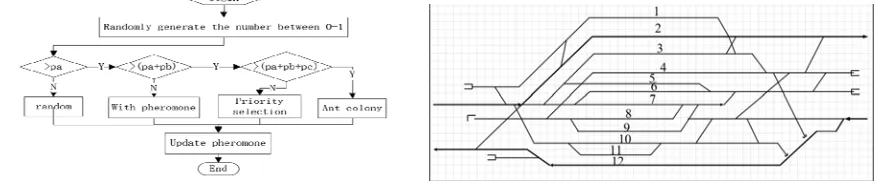
behavioral characteristics to find the global optimal solution of the problem, and its algorithm model consists of ants with the following behavior [6].(The algorithm flow of hybrid ant colony algorithm is shown in figure 1) The convergence rate can be adjusted by adjusting the ratio of these different behaviors. The different behavior of ants are as follows:
Ants randomly choose the next train, this behavior ant ratio of a p .
( ) ( )
0
k
ij ij s J i is is k ij
if j J i p
else
(5)
Ants in full accordance with the priority of the train to choose the next train, where in eq.5 0
,and the behavior of the ants accounted for pb .
The ant chooses the next train according to the pheromone of ant i from j, where in eq.5 0
,and the behavior accounts for c p .
Algorithm Optimization
The ant colony algorithm pheromone update formula [9,10] is as follows:
1
( 1) (1 ) ( ) m k
ij ij ij
k
n n Q L
. (6)
Where is the pheromone volatile factor, Q is the total amount of pheromone, m is the number of ants. k
ij
L indicates that the k-th Ants selected the train j after train i.
Adaptive Volatile Factor Ant Colony Algorithm. The pheromone volatile factorin eq.6 can be adjusted adaptively [11] to improve the global character of the algorithm. The initial value
0 ( ) 0.9t
,
then when the optimal value of the algorithm is not improved, it can be adjusted according to the following formula(The
min
ρ in the formula is the minimum value of ):
minmin
0.75 ( 1) 0.75 ( 1) ( )t t elseif t
. (7)
Adaptive Total Pheromone Ant Colony Algorithm. The Q of eq.6 can be combined with the dynamically adjust total pheromone algorithm [6].The Q initially maintains a smaller value, which keeps the ant colony algorithm initially biased towards random search, then increases, and finally remains relatively stable to balance the search range [6]. Qchanges as follows(Where a controls the growth of pheromone):
ln[( 1) ]
Q Q t a . (8)
Train to Determine the Corresponding Docking Station
For different trains, the priority of the docking station is different, according to the type of train can generate the priority of station. The train determines that the docked station constitutes an ant colony search model, in which the path information corresponds to the priority. The hybrid ant colony algorithm can then be used again to select the docking station.
[image:4.612.95.533.572.664.2]
Experiment and Result
Take Lanzhou station as an example, the station yard as shown in figure 2, 2 is the uplink main track, used for uplink train to send and through operation;12 is the downlink main track, for the downlink train to send and through operation; 1, 3, 4, 5, 6, 7 , 8 , 10 ,11 rode for the handling of passenger and cargo operations; 9 road is usually used as a locomotive line, or deal with cargo and out of gauge train operations, The safety interval of the train take 10min.
Using the above model and algorithm. Based on the train diagram of April 5, 2017, the train from 0 to 12 points in Lanzhou station is dispatched. During this time period, 52 trains were issued, among which the Intercity high-speed 7, EMU 2, express train 6, Direct Express 10, fast train 27.
Hybrid Ant Colony Optimization
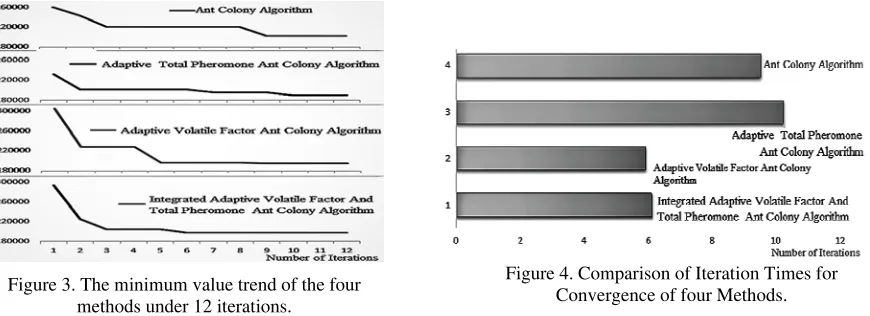
Ant colony algorithm and adaptive total pheromone ant colony algorithm, adaptive volatile factor ant colony algorithm, and integrated adaptive volatile factor and total pheromone ant colony algorithm in 12 iterations (After the experiment, the result value is kept converged at 12 times) of the objective function eq.4 minimum comparison shown in figure 3, and the average number of iterations for convergence in 50 experiments is shown in figure 4.
Figure 3. The minimum value trend of the four
[image:5.612.92.527.286.444.2]methods under 12 iterations.
Figure 4. Comparison of Iteration Times for Convergence of four Methods.
As shown in figure 3, the convergence speed of all adaptive algorithm (integrated adaptive volatile factor and total pheromone ant colony algorithm) and adaptive volatile factor algorithm is accelerated obviously, which the adaptive of the volatile factor can improve the convergence rate. Compared with the adaptive volatile factor algorithm, the all adaptive algorithm increases the total pheromone adaptive formula, and its convergence process is shown in figure 3, which can quickly jump out of the local minima compared with the adaptive volatility factor.
In figure 4, the only adaptive volatility factor algorithm has the fastest convergence rate, and the all adaptive algorithm also has relatively fast convergence speed. Combined with figure 3, the convergence rate of the whole adaptive method is slightly slower than that of the adaptive volatility factor, but the ability to jump out of the local minimum interval can be improved.
Adjust Weights
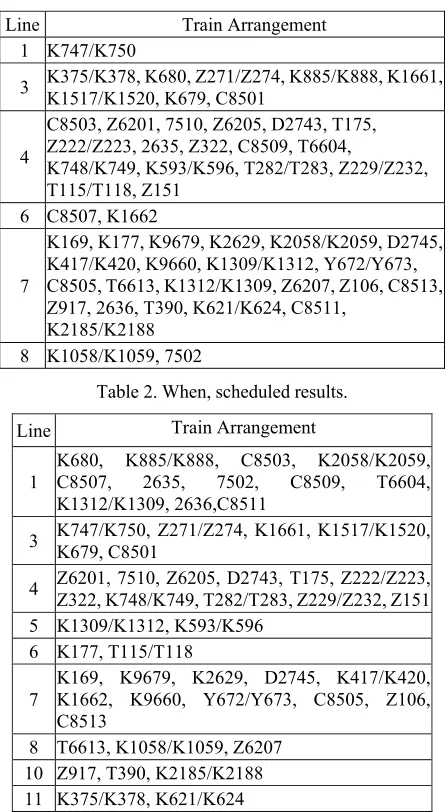
Table 1. When, scheduled results. Line Train Arrangement
1 K747/K750
3 K375/K378, K680, Z271/Z274, K885/K888, K1661, K1517/K1520, K679, C8501
4
C8503, Z6201, 7510, Z6205, D2743, T175, Z222/Z223, 2635, Z322, C8509, T6604,
K748/K749, K593/K596, T282/T283, Z229/Z232, T115/T118, Z151
6 C8507, K1662
7
K169, K177, K9679, K2629, K2058/K2059, D2745, K417/K420, K9660, K1309/K1312, Y672/Y673, C8505, T6613, K1312/K1309, Z6207, Z106, C8513, Z917, 2636, T390, K621/K624, C8511,
K2185/K2188 8 K1058/K1059, 7502
Table 2. When, scheduled results.
Line Train Arrangement
1
K680, K885/K888, C8503, K2058/K2059, C8507, 2635, 7502, C8509, T6604, K1312/K1309, 2636,C8511
3 K747/K750, Z271/Z274, K1661, K1517/K1520, K679, C8501
4 Z6201, 7510, Z6205, D2743, T175, Z222/Z223, Z322, K748/K749, T282/T283, Z229/Z232, Z151
5 K1309/K1312, K593/K596 6 K177, T115/T118
7
K169, K9679, K2629, D2745, K417/K420, K1662, K9660, Y672/Y673, C8505, Z106, C8513
8 T6613, K1058/K1059, Z6207 10 Z917, T390, K2185/K2188 11 K375/K378, K621/K624
In table 2, the value of the optimization function eq.4is relatively large, its distribution on each platform is more balanced than table 1.
In table 1, 2(Since the LanZhou Railway Station are mostly uplink trains this time period, therefore the table 1, 2 to the receiving-departure line arranged more concentrated in 3,4,7 line),In table 1, the value of the line equilibrium function f1(Eq.1) is 8.26, and the value of function f1 of table 2 is 4.35, table 2 is more balanced than table 1. With the increase of the value , the effect of the receiving-departure line balance on the result is increased correspondingly.
Conclusions
The convergence process of hybrid ant colony algorithm can combine the advantages of many different routes methods, which combine with adaptive total pheromone method and adaptive pheromone volatile factor method. Compared with the ant colony algorithm which does not use the above method, the convergence process is better.
In this paper, the optimization method for the comprehensive target of the receiving-departure line is presented, this method improves the adaptability of train scheduling in different stations, which can be applied to different section stations by adjusting the specific proportion of each target, and its application scope is more extensive and has strong universality.However, for different optimization goals, how to adjust the target weights according to the relationship between them, given the corresponding relationship model needs to be further studied.
References
[1] Lenstra, J.K., A.H.G. Rinnooy Kan, and P. Brucker, Complexity of machine scheduling problems, Annals of Discrete Mathematics, 1.4 (1977) 343-362.
[2] Yue, Y., et al, An Ant Algorithm for the Reception-Departure Line Assignment Problem, IEEE International Conference on Mechatronics and Automation IEEE, (2006) 2284-2289.
[3] Pen Zhao, Wenbo Sun, et al, Comprehensive optimization for utilization of arrival-departure tracks and throat area in large railway passenger station, Journal of Beijing Jiaotong University, 39.6 (2015) 1-7.
[4] Feng Shi, Yan Chen, et al, Comprehensive optimization of reception-departure line arrangement and route arrangement for railway passenger station, China Railway Science, 30.6 (2009) 108-113. [5] Ming Lei, Xuelei Meng, Track utilization planning of high-speed railway station with multi-objective optimization, Shandong Science, 2.4 (2016) 60-67.
[6] Haibin Duan, Ant colony algorithms-theory and applications, Beijing Science Press, 2010. [7] Zhian Lin, LingQiao Pan, Study on Allocation of Receiving & Departure Lines in Passenger Stations, Railway Transport and Economy, 32.10 (2010) 58-61.
[8] XiaoBing Hu, XiYue Huang, On hybrid behavior based ant colony algorithm, Control and Decision, 20.1 (2005) 69-72.
[9] Dorigo M., Caro G.D., Gambardella L.M., Ant algorithm for discrete optimization , Artificial Life, 5.2 (1999) 137–172.
[10]Merkle D., Middendorf M., Modeling the dynamics of ant colony optimization, Evolutionary Computation, 10.10 (2002) 235-262.