2016 Joint International Conference on Artificial Intelligence and Computer Engineering (AICE 2016) and International Conference on Network and Communication Security (NCS 2016)
ISBN: 978-1-60595-362-5
Research and Application of Parametric Modeling Technology for
Human Body Based on OpenGL
Xun ZHANG
1,a, Yuan YANG
1,b, Yuan GAO
1,c, Ao-Shuang DONG
1,d,*1Northeasten University, Shenyang, Liaoning, China
a[email protected], b[email protected], c[email protected], d[email protected]
*Corresponding author
Keywords: Modeling of 3D Human Body, NURBS Surface, Belly Shape Deformation.
Abstract. This paper aims to build the human body models based on the belly shape features. We use NURBS surface to build the human body models, and control vertex in the surface to deform. Based on the OpenGL, the integral deformation of the height and width of the whole human body model was carried out. Specifically, girth, radial and bulging deformation was accomplished on the area of belly. Finally, we get the human body models with different belly shape, which is of significance.
Introduction
Online shopping has become the trend but if there is a three-dimensional fitting system then it can improve the user’s experience. In such a system, shopper's automatic human modeling is the key. By entering the body's parameters, giving a standard human body model, 3D human body model can be built quickly and in the shape of shoppers. This modeling process requires the selection of decisive parameters from the human body model.
This paper focuses on the study of the deformation of the body's waist, mainly for the part between the chest and the abdomen. This paper adopts three steps of deformation: girth deformation, radial deformation, bulging deformation.
Feature Based Parametric Modeling of Human Body
For feature based parametric modeling of human body, the first thing is to determine the adjustment of human body model parameters, then adjust a 3D human body model according to parameters user input. In this way, we can get a three-dimensional model of the user. For users the parameters chose should be simple and measurable.
The Selection of Parameters
The human body model can be described by many parameters, the main parameters in this paper are shown in Table 1.
Table 1. Main parameters in this paper.
Overall adjustment parameters Height and weight The key points of the local regulation of the
abdomen Navel
Establishment of Standard Human Body Model
In this paper, we will construct the human surface model based on the NURBS surface modeling method which is a very powerful modeling method of curve and surface.
human body model will be redrawn. Figure 1 shows the basic process for the establishment of the human body model.
Get the NURBS human model in IGES format
Analyze the IGES file and get the basic data message of NURBS human model
[image:2.612.196.431.99.221.2]Display the human model by the help of OPENGL
Figure 1. The process of getting the information of model.
IGES (The Initial Graphics Exchange Specification) is defined as standard for general ANSI information interchange between different computer systems based on Computer-Aided Design (CAD)&Computer-Aided Manufacturing (CAM) systems. By using IGES format file, users can read NURBS data from different platforms [1].
Human Model Deformation Based on Parameters
For human model deformation based on parameters, the first step is integral adjustment of human body model according to the height and weight, the second step is partial adjustment based on parameters of abdomen.
Integral Adjustment of Human Body Model According to the Height and Weight
According to the human anatomy and anthropometry, two basic parameters describing the human body are height and weight. Human body model needs integral adjustment based on height and weight before adjustment of waist and that’s why we do length and width adjustment. Specific steps are as follows:
a. Users first enter a group of height (kg) and weight (m).
b. System scale the height proportionally based on the height users input.
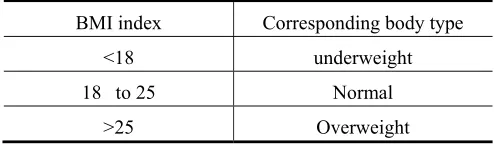
c. According to BMI exponent formula, taking the Intermediate BMI values of normal body size as standard, different deformation multiples are taken as the width is different.
Table 2. The different body type corresponding to different BMI index.
BMI index Corresponding body type
<18 underweight
18 to 25 Normal
>25 Overweight
Partial Adjustment Based on Parameters of Abdomen
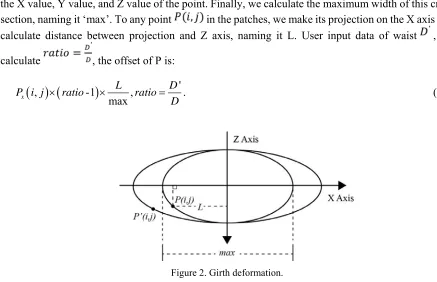
[image:2.612.182.429.535.607.2]the X value, Y value, and Z value of the point. Finally, we calculate the maximum width of this cross section, naming it ‘max’. To any point in the patches, we make its projection on the X axis and calculate distance between projection and Z axis, naming it L. User input data of waist , we
calculate , the offset of P is:
, -1
, 'max
x
L D
P i j ratio ratio D
[image:3.612.79.516.70.352.2] . (1)
Figure 2. Girth deformation.
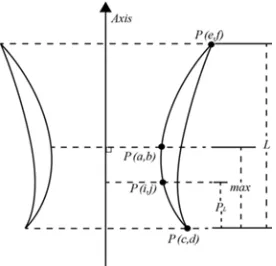
Radial Deformation. Radial deformation must be performed when changing waist circumference and before this we need to find axis center line, steps after that are as follows:
a. Find the Y axis coordinate value of the control point on the waist with smallest girth, and make the point do projection operation to the center line. Find the control point on the lowest end get its Y axis coordinate value , subtract from and we get ‘max’.
b. Connect P a bY( , ) and its projection, we get vector and offset vector .
c. For any point on other positions, make a projection from it to the central line, get the distance between the projection and the P c dY( , ), naming this distance PL. If point P i j
, is betweenthe lowest end and the point which has smallest or largest girth, then the offset vector of P is :
1
, 'max
L D
ratio r ratio D
. (2)
If point P is between the top and end, then find the control point of the top girth and get its Y axis coordinate , set the distance between top girth and lowest girth as PL, then the offset vector of P is[2]:
1
maxmax
L
P ratio r
L
Figure 3. Radial deformation.
Bulging Deformation. (1) From a muscle belly into flat belly
When a person’s body fat percentage is low, abdominal muscles will form. In order to let Abs go, we need to smoothing over the hollow, steps to adjust control points are as follows:
a. In the standard human body model, take the central line we got as the center, calculate straight distances between all the points on abdomen and the central line, we find hollows on abdomen which has three rows and three columns and we record the correspondent points. In this paper, we use to describe these points.
b. Adjustment for control points of three rows is
,
1,
( 1, ) 2Z Z
Z
P i j P i j
P i j . (4)
c. For the points of three columns, we make each of them equal to the Z axis coordinate control points on the leftmost in its column which we name
,
,
Z Z
P i j P m n . (5)
(2) From flat abdomen to beer belly
When BMI is larger than 25, people are overweight so we need to deform the abdomen which includes three steps:
a. Determine the range of deformation and the key points. We set navel, which is exactly the number 30 surfacePO
13,9
, as the key point of abdomen through test and perform bulging deformation, taking the navel as the center.b. We can calculate the value of BMI which we set as ‘x’. We set the smallest value of BMI for the overweight people as xmin 25 , then we can work out the parameter of deformation which is ‘m’.
min
1 m
2 x x
. (6)
c. After analysis and fitting, we decide that formula for deformation is Gauss formula:
2
21
f x = exp
2 2
x
,
2
0,15 , 20, 6
x . (7)
. (8)
Development Tools and Simulation Results System Development Environment
Development Language. In this paper, the OpenGL environment is built on the visual studio2010 and we use C++ to complete the development of the entire system.
Structure diagram of the module.
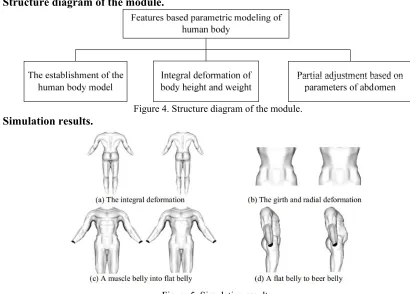
Figure 4. Structure diagram of the module.
[image:5.612.88.498.170.464.2]Simulation results.
Figure 5. Simulation results.
Summary
This paper aims to build the human body model with different sizes of waist, therefore, we studied the parametric modeling technology. This paper is a combination of computer graphics, human anatomy, human body aesthetics theory and other theories. We design and implement a feature based parametric model of the human body by using OpenGL, VC++ and other techniques. After that, in order to beautify the whole model, we can use MAYA or 3DS MAX to make complicated surface model such as head, hand and foot, storing as OBJ format. In accordance with the common boundary dimensions of the head, hand, foot and body torso, we can splice the coordinate position of the control point and adjust according to a certain proportion in the normal range. [3]
References
[1] Information on http://baike.baidu.com.
[2] Yue-Yue Wang, Rapid parametric modeling of human body, Zhejiang University, 2007.