2017 International Conference on Mathematics, Modelling and Simulation Technologies and Applications (MMSTA 2017) ISBN: 978-1-60595-530-8
Product Support Strategy Based on Availability
Jian-hua YANG, Long GUO, Yang SONG and Xiao ZHANG
Donlinks School of Economics & Management, University of Science and Technology Beijing, China
Keywords: Multi-level product support, Availability, System dynamics.
Abstract. By using the principle of the system dynamics research, an availability model of product maintenance spare parts support system and the dynamic mechanism of multi-level support process was constructed. Dynamic analysis of control feedback relationship in multilevel maintenance support system and the maintenance spare parts flow in the system is carried out. Satisfactory strategies for improving the availability of products were explored by means of analysis of product support parameters in spare parts supply and maintenance. Dynamic simulation was carried out in multilevel support model of product cycle to verify the effectiveness of product support strategy.
Introduction
Product support directly affects the performance level of the system. As an important part of product support, spare parts management (including spare parts financing, storage and supply, etc.) is affected by factors such as the availability of the system, time, funds, maintenance levels, maintenance strategies influences. Insufficient planning of spare parts will lead to the time waiting for spare parts during the maintenance of defective equipment, the loss caused by the equipment downtime maintenance and the impact on the execution of the tasks and the operation of the system. In order to ensure the availability of products, we need to improve the spare parts supply planning to ensure timely maintenance of spare parts, spare parts should not only maintain a certain amount of reserves, but also to avoid excessive storage of spare parts caused by waste. Spare parts supply planning affects equipment operation and support funding. Through resources cooperation at all levels, spare parts supply and maintenance strategies are rationally planned under a multi-level guarantee system to optimize the availability of products and meet the requirements of product optimal performance and economic affordability.
Availability as an important parameter to evaluate the protection performance, its evaluation and optimization by some scholar’s attention. Scholars mainly studied the availability models under different system working conditions, such as the reliability of components, the structure of complex systems, and the allocation of maintenance resources. The system availability, which consists of multiple components in series and parallel, mainly focuses on the parallel connection of components and the complex system of K/N structure. In 1997, Smith Ma. J studied the availability of 1 / N cold standby redundancy system [1], The model of availability of the system under preventive maintenance
strategy and replacement based on the number of years is established, and the analysis shows that the strategy can be used to appropriately increase the availability of the system. Maintenance strategy under the multi-component system [2], the availability of computing model is established, and
compared with the situation of maintenance and preventive maintenance strategy under the calculation results obtained after the adoption of preventive maintenance strategy to reduce the availability of conclusions, the study also found that the use of The same system availability can be achieved depending on the maintenance strategy and the preventive maintenance strategy. The former costs less. In 2008, Houbao Xu studied the problem of repairable system steady state availability in six states [3]. The system adopted preventive and repair strategies and preventive
maintenance strategies to calculate the optimal steady state availability of preventive maintenance and Repair maintenance cycle parameters. In 2005, Zhang Tao proposed a model for assessing the usability of an arbitrary structural system under arbitrary working initial conditions [4]. This model
distribution, the probability of state transition can not be Solve directly. Dong Bo Chao studied the availability planning model based on availability and spare parts based on Markov model [5] in 2011,
with availability as the optimization objective to ensure the maximum efficiency of the equipment under the limited spare parts quantity. Yang Shu-ming in 2012 to establish availability calculation model, combined with equipment health status of equipment health status test cycle optimization research [6].
The research of multi-level spare parts supply support mode mainly focuses on the theory and application of multi-level inventory management. The METRIC model proposed by Sherbrooke in 1968 is a classical inventory control model of repairable spare parts under multi-level maintenance support system the model solves the spare parts inventory allocation model under steady-state conditions [7]. The METRIC model still has room for improvement in terms of accuracy and scope of
application. Some scholars have put forward improved models on the basis of this. Muckstadt proposed the Dyna-Metric model in 1973 [8].
This paper studies the problem of multi-level product sustainment. From the perspective of the dynamic mechanism of the sustainment process and the optimization of product support strategies, this paper establishes a model of availability under the three-level product sustainment system. According to the actual situation, Maintenance and out-of-service factors, and to optimize the availability of the product, followed by economic affordability, and trade-off studies on strategies for spare parts preparation, supply and equipment maintenance.
Problem Analysis and Assumptions
Three levels of complex product system sustainment system is a common mode of support, including the base level, relay level and base level. When the product fails, it is necessary to restore its function as soon as possible through maintenance. First locate and disassemble the defective parts, send the defective parts to the primary repair station for repair, and repair the successful parts to the warehouse for use. Spare parts supply support system to spare parts demand for traction. Spare parts maintenance needs arising from the field level to the same level warehouse issued a request to apply for spare parts warehouse will be sent to the grassroots maintenance site needs, the base level of the warehouse can not meet the demand, you need to apply to the upper warehouse spare parts supply. Can not repair the fault will continue to send a superior maintenance site, base level is responsible for spare parts procurement. Spare parts supply support system is multi-stage dynamic system.
The following key assumptions need to be made to establish this model:
(1) The maintenance organizations at all levels adopt the principle of first-come-first-served on the faulty parts to be repaired regardless of the batch repair problem;(2) the failure between the various products are independent of each other, product failure obeys steady Poisson distribution;(3) The parts of the products under study are repairable spare parts, repaired and reused spare parts can be repaired as new effects, the service life does not change;(4) multi-level spare parts support system at each level has only one maintenance department;(5) The fault that can not be repaired at the current level is sent to the upper maintenance department for repair, and all the faulty parts can be finally repaired at the maintenance level at the base level.
Spare Parts Supply and Demand Modeling Based on System Dynamics
Spare Parts Supply and Demand Causal Relationship
supply and demand is negative and the inventory is reduced. Inventory, spare parts to increase inventory by order and repair and other means of replenishment; when the supply is greater than the demand, spare parts supply and demand is positive, at this time do not need to replenish inventory, spare parts inventory down to a certain threshold before ordering, inventory Volume up. In the model, the inventory of the basic level spare parts is affected by three factors: spare parts replenishment amount, back-up spare parts replenishment amount and spare parts delivery amount. The spare parts demand and use are controlled and influenced by many factors, which is a constantly changing Time series, factors that affect the demand for spare parts, such as spare parts replacement and parts failure or regular maintenance, product failure rate, product number, installed capacity and so on. Repairable spare parts affect the inventory level of spare parts, repair capabilities at all levels, including repair capabilities, assuming that beyond the maintenance capacity of the fault will be uploaded to the higher level maintenance agencies, the corresponding level to complete repair parts will be deposited into the appropriate level of warehouse as a new spare Such as new), repair and reuse the same as the complementary strategy of spare parts are used as an increase of spare parts inventory.
Spare parts demand and inventory supply spare parts supply poor, the information passed in the system, according to the poor supply of spare parts to the higher-level spare parts warehouse issued a claim request, adjust the inventory; higher warehouse issued spare parts, replace the fault under the unit-level protection unit maintenance, Repair successful parts stored in the base level warehouse standby, repair failure will be sent to the maintenance of faulty parts, maintenance points at the base level to receive the fault parts will be completely repaired, base-level warehouse by ordering additional spare parts, inventory levels lead to changes in supply and demand of spare parts The difference, through the spare parts adjustment to meet the demand. When the spare parts are sufficient, the maintenance tasks can be completed in time to ensure the products are running. However, the inventory is insufficient, the out-of-stock items cause maintenance, the availability of the product recovery function is impaired, and the availability is impaired. Therefore, a sufficient supply of spare parts is the basic condition for ensuring a high availability of the products, while excessive inventory causes waste of funds and waste of storage space.
System Dynamics Model
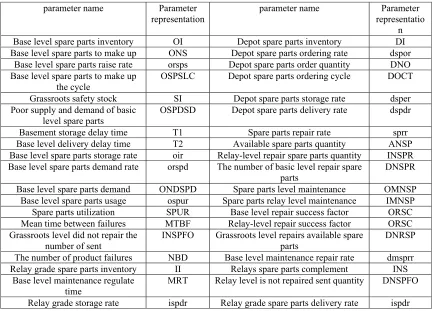
Model Parameters Defined
Table 1. Parameter definition.
parameter name Parameter
representation parameter name representatioParameter
n
Base level spare parts inventory OI Depot spare parts inventory DI
Base level spare parts to make up ONS Depot spare parts ordering rate dspor
Base level spare parts raise rate orsps Depot spare parts order quantity DNO
Base level spare parts to make up the cycle
OSPSLC Depot spare parts ordering cycle DOCT
Grassroots safety stock SI Depot spare parts storage rate dsper
Poor supply and demand of basic level spare parts
OSPDSD Depot spare parts delivery rate dspdr
Basement storage delay time T1 Spare parts repair rate sprr
Base level delivery delay time T2 Available spare parts quantity ANSP
Base level spare parts storage rate oir Relay-level repair spare parts quantity INSPR
Base level spare parts demand rate orspd The number of basic level repair spare
parts DNSPR
Base level spare parts demand ONDSPD Spare parts level maintenance OMNSP
Base level spare parts usage ospur Spare parts relay level maintenance IMNSP
Spare parts utilization SPUR Base level repair success factor ORSC
Mean time between failures MTBF Relay-level repair success factor ORSC
Grassroots level did not repair the
number of sent INSPFO Grassroots level repairs available spare parts DNRSP
The number of product failures NBD Base level maintenance repair rate dmsprr
Relay grade spare parts inventory II Relays spare parts complement INS
Base level maintenance regulate
time MRT Relay level is not repaired sent quantity DNSPFO
Relay grade storage rate ispdr Relay grade spare parts delivery rate ispdr
Spare Parts Ordering Module
Spare parts ordering is one of the ways to replenish spare parts inventory level. Spare parts ordering rate is subject to the triple restriction of parts delivery rate, spare parts supply and demand balance adjustment rate and safety stock. When the supply exceeds the demand, it does not need to be executed Order tasks, the inventory level will drop out with the spare parts, when the supply is less than the demand and meet the safety stock control threshold, the need to perform ordering task to replenish inventory, ordering rate should be greater than the previous time interval delivery rate, supply and demand balance will be ease.
The ordering relationship at the base level can be expressed as:
0
( 1) ( ) t[ ( ) ( )]
ONS t ONS t orsps t oir t dt
(1)
( ) ( 1)
oir t ONS tT (2)
0, ( ) 0
( )
( ) ( ) / ( ), ( )
OSPDSD t orsps t
ospocr t OSPDSD t OSPSLC t OSPDSD t SI
(3)
( ) ( ) ( )
OSPDSD t ONSPD t OI t (4)
0
( 1) ( ) t[ ( ) ( )] ( )
OI t OI t oir t ospocr t dtONRSP t
Spare Parts Requirements Module
The demand of spare parts is the traction to promote the flow of material and information in the system. The demand of spare parts is affected by the demand for maintenance of the products. The spare parts inventory is sufficient. The spare parts delivery rate is restricted by the spare parts demand rate. When the stock is insufficient and the demand can not be met, The current level of spare parts inventory, supply and demand can not meet the balance of spare parts by the superior sustainment units to apply for spare parts to complete. Spare parts demand is also affected by the reliability of the equipment itself, and some factors such as the average time between failures of the product, product uptime and downtime and spare parts utilization ratio and other factors in a proportional relationship. Take the grass-roots level as an example, the main requirements for the relationship between the needs of the grass-roots level of spare parts are as follows:
( ) ( ) ( )
OSPDSD t ONSPD t OI t (6)
0
( 1) ( ) t[ ( ) ( )]
ONSPD t OMSPD t orspd t ospur t dt
(7)
( ) ( )
ospur t ospocr t (8)
( )
( ) * ( ) *
( )
SPUR t
orspd t NISP t equipment numbers MTBF t
(9)
( ) ( )
( )
( )
total uptime t total downtime t MTBF t
number of breakdowns t
(10) Repair Module
During the repair process, the faulty parts need to be repaired and the repaired parts can be reused as new spare parts. This process is also a kind of reverse logistics. The limiting factors of the spare parts inventory level change include spare parts ordering rate, With the number of spare parts, when the number of defective parts repaired is increased, the spare parts inventory level increases accordingly. The spare parts order quantity can be reduced under the condition of satisfying the demand. Repair the amount of spare parts for spare parts supply and demand differences have a positive effect on the regulation. The fault parts are first sent to the base level maintenance. According to the corresponding node maintenance ability, the repair parts can be sent to the base level warehouse for backup and can not be repaired, and the relay level repair can be repaired, the successful parts can be repaired and sent to the relay level warehouse for backup and uncorrected transmission to the base level maintenance node Repair, repair success to continue to send base-level warehouse spare parts scrapped in accordance with the scrap ratio in the circuit is a wear-out process. The main expression of the relationship between the maintenance module:
0
( 1) ( ) t[ ( ) ( )]
ONS t ONS t orsps t oir t dt
(13)
0
( 1) ( ) t[ ( ) ( )]
ANSP t ANSP t sprr t spfr t dt
(14)
( ) ( ) ( ) ( )
sprr t ONSPR t INSPR t DNSPR t (15)
( ) ( ) * ( )
ONSPR t OMNSP t ORSC t (16)
( ) ( ) ( ) * ( )
( ) ( ) *
DNSPR t DNSPFO t dmsprr (18)
0
( 1) ( ) t[ ( ) ( )]
INSPDFO t INSPDFO t dumspr t dmsprr t dt (19)
( ) *
( ) ( ) * ( )
( ) ( )
D N S P F O t D R S C
d m sp rr t D N S P F O t S P S R t
M R T
IM S P R R t D M N S P t
(20)
System Availability and Cost Model
System availability is an important indicator to measure the support and effectiveness of the mission of the equipment system. The advantage of this system is that it comprehensively considers the features of reliability, maintainability and sustainment of the product. The inherent availability and reachability among multiple availability levels are used to quantitatively assess the extent to which equipment is operational when needed. One of the most direct characterization of equipment integrity is the use of availability. Availability is the percentage of equipment that can actually work over the entire life cycle versus the total calendar working time, so the quantitative measure of the availability of the research object is:
0
MTBF A
MTBF MTTR MLDT
(21)
The equation is the average time between failures, and the product fault rate; for the average fault repair time, and product troubleshooting cycles related to maintenance; for the average logistic delay time, is waiting for spare parts, waiting for maintenance, waiting for the equipment needed to repair equipment Average time.
Continuous work products exist in two working conditions, downtime maintenance status and work status, product status will continue to shift between the two states, the work of the equipment due to failure, the status of the work by the state into shutdown maintenance, overhauling Fault repair equipment, but also can be restored to working condition.
0 0
0 0 0
1 ( )
[1 ( , , )] [1 ( ) ]
!
t m j t
p B p
j
t
MLDT t P m t t e dt
t j
(22) Product support costs include spare parts costs, maintenance costs, technical support costs, inventory management costs and logistics costs and other expenses, this article protects the cost of considering spare parts costs and maintenance costs. Spare parts cost is the cost of spare parts to meet the needs of the grass-roots level, including spare parts costs for the maintenance work at the base level and base level, the expression is:
1 1 1 1 1 1 1 ( ) *
* (1 ) * * *
* * (1 ) * *
T t T t T i t
C O N SP D t U C
N ISP R IP N R T S D R C T U C M T B F
T T U P N IS P R IP SP S R U C M T B F
(23) The maintenance cost includes the cost of in-situ maintenance and out-of-site maintenance. This model only considers the in-situ maintenance costs at all levels. The in-site maintenance costs include the non-scheduled maintenance labor hourly labor and planned maintenance work time cost, which is expressed as:
2 1
1
( )
*[ * (1 )* ]*
( ) * * T t T t TTUP t
C RIP IMH RIP RMH BLR MTBF
TTUP t SMH BLR SMI
Case Study
Assuming the supply of spare parts for a product is analyzed, it is assumed that there are 36 units of the same kind at the grassroots level. The product is composed of 8 different types of components. The product performs a task in 50 weeks. Therefore, the simulation period is 50 units, The simulation step is 1, the storage delay time and delivery delay time of the spare parts of the unit at the basic level are 3 weeks and 2 weeks, and the ordering cycle is 4 weeks. The storage delay time and delivery time of the spare parts of the relay protection unit are 2 weeks and 1 week, base station spare parts warehousing delay and departure delay time of 1 week and 1.5 weeks, parts scrap rate of 0.19, the base level repair success factor of 0.5, the relay level repair success factor of 0.2, the base level repair success The coefficient is 0.3. Take any one of the simulation results, the number of spare parts protection units at all levels as shown in Figure 1, the number of repair parts that can be reused by the various levels of maintenance shown in Figure 2, the level of warehouse units at all levels of protection as shown in Figure 3, parts failure rate such as Figure 4 shows.
[image:7.612.110.515.283.509.2]
Figure 1. The demand for spare parts at all levels. Figure 2. Repair the number of spare parts at all levels.
Figure 3. Spare parts inventory levels. Figure 4. Spare parts fault rate result.
Spare parts support process, base level and base level spare parts volume fluctuations showed a rising trend, while the relay level is the first increase after the flat trend, the reason is that the needs of the basic level of spare parts directly affected by product maintenance strategy, the base level is responsible for making up The shortage of spare parts in front of the obvious changes in demand, the relay-level warehouse to provide buffer effect, demand changes in most of the time is not obvious. The number of components repaired and reused at all levels also fluctuates. Due to the constant maintenance capability at all levels and the different numbers of faulty items received, the number of repairs is different.
From the system availability calculation formula (21) shows that the system availability by the average time between failures, the average repair time and the average logistics delay time of three factors. The changes of MTBF and MTTR have nothing to do with the supply of spare parts and are related to the reliability of spare parts and the formulation of maintenance strategies. MLDT is closely related to the supply of spare parts and shortening the supply and delay time in the guarantee process, which can be effectively reduced and increased System availability.
[image:7.612.121.491.289.371.2]Strategy M0: Mean time to repair = 1.2 weeks, in-place repair failure ratio = 0.15, in situ repair time = 100 hours, average logistics delay time = 1.5 weeks, spare parts repair rate = 0.5.
Strategy M1: Mean Time to Repair = 0.9 Weeks, Home Maintenance Failure Rate = 0.2, Home Restoration Time = 90 Hours, Average Backlog Delay = 1.2 Weeks, Spare Parts Repair Rate = 0.8.
Strategy M2: Mean time to repair = 1.5 weeks, in-service repair failure rate = 0.18, in situ repair time = 110 hours, average logistics delay time = 2.5 weeks, spare parts repair rate = 0.7.
Under this strategy, adjustments can affect the change of availability. Adopting preventive maintenance strategy can reduce the average repair time of equipment. The efficiency of management and logistics in spare parts storage can shorten the logistics delay time, of course, improve equipment reliability in the beginning, the equipment R & D process needs to be controlled. The parameters such as the proportion of the original repair failure in the repair cost will affect the change of the maintenance cost. The most significant factor in the guarantee cost is the spare parts cost and the maintenance cost. The repair rate of the spare parts in the system is increased and recycled increased number of fixtures can buffer the supply and demand gap between spare parts and reduce the number of spare parts ordered. However, increasing the resources for sustainment and reducing the guarantee delay time can effectively increase the availability and at the same time increase the sustainment cost. Through simulation, product multi-level protection M1 strategy, the highest level of system availability, the highest value of 0.975077. Spare parts orders and spare parts inventory levels are also the lowest, confirming the availability of spare parts can be effectively reduced at all levels. While availability increases with escalating costs, the M1 strategy is an effective solution to increasing system availability to a degree that is affordable.
Conclusion
In order to solve the supply guarantee planning of product multi-level support model spare parts based on the availability, the system dynamics method is used to carry out the simulation analysis, and the reasonable support plan is planned from the perspective of improving the product availability. System dynamics model can determine the impact of different supply and demand strategies on system availability, early warning of supply and demand issues and effective control of the system.
In the actual use of the product, the guarantee process will be more complicated. There are still many unexpected factors that affect the demand of spare parts. How to solve the problem of including the contingency guarantee and the performance degradation of parts is still to be further considered in the follow-up study.
Acknowledgement
The research was partially supported by National natural science foundation No. 71231001. Fundamental Research Funds for the Central Universities project No. FRF-BD-16-006A.
References
[1] Smith Ma. J., Dekker R. Preventive maintenance in a 1-out-of-n system: the uptime downtime and costs [J]. European Journal of Operations Research, 1997, 99: 565~583.
[2] You-Tern Tsai, Kuo-Shong Wang, Lin-Chang Tsai. A study of availability-centered preventive maintenance for multi-Component systems [J]. Reliability Engineering & System Safety, 2004, 84(3): 261~270.
[3] Hou-bao Xu, Weiwei Hu. Availability optimization of repairable system with preventive maintenance policy [J]. International Journal of Systems Science, 2008, 39(6): 655~664.
[5] Dong Bochao, Song Baowei, et al. Optimization of spare parts configuration based on Markov model [J]. Systems Engineering, 2011, 29 (9): 124 - 126.
[6] Yang Shuming, Qiu Jing, Liu Guanjun, et al.Optimal optimization of equipment health management information test period under availability constraints [J]. Journal of the Chinese People's Armed Police Forces, 2012, 33 (7): 892 ~ 896.
[7] J.A. Muckstadt. A model for a multi-item, multi-echelon, multi-indenture inventory system [J]. Management Science, 1973, 20(4): 472~481.