5G
innovat
ion
opportun
it
ies-
A
d
iscuss
ion
paper
Futu
re
Techno
log
ies
Netwo
rk
On
the
shap
ing
of
5G
techno
log
ies
and
networks
,
scope
for
w
ider
serv
ice
and
app
l
icat
ions
innovat
ion
and
UK
strengths
and
opportun
it
ies
1
5G innovation opportunities – A discussion paper
Contents
Contents ... 1
1 Introduction ... 5
2 Executive summary, conclusions and recommendations ... 9
2.1 Key innovation opportunities ... 9
2.2 Funding test beds and trials ... 11
3 5G use cases and commercial considerations ... 12
3.1 Commercial considerations, Cost per bit – EBITDA ... 16
4 5G Technology and Innovation ... 17
4.1 Radio Access Technology (RAT) – Air Interface ... 18
4.2 Radio technology options and building blocks > 6GHz ... 20
4.2.1 Choice of Frequency bands – leveraging existing technology ... 22
4.2.2 Propagation modelling and measurement ... 22
4.2.3 User Equipment Antenna Design for mm-Wave Bands ... 22
4.2.4 Radio Transceiver ... 23
4.2.5 Baseband processing ... 23
4.2.6 Technology example – 60GHz Blu Wireless Modem ... 25
4.2.7 Technology example – 60GHz Wi-Fi capable of 4.6Gbps ... 25
4.2.8 Technology example – 71-76/81-86GHz Filtronic Transceiver Module ... 26
4.3 Radio technology options and building blocks – non Frequency Specific ... 27
4.3.1 Power Amplifier (PA) Architectures ... 27
4.3.2 Massive MIMO... 29
4.3.3 Filter technologies ... 34
4.3.4 Full Duplex ... 35
4.4 Core networks, Virtualisation and Software Defined Networks (SDN)... 37
4.4.1 Topologies ... 37
4.4.2 Convergence, Fixed and Core Network challenges ... 41
4.4.3 Getting ready to exploit BIG DATA ... 47
4.5 Energy and Throughput Efficiency Metrics for 5G Wireless Networks ... 54
2
5G innovation opportunities – A discussion paper
4.7 The Internet of Things (IoT) and Tactile Internet in 5G Networks ... 60
4.7.1 Evolving Internet Generations ... 61
4.7.2 The Things Internet (IoT) ... 62
5 Frequency related Radio innovation opportunities ... 69
5.1 Low ARPU markets – use of satellite and associated frequencies ... 69
5.2 High bandwidth urban requirements ... 70
5.2.1 Control and user plane spectrum ... 71
5.3 6 to 200 GHz review ... 71
5.4 Key enablers ... 73
5.4.1 Spectrum Sharing ... 76
5.5 World Radiocommunication Conference (WRC) 2015 and 2019 ... 77
5.6 Potential bands and associated challenges - examples ... 77
5.6.1 20 GHz to 40GHz ... 78
5.6.2 45 to 49 GHz ... 78
5.6.3 66 to 71 GHz ... 79
5.6.4 71 to 95 GHz ... 79
6 Standards – test and measurement ... 83
6.1 Operation of the regulation and specification standards bodies ... 85
6.1.1 3GPP and ETSI ... 85
6.1.2 ITU ... 86
6.1.3 IEEE ... 87
6.1.4 CTIA ... 88
6.2 Forward look ... 88
7 Summary and conclusions ... 89
8 Appendix – UK SPF 5G working group – Spider diagrams ... 91
9 Appendix - Glossary and abbreviations ... 94
10 Appendix – Spectrum band naming and history ... 100
3
5G innovation opportunities – A discussion paper
About techUK
techUK represents the companies and technologies that are defining today the world that we will live in tomorrow. More than 850 companies are members of techUK. Collectively they employ approximately 700,000 people, about half of all tech sector jobs in the UK. These companies range from leading FTSE 100 companies to new innovative start-ups. The majority of our members are small and medium-sized businesses. techUK is committed to helping its members and the sector grow.
It does this by helping members to: Expand Market Opportunities
techUK works with its members to identify and advance innovation in the key markets representing the most significant opportunities for growth both domestically and internationally.
Improve Operating Performance
techUK works with our members to identify and help shape key public policy issues to optimise our industry's economic potential–both domestically and overseas.
Make Informed Decisions
techUK affords unique insights on key issues to help members make more informed decisions—and ensure a competitive edge in their markets.
Build Stronger Relationships
4
5G innovation opportunities – A discussion paper
About the Future Technologies Network
The Future Technology Network (FTN) is a Technology and Innovation network, partnering with other industry networks and techUK activities, leveraging the 'network of networks' principle to address grand socio-economic challenges for the benefit of society, whilst creating the platform for UK innovation and international engagement increasing UK capability and UK wealth.
Contacts for paper
Name Affiliation Email
Dan Rhodes Filtronic [email protected]
David Barker Quintel Technology Limited [email protected]
David Happy Telint Ltd/Ordnance Survey [email protected]
David Humphreys NPL [email protected]
David Lund HW Comms [email protected]
Falaki Hamid Digital Catapult Centre [email protected]
Geoff Varrall RTT [email protected]
Graham Macdonald Intel [email protected]
Jaswinder Lota
Mark Barrett University of East London BluWireless [email protected] [email protected]
Mark Beach University of Bristol [email protected]
Michael Fitch BT [email protected]
Mike Geen Filtronic [email protected]
Mischa Dohler Kings College [email protected]
Mohaned Juwad Avanti [email protected]
Paul Jenkins BT [email protected]
Qiang Ni Lancaster University [email protected]
Rahim Tafazoli 5GIC [email protected]
Raj Sivalingam techUK [email protected]
Shaswar Baban Kings College London [email protected]
Simon Fletcher NEC [email protected]
Steve Methley Quotient Associates [email protected]
Stuart Revell techUK [email protected]
Timothy O'Farrell University of Sheffield [email protected]
William Webb the IET [email protected]
Zhiguo Ding Lancaster University [email protected]
The opinions and views expressed within this document have been reviewed by the
members of the Future Technologies Network – Radio working group. The views and opinions do not necessarily reflect those of the individual members of the working group or the
5
5G innovation opportunities – A discussion paper
1 Introduction
5G means different things to different people, but an agreed definition that is emerging is that it is a wireless connectivity solution that will deliver seamless services, sufficient
bandwidth, and in any context. Consumers don’t care how their communications services are delivered, simply that they are delivered when they want them and where they want them. This is not how things work today, and it will be technically challenging to deliver. Integrating two independent networks can be complex enough when all the required information is “known.” We are now moving into a world of “known unknowns.”
To deliver 5G therefore requires a “network of networks.” It needs to deliver higher speeds, quickly and reliably, whether fixed or mobile, in an energy and spectrally efficient manner, with improved battery life and based on common standards - and all this at a sensible cost that makes it a viable proposition for businesses, consumers and citizens equally. This will happen, and the countries pioneering 5G developments will energise their economies and create growth and high value jobs. The UK is no longer starting from a technology leadership position – but we have pockets of real excellence, and via tech UK and other industry
networks we can sit down and try to better “know the unknowns.”
The purpose of this paper is to alert interested parties to the UK’s excellent capabilities in 5G, to identify the key technical challenges that must be overcome, and to stimulate the
change needed to make the UK a true 5G powerhouse - by helping UK technology companies to play a valuable role in contributing to the development of key facets of 5G technology and applications as well as in the roll out and exploitation of 5G networks. It can be done. Investment of time and money in this sector does not just have huge business benefits. Socioeconomically too, when we all have more to do and less to do it with, we can still look after our ageing population, help local Government leverage the changes that are coming to provide their services ever more intelligently, and even improve remote
learning to foster the key skills where they are currently lacking.
It is in difficult times that much creativity is often unleashed. This was so during the industrial revolution. So it is proving to be for the “informisation” and “digital” revolution. We may be living in changing times, but the energy, dynamism, and in particular the technical acumen of our scientific and technical community remains robust and ready for the challenge it now faces. With a properly joined-up strategy, united and decisive leadership from the very top, a shared vision, and the determination to succeed, this is one challenge that the UK is well placed to meet, provided we give it adequate focus with immediate effect.
Prototype 5G networks in some form will emerge in Korea in 2018 and in Japan by 2020. Everyone faces the same technical challenges, and those able to rise and meet those challenges will prosper.
6
5G innovation opportunities – A discussion paper
limited to the 5GIC1 and the Bristol is Open2 test bed, can help towards a far greater
proposition for the UK proposed in this paper.
This document focuses particularly on the technology innovation challenges necessary to enable the technological evolution to 5G and examines user requirements, architecture, enabling technologies, spectrum and the future direction of the telecommunications network topologies.
Industry initiatives, such as GSMA’s December 2014 paper on ‘Understanding 5G:
Perspectives on future technological advancements in mobile’ 3, progressed thinking on 5G.
It identified a set of eight core requirements:
1.
1-10Gbps connections to end points in the field (i.e. not theoretical maximum)
2.
1 millisecond end-to-end round trip delay (latency)
3.
1000x bandwidth per unit area
4.
10-100x number of connected devices
5.
(Perception of) 99.999% availability
6.
(Perception of) 100% coverage
7.
90% reduction in network energy usage
8.
Up to ten year battery life for low-power, machine-type devices
The UK Spectrum Policy Forum (“UK SPF”)4 vision for 5G5, developed by the UK SPF 5G working
group, was submitted by Ofcom to the relevant preparatory group for The International Telecommunications Union (“ITU”). It is not identical, but along similar lines to these 8 core requirements .
NGMN published a paper in February 20156 further exploring the 5G requirements and
providing analysis supporting the requirements and challenges to be addressed. The paper is aligned in terms of the scope of this paper. An extract states:
“In 5G, NGMN anticipates the need for new radio interface(s) driven by use of higher frequencies, specific use cases such as Internet of Things (IoT) or specific capabilities (e.g., lower latency), which goes beyond what 4G and its enhancements can support. However, 5G is not only about the development of a new radio interface. NGMN envisions 5G as an end-to-end system that includes all aspects of the network, with a design that achieves a high level of convergence and leverages today’s
1 5G INNOVATION CENTRE, http://www.surrey.ac.uk/5gic/about
2 Bristol is Open, http://www.bristolisopen.com/
3 https://gsmaintelligence.com/research/?file=141208-5g.pdf&download
4 UK Spectrum Policy Forum (UK SPF) https://www.techuk.org/about/uk-spectrum-policy-forum
5 UK Spectrum Policy Forum, 5G working group vision
https://www.techuk.org/events/meeting/item/1673-uk-5g-vision
7
5G innovation opportunities – A discussion paper
access mechanisms (and their evolution), including fixed, and also any new ones in the future7.”
Achieving the eight requirements above, requires a significant change with respect to networks and services and how industry addresses the challenges they present. Previously, evolution saw access networks evolve in silos (e.g. 2G, 3G, 4G, Wi-Fi, Fixed, Fibre, Cable etc.). In the 5G world all of these have to be working in a converged manner, transparent to the user and leveraging best available assets to achieve the bandwidth, density, capacity, quality of service and latency required.
Additionally, existing services which require multi network hops rely on non-deterministic internet based connectivity and interworking (which 5G has the opportunity to address the requirements across multiple network boundaries), and optimise and dynamically negotiate the required network connectivity parameters such as QoS, speed and latency, based on the service requirement or context of the ‘User’ or ‘Thing’ being connected.
The vision of 'Infinite capacity' and the ‘Perception of’ it is debated as a key 5G differentiator. This will require new 5G technology to be developed and radical new
approaches enabling significant cooperation across multiple networks (new and existing) to achieve the required COVERAGE, SPEED and CAPACITY to be delivered in any context / geographic area. Extrapolating existing network usage and solving today’s UK coverage and capacity challenges alone presents a compelling case for 5G innovation, investment, leadership and accelerated / early implementation.
Based on these challenges the future of 5G will require two approaches, closely coupled through evolved architectures for network and future service evolution:
1) Traditional mobile evolution from 4G to 5G based on increased speed, lower latency and usage of new frequency bands, whilst dramatically reducing energy consumption for IoT nodes, user equipment and infrastructure.
2) Increased interworking, interoperability and connectivity across multiple network and services boundaries.
To deliver the new model we require catalyst(s) in the form of test beds and trials in
key areas.
The table below provides high level recommendations. The call for Government intervention is initially focused on providing funding to stimulate R&D test beds and trials intervention through instruments such as Collaborative R&D. In the short term we believe this is a focused activity working closely with Industry, Academia and (in particular BIS8 and DCMS9). Longer
7 NGMN 5G White Paper, February 2015 page 9. Source:
https://www.ngmn.org/uploads/media/NGMN_5G_White_Paper_V1_0.pdf
8 Department for Business Innovation & Skills (BIS)
https://www.gov.uk/government/organisations/department-for-business-innovation-skills
9 Department for Culture Media & Sport
8
5G innovation opportunities – A discussion paper
term, 5G could form a key foundation for the UK critical national infrastructure, as well as being the fundamental driver for the Digital Economy. Therefore it is believed that all Government departments should be engaged with particular focus on exploiting the full potential of 5G in tackling the major socio-economic challenges such as Future Smart Cities, Transport, Health & Social care and Energy / Utilities.
Table of recommendations calling for test beds and trials
Challenge Notes Recommendations Who
Assessing UK capability and current projects
Bring together existing research and activities.
Harmonise and link activties, and identify gaps to be addressed
techUK, UK Spectrum Policy
Forum, InnovateUK and the Digital economy Catapult Mapping of
network infrastructure, topology and 5G digital fabric
Leveraging new and existing network
infrastructure – enabling network of networks
Create 5G & IoT innovation network
Test beds and trials, enabling 5G Digital Fabric and
technology validation
Create UK eco-system to develop leading position for international 5G standards activity.
FTN industry and academic member
contribution
Strategic government funded
5G & IoT innovation network providing steering, dissemination and co-ordination Government – significant investment through R&D intervention instruments. Radio technology evolution Air-Interfaces and antennas Spectrum engineering Co-existence and interference, global economies of scale
Enhanced radio planning. 3D, mapping/terrain tools
Data processing, data handling
Data, Control and User plane - Big Data enabled networks, addressing the 3 V’s = Volume, Velocity and Variety
Socio Economic challenges
Technical use case
validation. Health & Social care, energy and
transportation
The authors of this paper would like to thank the members of the Future Technologies
Network for attending the paper review meetings, developing and providing vital feedback / guidance in developing this report. From September ‘14 to the publication date of the paper, seven Future Technologies Network working group meetings ( with approx. 250
attendees) took place to review and develop the content used within this report. Several ad-hoc, ‘Chatham House Rule’, meetings took place in between the main working group
9
5G innovation opportunities – A discussion paper
2 Executive summary, conclusions and recommendations
A Network of networks capable of delivering the eight core 5G objectives identified in the Introduction requires a “joined-up” approach to the research and development efforts needed. It was not as important in the pre-Internet age to worry about the way in which things inter-worked. Often people were just happy that they did at all! The transmission of the first electronic fax10 is a good example - previously the capability had not even existed. In the
5G and Internet of Things (“IoT”) age, where everything is connected to everything else, such an approach will no longer work.
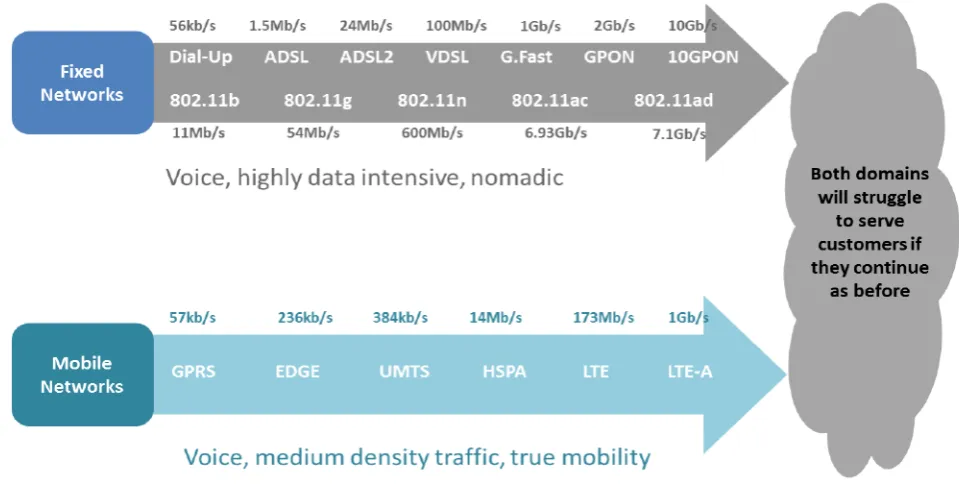
Today’s infrastructure comprises a range of fixed and mobile architectures that have evolved significantly. The fixed network was originally only designed for voice, as was the mobile network. Now it is data that comprises the bulk of the bits that they move about – globally. In a converging world, 5G does not “see” any of these traditional silo based
approaches. It starts from the customer centric viewpoint that they don’t care anyway. We therefore have to evolve what we have already and identify areas that we need to
develop.
2.1 Key innovation opportunities
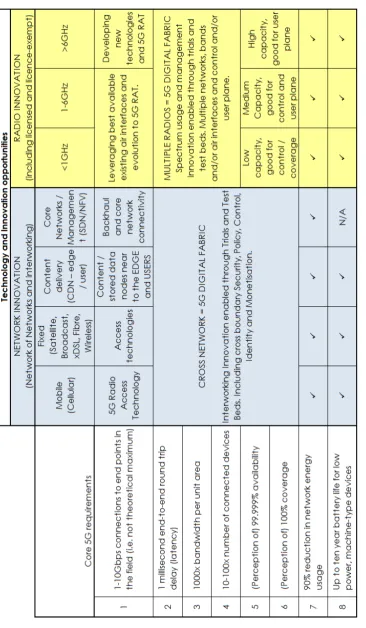
So, how can we join up our thinking and decide where to focus our R&D activities to best effect? The table below maps the 8 core requirements describing 5G, identified by GSMA, to the main opportunities we see for innovation and rapid development. The table is spilt into key areas:
1. NETWORK INNOVATION (Network of Networks and interworking), highlighted in light blue 2. RADIO INNOVATION (including licensed and licence-exempt), highlighted in yellow Because a network of networks approach is required, one must include all networks, as well as consider what they are capable of delivering as well as how they deliver it. We also have to consider both current and future radio technology factors, as a part of the matrix. What becomes clear is that R&D activity falls into two key areas. There are certain specific challenges that relate only to one part of the overall network of networks, and others that absolutely need to be developed and tested in a cross network environment.
It should be noted that this is a high level table and brings together a range of applicable contexts. For example, the requirement for a 10 year battery life is only needed for battery operated Internet of Things (“IoT”) and Machine to Machine (“M2M”) communications in a particular context where no power is available and therefore the device needs to operate from a battery without charging. For further information on the different requirements related to context please see Appendix 8’s Spider Diagrams developed by the UK SPF 5G working group. In the future 5G world, all of these different context settings have to be taken into account.
10 It was in 1980 that the ITU G3 Fascimile Standard was developed, primarily by Japan’s domestic
10
[image:11.595.71.438.75.704.2]5G innovation opportunities – A discussion paper
Figure
1
- C
ap
ab
ili
ty
requ
iremen
ts and
ch
al
le
ng
es
=
inn
ov
ati
on
op
port
un
iti
11
5G innovation opportunities – A discussion paper
2.2 Funding test beds and trials
The above table demonstrates a significant opportunity and available first mover advantage for the UK to lead the 5G evolution to address socio-economic challenges whilst enabling new jobs and creating wealth through global exploitation.
No industry that we know of anywhere in the world is currently addressing the 5G challenges for cross industry collaboration in this way. There is in particular a key role for Government to act as technology enabler, to facilitate a properly joined-up 5G strategy, and to promote the UK globally as the best place to do 5G technology and service innovation.
It is strongly recommended that the UK Government enables this strategy through
collaborative R&D seed funding for the UK innovation communities to work “across the silos" to develop the technology and solutions required. This could be achieved by leveraging traditional instruments providing the catalyst for significant industry funding multiplying the capability and providing economies of scale to attract further inward investment and growth.
The trials and test beds will initially be focused on technology building blocks addressing the key 5G and IoT future capability requirements, evolving to 5G and IoT systems, Digital Fabric and network of networks cross sector approaches. Longer term infrastructure developed and deployed will then start to address new services and applications trials focused on major socio-economic challenges such as Future Smart Cities, Transport, Health & Social care and Energy / Utilities. See figure below.
Figure 2 - Trials and test beds chronological evolution Technology
Building Blocks
Systems, integration and interoperability
Network of networks and
Digital Fabric
12
5G innovation opportunities – A discussion paper
3 5G use cases and commercial considerations
5G is about better end to end performance, better support for non-traditional applications, and longer battery life. It is not necessarily about higher speeds, new air interfaces, or enabling M2M, although any/all of these may be ingredients.
Different applications and their users make different requests on the network in relation to quality of service (“QoS”). The QoS parameters include bit-rate, time of session, latency, response time, tolerance to information loss, and security (in some cases only a sub-set of these parameters are required and characteristics vary by service). One example
application might be autonomous driving, which requires extremely reliable real-time communications, location awareness with low latency and mapping. Other applications needing reliable and low latency communications include the tactile internet and remote computing. None of these applications necessarily require very high speed data-rates. However, a broadband connection at home, where a user for example undertaking on-line banking requiring a reliable connection with high security, then decides to download a movie to watch over the next couple of hours signifies a different type of application. The user’s average bit-rate during the evening is less than 10Mbit/s but if (s)he then demands the movie in 10 seconds, and is prepared to pay a premium to get it that quickly, a burst of 1Gbit/s will need to be delivered.
The use-cases defined prior to launching a new ecosystem of services have traditionally
considered the likelihood of a positive business case for network and service providers offering those new services. Here we list the influencers in the definition of the use-cases of such
communication services as stakeholders in their communication eco-system.
13
5Ginnovation opportunities – A discussion paper
The table below provides an example of 5G use cases working seamlessly together. Individually, each use case willrequire new developments and technologies.Mapped against the eight keyrequirements, withthe addition of a ninthrequirementforinte
r-networking, the table areas marked ‘High’(infunctionality)indicate applications which are not achievable withinfrastructure, technologies and services available today. See key at the bottom of tablefor more detail on the high, medium andlow categorisation.In the scenario described,you can see that no area has been categorised as Low,i.e. capable of being deliveredtoday using currenttechnology, services andinfrastructure.
Traditionally, services are created by consideringthe social behaviour of the members of public or corporationsforming the use-cases. The use-cases are normally processedinto scenarios andtheninto business cases. As we are goingforwardintimefrom our 1G network towardthe upcoming 5G networks, the capture of use-cases are becoming more complex as the types of stakeholders are expandingin this ecosystem. For examplein Figure 3 above the public and corporate consumers of communications are expanding toinclude government bodies, emergency services,military, and manufacturing plant machinery control services. Also, thereis a trendtowardsthe blurring of traditional demarcationsinthe value chain. For example equipment vendorsincreasingly tend to provide not onlyinstallation and
14
5G innovation opportunities – A discussion paper
All in all this leads us to consider the use case of the future 5G networks in the context of the likely shape of such a communication eco-system along with their stakeholders.
The focus now, within the constraints of their commercial policies, is for service providers to give customers the appropriate user experience, based on context, for the price they are willing to pay, rather than specific headline speeds.
Figure 4 - Key Service features provided by each generation of Mobile Networks
A quick look at trends of successive mobile network generations and their service offerings and capabilities suggests that 5G networks should provide us with a solution for ultra-dense connectivity to enable a path towards services such as tactile internet, as described later in this document, see section 4, 5G Technology and Innovation. For such services and use-cases to be made available we require high throughput from a single cell plus an improved resource scheduler in the network, providing sufficient bandwidth and latency for the service in demand.
The ‘appropriate user experience’ depends on several parameters: support for the particular application, time to deliver, latency, consistency, reliability and security.
The NGMN has defined 25 use-cases in eight families with recommendations on these parameters11, and the purpose of this paper is not to repeat this work, but to highlight
opportunities for research and innovation. These eight families are
- Broadband access in dense area - Broadband access everywhere - High user mobility
- Massive Internet of Things
- Extreme real-time communications - Lifeline communications
- Ultra-reliable communications - Broadcast-like services
11NGMN 5G White Paper, version 1.0 dated 17 February 2015, section 3
15
5G innovation opportunities – A discussion paper
Current systems such as Wi-Fi, LTE, Broadcast, Internet etc. are already addressing the eight families listed above. 5G systems will build on the capability of these existing systems, in some cases building on legacy and leveraging previous generation assets. The extended
capabilities outlined in sections 1 and 2 will require a new approach and will move towards a library of fixed and wireless connectivity options and select the best option or combination of options according to the user requests, the options that are available at the user location, and the operator(s) policy. In some cases the 5G core network will leverage previous communication generation assets to deliver the service in the context required, therefore leveraging and building on existing CAPEX. This approach presents exciting new CORE
network opportunities in advance of 5G RAT being available: Evolving existing CORE networks to be 5G ready leveraging all available transport communication pipes.
Some 5G system parameters will have choices associated with them, so that the user can, for example, have the option of paying a premium for a permanent or temporary grade of service that is above his or her normal service bundle. This could include higher bit-rate, additional security or reduced latency. Therefore the requirement on the 5G system is to adapt to users’ needs in a way that includes decisions to temporarily upgrade, and hence dynamically shift user plane capacity among users. User traffic is bursty in nature, and will probably become more bursty in future, and this suggests that separation of control and user plane would be of benefit, with the control plane being served perhaps from a number of macrocell sites, while the user plane can be served by more local and smaller cells as appropriate. Separation allows for lower latency and higher reliability on the control plane, and these attributes may be more important than on the user plane for some applications. The choice of connectivity options available to the user will depend on the location, which could be from sparse rural to dense urban, and indoors or outdoors. Information relating to user type, user location and network topology is usually held centrally in the operational support system (OSS). The choice of connectivity can also depend on the location of the content that the user wishes to access. So decisions about which connectivity option to offer the user will depend on information about the user, the network (including backhaul) and the content. So in the design of 5G system there are several areas where opportunities for
innovation exist. These include:
- Where information should be located and how it is to be used in deciding on
connectivity options, to enable the system to dynamically allocate network resources in response to user requests,
- Greater interaction with the user to offer premium QoS and inform about trade-offs such as large file delivery time, reliability risks, cost and battery life, building on today’s connection managers,
- Where content is best located, depending on content type, network topology and user behaviour,
- Dynamic radio resource management including transmit energy, spectrum choice, waveform choice that allows sufficient QoS with minimal wastage.
As use cases are ultimately means of capturing the requirements for the next generation of networks; further use cases for the 5G network should consider necessary architectural capability to provide communication services using, integration of fixed networks; licensed and unlicensed terrestrial wireless networks for peer to peer or broadcasting as well as use of satellite communication where possible.
This also means the future networks require to operate and integrate the new generation with their legacy networks in providing a holistic approach to serving the communication
16
5G innovation opportunities – A discussion paper
3.1 Commercial considerations, Cost per bit – EBITDA
Most operators in most markets are presently experiencing reduced EBITDA12 even in
relatively high ARPU markets such as the US.
This suggests a reverse coupling between increased data rates and profitability - as data rates go up, EBITDA and associated operator margins go down. Partly this is due to the increased maintenance and management costs that are a consequence of increasing network density.
Higher density networks also increase capital spending and reduce ROI. In the short term the Mobile industry is addressing EBITDA through rationalisation of their cost base13, but in the
longer term there is a requirement to achieve step function reductions in cost per delivered user bit.
Many different views of 5G are currently being formed including the need for networks to be designed as ‘ultra-dense high capacity networks’ -a view that is true, but maybe misleading. Wide area large cell high capacity high data rate physical layer options are also required and must be considered as part of 5G. In some cases the use of different frequencies for control and user plane will provide the capability to adapt and provide flexibility in a dynamic way - see Figure 1 - Capability requirements and challenges = innovation opportunities.
With respect to high speed / density, the millimetre bands (30 to 300 GHz) are usually discussed in the context of dense urban topologies but these environments are typified by high levels of specular reflection and by surface and resonant absorptions at 24 and 60 GHz14.
The counter argument is that millimetre wavelengths are better suited to line-of-sight access which implies coverage from high towers or sub-space or satellite platforms which in turn can support large high capacity cell topologies. At this point both approaches from innovation and technology development perspectives are valid i.e. these frequencies could be applied to provide, user connectivity for, both, short range small cells (indoor and outdoor), and, by leveraging smart antenna techniques for larger cells / longer distances, as well as fixed point
12 EBITDA Earnings Before Interest, Taxes, Depreciation and Amortization
13 The Mobile Economy 2014 GSM Association Europe report
http://gsmamobileeconomyeurope.com/GSMA_ME_Europe_2014_read.pdf
Extract from report: A combination of declining revenues, competitive and regulatory pressures and the economic backdrop have also led to falling profitability for the European mobile industry. EBITDA margins have declined by almost seven percentage points over the last five years, with negative economies of scale a key factor. Operators are taking a range of measures to maintain profitability, including a move away from handset subsidies (in order to reduce subscriber acquisition costs) as well as ongoing rationalisation of their cost base.
17
5G innovation opportunities – A discussion paper
to point backhaul connections, which may be the only solution in specific scenarios (eg. in highly built up areas. It also suggests a need to amortize development, build and coverage costs across industries beyond consumer mobile broadband.
Section 5, Frequency related radio innovation opportunities, explores potential for 5 G deployments in different frequency bands.
4 5G Technology and Innovation
The following section provides some further technical information with respect to the different technologies, capabilities, candidates, innovation opportunities and research activities currently taking place. It is likely that 5G systems will evolve leveraging multiple assets from previous generation networks plus adding new technologies to the eco-system. Therefore, these sections need to be read in the context that these are options in a future infrastructure that are currently in the research phase and therefore subject to change.
The evolutionary approach is an important factor in preparing for a future 5G world, where many technologies may be introduced in a progressive manner. One of the key
recommendations of this paper is for further trials and test beds which could be used as a vehicle to stimulate industry and the supply chain to develop solutions that are 5G ready in advance of a full 5G roll out. To assist navigating this section, please see table below for explanation:
Section Page Section Title Description / explanation
4.1 18 Technology (RAT) – Radio Access Air Interface
Several candidates and combinations of the candidates are currently being considered for the future 5G RAT. This section only describes some, but not all of the techniques and technologies being researched and considered.
4.2 20
Radio technology options and building blocks
All of the sub sections are focused on >6GHz frequencies; the use of spectrum above 6GHz is attractive to deliver high data rates due to large amounts of bandwidth available.
0 27
Radio technology options and building blocks –
non Frequency Specific
All of the sub sections are NOT frequency specific and can be applied in any Frequency. Techniques and
technologies such as Power Amplifiers, Massive MIMO, duplexer, diplexers and CMOS filters are explored in this section.
4.4 37
Core networks, Virtualisation and Software Defined Networks (SDN)
This section is focused on the CORE network and the
building blocks required to address the 5G Digital Fabric
18
5G innovation opportunities – A discussion paper
4.5 54
Energy and Throughput Efficiency Metrics
for 5G Wireless Networks
The imminent development of the 5G wireless standards emphasises throughput efficiency in order to meet an expected 1000 fold increase in the amount of data traffic. One of the biggest challenges to achieve increased throughput will be energy usage in all areas of the
network. This section explores the challenge and the need for further granularity, framework and measurement.
4.6 57 Security of 5G
5G aims to yield a more virtualised, distributed and fluid environment comprising different communication technologies and compute objects. It is imperative that security is ‘designed-in’ at all levels to ensure resilience, robustness and address the future hyper-connected connected that will be enabled by 5G and IoT systems
4.7 60
The Internet of Things (IoT) and Tactile Internet in
5G Networks
The Internet of Things and Tactile present many challenges around coverage, capacity, quality of service,
deterministic / low latency connections for real time activities which present 5G a plethora of innovation opportunities which can part of future critical national infrastructure based on a 5G architecture. The section explores these challenges with a view to address these in a 5G evolving architecture.
4.1 Radio Access Technology (RAT) – Air Interface
Several candidates and combinations of the candidates are currently being considered for the future 5G RAT. This section describes some, but not all of the techniques and
technologies being researched and considered.
Multiple access techniques allow multiple mobile users for sharing the limited bandwidth resources and being admitted by service providers in modern mobile networks. During the last four decades, the paradigm shifts of multiple access techniques have been the key milestones of the evolution of cellular networks. In particular, time division multiple access (TDMA) and frequency division multiple access (FDMA) have been used in the first and second generations of mobile networks. The third generation of cellular networks are based on code division multiple access (CDMA), and the currently being deployed fourth
19
5G innovation opportunities – A discussion paper
utilized by the admitted user. Motivated by this, a few non-orthogonal multiple access techniques have been recently proposed.
NOMA, power domain non-orthogonal multiple access15, can efficiently improve
spectrum efficiency by opportunistically exploiting a users’ channel condition. The idea of NOMA can be simply described using the following example. Consider a cell with one base station (BS) and two users, A and B. Without loss of generality, User A has a better connection to the BS than B. The key idea of NOMA is to serve both users at the same time/code/frequency channel, and the signal transmitted by the BS is a
superposition of the two users’ signals, where the user B’s signal is put on a higher power level. User B will simply treat User A’s signal as noise and decode its own signal.
Successive interference cancellation (SIC) will be carried out at User A which will decode User B’s signal first and then decode its own information after subtracting User B’s signal from the observation. If conventional orthogonal multiple access techniques are used, no one else can be admitted to the channel allocated to User B, even though User B cannot fully use this channel due to its poor connection the BS. The benefit of using NOMA is that the bandwidth resource allocated to the users whose channel conditions are poor is released to other users.
The benefit for using NOMA can be alternatively explained by viewing NOMA as a special case of cognitive radio (CR) networks. Particularly User B can be viewed as a primary user in CR networks. Because of the use of NOMA, User A is admitted to the same channel as User B. With careful power allocation, it can be ensured that
admitting User A will not cause too much performance degradation for User B, but the superior channel condition between User A and the BS ensures that the spectral
efficiency can be improved significantly. NOMA can also be combined with
conventional orthogonal multiple access schemes. For example, users in one cell can be divided into multiple clusters, where NOMA is implemented within each cluster and conventional multiple access can be used among the multiple cluster.
SCMA, sparse code multiple access, provides an alternative to implementing non-orthogonal multiple access. Particularly a SCMA encoder maps each user’s information to a K-dimension codebook, and each codeword has a small number of non-zero entries. Similar to NOMA, SCMA is naturally complimentary to OFDMA, where SCMA codewords are multiplexed over K orthogonal subcarriers. When the number of non-zero entries in each codeword is much smaller than K, i.e., the codebook is sparse, SCMA can serve more than K users simultaneously over K orthogonal subcarriers. SCMA naturally combines forward error correction coding, modulation, with multiplexing,
15 Newly proposed coding strategy, Source: Zhiguo Ding; Zheng Yang; Pingzhi Fan; Poor, H.V., "On the
Performance of Non-Orthogonal Multiple Access in 5G Systems with Randomly Deployed Users," Signal Processing Letters, IEEE , vol.21, no.12, pp.1501,1505, Dec. 2014 doi: 10.1109/LSP.2014.2343971
Globalnet News April 30 2015
20
5G innovation opportunities – A discussion paper
where advanced encoding/decoding algorithms based on LDPC and lattice have been proposed. In addition to its superior spectral efficiency, SCMA also yields low signalling overhead, low delay, and support of massive connectivity.
Domains used for MA
Open Loop
Compatibility with existing MA
Rate gain over OFDMA
Support to high order modulation
Resilient to high mobility
NOMA Power Partial Yes Positive Yes Yes
SCMA Frequency -time-code
yes Partial Positive Yes Yes
In addition to those newly developed multiple access techniques, like NOMA and SCMA, OFDMA has also been identified as a potential multiple access candidate in 5G networks because of its superior resilience to inter-symbol interference, a challenging issue in broadband mobile networks. However the use of conventional Fourier transform might not be sufficient to support the high system throughput expected for 5G, and there have been a huge amount of efforts to find new waveforms. For example, generalized frequency division multiplexing (GFDM) has been proposed to efficiently supress the peak-to-average power ratio, an issue which has limited the application of conventional OFDM in 5G systems. In addition, GFDM is also particularly useful for the scenario with spectrum fragmentation, a feature which further improves the spectral efficiency of 5G networks.
Filter Bank Multicarrier (FBMC) is another waveform which is being considered due to the fact that conventional OFDM requires the use of cyclic prefixing (CP). While the use of a CP removes inter-symbol interference (ISI) between OFDM symbols, it also reduces spectral efficiency. The key feature of FBMC is to keep the advantages of conventional OFDM without using CP, by applying advanced filter bank techniques. It must be noted that FBMC offers advantages in other areas, including good sidelobe performance. However, further research is recommended with respect to MIMO implementations, as it has long filters that make it inefficient with short messages. Because of this, Universal-Filtered OFDM (UF-OFDM), also known as Universal Filtered Multi-Carrier (UFMC) is being considered to address the limitations of FBMC such as long filter challenges, use of MIMO and Coordinated Multipoint (CoMP).
4.2 Radio technology options and building blocks > 6GHz
A key requirement for 5G mobile is the addition of a new gigabit rate capable air interface. The use of millimetre wave spectrum to deliver these data rates is seen as being very
21
5G innovation opportunities – A discussion paper
high gain (>30 dBi) fixed antennas. The technology used in these solutions would not be fit for purpose for direct transfer into mobile applications, due to the increased complexity for mobile use, smaller form factor and associated integration to achieve the cost, size,
performance and power consumption required. However, wireless technologies are already emerging which are reaching the necessary power, cost and performance requirements for mobile devices, therefore providing the economies of scale. The Wi-Fi Alliance is currently working on launching ‘WiGig certified’ products, based on the IEEE 802.11ad standard. This operates over 4 x 1.76 GHz channels in the 57 – 64 GHz band and is specified to deliver data rates of between 1 and 7 Gbps over ranges of 10 – 20 m (depending on the radio
configuration). Moreover, the use of beamforming is enshrined within the standard thus allowing implementers great flexibility to provide innovative solutions around antenna, transceiver and baseband technologies. Pre-certified products are available today (e.g. from Qualcomm – Wilocity) and the Wi-Fi Alliance currently projects that the ‘WiGig Certified’ interoperability programme will be complete by H2 2016. This wireless technology will drive the economies of scale and set the scene for adaptions and extensions to meet the needs of 5G mobile.
Mention should also be made about the two main classes of applications for millimetre wave wireless in the context of 5G as follows:
1) Mobile applications
Integration of millimetre wave wireless within user devices to provide complementary gigabit rate access to current and emerging LTE and Wi-Fi (e.g. 802.11ac) technologies. Typical data rates in the region of 1-4 Gbps with power consumption requirements of 100 – 200 pJ/bit and volume chipset costs measured in the $10’s maximum. This is the market targeted by the Wi-Fi Alliance with their ‘WiGig certified’ program and where projections of additional volumes of up to 1B units are over current Wi-Fi chipset volumes of 2B units in the timeframe 2017-18.
2) Infrastructure applications
A key Infrastructure consideration is the need for wireless backhaul of data rates from 100 to 1000MBps over ranges of 100 to 300m from LTE base stations to the core network – for example for use within small cells. Network densification, particularly in fast growing urban areas in emerging economies such as India and China, is driving the need for cost
effective gigabit rate backhaul solutions. Current back haul solutions operating in V band (60 GHz) and E band (70/80 GHz) are considered as good innovation opportunities to reduce size and cost to make them more attractive for larger scale deployments (Mu’s). Hence there is an opportunity to adapt the WiGig derived technologies for mobile applications for extended range operation for this application in the above mentioned markets.
22
5G innovation opportunities – A discussion paper
4.2.1 Choice of Frequency bands – leveraging existing technology
Spectrum is discussed in more detail elsewhere in this document but an example of ‘leveraging’ opportunities relating to the high bandwidth millimetre wave frequencies is in the range 66-71 GHz (just above the band specified for 802.11ad). This offers the potential for simple adaption of radio technologies designed for WiGig mobile applications (57 – 64 GHz) which would leverage ongoing investment in the development of RF semiconductors for this market. Other options at E band and W band are also of interest for ‘lightly licensed’
applications aimed at infrastructure. The 66 -71 GHz band was one of three bands
mentioned as being worthy of further consideration for 5G in the recent consultation from OFCOM16 and was one of the options proposed by the FCC in their ROI (FCC 14-154) dated
October 2014. Other bands under consideration are outlined in more detail elsewhere in this document.
4.2.2 Propagation modelling and measurement
Typical outdoor operation at millimetre wave frequencies use near Line of Sight (LoS) conditions rather than traditional mobile operation at ~2 GHz where non-LoS operation dominates. Rician channel models, where LoS propagation combines with non-LoS
multipath, is typical and the parameters (k factor and delay spread) are key parameters in designing optimised PHY interfaces. In addition, frequency re-use of channels for increased capacity and interference avoidance require accurate propagation prediction tools which can account for complex propagation conditions in urban environments. As networks move to self-optimisation these techniques and associated research will be essential in helping to inform and develop the algorithms required to operate in this the real time dynamic mode required. Such tools need to be based on ray tracing methods and also need accurate models for reflection and absorption from a wide range of materials such as glass, concrete, wood and of course vegetation. Models also need to account for frequency dispersion caused by mobility. Finally, these tools also need to allow for a wide range of (phased array and fixed gain) antenna specifications as this has a major impact on channel conditions. Tools are beginning to emerge but more work is needed on propagation measurements and optimised (cloud based) computing to increase the integration with geo-mapping
databases (e.g. Google Maps), accuracy of channel estimation and computing efficiency of tools.
4.2.3 User Equipment Antenna Design for mm-Wave Bands
This is a key consideration as the antenna design will dominate radio link budget and
physical size of the user equipment. It is accepted that active phased array antennas17 may
offer benefits of conformal design and small size compared to traditional fixed antenna structures. Typical design rules for a phased array includes spacing an array of antenna
16 Laying the foundations for next generation mobile services: Update on bands above 6 GHz
http://stakeholders.ofcom.org.uk/consultations/above-6ghz/update-apr15/
17(A phased array is composed of a set of antenna elements, signals to which are fed directly and
23
5G innovation opportunities – A discussion paper
elements by half wavelength spacing (wavelength of 10mm at 30 GHz or 5mm at 60 GHz) in 1 or 2 dimensional arrays. Assuming array sizes ranging from 4 elements through to 16 or even 32 elements for mobile devices up to laptop sizes will be required, an array may vary in size from 10 x10mm for a 2x2 array at 30 GHz or 5x5mm at 60 GHz through to 10x10mm for a 4x4 16 element array at 60 GHz. The later array configuration delivers antenna gain in the region of 12-14 dBi and half-power beam width (HPBW) of 30 degrees in elevation and azimuth. For infrastructure applications increased gain of >+20 dBi require larger arrays or optimised antenna element design to deliver the system link budget needed for extended range operation over 100m.
4.2.4 Radio Transceiver
The rapid development of deep sub-micron CMOS and SiGe BiCMOS semiconductor technologies has seen the introduction of complex single chip phased array transceivers which combine up to 16 Tx and Rx chains, RF beamformers, low phase noise synthesis and baseband analog processing compatible with delivering ~2 GHz wide channels with Tx output levels of typically +10 dBm per PA and Rx noise figures of +6 dB per Rx LNA. Several manufacturers (notably Si Beam, IBM, Intel, Qualcomm, Samsung) have such devices in production today operating in the 60 GHz band.
While Si based transceiver chips operating in the E Band and even W band are emerging there remains a substantial performance gap compared to traditional transceivers based on GaAs technologies. In short range E band applications Si/SiGe transceiver chips may offer cost effective performance with phase noise compatible with 64QAM operation but for carrier grade backhaul links of greater than 1km they must be used in conjunction with external GaAs Power Amplifiers, LNAs and VCOs.
This is an area of innovation requiring $100M’s of investment and one that is dominated by Tier 1 Semiconductor and well-funded fabless semiconductor companies. Therefore, large investment instruments through venture capital and/or Government funding would be required for UK companies to be able to make a major impact.
However, an area where UK companies can make an impact is in 5G backhaul which will see a huge increase in capacity which can be addressed by moving to even higher frequencies. This will present UK companies opportunities to develop MMICs18 and
transceivers for these bands, opening up new innovation opportunities for 5G 92GHz to TeraHz Backhaul19.
Higher frequency mm Wave bands under consideration for back haul include 92GHz to 134GHz, 141 to 175GHz and 192 to 275GHz to support data rates up to 40Gbps.
4.2.5 Baseband processing
Baseband PHY and MAC design for the delivery of 1-10 Gbps of wireless data rate requires Teraops of real time signal processing and packet processing. Current implementations lean
18 MMIC - Monolithic Microwave Integrated Circuit
24
5G innovation opportunities – A discussion paper
25
5G innovation opportunities – A discussion paper
4.2.6 Technology example – 60GHz Blu Wireless Modem
An example of a millimetre wave platform, designed for street level outdoor operation, is the ‘Lightning’ 60 GHz wireless modem from Blu Wireless Technology. This is a demonstrator grade evaluation platform based on Blu Wireless’s HYDRA PHY/MAC technology integrated within the PHY1 SoC which is based on the IEEE 802.11ad TDD wireless standard together with several extensions for optimised operation in outdoor conditions. A 60 GHz active phased array antenna is used to deliver electronic beam steering with 2x12 element antenna arrays for transmit and receive operation. Several channel
bandwidths are provided up to the full 802.11ad channel width of 1760 MHz are supported with typical ranges of >200m at 1 Gbps. The platform also includes a
programmable FPGA engine for MAC and a LINUX based embedded controller and is designed to software
upgradable in the field. GPS for location detection and Bluetooth for remote control and software upload is also provided. A network of ‘Lightning’ modules is currently being deployed as part of the ‘Bristol is Open’ project and is expected to report first results by the end of 2015. Notably, a key objective of this project is to explore open source SDN methods based on ‘Openflow’ and therefore the ‘Lightning’ module will support an Openflow client for SDN control. The ‘Lightning’ module is mounted in a weather proof enclosure of size 400x140x50mm. Further development is under way to increase integration levels with a production ready version planned for release in 2016 with approximately 20% of this size. Looking ahead to 5G this software defined platform will be used to explore various scenarios for 5G millimetre wave operation.
4.2.7 Technology example – 60GHz Wi-Fi capable of 4.6Gbps
Samsung has already tested 5G systems at circa 61 GHz. Samsung developed 60 GHz Wi-Fi capable of 4.6Gbps entering the 60GHz 802.11ad Wi-Fi development. Samsung says it has a commercialized version of 60GHz Wi-Fi (aka WiGig) that’s capable of 4.6Gbps, or 575
megabytes per second — about five times faster than current dual-stream 802.11ac devices, or fast enough to download a movie in a couple of seconds. Samsung says the first devices supporting its 60GHz Wi-Fi tech will be available in 201520.
20
http://www.extremetech.com/computing/191872-samsung-develops-60ghz-Wi-Fi-capable-of-4-6gbps-will-be-in-devices-next-year
Figure 5 –
26
5G innovation opportunities – A discussion paper
4.2.8 Technology example – 71-76/81-86GHz Filtronic Transceiver Module
Examples of E-band transceiver modules designed for deployment within high capacity backhaul links are the Theseus and Orpheus modules from Filtronic Broadband. These are carrier grade transmit / receiver modules incorporating integrated no tune diplexers together with differential IQ interface, direct conversion chipsets and an on board microcontroller - simplifying integration between the modem and antenna. The low phase noise, wide-band architecture means that these modules could support >10Gbps in 2GHz channels at
128/256QAM modulation, once modems have been developed sufficiently to support wider bandwidths. Theseus is Filtronic’s second generation module released last year, with
significant quantities now deployed in the field for multi-gigabit applications. Filtronic have a reference link employing Theseus already demonstrating 3.2Gbps in 500MHz channels. Orpheus is the third generation product due for release later this year, incorporating a simplified receive architecture and smaller, lower cost mechanical construction. Roadmap development of the platform, including MMIC redesign by Filtronic’s MMIC team, is planned in order to keep pace with both the commercial and technological pressures dictated by this demanding market.
27
5G innovation opportunities – A discussion paper
4.3 Radio technology options and building blocks – non Frequency Specific
4.3.1 Power Amplifier (PA) Architectures21
Wideband PA architectures are good candidates for sub-6GHz band for 5G due to the complex frequency-space slicing that has evolved over several decades of wireless communication standards evolution. Despite this, fixed channel multi-band architectures currently offer higher performances in term of efficiency, since these customised
architectures align well with specific frequencies on a per country/continent basis. However, wideband PA designs are likely to offer the most efficient solution for dynamic inter-band carrier aggregation.
A wideband PA consist of the PA and associated baseband and up-conversion blocks. The chosen topology will depend on the amount of signal processing involved to compensate for the nonlinear behaviour of the PA. One architecture, presented below, shows a
wideband transmitter composed of a single baseband and up-conversion block.
Multiple design challenges exist within each of the blocks within the figure above. Firstly, new nonlinearity compensation algorithms are required to cancel out the PA nonlinear behaviour in the presence of wideband signals (more than a GHz bandwidth). This requires substantial new research in the field of microwave instrumentation to characterise PA nonlinear
behaviour in the presence of wideband signals. Compensating for the nonlinear behaviour of PAs in the presence of wideband signals from the baseband is also challenging. Some analogue linearisation schemes will have to be considered and future linearisation methods are likely to be of hybrid type, i.e. digital baseband and analogue RF based.
21 PA Architecture Research, Dr Souheil Ben Smida, University of Bristol
IQ modulator DAC
DAC
PA
Baseband processing
I
Q
28
5G innovation opportunities – A discussion paper
In an inter-band carrier aggregation scenario, the architecture shown above is a possible candidate when a single wideband PA is used.
New linearization algorithms are currently being developed to cancel out the PA nonlinear behaviour when 2 or 3 waveforms (carriers) at different frequency bands are concurrently driving the PA. Future work in this area requires the development of highly efficient, and hence realistically implementable, algorithms in the baseband domain. In this context, the diplexer/triplexer block (not shown here) will present challenges and might become the new ‘bottleneck’ for wide-band and multi-band transceivers architectures.
PA architectures that are currently being considered can be divided into two categories. The first consists of classic architectures such as Linear amplification using nonlinear components (LINC), Doherty and envelope tracking (ET). The second, consists of digital architectures such as Sigma-Delta architectures. Both approaches present advantages but not able to provide the specifications required by 5G in terms of bandwidth, efficiency and linearity. Therefore, ambitious research needs to be done to come up with innovative solutions. One direction, could be a hybrid solution that combines analogue and digital principles to perform the amplification. In addition, further work and research with respect to RF Power DAC22
technology could offer future alternatives and hence recommended as an area for further work.
More than ever, PA designers will have to explore the surrounding building blocks of the PA transmitter architectures and get used to a holistic design approach to come up with appropriate solutions. In addition, due to the increased complexity the nature of these amplifiers will require innovative thinking to develop new verification and testing methods.
22RF Power DAC, Radio Frequency Power Digital to Analog conversion
IQ Modulator Channel A DAC
Baseband processing
I
Q DAC
PA
IQ Modulator Channel B DAC
Baseband processing
I
Q DAC
Pow
er
c
om
biner
29
5G innovation opportunities – A discussion paper
4.3.2 Massive MIMO23
Massive MIMO, with base-station or access point deployments with >50 antennas and user equipment with a few antennas, represents a fundamental shift in the architecture
(hardware and algorithms) of wireless MIMO operation as we strive for the x1000 capacity goals of 5G. In a massive MIMO system, the large antenna array exploits the spatial diversity of the radio channel to allow many terminals to use the same time-frequency resource, simultaneously increasing energy efficiency and reducing the requirements on the RF chains as illustrated in figure below.
Figure 9 - Top conventional MIMO, below massive MIMO system
A significant body of theoretical analysis has been undertaken to ascertain the potential benefits of massive MIMO, as illustrated in the figures below, illustrating the relative
23 Massive MIMO research, Paul Harris, University of Bristol
Conventional 2 x 2 MIMO ‘hXX’ denotes the four paths between the antennas.
User 1 and User 2 have been used to demonstrate concept.
Example: User 1 becomes Access Point or Base Station and User 2 the user terminal.
30
5G innovation opportunities – A discussion paper
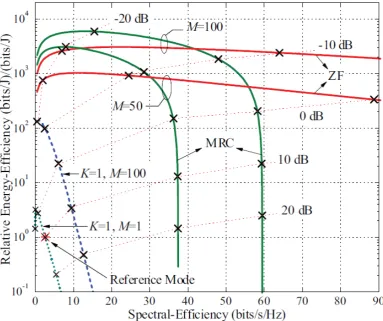
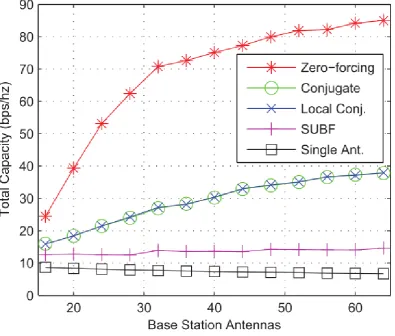
[image:31.595.121.505.161.482.2]efficiency gains of the approach for two different precoding schemes (red and green curves) compared to a SISO reference (light blue, bottom left). The results indicate a 6-fold increase in spectrum efficiency for the single user case when identical radiated powers are considered, when extended to the multi-user case sum-rate capacities of up to 85 bps/Hz have been reported24.
Figure 10 - Relative Energy Efficiency of conventional and massive MIMO25
24 C. Shepard, H. Yu, N. Anand, E. Li, T. Marzetta, R. Yang, and L. Zhong, “Argos: practical
many-antenna base stations,” in Proceedings of the 18th annual international conference on Mobile computing and networking - Mobicom ’12, 2012, no. i, p. 53.
25 E. G. Larsson and T. L. Marzetta, “Energy and Spectral Efficiency of Very Large Multiuser MIMO
Systems,” IEEE Trans. Commun., vol. 61, no. 4, pp. 1436–1449, Apr. 2013.
31
[image:32.595.119.515.84.420.2]5G innovation opportunities – A discussion paper
Figure 11 - Sum-rate capacity for BS antenna numbers with different precoding26, single antenna case shown for reference.
There is now a significant body of activity to take the massive MIMO concept and
demonstrate the practical viability as well as addressing the known research challenges. The table below provides a summary of the currently known test beds.
26 C. Shepard, H. Yu, N. Anand, E. Li, T. Marzetta, R. Yang, and L. Zhong, “Argos: practical
many-antenna base stations,” in Proceedings of the 18th annual international conference on Mobile
32
5G innovation opportunities – A discussion paper
Organisation Configuration Hardware Notes
University of Bristol, National Instruments
128 antennas dual-polar patch antennas in 4x 32 element
subsystems. Centralised and distributed FPGA processing. Up to 20 UEs. 3.5 GHz. TDD.
National Instruments PXIe, FGPA and USRP RIOs. Octoclock synchronisation.
This system builds upon the work done by Lund University and is
designed to be
inherently distributable.
Lund University, National Instruments
100 dual-polar patch antennas with both centralised and distributed FPGA processing. Up to 10 s. 3.7 GHz. TDD.
National Instruments PXIe, FGPA and USRP RIOs. Octoclock synchronisation.
Built with COTS NI hardware. Uses a LabVIEW software framework27.
Nutaq’s Titan MIMO 100x100 SISO links. Perseus 6111 AMC
FPGA cards, Xilinx Aurora-4x high speed serial interface.
A focus on OTA (over the air) RF to
baseband processing rates and throughput. Total system
throughput of 256 Gbps28.
Rice University’s Argos System
64 antennas, 15 clients. 2.4 GHz TDD.
WARP boards, Maxim 2829 transceiver, MATLAB Framework
85 bps/Hz sum-rates reported. Modular and scalable.
Commonwealth Scientific and Industrial Research Organisation (CSIRO) - Ngara
32 vertically polarised dipole antennas, 14-18 users. FDD – 638 MHz & 806 MHz.
Xilinx Virtex 6 FPGAs, VLX240T RF front ends.
Symmetric 50 Mb/s uplink and downlink for at least 12
simultaneous users29.
Table: Known massive MIMO testbeds
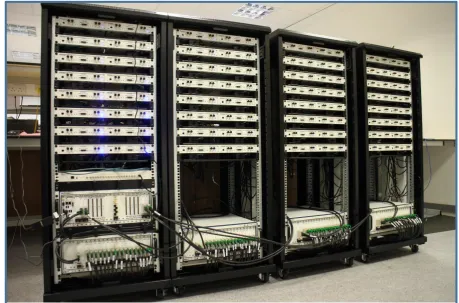
The University of Bristol massive MIMO testbed shown in the figure below is the only known prototype of the technology within the UK and one of a select few worldwide. Using the same COTS hardware as the Lund University system through a collaboration with National Instruments, it can operate with up to 128 antenna elements and has the ability to perform
27 E. Luther, S. Product, and M. Manager, “5G Massive MIMO Testbed : From Theory to Reality,” 2014.
28 M. Brown and M. Turgeon, “TitanMIMO,” 2014.
29 H. Suzuki, R. Kendall, K. Anderson, A. Grancea, D. Humphrey, J. Pathikulangara, K. Bengston, J.
Matthews, and C. Russell, “Highly spectrally efficient Ngara Rural Wireless Broadband Access
Demonstrator,” in 2012 International Symposium on Communications and Information Technologies,
33
5G innovation opportunities – A discussion paper
[image:34.595.79.539.228.531.2]both distributed and centralised hardware processing using FPGAs. The hardware is all programmed using National Instruments’ LabVIEW graphical programming language which should provide a solid framework for other researchers to build upon. As part of the Bristol is Open (BIO) programmable city testbed, it will ultimately be linked to the existing fibre optic network in Bristol, which is seen to be an enabler for distribution of the base station into four constituent nodes. Distributed massive MIMO has yet to be explored in great depth and could offer a more feasible deployment strategy for the technology, so enabling practical research to be conducted is an important role for this system.
Figure 12 - University of Bristol Massive MIMO Testbed
34
5G innovation opportunities – A discussion paper
4.3.2.1 Massive MIMO frequency considerations
Massive MIMO includes 2D Beamforming (or classic Beamforming, i.e. creating a beam in a particular angular direction) and 3D Beamforming (or Full Dimension Beamforning, i.e. creating a particular location of coherence or incoherence in 3D space by exploitation of the multipath radio channel). For mm-Wave bands, where increased spectrum bandwidth is available to serve capacity needs, but where LOS dominates / is required, 2D beamforming for example allows the required gain to be developed for the link budget. At sub 6GHz however where non-LOS, rich scattering propagation dominates then 3D Beamforming promises hu
![Figure 28 - A variety of promising Internet of Things applications are shown here, spanning from consumer to industry driven markets56; courtesy of [1] and © of Olga Galinina, TUT Finland](https://thumb-us.123doks.com/thumbv2/123dok_us/419013.1041715/64.595.89.534.76.362/promising-internet-applications-consumer-industry-courtesy-galinina-finland.webp)