[1]
LONDON SCHOOL OF ECONOMICS AND POLITICAL SCIENCE
The making of consumer decisions: revisiting
the notions of evaluation and choice by
reconstructing consumer habits through subject
evidence based ethnography
Andrea Gobbo
PhD Thesis
Supervision by Prof. Saadi Lahlou – LSE
[2]
Contents
FIRST PART: Research question, literature review, methods ... 9
1 Introduction, research question and research ethics ... 9
1.1 Economics and Psychology ... 9
1.2 The marketplace, consumer psychology and economic theory... 13
1.3 Activities and Environment... 17
1.4 Rationality, rationalization and practice of economic exchange ... 22
1.5 Research question and field of exploration ... 26
1.6 Ethical issues in this research ... 30
2 Theoretical literature... 33
2.1 Stepping back in time: orthodox and unorthodox economics ... 35
2.2 Consumer behaviour, Consumer psychology and Behavioural economics ... 47
2.2.1 Consumer psychology constructs ... 50
2.2.2 Models of consumer behaviour ... 66
2.2.3 Behavioral economics between psychology and economics ... 72
2.3 Summarizing: methodological individualism versus ecology of decision... 77
3 Methodology literature ... 83
3.1 Activity theory ... 84
3.1.1 The Russian school of activity theory ... 88
3.1.2 Situated approaches: focus on the social dimension of activity ... 93
3.1.3 Perception of the environment ... 97
3.2 Activity observed: first-person ethnography versus classic video ethnography ... 101
3.3 Activity, memory and verbal accounts ... 115
SECOND PART: Data gathering and analysis ... 124
4 Face-to-face interviews: representations of decision making processes ... 124
4.1 Material: topic guide and participants ... 125
4.2 Levels of coding: Activities versus Attributes... 127
4.3 Summary on semi-structured interviews: representations of evaluation ... 131
5 Subjective camera ethnography as the second stream of data. Recording activity. ... 137
5.1 Material: subjective camera recordings ... 138
5.2 Content analysis of subjective camera recording ... 141
5.3 Regrouping similar activities: phases in the buying process ... 145
5.4 Increasing validity and reliability: Joint coding sessions ... 152
5.5 Summarizing the findings ... 157
6 Replay interviews as the third data stream. Making activity explicit... 161
6.1 Replay interviews: developing the method ... 162
6.2 Replay interviews: applying the method ... 165
6.2.1 Participant 004 ... 165
6.2.2 Participant 005 ... 170
[3]
6.2.4 Participant 007 ... 186
6.2.5 Participant 008 ... 195
6.2.6 Participant 009 ... 205
6.2.7 Participant 011 ... 210
6.2.8 Participant 013 ... 215
6.2.9 Participant 014 ... 221
6.2.10 Participant 015 ... 227
6.2.11 Participant 017 ... 235
THIRD PART: Discussion of results, Conclusion ... 240
7 Discussion of results ... 240
7.1 Phases of buying behaviour revised after replay interviews ... 241
7.1.1 Orientation phase ... 243
7.1.2 Exploratory phase: entering shops... 244
7.1.3 Consideration phase: manipulation ... 245
7.1.4 Involvement phase: fitting and mirror ... 246
7.1.5 Decision point and Post-decision phase ... 247
7.2 A model of consumer behaviour based on activities ... 248
7.3 Replay interviews, memory and the reconstruction of activity ... 253
7.3.1 From Episodes to Repisodes... 258
7.3.2 Procedures and habits ... 264
7.4 Economic behaviour and habitual activities ... 268
7.5 SEBE and consumer behaviour ... 273
[4]
Table of Figures
Figure 1 Theorists vs. practitioners ... 23
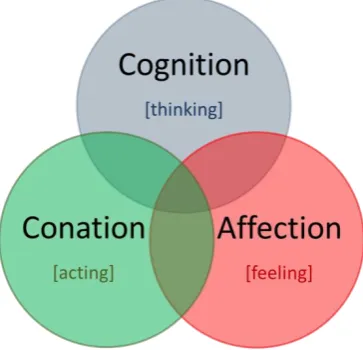
Figure 2 A classical tripartition of the human psyche (from Hilgard) ... 57
Figure 3 Reversal theory model (from Apter) ... 65
Figure 4 Telic vs. Paratelic states in reversal theory ... 66
Figure 5 Activity theory constructs after Leontiev - adapted from(Barabanchtchikov, 2007) ... 90
Figure 6 Scheme on the hierarchy of Activity components ... 92
Figure 7 von Uexkuell functional cycle of animal behaviour (from Eibl-Eibesfeldt) ... 98
Figure 8 Memory types (Squire, 1992; Squire & Zola-Morgan, 1991). ... 119
Figure 9 Evolution of the subcams used: a) first prototype, b)subcams from the ISP, c) Panasonic HX-A100 ... 140
Figure 10 Frames from content analysis part_004... 147
Figure 11 Frames from content analysis part_007... 151
Figure 12 An example of typical gesture caught with the subcam: handing the shoes to the sales assistant as marker of decision ... 151
Figure 13 Joint interpretation sessions at ESCP and ISP ... 154
Figure 14 Part_006 – replay - Building options ... 183
Figure 15 Part_006 – replay - Nearing the decision point ... 183
Figure 16 Part_006 – replay - Mirror episode and checking the ranking of factors ... 184
Figure 17 Part_006 – replay - Looking again at the shoe before the signal action of decision... 184
Figure 18 Part_006 – replay - Description of the environment ... 185
Figure 19 Part_008 – replay - Orientation phase ... 196
Figure 20 Part_008 – replay - Finding the focal shoe ... 199
Figure 21 Part_008 – replay - Episode of social interest ... 200
Figure 22 Part_008 – replay - Perception of items on display ... 201
Figure 23 Part_008 – replay - Negotiating the function of the shoe ... 203
Figure 24 Part_008 – replay - Considering an alternative model and handing the shoes to the sales assistant ... 205
Figure 25 Revised model of consumer behaviour based on phases from content analysis and participants’ explanations ... 249
Figure 26 Splitting of the model of consumer behaviour in paratelic and telic parts ... 252
Figure 27. The repisodic chain ... 263
Figure 28 Cognition versus affection ... 269
Figure 29 A general model of activity embedding the repisodic chain ... 271
[5]
Table of tables
Table 1 Overview of the PhD structure ... 29
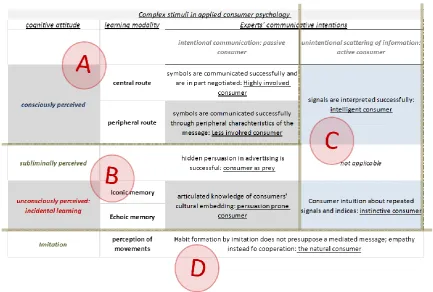
Table 2 Proposal of stimuli classification in consumer psychology ... 61
Table 3 - Scheme of comparison visual ethnography vs. first-person ethnography ... 111
Table 4 Table of the division of codes in 1st and 2nd levels ... 129
Table 5 Participants in the subcam experience ... 139
Table 6 Template for content analysis of subcam recordings ... 143
Table 7 Raw counts of events from subcam recordings for content analysis ... 145
Table 8 Division of phases for content analysis ... 146
Table 9 Duration of activity phases by total duration ... 152
Table 10 Phases of buying behaviour resulting from content analysis ... 158
[6]
Declaration
I certify that the thesis I have presented for examination for the MPhil/PhD degree of the London School of Economics and Political Science is solely my own work other than where I have clearly indicated that it is the work of others (in which case the extent of any work carried out jointly by me and any other person is clearly identified in it).
The copyright of this thesis rests with the author. Quotation from it is permitted, provided that full acknowledgement is made. This thesis may not be reproduced without my prior written consent.
I warrant that this authorisation does not, to the best of my belief, infringe the rights of any third party.
I declare that my thesis consists of 107.386 words, title, abstract, references and appendices excluded.
[7]
Acknowledgments
Researching and writing for a PhD thesis has proven a challenging and also a fortuitous one for some aspects. I would then thank in this page the persons who built the chain of events that brought me to the accomplishment of this special goal.
Chronologically I am indebted to prof. Mantovani of the University of Padua and prof. Perissinotto of the University of Venice for helping develop my hermeneutical sensibility and providing the initial presentation letters to come to the LSE. Further I want to thank prof. Jovchelovitch who introduced me to the framework of contemporary social and cultural psychology from where I started this intellectual journey. I am then indebted to my supervisor prof. Lahlou who accepted to take me on as a research student for this enterprise and who let me appreciate the wonders of first person ethnography. A really great thank to him as I learned that a steady and discreet presence of an expert is necessary to academic achievement.
I am also grateful to my participants who accepted to undergo the inconveniences that the method implied: wearing the camera in public spaces and doing the replay interviews. A special thanks to Bankole Falade who agreed in piloting the analysis and who participated in important discoveries about the SEBE method. Also a thanks to Sophie Le Bellu who kindly offered to be on video for the LSE Research Festival where this research has been presented in March 2014. Also a thank to the whole collegial companionship of the Department of Social Psychology for keeping the stimulus going in our discussions.
The technical side of this research would not have succeeded without the contribution of Steve Bennett and Steve Gaskell of the Social Psychology workshop at LSE; they are still on the forefront in the development of the subcam tools.
[8]
Abstract
This research is concerned with processes of choice in consumers and models of consumer behaviour. It also envisages a broader contribution towards economics in general to clarify how preferences in economic agents arise and change.
The research question is: “are the models and factors of evaluation predicted by experts applicable to real cases?” Factors of value and evaluation processes will be observed in real world participants and in everyday behaviour. The results will be compared to models found in the consumer
research literature.
The fieldwork will focus on a single activity carried out by a sample of consumers: shoe buying behaviour. The first set of data is drawn from 11+11 open ended interviews of participants chosen in the two complementary groups of experts and consumers for the purpose of construal
identification. The second stream of data relies on an ethnographic approach that involves recording first-person experiences by use of a miniature camera applied at eye-level, or “subcam” (17 participants). The recordings are analysed in order to reconstruct the choice processes through content analysis of events. The third stream of data in the research is produced by means of replay interviews conducted on those same participants who produced the subjective recordings
(selection of 12 participants).
Using a first-person ethnographic method allowed: (i) A more exact tracking of the actions involved in the choice process versus standard participant observation or in-shop surveillance cameras, (ii) intersubjective post-hoc account of the recorded activity and, (iii) elicitation of reflective
rationalization from the participants in narrative form. The material collected at this step underwent a special kind of process analysis involving memory registers.
Findings suggest the need to re-rank factors typically considered for choice in consumer behaviour. A fundamental rebalancing of weight must be attributed to habits versus rational evaluation as long-term factor of choice.
Equally short-term factors, like emotions and attitudes, acquire distinctive significance in connection with environmental cues that are susceptible to trigger their repetition in future shopping episodes.
The contribution to methodology is twofold. The empirical component extends the use of first-person ethnographic methods to self-reporting of consumer activities in addition to introspective and survey methods. Activity reconstruction led to amending consumer behaviour models by including the influence of social environment found in installation theory.
Keywords:
[9]
FIRST PART: Research question, literature review, methods
1 Introduction, research question and research ethics
1.1 Economics and Psychology
Over the last two decades there has been increasing reconciliation between
psychology and economics. The contention of this study is that the dialogue between
economics and psychology is being recovered after a long divergence begun with the first
marginalists. As has been recognized by historians of economics, the initial interest for the
psychological premises of classical authors like Smith and Marx, underwent a slow
evolution into a purely formalistic approach known as orthodox economics (Blaug, 1992).
This work wants to contribute something to another field, institutional economics, as an
alternative realm of explanation where the sub-field of consumer behaviour finds a
legitimate place.
Evaluation processes, choice and decision-making are notions now commonly used
in both economics and psychology, although they were first proposed in psychology.
Among the many branches of economics that have an interest in human psychology, two of
them stand out: behavioural economics and consumer psychology. The empirical field of
inquiry of this study relates to the latter, although some aspects of behavioural economics
will be dealt with. A specific human procurement activity in the consumer good area will
be analysed. So from the beginning the specific question of this work is defined: how do
people evaluate material objects in real life and how are these evaluation processes
accounted for in economic literature? The broader question has naturally to do with
economics in general: how does economic theory account for variation in empirically
observed preferences?
By considering the procurement activity of material objects of consumption, one is
bound to consider a whole series of phenomena that the decision process implies.
Procurement and consumption are indeed complex activities that have far reaching effects
on the aggregate scale. As a researcher in psychology I will however limit the inquiry to
[10]
consumer related activities. The empirical considerations I will derive from the research on
individuals will hopefully in turn shed light on the broad organization that brings about the
availability of goods and sustainability of the consumer market. Under this light the value
of an object becomes something more than just a personal preference, a rather restricted
notion, but also a matter of material relationship of consumer-artefact-external
environment, where external environment is meant the complete installation that makes
the economic transaction possible and the market as a whole. Under the notion of market
thus I include producers, locations where the products are stored and sold, the people who
design and advertise them, the financial and logistic support, etc., in practice what is
sometimes called the value chain (in a broad sense). This is why my discourse about
consumer choice will rest not only on the demand side but also will take into account
activities involved in the set-up of the supply side.
In contrast to mainstream economics which considers preferences to be individual, I
endorse the unorthodox view that artefacts, just like intellectual products or other material
and immaterial goods, predominately have a social, however local, value and that this local
value is connected with specific human activities and the social setting where such
activities occur. Since local utilities are given by a common use that is socially constructed
and culturally shared, both individual needs and the ways to fulfil them are also socially
steered. Moreover the perspective here endorsed considers a specific use value is learned
in the socialization process so that it is dependent on the ontogenetic cycle as well as on
the sociogenetic one. As an empirical proposition this research also addresses the problem
of the differences in preferences that might originate in the social context.
I would like to remind here that the first scientific connection between psychology
and economics was actually heralded by the interactional view of economic behaviour in
contrast with the mainstream. Tarde’s “
La Psychologie Economique
” (1902) was built on
the author’s knowledge of social psychological dynamics. His treatise however did not lead
a specific stream of study until Katona, an economic psychologist with a phenomenological
background. This last scholar started his work on social behaviour and economic attitudes
in the ‘50s, and he was among the first thinkers to state that classical economic models
implicitly owe their concepts to psychology: “
behavioural economics measures and
[11]
and expectations that influence decisions in economic matters
” (Katona & Morgan, 1980).
It should be noted that the author uses behavioural economics in a different way in this
passage than it would today. Here it stands for psychological economics as understood by
Tarde, ideally referring back to the psychological premises that characterized Jevons’ and
Bentham’s works in the early nineteenth century.
Since then, even though the construct of expectation suggested by Katona
remained in place, it has been studied by scholars of decision making and behavioural
economists with specific experimental frames of reference in a quest for formalization that
led to the progressive dismissal of the societal dimension.
From the point of view of social knowledge, the mentioned development is
documented by Kirchler and Hölzl (2006), who constructed an index from the
Journal of
Economic Psychology
showing the proliferation of ever more specialized sub-fields
common to the two disciplines. They found that topics like individual decision-making and
cooperation and competition showed the greatest increase, whereas topics like
socialization, lay theories and consumer expectations suffered a decline in interest. This
dynamic once again states the success of decision-making and limited rationality models at
the expense of social-observational methods. However, the rational expectation
presupposition has not completely monopolized either the public or all economics
disciplines. Mainly out of practical needs, some fields in applied economics have pursued
research on economic agents’ behaviour with observational methods. These fields can be
collectively called empirical economics and they correspond roughly to a series of
sub-disciplines in consumer behaviour, marketing, empirical economics, experimental
economics and preferences studies. This study can be placed in consumer psychology and
consumer behaviour studies that are understood as branches of empirical economics. My
literature review of consumer psychology, plus its connections to behavioural economics,
and to micro- and macro-economics, is presented in the chapter 2.
The methodological framework of this study, activity theory, is based on the
empirical methods explained below and on a non-mainstream view of human economic
behaviour. The latter requires a long explanation which is the final product/conclusion of
[12]
theory should no longer deal with economic behaviour but instead with economic activity.
Chapter 3 will review the literature of activity theory.
In the empirical part of this paper, I decided to gather my data from a specific
consumer sector, shoes. The reason for this choice is my professional background in the
sector that allowed me to learn the activities involved in the production and marketing of
shoes between 1992 and 2004.
I used three methods for three sets of fieldwork.
The first is semi-directive interviews a well-established method, included two
groups of consumers and producers. This served the purpose of getting acquainted to the
field to better understand the reasoning of the professional groups involved and their
major concerns when building their decision processes. It also gave me the opportunity to
test the acceptability of the subcam method and to find ways to recruit participants for the
following part of the study. This introductory part of the research is presented in chapter
4.
The second method is an innovative kind of ethnography that has been devoted to
the analysis of real buying behaviour in a natural setting. It makes use of subjective
cameras: these are small recording devices worn at eye level. They allow to record the
participant’s field of view continuously for a period of time (up to 2 hours in this study). In
the literature this methodology is referred to as subjective evidence based ethnography or
SEBE (Lahlou, 2011). The innovativeness of the method refers to the fact that ethnography
uses a first-person perspective instead of the traditional third person. As I will explain, this
partly overcomes bias problems inadvertently caused by the research process. Due to the
weight of data collected, this in part accounts for the small sample of 17 consumers. First
person accounts of activity are truly a booming field (I started the research process in
2010) and real world data are being collected by a host of tools and gadgets that
individuals wear or carry leisure (like Google Glass). Such devices have also generated the
life-logging field studies (Lee, Smeaton, Jones, et al., 2008). Methodology and samples of
[13]
The third method follows from the second but has to be distinguished from it
because it occurs separately and makes use of the video and aural data generated in the
second step. It revolves around face-to face interviews between the researcher and
participants and has been called a replay interview or confrontation interview by earlier
developers of the method (S. Le Bellu, 2011; Rieken, 2013). The aim of this interview is to
explain a participant’s activities by commenting on the subcam recordings following an ad
hoc protocol. The first-person recordings of activity done in the second part can indeed
stand on their own; however it would remain a dumb kind of data for the recordings do not
speak for themselves. The third part on the other hand obviously cannot be produced
without the previous one. The replay interviews are described in chapter 6.
Discussion of the analysis of empirical data is given in chapter 7, where I will explain
how these data modify the landscape of empirical research in consumer psychology,
marketing and possibly empirical economics.
I will conclude by referring to the psychological precedents in economic research
and why we should think differently about them after a first-person research into buying
behaviour. This will be done in chapter 8.
With this endeavour it is hoped to contribute a small methodological brick to
empirical economics and suggest why mainstream economics should become much more
unorthodox than it is now. I also hope to give some indication of how real-world
observations can affect the abstract assumptions concerning human rationality still so
pervasive in many branches of economics.
1.2 The marketplace, consumer psychology and economic theory
On different levels, the marketplace is the field of inquiry for consumer
psychologists, marketing experts as well as anyone else interested in an economic
procurement activity. Traditionally methods have been developed to measure how
markets work, either of individuals (the realm of ethnography) as well as of groups of
micro-[14]
economics). These approaches can be described as observational, because they stay
neutral both on assumptions on participants and on methods.
The distance from economic
theory, be it macro, micro, or political economic, is notable: the latter are theoretical
approaches that look at aggregated data to confirm or reject models of economic
behaviour that are built on a certain idea of how humans should behave in complex
societies.
The ethnographic approach, or micro-psychological one, I am advocating in this
thesis refers rather to individuals immersed in their cultural and material context and asks
essentially why individuals do what they do in those places and circumstances. This is quite
different from simply asking why people behave in a certain way. Also I am trying to
discover if people do what they say they will do and if they recognize what they do; this
part is done through the empirical observational method cited above. Finally the aim of a
complex ethnographic approach is to build a model of economic preferences in a much
more efficient way and to link them the participants’ activities accounts.
The natural frame of reference of this study is then consumer psychology and
behaviour, in that I choose not to refer to economic models at the level of individual
observation, but to trace regularities of behaviour only as a result of the finely detailed
screening of activities involved in the buying process observed.
By looking into people’s activities, one cannot hope to encounter a representative
sample as for example in marketing studies. Demographic factors are not assumed to say
much about people’s activities at this stage. If this is the case, what can one hope to
discover through such a study that is relevant for economics theory? The contention is
that the detailed data scrutinized in this study in the form of smaller actions, tasks, goals,
purposeful behaviour, motivations can become the material for a different frame of
reference for grand theories: away from alleged psychological regularities of a higher
order, towards different regularities of a lower order.
By doing so we will probably have to renounce constructs we are accustomed to,
like attitudes or preferences, and embrace constructs that are found in older studies,
[15]
and others are linked more to activities than to internal cognitive states, so that some
concepts in the literature might be linked to real-world observation differently.
As for the similarity of individuals in different groups, this study, while not
indicating precise groups, will provide the material from which clusters of representative
activity patterns are derived instead of beginning from demographic groups.
The product of interest in this study is shoes as a representative consumer good.
Everyone in western society is concerned by shoes, both for physical, objective reasons
(protection) as well as for social reasons (fashion, group-belonging etc.). It is also
conceivable that consumers build personal relationships to products and that shoes are no
exception. This means that in seeking information, selecting and deciding, the actor
participates in social practices that are at one time distinctive of each participant and
possibly common to given cohorts or social groups. As the literature claims, such practices
will entail distinctive linguistic patterns.
The final decision of which item to buy is then at the end just accessory to the final
experience. As is understandable, each individual will have her/his own preferences for a
single product but the product itself will have little to say about the whole process that
leads to its purchase, if anything at all.
Economic approaches are much more interested in whether choice is a product of
rational decision making and ultimately if it is rational at all. A rationality versus
irrationality opposition has been among the most appealing schemes in the western
tradition and is still used in economics. The literature in behavioural economics, for
example, is in fact largely informed by such a normative approach. The underlying
presumption is that rational behaviour is the norm in real-world humans. This makes of
the mainstream economics approach a top-down one, a model building exercise through
the revision of rational models whenever reality seems to diverge from the model.
On the other hand, the research on economic behaviour in consumer psychology
has a distinctive empirical approach. Researchers in this field observe the market and its
participants mostly by describing what they do and trying to formulate psychological
[16]
The most popular vision of the rational economic agent is still derived from
mainstream economics with the main assumption that describes behaviour in terms of
rationality and irrationality.
In the western culture decision theory has seen humans as being of two minds, one
rational, one irrational. As I suggested above, this belief has existed since antiquity and is
found in classical economic thinkers; J.S. Mill for example:
Men often, from infirmity of character, make their election for the nearer good, though they know it to be the less valuable; and this no less when the choice is between two bodily pleasures, than when it is between bodily and mental. They pursue sensual indulgences to the injury of health, though perfectly aware that health is the greater good.
(Mill, 1972 [1863], p. 14)
The fact that this view still persists after centuries points to its saliency in real life
events. As we have seen, decision making studies traditionally have not distinguished
contingent decision processes (the actual activity) from prospective decision processes (the
declared modes of evaluation). This distinction, however, would provide a justification of
the core difference between an experimental discipline based on presuppositions of
rationality and an observational one concerned with inconsistencies in behaviour.
Kahneman’s work seems to paint the same picture; humans are endowed with two quite
separate modes of thought that come into action depending on the circumstances of the
decision process. The quote below, while stating the above also questions the classical
picture of the two minds, suggesting going beyond it. He also implies that new research
should dig into the causes of what traditionally has been called irrationality:
The time has perhaps come to set aside the overly general question of whether or not people are rational, allowing research attention to be focused on more specific and more promising issues. What are the conditions under which the assumption of rationality can be retained as a useful approximation? And where the assumption of rationality must be given up, what are the most important ways in which people fail to maximize their outcomes?
(Kahneman, 1997, p. 124)
This corroborates the turn that behavioural economics has undergone becoming
much more empirical than experimental. For several decades the tide has turned towards
natural decision making (Ainslie, 1992); this is the very moment in which the situated
[17]
has been the lack of methods to investigate natural decision making (Ariely & Norton,
2007). This work aims to build on this fundamental distinction with the introduction of the
mentioned ethnographic subject-based method (Lahlou, 2011) to start filling in this gap
with a new methodology that effectively taps into the moment of decision.
1.3 Activities and Environment
Having found that economic theory is a composition of factors the traditional
dichotomy of factors in two general classes: factors that are internal and factors that are
external to the individual. The former are factors such as cognitive ones, personality,
rationality and everything that derives from the agency of the person involved in the
economic decision. I add to these habits, that for the time being might be considered to
originate internally and are traditionally placed under the cognitive label. The latter are
what usually are seen as influence factors, such as the physical environment, advertising,
social encounters, social setting, also collectively defined as being cultural. I set aside
evolutionary factors that are a class of their own and belong to even broader accounts that
as such are widely debated and, probably, cannot be tested empirically on participants.
If decisions do indeed comprise an evaluation process that to some extent follows
rational utility, but which is also dependent on affective states and ecological affordances,
the question becomes: how is it possible to reconstruct the decision process that account
for environmental and habitual factors that are as a rule excluded by theory? How is it
possible to consider decisions as a unitary process if orientation, information gathering,
consideration, selection and decision are composed of a host of small steps? Is there a
unifying principle of coherence in all such behaviour? How does a planned course of action
include rational values (various types of long-term utility) and how are those realised in
real-world situations? Naturally these are complex questions and I do not pretend to
answer them at this stage in this manner, but it is at least possible to account for some of
[18]
Since we seem to be dealing with processes of two distinct psychological natures
here, one about how subjects think of something and the other about how they act
towards it, a clear strategy to recognize these two cognitive states has to be determined.
As suggested above, if the evaluative dimension refers to general motives and attitudes
whose coincidence with actual behaviour must be assessed, empirical investigation has to
address both problems under the constraint of action in real-time. To act in a situated
environment seems in fact to be a very different psychological situation than to describe a
prospective or imagined action. Traditionally self-description of prospective behaviour has
always been a narrative exercise in explicitation of intentions that may or may not coincide
with what the individual will ultimately do. Indeed intentions and expectations can be
substantially different from actual behaviour. Situated decision points are actual deeds,
intense and engaging emotionally, during which he/she will experience a cognitive shortfall
and is bound to trim and modify his/her tasks in unforeseen ways (Herbert A. Simon, 1990).
Such discontinuities constitute the experiential inflection points that are object of the
empirical study.
For the time being I would like to address these two dimensions of evaluation and
decision as two hypothetical constructs; but how is it possible to get grip on them? The
material I plan to evaluate for this purpose will be videos and post-hoc verbal interviews on
them. The mismatch between real-time action and verbal report is obviously not
completely overcome by this method, but current research shows that it approximates
actual behaviour quite effectively by tapping into different types of memories (Brown,
Dilley, & Marshall, 2008). Ethnographic subcam recording belongs to this class and adds to
the methods of elicitation of past actions through a shift from recall to recognition (Heisley
& Levy, 1991). It is in essence a special kind of introspection that I will use to produce a
guided explanation of a choice that has been recorded by the participant. What usually
gets lost with the decay of short term memory after an activity has been completed, is
partially preserved and with the help of the participant made available to observers. This
kind of recording also makes observation more certain and enhances validity as recordings
can be reviewed at any time in the future.
The empirical case studies considered here are situated actions, traditional buying
[19]
consumer good. Often buying situations lead to deviations from initial objectives due to
many environmental and interactional distractions that are difficult to foresee. The aim is
to clarify how unexpected and implicit factors influence the final decision.
Recent work conducted with the ethnographic method of subjective point of view
recording has already produced findings in emergent behaviours driven by technological
change, where it is possible to compare hypothetical formalized sequences of actions with
real ones. The use of mobile phones is an example; it has been monitored at France
Telecom and UC Irvine to pinpoint elementary decision steps of activities like sending a text
message (Christensen, Gilleard, Mark, & Shafae, 2001). Ethnography applied on consumer
behaviour has seen great development in the 1990s with sophisticated results and
applications (Underhill, 1999). However, it has been seen how micro-activities often go
unnoticed when a participant is observed by a third party. In marketing the subcam (also
called mindcam) has been tested in shopping malls as an extension to commercial
ethnography done with a fly-on-the-wall camera or simple written accounts of observed
behaviour. Researchers have noted how this method can be extended to environmental
cues such as the look and feel of lighting, the aesthetics of an environment, the nature of
sounds and music, the stillness or business of the setting (Starr & Fernandez, 2007). On
another level of subjective experience these same researchers observe how it is possible to
faithfully recreate participants’ experiences: “
what they see, what they hear, what they
say, where they move, how long they spend in each area of the premises, what they touch,
what they do purchase, what they do not purchase, what they say, and how others interact
with them
” (ibid.). It is further pointed out that it had never been possible to recreate the
subject’s experience in such detail before. Activity theory adds to these empirical findings
the insight that what was normally considered a simple deterministic behaviour is in fact a
complex bundle of reactions and proactions brought about by stimuli selection coupled
with personal cognitive elaboration steered by overarching motives (Lahlou, 2011).
Activity theory has undermined the assumption that the individual operates
through independent streams of activity that can be easily chunked as implied by the first
wave of behaviourism. This constitutes an important step forward because purposiveness
could be considered to give coherence to the succession of activities. However,
[20]
tradition. Activity theory links decisions and actions with purposes and goals that in turn
imply basic needs, but also more abstract overarching motives hard to account for in the
behaviouristic stream. This model shifts the focus from reactive to proactive behaviour
where larger motivations can be accounted for as the source of individual as well as
organizational conatus (Lahlou, 2010b). Following activity theory, the construct can be
further divided in terms of tasks of various hierarchical and temporal levels. Each task
would then entail additional local and contingent motives. Although a coherent model of
human activity still does not exist, the two main dimensions of sequential and hierarchical
ordering of acts and motives seem to be present in every seminal author (A. Leontiev,
1989), (Von Cranach, Mächler, & Steiner, 1985).
Motives explain why even in the presence of deviations from prior deliberation,
humans are able to find their way in the complexity of the physical and social world.
Activity expands the fundamental opposition of the rational versus the affective by
showing that unexpected diversions in the course of activity are not solely dependent on
individual but they are largely caused by environmental affordances that both lead and
constrain human plans, making human actions highly unpredictable in the short run but
remarkably consistent in the long run by virtue of their superior motives (Nordenfelt,
2007). Finally, from an interpretive point of view for the empirical material, motives can be
considered as hierarchically more important than what is usually called rational evaluation;
they are much more persistent than rational decisions and contribute to give unity to
sequences of divergent activities.
As said above, the unifying construct of motivated activity is assumed to be the
principle that links the rational, affective, cognitive components of a decision path. The
contributors are unfortunately quite unrelated; because each of them started from very
different needs. In any case one has to consider these precursors of the concept are James
and the pragmatists, ethologists like von Uexküll and Lorenz, phenomenologists like Talcott
Parson and Alfred Schutz, the Russian school of Leontiev and Rubinstein, down to von
Cranach and many researchers now working on human goals. Each school has its own
concepts of act, action, activity while maintaining the underlying link of motive and action.
I will come back to activity theory in the section on the replay interviews and in the general
[21]
A completed course of action, beginning from the initial desire and through the final
deliberation is the pattern I aim to describe through a reconstruction of the participants’
accounts of buying situations. In the analysis of the replay interviews I will try describe the
initial goals, flag the probable deviations from the initial deliberation and reveal how the
course of action actually developed in contrast with the participant’s narrative
reconstruction. I will assume that most participants are unaware of the large number of
nested sub-activities that compose the entire activity. Hopefully, it will be possible to
outline the short term deviations and local goals and contrast them with long term
evaluations. Also I will try to assess how much the situated action is dependent on the
environmental context when compared to long term evaluations expressed as a narrative.
Methodologically long term evaluations are usually elicited through open-ended
interviews and which I also intend to carry out. Long term evaluations and motives are
ultimately compared with short term deviations and local goals using a mixed method
approach. As anticipated, this will include open-ended interviews (chapter 4) and the
subcam method (chapters 5 and 6). It makes sense to think of long term evaluations as
referring both to goods and to general values concerning consumption, lifestyle and,
perhaps moral values, which are easier to elicit through open-ended interviews
(Jovchelovitch & Bauer, 2000). The replay interview would then confirm or contrast with
the picture from simple open-ended interview, by virtue of the differentiated cueing used
in the protocol. The path to higher motivations is somehow longer in this case because the
method aims at shifting the search for motivations from pure introspection to a
retrospective assessment with the help of images. What these motivations were would
then be inferred from their connection with the material task recorded. Prospectively the
interview genre might steer from the narrative towards the episodic register (Flick, 2000).
Another methodological concern in this research is how a new perspective on value
in economics can be attained. In my opinion the usual methods of surveying or
interviewing adopted in industry would benefit from a description of the modes of value
satisfaction conducted in the first-person ethnographic approach would allow to look at
micro-level activities as the new basis of discussion of value in abstract. As has already
been pointed out in recent literature, evaluation would become a process that is
[22]
then be satisfied through actions that are not only directed towards changing the
environment, but are truly performed in order to attune internal motivational states to the
goals (Tory Higgins, 2005). The real cases observed will hopefully contribute to discover if
patterns of actions are independent from specific environments, in other words if the
participant would behave in the same way in alternative environments or not.
1.4 Rationality, rationalization and practice of economic exchange
This section suggests a distinction between the actors involved in economic
exchange that is shared by microeconomics and consumer psychology: consumers and
producers. This division is not very different from the one retained in the more abstract
economic theories such as macroeconomics and political economy. These use terms like
and demand or consumption and production, including the presence of distinct social roles
that can be traced back not merely to attitudes or taste but more significantly to material
activities. A different picture might emerge in psychology where this classification is not
normative but constitutes a starting point for experimentation.
From a societal point of view a third category must be added to the above division:
economists and social scientists in general are the ones who are endowed with awareness
at the societal level, i.e. are conscious of the market. To distinguish among experts and
non-experts is a traditional division of the field of economics that maps polar categories
traditionally considered in the sociology of science: theory vs. practice (Schütz, 1946).
These three social groups, although participating differently in the economic
equation, can be understood to be stakeholders in the economic process; they constitute
the ideal sample for my research. However, since the method is observational, an
expansion into sociological categories has to be advanced with care. It is however useful
to keep in mind that theorists are the ones responsible for the concepts that are used in
economic theory and as a consequence for the words we use to describe phenomena.
Their link to the research is ultimately about words: are same words used with similar
[23]
Furthermore, the theoretical division into three groups is useful to understand the
two groups of physical stakeholders of the economic exchange, consumers and producers
and if and why the two behave differently towards same products (here consumer goods).
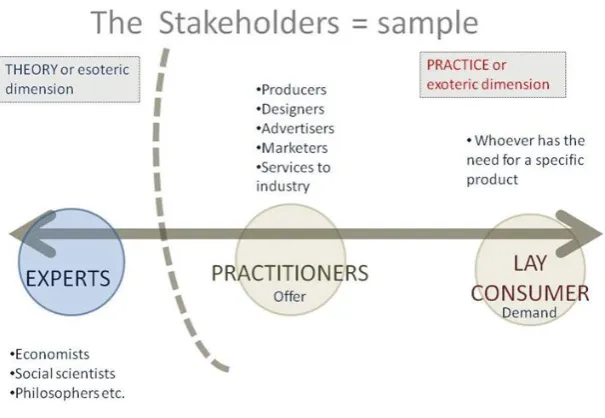
The following diagram suggests that the group of experts is not part of the
economic process itself but they are observers of the economic process; they are assigned
the task of rationalizing the material processes of economic exchange. While a
measurement of the success theorists have theoretically remains beyond the scope of this
study, I suggest that this could become a research venue for applied linguistic studies at the
[image:23.595.176.479.273.482.2]crossroads between psychology and economics.
Figure 1 Theorists vs. practitioners
The scheme suggests that theorists hide behind a one way mirror through which
they are allowed to contemplate what the public does but where the opposite is not
necessarily true. The public generally is not interested in and as a rule might not
understand what theorists are doing. As has been pointed out, the two domains of
scientific understanding of human activities and public understanding of the same do not
match and often ends up in an opposition of rational and irrational representation of
human activity (Moscovici, 1993). Traditionally, experts are those who know about the
theories, are able to discuss them and provide alternative models to amend those. Experts
are such not only because of their objective knowledge but also because of the acceptance
of their role by the surrounding social milieu. Such acknowledgment fulfils the other
[24]
essence today experts in the economic field are represented by a vast range of academic
economists and social scientists whose quality (or alleged one) is measured in the arena of
esoteric scientific discourse, of which peer-review is but one form. By contrast I will
consider as inexpert everyone else who is described as an actor in expert accounts, and
these are the real stakeholders in economic exchange. These are also what I call the
physical stakeholders in the process observed in this study. Furthermore, since economics
is traditionally divided into supply and demand, the separation in
producers/suppliers/retailers and consumers ultimately makes sense: this is the division of
the sample in the first data set of open ended interviews discussed in chapter 4.
Market stakeholders are on the other hand the physical market, where situated
instances of selection, choice and consumption of a product occur. The material produced
by these groups is of a different nature than theory. It is indeed possible to study
suppliers/retailers and consumers through direct methods such as interviews and surveys,
with the aim of building representations of the economic exchange or in other words
models of their behaviour. Although it is not the aim of this study to create social
representations of consumer choice, I conducted some exploratory interviews to collocate
the knowledge involved in the consumer selection process. For this purpose I selected a
sample of insiders to approximate the supply side of the specific market. These
participants represented the one pole of the knowledge of market stakeholders, those
involved in production, distribution and general services. For the third group, the
knowledge of consumption, I selected 11 shoppers in London in 2011. The two groups of
stakeholders are quite homogenous and provide a good introduction of the practices
involved
through 11+11 open ended interviews.
In short, experts are the rational side of the equation and are responsible of
interpreting what stakeholders do. I will portray the theoretical side of the problem in
chapter 2, discussing consumer psychology, behavioural economics, and economics in
general. In particular behavioural economists lately have become the most well-known
group of economics esoterics in our society. These are experts who in the last 40 years
have produced models of economic behaviour referring to psychological constructs like risk
aversion, preference reversals or time-discounting; such constructs have been tested
[25]
mechanisms of evaluation and choice whose model come from cognitive studies and suffer
from a poor mapping power onto real-world phenomena for this reason. Behavioural
economics is however responsible for several of the social representations our society
holds about economic exchange due to the popularization of studies that fall under its
umbrella (Thaler, 2008), (Gladwell, 2000), (Kahneman, 2011). On the other hand, studies in
consumer choice have a marked observational bent and suffer from the opposite problem,
a difficulty in contributing to larger theories.
The literature review in chapter 2 will consider of the three kinds of theory
discussed above. The material will also be treated as data itself in quantitative text analysis;
this method has the advantage of chronological ordering and of being replicable by anyone
[26]
1.5 Research question and field of exploration
The research question includes a summary of the problem of the relationship between
the knowledge of theorists about the economic process and the economic process as
performed by real actors. It is also about the content of the economic process, in fact in
order to unveil it the study will examine actual behaviour and will conclude describing
those behaviours. The question that embraces to these two concerns is:
“Do factors of evaluation in real world consumer choice match the ones found in the
relevant literature?”
In each chapter I will try to answer the following questions. In the literature review:
1.1)
What are the factors and paradigms of consumer choice in consumer
psychology, consumer behaviour and related economic literature? Is it possible
to group those factors in specific classes?
Concerning the knowledge of market stakeholders (open ended interviews):
2.1)
What do producers and suppliers think are the main factors of choice?
2.2)
What do consumers think are the main factors of choice?
Concerning real world consumer behaviour (situated first-person observation and replay
interviews):
3.1)
How do actual instances of consumer evaluation and choice occur?
3.2)
How are those behaviours rationalized and explained retrospectively? Are there
common patterns of explanation?
To summarize the issues emerged in this research:
1) The study of human evaluation processes is ancient, entailing virtually the history of
philosophy down to economics. Some fields in economics like behavioural and
experimental economics and psychology in comparison are new disciplines, and are both
concerned with evaluation, choice and decision making although with different
approaches. Consumer behaviour is again concerned with evaluation and choice but with a
more material and situated approach.
[27]
representational kind of reasoning and evaluation. I suggest operationalizing the concept
of rationality in this research by attributing to it a set of characteristics: long-term process,
reasoning, long-term memory, weighing of alternatives, prudence, in essence the usual
suspects that relate to a cognitive approach to the question. Typically, theorists in
philosophy and economics until mid of the 19
thcentury when psychology and historicism
were born, have understood deviations from the norm of rationality to be weaknesses of
will or biases. Consequently, competing models between the two human faculties of
explicit-representation and of implicit, cue-based or emotionally driven action could not be
developed before the advent of scientific psychology.
3) An alternative approach to evaluation, choice and decision making has in my opinion
to contain not only the two sides of human action, rationality and emotion, the
dual-processing models (Chaiken & Trope, 1999), but also a third aspect that is not accounted
for in the classical models, the habitual dimension.
The traditional concept of rationality would mirror the first part of the dual-process, the
emotional/implicit/primed psychological mechanisms would refer to the second part,
whereas habit would be the third part of the equation. The latter takes into account the
ecological constraints of the process that pertain to the bodily extension of the mind and
its movement as well. Choice and evaluation are then bound to take into account these
three dimensions in which reasoning is put on the same level of relevance as emotional
states and situated activities.
4) Activity theory is the paradigm that will help to integrate constructs like motivation,
goal, evaluation and decision in a better model compared to the simple opposition of
reason and emotion. Aim of this study is further to ascertain the different moments into
which the economic activity under consideration can be divided. It will be discussed if
activities implied by evaluation and choice are explicit versus implicit and how much they
depend on environmental and socio-institutional constraints.
5) Because of the presence of an eco-social track, the process of evaluating and
choosing a consumer good shall be theoretically addressed using a social constructionist
approach. Many factors, attributes, installations and institutions contribute to directing
individual choices and are ultimately responsible for the most individual decisions and most
of all for fixing habitual behaviours. Habit formation is what replay interviews intend to
assess among other phenomena.
[28]
medium, but also the long-term motivations that are neglected particularly in behavioural
psychology.
[29]
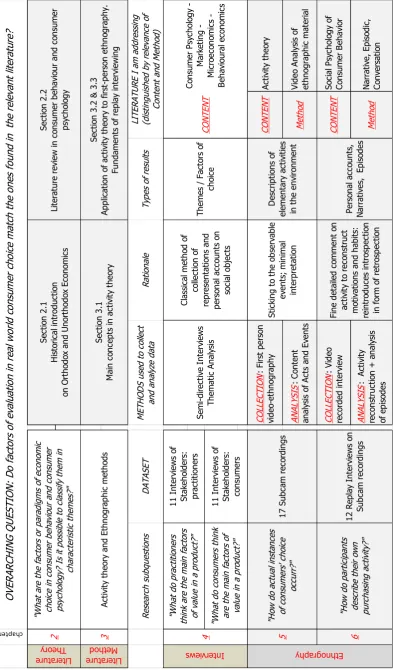
[image:29.595.132.526.57.728.2]Table 1 Overview of the PhD structure
ch ap ters Re se ar ch s ub qu es tio ns D AT AS ET M ET H O D S us ed t o co lle ct an d an al yz e da ta Ra tio na le Ty pe s of r es ul ts CO LL EC TI O N : Fi rs t pe rs on vi de o-et hn og ra ph y Ac tiv ity t he or y AN AL YS IS : Co nt en t an al ys is o f A ct s an d Ev en ts Vi de o An al ys is o f et hn og ra ph ic m at er ia l CO LL EC TI O N : Vi de o re co rd ed in te rv ie w So ci al P sy ch ol og y of Co ns um er B eh av io r AN AL YS IS : A ct iv ity re co ns tr uc tio n + a na ly si s of e pi so de s N ar ra tiv e, Ep is od ic , Co nv er sa tio n Se ct io n 3.2 & 3 .3 Ap pl ic at io n of a ct iv ity t he or y to fi rs t-pe rs on e th no gr ap hy . Fu nd am en ts o f r ep la y in te rv ie w in g Lite rat ure Met
hod 3 4 5
[30]
1.6 Ethical issues in this research
The present study involved a complex protocol for data gathering and some novel
considerations concerning the ethnographic fieldwork. The first consideration is about the
spaces chosen to recruit and observe participants. In Britain a distinction between Public,
semi-public and private spaces is made. In such spaces some research actions are allowed
without consent and some others are not.
In study 4 (face to face interviews) participants were approached in a semi-public space
in London, Somerset house, where the beneath mentioned fashion fairs were held (section
4.1). In this case the protocol involved approaching the participants stating why the
researcher would like to interview them and how the interview will unfold. The researcher
introduced himself as a PhD student doing a research about consumer behaviour and
stating that the interview will consist of around 8 questions for a maximum time of 15
minutes. As some of them did not mind being interviewed for longer and seemed to enjoy
the process, some recordings turned out to be up to 40 minutes. Almost all participants
have been interviewed inside the fair coffee shop where professionals in the various
branches of the industry convened to eat, drink and have a rest. Some participants were
interviewed outside in the scenic internal court of the building. For this study the
researcher used always an audio recorder and in few cases a video recorder although video
material was subsequently not used in the research.
In study 5 (subcam recordings) participants have been recruited through advertising at
the University and directly by the researcher in his circle of acquaintances. One participant
was also recruited by chance in a pub through small-talk. To all of them was given copy of
a participation sheet explaining what the recording was about (PDF in appendix). They
were required to sign and give it back to the researcher with name, contact and signature;
they can be viewed any time. The form used for this research is a standard form used in
subcam experiences since some years by Prof.Lahlou in various countries where he
recorded diverse experiences. No compensation was promised to anyone for participating.
Participants were given a copy of the recording to thank them for participation. All
participants have been adequately explained that the research was about consumer
behaviour and more specifically about their own behaviour. The researcher first showed
the subcam recording tool in order to make sure that they would like to wear it for a longer
period (two hours was the projected time of experience).
[31]
encounter the wearer have their image captured without the opportunity to provide
informed consent. Over the course of a typical day, a participant may encounter many
people. These people may be photographed, knowingly or unknowingly, and will not have
the opportunity to provide informed consent. In traditional methods, there would likely be a
single image and those nearest the photographer (so most prominent in the image) would
have an understanding of being “photographed”; this is not the case for automated,
wearable cameras
” (Kelly et al., 2013). A similar position is held by Kirkup and Carrigan
who also recognize that the continuously updated guidelines proposed by several agencies
(
UK market research society, ICC international chamber of commerce, ITC Independent
television commission, ESOMAR
) are at the stage of voluntary adoption and ultimately
relying on the professionalism of researchers. They also insist on the collection and
archival of written consent for participation and disclosure of future uses of footage (Kirkup
& Carrigan, 2000).
In the main codices of research conduct a distinction is done between inadvertent
recording and purposeful recording by researcher. This issue is slightly different for the
subcam device because the participant is actually steering the device not for research
purposes but following natural behaviour; this fact is even less documented and until now
not censed. In my research since recording consumer behaviour did not involve any
sensitive activity or any disadvantaged or protected group in the British society, nor
involved filming in private spaces, it was considered safe to let the participants use them
freely to do their shopping trips. To my knowledge as shops are classified as semi-public
spaces it is allowed to use video-wearables (wearable electronic devices containing video
capture systems) inside them if not explicitly advised outside the shop. Persons that are
inadvertently caught on camera while walking around in the shop are obviously not
debriefed for the reason that being in such a space they cannot presuppose not being
filmed by fixed or mobile devices (Wiles et al., 2008).
Since in this research the participant engaged in normal consumer exploration
activity but also interaction, it has indeed happened that some of them have been
recorded. This possibility refers especially to shop assistants inside the shops. The
approach taken has been to instruct the participant to tell the shop assistant about the
recording tool as soon as she had the impression that they wanted to know more about the
device. Participants have always explained what the subcam was and indeed many of
them did not object to the recording. In few cases they did not give consent (see
subcam
editing participant 005
) so that the participant left the shop immediately. The researcher
[32]
to prices. However made sure that this was not the case they had the option to agree or
refuse filming.
In study 6 (replay interviews) ethical issues involved were compatible with the usual
protocol for face to face interviews conducted in a closed space. It must be noticed
however that such interviews present some new aspects for participants when confronted
with recording of their own behaviour in first-person perspective. As this procedure is
somehow revelatory of fine details of own actions and routines some persons could feel
embarrassed in discovering aspects of their behaviour that they did not imagine to be
revealed. Partly because this study did not involve any self-directed activity, and because
of the public nature of shopping, such events did not occur. From the point of view of the
effort however it must be noticed that this sort of interview was probably perceived as
tiring also because the researcher had to be slightly pushy in rehearsing twice or three
times the same excerpt of the subcam recording. This is understandable also in the light
that participants were not compensated for spending time in this way.
[33]
2 Theoretical literature
This literature review like the rest of the paper is best framed by a question: what are the main paradigms in the literature concerned with evaluation and choice? As a starting point it begins by defining some keywords such as consumer choice, consumer decision making, consumer behaviour, rational buying behaviour and so on. This obviously is difficult if one wants to deal with all the work relevant to the question. At this point it is enough to say that many aspects of the problem are found not only in consumer psychology and consumer behaviour literature but also in behavioural economics, microeconomics and in the parent fields of macroeconomics and political economy. To get a comprehensive view of consumer choice it will be necessary to refer back to classical authors to understand how older models of economic behaviour can still be subsumed in recent ones and what they still have in common.
I will first draw with very large leaps the economic landscape in which this study finds its place. I will recall the classic division between neo-classical economic thought and Institutional schools in economics.
Subsequently I propose to analyse how evaluation and choice have been dealt with in consumer research, consumer psychology, down to the more recent social psychology of consumer behaviour. I will make the point that the literature in consumer behaviour is quite distinct from that of consumer psychology and that the two are generally contrasted as anecdotal versus scientific and how this is nowadays a controversial position. Finally, the contribution made by experimental economic psychology (behavioural economics), a field well respected by economists but largely lacking adherence to empirical data.
In section 2.2 I will consider the still more general disciplines of micro- and
macroeconomics in order to highlight the general assumptions among economists. The question I am interested in at this stage is classifying perspectives of economists in a few classes and compare them to consumer researchers. I will make the point that economic theories (especially
macroeconomics and political economy) are largely prescriptive; as such they influence applied research with predefined conceptions of human behaviour. How larger theories have the power to orient applied research will be discussed.
Finally thinking about economic behaviour traditionally implies a twofold division of
[34]
also try to keep in the foreground how different fields of inquiry of economic psychology apply their models empirically.
The chapter is divided in the following sections and subsections:
Section 2.1. How the two classical strands of economic thought have dealt with
individual preferences and utility: orthodox and heterodox economics
Section 2.2. A comparison of three fields of study: consumer psychology,
consumer behaviour and behavioural economics.
Section 2.1.1 A bird’s eye view of the relevant literature in consumer
research
Section 2.1.2 The constructs used in consumer psychology and how
this more recent literature has evolved over the last two decades.
Section 2.1.3 How consumer behaviour is distinct from consumer
psychology.
Section 2.1.4 Behavioural economics, economic psychology and their
connections to economic disciplines.
Section 2.3: Summarizing how the concepts of preferences, choice and