Journal of Chemical and Pharmaceutical Research
__________________________________________________
ISSN No: 0975-7384 CODEN(USA): JCPRC5
J. Chem. Pharm. Res., 2011, 3(6):655-664
Improved dissolution of domperidone in solid dispersion with
polymeric hydrophillic additive
Rajender Guleria1, NS Kaith2, Ranjit Singh3
1
Govt. College of Pharmacy, Rohru, Distt. Shimla (HP) India 2
K V K, Rohru, Distt. Shimla (HP), India 3
Scoohl of Pharmaceutical Sciences, Shobhit University, Meerut, (UP) India
_____________________________________________________________________________
ABSTRACT
Being an effective prokinetic drug, poor bioavailability of Domperidone because of poor aqueous solubility limits its therapeutic and other uses. Currently, several products of this drug substance are available in the market. Solid dispersions of domperidone were prepared using polyethylene glycol (PEG) 4000 as carrier. They were evaluated for solubility study, drug content, intactness of the drug in the formulation and dissolution. FTIR spectral, XRD and DSC studies were used to characterize the solid dispersion and to study the possibility of drug interaction with carrier. The dissolution of domperidone from the solid dispersions exhibited higher rates of dissolution and dissolution efficiency values over that of pure drug. The study indicates the solubility enhancement property of PEG without significant interaction with test drug, domperidone.
______________________________________________________________________________________
INTRODUCTION
insoluble drugs has shown to improve their dissolution character when converted to solid dispersion [3].Solid dispersion technology is a well known process used to increase the dissolution kinetics and oral absorption of poorly water soluble drugs using water soluble inert carriers [4]. The use of hydrophilic polymers as carriers for the dissolution enhancement of poorly water-soluble drug is increasing [5]. Various hydrophilic carriers such as polyethylene glycol [6], polyvinylpyrrolidone [7] and sugars [8] have been investigated for improvement of dissolution characteristics and bioavailability of poorly aqueous soluble drugs.
Domperidone (5- chloro- 1- [1- [3-(2- oxo- 2, 3- dihydro- 1H-benzimidazol- 1- yl) propyl]- piperidin- 4- yl]- 1, 3- dihydro- 2Hbenzimidazol- 2- one) is a D2 receptor antagonist and
increases gastrointestinal peristalsis and motility that prevent reflux esophagitis. It is used as a prokinetic and antiemetic agent for the treatment of gastroparesis, nausea, and vomiting [9]. Domperidone is a weak base with good solubility in acidic pH but in alkaline pH, its solubility is significantly reduced [10]. The oral bioavailability of domperidone has been reported at the range of 13–17% [11] and it has poor aqueous solubility (0.986mg/L) too [12]. Polyetheylene glycol (PEG) has been used for the preparation of solid dispersion as component of binary system for various drugs. The present investigation aims to evaluate the potential of solid dispersion (SD) technique for domperidone using polyethylene glycol as hydrophilic carrier.
EXPERIMENTAL SECTION
Materials
Domperidone was received as gift from Arion health care Baddi (Himachal Pradesh, India). PEG 4000 was purchased from Sigma Aldrich, Germany. Double distilled water was used throughout the study and all the other chemicals used were of analytical grade.
Solid Dispersions of Domperidone
Solid dispersions of domperidone at four mass ratios (1:1, 1:3, 1:5 and 1:7) were prepared by the fusion method. PEG 4000 was placed in a porcelain dish and allowed to melt by heating up to 70°C. To the molten mass, an appropriate amount of domperidone was added and stirred constantly until homogenous dispersion was obtained. The mixture was cooled rapidly by placing the porcelain dish in an ice bath for 5 min to solidify with continuously stirring, then powdered in a mortar, sieved through a 100-mesh screen, and stored in a screw-cap vial at room temperature for further use.
Determination of Domperidone Solubility
Drug Content Estimation
The drug contents in solid dispersion were determined by the UV-spectroscopic method. An accurately weighed quantity of solid dispersion equivalent to 10 mg of domperidone was transferred to a 100 ml volumetric flask containing 20 ml of Dimethylformamide (DMF) and dissolved. The solution was filtered through 0.45µm membrane filter paper. One ml of this solution was diluted 100 times with same solvent Dimethylformamide (DMF): distilled water (20:80) and the absorbance was measured at 284 nm.
Dissolution studies
Dissolution studies on domperidone powder as well as the SDs were performed using the U.S. Pharmacopoeia (USP) tablet dissolution test apparatus 2 (6+2 station) Lab India, Mumbai with the paddle rotating at 50 rpm in 900 ml 0.1N HCl at 37±0.5°C. SDs equivalent to 10 mg of domperidone were used as samples for the dissolution test. At 10 min intervals, 5 ml samples were withdrawn, filtered through a 0.45µm membrane filter and assayed for domperidone content by measuring the absorbance at 284 nm using UV-Visible spectrophotometer (Shimadzu UV-1700). Fresh medium (5 ml), prewarmed at 37±0.5°C, was added to the dissolution medium after each sampling to maintain a constant volume throughout the test. Dissolution studies were performed in triplicate (n=3).
Fourier-transform infrared (FTIR) spectroscopy
Fourier-transform infrared (FT-IR) spectra were recorded using an FT-IR spectrophotometer (Shimadzu). The samples (domperidone, PEG 4000 and its SDs) were previously ground and mixed thoroughly with potassium bromide, an infrared transparent matrix, at 1:5 (Sample: KBr) ratio, respectively. The KBr discs were prepared by compressing the powders at a pressure of 5 tons for 5 min in a hydraulic press. Forty scans were obtained at a resolution of 4 cm-1, from 4000 to 400 cm-1.
Differential scanning calorimetry
DSC measurements were performed on a DSC-6100 (Seiko Instruments, Japan) differential scanning calorimeter with a thermal analyzer. Samples (about 1.675 mg of domperidone SDs containing an equivalent amount of the drug) were placed in sealed aluminium pans and heated under nitrogen flow (20 ml/min) at a scanning rate of 10°C min-1 from 25 to 250oC. An empty aluminium pan was used as a reference.
X-ray diffraction
The crystalline state of different samples was evaluated with X-ray powder diffraction. Diffraction patterns were obtained IIC, IIT Roorkee using an XPERT-PRO diffractometer (PAnalytical) with a radius of 240 mm. The Cu Ka radiation (Ka 1.54060Å) was Ni filtered. Diffractograms specification are Step: 0.0090, Step time – 2 Th/Th locked – Start: 5.000o End: 119.998o – 19.25 – Tem 25oC – Time started 13s -2- Theta 5000o – Theta: 2.500o –Chi 0.00o operation smooth 0.150/ Y scale Mul 0.75o.
RESULTS AND DISCUSSION
Drug Content
Table: 1 Percent drug content in solid dispersion of PEG 4000 in mass ratio of 1:1, 1:3, 1:5, 1:7 respectively
Solid dispersion (drug to PEG mass ratio)
Formulation code Solid dispersion (drug to PEG mass ratio)
Drug content (%)
PEG 4000 (1:1) SD D411 99.16 ± 1.65
PEG 4000 (1:3) SD D413 98.8 3± 2.23
PEG 4000 (1:5) SD D415 99.85± 1.86
PEG 4000 (1:7) SD D417 98.22 ± 1.58
Solubility and dissolution data analysis Solubility studies
The phase solubility for the complex formation between domperidone and PEG-4000 was performed by the Higuchi and Connors method. The aqueous solubility of domperidone is increased linearly as a function of carrier concentration. The phase solubility diagram showed AL
type, due to the straight line had a slope less than unity; indicates the formation of complex. The apparent stability constant, K was calculated from the linear plot of the phase solubility diagram according to the equation (1).
Ks = Slope
Intercept (1 - Slope) ….. (1)
Gibbs free energy of transfer of domperidone from pure water to the aqueous solutions of carrier was calculated as in Eqn2:
∆ Gtr0 = - 2.303RT log So/ Ss ... (2)
Where, So/Ss is the ratio of molar solubility of domperidone in aqueous solution of PEG 4000 to that of the same medium without PEG 4000. In solid dispersion of Domperidone with 0.3 w/v PEG 4000 increase in solubility was found to be 9.04 fold as shown in Table 2.
The stability constant, K of domperidone and PEG-4000 complex was found to be 39.41 ml-1 mg, which indicates the formation of stable complex for A L type solid complexes prepared
by fusion method. ∆ Gtr0 values were all negative for PEG -4000 at various concentrations
indicating the spontaneous nature of the drug solubilisation. The values decreased by increasing PEG-4000 concentration, demonstrating that the reaction become more favourable as the concentration of PEG-4000 increased.
Table: 2 Thermodynamic parameters of solubility process of domperidone in aqueous solution of PEG 4000 at 250c Concentration
Δ Gtr0 (J/Mol)
PEG 4000 (%w/v) Domperidone (* 10-4 mg/ml) at 250C
0 9.86±0.52 0
0.05 20.23±0.60 -1780
0.1 33.72±0.45 -3046
0.15 45.6±0.70 -3794
0.2 57.86±1.20 -4386
0.25 76.74±0.50 -5084
Dissolution studies
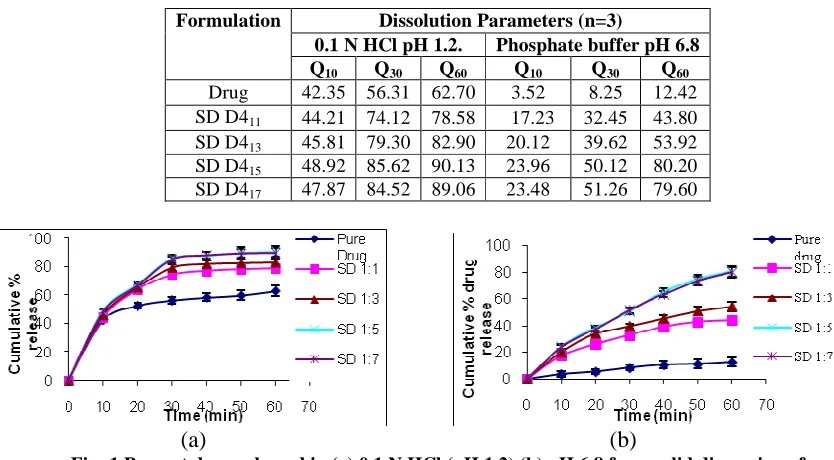
Q10, Q30 and Q60 values (percent drug dissolved within 60 min) are reported in Table 3. From Table 3, it is evident that the onset of dissolution of pure domperidone was very slow (62.70% of drug was dissolved within 60 min in pH 1.2 while in pH 6.8 it was 12.42 %). The dissolution rate of domperidone SDs was considerably enhanced by PEG 4000 within 60 min compared to pure domperidone. Dissolution was enhanced with SDs as the concentration of PEG increased in pH 1.2 from 44.21 to 78.58 % in ratio 1:1, 45.81 to 82.90 % in ratio 1:3, 48.92 to 90.13% in ratio
1:5 and 47.87 to 89.06% in ratio 1:7. In pH 6.8 it was enhanced from17.23 to 43.80 % in ratio 1:1, 20.12 to 53.92 % in ratio 1:3, 23.96 to 80.20% in ratio 1:5 and 23.48 to 79.60% in ratio 1:7. Increase in dissolution of domperidone was approximately similar in the ratio 1:5 and 1:7.
Table: 3 In vitro dissolution of DOM and solid dispersions of DOM in PEG 4000
Formulation Dissolution Parameters (n=3)
0.1 N HCl pH 1.2. Phosphate buffer pH 6.8
Q10 Q30 Q60 Q10 Q30 Q60
Drug 42.35 56.31 62.70 3.52 8.25 12.42 SD D411 44.21 74.12 78.58 17.23 32.45 43.80
SD D413 45.81 79.30 82.90 20.12 39.62 53.92
SD D415 48.92 85.62 90.13 23.96 50.12 80.20
SD D417 47.87 84.52 89.06 23.48 51.26 79.60
[image:5.595.79.496.272.502.2]
(a) (b)
Fig: 1 Percent drug released in (a) 0.1 N HCl (pH 1.2) (b) pH 6.8 from solid dispersion of Domperidone with PEG 4000, vertical bars indicates the standard deviation .
The in-vitro drug release data were applied to various kinetics models i.e., first order kinetic plot, Korsmeyer Peppas plot and Hixson Crowell plot to predict the drug release mechanism and kinetics (Fig 2).
Fourier-transform infrared (FTIR) spectroscopy
(a1) (a2)
(b1) (b2)
(c1) (c2)
Fig: 2 First order kinetic plot of DOM and its SDs with PEG 4000 (a1) pH 1.2 (a2) pH 6.8,
Korsmeyer Peppas plot of DOM and its SDs with PEG 4000 (b1) pH 1.2 (b2) pH 6.8 and
Hixson Crowell plot of DOM and its SDs with PEG 4000 (c1) pH 1.2 (c2) pH 6.8.
Differential Scanning Calorimetry
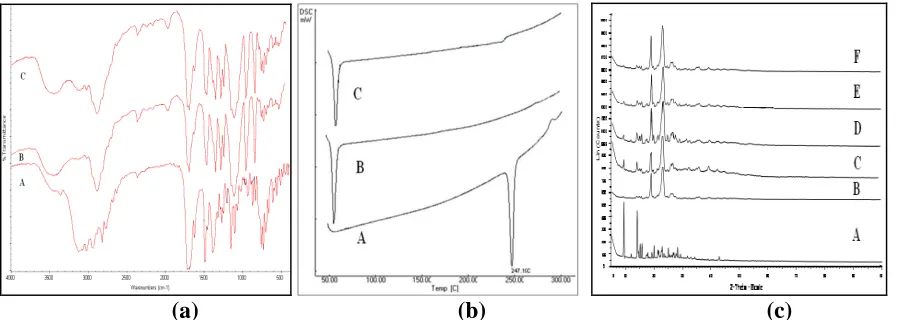
The DSC curve of pure domperidone exhibits a single endotherm corresponding to the melting of the drug. The onset of melting was observed at 247.15°C whereas pure PEG 4000 shows a melting endotherm at 60.2°C. Thermograms of SDs (Fig. 3 b) exhibited endothermic peak at 246.9°C.
Table: 4 Stretching vibrations of Domperidone and Solid Dispersion (SDs) of Domperidone with PEG 4000
The phase transition profile of the domperidone in the solid dispersion exhibited broad and size reduced peak with a concomitant shift to lower temperature, indicating that domperidone is completely soluble in the liquid phase of the polymer or that the crystalline nature of domperidone is absent. The exothermic peak may be due to crystallization above the glass transition temperature, Tg.
X-Ray Diffraction
The diffraction spectrum of pure domperidone shows that the drug was of crystalline nature as demonstrated by numerous peaks observed at 2θ of 9.39, 11.96, 14.08, 15.09, 15.74, 25.47, 26.23, 27.70, 28.24, 29.24 etc in finger print region (Fig.3c). Pure PEG 4000 shows two peaks with the highest intensity at 2θ and d-spacings of 19.04 and 4.65 Å; 23.18 and 3.83 Å. Similarly, some changes in domperidone peak position were observed in SDs. The prominent peaks from pure domperidone were clearly seen at the same positions in the SDs, but with decreased intensities. Relative reduction in diffraction intensity (Fig. 3c) of domperidone in PEG solid dispersion at these angles suggests that the size of the crystals was more reduced to a microcrystalline form. Results of this study imply that domperidone is present in microcrystalline form in the SDs.
(a) (b) (c)
Fig 3: (a) FTIR spectrograms of A – Domperidone, B-PEG 4000 C-Domperidone-PEG 4000 SD (b) DSC Thermograms of A – Pure domperidone, B-PEG 4000, C-Domperidone-PEG 4000 SD (c) X-ray diffractograms of A-Pure domperidone, B- Pure PEG 4000, C- SD D411, D- SD D413, E- SD D415 and SD D417
DISCUSSION
Rapid dissolution rates that result in an increase in the rate and extent of the absorption of the drug, and a reduction in presystemic both can lead to the need for lower doses of the drug. Other advantages may include protection of certain drugs by PEGs (e.g., cardiac glycosides) against decomposition by saliva to allow buccal absorption. In the present study too, we have received
the enhanced solubility and improved dissolution rate.
Solubility
[image:7.595.69.519.339.499.2]obtained from the values of Gibbs free energy change. Δ Gtr0 values were all negative and
decreases with increase in concentration of PEG 4000, indicating the spontaneous nature of drug solubilisation.
Dissolution
The aqueous solubility lesser than 1 μg/ml will definitely creating a bioavailability problem affecting the efficacy of a drug. Up to 40 percent of new chemical entities discovered by the pharmaceutical industry today are poorly soluble or lipophilic compounds [14]. To tackle the solubility challenges of poorly soluble drugs, strategies such as micronization, cosolubilisation, preparation of inclusion complexes, use of nano suspensions, micellar solubilisation by surfactants, drug dispersion in carriers and lipid-based formulations are employed[15].
Reduction of crystal size, absence of aggregation of drug crystals and conversion of the drug from crystalline to amorphous/microcrystalline state led to increase in the dissolution kinetics of domperidone from PEG-4000 soluble dispersion. Improvement in the wettability of the domperidone might have resulted from the formation of a film of polyethylene glycol around it, thus reducing the hydrophobicity of their surfaces. This explains the improvement in the dissolution of solid dispersions. Drug release depends upon concentration as per first order kinetic plot. A graph plotted between log time taken on x axis and log cumulative % drug released on y axis gives the straight line r2 =0.9 and n= 0.207-0.361 in pH 1.2. The release exponent obtained is beyond the limits of Korsmeyer model so called power law values of exponent n indicate a diffusion controlled drug release mechanism [16] In pH 6.8 r2 =0.9 and n= 0.5-0.69 which showed 0.45<n<0.89 indicates anomalous diffusion or non-fickian diffusion. Dissolution data was also plotted with reference to Hixson Crowell cube root law. Applicability of data indicates a change in surface area and diameter of tablets with progressive dissolution as a function of time.
FTIR spectroscopy
The shift of the peaks of domperidone in SDs was as a result of physical interaction between domperidone and PEG 4000.However, the minor shift of NH peak of domperidone in SDs could be due to hydrogen bonding between the hydrogen atom of the NH group of domperidone and one of the ion pairs of oxygen atom in the PEG.
X-ray diffraction
Diffraction intensity of domperidone was relatively reduced in SDs preparations at these angles suggests that the size of the crystals was reduced to that of microcrystals. The positions of PEG 4000 peak patterns in the SDs was the same and superimposable, which again rules out the possibility of well defined chemical interaction and new compound formation between these two components. The results of this study imply that domperidone is present in partially crystalline or microcrystalline form in the SDs, characterized by a fusion method and concluded that the drug was in microcrystalline form and that no chemically well-defined interaction took place between domperidone and PEG 4000 either in solution or in the solid state.
Differential scanning calorimetry
polymer or the absence of a crystalline form of domperidone. The exothermic peak might be due to crystallisation above Tg (glass transition temperature). The molecular motion of amorphous solids depends on temperature. The kinetic energy of amorphous solids increases significantly as the temperature gets close to Tg. Due to the thermodynamic instability of amorphous solids, compared to the crystalline state, spontaneous crystallisation is always possible as soon as molecular mobility is above the threshold of nucleation. However, the melting peak of PEG 4000 in SDs was observed at the same temperature (60.2°C) as the pure PEG 4000. It is speculated that domperidone dissolved in molten PEG 4000 during the DSC measurement, and that only one endothermic peak at 60.2°C, corresponding to melting of PEG 4000 was observed.
CONCLUSION
Technological advancements have revolutionized the current scenario of drug formulation and drug kinetics. The newer techniques have helped the several poor soluble drugs to reach the market and augmented their clinical applications. Domperidone, although insoluble in aqueous media yet, it has quite satisfactory solubility at gastric pH but unfortunately, it exhibits poor solubility in alkaline and neutral media. Among the various approaches to improve the dissolution of poorly soluble drugs, the preparation of solid dispersions has often proven to be very successful. On the same line, in the present work, hydrophilic carrier (PEG, 4000) was used in the preparation of solid dispersions and evaluated for their efficiency in increasing the dissolution rate of domperidone. The study shows that the dissolution rate of domperidone may be enhanced to a great extent by the present technique and it can also be helpful in enhancement of solubility of domperidone at various organ and media where the pH fluctuates beyond the favourable limits for domperidone solubilisation.
Acknowledgement
Authors are thankful to Arion Healthcare (Baddi, Himachal Pradesh) for the gift samples of domperidone.
REFERENCES
[1] K Sekiguchi; N Obi. Chem. Pharm. Bull., 1961, 9, 866-872.
[2] SL Law; WY Lo; FM Lin; CH Chaing. Int. J. Pharm., 1992, 84, 161-166.
[3] B Madhusudhan; D Rambhav; VR Gudsoorkar; JS Shete; SS Apte. Indian J. Pharm. Sci.,
2002, 64(3), 233-238.
[4] N Delahaye; R Duclos; Jm Saiter; S Varnier. Drug Dev. Ind. Pharm., 1997, 23(3), 293-303. [5] K Okimoto; M Miyake; R Ibuki; MYasumura; N Ohnishi; T Nakai. Int. J. Pharm, 1997, 159, 85-93.
[6] MV Margarit; IC Rodryguez; A Cerezo. Int. J. Pharm, 1994, 108, 101-107.
[7] N Yagi; Y Terashima; H Kenmotsu; H Sekikawa; M Takada. Chem. Pharm. Bull., 1996, 44, 241-244.
[8] K Danjo; T Nataka; A Otsuka. Chem Pharm Bull, 1997, 45, 1840-1844.
[9] N Ahmad; J Keith-Ferris; E Gooden; T Abell. Current Opinion in Pharmacology, 2006, 6(6), 571–576.
[11] SC Reddymasu; I Soykan; RW McCallum. American Journal of Gastroenterology, 2007, 102(9), 2036–2045.
[12]JA Barone. Ann. Pharmacother, 1993, 33, 429-440.
[13]T Higuchi; K Connors. Analytical chemistry and instrumentation, 1965, 4, 117–123.
[14]VL Narasaiah; BK Reddy; MR Kumar; AK Kumar; S Kumar; V Reddy. J. Chem. Pharm. Res., 2010, 2(3),304-311.
[15]SR Uppugalla; M Rathnanand; P Srinivas; K Deepak; A Kumar; S Priya. J. Chem. Pharm. Res., 2011, 3(2),280-289