i
EFFECTS OF BIODIESEL FUEL TEMPERATURE ON PERFORMANCE AND EMISSIONS OF A COMPRESSION IGNITION (CI) ENGINE
NORRIZAL BIN MUSTAFFA
A project report submitted in partial fulfilment of the requirement for the award of the Master of Engineering (Mechanical)
Faculty of Mechanical and Manufacturing Engineering Universiti Tun Hussein Onn Malaysia
ABSTRACT
v
ABSTRAK
CONTENTS
TITLE i
DECLARATION ii
ACKNOWLEDGEMENT iii
ABSTRACT iv
ABSTRAK v
CONTENTS vi
LIST OF TABLES ix
LIST OF FIGURES xi
LIST OF SYMBOLS AND ABBREVIATIONS xiv
LIST OF APPENDIX xvi
CHAPTER 1 INTRODUCTION 1
1.1 Background of study 1
1.2 Problem statement 2
1.3 Objectives 3
1.4 Scopes 4
1.5 Significant of study 4
CHAPTER 2 LITERATURE REVIEW 5
2.1 Biodiesel fuels 5
2.1.1 Advantages of biodiesel 6
2.1.2 Disadvantages of biodiesel 7
vii
2.2 Palm oil 9
2.3 Properties of palm oil biodiesel and comparison with diesel fuel
10
2.4 The effects of palm oil biodiesel on engine performance and emissions
12
2.5 The changes of fuel inlet temperature and its effects
14
2.6 Performance of preheated biodiesel 15
2.7 Emissions of preheated biodiesel 22
2.8 Summary 30
CHAPTER 3 METHODOLOGY 32
3.1 Test fuels 32
3.1.1 Blending process 32
3.1.2 Properties of test fuel 33
3.2 Experiment apparatus 34
3.2.1 Test engine 34
3.2.2 Chassis dynamometer 35
3.2.3 Emissions measurement 36
3.3 Experimental setup 39
3.4 Process flow chart 41
CHAPTER 4 RESULTS AND DISCUSSIONS 42
4.1 Fuel properties 42
4.2 The effects of palm oil biodiesel blends on engine performance and emissions
43
4.2.1 0% load condition 43
4.2.2 50% load condition 44
4.2.3 100% load condition 45
4.3 The effects of preheat and blending ratio on performance and emissions
49
4.3.1 B5 (5% blending ratio) 49
4.3.2 B10 (5% blending ratio) 53
4.3.3 B15 (5% blending ratio) 56
4.3.4 Summary 60
CHAPTER 5 CONCLUSIONS AND RECOMMENDATIONS 64
5.1 Conclusions 64
5.1.1 The effects of biodiesel blends temperature on fuel characteristics
64
5.1.2 The effects of palm oil biodiesel blends on engine performance and emissions
64
5.1.3 The effects of preheat and blending ratio on performance and emissions
65
5.2 Recommendations 66
REFERENCES 67
ix
LIST OF TABLES
1.1 Problems and potential solutions for using straight vegetable oils as diesel engines fuel
3
2.1 Biodiesel blends its effect on engine performance and emissions
6
2.2 Emission reduction factors 6
2.3 European Standard for Biodiesel (EN 14214) 8
2.4 Standard Specification for Biodiesel Fuel (B100) Blend Stock for Distillate Fuels (ASTM D6751)
9
2.5 Present and forecasted production of palm oil for the year 2000-2020 in MnT for Malaysia and Indonesia
10
2.6 Fatty acid composition of palm oil 11
2.7 Comparison of fuel properties of Malaysian diesel, palm oil biodiesel (normal and winter grade)
11
2.8 Literatures on the effects of palm oil biodiesel on engine performance and emissions
12
2.9 Statistics of effects of pure biodiesel on engine performance and emissions
14
3.1 The properties of test fuels at room temperature 34
3.2 Test engine specifications 34
3.3 The specifications of Dynapack chassis dynamometer 35 3.4 The specification of Autocheck gas analyzer 37 3.5 The specifications of Autocheck smoke opacity meter 38
3.6 The specification of Drager MSI EM200-E 39
4.2 The effects of preheated biodiesel blends on performance and emissions at three different load conditions relative to the diesel fuel
48
4.3 The effects of preheated B5 on performance and
emissions at three different load conditions relative to the diesel fuel
61
4.4 The effects of preheated B10 on performance and
emissions at three different load conditions relative to the diesel fuel
62
4.5 The effects of preheated B15 on performance and
emissions at three different load conditions relative to the diesel fuel
xi
LIST OF FIGURES
2.1 Palm Oil trees planted in Malaysia 10
2.2 Engine performance parameters of Jatropha oil (heated and unheated conditions)
15
2.3 Performance parameters of rapeseed oil biodiesel 16 2.4 Engine performance parameters of Jatropha oil 18 2.5 The brake torque and BSFC versus engine speed of
preheated crude sunflower oil
18
2.6 BSFC and BTE versus brake power of preheated Jatropha and kranja oils
19
2.7 Thermal efficiency versus load for preheated peanut, canola and sunflower oils operated on Yanmar and Kubota engines
20
2.8 Specific fuel consumption versus power of preheated animal fat
21
2.9 Power and BSFC versus rpm of processed waste cooking oil
21
2.10 BSCF and brake thermal efficiency versus BMEP of crude palm oil
22
2.11 Emissions parameters of Jatropha oil (heated and unheated conditions)
23
2.12 Effects of preheating raw rapeseed oil and its blends on emissions parameters
23
2.13 CO and NO emissions of preheated crude palm oil 24 2.14 Emissions parameters for the preheated rapeseed methyl
ester at engine speed of 1550rpm
2.15 Effects of preheated jatropha oil on the emissions parameters
26
2.16 Emissions parameters of preheated crude sunflower oil 27 2.17 Emissions parameters of preheated Jatropha and kranja
oils
29
2.18 CO and NO emissions of vegetable oil running at two different engines
29
2.19 Emissions parameters of preheated animal fat 30 2.20 Comparison of CO and NO emissions for preheated
crude palm oil and diesel fuel
30
3.1 Laboratory scale blending machine 33
3.2 Schematic diagram of blending process 33
3.3 Test engine 35
3.4 Dynapack chassis dynamometer 36
3.5 Autocheck gas analyzer 37
3.6 Autocheck smoke opacity meter 38
3.7 Drager MSI EM200-E 39
3.8 Schematic diagram of experimental setup 40
3.9 Process flow of the project 41
4.1 Performance and emissions of palm oil biodiesel blends at 0% load condition
44
4.2 Performance and emissions of palm oil biodiesel blends at 50% load condition
45
4.3 Performance and emissions of palm oil biodiesel blends at 100% load condition
46
4.4 Performances of preheated B5 at 0%, 50% and 100% load conditions
50
xiii
4.7 Emissions of preheated B5 at 100% load condition 52 4.8 Performances of preheated B10 at 0%, 50% and 100%
load conditions
53
4.9 Emissions of preheated B10 at 0% load condition 55 4.10 Emissions of preheated B10 at 50% load condition 55 4.11 Emissions of preheated B10 at 100% load condition 56 4.12 Performances of preheated B15 at 0%, 50% and 100%
load conditions
57
LIST OF SYMBOLS AND ABBREVIATIONS
B - Palm oil biodiesel
B5 - 5% blending ratio
B10 - 10% blending ratio B15 - 15% blending ratio
BMEP - Brake mean effective pressure BSEC - Brake specific energy consumption BSFC - Brake specific fuel consumption BTE - Brake thermal efficiency
o
C - Degree celsius
cc - Cubic centimeter
CI - Compress ignition
cm - Centimeter
CO - Carbon monoxide
CO2 - Carbon dioxide
cP - Centipoise
CPKO - Crude palm kernel oil
CPO - Crude palm oil
D - Diesel
DF - Diesel fuel
xv
FAME - Fatty acid methyl ester
g - gram
h - hour
HC - Hydrocarbon
HP - Horsepower
kg - kilogram
kJ - kilo Joule
kPa - kilo Pascal
kW - kilowatt
MPa - Megapascal
N - Ambient temperature condition
Nm - Newton meter
NOx - Nitrogen oxides
O2 - Oxygen
P - Preheat temperature
P40 - 40oC of preheat temperature P50 - 50oC of preheat temperature P60 - 60oC of preheat temperature
PKO - Palm kernel oil
ppm - Parts per million rpm - Revolution per minute
s - Second
SFC - Specific fuel consumption
SO2 - Sulfur dioxide
LIST OF APPENDIX
APPENDIX TITLE PAGE
CHAPTER 1
INTRODUCTION
1.1Background of study
In the era of improvement technologies, emission regulations have become more stringent in order to keep and maintain clean and healthy environment. Industrial revolution especially in automotive industry was contributing quite higher number of percentage to the earth pollutions in our daily life that consequently will contribute to global warming effects and acid rain formation. Despite years of improvement on the petroleum fuels and combustion characteristics were attempts, issues regarding emissions still become the main conversation in the automotive industry. Limited supply of world petroleum resources and unpredicted increment on the petroleum price made the situation more critical. Thus, demand on the utilization of biodiesel fuels and its blends as alternative energy sources is urgently required to meet the future legislation.
1.2Problems statement
Biodiesel is an alternative fuel that receiving a lot of attention nowadays due to its availability sources and renewability. Source of biodiesel may be divided into two categories; vegetable oils and animal fats. However, vegetable oils have become the main actor in producing biodiesel such as soybean oil, raw rapeseed oil, waste cooking oil, cottonseed oil, sunflower oil, crude palm oil and many more. The usage of this vegetable oil is due to the great fuel properties such as flash point and acid value that comparable to the diesel fuel. In Malaysia, abundantly sources of crude palm oil have resulted on the large numbers of research and development was conducted. It can be use in diesel engine directly without major modification. However, lack of study is carry out on the preheat biodiesel blends before entering to the combustion chamber.
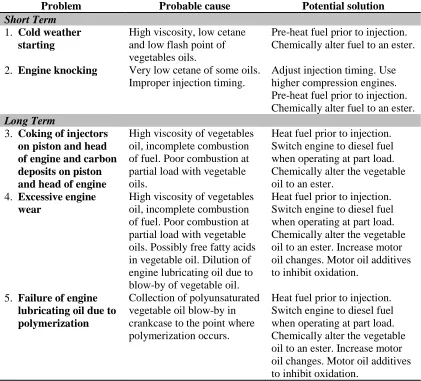
Most biodiesel fuels have faced a problem where the fuels are not operating effectively in cold weather. It is due to the fuel properties such as viscosity that affected the fuels flow rate and poor fuel atomization during combustion process (Karabektas et al., 2008). Moreover, viscosity also may causes carbon deposits build up on injector and valve seat during extended operation of the engine (Yilmaz & Morton, 2011). Table 1.1 simplified the known problems, probable cause and the potential solutions for using straight vegetable oil in diesel engines (Balat & Balat, 2008).
3
Table 1.1 : Problems and potential solutions for using straight vegetable oils as diesel engines fuel (Balat & Balat, 2008)
Problem Probable cause Potential solution
Short Term
1. Cold weather starting
High viscosity, low cetane and low flash point of vegetables oils.
Pre-heat fuel prior to injection. Chemically alter fuel to an ester.
2. Engine knocking Very low cetane of some oils. Improper injection timing.
Adjust injection timing. Use higher compression engines. Pre-heat fuel prior to injection. Chemically alter fuel to an ester.
Long Term
3. Coking of injectors on piston and head of engine and carbon deposits on piston and head of engine
High viscosity of vegetables oil, incomplete combustion of fuel. Poor combustion at partial load with vegetable oils.
Heat fuel prior to injection. Switch engine to diesel fuel when operating at part load. Chemically alter the vegetable oil to an ester.
4. Excessive engine wear
High viscosity of vegetables oil, incomplete combustion of fuel. Poor combustion at partial load with vegetable oils. Possibly free fatty acids in vegetable oil. Dilution of engine lubricating oil due to blow-by of vegetable oil.
Heat fuel prior to injection. Switch engine to diesel fuel when operating at part load. Chemically alter the vegetable oil to an ester. Increase motor oil changes. Motor oil additives to inhibit oxidation.
5. Failure of engine lubricating oil due to polymerization
Collection of polyunsaturated vegetable oil blow-by in crankcase to the point where polymerization occurs.
Heat fuel prior to injection. Switch engine to diesel fuel when operating at part load. Chemically alter the vegetable oil to an ester. Increase motor oil changes. Motor oil additives to inhibit oxidation.
1.3Objectives
The objectives of this research are;
i. To conduct biodiesel blending process at various ratio.
ii. To investigate the effect of various biodiesel fuel temperature and blending ratio on performance and emissions of CI engine.
1.4Scopes
The scopes of study are:
i. Determine the fuel properties of B5, B10 and B15 biodiesel blending ratio at 40oC, 50oC and 60oC.
ii. Set up and conduct the experiment of performance and emissions of Mitsubishi Pajero (4D56) CI engine at various rpm (1500 rpm, 2000 rpm, 2500 rpm and 3000 rpm) and load conditions (0 %, 50 % and 100 %). iii. Study the comparison of CI engines performance operating by preheated
biodiesel fuel and normal diesel fuel.
1.5Significant of study
This study is based on the analysis of the crude palm oil (CPO) biodiesel at three types of blending ratio as per stated below:
i. B5 (5% palm oil biodiesel, 95% diesel) ii. B10 (10% palm oil biodiesel, 90% diesel) iii. B15 (15% palm oil biodiesel, 85% diesel)
Moreover, the blended fuels were heated up to three different temperatures that were 40oC, 50oC and 60oC. The influences of preheat fuel properties on performance and emissions were obtained and further analyzed in order to understand the relation between temperature, fuel properties and combustion
CHAPTER 2
LITERATURE REVIEW
2.1 Biodiesel fuels
Biodiesel is known as a non-petroleum diesel, a mixture of mono-alkyl esters of long chain fatty acid (FAME) and it is an alternative fuel that made from vegetable oils and animal fats. It is a renewable energy, more cleanly than petroleum fuel and large availability sources (Mekhilef et al., 2011; Abdullah et al., 2009). The concern about biodiesel is quickly increased since the petroleum crises in 1970s that cause rapidly increasing in market prices. Growing concern of the environment and the effect of greenhouse gases also had revived more and more interests in the use of vegetable oils as a substitute of petroleum fuel (Abdullah et al., 2009; Balat & Balat, 2008).
Biodiesel is produced by transesterification reaction of vegetable oil with low molecular weight alcohol, such as ethanol or methanol (Mekhilef et al., 2011). The properties of biodiesel generally has higher density, viscosity, cloud point, cetane number, lower volatility and heating value compared to diesel fuel that affecting on the engine performance and emissions. However, neat biodiesel or its blends may be used in the existing diesel engines with little or no modification to the engine (Benjumea & Agudelo, 2008; Haseeb et al., 2010).
Table 2.1: Biodiesel blends its effect on engine performance and emissions (Combs, 2008)
Name Blend Properties and effect on engine performance and emissions
B5 5% biodiesel 95% diesel fuel
Very similar to diesel fuel; generally accepted by all engines manufacturer. Reduces air pollution from unburned hydrocarbons, carbon monoxide and particulate matter, and emits lower levels of carbon dioxide than diesel fuel. Approved for use in Texas.
B10 10% biodiesel 95% diesel fuel
Reduces air pollution and emits lower levels of greenhouse gases than diesel fuel.
B20 90% diesel fuel 95% diesel fuel
May cause a slight (1% to 2%) decrease in engine power and fuel economy. Lowers unburned hydrocarbons by 21%, carbon monoxide by 11% and particulate matter by 10%. Previously thought to cause a less than 2%v increase in NOx
emissions, although broader, more recent studies indicate no increase on average. Approved to use in Texas with additives. B100 5% biodiesel
95% diesel fuel
May cause a 5% to 10% decrease in engine power and fuel economy.
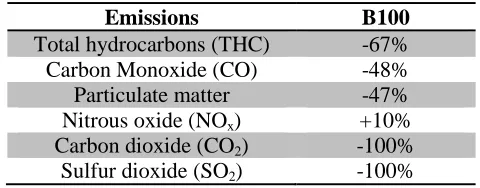
Table 2.2: Emission reduction factors (Lozada et al., 2010)
Emissions B100
Total hydrocarbons (THC) -67%
Carbon Monoxide (CO) -48%
Particulate matter -47%
Nitrous oxide (NOx) +10%
Carbon dioxide (CO2) -100%
Sulfur dioxide (SO2) -100%
2.1.1 Advantages of biodiesel
Among the advantages of biodiesel to the consumers are:
(i) It is sustainable renewable fuel and may be produced domestically, thus lower dependence on crude oil (Abdullah et al., 2009)
(ii) It has higher flash point than conventional diesel fuel results on safer handling (Abdullah et al., 2009)
(iii) It is environmental friendly and lower harmful emissions (Abdullah et al., 2009)
[image:20.595.181.421.358.452.2]7
(v) It does not contains any sulfur, aromatic hydrocarbons and metal crude residues; these properties contribute to improve the combustion efficiency and emission profile (Gomma, 2010)
(vi) It contains high oxygen amount 10 to 12% by weight which can significantly contribute to complete combustion (Gomma, 2010)
(vii) It can be directly use as fuel without any modifications as biodiesel is compatible with existing diesel engines (Lam & Lee, 2011; Lim & Teong, 2010; Kannan et al., 2011; Xue et al., 2011)
2.1.2 Disadvantages of biodiesel
Among the disadvantages of biodiesel to the consumers are:
(i) It has higher viscosity that results on poor fuel atomization and incomplete combustion (Yilmaz & Morton, 2011)
(ii) It produce lower engine performance compared to diesel fuel
(iii) Fuel consumption of an engine becomes higher because it is needed to compensate the loss of heating value of biodiesel compared to diesel fuel (Xue et al., 2011)
(iv) It may cause dilution and polymerization of engine sump oil, as a result it requiring more frequent oil changes (Rakopoulos et al., 2006)
(v) It has higher pour point, lower calorific value and lower volatility (Rakopoulos et al., 2006)
(vi) It has lower oxidation stability, hygroscopic, and as solvents, it will cause corrosion of components, attacking some plastic materials used for seals, hoses, paints and coatings (Rakopoulos et al., 2006)
(vii) It has higher oxygen content compared to diesel fuel and it provides relatively high NOx emissions during combustion process
(viii) It has higher cold filter plugging point temperature than diesel fuel, hence it will crystallize into a gel when used in its pure form (Gomma, 2010)
2.1.3 Biodiesel standard
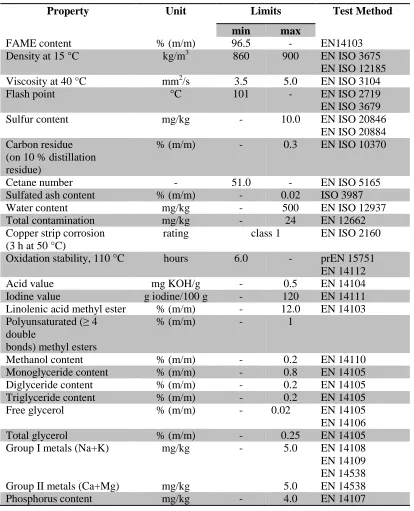
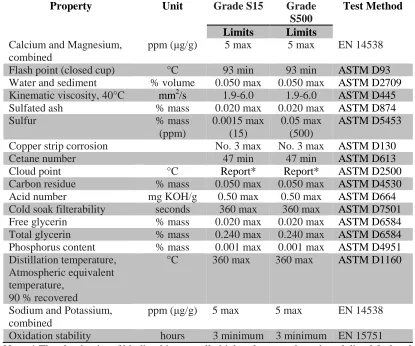
[image:22.595.113.527.254.765.2]In Malaysia, two major biodiesel standards that are most referred are European Standard for Biodiesel (EN 14214) and Standard Specification for Biodiesel Fuel (B100) Blend Stock for Distillate Fuels (ASTM D6751) as per shown in Table 2.3 and 2.4 respectively.
Table 2.3: European Standard for Biodiesel (EN 14214)
Property Unit Limits Test Method
min max
FAME content % (m/m) 96.5 - EN14103
Density at 15 °C kg/m3 860 900 EN ISO 3675
EN ISO 12185
Viscosity at 40 °C mm2/s 3.5 5.0 EN ISO 3104
Flash point °C 101 - EN ISO 2719
EN ISO 3679
Sulfur content mg/kg - 10.0 EN ISO 20846
EN ISO 20884 Carbon residue
(on 10 % distillation residue)
% (m/m) - 0.3 EN ISO 10370
Cetane number - 51.0 - EN ISO 5165
Sulfated ash content % (m/m) - 0.02 ISO 3987
Water content mg/kg - 500 EN ISO 12937
Total contamination mg/kg - 24 EN 12662
Copper strip corrosion (3 h at 50 °C)
rating class 1 EN ISO 2160
Oxidation stability, 110 °C hours 6.0 - prEN 15751
EN 14112
Acid value mg KOH/g - 0.5 EN 14104
Iodine value g iodine/100 g - 120 EN 14111
Linolenic acid methyl ester % (m/m) - 12.0 EN 14103
Polyunsaturated (≥ 4 double
bonds) methyl esters
% (m/m) - 1
Methanol content % (m/m) - 0.2 EN 14110
Monoglyceride content % (m/m) - 0.8 EN 14105
Diglyceride content % (m/m) - 0.2 EN 14105
Triglyceride content % (m/m) - 0.2 EN 14105
Free glycerol % (m/m) - 0.02 EN 14105
EN 14106
Total glycerol % (m/m) - 0.25 EN 14105
Group I metals (Na+K)
Group II metals (Ca+Mg)
mg/kg
mg/kg
- 5.0
5.0
EN 14108 EN 14109 EN 14538 EN 14538
9
Table 2.4: Standard Specification for Biodiesel Fuel (B100) Blend Stock for Distillate Fuels (ASTM D6751)
Property Unit Grade S15 Grade
S500
Test Method Limits Limits
Calcium and Magnesium, combined
ppm (µg/g) 5 max 5 max EN 14538
Flash point (closed cup) °C 93 min 93 min ASTM D93
Water and sediment % volume 0.050 max 0.050 max ASTM D2709
Kinematic viscosity, 40°C mm2/s 1.9-6.0 1.9-6.0 ASTM D445
Sulfated ash % mass 0.020 max 0.020 max ASTM D874
Sulfur % mass
(ppm) 0.0015 max (15) 0.05 max (500) ASTM D5453
Copper strip corrosion No. 3 max No. 3 max ASTM D130
Cetane number 47 min 47 min ASTM D613
Cloud point °C Report* Report* ASTM D2500
Carbon residue % mass 0.050 max 0.050 max ASTM D4530
Acid number mg KOH/g 0.50 max 0.50 max ASTM D664
Cold soak filterability seconds 360 max 360 max ASTM D7501
Free glycerin % mass 0.020 max 0.020 max ASTM D6584
Total glycerin % mass 0.240 max 0.240 max ASTM D6584
Phosphorus content % mass 0.001 max 0.001 max ASTM D4951
Distillation temperature, Atmospheric equivalent temperature,
90 % recovered
°C 360 max 360 max ASTM D1160
Sodium and Potassium, combined
ppm (µg/g) 5 max 5 max EN 14538
Oxidation stability hours 3 minimum 3 minimum EN 15751
Note: * The cloud point of biodiesel is generally higher than petroleum based diesel fuel and should be taken into consideration when blending.
2.2 Palm oil
Figure 2.1: Palm Oil trees planted in Malaysia
Palm oil is edible oil that used for biodiesel production. There are two types of palm oil; crude palm oil (CPO) that derived from the red fruits of the oil palm and crude palm kernel oil (CPKO) that derived from the fruit’s nut. Although both oils originate from the same fruit, palm oil is chemically and nutritionally different from PKO. Table 2.5 shows the present and forecasted production of palm oil for the year 2000-2020 in MnT for Malaysia and Indonesia. In terms of the world market, both Malaysia and Indonesia account for 90% of the palm oil world export trade and will likely remain the key players in the palm oil sector (Sumathi et al., 2008).
Table 2.5: Present and forecasted production of palm oil for the year 2000-2020 in MnT for Malaysia and Indonesia (Sumathi et al., 2008)
Year Malaysia Indonesia World total
1996-2000 9022 (50.3%) 5445 (30.4%) 17,932
2001-2005 11,066 (47.0%) 8327 (35.4%) 23,530
2006-2010 12,700 (43.4%) 11,400 (39.0%) 29,210
2011-2015 14,100 (40.2%) 14,800 (42.2%) 35,064
2016-2020 15,400 (37.7%) 18,000 (44.1%) 40,800
2.3 Properties of palm oil biodiesel and comparison with diesel fuel
[image:24.595.136.504.518.606.2]11
[image:25.595.224.434.278.395.2]process used for its production. Among the properties are sulfur content, cetane number and flash point. Higher cetane number of palm oil compared to diesel fuel contributes to easy cold starting and low idle noise. Flash point of palm oil biodiesel is higher than diesel fuel offers easily of handling and much safer because it is less combustible. Moreover, lack of sulfur content contributes to lower particulate emissions of diesel engines. Table 2.6 shows the fatty acid composition of palm oil while Table 2.7 shows the details of palm oil biodiesel and comparison with diesel fuel.
Table 2.6: Fatty acid composition of palm oil (Lam & Lee, 2011) Fatty acid Composition (%)
Lauric (12:0) 0.1
Myristic (C14:0) 1.0
Palmitic (C16:0) 42.8
Stearic (C18:0) 4.5
Oleic (C18:0) 40.5
Linolic (C18:1) 10.1
Others 1
Total 100
Table 2.7: Comparison of fuel properties of Malaysian diesel, palm oil biodiesel (normal and winter grade) (Lam & Lee, 2011; Lim & Teong, 2010)
Property Unit Diesel Palm oil biodiesel Normal grade Winter grade
Ester content % mass - 98.5 98.0-99.5
Free glycerol % mass - <0.02 <0.02
Total glycerol % mass - <0.25 <0.025
Density at 15°C kg/L 0.853 0.878 0.87-0.89
Viscosity at 40°C cSt 4 4.4 4.0-5.0
Flash point °C 98 182 150-200
Cloud point °C - 15.2 -18 to 0
Pour point °C 15 15 -21 to 0
Cold filter plugging point °C - 15 -18 to 3
Sulfur content % mass 0.1 <0.001 <0.001
Carbon residue % mass 0.14 0.02 0.02-0.03
Cetane index 53 58.3 53.0-59.0
Acid value mgKOH/g - 0.08 <0.3
Copper strip corrosion 3 h at 50°C - 1a 1a
[image:25.595.117.522.456.677.2]2.4 The effects of palm oil biodiesel on engine performance and emissions
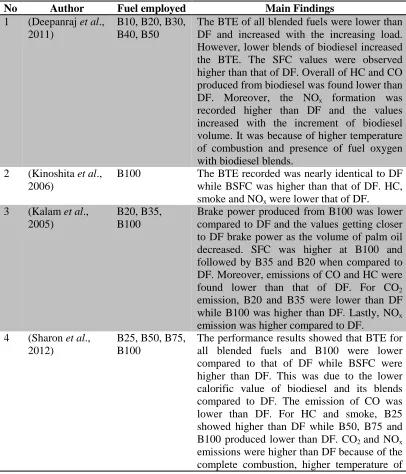
[image:26.595.115.521.298.772.2]Throughout the years, lots of researchers have studied and investigated the effects of palm oil biodiesel on engine performance and emissions. The research conducted including the use of neat palm oil biodiesel and its blends at various percentages. The main findings of past studies of palm oil biodiesel were recorded and summarized in Table 2.8.
Table 2.8: Literatures on the effects of palm oil biodiesel on engine performance and emissions
No Author Fuel employed Main Findings
1 (Deepanraj et al., 2011)
B10, B20, B30, B40, B50
The BTE of all blended fuels were lower than DF and increased with the increasing load. However, lower blends of biodiesel increased the BTE. The SFC values were observed higher than that of DF. Overall of HC and CO produced from biodiesel was found lower than DF. Moreover, the NOx formation was
recorded higher than DF and the values increased with the increment of biodiesel volume. It was because of higher temperature of combustion and presence of fuel oxygen with biodiesel blends.
2 (Kinoshita et al., 2006)
B100 The BTE recorded was nearly identical to DF while BSFC was higher than that of DF. HC, smoke and NOx were lower that of DF.
3 (Kalam et al., 2005)
B20, B35, B100
Brake power produced from B100 was lower compared to DF and the values getting closer to DF brake power as the volume of palm oil decreased. SFC was higher at B100 and followed by B35 and B20 when compared to DF. Moreover, emissions of CO and HC were found lower than that of DF. For CO2
emission, B20 and B35 were lower than DF while B100 was higher than DF. Lastly, NOx
emission was higher compared to DF. 4 (Sharon et al.,
2012)
B25, B50, B75, B100
The performance results showed that BTE for all blended fuels and B100 were lower compared to that of DF while BSFC were higher than DF. This was due to the lower calorific value of biodiesel and its blends compared to DF. The emission of CO was lower than DF. For HC and smoke, B25 showed higher than DF while B50, B75 and B100 produced lower than DF. CO2 and NOx
13
combustion and higher oxygen content in the fuels.
5 (Khalid et al., 2012)
B5, B10, B15 The brake power and fuel consumption of biodiesel and its blends fuels were comparable to DF and there were not much different than DF. Moreover, flywheel torque was lower than DF while torque was higher for all biodiesel and its blends. The emissions of CO, CO2 and HC were lower compared to DF and
O2 was higher than DF. Smoke emission was
higher at low load and it became lower at higher load compared to DF.
6 (Vedaraman et
al., 2011)
B20, B30, B40, B100
The results showed that BTE was lower than DF and it was decreases with increase in blend ratio meanwhile BSFC was higher than DF and it was increases as blend ratio increase. For emissions, HC and CO depicted the same trend that it was lower compared to that of DF. The CO2 and NOx emissions were
higher than DF. 7 (Almeida et al.,
2002)
B100 B100 resulted in slightly higher of SFC compared to DF (almost 10% higher at low load). Moreover, CO obtained was higher than that of DF while O2 and CO2 were almost the
same to DF. HC emission of was higher at partial load and lower at higher load compared to DF and NOx was lower than DF.
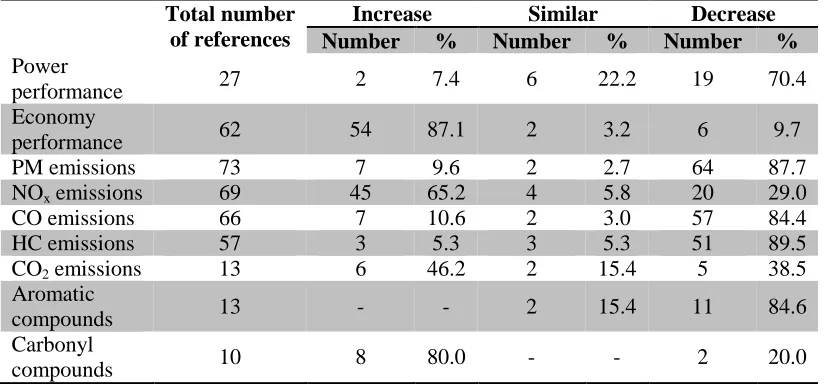
The results of previous studies showed that palm oil biodiesel can be used straight away in operating diesel engines without or little modifications. However, generally most of the researchers reported that the BTE of palm oil biodiesel and its blends were lower than that of diesel fuel while the BSFC was higher for palm oil and its blends compared to diesel fuel. The NOx emission was recorded higher than diesel fuel for both palm oil and its blends and the HC and CO emissions were recorded lower than that diesel fuel. Table 2.9 shows the statistics of effects of pure biodiesel on engine performance and emissions.
DF – Diesel Fuel
BCSFC – Brake Specific Fuel Consumption SFC – Specific Fuel Consumption
BTE – Brake Thermal Efficiency O2 – Oxygen
CO – Carbon Monoxide
CO2 – Carbon Dioxide
HC – Hydrocarbon NOx – Oxides of Nitrogen
B – Palm Oil Biodiesel
Table 2.9 : Statistics of effects of pure biodiesel on engine performance and emissions (Xue et al., 2011)
Total number of references
Increase Similar Decrease Number % Number % Number %
Power
performance 27 2 7.4 6 22.2 19 70.4
Economy
performance 62 54 87.1 2 3.2 6 9.7
PM emissions 73 7 9.6 2 2.7 64 87.7
NOx emissions 69 45 65.2 4 5.8 20 29.0
CO emissions 66 7 10.6 2 3.0 57 84.4
HC emissions 57 3 5.3 3 5.3 51 89.5
CO2 emissions 13 6 46.2 2 15.4 5 38.5
Aromatic
compounds 13 - - 2 15.4 11 84.6
Carbonyl
compounds 10 8 80.0 - - 2 20.0
2.5 The changes of fuel inlet temperature and its effects
15
temperature (Mamat et al., 2009). Thus, it gives better spray formation and combustion process.
2.6 Performance of preheated biodiesel
The performance parameters of preheat biodiesel had been reviewed such as BTE, BSFC and brake power. The parameters were evaluated and compared to the neat diesel fuel.
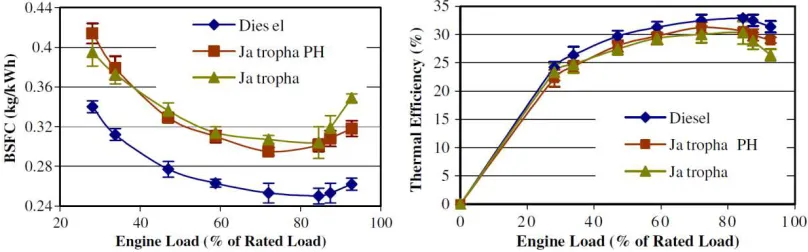
[image:29.595.117.521.447.573.2]Agrawal & Agrawal (2007) studied the performance of a four stroke single cylinder diesel engine fuelled by preheated Jatropha oil as fuel. They reported that the BSFC of preheated Jatropha oil was higher than that of diesel fuel but lower that unheated Jatropha oil at medium load as per depicted in the Figure 2.2. Moreover, the thermal efficiency of preheated Jatropha oil was lower that diesel fuel but slightly higher than unheated Jatropha oil as shown in Figure 2.2. The reason for this behavior may be improved fuel atomization because of reduced fuel viscosity.
Figure 2.2: Engine performance parameters of Jatropha oil (heated and unheated conditions) (Agarwal & Agarwal, 2007)
operations either with preheat or not because diesel fuel has higher calorific value. The increment of rapeseed oil in the blends remained lower compared to diesel fuel because the viscosity of the blend is reducing with prehe
leakages in the pump and injector resulting in lower power outputs. The
[image:30.595.216.424.198.608.2]increased with the increasing rapeseed oil in the blends compared with diesel fuel
Figure 2.3: Performance
Karabektas et al.
performance on a diesel engine and concluded that the brake power of the heated fuel was lower than that of diesel fuel due to an excessive leakage through the fuel pump and injectors. However, thermal efficie
they reported it was attributed to the preheating process that gives better combustion operations either with preheat or not because diesel fuel has higher calorific value. The increment of rapeseed oil in the blends remained lower compared to diesel fuel because the viscosity of the blend is reducing with preheating led to the higher leakages in the pump and injector resulting in lower power outputs. The
increased with the increasing rapeseed oil in the blends compared with diesel fuel
: Performance parameters of rapeseed oil biodiesel (Hazar & Aydin, 2010)
et al. (2008) analyzed the preheated cottonseed methyl ester
performance on a diesel engine and concluded that the brake power of the heated fuel was lower than that of diesel fuel due to an excessive leakage through the fuel pump and injectors. However, thermal efficiency was higher compared to diesel fuel and they reported it was attributed to the preheating process that gives better combustion operations either with preheat or not because diesel fuel has higher calorific value. The increment of rapeseed oil in the blends remained lower compared to diesel fuel ating led to the higher leakages in the pump and injector resulting in lower power outputs. The BSFC was increased with the increasing rapeseed oil in the blends compared with diesel fuel.
(Hazar & Aydin, 2010)
17
characteristics of biodiesel because of decreased viscosity and improved volatility. Pugazhvadivu & Jeyachandran (2005) investigated the performance of a diesel engine using preheated waste frying oil as fuel. They reported that brake specific energy consumption for preheated waste frying oil was higher than diesel fuel and the value was increased with decreasing fuel temperature ranging from 135oC to 30oC. They also concluded that thermal efficiency was lower compared to diesel fuel.
Singh et al. (2010) studied the performance of preheated Jatropha oil on medium capacity diesel engine. They found that the BTE for Jatropha oil was lower than diesel fuel throughout the entire operating range. However, when the temperature of preheating fuel increases, BTE also increases close to diesel fuel as per shown in Figure 2.4.The reason why the BTE lowers compared to diesel fuel are lower calorific values due to presence of oxygen in unsaturated hydrocarbon and high viscosity of Jatropha oil. They also reported that brake specific energy consumption is higher than diesel fuel due to high density and low calorific value of fuel.
Figure 2.4: Engine performance parameters of Jatropha oil (Singh et al., 2010)
[image:32.595.177.464.456.646.2]19
[image:33.595.212.426.320.655.2]Hossain and Davies (2012) investigated the performance an indirect injection multi-cylinder compression ignition operating on preheated Jatropha and kranja oils. The authors reported that BSFC of Jatropha and kanja oils were higher as compared to diesel fuel because the calorific value for both oils was lower than diesel fuel thus more fuel is needed for the same engine output. BTE recorded for both oil were close to diesel fuel at high load but 10% lower than diesel fuel at low load condition as per shown in Figure 2.6. Yilmaz and Morton (2011) studied the performance of three vegetable oils at two different engines; Yanmar and Kubota engines. They found that preheating increases thermal efficiency and vegetable oil shows higher thermal efficiencies than diesel fuel for all of the preheated fuels and both engines. Thermal efficiencies for both engines are shown in Figure 2.7.
Figure 2.7: Thermal efficiency versus load for preheated peanut, canola and sunflower oils operated on Yanmar and Kubota engines (Yilmaz & Morton, 2011)
21
[image:35.595.214.431.179.327.2]power. Figure 2.10 shows the BSFC at 400kPa BMEP was about 13% more than diesel fuel and it’s was attributed to the lower calorific value of crude palm oil. They also reported that crude palm oil combustion produced higher BTE than diesel fuel combustion.
Figure 2.8: Specific fuel consumption versus power of preheated animal fat (Kumar et al., 2005)
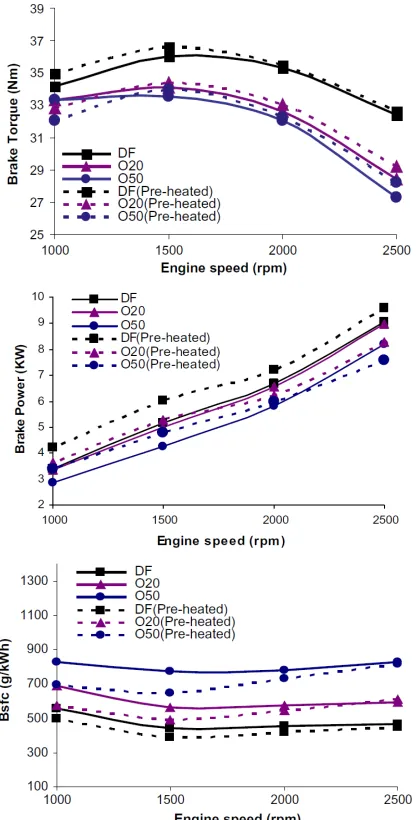
[image:35.595.183.465.405.724.2]
Figure 2.10: BSCF and brake thermal efficiency versus BMEP of crude palm oil (Lim et al., 2002)
2.7 Emissions of preheated biodiesel
Emissions from combustion of biodiesel and its blends generally similar to combustion of diesel fuel such as CO2, CO, NOx, smoke, unburned HC and sulphur oxides. A review has been made about preheat biodiesel emissions.
23
Figure 2.11: Emissions parameters of Jatropha oil (heated and unheated conditions) (Agarwal & Agarwal, 2007)
[image:37.595.218.426.414.712.2]
Karabektas et al. (2008) observed that CO emissions lower in comparison to diesel fuel while running the diesel engine using cottonseed oil methyl ester. Preheating of biodiesel decreases the viscosity and improves the oxidation of biodiesel in the cylinder. The NOx emission was higher than diesel fuel and the authors found that the maximum increase was obtained in the case of preheating temperature was 90oC. Pugazhvadivu & Jeyachandran (2005) stated that NOx emission of waste frying oil was lower compared to diesel fuel and its keep increasing close to diesel fuel with the increase of temperature. The increase in NOx was due to the increase in the combustion gas temperature with an increase in fuel inlet temperature. The CO and smoke emissions show the same trend where the emissions were higher than that of diesel and the values tend to decrease to diesel fuel emissions when the heating temperature increase. The decrease was due to the improvement in spray characteristics and better air-fuel mixing. The crude palm oil emissions were tested by Bari et al. (2002) and observed that the CO and NO were higher than those for diesel fuel by average values of 9.2% and 29.3% respectively, throughout the load range as per depicted in the Figure 2.13.
REFERENCES
Abdullah, A. Z., Salamatinia, B., Mootabadi, H., & Bhatia, S. (2009). Current status and policies on biodiesel industry in Malaysia as the world’s leading producer of palm oil. Energy Policy, 37(12), 5440–5448.
Agarwal, D., & Agarwal, A. K. (2007). Performance and emissions characteristics of Jatropha oil (preheated and blends) in a direct injection compression ignition engine. Applied Thermal Engineering, 27(13), 2314–2323.
Almeida, S. C. A. D., Rodrigues, C., Nascimento, M. V. G., Vieira, S. R., & Fleury, G. (2002). Performance of a diesel generator fuelled with palm oil. Fuel, 81, 2097– 2102.
American Society for Testing and Materials, (2012). Standard Specification for Biodiesel Fuel Blend Stock (B100) for Middle Distillate Fuels. West
Conshohocken: ASTM D6751.
Anand, R. (2010). Performance Emission and Combustion Characteristics of a Diesel Engine Fueled with Biodiesel Produced from Waste Cooking Oil. SAE Paper, 2010-01-0478.
Augustine, A., Marimuthu, L., & Muthusamy, S. (2012). Performance and evaluation of DI diesel engine by using preheated cottonseed oil methyl ester. Procedia Engineering, 38, 779–790.
Balat, M., & Balat, H. (2008). A critical review of bio-diesel as a vehicular fuel, Energy Conversion and Management, 49, 2727–2741.
Benjumea, P., & Agudelo, J. (2008). Basic properties of palm oil biodiesel – diesel blends, Fuel, 87, 2069–2075.
Canakci, M., Necati, A., & Turkcan, A. (2009). Combustion analysis of preheated crude sunflower oil in an IDI diesel engine. Biomass and Bioenergy, 33(5), 760–767. Combs, S. (2008). The Energy Report. Biodiesel. Retrieved on October 18, 2012, from
http://www.window.state.tx.us/specialrpt/energy/pdf/96-1266EnergyReport.pdf Deepanraj, B., Dhanesh, C., Senthil, R., Kannan, M., Santhoshkumar, A., Lawrence, P.
(2011). Use of Palm oil Biodiesel Blends as a Fuel for Compression Ignition Engine. American Journal of Applied Sciences, 8(11), 1154–1158.
European Standard (2008). Automotive fuels - Fatty acid methyl esters (FAME) for diesel engines - Requirements and test methods. Brussels: EN14214.
Hai, T. C. (2002). The Palm Oil Industry in Malaysia: From Seed to Frying Pan. Retrieved on November 5, 2012, from
http://assets.panda.org/downloads/oilpalmchainpartaandb_esri.pdf
Haseeb, A. S. M. A., Sia, S. Y., Fazal, M. A., & Masjuki, H. H. (2010). Effect of temperature on tribological properties of palm biodiesel. Energy, 35(3), 1460–1464. Hazar, H., & Aydin, H. (2010). Performance and emission evaluation of a CI engine
fueled with preheated raw rapeseed oil (RRO)–diesel blends. Applied Energy, 87(3), 786–790.
Hossain, A. K., & Davies, P. A. (2012). Performance, emission and combustion characteristics of an indirect injection (IDI) multi-cylinder compression ignition (CI) engine operating on neat jatropha and karanj oils preheated by jacket water. Biomass and Bioenergy, 44, 1–11.
Gomma, M. G. G. (2010). Trade-off between NOx and smoke emissions using EGR for a C.I engine fuelled with Jatropha biodiesel blends. Universiti Tun Hussein Onn
Malaysia: Masters Thesis.
Kalam, M. A., & Masjuki, H. H. (2005). Emissions and Deposit Characteristics of a Small Diesel Engine When Operated on Preheated Crude Palm Oil. SAE Paper, 2005-01-3697.
69
Kannan, G. R., Balasubramanian, K. R., Sivapirakasam, S. P., & Anand, R. (2011). Studies on biodiesel production and its effect on DI diesel engine performance, emission and combustion characteristics. International Journal of Ambient Energy, 32(4), 179–193.
Karabektas, M., Ergen, G., & Hosoz, M. (2008). The effects of preheated cottonseed oil methyl ester on the performance and exhaust emissions of a diesel engine. Applied Thermal Engineering, 28(17-18), 2136–2143.
Khalid, A., Osman, S. A., Jaat, N. M., Mustaffa, N., Basharie, S. M., & Manshoor, B. (2012). Performance and Emissions Characteristics of Diesel Engine Fueled by Biodiesel Derived from Palm Oil. International Conference on Mechanical and Manufacuring Engineering 2012, 3(150).
Kinoshita, E., Myo, T., & Hamasaki, K. (2006). Diesel Combustion Characteristics of Coconut Oil and Palm Oil Biodiesels. SAE Paper, 2006-01-3251.
Kumar, M. S., Kerihuel, A., Bellettre, J., & Tazerout, M. (2005). Experimental investigations on the use of preheated animal fat as fuel in a compression ignition engine. Renewable Energy, 30, 1443–1456.
Lam, M. K., & Lee, K. T. (2011). Production of Biodiesel Using Palm Oil. Biofuels. Biofuels: Alternative Feedstocks and Conversion Process. Elsevier Inc. pp. 353–
374.
Licauco, J. B. M. B. Æ. J. (2009). Performance, smoke characteristics and economics of pre-heated used vegetable oil utilization in Philippine public utility jeepneys. Clean techn Environ Policy, (2009), 239–245.
Lim, S., & Teong, L. K. (2010). Recent trends, opportunities and challenges of biodiesel in Malaysia: An overview. Renewable and Sustainable Energy Reviews, 14, 938– 954.
Lim, T. H., Bari, S., & Yu, C. W. (2002). Using crude palm oil (CPO) as diesel engine fuel. AJSTD, 19(2), 1–13.
Mamat, R., Abdullah, N. R., Xu, H., Wyszynski, M. L., & Tsolakis, A. (2009). Effect of Fuel Temperature on Performance and Emissions of a Common Rail Diesel Engine Operating with Rapeseed Methyl Ester ( RME ). SAE Paper, 2009-01-1896.
Mekhilef, S., Siga, S., & Saidur, R. (2011). A review on palm oil biodiesel as a source of renewable fuel. Renewable and Sustainable Energy Reviews, 15(4), 1937–1949. Muhammad, (2012). The Effect of Diesel and Biodiesel Fuel on Performance and
Emission of Low Load on 2500cc Engine. Universiti Tun Hussein Onn Malaysia:
Undergraduate Project Report.
Pugazhvadivu, M., & Jeyachandran, K. (2005). Investigations on the performance and exhaust emissions of a diesel engine using preheated waste frying oil as fuel. Renewable Energy, 30(14), 2189–2202.
Rakopoulos, C. D., Antonopoulos, K. A., Rakopoulos, D. C., Hountalas, D. T., & Giakoumis, E. G. (2006). Comparative performance and emissions study of a direct injection Diesel engine using blends of Diesel fuel with vegetable oils or bio-diesels of various origins. Energy Conversion and Management, 47, 3272–3287. Sharon, H., Karuppasamy, K., Kumar, D. R. S., & Sundaresan, A. (2012). A test on DI
diesel engine fueled with methyl esters of used palm oil. Renewable Energy, 47, 160–166.
Singh, B., Kumar, N., Du, Y., & Bae, K. (2010). Performance and emission study of preheated Jatropha oil on medium capacity diesel engine. Energy, 35(6), 2484– 2492.
Sumathi, S., Chai, S. P., & Mohamed, A. R. (2008). Utilization of oil palm as a source of renewable energy in Malaysia, Renewable and Sustainable Energy Reviews, 12, 2404–2421.
Vedaraman, N., Puhan, S., Nagarajan, G., & Velappan, K. C. (2011). Preparation of Palm Oil Biodiesel and Effect of Various Additives on NOx Emission Reduction in B20: An Experimental Study. International Journal of Green Energy, 8, 383–397. Xue, J., Grift, T. E., & Hansen, A. C. (2011). Effect of biodiesel on engine performances
71