A STUDY ON CREDIT EVALUATION OF POWER CONSUMER BASED ON THE TOPSIS AND AHP METHOD
JUMRIANI HJ NONGKANG
A thesis submitted in
fulfilment of the requirement for the award of the Degree of Master of Electrical Engineering
v
ABSTRACT
CONTENTS
TITLE i
DECLARATION ii
DEDICATION iii
ACKNOWLEDGEMENT iv
ABSTRACT v
CONTENTS vi
LIST OF TABLE vii
LIST OF FIGURES viii
LIST OF SYMBOLS AND ABBREVIATIONS ix
CHAPTER 1 INTRODUCTION 1
1.1 Project Background 1
1.2 Problem Statements 2
1.3 Project Objectives 4
CHAPTER 2 LITERATURE REVIEW 6
2.1 Theories 6
2.2 AHP method 6
2.3 TOPSIS method 9
CHAPTER 3 METHODOLOGY 13
3.1 Introduction 13
3.2 AHP Methodology 16
3.3 TOPSIS Methodology 24
CHAPTER 4 EVALUATION RESULTS AND ANALYSIS
29
4.1 Introduction 29
4.2 Evaluation Results 30
4.3 Result Analysis 36
CHAPTER 5 CONCLUSION
5.1 Conclusion 39
5.2 Suggestion 40
REFERENCES 41
APPENDIX
LIST OF FIGURES
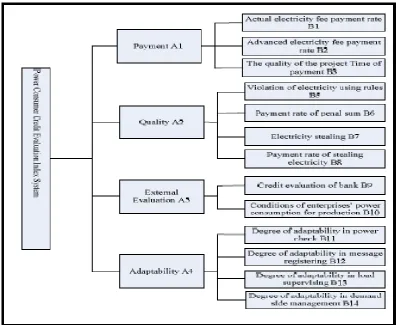
3.1 Power consumer Credit Evaluation Index System 20
4.1 Verify by using Microsoft Office Excel –The Criteria Mean (1st) 32 4.2 Verify by using Microsoft Office Excel –The Criteria Mean (2nd ) 32 4.3 Verify by using Microsoft Office Excel –The Criteria Mean (3rd ) 33
4.4 standardization weighted decision matrix Z 33
4.5 Verify by using Microsoft Office Excel – Ideal Solution 35
4.6 The separation measures for each alternative 35
ix
LIST OF SYMBOLS AND ABBREVIATIONS
AHP Analytic Hierarchy Process
aij Quantified judgment on a pair of elements Ci, Cj A* Ideal solution
A' Negative ideal solution
Ci* Relative Closeness To The Ideal Solution C.I. Consistency Index
C.R. Consistency Ratio
MCDM Multi-criteria decision-making
λmax Maximum eigenvalue
R.I. Average consistency index over numerous random entries of same order reciprocal matrices
Si* Ideal Alternative
S'i Negative Ideal Alternative
TOPSIS Technique for Order Preference by Similarity to Ideal Solution
wp Weighted Normalized Decision Matrix [xij] nxp Original Decision Matrix
[yij] nxp Normalized Decision Matrix
LIST OF TABLES
3.1 Power consumer Credit Evaluation Index System 19
3.2 The Criteria Mean in the Judgment Matrix 22
3.3 The Criteria Mean In The Judgment Matrix 22
3.4 Comparison Of Consumer Credit Rating And Credit Condition 23
3.5 Power consumer Credit Evaluation Index System 27
4.1 Power Consumers’ Credit Evaluation Index Value 30
4.2 Evaluation Results Table (TOPSIS Method) 36
CHAPTER 1
INTRODUCTION
1.1 Project Background
Reliability and quality are important parameters in the scene of electricity power consumer. Electricity delivery is no expectation. Combining today’s utility power with the ever increasing quantity of electrical sensitive loads yields one of the major contributors to downtime in business and industries today. Issues of deregulation, standards and customer awareness (economics & legal) have brought forth a great deal of focus and motivation in these areas. Tremendous dedication from engineers as well as huge amounts or revenue has been spent to enhance the quality and reliability of electricity delivery.
In today’s markets, customer want to buy the best quality products at the lowest prices, regardless of where they are produced. To penetrate global markets and obtain their benefits, companies are under tremendous pressure to be competitive and to reduce their production costs.
As the development of market economy and the reformation of electric system, the status of power consumers becomes more crucial. They have been the decision making center of supply enterprises which are in face of much huger venture such as receiving fees. The reasons are that electricity has the characteristic of being not stored and that the consumers’ lawless behaviours happen frequently. Therefore in order to facilitate the sustained and healthy development of power supply enterprises designed a set of scientific index system to evaluate the consumers’ credit evaluation necessary, which has actual significance.
The improved TOPSIS and Analytic Hierarchy Process (AHP) method presents an effective and reliable methodology of studying the power consumer credit evaluation.
1.2 Problem Statements
3
consumer services strategies. Study on credit evaluation of electric power suppliers’ operation ability is a fundamental in electricity marketing management.
The main purpose of this study is to determine the power consumer credit evaluation by using the improved TOPSIS and Analytic Hierarchy Process (AHP) method. Predicting the credit level of power consumer in advance is the important premise of implementing differential service.
The consumer credit evaluation is more and more important for financial reputation of the power company. The consumer credit payment is the important part in electricity marketing management. Consumer credit evaluation can divide power consumer into different credit ratings. Based on the consumer payment credit data and questionnaire, this study determines the consumer’s credit rating and consumer’s credit level through consumer credit evaluation based on AHP method, is used in determining the weights of the criteria by decision makers and then rankings of the operating systems are determined by TOPSIS method. Empirical study has also been demonstrated.
1.3 Project Objectives
Quantitative evaluation of service quality is very important in modern service industry, so there has important theoretical and practical significance of studying power consumer credit evaluation. The major objective of this research is study the credit evaluation of power consumer based on the improved TOPSIS (Technique of Order Preference by Similarity to Ideal Solution) Method and AHP (Analytic Hierarchy Process) method.
Its measurable objectives are as follows:
1.3.1 To identify the indexes for power consumer credit rating evaluation 1.3.2 To determine the pretreatment on the calculated value of primary index 1.3.3 To analyze and calculate the indexes data of ten consumer samples
1.3.4 To determine the credit evaluation of the ten power consumer by using AHP and TOPSIS method.
1.4 Project Scopes
The method used for credit evaluation based on TOPSIS and AHP method to evaluate and research the power consumers’ credit evaluation. The scopes of this project are:
5
1.5 Layout of Thesis
This thesis contained five chapters. Chapter 1 describes the overview of the study including the project background, problem statement, project objectives and project scopes of this study. Meanwhile, chapter 2 represents the literature review of the study including the theories, Analytic Hierarchy Process (AHP) and Technique for Order Preference by Similarity to Ideal Solution (TOPSIS) method.
Chapter 3 outlines the methodology throughout the study. The explanation of two types Multi-criteria decision-making (MCDM) method used in this study, Analytic Hierarchy Process (AHP) and Technique for Order Preference by Similarity to Ideal Solution (TOPSIS) method.
CHAPTER 2
LITERATURE REVIEW
2.1 Theories
Assume that a decision-maker knows what he or she wants and has accurate information about his or her own abilities, and the state of world. But people are not rational decision-maker. They have varying accuracy in assessing their own skills, often believing themselves to be more skillful than they are. In order to assist people in making better decisions, many researchers have turned to various decision methods and decision support tools. Multi-criteria decision-making (MCDM) literature can be traced back to the 1960s and earlier. The work on MCDM methods proceeded in parallel with development of methods for applying utiity theory. All MCDM methods involve making preference decisions over a set of alternatives which are characterized by multiple, usually conducting, criteria. These methods are categorized by the combination of multiple objectives into a single, overall objective.
2.2 Analytic Hierarchy Process (AHP) Method
7
issues have been discussed in various management functions like in research and development (Loch and Kavadias, [3]), environmental management (Eugene and Dey, [4]), and quality management (Hariharan et al., [5]). Projects are unique in nature. Hence, each model has its own pros and cons for various applications.
The AHP is a comprehensive framework, which is designed to cope with the intuitive, the rational, and the irrational when we make objective, multi-criterion and multifactor decisions with and without certainty for any number of alternatives. The AHP has been applied to many complex problems with various decision analyses, which enable decision-makers to derive ratio scale priorities or weights as opposed to arbitrarily assigning them. Many others recognizes a very important feature that AHP supports decision-makers by allowing them to structure complexity, to exercise judgment, and to incorporate both objective and subjective considerations in the decision process. The AHP is also a novel decision analyzing approach that structures a problem using a hierarchy. It enables us to make effective decision on complex issues by simplifying and expediting human natural decision-making processes. Some other sees the AHP is the theory of measurement for dealing with quantifiable or tangible criteria that has found rich applications in decision theory, conflict resolution and in models of the brain. To illustrate this process in an easy way, Bagchi and Rao define that this hierarchy starts with a top level containing the ultimate objective of the problem. The sub-objectives, if any, constitute the next level, followed by the criterion variable affecting the higher-level objectives. The bottom level of the hierarchy contains the options or alternatives. Therefore, each hierarchical level can be seen as being made up of elements (or criterion variables) that in turn, are decomposed into sub-elements that make up the next level of the hierarchy.
The AHP is an operational research model which can be adapted for any analysis involving pair-wise comparison. This tool was first developed by Saaty in 1980, and later improved upon in subsequent years (Saaty, 1980, 1994, 2000, and 2001). The process requires the decision maker to provide judgments about the relative importance of each criterion and then specify a preference for each decision alternative to 3 each criterion. The output of the Analytic Hierarchy Process is a prioritized ranking indicating the overall preference for each of the decision alternatives (Saaty, 1980, 1994, 2000, and 2001). One advantage of the Analytic Hierarchy Process is that it is designed to handle situations in which the subjective judgments of individuals constitute an important part of the decision process. It is designed for situations in which ideas, feelings, and emotions affecting the decision process are quantified to provide a numerical scale for prioritizing the alternatives (Taha, 2006). This tool can enable the marketers in the companies in the Nigerian food and beverage industry, which is the main focus of this study, determine the relative importance of the relationship marketing variables and use this knowledge to develop their strategic relationship marketing mix.
The Analytic Hierarchy Process (AHP) by Saaty [9] is a multicriteria decision-making (MCDM) technique that has been widely used to solve complex decision problems, in which both qualitative and quantitative aspects are considered. Although AHP has been widely applied in engineering, government, industry, management, manufacturing, personal, political, social, and sports [10], it is also considerably criticized for its possible rank reversal phenomenon [11], which means changes of the relative rankings of the other alternatives after an alternative is added or deleted.
9
multiple criteria and no architectural characteristic. AHP can make the complex decision-making process by using less quantify information on the bases of analysis inner, affecting factors and inherent relations of the problems.
There are three steps common to all decision-making technique involving numerical analysis of alternatives.
1) determine the relevant criteria and alternatives.
2) attach numerical measnres indicating relative importance of the criteria, 3) assign a ranking or preference to each alternative, possibly by processing the numerical values.
2.3 Technique for Order Preference by Similarity to Ideal Solution (TOPSIS) Method
Technique for Order Preference by Similarity to Ideal Solution (TOPSIS) is a sorting method approaching to ideal solution, first proposed by Hwang and Yoon in 1981[5] Wang.C.L, Yoon.K.S. Multiple attribute decision making [M]. Sring-rerlag, Berlin, 1981:12-23. , Laietal changed the TOPSIS concept to the multi-objective decision problems in 1994, and it has been a frequently used method for the multi objective decision analysis of finite projects in system engineering, and it can be used in many domains such as profit evaluation, decision, and management. This method can realize the performance evaluation of different types of things with multiple attributes, with wide application. The TOPSIS method adopted in this study to comprehensively evaluate the power consumer credit.
of limited schemes (respectively expressed by positive and minus Ideal Solutions), then separately calculate the distance between the evaluation units and inferior scheme, to obtain C value relatively close degree of the evaluation units and the optimal scheme. C value is between 0 and 1 in values, the value is closer to 1, the evaluation object is more approximate to the optimal level; conversely, the value is closer to, the evaluation object is more approximate to the inferior level.
The phenomenon of borrowing and lending has a long history associated with human behaviour (Thomas et al., 2002). Therefore, credit is perhaps a phenomenon as old as trade and commerce. Traditionally, the price of power in the electrical utility was based solely on the quantity used. The customer pays more for using more power and less if the usage is less. A customer who is prepared to pay for higher quality and one who wants a discount even if it meant lower quality power-both get the same quality and pay the same rate. Howard & Sheth (1969) thought that customer satisfaction is the cognitive status of customer’s revenue to pay.
11
Customers are part of organizations’ family; hence there is a need to ensure that they have long lasting enduring relationships with the organizations. The power company, like any other marketer, has to devote time to build relationships with the customers in order to gain repeat patronage (Brondmo, 2002).To do this effectively marketers have to develop an optimal strategic relationship marketing mix.
Electricity is an energy commodity in final energy consumption market, whose competence performance is its appeal of consumers [11]. The main factors influencing the electricity competence in final energy is that electricity market capacity, electricity products and electricity enterprises capability, and the among them the electricity market capacity is a key factor which is the competitiveness result of final energy market and can be reflected by the market share and benefits of the electricity.
Past researchers have already do the study of the power consumer credit evaluation. The research using the clustering analysis and AHP method. Guoliang and Rui Wei [7]. The model classifies a large number of power consumers quickly and objectively according to their pre-processed index data samples. Then the weight of each index is calculated flexibly with the method of AHP.
Power consumers’ index system of credit evaluation can reflect credit level in different aspect. Its establishment is the basis of credit evaluation for power supply enterprises. “5C” is often made use of by department of credit management in current credit evaluation [8], including :
Character, is a measure of corporate reputation and the most important factor of evaluating a consumer’s credit. It is the possibility that the consumer is willing to fulfil payment commitment and determines the number of accounts receivable.
operating performance, the consumer has strong capacity to pay and vise versa. This kind of indexes include asset-liability ratio and so on.
Capital, referring to the financial situation of a consumer, can be gained through the enterprise’s financial statements and ratio related. We usually select index like the ratio of income as a percentage of sales which reflects the profitability of the business.
Collateral, is that consumers guarantee their accounts payable with assets. Once they refuse or unable to pay the money, the collateral will offset corresponding losses. It is necessary for these people who don’t have credit record or have bad history.
13
CHAPTER 3
METHODOLOGY
3.1 Introduction
Using the improved TOPSIS (Technique of Order Preference by Similarity to Ideal Solution) Method and AHP (Analytic Hierarchy Process) method, is a fast, accurate and effective method to study the power consumer credit evaluation. The project’s Gantt chart is given in Appendix A. The research is conducting in phase’s basis as follows:
Phase 1: Literature reviews on previous works of Power Consumer Credit Evaluation and also the method of the research (TOPSIS & AHP)
To study the credit evaluation of Power Consumer
To study the Analytical Hierarchy Process (AHP) Method
Phase 2: Construction of Power Consumer’s Index System
To develop a Power Consumers’ Index system of credit evaluation can reflect credit level in different aspects.
To determine the pre-treatment on index data of consumer sample To obtain the system state information
Phase 3: AHP & Improved TOPSIS Module
To determine the Weights of the criteria by decision makers into considerations (AHP method)
To determine rankings of the operating systems (Improved TOPSIS method)
To synthesis the data obtained from the module
Phase 4: Study on Credit Evaluation of Power Consumer based on Improved TOPSIS & AHP method
To prepare the Final assessment and report writing.
To complete the paper : Credit Evaluation of Power Consumer based on Improved TOPSIS & AHP method
15
The decision method decomposes a complex multi-criteria decision problem into hierarchy (Saaty, 1980). AHP is also a measurement theory that prioritizes the hierarchy and consistency of judgmental data provided by a group of decision, without having to elicit their utility functions on subjective and objective criteria, by pair wise comparisons of teh alternatives (Saaty, 1990). Firstly must conducts a preliminary classification of a large number of consumers and then calculates the index weights, as well as the repsentative credit score of each type of consumer, and finally determines the consumers’ credit rating. The appropriate risk precautions and consumer marketing strategies can be developed in accordance with each consumer’s credit level through consumer credit evaluation.
In this article, by using AHP and TOPSIS technique, we calculates the index weights, as well as the representative credit score of each type of consumers, and finally determines the consumers’ credit rating. TOPSIS method was firstly proposed by Hwang and Yoon. According to this technique, the best alternative would be the one that is nearest to the positive ideal solution and farthest from the negative ideal solution. AHP and TOPSIS methods can be used together for complex decision problems. Proposed methodology has two steps. By using AHP method the qualitative judgment can be qualified to make comparison more intuitionistic and reduce or eliminate assessment bias in pairwise comparison process. In step 2, obtained results have been used as input weights in TOPSIS algorithm.
3.2 Analytical Hierarchy Process Methodology
The decision method decomposes a complex multi-criteria decision problem into a hierarchy (Saaty, 1980). AHP is also a measurement theory that prioritizes the hierarchy and consistency of judgmental data provided by a group of decision makers. AHP incorporates the evaluations of all decision makers into a final decision, without having to elicit their utility functions on subjective and objective criteria, by pair-wise comparisons of the alternatives (Saaty, 1990). Tarantino (David, 2003) applied analytical hierarchy process to determine the performance of management indicators using the Balanced Scoreboard. AHP has thus been successfully applied to a diverse array of problems, with the calculation procedure as follows:
Establishment of pair-wise comparison matrix A
Let C1, C2, , Cn denote the set of elements, while aij represents a quantified
judgment on a pair of elements Ci, Cj. This yields an n-by-n matrix A as follows:
1 2
C
C
C
n
ijA a
1 2 n C C C 12 1 2 12 1 2 1 1 1 1 1 1 n n n n a a a a a a
(3.1)
Where aij =1 and aij = 1
ij
a , i,j =1,2…,n. In matrix A, the problem becomes one of
assigning to the n elements C1, C2…Cna set of numerical weights W1, W2, , Wnthat
reflects the recorded judgments. If A is a consistency matrix, the relations between
weights Wi and judgments aij are simply given by
j ij i W
a
17
Saaty (Saaty, 1990) suggested that the largest eigenvalue λmax would be
1 n j max ij i j W a W
(3.2)If A is a consistency matrix, eigenvector X can be calculated by
(AmaxI X) 0
(3.3)
Saaty (Saaty, 1990) proposed utilizing consistency index (C.I.) and consistency ratio (C.R.) to verify the consistency of the comparison matrix. C.I. and R.I. are defined as follows: . . 1 max n C I n
(3.4)
. . . . . . C I R I R I (3.5)
This AHP model for evaluating the credit evaluation of power consumer has the following steps:
Step 1: Define the evaluative criteria and sub-criteria used to evaluate.
The development of science provides many methods and means for the credit evaluation of power consumer, but no matter what the method to adopt, a scientific and rational evaluation index system must be established first, in order to make the evaluation more real and objective.
The principles should be followed when selecting indexes for power consumer credit rating evaluation [7]:
1) Indexes should relate well with each other and form a system. They should not be repetitive and paradoxical. Each index should have aunthentic and reliable basis.
2) Indexes that can show Indexes that can show the complete picture of a company should be picked out. In the selection, the past and present conditions should be studied, and the future of the company should be forecast.
3) The existing consumer payment credit data should be taken as the core of the evaluation. Quantitative and qualitative factors should be fully studied and quantitative and qualitative analysis should correct mutually so as to form a comprehensive conclusion for the company credit evaluation.
19
5) Selected indexes should be comparable horizontally and vertically, and impacts of abnormal items should be excluded as much as possible.
After reviewing “5C” of credit management in current credit evaluation (character, capacity, capital, collateral and condition) we use them to builds a simple and effective power consumer credit evaluation index system, and carries out consumer sample credit rating with reference to it.
[image:26.595.109.547.370.552.2]The evaluation indexes of power consumer characteristics are formed and showed in Table 3.1.
Table 3.1. Power consumer Credit Evaluation Index System
P o wer co ns um er cr edit ev a lua tio n Ind ex Sy st em
First level Index Second Level Index
Payment, A1 Actual Electricity Fee Payment Rate, B1
Advanced Electricity Fee Payment Rate, B2 The Quality of The Project Time Payment, B3 Quality, A2 Violation of Electricity using Rules, B4
Payment Rate of Penal Sum, B5 Electricity Stealing, B6
Payment Rate of Stealing Electricity, B7 External Evaluation, A3 Credit Evaluation of Bank, B8
Condition of Enterprises’ power consumption for production, B9 Adaptability, A4 Degree of Adaptability in Power Check, B10
Degree of Adaptability in Massage Registering, B11 Degree of Adaptability in Load Supervising, B12
Degree of Adaptability in Demand Side Management, B13
Step 2: Establish a hierarchical structure.
Figure 3.1. Power consumer Credit Evaluation Index System
Step 3: Establish the pair-wise comparison matrix
Weight the criteria, sub-criteria and alternatives as a function of their importance for the corresponding element of the higher level. For this purpose, AHP uses simple pairwise comparisons to determine weights and ratings so that the analyst can concentrate on just two factors at one time.
Step 4: Calculate the eigenvalue and eigenvector
21
Step 5: Results of the consistency test and the C.R. of the comparison matrix from each of the eighteen experts are all < 0.1, indicating “consistency”. Furthermore, the C.R. of the aggregate matrix is also < 0.1, also indicating “consistency”.
Step 6: Estimate the relative weights of the elements of each level.
Relative weights of the elements for each level are estimated from the aggregated values of the fifteen experts using the eigenvector method. After a judgment matrix has been developed, a priority vector to weight the elements of the matrix is calculated. This is the normalized eigenvector of the matrix.
The use of AHP instead of another multi-criteria technique is due to the following reasons:
1. Quantitative and qualitative criteria can be included in the decision making. 2. A large quantity of criteria can be considered
3. A flexible hierarchy can be constructed according to the problem.
Step 7: Calculate the weights of overall levels
According to Table 3.1, the eigenvectors of the five evaluative criteria are payment factor, quality factor, external evaluation factor and adaptability factor. The
Synthesis Values of each of the five factors, also called the relative weights,
determine the accomplishments with which each factor is evaluated. Priorities of the five factors are factor A1, A2, A3 and A4.
answers, where, 1 denoted “equal importance”, 3 represented “moderate importance”, 5 was “strong importance”, 7 denoted “very strong importance”, and 9 was “extreme importance” [16]. The even numbers represented intermediate importance levels. Table 3.2 presents the criteria mean in the judgment matrix.
Table 3.2. The Criteria Mean in the Judgment Matrix
Calibration Comparison between two criteria
Explanation
1 Equally important The criterion i is the same important as the criterion j
3 Moderately important The criterion i is a little important than the criterion j
5 Strongly important The criterion i is important than the criterion j
7 Very strongly
important
The criterion i is much more important than the criterion j
9 Extremely important The criterion i is greatly important than the criterion j
2, 4, 6, 8 Compromise between the above values
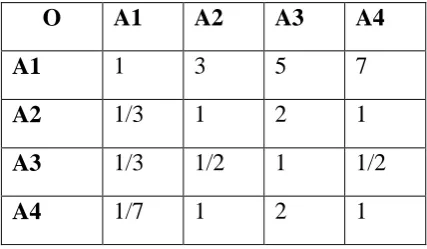
To establish the pairwise judgment matrix, comparison of the importance of each element on the same level for the corresponding elements on the upper level is necessary, where A1 is the first level index : payment, A2 quality, A3 external evaluation and A4 adaptability. The O-A hierarchical comparison matrix should be established, as shown in Table 3.3.
Table 3.3. The Criteria Mean In The Judgment Matrix
O A1 A2 A3 A4
A1 1 3 5 7
A2 1/3 1 2 1
A3 1/3 1/2 1 1/2
[image:29.595.212.426.611.735.2]23
Alternative comparisons are made in the evaluation phase, according to each of the criteria. Comparisons are made pairby- pair indicating witch alternative is preferable in relation to another. Comparisons are registered in pairwise matrix, where element aij represents a comparison between alternative i versus alternative j.
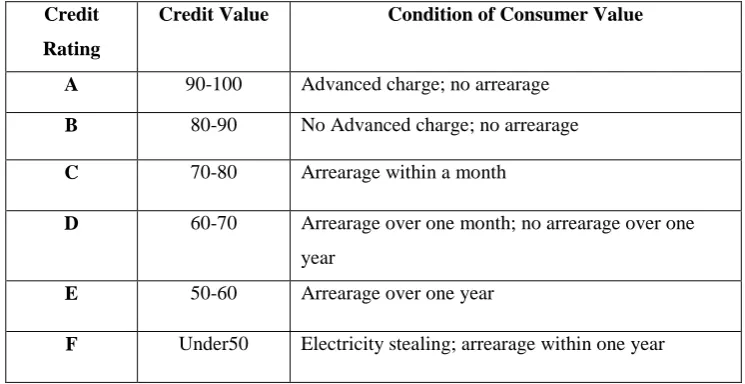
[image:30.595.132.505.298.490.2]According to the worked out credit score of consumers, their credit rating determination is shown in Table 3.4.
Table 3.4 Comparison Of Consumer Credit Rating And Credit Condition
Credit
Rating
Credit Value Condition of Consumer Value
A 90-100 Advanced charge; no arrearage
B 80-90 No Advanced charge; no arrearage
C 70-80 Arrearage within a month
D 60-70 Arrearage over one month; no arrearage over one
year
E 50-60 Arrearage over one year
3.3 Technique for Order Preference by Similarity to Ideal Solution Methodology
TOPSIS (Technique for Order Preference by Similarity to Ideal Solution) is one of the useful Multi Attribute Decision Making Techniques that is very simple and easy to implement, so that it is used when the user prefers a simpler weighting approach. On the other hand, the AHP approach provides a decision hierarchy and requires pairwise comparison among criteria.
41
REFERENCES
1 Dey P. K., Gupta S. S., Feasibility analysis of cross country pipeline projects: A quantitative approach, Project Management Journal32(4), 50–58, 2001.
2 Mian, S. A., Christine, N.D., Decision-making over the project life cycle: An analytical hierarchy approach. Project Management Journal 30 (1), 40–52. 1999
3 Loch C. H., Kavadias S., Dynamic portfolio selection of NPD programs using marginal returns, Management Science48 (10), 1227–1241, 2002.
4 Eugene R., Dey P. K., The role of environmental factors in industrial site selection activities: A case of limestone quarry expansion in
Barbados, Impact Assessment and Project Appraisal23 (2), 2005.
5 Hariharan S., Dey P. K., Kumar A. Y., Moseley H., A new tool for measurement of process-based performance of multispecialty tertiary care hospital, International Journal of Health Care Quality Assurance 17 (6), 302– 312. 116–133, 2004.
6 Saaty T. L., The analytic hierarchy process, New York: McGraw-Hill;1980. 7 Guoliang Luo, Rui Wei, Study on Credit Evaluation of Power Consumer
based on the Clustering Analysis and AHP method, The 1st International Conference on Information Science and Engineering, 2009 .
8 Jianchang Lu, Donghui Xu, Jipeng Wu, Research on Credit Risk Evaluation of Power Consumer Based on Interval Number and Entropy, International Symposium on Computational Intelligence and Design, 2010.
10 Vaidya O.S., Kumar S., Analytic hierarchy process: An overview of applications, European Journal of Operational Research, vol. 169, no. 1, pp. 1-29, 2006.
11 Y.Y. Li, D.X.Niu, H.F.Li, Z.H.Gu and Y.Zhang, Construction of competence assessment systems for electricity in final enery, East China Electric Power,
vol.36, No.5, pp.1-5, 2008.
12 Chunhao, L. An Improved Ranking Approach to AHP Alternatives Based on Variable Weights, World Congress on Intelligent Control and Automation, June 25 -27, 2008, China, 2008.
13 Guoliang, L. Study on Credit Evaluation of Power Consumer based on Clustering Analysis and AHP Method. The 1st International Conference on Information Science and Engineering (ICISE2009), 2009.
14 Mahmoodzadeh, S. Project Selection by Using Fuzzy AHP and TOPSIS Technique, World Academy of Science, Engineering and Technology 30 2007.
15 Weedy, B.M. Electric Power Systems, 4th Edition, John Wiley & Sons, Inc.England, 2001.
16 Steven Stoft. Power System Economics Designing Markets for Electricity.Wiley.Interscience; 2003.
17 Dr Mohammad Yusri bin Hassan. Teaching Module: Power System Control.
1stedition. Faculty of Electrical Engineering, Universiti Teknologi Malaysia; 2006.
18 Hisham Khatib. Economic evaluation of Projects in the Electricity Supply Industry. The Institutional of Electrical Engineers; 2003.
19 Paul L. Joskow. California Electricity Crisis. NBER Working Paper Series; August 2001.
20 J.K. Park. Status and Perspective of Electric Power Industry in Korea. IEEE; 2005.
21 Daniel Kirschen and Gorban Strbac. Fundamental of Power System Economics.John Wiley&Sons Ltd.; 2004.
22 Sally Hunt and Graham Shuttleworth. Competition and Choice in Electricity.