A Comparative Study of 1D Monatomic Fe-chain and
3D Fe-bulk within the Density Functional Theory (DFT)
D. P. Rai
1,∗,
Sandeep Chettri
2,
A. Shankar
3,
P. K. Patra
4,
R. K. Thapa
21DepartmentofPhysics,PachhungaUniversityCollege,Aizawl,796001,India 2DepartmentofPhysics,MizoramUniversity,Aizawl,796004,India 3DepartmentofPhysics,UniversityofNorthBengal,Darjeeling,734013,India
4FacultyinCentreforScienceEducation,NEHUShillong,794022,India
Copyright c2016 by authors, all rights reserved. Authors agree that this article remains permanently
open access under the terms of the Creative Commons Attribution License 4.0 International License
Abstract
The structural, electronic and magnetic prop-erties of Fe bulk and the monatomic Fe-nano wire has been theoretically investigated within the full potential linearized augmented plane wave (FP-LAPW) based on density func-tional theory (DFT). This work is a comparative study of Fe-bulk and the 1D Fe chain. A most commonly adopted GGA approximation is use for electron exchange correlation. In our calculation the property of bulk is predicted to be magnetic metal.Though there is no significant band gap at the Fermi level (EF) in Fe-wire, whereas the presence of deep valley (Spin up) and a peak(Spin down) at the EF shows the phenomenon of high antisymmetric density of states (DOS). The presence of high antisymmetric DOS may lead to spin polarization at the EF. Also the two anti-symmetric sharp peaks at two different energies give the exchange splitting. The exchange splitting between the degenerated d-states is dispersed and not much effective in the bulk system but the splitting between t2g states is very prominent in Fe-chain which enhanced the magnetic moment.Keywords
DFT, GGA, 1D Fe-wire, Magnetism1
Introduction
The magnetic properties of nano particles, thin films and nano wires have recently attracted a lot of attention due to their potential technological applications. It is thus very important to investigate the influence of dimensionality on these properties. In many experimental systems, some atoms are in a bulk-like environment while some others have a very low coordination in a strongly asymmetric environ-ment. As a consequence, the magnetic properties of such systems need to be treated at an atomic level, by studying their electronic structure in the framework of quantum me-chanics. In principle, these properties can be determined
from ab initio calculations. However, the computer time
and storage increase drastically with the number of inequiv-alent atoms. It is known through theoretical analysis that the
one-dimensional atomic array shall not be ferromagnetic in many cases. However several reports revealed that slightly disordered monatomic atom array might have ferromagnetic ground state [1, 2, 3]. From the experimental works the ferro-magnetism is confirmed for one-dimensional Co wire which is self assembled on the Pt (997) plane [4]. Before this work several researches were carried out on the ferro-magnetism of nanometer sized structure formed using steps in the (11n) plane [5, 6]. Since then tremendous researches are made in one dimensional monatomic wires. Among them the ferro-magnetism in Fe monatomic wire formed on Au (111) plane was confirmed using angle-resolved photo-emission spec-troscopy [7] and also the same group reported that the mag-netic direction of the Fe monatomic wire self organized on the terrace edge of Au (788) [8]. In addition Spisak and Hafner carried outab initiocalculation on the Fe monatomic wire on the Cu (11n) plane and reported that Fe becomes fer-romagnetic and its Curie temperature is between 200 and 300 K [9]. In recent experimental paper, Mn atomic wire was suc-cessfully mounted on the W(111) substrate and the spin po-larization at different sites in relation to spin orientation was calculated. The orientation of moment is controlled by an applied magnetic field, the changes of orientation at differ-ent sites gives the Dzyaloshinskii-Moriya interaction (DMI effect)[10]. In this work we have carried outab initio calcu-lation on the 1D monatomic Fe wire and Fe-bulk. We exam-ined the electronic and magnetic properties at their respective dimensions also we tried to analyze the change in the mag-netic moment with the change in structural dimensionality.
2
Model and calculation details
iden-tical atoms with a single atom per unit cell) with the repeti-tion along z-axis as shown in Fig.1a. The lattice constant (a and b) of the Fe-wire has been changed to a=b=10 ˚A. The lattice constant (c) was optimized and the plot of energy ver-sus c is shown in Fig.1a(top). The optimized lattice constant (c) of Fe-wire is 2.38 ˚A. The Fe-bulk structure has the bcc structure with space group Im3m and Wyckoff positions (0, 0, 0) as shown in Fig. 1(bottom). Further we choose the experimental lattice constant of a=b=c=2.84 ˚A[11] for struc-tural relaxation of the Fe-bulk. The most stable grand state structure was obtained by volume optimization method [see Fig.1a(bottom)]. The volume optimization gives the mini-mum negative energy. The minimini-mum negative energy value is the ground state energy of a compound which indicates the stability its structure. The optimized lattice constant (2.85 ˚A) is used for the calculation of electronic structures adopting the KS-DFT [13] with FP-LAPW method, as implemented in the WIEN2K package [14]. The electron exchange cor-relation was treated within generalized gradient approxima-tion (GGA) [15]. Non-spherical contribuapproxima-tions to the charge density and potential within the muffin tin (MT) spheres are considered up to lmax= 10 (the highest value of angular mo-mentum functions). The cut-off parameter isRM T ×Kmax = 7 whereKmax is the maxi-mum value of the reciprocal lattice vector in the plane wave expansion andRM T is the smallest atomic sphere radii of all atomic spheres. In the in-terstitial region the charge density and potential are expanded as a Fourier series with wave vectors up to Gmax = 12 a.u. The Monkhorst-Pack grid of dimensions of6×6×6for the bulk and5×5×32for the Fe-nano wire was generated to sample the Brillouin zone. The number of k-points used in the irreducible part of the Brillouin zone is 286. The crite-rion for the convergence of the self-consistent DFT calcula-tion is 0.0001 Ry in total energy. However the core states are treated relativistically, the semicore states are treated semi-relativistically i.e. ignoring the spinorbit (SO) coupling.
3
Result and discussion
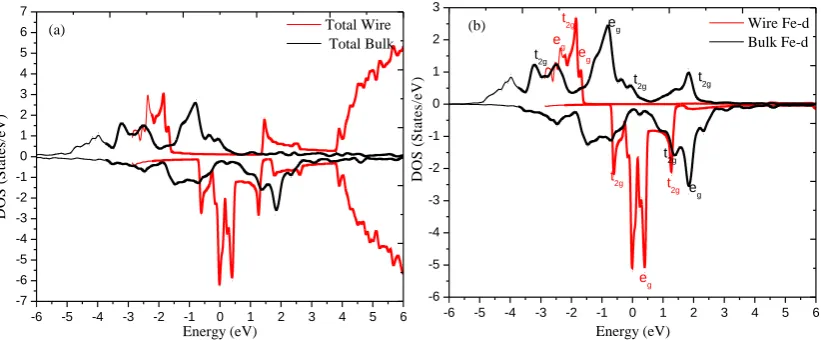
Iron can be considered an obvious choice to start studying magnetic, and hence spin polarized systems. The LDA fails to determine the correct ground state structure of Fe [16]. In nature, Fe is found to be body centered cubic and ferro-magnetic. According to the all-electron calculations [16], the LDA gives the face centered cubic non-magnetic structure as the most stable but the PBE-GGA predicts the correct struc-ture (ground state stable ferromagnetic strucstruc-ture). The bcc structure is depicted in Fig.1(a). To investigate the effect of each states we repeat the PBE calculations using FP-LAPW method. For this model of exchange-correlation, the bcc fer-romagnetic structures were used. The density of states (DOS) calculated from GGA for both bulk and Fe-wire is shown in Fig. 2. The majority contribution in both the systems (bulk and wire) are due to Fe-d states. The total DOS of bulk ex-tended from -6 eV to 3.0 eV and from -3.0 eV to 3.0 eV for 1D Fe wire. In case of Fe-wire the DOS above 3.0 eV in con-duction band is mainly due to the vacuum that was applied to discontinue the atomic wave functions (see Fig. 2(a) red line). The DOS in the valence band for the bulk system is al-most symmetric. The anti-symmetric DOS arises due to the d-d hybridization which confirms the ferromagnetic behav-iors. In the case of 1D Fe-wire, one can see the spin DOS is
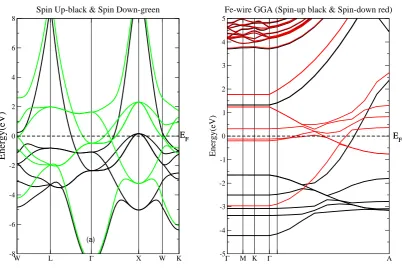
completely anti-symmetric. The sharp and spiky peaks in the DOS (see Fig.2b) in 1D Fe wire represents the discrete en-ergy bands which can be compared with the band structures as shown in Fig. 5(b). In the case of bulk there are no such sharp and spiky peaks to represent the discrete energy levels. The DOS in the bulk materials are dispersed around the Fermi level (EF) in both the spin channels (up and down) which pre-dicts its metallic character (see Fig. 5a). On the other hand the low-flat DOS in the spin up channel and the sharp peak around EFin spin down region is an interesting feature. The two anti-symmetric peaks in the spin up and down region of the Fe-wire is due to the deg and t2gstates, which attributes an exchange splitting. The result of difference in the ampli-tude of the DOS peaks at EF gives higher amplitude of spin DOS, which may give an effect like spin polarization which is a typical signature of the half metallic system [17]. Our result of DOS for 1D Fe-wire is compared with the results of Fe-atomic chain placed on the Au (111) surface and the result is in good agreement (see Fig. 2a, Ref.[18]). The electron density plot for Fe-bulk and Fe-wire along 100 plane is pre-sented in Fig.3(a,b). The charge distribution on the surface of Fe-wire is predicted by calculating the Fermi surface. The picture of solenoid type Fermi surface is shown in Fig.4(a,b). The magnetic moments are the results of the asymmetric spin DOS. The magnetic moment of Fe-bulk and wire are analyzed with variation in lattice constant. The result of lat-tice constant versus magnetic moment are displayed in Fig. 1(b). Our calculated magnetic moment for the bulk system is 2.24µB in good agreement with the previous results. The previous results of magnetic moment for the bulk systems are of 2.28µB within LSDA [19], 4 µB for TB-GGA [20] and the experimental magnetic moment of the Fe bulk sys-tem is 2.20µB [21] similar result was obtained by Starrost et al.[22]. As compared to the bulk system the magnetic mo-ment of 1D system is high. This is due to the reason that Fe-d states exhibit an exchange splitting between the t2gstates (see fig.2b) with the splitting value around 1.00 eV in 1D Fe wire which is missing in Fe-bulk system. The magnetic moment of the monatomic Fe-chain using tight binding local density approximation (TB-LDA) is 3.20µB. In earlier calculations a magnetic moment of 2.65 µB was obtained for 2D Fe(1 1 0) slab shows [23] which is less than the magnetic mo-ment of 1D Fe-wire. From the previous DFT calculation it is found that the 6 layers Fe slabs gives a magnetic moment of 3.66µB, 5 layers Fe slabs give 3.30µBand an infinite num-ber of slabs which mimic the bulk gives magnetic moment of around 2.2µB [24]. Our calculated magnetic moment of 1D monatomic Fe wire is 2.95µB which is higher than the value of bulk system but consistent with the previous results as discussed above.
4
Conclusion
2 . 0 2 . 2 2 . 4 2 . 6 2 . 8 3 . 0 3 . 2 1 . 5
2 . 0 2 . 5 3 . 0 3 . 5 4 . 0
L a t t i c e c o n s t a n t ( A o)
M
a
g
n
e
ti
c
m
o
m
e
n
t
(u
B
)
B u l k
[image:3.595.91.521.89.260.2]W i r e
Figure 1.(a) Crystal structure & Volume optimization curves of 1D Fe-wire and bulk (b) Lattice constant versus magnetic moment
- 6 - 5 - 4 - 3 - 2 - 1 0 1 2 3 4 5 6 - 7
- 6 - 5 - 4 - 3 - 2 - 1
0
1
2
3
4
5
6
7
D
O
S
(
S
ta
te
s/
e
V
)
E n e r g y ( e V )
T o t a l W i r e
T o t a l B u l k ( a )
- 6 - 5 - 4 - 3 - 2 - 1 0 1 2 3 4 5 6 - 6
- 5 - 4 - 3 - 2 - 1
0
1
2
3
t
2 g
t2 g
e g
e
g
t
2 g t2 g
e
g
e g
t2 g t2 g
t2 g
e g
E n e r g y ( e V )
D
O
S
(
S
ta
te
s/
e
V
)
W i r e F e - d
[image:3.595.101.512.337.507.2]B u l k F e - d ( b )
Figure 2.(a) Total DOS (bulk-blue & Fe chain-red) and (b) Partial DOS of Fe-d (bulk-blue & Fe chain-red)
-2 -1.5-1 -0.5 0.5 1.5 0 1 2
[image:3.595.141.491.584.778.2]Figure 4.Fermi surface of Fe-wire (a) longitudinal view and (d) cross-section view
W L Γ X W K -8
-6 -4 -2 0 2 4 6 8
Energy(eV)
Spin Up-black & Spin Down-green
EF EF
F
Γ M K Γ A -5
-4 -3 -2 -1 0 1 2 3 4 5
Energy(eV)
Fe-wire GGA (Spin-up black & Spin-down red)
EF EF
[image:4.595.89.493.460.737.2]with the change in the structural dimensionality. We might need further analysis to know the affect of reduced struc-tural dimensionality and its effect on the magnetic moments as well as on its electronic structure.We may intend to use the LSDA+U method to treat the strong correlation of 3d-electrons to obtained the most accurate ground state proper-ties.
Acknowledgements
DPR acknowledges UGC-Start-Up Grant (BSR) (New Delhi, India). SD a grant from DST,New Delhi, India un-der Dy No. SERB/F/3586/2013-14. Authors thank Dr. Vikas Kasid (Pune University, India) for providing the related in-formation regarding Fe-wire.
REFERENCES
[1] S. Liang and H. Pang,Europhys. Lett.32, 173 (1995).
[2] S. Watanabe, M. Ichimura, T. Onogi, Y. Ono, T. Hashizume and Y. Wada,Jpn. J. Appl. Phys.36, L929 (1997).
[3] S. Daul and M. Noack,Phys. Rev. B58,2635 (1998).
[4] P. Gambardella, A. Dallmeyer A, K. Maiti, M. Malagoli, W. Eberhardt, K. Kern and C. Carbone,Nature416301 (2002).
[5] H. Elmers, J. Hauschild, H. Hoche, U. Gradmann, H. Berthge, D. Heuer and U. Kohler,Phys. Rev. Lett.73,898 (1994).
[6] J. Schen, R. Skomski, M. Klaua, H. Jenniches, S. Manoharan and J. Kirschner,Phys. Rev. B56,234 (1997).
[7] S. Shiraki, H. Fujisawa, M. Nantoh and M. Kawai,J. Phys. Soc. Jpn.74,2033(2005).
[8] H. Fujisawa, S. Shiraki, M. Furukawa, S. Ito, T. Nakamura, T. Muro, M. Nantoh and M. Kawai,Phys. Rev.B75,245423 (2007).
[9] D. Spisak and J. Hafner,Phys. Rev. B65,235405 (2002).
[10] M. Bode et al., nature 447, 190 (2007).
[11] A. Jephcoat, H. Mao, and P. Bell,Journal of Geophysical Re-search91, 4677 (1986).
[12] F.D. MurnaghanProc. Natl. Acad. Sci. USA30,244 (1944).
[13] W. Kohn and L. J. Sham,Phys. Rev.140,A1133 (1965).
[14] P. Blaha, K. Schwartz, P. Sorantin and S. Trickey,Comp. Phys. Commun59,399 (1990).
[15] J. Perdew, S. Burke and M. Ernzerhof, Phys. Rev. Lett.77, 3865 (1996).
[16] E. Blanca, C. Rodriguez, J. Shitu, and D. Novikov,J. Phys.: Condens. Matter13,9463 (2001)
[17] I. Galanakis and P. H. Dederichs, Phys. Rev. B66, 174429 (2002).
[18] T. Yasui and M. Nawate,Journal of Physics: Conference Se-ries200,072068 (2010)
[19] V. L. Moruzzi, J. F. Janak, and A. R. Williams, Calculated Electronic Properties of Metals(Pergamon, New York, 1978). [20] G. Autes et al., J. Phys.: Condens. Matter 18 67856813 (2006).
[21] A.H. Morrish, The Physical Principles of MagnetismWiley: New York,p. 264-272 (1965).
[22] F. Starrost,Phys. Rev. B64,235105 (2001).
[23] A.J. Freeman, C.L. Fu,J. Appl. Phys.61,3356 (1987).