Journal of Chemical and Pharmaceutical Research, 2012, 4(11):4702-4709
Research Article
CODEN(USA) : JCPRC5
ISSN : 0975-7384
Development and validation of stability indicating UPLC assay method for bupivacaine in
pharmaceutical formulation
Prathyusha. PCHGS
1*, P. Shanmugasundaram
1, P. Y. Naidu
2and Sanjeev Singamsetty
21
Department of Pharmaceutical analysis, School of Pharmaceutical Sciences, Vels University,
Chennai - 600117. (India)
2
Analytical Research & Development, Hospira Health Care India Pvt Ltd., Irungattukottai,
Chennai -602105. (India)
_____________________________________________________________________________________________
ABSTRACT
The present method provides the detailed description of development and validation of a simple stability indicating liquid chromatographic method for Bupivacaine Assay in the presence of Methyl paraben. Successful separation of the drug from methyl paraben was achieved with in 6min on C18, 50 x 4.6mm, 1.8µm column, using a 0.2M pH 6.8 Phosphate buffer, Acetonitrile and Milli Q water in the ratio of 5:40:650v/v/v at a flow rate of 1.0 mL per minute. Column oven temperature was selected as 45ºC where the detection was carried out at 234 nm. The developed LC method was validated with respect to specificity, linearity, accuracy, precision, ruggedness and robustness. The assay method was found to be linear in the range of 25 µg·mL–1 to with 300 µg·mL–1 correlation coefficient of 0.9999 for methyl paraben and 125 µg·mL–1 to with 900 µg·mL–1 correlation coefficient of 0.9999 for Bupivacaine. A recovery of assay of methyl paraben was found between 98.5% and 101.5% and Bupivacaine was found between 98.5% and 101.5%. The developed LC method to determine the assay of Bupivacaine can be used to evaluate the quality of regular production samples and stability samples.
Keywords: Bupivacaine, stability indicating; Liquid chromatography; Assay; Development; Validation;
_____________________________________________________________________________________________
INTRODUCTION
Bupivacaine [(RS)-1-butyl-N-(2,6-dimethylphenyl)piperidine-2-carboxamide ] Figure 1.1 is a local anesthetic [1] drug belonging to the amino amide group, a white crystalline powder that is freely soluble in 95 percent ethanol, soluble in water, and slightly soluble in chloroform or acetone. Whereas Methyl paraben is a preservative [2] with the chemical structure as shown in Figure 1.2. It is the methyl ester of p-hydroxybenzoic acid.
N
NH C H3
CH3 O C
H3
.HCl.H2O
O H
O
OCH3
of the action potential. Bupivacaine binds to the intracellular portion of sodium channels and blocks sodium influx into nerve cells, which prevents depolarization. Few HPLC methods were reported in the literature for the analysis of Bupivacaine injection. HPLC method to determine the stability of fentanyl citrate and Bupivacaine hydrochloride mixtures in infusion solutions [3] RP-HPLC method for simultaneous determination of Bupivacaine and its two metabolites, desbutyl- and 4’-hydroxybupivacaine, in human serum and urine.[4] LC method for Simultaneous determination of Bupivacaine, mepivacain, prilocaine and ropivacain in human serum by liquid chromatography– tandem mass spectrometry [5]. Extensive literature survey reveals there is no stability indicating UPLC method for Assay Method for Bupivacaine Injection. Hence, an attempt has been made to develop and accurate, rapid, specific and reproducible method for the determination of Bupivacaine and methyl paraben using UPLC along with method validation as per ICH norms. The stability tests were also performed on both drug substances and drug product as per ICH norms.
EXPERIMENTAL SECTION
2.1. Chemicals
Active pharmaceutical ingredient samples of Bupivacaine and Methyl paraben were received from bulk manufactures of Hospira health care India (Chennai, India). The HPLC grade Acetonitrile (ACN) was purchased from J.T.Baker. Sigma- Aldrich, ACS grade Potassium dihydrogen phosphate & Dibasic Potassium phosphate were obtained from Merck (Mumbai, India). High purity water was prepared by using Milli- pore Milli-Q plus purification system (Millipore, Bedford, USA). All samples and impurities used in the study were greater than 99.0% purity.
2.2. Equipment
A Waters Acquity H-class UPLC system with a photo diode array detector was used for method development and forced degradation studies. The output signal was monitored and processed using Empower software.
2.3. Chromatographic Conditions
The Chromatographic column used was an peerless HT C18 column (50 × 4.6 mm 1.8 µm) using Mobile phase consists of Mobile phase consisting of 0.2M pH 6.8 Phosphate buffer, Acetonitrile and Milli Q water in the ratio of 5:40:650v/v/v, Buffer was prepared by dissolving about 3.45g of anhydrous monobasic potassium phosphate and 4.35g of anhydrous dibasic potassium phosphate in 250mL of Milli-Q water, adjusted pH of solution to 6.80 ± 0.05 with 1M Phosphoric acid (or) 10% Potassium hydroxide solution and filter through 0.22 µm filter. The flow rate of the mobile phase was 1.0 mL· min–1. The column temperature was maintained at 45°C. A wave length of 234 nm was employed for the detection. The injection volume was 5 µL. Mobile phase was used as diluent.
2.4. Preparation of Solutions
2.4.1. Preparation of Standard Solutions
A stock solution of Bupivacaine (2.0 mg· mL–1) was pre- pared by dissolving an appropriate amount in diluent. A stock solution of Methyl paraben (2.0 mg· mL–1) was also prepared in diluent. Working solutions were prepared from above stock solution for assay determination.
2.4.2. Preparation of Sample Solution
The Bupivacaine injection was diluted accordingly to a concentration of 2.0 mg.mL -1 by using diluent.
RESULTS AND DISCUSSION
2.5.1 Method development
The development of selective method for the Estimation and Separation of methyl paraben and Bupivacaine was described as important issue in method development. Bupivacaine and Methyl paraben show different affinities for chromatographic stationary and mobile phases due to differences in their molecular structures. The resultant differences in the distribution constants may be used for the separation of the investigated components by liquid chromatography.
Selection of wavelength:
Fig 2.1 UV spectra of Bupivacaine Fig 2.2 UV spectra of Methyl paraben
Selection of pH of mobile phase:
Different pH values of the mobile phase were checked to establish the optimum separation and the highest analytical sensitivity for Bupivacaine and Methyl paraben. The mobile phase was buffered because of the existence of ionizable groups in the chemical structure of the drug, which could ionize at different pH values. The pH values tested were 6.3, 6.5 and 6.7. Finally, the best results were obtained at pH 6.5 ±0.2 by adjusting with 1M Phosphoric acid solution. The choice of this mobile phase is justified by the excellent symmetry of the peaks and adequate retention times of Bupivacaine and Methyl paraben.
Flow rate optimization
Different mobile phase flow rates (1.3, 1.5 and 1.7 mL min-1) were investigated. The optimum flow rate for which the column plate number was maximum, with the best resolution between all compounds and with a short runtime (6min) observed was 1.5 mL min-1.
Column temperature optimization
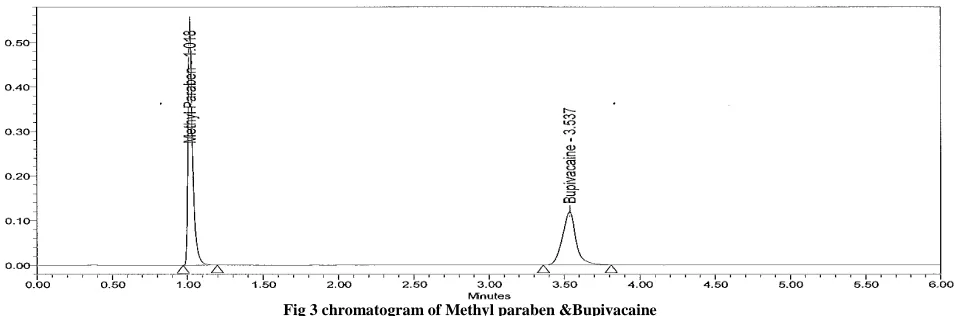
[image:3.595.71.548.394.552.2]Column thermostat temperatures were used at, 40°C,45°C and 50° for better peak shapes, baseline and resolution. At the column oven temperature of 45°C the finest baseline resolution was observed between the components. For chromatogram refer Figure 3.
Fig 3 chromatogram of Methyl paraben &Bupivacaine
2.5.2. Analytical Method Validation
Method validation of Analytical procedures used in the testing of Drug substances and Finished products in Pharmaceutical companies, indicated that the Method validation shows an essential similarity in different laboratories there is much diversity in the detailed application of validation parameters applied to chromatographic procedures [6]. Owing to increased interdependence among countries in recent times, it has become necessary for results of many analytical methods to be accepted internationally. Consequently, to assure a common level of quality, the need for use of validated methods has increased in the Pharmaceutical Industry. According to FDA [7-8] and ICH [9-10], the key Analytical parameters that require validation were Accuracy, Precision, Linearity, Recovery, Limit of Detection, Limit of Quantification and Ruggedness.
2.5.2.1. Specificity
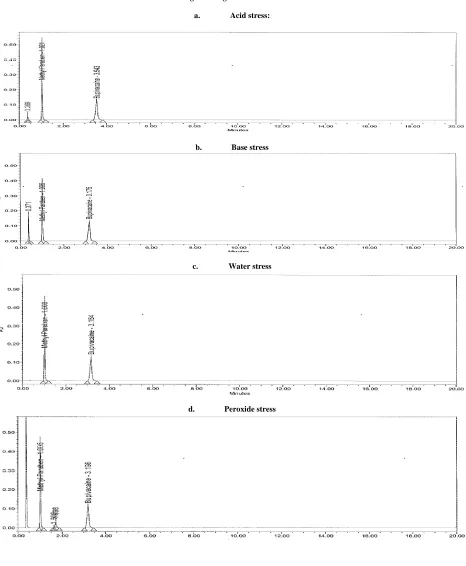
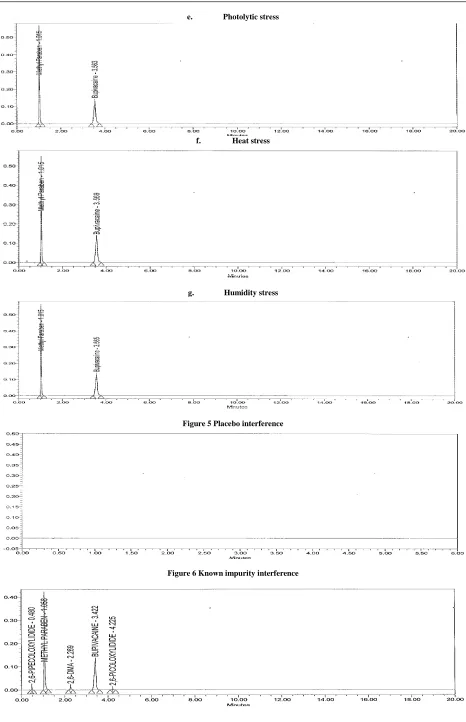
The specificity of Bupivacaine and Methyl paraben was determined by the developed LC method. Forced degradation studies were also performed on Bupivacaine and Methyl paraben to provide an indication of the stability indicating property and specificity of the proposed method. The stress conditions employed for degradation study includes light (carried out as per ICH Q1B), heat (105°C for 24 hours), acid hydrolysis (1 N HCl), base hydrolysis (1 N NaOH), water hydrolysis (temperature at 80 for 2hours) and oxidation (3% H2O2). For light studies, the study period was 10 days .Peak purity of stressed samples of Bupivacaine and Methyl paraben was checked by using a photo diode array detector of waters Corporation, MA, USA. Results were presented in Figure 4.
Figure 4 Degradation studies
a. Acid stress:
b. Base stress
c. Water stress
e. Photolytic stress
f. Heat stress
g. Humidity stress
[image:5.595.73.539.60.782.2]Figure 5 Placebo interference
Placebo interference and known impurity interference of the samples were performed and found that there was no placebo interference or impurity interference with methyl paraben and Bupivacaine. Results were presented in the figure 5 & 6 respectively.
2.5.2.2. Precision
Assay method precision was evaluated by carrying out six independent assays of test sample of Bupivacaine and Methyl paraben. The %RSD for percentage of each was calculated. Precision study was also determined by performing the same procedures on a different day (Inter-day precision). The intermediate precision (ruggedness) of the method was also evaluated by different analyst, different column and different instrument in the same laboratory.
The %RSD of Bupivacaine during the assay method precision study was within 0.4% for methyl paraben and 0.4% for Bupivacaine and intermediate precision study was within 0.4% for methyl paraben and 0.8% for Bupivacaine. The %RSD of area of Bupivacaine and methyl paraben of method precision study was within 0.4% for methyl paraben and 0.4% for Bupivacaine. Conforming the good precision of the developed analytical method.
2.5.2.3. Linearity
Linear calibration plot for assay method was obtained over the calibration range tested, 25 µg·mL–1 to with 300
µg· mL–1 for methyl paraben and 125 µg· mL–1 to with 900 µg· mL–1 and the correlation coefficient obtained was greater than 0.999. The results showed an excellent correlation between the peak area and concentration of the analyte.
2.5.2.4. Accuracy
The accuracy of the assay method was evaluated in triplicate at six concentration levels i.e. 125, 250, 400, 500, 600 and 750 µg·mL–1 in Bupivacaine and 50,100,160,200,240 and 300 µL–1 at each concentration, three sets were prepared and injected in triplicate. The percentage of recovery was calculated at each level.
Recoveries of assay of methyl paraben was found between 98.5% and 101.5% and Bupivacaine was found between 98.5% and 101.5%. The results are presented in Table 1.
Table1. Results of accuracy study for bulk methyl paraben and Bupivacaine
Added (µg) % Recovery % RSD
Methylpara-ben(µL-1) Bupivacai-ne (µL-1) Methyl paraben Bupivacaine Methyl paraben Bupivacaine
50 125 98.6 98.7 0.4 0.5
100 250 100.6 99.6 0.3 0.5
160 400 101.4 101.4 0.4 0.4
200 500 101.4 101.1 0.3 0.4
240 600 101.0 101 0.3 0.3
300 750 100.6 100.5 0.4 0.4
2.5.2.5. Robustness
Robustness of a method was defined as a measure of its capacity to remain unaffected by small, but deliberate changes in method parameters and provides an indication of its reliability during normal usage. The one, now days most widely applied in the Pharmaceutical world is the one given by the International Conference on Harmonization of Technical Requirements for the registration of Pharmaceuticals for human use [11] and which was given by the definition of Robustness of an analytical procedure. In the varied conditions viz. Mobile phase composition variation, Flow rate, Column temperature and pH of the buffer, the Resolution between the peaks and the amount of impurities were estimated.
Table 2.1 Mobile phase composition variation – Acetonitrile
System suitability parameter 90% 100% 110% USP resolution between methyl paraben and Bupivacaine 17.8 18.0 14.8 USP tailing factor Methyl paraben 1.1 1.1 1.0
Bupivacaine 0.9 0.9 0.8
Theoretical plates Methyl paraben 3569 3657 3425 Bupivacaine 4380 4843 3844 Average area of the standard Methyl paraben 1083647 1079788 1086297
Bupivacaine 671812 678460 677574 %RSD of the standard Methyl paraben 0.7 0.4 0.5
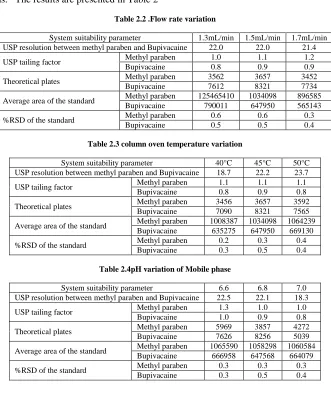
The Robustness was studied by varying ±0.2 units of Flow rate (in mL min-1), ±0.1 unit of pH, ±10% relative of organic phase composition and ±5ºC in Column temperature to the actual method parameters. This study reveals that the relative retention time of Doripenem impurities were comparable with that of the data acquired from nominal method conditions. The results are presented in Table 2
Table 2.2 .Flow rate variation
System suitability parameter 1.3mL/min 1.5mL/min 1.7mL/min USP resolution between methyl paraben and Bupivacaine 22.0 22.0 21.4
USP tailing factor Methyl paraben 1.0 1.1 1.2
Bupivacaine 0.8 0.9 0.9
Theoretical plates Methyl paraben 3562 3657 3452
Bupivacaine 7612 8321 7734
Average area of the standard Methyl paraben 125465410 1034098 896585 Bupivacaine 790011 647950 565143 %RSD of the standard Methyl paraben 0.6 0.6 0.3
[image:7.595.141.472.113.507.2]Bupivacaine 0.5 0.5 0.4
Table 2.3 column oven temperature variation
System suitability parameter 40°C 45°C 50°C USP resolution between methyl paraben and Bupivacaine 18.7 22.2 23.7 USP tailing factor Methyl paraben 1.1 1.1 1.1
Bupivacaine 0.8 0.9 0.8
Theoretical plates Methyl paraben 3456 3657 3592 Bupivacaine 7090 8321 7565 Average area of the standard Methyl paraben 1008387 1034098 1064239
Bupivacaine 635275 647950 669130 %RSD of the standard Methyl paraben 0.2 0.3 0.4
Bupivacaine 0.3 0.5 0.4
Table 2.4pH variation of Mobile phase
System suitability parameter 6.6 6.8 7.0 USP resolution between methyl paraben and Bupivacaine 22.5 22.1 18.3 USP tailing factor Methyl paraben 1.3 1.0 1.0
Bupivacaine 1.0 0.9 0.8
Theoretical plates Methyl paraben 5969 3857 4272 Bupivacaine 7626 8256 5039 Average area of the standard Methyl paraben 1065590 1058298 1060584
Bupivacaine 666958 647568 664079 %RSD of the standard Methyl paraben 0.3 0.3 0.3
Bupivacaine 0.3 0.5 0.4
2.5.2.6. Stability of solution
Drug Stability was a function of storage conditions and chemical properties of the drug and its impurities. Conditions used in stability experiments should reflect situations likely to be encountered during actual sample handling and analysis. Stability data is required to show that the concentration and Purity of Analyte in the sample at the time of analysis corresponds to the concentration and Purity of Analyte at the time of sampling. The stability study of the analyte should be conducted at the temperatures, for example; Room temperature and Refrigerator conditions that will be experienced over the period needed to process a batch of study samples.
The solution stability and mobile phase stability experiments data confirmed that sample solution and mobile phase used during assay determination were stable up to the study period was 48 hours.
2.5.2.7. Assay Analysis
Analysis was performed for different batches of Bupivacaine & Methyl paraben ranged from 99.5% to 101.5% and 99.5% to 101.5%.
CONCLUSION
REFERENCES
[1] Bupivacaine for injection http://www.drugs.com/mtm/bupivacaine.html [2] Bupivacaine HCl injection http://www.rxlist.com/sensorcaine-drug.html
[3] Mikołaj Piekarski; Anna Jelin'ska1; Kamil Szymczak, Eur J Hosp Pharm., 2012, 19, 447-451. [4] R.L.P. Lindberg; J.H. Kanto; K.K. Pihlajamaki, Journal of Chromatography., 1986, 383, 357-364. [5] A. Koehler; r. Oertel; w. Kirch, Journal of Chromatography A., 2005, 1088, 126–130.
[6] Clarke; G.S, J. Pharm. Biomed. Anal., 1994, 12, 643-652.
[7] FDA, Food and Drug Administration, 1994, Guidance for industry: Analytical Procedures and Methods Validation, (Draft Guidance).
[8] FDA, Food and Drug Administration, Center of Drug Evolution and Research, 1994, Reviewer Guidance, Validation of Chromatographic Methods.
[9] ICH, International conference on harmonization, October 1994, Text on Validation of Analytical Procedures Q2A.
[10] ICH, International conference on harmonization November 1996, Validation of Analytical Procedures methodology (Q2B).