http://dx.doi.org/10.4236/ojbm.2016.43055
Residential Difference and Settlement
Intention: Based on Ordered Logit Model
Murong Guo
School of Public Management, Jinan University, Guangzhou, China
Received 30 June 2016; accepted 19 July 2016; published 22 July 2016
Copyright © 2016 by author and Scientific Research Publishing Inc.
This work is licensed under the Creative Commons Attribution International License (CC BY).
http://creativecommons.org/licenses/by/4.0/
Abstract
Based on the survey of the National Dynamic Monitoring of the Floating Population of China in 2014, this paper applies ordered logit model to present statistical evidence showing how residen-tial difference can lead to variations in the probabilities of settlement of the floating population. The empirical results show that the residential difference is positively related to the settlement intensions of migrant workers. Specifically, the probability of settlement for the people who live in commercial housing is the highest, followed by those living in government subsidized housing and rental private housing, while those living in work unit housing is the lowest. Therefore, in order to promote the process of urbanization, we should respect migrants’ settlement intensions and achieve the goal of their permanent settlement by improving the multi-level residential pattern and establishing a multiple security housing supply systems.
Keywords
Residential Difference, Settlement Intention, Ordered Logit Model
1. Introduction
enterprises, especially the intensive labor firms. The percentage of other housing choices, including self-built sheds and temporary housing on construction site, added up to about 30%. The proportion of migrants who have purchased ownership right to their housing in urban or small town is minimal, merely about 1% [1]. In compari-son with the local residents, the conditions of migrant housing in urban were at best mediocre, but most of them were obligated to endure these harsh situations [2]. And the existence of social exclusion leads the immigrants to have a limited possibility to own private house or get public rental house than the natives [3]. So how to settle down the migrant workers, housing problem seems to be a central topic among scholars. However, the differential in the housing choices seems to have crucial implication that the higher use right or ownership right on housing they got, the more resources their family may possess. But whether the housing choice plays a vital role in mi-grants’ settlement intention, it has no empirical evidence before. So this paper is dedicated to testing the relation-ship between the residential difference and the settlement intention of migrants by employing empirical method.
The rest of the paper is organized as follows. Section 2 describes the data source and gives descriptive Analy-sis. In Section 3, we introduce the method we have used. Section 4 presents our empirical findings and Section 5 makes a conclusion.
2. Data Source and Descriptive Analysis
2.1. Data Source
The paper uses data from the survey on the National Dynamic Monitoring of the Floating Population of China in 2014 (NDMFP) conducted by National Health and Family Planning/Commission of the People’s Republic of China. The data are collected from around 163,000 subjects between the age of 15 and 59 in 2014, who migrant to cities above one month. It provides plenty of household and individual information, such as demographic characteristics, migration destination, and work and employment information.
2.2. Descriptive Analysis
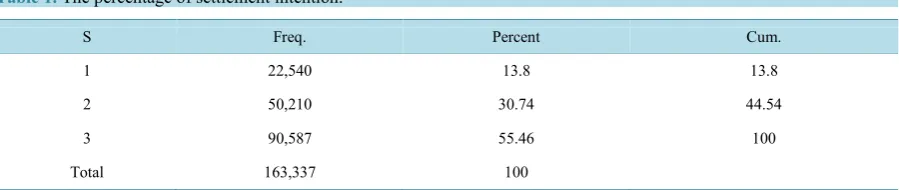
The purpose of this study is to test the relationship between the residential difference and the settlement inten-tion of migrants. We suppose that the higher use right or ownership right on housing for migrants, the higher settlement intention they have. We measure the migrants’ settlement intention by respondents’ answer to the question: “Do you intend to live in this region for more than five years in the future?”, and the answer to this question ranges from “Yes” and “Not sure” to “No”. Answers to this question from the respondents to some ex-tent reflect their migratory and settlement inex-tention. Suppose the variable S is equal to 1 if the subject give the answer is “No”, S = 2 if the answer is “Not sure”, and S = 3 while the answer is “Yes”. The way settlement in-tention is measured is important in empirical analysis because it considers all the situations including “Not sure” option, avoiding sample error. As can be seen in Table 1, the proportion of the answer “Yes”, “Not sure” and “No” was 55.46%, 30.74% and 13.8% respectively. Up to half of them had a strong settlement intention.
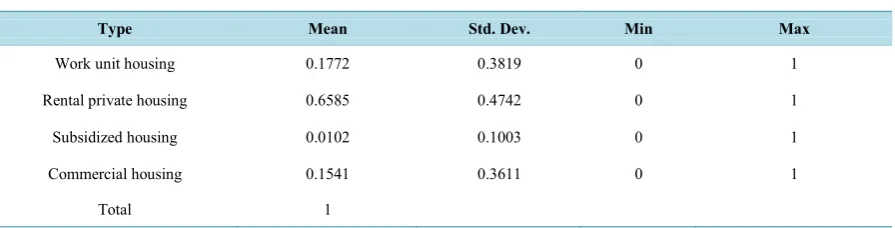
[image:2.595.89.539.625.720.2]Then we define the differential in the housing types as residential difference. Based on the housing provision mechanisms, they have been divided into four parts. The first one, subsidized housing with government support, including public housing, low-rent housing and economic and comfortable housing, is distributed by govern-ment. The second one is work unit housing, mainly provided by enterprises and businesses but also included temporary housing on construction sites. The third one is rental private housing provided by society, a popular option for migrants settling in suburban areas through the rental agencies, and the sitting tenants only have use rights. The last one is commercial housing which involved self-constructed housing and self-purchased housing, and migrants gain full right to sell and transfer. These variables are defined as binary variables. As shown in Table 2, renting was a key housing choice for migrants, accounting for a percentage of 65.85%, followed by
Table 1. The percentage of settlement intention.
S Freq. Percent Cum.
1 22,540 13.8 13.8
2 50,210 30.74 44.54
3 90,587 55.46 100
Table 2.The Housing Types of The Floating Population.
Type Mean Std. Dev. Min Max
Work unit housing 0.1772 0.3819 0 1
Rental private housing 0.6585 0.4742 0 1
Subsidized housing 0.0102 0.1003 0 1
Commercial housing 0.1541 0.3611 0 1
Total 1
working unit housing (17.72%) and commercial housing (15.41%), while the proportion of subsidized housing was merely 1%.
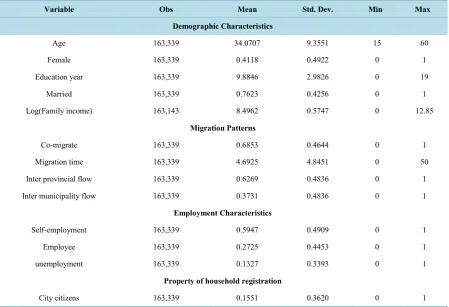
In addition, a preliminary analysis of the survey results revealed some important demographic characteristics and employment status of the respondents. Most of the respondents were middle age, and their mean age being 34 years. Male (59%) and female (41%) migrants were almost equally represented, and their mean educational years was 9.8, which was generally consistent with the implementation of the nine years compulsory education in China since 1990s. 76.23% of migrants had been married, 68.53% of among them went out together. The most common employment status of the respondents was self-employment (59.47%), followed by employee (27.25%), with 13.27% of unemployment also represented in the survey. Among the floating population, 15.51% of them were urban residents (see Table 3). In order to eliminate heteroskedasticity, we convert the va-riable of family income into logarithm.
3. Methods
In the classical econometric model, the dependent variables are usually assumed to be continuous variables. However, we always face many decision-making problems that people must make a decision in a number of al-ternative programs. Such programs can be represented by discrete variables. For example, the degree of settle-ment intention of the floating population is denoted by 1, 2 and 3. If using such explanatory variable to establish the econometric model, we call it discrete choice model, including binary choice model and multiple choice model. Multiple choice models can further divide into general multiple choice and ordered multiple choice model, and the latter one focus on the sequential options but the former not. Because of our outcomes can be ranked: the ordering S = 1, 2, 3 represents a ranking of settlement intention. Thus, this study should apply the ordered multiple model. Such model is involved in two kinds of multiple choice models-the ordered logit model and the ordered probit model. But ordered logit model, based on the assumption that the random disturbances are independently and identically distributed with the logistic distribution, which is the most widely used. Therefore, this paper will use the ordered logit model, which is:
i i i
y∗=χ β ε' + (1)
i i'
V =χ α (2) What we can actually observe is the answer given by the respondent i, in other words, is the discrete variable i
y (i.e. 1, 2, 3). But using discrete variable to be dependent variable will bring serious heteroscedastic and in-consistent error, so we convert it to continuous variables yi∗. yi∗ consist of a set of identified items Vi and random items εi. Vi is a series of factors that affect the function of χi' and α is a estimated coefficient. We formalize the relationship between yi∗ and yi as follow:
i i 1
i 1 i 2
i 2 i
y 1 if y w
y 2 if w y w
y 3 if w y
∗
∗
∗
= ≤
= ≤
=
≺ ≺
Table 3. Other control variables.
Variable Obs Mean Std. Dev. Min Max
Demographic Characteristics
Age 163,339 34.0707 9.3551 15 60
Female 163,339 0.4118 0.4922 0 1
Education year 163,339 9.8846 2.9826 0 19
Married 163,339 0.7623 0.4256 0 1
Log(Family income) 163,143 8.4962 0.5747 0 12.85
Migration Patterns
Co-migrate 163,339 0.6853 0.4644 0 1
Migration time 163,339 4.6925 4.8451 0 50
Inter provincial flow 163,339 0.6269 0.4836 0 1
Inter municipality flow 163,339 0.3731 0.4836 0 1
Employment Characteristics
Self-employment 163,339 0.5947 0.4909 0 1
Employee 163,339 0.2725 0.4453 0 1
unemployment 163,339 0.1327 0.3393 0 1
Property of household registration
City citizens 163,339 0.1551 0.3620 0 1
4. Empirical Results
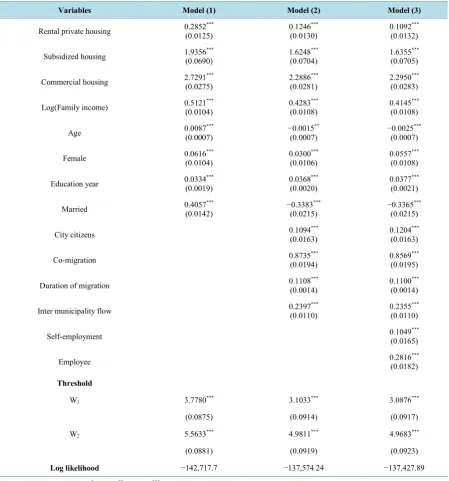
Our primary objective is to test the assumption that whether residential difference can lead to variations in the probabilities of settlement intention of the floating population. Model (1) controls for age, gender, years of schooling, marital status dummies and household income. Because of the differences in migration patterns (i.e. the scope and duration of migration, and co-migration dummies variable) and the property ofhousehold regis-tration, we try to test the robustness of our results by introducing these detailed control variables into our regres-sion (see Model (2)). Model (3) is the same as Model 2 except that it further controls for the employment status of migrants.
From Table 4, all of the variables in the equation are significant. The log likelihood function values from Model (1) to Model (3) are −142717.7, −137574.24 and −137427.89 respectively. Due to the value of settlement intention is gradually increased from 1 to 3, which means that the degree of settlement intention is from weak to strong. Therefore, the significant positive coefficient indicates that such immigrants have a stronger willingness to settle down the cities.
Table 4. Estimation results of ordered Logit model.
Variables Model (1) Model (2) Model (3)
Rental private housing 0.2852(0.0125) *** 0.1246(0.0130) *** 0.1092(0.0132) ***
Subsidized housing 1.9356(0.0690) *** 1.6248(0.0704) *** 1.6355(0.0705) ***
Commercial housing 2.7291(0.0275) *** 2.2886(0.0281) *** 2.2950(0.0283) ***
Log(Family income) 0.5121(0.0104) *** 0.4283(0.0108) *** 0.4145(0.0108) ***
Age 0.0087(0.0007) *** −0.0015(0.0007) ** −0.0025(0.0007) ***
Female 0.0616(0.0104) *** 0.0300(0.0106) *** 0.0557(0.0108) ***
Education year 0.0334(0.0019) *** 0.0368(0.0020) *** 0.0377(0.0021) ***
Married 0.4057(0.0142) *** −0.3383(0.0215) *** −0.3365(0.0215) ***
City citizens 0.1094(0.0163) *** 0.1204(0.0163) ***
Co-migration 0.8735(0.0194) *** 0.8569(0.0195) ***
Duration of migration 0.1108(0.0014) *** 0.1100(0.0014) ***
Inter municipality flow 0.2397(0.0110) *** 0.2355(0.0110) ***
Self-employment 0.1049(0.0165) ***
Employee 0.2816(0.0182) ***
Threshold
W1 3.7780*** 3.1033*** 3.0876***
(0.0875) (0.0914) (0.0917)
W2 5.5633*** 4.9811*** 4.9683***
(0.0881) (0.0919) (0.0923)
Log likelihood −142,717.7 −137,574.24 −137,427.89 Standard errors in parentheses: *p < 0.1, **p < 0.05, ***p < 0.01.
controlling the migration patterns and the employment status (see Model (2) and Model (3)), which is an extra supportive evidence to prove the above findings.
probability of settlement for the co-migrated couple is higher than the separated couple, known by Model (3). We also find that the employment status, the property of household registration and household income are posi-tively related to settlement intention.
5. Conclusions
We estimate ordered logit model on the data of the National Dynamic Monitoring of the Floating Population of China in 2014 to test our assumption that the higher use right or ownership right on housing for migrants, the higher settlement intention they have. All empirical results are statistically significant and consistent with our prediction. Additionally we have introduced extensive sets of control variables to check the robustness of our results, and they have provided some extra evidences to support our finding—the residential difference is posi-tively related to the settlement intensions of migrant workers. Specifically, the probability of settlement for the people who live in commercial housing is highest, followed by those living in government subsidized housing and rental private housing, while those living in working unit housing is lowest. However, due to lacking longi-tudinal data, we use the subjective variable-settlement intention to replace the real settlement situations, which may be a limitation for our paper.
Therefore, in order to promote the process of urbanization, several concrete measures should be implemented. Firstly, establishment of multiple ladder housing patterns is the best way, for example, building moderate low-rent housing to low income migrants, providing some affordable housing to middle-income migrants and encouraging well-paid migrants to purchase house through market mechanism. Secondly, to establish a perfect alternative multiple housing provision system that helps migrants to obtain an accommodation more easily in urban China, exerting the financial power to explore diverse housing construction channels. Finally, establish-ment of housing provident fund system for the city’s floating population enhances their purchasing ability to pay commercial housing in market.
Fund Project
2015 Challenge Cup of Jinan University, Guangdong, China (Grant No. 14121034).
References
[1] The People’s Republic of China National Bureau of Statistics (2014) The Report of the National Survey on Migrant Workers in 2014 [EB]. http://www.stats.gov.cn/tjsj/zxfb/201504/t20150429_797821.html
[2] Chen, H.B. and Xu, Z.Z.(2013)Problems and Countermeasures of Housing for Migrant Workers—Taking Zhengzhou City as an Example. Regional Research and Development, No. 1, 41-44.
[3] Battiston, D., Dickens, R., Manning, A. and Wadsworth, J. (2014) Immigration and the Access to Social Housing in the UK. CEP Discussion Paper No 1264.