On the Metaheuristics Approach to the Problem of Genetic
Sequence Comparison and Its Parallel Implementation
Sergey Makarkin1, Boris Melnikov2, Alexander Panin3
1Department of Mathematics and Information Science, Togliatti State University, Togliatti, Russia 2Togliatti Branch of Samara State University, Togliatti, Russia
3Yandex Company, Moscow, Russia
Email: [email protected], [email protected], [email protected]
Received August 2, 2013; revised September 2, 2013; accepted September 9, 2013
Copyright © 2013 Sergey Makarkin et al. This is an open access article distributed under the Creative Commons Attribution License, which permits unrestricted use, distribution, and reproduction in any medium, provided the original work is properly cited.
ABSTRACT
We describe parallel implementation of the metaheuristic approach to the problem of comparing strings representing DNA sequence. By this approach, one can define a whole new class of metrics on a set of strings; some of this metrics can lead to interesting results when used for string comparison. We propose several heuristics; compare results achieved when using those heuristics and compare parallel and sequential implementation of proposed approach.
Keywords: Metaheuristic Approach; Genetic Sequence Analysis; Levenshtein Distance; Strings Alignment; Parallel Programming
1. Introduction
Determining DNA likeness is a particular case of a more common task of approximate comparison of strings, al- though called fuzzy comparison [1]. “Fuzzy” means here, which we should be able to determine similar sequences even if there are some errors and distortions, like inser- tion or deletion of several symbols. The amount of such distortions can be used as a metrics on a set of strings, defined as the minimum number of edits needing to transform one string into the other. This task can be found in many areas, like comparison of genes, chromosomes and proteins, which are one of the most important prob- lems and at the same time one of the basic tools in mo- lecular biology and bioinformatics [1,2]. Strict compari- son of chains of nucleotides is unacceptable because of errors in data and possibility of mutations. Although the fuzzy comparison is used in text processing, Levenshtine metrics is used for error correction, for improvement of text recognition quality and in database search [1].
There are several approaches used for string compari- son. Algorithms based on dynamic programming (like Hunt-Shimansky, Khirshberg, Wagner-Fisher and other) can provide the exact solution ([1,3-6]). Mostly, such al- gorithms have quadratic worst-case complexity and are considered too slow when speed is more important than accuracy (like database search). There are many appro- ximate algorithms designed especially for some field of
science, like BLAST [7] algorithm, designed for genetic database search.
Metaheuristic approach to fuzzy string comparison was firstly described in [8]. The strings likelihood assertion made by this approach is close to Levenshtein distance, but it is not equal to, nor is an approximation of Leven- shtine distance. This algorithm allows using multiple al- ternative metrics on space of chains of nucleotides, de- pending on used heuristics. This metrics can reflect the likelihood of compared strings, although they show dif- ferent meanings of likelihood itself.
2. Implementing Metaheuristic Approach
Meta-heuristic approach to discrete optimization prob- lems uses branch and bound algorithm combined with se- veral different heuristics that are used for next step selec- tion. Heuristics assessments are averaged using dynami- cal risk functions. Genetic algorithms are used to fit the averaging ratios, the same genetic algorithms with sim- plified self-learning are used for branch and bound start- up ([9,10]).
For this particular problem we did the following. Let x, y be the source strings, i, j be indexes of symbol in x and y, respectively, r be metrics value. By shift of a string we mean increasing appropriate index by 1. The algorithm is described by the following:
Step 1: i: = 0, j: = 0, r: = 0; Step 2: if x [i] = y [j] then begin Shift both strings;
r: = r + cost of matching x [i] and y [j]; end
else begin
apply heuristics to generate possible “trajectories” to shift into i' and j' such, that x [i'] = y [j'];
rate trajectories with some other heuristics; apply risk function to average ratings; perform a shift (possibly updating r); end;
Step 3: repeat step 2 until the end of one of the strings is reached.
The cost of matching two symbols in a simplest case equals to 1; for DNA it can be defined using some table of amino acid replacement costs, e.g. BLOSUM [11].
The following heuristics were used:
1) We select such trajectories that the value (i' − i) + (j' − j) is minimum, or close to minimum. E.g. we first lookup all the trajectories with one string shifted by one symbol; next with one string shifted by two symbols or both strings shifted by one symbol, etc.
2) We shift a string, which current symbol found less frequent in the other string. For this heuristics it’s pref-erable to know probabilities of appearance of a given symbol in each of the strings. If those probabilities are not known a priori, we consider them being equal. While following the algorithm we can adjust those probabilities or use aging algorithm, such that probability of a given symbol will be defined by some fragment of a string in- stead of a whole string. If probabilities for both strings are equal, we shift a string in which more symbols are left.
3) Combination of previous heuristics (1 and 2); to cal- culate the position using second heuristics we sum prob- abilities of finding other string for all symbols that will be passed by a shift.
4) Use of an algorithm of a longest common subse- quence search for x [i..i + k] and y [j..j + k], where k ~ 15. For shift we use i', j', at which the longest common sub- sequence ends. If no common subsequence found, the search range is increased. When using this heuristics the result is close to the longest common subsequence value.
5) Combination of 3 and 4; the position (i', j') given by forth heuristics is a ratio of length of the longest common subsequence of strings x [i..i'] and y [j..j'] to an average shift length from (i, j) to (i', j').
6) We use algorithm [10] for strings x [i..i + k] and y [j..j + k], where k ~ 15, then shift to (i', j'), having the greatest value in Needleman-Wunsch table.
Combination of 3 and 6; the position (i', j') given by sixth heuristics is a ratio of a value in Needleman- Wunsch table, corresponded to that position, to average
shift length from (i, j) to (i', j').
3. Using Multiple Greedy Heuristics
Now let us consider heuristics used to select the element that separates the problem into right and left sub-prob- lems for branch and bounds method. Solving a discrete optimization problem by branch and bounds method, it is desirable to choose separating algorithms depending on the solved sub-problem. Separating algorithms can be se- lected based on dimension of the solved problem, its bound, and by taking into account some specific charac- teristics of considered problem.
In classical examples of branch and bounds method for travelling salesman problem ([12] etc.), some good sepa- rating algorithms were used (by “good” we mean that they perform better than other ones). However, long be- fore [12], various other heuristics were used for the bran- ching, see, e.g., [13] Let us mention, for example, the fol- lowing heuristics for the reduced TSP-matrix: total num- ber of zeroes, sum of minimums for all the rows and co- lumns, sum of some minimum values of considered row and columns multiplied by special “dam-nation constants”; all these values are computed by the TSP-matrix after re- ducing and selecting separating element (i.e., separating edge for branching). Probably we mentioned here less than 10% of the heuristics used before.
Thus, how can we use the fact that in different situa- tions (i.e., in different sub-problems of the same discrete optimization problem) different heuristics relatively per- form better? (This question is true for both exact and un- finished algorithms). We need decide which separating element to use for branching. We have information from various experts, i.e., of various special heuristics, so call- ed predictors (or estimators). The predictors often give discrepant information, and we have to average it in some special way. We use an approach that is used in nonde- terministic games programming: dynamic risk functions. Since different heuristics return values of different mea- surement units, we have to normalize them for comput- ing the final result. For that purpose one can use a special set of normalizing coefficients. The other possible solu- tion is a modification of “voting method”: use special dy- namic risk functions for the results of voting. It is impor- tant to note, that the dynamic selection of the particular risk function is similar to selecting it in nondeterministic games programming ([14,15]). Since we consider here discrete optimization problems (not nondeterministic games programming), we have to add here new heuristics, i.e. heuristics for selecting “current position estimation”, in other words, for evaluation of the situation obtained by the solving some discrete optimization problem using branch and bounds method.
erally speaking, for selecting the strategy of solving). Let each of possible strategies have some various expert eva- luations of availability (i.e., let us have some independent expert sub-algorithms, so called predictors). Then the con- cluding strategy could be chosen by maximum of aver- age values. However, let us consider the following exam- ple; this example is connected with backgammon pro- gramming, because it uses 36 predictors).
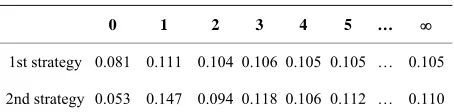
Let expert evaluations of availability lie in segment [0,1]. Let the 1st expert evaluation of availability for the 1st strategy be equal to 1, and evaluations of 35 other ex- perts be equal to 0.055. And for the 2nd strategy, 2 ex- perts have evaluation equal to 0.95, and other 34 experts have evaluation equal to 0. It is very likely that each hu- man expert in such case will choose 2nd strategy. How- ever, averaging-out by the simplest algorithm (i.e. simple average of expert evaluations) gives 0.081 for the 1st case and 0.053 for the 2nd one; so do we have to choose the 1st strategy?
On the other hand, we can use an approach similar to [15], i.e., use the same algorithms for dynamic risk func- tion construction. For the 1st strategy, we obtain the fol- lowing risk function:
–0.685·x2 + 1.300·x + 0.386; and for the 2nd strategy:
–0.694·x2+1.374·x +0.321.
The final values of expert evaluations averaging-out by using these risk functions are 0.111 for the 1st strategy and 0.147 for the 2nd strategy. Therefore, using such al- gorithms for dynamic risk function construction for ex- pert evaluations averaging-out gives “natural” answers.
Note that repeating the averaging procedure twice (i.e., averaging-out using preliminary values of the first step of dynamic risk functions) chooses 1st strategy. However, in the limit we have “natural” answers again. This can be seen in Table 1; the column headers are equal to the number of step of averaging-out using dynamic risk func- tion (i.e., the number of iterations ran by a dynamic risk function constructing algorithm). The column 0 is the sim- ple average of expert evaluations, and the column is the limit value.
[image:3.595.59.286.677.733.2]Note that in real discrete optimization problems such situations, when the difference between minimum and maximum values is more than 0.5 (i.e., more than 50% of the segment of values) are very often; for example, for accidental TSP having dimension 75 and some of pre- dictors mentioned before, they contain, by statistics of
Table 1. Risk function values for different strategies.
0 1 2 3 4 5 …
1st strategy 0.081 0.111 0.104 0.106 0.105 0.105 … 0.105
2nd strategy 0.053 0.147 0.094 0.118 0.106 0.112 … 0.110
the author, about 10%.
4. Approach to a Parallel Algorithm
Main problem in parallel algorithm design is finding in- formational dependencies and independent sub-tasks.
The proposed algorithm is based on iterative shift of strings in some position, defined by two indexes (i, j) for first and second string respectively. To define next step we search in some small set of positions, closest to cur- rent one, and then we select the position with the highest score. Obviously, such shifts can be made only sequen- tially, and the only part of an algorithm that has indepen- dent subtasks is a usage of heuristics for position selec- tion. There are two possible ways for parallelizing this subtask: applying each heuristics in separate thread, and using parallel algorithms for heuristics themselves.
Using separate threads for each heuristics has the fol- lowing disadvantages. First, the final result of using sev- eral heuristics is not always their “linear sum”, some- times several heuristics are combined and considered as one complex heuristics. Second, some heuristics have re- latively low computational complexity, and thread mana- gement costs become too significant.
Parallelizing heuristics although has disadvantages. Some heuristics being parallelized work slower, then their serial analogues, because of high overhead costs (like men- tioned above thread management costs).
Thereby selecting independent subtasks seems not to be effective enough for practical use. But this does not mean that it is impossible to create effective parallel al- gorithm, because one can define some new subtasks. Thereto at each step we can select multiple possible shift positions, creating several “phase trajectories” in shift po- sition space. There are several ways to do that, e.g. use several positions with highest score or use some ad hoc heuristics. Subtasks created like this can have a fixed size (i.e. iterations of basic shift cycle). After processing sub- tasks we can select several best results and generate new subtasks based on them.
Parallel implementation of meta-heuristic approach de- scribed above is a new algorithm, and introduced method of subtasks creation is basically, a new heuristics. This new parallel algorithm has better results than the sequen- tial one, it is more precise. While the initial algorithm uses greedy heuristics to select next shift position, the intro- duced algorithm make deeper analysis of consequences of next step selection.
5. Results of DNA Comparison
organisms. Therefore they can be changed only due to mutations. By analyzing mitochondrial DNA and its mu- tations, one can determine not only the degree of kinship of two species, but although a time, needed to accumu- late some mutations in population [16]. Thereby one can estimate a moment of time when there were no mutations and population was genetically homogeneous.
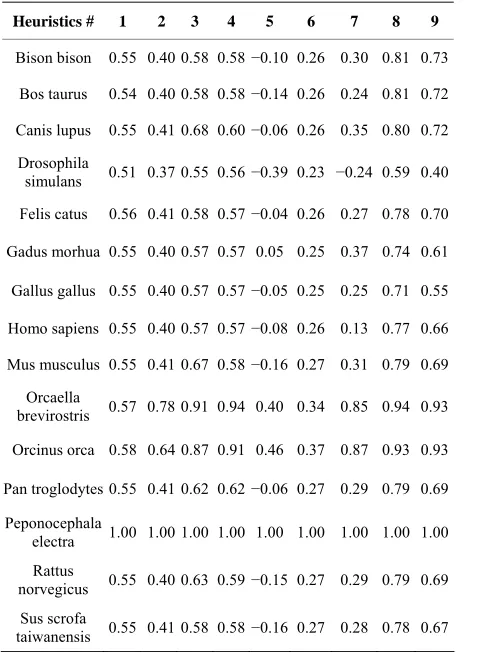
We used genetic data for next species: Homo sapiens (human), Pan troglodytes (chimpanzee), Bison bison (bi- son), Bos taurus (wild bull), Sus scrofa taiwanensis (pig), Canis lupus (wolf), Felis catus (domestic cat), Gallus gal- lus (chicken), Mus musculus (mouse), Rattus norvegicus (rat), Orcinus orca (killer whale), Orcaella brevirostris (Irrawaddy dolphin), Peponocephala electra (melon-hea- ded whale), Gadus morhua (Atlantic cod), Drosophila si- mulans (see [17]). An example of DNA comparison re- sults are presented in Table 2.
[image:4.595.58.306.411.737.2]After analyzing test results we have made the follow- ing conclusions: First two heuristics show insignificant differences for all compared pairs of DNA. However this does not mean that the underlying principals are wrong, because the third heuristics, which based on the former two, showed adequate results, pretty close to the results showed by longest common subsequence search. Thus
Table 2. Results of comparison Peponocephala electra with other species.
Heuristics # 1 2 3 4 5 6 7 8 9
Bison bison 0.55 0.40 0.58 0.58−0.10 0.26 0.30 0.81 0.73
Bos taurus 0.54 0.40 0.58 0.58−0.14 0.26 0.24 0.81 0.72
Canis lupus 0.55 0.41 0.68 0.60−0.06 0.26 0.35 0.80 0.72
Drosophila
simulans 0.51 0.37 0.55 0.56−0.39 0.23 −0.24 0.59 0.40
Felis catus 0.56 0.41 0.58 0.57−0.04 0.26 0.27 0.78 0.70
Gadus morhua 0.55 0.40 0.57 0.57 0.05 0.25 0.37 0.74 0.61
Gallus gallus 0.55 0.40 0.57 0.57−0.05 0.25 0.25 0.71 0.55
Homo sapiens 0.55 0.40 0.57 0.57−0.08 0.26 0.13 0.77 0.66
Mus musculus 0.55 0.41 0.67 0.58−0.16 0.27 0.31 0.79 0.69
Orcaella
brevirostris 0.57 0.78 0.91 0.94 0.40 0.34 0.85 0.94 0.93
Orcinus orca 0.58 0.64 0.87 0.91 0.46 0.37 0.87 0.93 0.93
Pan troglodytes 0.55 0.41 0.62 0.62−0.06 0.27 0.29 0.79 0.69
Peponocephala
electra 1.00 1.00 1.00 1.00 1.00 1.00 1.00 1.00 1.00
Rattus
norvegicus 0.55 0.40 0.63 0.59−0.15 0.27 0.29 0.79 0.69
Sus scrofa
taiwanensis 0.55 0.41 0.58 0.58−0.16 0.27 0.28 0.78 0.67
the kinship rate for Irrawaddy dolphin and melon-headed was 0.91, Irrawaddy dolphin and a killer whale were 0.87, Irrawaddy dolphin and other Chordata were 0.59 to 0.63, Irrawaddy dolphin and Drosophila were 0.45. Results shown by the forth heuristics are pretty similar to those of the third one. Fifth heuristic showed pretty similar re- sults, but feebly marked for small values. Results shown by sixth heuristics do not allow to mate any conclusion about DNA kinship. Seventh heuristics (that is a com- bination of third and sixth one) showed results pretty si- milar to Needlemah-Wulsch algorithm. For big values (more than 0.9) seventh heuristics results differing from Needleman-Wulsch were not more than 1%.
Results shown by parallel version of algorithm showed the same results, but shifted to a high values range. Pa- rallel implementation of fifth heuristics performed better than sequential one, and was closer to results showed by the longest common subsequence search algorithm. On the contrary, results of parallel implementation of the seventh heuristic performed poor, and showed obviously wrong results for some DNA pairs. In [10] we had al- ready covered an approach to parallelizing branch-and- bouds algorithms, and here we used the same approach with heuristics. The results of that research contain lots of data and can’t be presented here, so it will be describ- ed in a separate paper.
For most of heuristics the results of DNA comparison correspond to biological taxonomy [18]. At the same time the proposed algorithms are pretty fast, because the run time is in linear dependence with input length, but depends on heuristics parameters. This makes the pro- posed algorithms applicable for DNA data analysis.
REFERENCES
[1] D. Gusfield, “Algorithms on Strings, Trees and Sequences,” Informatics and Computers, BHV-Peterburg, Saint-Pe- tersburg, 2003.
[2] I. Torshin, “Bioinformatics in the Post-Genomic Era: The Role of Biophysics,” Nova Publishers, 2006.
[3] D. S. Hirschberg, “A Linear Space Algorithm for Compu- ting Maximal Common Subsequences,” Communications of the ACM, Vol. 18, No. 6, 1975, pp. 341-343.
http:dx.doi.org/10.1145/360825.360861
[4] J. W. Hunt and T. G. Szymanski, “A Fast Algorithm for Computing Longest Common Subsequences,” Commu- nications of the ACM, Vol. 20, No. 5, 1977, pp. 350-353. http:dx.doi.org/10.1145/359581.359603
[5] E. W. Myers, “An Overview of Sequence Comparison Al- gorithms in Molecular Biology,” 1991.
[6] R. A. Wagner and M. J. Fischer, “The String-to-String Cor- rection Problem,” Journal of the ACM, Vol. 21, No. 1, 1974, pp. 168-173.
http:dx.doi.org/10.1145/321796.321811
Smith-Waterman,” CLCBio, 2007.
[8] A. Panin, “Using Metaheuristic Approach for DNA Com- parison,” Vector of Science TSU, Vol. 3, No. 17, 2011, pp. 27-29.
[9] B. Melnikov, “Discrete Optimization Problems. Some New Heuristic Approaches,” 8th International Conference on High Performance Computing and Grid in Asia Pacific Region, IEEE Computer Society Press, 2005, pp. 73-80. http:dx.doi.org/10.1109/HPCASIA.2005.34
[10] B. Melnikov, “Multiheuristic Approach to Discrete Opti- mization Problems,” Cybernetics and Systems Analysis, Vol. 42, No. 3, 2006, pp. 335-341.
http://dx.doi.org/10.1007/s10559-006-0070-y
[11] S. Henikoff and J. G. Henikoff, “Amino Acid Substitu- tion Matrices from Protein Blocks,” PNAS, Vol. 89, No. 22, 1992, pp. 10915-10919.
http:dx.doi.org/10.1073/pnas.89.22.10915
[12] J. Hromkovič, “Algorithms for Hard Problems. Introduc- tion to Combinatorial Optimazation, Randomization, Ap- proximation, and Heuristics,” Springer, Berlin, 2003. [13] M. Bellmore and G. Nemhauser, “The Traveling Sales-
man Problem: A Survey,” Operation Research, Vol. 16, No. 3, 1968, pp. 538-558.
http:dx.doi.org/10.1287/opre.16.3.538
[14] B. Mel’nikov and A. Radionov, “A Choice of Strategy in Nondeterministic Antagonistic Games,” Programming and Computer Software, Vol. 24, No. 5, 1998, pp. 247-252. [15] B. Melnikov, “Heuristics in Programming of Nondetermi-
nistic Games,” Programming and Computer Software, Vol. 27, No. 5, 2001, pp. 277-288.
http://dx.doi.org/10.1023/A:1012345111076
[16] A. C. Wilson, R. L. Cann, S. M. Carr, M. George Jr., U. B. Gyllensten, K. Helm-Bychowski, R. G. Higuchi, S. R. Palumbi, E. M. Prager, R. D. Sage and M. Stoneking, “Mitochondrial DNA and Two Perspectives on Evolutio- nary Genetics,” Biological Journal of the Linnean Society, Vol. 26, No. 4, 1985, pp. 375-400.
http:dx.doi.org/10.1111/j.1095-8312.1985.tb02048.x [17] NCBI Nucleotide Database.
http:www.ncbi.nlm.nih.gov/nuccore