Relay Selection and Power Allocation in
Amplify-and-Forward Cognitive Radio Systems Based on
Spectrum Sharing
Daqian Zhao, Zhizhong Zhang, Fang Cheng
School of Communication and Information Engineering, Chongqing University of Posts and Telecommunications, Chongqing, China Email: [email protected], [email protected], [email protected]
Received July, 2013
ABSTRACT
In this paper, we consider a spectrum sharing scheme that is a joint optimization of relay selection and power allocation at the secondary transmitter, which aims to achieve the maximum possible throughput for the secondary user. This pa-per considers the scenario where the primary user is incapable of supporting its target signal-to-noise ratio (SNR). More especially, the secondary transmitter tries to assist the primary user with achieving its target SNR by cooperative am-plify-and-forward (AF) relaying with two-phase. By exhaustive search for all candidate secondary transmitters, an op-timal secondary transmitter can be selected, which not only can satisfy the primary user’s target SNR, but also maxi-mize the secondary user’s throughput. The optimal secondary transmitter acts as a relay for the primary user by allocat-ing a part of its power to amplify-and-forward the primary signal over the primary user’s licensed spectrum bands. At the same time, as a reward, the optimal secondary transmitter uses the remaining power to transmit its own signal over the remaining licensed spectrum bands. Thus, the secondary user obtains the spectrum access opportunities. Besides, there is no interference between the primary user and the secondary user. We study the joint optimization of relay selec-tion and power allocaselec-tion such that the secondary user’s throughput is maximized on the condiselec-tion that it satisfies the primary user’s target SNR. From the simulation, it is shown that the joint optimization of relay selection and power al-location provides a significant throughput gain compared with random relay selection with optimal power alal-location (OPA) and random relay selection with water-filling power allocation (WPA). Moreover, the simulation results also shown that our spectrum sharing scheme obtains the win-win solution for the primary system and the secondary system.
Keywords: Spectrum Sharing; Cooperative Communication; Relay Selection; Power Allocation; Throughput; Maximum Ratio Combining; Cognitive Radio Systems
1. Introduction
Currently, the fixed spectrum access (FSA) policy has traditionally been adopted by spectrum regulators, which assigns each piece of spectrum with certain bandwidth to one or more dedicated users. By doing so, only the as-signed (licensed) users have the right to exploit the allo-cated spectrum, and other users are not allowed to use it, regardless of whether the licensed users are using it or not. Recent studies on the actual spectrum utilization measurements have revealed that a large portion of the licensed spectrum experiences low utilization [1-3]. However, cognitive radio (CR) is an agile spectrum ac-cess/sharing technology that allows unlicensed (secon-dary) systems to operate in licensed frequency bands without causing harmful interference to licensed (pri-mary) systems, and thus spectrum utilization can be sig-nificantly improved [4-6]. Thus, CR is widely regarded as one of the most promising technologies for future
wireless communications.
Cooperative relay communication can improve power efficiency in the wireless networks by increasing the spa-tial diversity. By the use of relays, the transmitted power from the source terminal can be significantly reduced [7-9].
decompo-sition method and the authors was derived the closed-form solutions for the set of subcarriers, subcar-rier pairing and power allocation, so the algorithm was complex. In our paper, we study the problem of relay selection in a multi-relay secondary system so that the outage can’t easily occur at the primary system. Fur-thermore, the algorithm complexity in our paper is straightforward compared with the literature [10] and the simulation results also shown that our spectrum sharing scheme is better than [10].
In [11], the authors studied the problem of joint relay selection and power allocation at the source and relay the nodes in a CR system in which nodes were allowed to amplify-and-forward cooperate with each other. How-ever, the literature [11] used the opportunistic spectrum access (OSA) model: the CR user carried out spectrum sensing to detect spectrum holes [12], so it presented a very high demand for the spectrum sensing accuracy when the primary system exist, and it was not easily to realize. In addition, the literature [11] had set up the in-terference threshold to protect the primary user, so the throughput was limited. In our paper, we don’t need set up the interference threshold to protect the primary user. On the contrary, we assist the primary user with achiev-ing its target SNR, as a reward, the secondary user can access the primary user’s licensed spectrum bands.
In this paper, we study the joint optimization of relay selection and power allocation such that the secondary user’s throughput is maximized on the condition that it satisfies the primary user’s target SNR. By exhaustive search for all candidate secondary transmitters, an opti-mal secondary transmitter can be selected, which not only can satisfy the primary user’s target SNR, but also maximize the secondary user’s throughput. Since the optimal secondary transmitter uses different licensed spectrum bands to amplify-and-forward primary signal and to transmit its own signal, so there is no interference between the primary user and the secondary user. From the simulation, it is shown that the joint optimization of relay selection and power allocation provides a signifi-cant throughput gain compared with OPA and WPA. Moreover, the simulation results also shown that our spectrum sharing scheme obtains the win-win solution for the primary system and the secondary system.
The rest of this paper is organized as follows. In Sec-tion 2, we introduce the system model. System perform-ance is analyzed in Section 3. The joint optimization of resource allocation is presented in Section 4. Simulation results are shown in Section 5. Finally, this paper is con-cluded in Section 6.
2. System Description
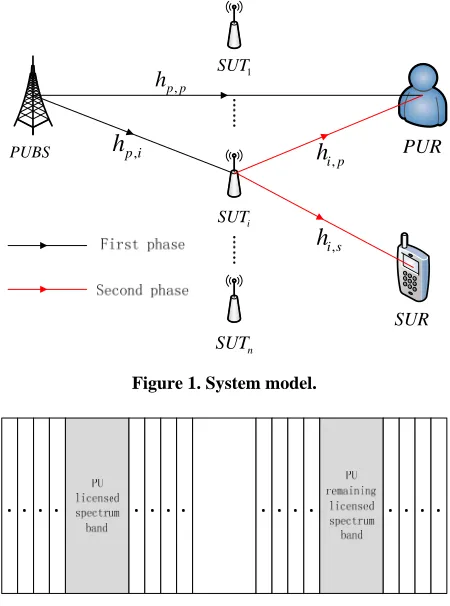
We consider cooperative cognitive radio systems as
shown in Figure 1. The primary system, comprising of a primary user base station (PUBS) and a primary user receiver (PUR), supports the relaying functionality and has the license to operate in some spectrum bands. We assume that the primary system has multiple licensed spectrum bands as shown in Figure 2, and PUR can keep track of the SNR of the PUBS→PUR link. The secon-dary system, comprising of n secondary user transmitters (SUT ii, 1...n) and a secondary user receiver (SUR), can only operate in licensed spectrum bands by using the scenario where the PUR is incapable of supporting its target SNR (e.g., the SNR of the PUBS→PUR link is below a threshold due to path loss, shadowing, moving, or interference). Specifically, the secondary transmitter tries to assist the primary user with achieving its target SNR by cooperative AF relaying with two-phase. The scenario provides an opportunity for the secondary user to access the licensed spectrum bands of the primary system. Since the optimal secondary transmitter uses dif- ferent licensed spectrum bands to amplify-and-forward primary signal and to transmit its own signal, so there is no interference between the primary user and the secon-dary user. We assume that the seconsecon-dary system is able to emulate system parameters of the primary system. For the sake of simplicity, we assume that the relay ( i) has been selected as the optimal relay. The
prob-lem of relay selection will be addressed in Section 4.
th
i SUT
PUBS
1
SUT
i SUT
n
SUT
PUR
SUR ,
p p h
,
p i
h
,
i p
h
,
i s
[image:2.595.311.536.421.724.2]h
Figure 1. System model.
Both the primary system and the secondary system ex-perience independent and frequency-selective Rayleigh
fading. The channel gains of the ,
, , i links are
denoted as ,
PUBSPUR SUR
i
PUBSSUT SUTiPUR SUT
p p, ,
h p i, i p, , i s, , respectively. We
as-sume that these channel state information (CSI) are available at prior to transmission. We consider slow fad-ing where the channel gains remain constant over the one-phase. We assume that ,
h h h
p p, ,
n p i, i p, , i s, are
independent additive white Gaussian noises with zero mean and variance 0. Let
n n n
N Xp and Xs denote the
signal to be transmitted to PUR and SUR, respectively, which have unit power. The PUBS and SUT ii, 1...n each have a sum transmit power constraint, denoted as
max
PUBS
P and max , 1... . i
SUT
P i n
3. Analysis of Performance
In the first phase, as shown by the black solid arrows in
Figure 1, PUBS transmits the signal Xp while PUR
and i listen. The signal received at PUR in the first
phase is given by SUT
, , ,
p p p p p p p
y P h X n p (1)
where Pp is the power transmitted from PUBS to PUR
and PUBS to . PUBS uses the maximum transmis-sion power
i
SUT max
PUBS
P to transmit the primary signal, namely as max
PUB p
P P S. From equation (1), the instanta-neous SNR of PUR in the first phase can be written as
2 , 1
0
| |
p p p
P h
N
(2)
Similarly, the signal received at SUTi is given by
, , ,
p i p p i p
y P h X np i
,
(3)
In the second phase, as shown by the red solid arrows in Figure 1, PUBS remains silent while i amplify-
and-forward primary signal over the primary user’s li-censed spectrum bands as shown in Figure 2. The signal received at PUR in the second phase can be written as
SUT
, , ,
i p i i p p i i p
y h y n (4) where i is the amplification factor and is defined as
, 2 , 0 | | s p i
p p i P
P h N
(5)
where s p, is the power transmitted from i to
PUR. By replacing equation (3) and equation (5) into equation (4), we have
P SUT , , , ' , , 2 , 0 | |
p s p i p p i
i p p i p
p p i
P P h h
y X
P h N
where ', , , ,
2
, 0
| | s p i p
i p p i i p
p p i P h
n n n
P h N
, . Since np i, and
, i p n ' , i p n
are independent additive white Gaussian noises, is also Gaussian with zero mean and variance
2 , , '
0 2 0
, 0
1 s p i p p p i
P h
N N
P h N
(7)
From equation (6) and equation (7), the instantaneous SNR at PUR in the second phase can be written as
2 2
, , ,
2 2 2
, , , 0
| | | |
p s p i p p i
p p i s p i p
P P h h
0
P h P h N N
(8)
It has been shown that applying the maximum ratio combining at PUR in an AF relay system maximized the SNR [13]. Therefore, we use the maximum ratio com-bining (MRC) at PUR to combine the two received sig-nals from the first phase and the second phase. We as-sume that PUR has all the CSIs. As the instantaneous SNR at the output of combiner equals the sum of the SNRs of the incoming signals [13], we can write the in-stantaneous SNR p after applying the MRC as
1 2
p
(9)
where 1 and 2 are obtained from equation (2) and
equation (8), respectively. Since i must be assist
PUR with achieving its target SNR by acting as an AF relay, the PUR’s target SNR constraint as follows
SUT
p T
(10)
where T is the PUR’s target SNR.
In the second phase, i also uses its remaining
power to transmit its own signal over the remaining li-censed spectrum bands on the condition that it satisfies the PUR’s target SNR as shown in Figure 2. The signal received at SUR is given by
SUT
, , ,
i s s s i s s i s
y P h X n, (11)
where s s, is the power transmitted from i to
SUR. From equation (11), the instantaneous SNR at SUR in the second phase can be written as
P SUT
2 , ,
0
s s i s s
P h
N
(12)
Therefore, assuming that the relay has been se-lected, we can write the instantaneous throughput of SUR as
th
i
, 2
( ) (1
i s s s
T P log ) (13) n (6) Since Ps p, and s s, are the transmit power from
, this two transmit power must be satisfy the fol-P
i
lowing constraint
, ,
i
SUT
s p s s max
P P P (14) In the next section, we solve the joint optimization of resource allocation problem to maximize the instantane-ous throughput of SUR in equation (13).
4. Resource Allocation
In this section, we solve the joint optimization of relay selection and power allocation at the secondary transmit-ter to achieve the maximum possible throughput for the SUR while guaranteeing the PUR to achieve its target SNR. The optimal power allocation at the secondary transmitter to maximize the throughput for the SUR is calculated. Then, through an exhaustive search for all candidate secondary transmitters, an optimal secondary transmitter can be selected, which not only can satisfy the primary user’s target SNR, but also maximize the secondary user’s throughput as defined in equation (13). Therefore, in the following, we set up the optimization problem to find the optimum set of transmit powers s p,
and ,
P
s s for the secondary transmitter. The power
allo-cation problem for all candidate secondary transmitters can be formulated as the following optimization
P
,
*
, , arg max ( , ) s s
s s i i s s P
P T P (15)
subject to
, ,
, 0, , 0
i
p T
SUT
s p s s max
s p s s
P P P
P P
where * , ,
s s i
P is the optimal values of s s, for the
secondary transmitter. The optimal relay selection can be formulated as an exhaustive search for all candidate sec-ondary transmitters
P ith
* , , arg max )
ˆ (
i s s i i
i T P (16)
where i ranges from 1 to n and i represents the optimal secondary transmitter. From equation (10) we can obtain
2 2
1 , 0 0
, 2 2 2
, , 1 ,
( )( )
( )
T p p i s p
p i p p i T i p
P h N N
P
P h h h N
0 (17)
According to our spectrum sharing scheme, as long as the optimal secondary transmitter can satisfy the PUR’s target SNR, it can access the remaining licensed spec-trum bands instead of exceeding the PUR’s target SNR. Therefore, the equation (17) can be rewritten as
2 2
1 , 0 0
, 2 2 2
, , 1 ,
( )( )
( )
T p p i s p
p i p p i T i p
P h N N
P
P h h h N
From equation (14), we know that the power allocation is optimal when , , i
SUT
s p s s max
P P P
SUT
, namely as
0
(18)
, i ,
s s max s
P P P p (19) By replacing equation (18) into equation (19), the op-timal power allocation Ps s i*, , can be written as
2 2
1 , 0 0
*
, , 2 2 2
, , 1 ,
( )( )
( )
i T p p i
SUT s s i max
p i p p i T i p
P h N N
P P
P h h h N
0
Hz
(20)
The optimal secondary transmitter is then found by an exhaustive search for all candidate secondary transmit-ters and finding the optimal secondary transmitter that maximizes the throughput using equation (16).
5. Simulation Results
In this section, the simulation results are presented to demonstrate the performance of our spectrum sharing scheme in terms of SUR throughout.
We consider cooperative cognitive radio systems with n secondary transmitters operating in AF mode as shown in Figure 1. All the channels are assumed to be Rayleigh fading with unity bandwidth. We assume that
10W PUBS max
P , N00.1W/ .
First, we simulate that SUR throughput versus PUR
target SNR, assuming that . The
number of the candidate secondary transmitters are fixed at
10 , 1 i
SUT max
P W i n
10
[image:4.595.313.537.568.718.2]n , which have already satisfied the PUR’s target SNR. We apply our spectrum sharing scheme and simu-late that SUR throughput versus PUR target SNR in
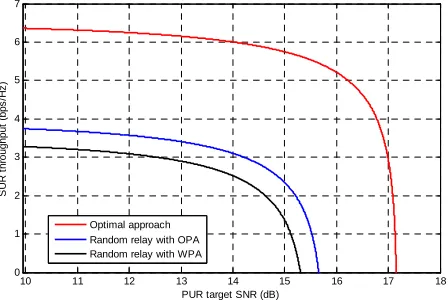
Figure 3. We have also simulated the cases of random relay selection with optimal power allocation (OPA) and random relay selection with water-filling power alloca-tion (WPA). Similarly, both of two algorithms have al-ready satisfied the PUR’s target SNR. Note in the WPA that the power allocation at PUBS and i are
prede-termined by the water-filling algorithm based on the channel and the channel,
SUT
i
SUT SUR PUBSPUR
10 11 12 13 14 15 16 17 18
0 1 2 3 4 5 6 7
PUR target SNR (dB)
S U R t hr o ughp ut ( bps /H z ) Optimal approach Random relay with OPA Random relay with WPA
respectively. From Figure 3, we see that the SUR throughput increases significantly when our spectrum sharing scheme for relay selection and power allocation is applied compared with the OPA and the WPA. When the PUR’s target , it means that the PUR no need to cooperate and the SUR throughput is the maximum equal 6.3626 bps/Hz. However, the optimal secondary transmitter can’t access the PU’s licensed spectrum bands, so it’s a peak for the SUR throughput. When the PUR’s target , the PUR seeks to cooperate and the optimal secondary transmitter assists the PUR with achieving its target SNR by acting as an AF relaying with two-phase. Then, as a reward, the op-timal secondary transmitter can access the remaining licensed spectrum bands. With the PUR target SNR in-creases, the optimal secondary transmitter needs allocate more power to assist the PUR with achieving its target SNR and thus leading to a lower SUR throughput. Ap-plying our optimal approach the SUR throughput gains of 2.6351 bps/Hz and 3.1046 bps/Hz compared with the OPA and the WPA are obtained, respectively, at the
PUR’s target . When in the
optimal approach; in the OPA and the WPA, the SUR throughput rapid decline. This is because the optimal secondary transmitter allocates more power to amplify-and-forward the primary signal, so the SUR throughput decreases rapidly.
9.95 SNR dB
9. SNR
12 SNR dB
15 SNR dB
95dB
[image:5.595.310.537.87.236.2]SNR17dB
Figure 4 shows that SUR throughput versus
compared with the OPA and the WPA while the PUR’s target SNR is fixed at 12dB and the number of the can- didate secondary transmitters are fixed at . When , the optimal approach provides 2.6338 bps/Hz and 3.0904 bps/Hz throughput gains compared with the OPA and the WPA, respectively. Because a part of the transmit power is allocated to amplify-and-forward the primary signal, so the curve didn’t start from zero. From the Figure 4, we also can see that the OPA and the WPA need allocate more power to amplify-and-forward the primary signal compared with optimal approach.
i SUT max P
10 n 5
i SUT max
P W
0 1 2 3 4 5 6 7 8 9 10
0 1 2 3 4 5 6 7
SUTi Pmax (W)
S
U
R
t
hr
oughp
ut
(
bp
s
/H
z
)
[image:5.595.66.281.566.712.2]Optimal approach Random relay with OPA Random relay with WPA
Figure 4. SUR throughput versus SUTi . max P
2 3 4 5 6 7 8 9 10
3 3.5 4 4.5 5 5.5 6 6.5
Number of candidate SUT
i
S
U
R
t
hr
ough
put
(bp
s
/H
z
)
Optimal approach Random relay with OPA Random relay with WPA
Figure 5. SUR throughput versus the number of candidate SUTi.
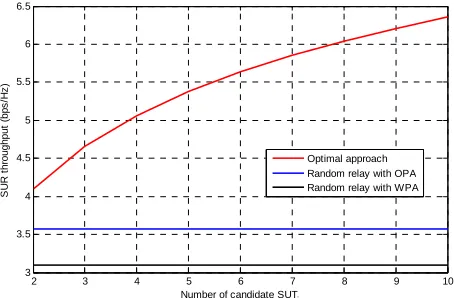
Figure 5 shows that SUR throughput versus the num-ber of candidate i compared with the OPA and the
WPA while the PUR’s target and SUT
1 i
12 SNR dB 10 ,
i SUT max
P W n. As seen, the optimal approach provides an appealing throughput increase by increasing the number of candidate i while the OPA and the
WPA do not provide any throughput increase. This is because the optimal secondary transmitter is selected randomly in the OPA and the WPA.
SUT
6. Conclusions
In this paper, we consider a spectrum sharing scheme that is a joint optimization of relay selection and power allocation at the secondary transmitter, which aims to achieve the maximum possible throughput for the sec-ondary user. This paper considers the scenario where the primary user is incapable of supporting its target SNR. Specifically, the secondary transmitter tries to assist the primary user with achieving its target SNR by allocating a part of its power to amplify-and-forward the primary signal over the primary user’s licensed spectrum bands. At the same time, as a reward, the secondary transmitter uses the remaining power to transmit its own signal over the remaining licensed spectrum bands. By exhaustive search for all candidate secondary transmitters, an opti-mal secondary transmitter can be selected, which not only can satisfy the primary user’s target SNR, but also maximize the secondary user’s throughput. We study the joint optimization of relay selection and power allocation such that the secondary user’s throughput is maximized on the condition that it satisfies the primary user’s target SNR. Simulation results confirmed the efficiency of this spectrum sharing scheme and it benefits to both the pri-mary system and the secondary system.
7. Acknowledgements
Sci-ence and Technology Special Project of China (2012ZX03005008, 2012ZX03005002-005), Chongqing Municipal Education Commission Science and Technol-ogy Research Project (KJ130513), Chongqing Basic and Cutting edge Project (cstc2013jcyjA40020), 2011 Chongqing Universities outstanding achievement trans-formation funded project, 2010 Chongqing Municipal Intellectual Property special funds.
REFERENCES
[1] P. Kolodzy and I. Avoidance, “Spectrum Policy Task force,” Federal Commun. Comm., Washington, DC, Rep. ET Docket, 2002 (02-135).
[2] M. H. Islam, C. L. Koh, S. W. Oh, et al., Spectrum Sur-vey in Singapore: Occupancy Measurements and Analy-ses[C]//Cognitive Radio Oriented Wireless Networks and Communications, 2008. Crown Com 2008. 3rd Interna-tional Conference on. IEEE, 2008, pp. 1-7.
[3] D. Datla, A. M. Wyglinski and G. J. Minden, “A Spec-trum Surveying Framework for Dynamic SpecSpec-trum Ac-cess Networks,” Vehicular Technology, IEEE Transac-tions on, Vol. 58, No. 8, 2009, pp. 4158-4168. doi:10.1109/TVT.2009.2021601
[4] III. J. Mitola and Jr. G. Q. Maguire, “Cognitive Radio: Making Software Radios More Personal,” Personal Com-munications, IEEE, 1999, Vol. 6, No. 4, pp. 13-18.
doi:10.1109/98.788210
[5] S. Haykin, “Cognitive Radio: Brain-empowered Wireless Communications,” Selected Areas in Communications,
IEEE Journal on, Vol. 23, No. 2, 2005, pp. 201-220. doi:10.1109/JSAC.2004.839380
[6] A. Jovicic and P. Viswanath, “Cognitive Radio: An In-formation-theoretic Perspective,” Information Theory,
IEEE Transactions on, Vol. 55, No. 9, 2009, pp. 3945-3958.doi:10.1109/TIT.2009.2025539
[7] C. H. Chen, C. L. Wang and C. T. Chen, “A Resource Allocation Scheme for Cooperative Multiuser OFDM-Based Cognitive Radio Systems,” Communica-tions, IEEE Transactions on, Vol. 59, No. 11, 2011, pp. 3204-3215.doi:10.1109/TCOMM.2011.092011.100197
[8] M. Shaat and F. Bader, “Asymptotically Optimal Re-source Allocation in OFDM-based Cognitive Networks with Multiple Relays,” Wireless Communications, IEEE Transactions on, Vol. 11, No. 3, 2012, pp. 892-897. doi:10.1109/TWC.2012.011012.110880
[9] L. Li, X. Zhou, H. Xu, et al., “Simplified Relay Selection and Power Allocation in Cooperative Cognitive Radio Systems,” Wireless Communications, IEEE Transactions on, Vol. 10, No. 1, 2011, pp. 33-36.
doi:10.1109/TWC.2010.101810.100311
[10] W. D. Lu, Y. Gong, S. H. Ting, et al., “Cooperative OFDM Relaying for Opportunistic Spectrum Sharing: Protocol Design and Resource Allocation,” Wireless Communications, IEEE Transactions on, 2012, Vol. 11, No. 6, pp. 2126-2135.
doi:10.1109/TWC.2012.032812.110524
[11] K. R. Budhathoki, M. Maleki and H. R. Bahrami, “Relay Selection and Power Allocation in Amplify-and-forward Cognitive Radio Systems[C]//Computing, Networking and Communications (ICNC), 2013 International Con-ference on. IEEE, 2013, pp. 686-690.
[12] Y. C. Liang, K. C. Chen, G. Y. Li, et al., “Cognitive Ra-dio Networking and Communications: An Overview,”
Vehicular Technology, IEEE Transactions on, 2011, Vol. 60, No. 7, pp. 3386-3407.
doi:10.1109/TVT.2011.2158673