New Topological Approaches for Data Granulation
A. S. Salama, O. G. Elbarbary
Department of Mathematics, Faculty of Science, Tanta University, Tanta, Egypt. Email: [email protected],[email protected]
Received March, 2013
ABSTRACT
Data granulation is a good tool of decision making in various types of real life applications. The basic ideas of data granulation have appeared in many fields, such as interval analysis, quantization, rough set theory, Dempster-Shafer theory of belief functions, divide and conquer, cluster analysis, machine learning, databases, information retrieval, and many others. In this paper, we initiate some new topological tools for data granulation using rough set approximations. Moreover, we define some topological measures of data granulation in topological I formation systems. Topological generalizations using δβ-open sets and their applications of information granulation are developed.
Keywords: Knowledge Granulation; Topological Spaces; Rough Sets; Data Mining; Decision Making; Fuzzy Sets
1. Introduction
Granulation of the universe involves the decomposition of the universe into parts. In other words, the grouping individual elements or objects into classes, based on offering information and knowledge [7,14,21,40,44,45]. Elements in a granule are pinched together by indiscerni- bility, similarity, proximity or functionality [42,43]. One can thus form a granulated view of the universe. The theory of rough sets can be used for constructing a granulated vision of the universe and for interpreting, representing, and processing concepts in the granulated universe. It offers a more actual model of granular computing. The starting point of the theory of rough sets is the indiscernibility of objects or elements in a universe of concern [15-22]. The customary approach for model- ing indiscernibility of objects is through an equivalence relation defined based on their attribute values with reference to an information system [16]. Two objects are comparable if they have exactly the same description. The induced granulation is a part of the universe, i.e., A
family of pairwise disjoint subsets. It is studied widely in mathematics under the name of quotient set. The notion of indiscernibility can be generalized by any general binary relation.
The original rough set theory was based on an equivalent relation on a finite universe U. For practice use, there have been some extensions on it. One extension is to replace the equivalent relation by a arbitrary binary relation ; the other direction is to study rough set via topological method [8,14]. In this work, we construct topology for a family covering rough sets.
After that, we study the relationship among upper approximations based on this topological space so that we can study data granulation by method of topology.
In [40] Y.Y. Yao addressed four operators on a knowledge base, which are sufficient for generating new knowledge structures. Also, they addressed an axiomatic definition of knowledge granulation in knowledge bases. Rough set theory, proposed by Pawlak in the early 1980s [17-20], is an expansion of set theory for the study of intelligent systems characterized by inexact, uncertain or insufficient information. Moreover, this theory may serve as a new mathematical tool to soft computing besides fuzzy set theory [42-45], and has been successfully applied in machine learning, information sciences, expert systems, data reduction, and so on [30-38,40]. In recent times, lots of researchers are interested to generalize this theory in many fields of applications [1-6,16,22].
ble real world applications of these measures in pattern recognition and image analysis problems [13,24,30].
Topology is a significant and interesting area of mathematics, whose study introduces you to new concepts ( semi-open, pre open, δβ-open sets and others) and theorems, which are very useful in many applica- tions .Topological notions like semi-open, preopen,
open sets are as basic to mathematicians of today as sets and functions were to those of last century [14,15,17]. Then, we think the topological structure will be so important base for knowledge extraction and processing.
The topology induced by binary relations on the universes of information systems is used to generalize the basic rough set concepts. The suggested topological operations and structure open up the way for applying affluent more of topological facts and methods in the process of granular computing. In particular, the notion of topological membership function is introduced that integrates the concept of rough and fuzzy sets [17,42-45].
2. Essentials of Rough Set Approximations
under General Binary Relations
For any approximation space A( , )U R , where is
an equivalence relation, lower and upper approximations of a subset
R
XU , namely R X( ) and R X( ) are
defined as follows:
( ) { :[ ]R }
R X x U x X ,
( ) { :[ ]R }
R X x U x X .
The lower and upper approximations have the following properties:
For every ,X YU from the approximation space ( , )
A U R we have:
1. ( ) ( ),
2. ( ) ( ) , 3. ( ) ( ) , 4. ( ) ( ) ( ),
R X X R X
R U R U U
R R
R X Y R X R Y
5. ( ) ( ) ( ),
6. ( ) ( ) ( ),
7. ( ) ( ) ( ),
8. ( ) ( ),
9. ( ) ( ),
10. ( ( )) ( ( )) ( ), 11. ( ( )) ( ( )) ( ),
12. , ( ) ( )
( ) ( ) .
R X Y R X R Y
R X Y R X R Y R X Y R X R Y
R X R X
R X R X
R R X R R X R X
R R X R R X R X
If X Y then R X R Y and R X R Y
The equality in all properties happens when
( ) ( )
R X R X X . The proof of all these properties can
be found in [17-20].
Furthermore, for a subset XU, a rough membership
function is defined as follows: ( ) [ ] [ ]
R X
R
x X x
x
,
where X denotes the cardinality of the set X. The
rough membership value X( )x may be interpreted as
the conditional probability that an arbitrary element belongs to X given that the element belongs to [ ]xR.
Based on the lower and upper approximations, the universe can be divided into three disjoint regions, the positive , the negative and the boundary , where:
U
( )
POS X
( )
BND X
( )
NEG X
( ) ( )
( ) ( )
( ) ( ) ( )
POS X R X
NEG X U R X
BND X R X R X
Considering general binary relations in [18,52] is an extension to the classical lower and upper approxima- tions of any subset X of U. {Rx:xX} is the base generated by the general relation defined in [18,52]. The general forms based on are defined as follows:
( ) { : x, }
R X B B BX ,
( ) { : x, }
R X B B BX ,
where x{B:xB}.
For data granulation by any binary relation, in [8] a rough membership function is defined as follows:
( )
( ) x
X
x X
x
.
3. Data Granulation Using Equivalence and
General Binary Relations
By generalizing equivalence relations to general binary relations, one may obtain a different granulation of the universe. For any kind of relations, a pair of rough set approximation operators, known as lower and upper ap- proximation operators can be defined in many ways [17-20].
Let be an equivalence relation on finite non-empty universe U . The equivalence class,
R
R U U
{ : ( ,
[ ]x y U x y)R} consists of all elements equivalent to
x
, and is also the equivalence class con- tainingx
. The relation R induces a partition of the uni- verse U namely U R/ {[ ] :xR x U }.The partition is regularly known as the quotient set and provides a granulated view of the universe under the equivalence classes of U . Naturally speaking, the
available knowledge only allows us to talk about an equivalence class as a single unit. In other words, under the granulated view, we consider an equivalence class as a whole instead of individuals. The pair
/R U
( , )
A U R is
tended application of the partition for approxima- tion. Each equivalence class is called a simple granule.
/
U R
A topological space [1,2,25] is a pair ( , )X
consisting of a set X and a family of subset of X
satisfying the following conditions: (1) ,X,
(2) is closed under arbitrary union, (3) is closed under finite intersection.
The pair ( , )X is called a topological space. The
elements of X are called points . The subsets of X
belonging to are called open sets. The complement of the open subsets are called closed sets. The family of all open subsets of X is also called a topology for X.
is called
( ) = { a i }
cl A
FX:AF nd F s closed -closure of a subset AX.
Obviously, cl A( ) is the smallest closed subset of X
which contains A . Note that A is closed iff
= ( )
A cl A . int A( ) =
{GX:GA and Gis open}is called the -interior of a subset AX . Manifestly,
is the union of all open subsets of
( )
int A
X whichcontained in A. Make a note of that A is open iff
= ( )
A int A . b A( ) = ( )cl A int(A) is called the -
boundary of a subset AX .
For any subset A of the topological space ( , )X ,
, and are closure, interior, and boundary of
( )
cl A int A( ) b A( )
A respectively. The subset A is exact if ( )
b A =, otherwise A is rough. It is clear that A is
exact iff cl A( )=int( )A . In Pawlak space a subset
AX has two possibilities either rough or exact.
In later years a number of generalizations of open sets have been considered [22,23]. We talk about some of these generalizations concepts in the following defini- tions.
Let be a finite universe set and is any binary relation defined on , and be the set of all el-ements which are in relation to certain elel-ements
U R
) x U rR(
x in
from right for all
U x U
; , )
, in symbols where
( ) {x xR,xU}
rR
{ : ( , }
xR y x y R x y U .
Let be the general knowledge base (topological base) using all possible intersections of the members of . The component that will be equal to any union of some members of
( rR x)
must be misplaced.
4. Topological Granulation of Topological
Information Systems
Let A( , )U R be an approximation space where is
any binary relation defined on . Then we can define two new approximations as follows:
R U
( )X X R( ( ))
R X ,
( )X X R( ( ))
R X .
The topological lower and the topological upper
ap-proximations have the following properties:
For every X Y, U and every approximation space ( , )
A U R we have:
1. ( )X X( )X ,
2. ( )U U ( )U ,
3. ( ) ( ),
4. (XY)( )X ( )Y ,
5. (XY)( )X ( )Y ,
6. (XY)( )X ( )Y ,
7. (XY)( )X ( )Y , 8. (X) ( )X ,
9. (X) ( )X ,
10. ( ( )) X ( )X ,
11. ( ( )) X ( )X ,
12. If X Y then, ( )X ( )Y
( ) ( ).
and X Y
Given that topological lower and topological upper approximations satisfy that:
( ) ( ) ( ) ( )
R X X X X R X U
this enables us to divide the universe into five dis- joint regions (granules) as follows:
U
1. POS( )X R( )X ,
2. POS X( )( )X R( )X ,
3. BND X( )( )X ( )X ,
4. NEG X( )R( )X ( )X ,
5. NEG( )X U R( )X .
The following theorems study the properties and rela- tionships among the above regions namely boundary, positive and negative regions.
Theorem 4.1 let IS( , , )U AR be a topological in- formation system and for any subset X U we have:
1. BND X( )( )X ,
2. BND X( ) NEG X( ), 3. ( )X ( )X BND( )X ,
4. ( ),X NEG X( ) and BND X( ) are dis- joint granules of U.
Proof: directly.
Theorem 4.2 let IS( , , )U AR be a topological in-
formation system and for any subsets ,X YU we
have:
1. BND U( ),
( ) ( ) (
BND X Y BND X BND Y)
Proof: (1) and (2) is obvious, by definitions.
( ( )) ( ( ) ( )) ( ( ) ( )) ( ( ( ) ( )) ( ) ( ) ( ) ( ) ( ) ( )
BND BND X
BND X U X X U X U X U X
X U X
BND X BND X Y
)
X Y U X Y
Theorem 4.3 let IS( , , )U AR a topological infor- mation system and for any subset X Y, U we have:
1. U NEG( ) ,
2. NEG X( )(UX), 3. X NEG X( ),
4. NEG U( NEG X( )) NEG X( ),
( ) ( ) (
NEG X Y NEG X NEG Y)
( ) ( ) (
NEG X Y NEG X NEG Y)
Proof: (1), (2), (3) and (4) are obvious.
( ) ( ) ( ( ) ( ( ( )) ( ( )) ( ) ( ) ( ) ( ) ( ( )) ( ( )) ( ( ) ( )) ( ) ( ).
NEG X Y
U X Y U X Y U X U Y
NEG X NEG Y NEG X NEG Y U X U Y
U X Y
U X Y NEG X Y
))
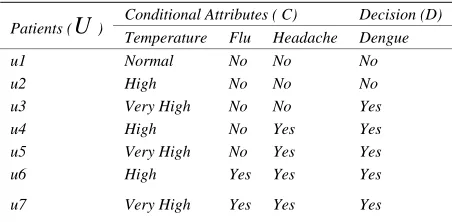
Example 4.1 let 1 2 3 4 5 6 7 be the universe of 7 patients have data sheets shown in Table 1
with possible dengue symptoms. If some experts give us the general relation
{ , , , , , , }
U u u u u u u u
R
defined among those patients as follows:1 1 1 7 2 2 3 3
3 6 4 4 5 5 6 6 7 7 {( , ),( , ),( , ),( , ), ( , ),( , ), ( , ),( , ),( , )}.
R u u u u u u u u
[image:4.595.59.285.582.693.2]u u u u u u u u u u
Table 1. Patients information system.
Conditional Attributes ( C) Decision (D) Patients (
U
)Temperature Flu Headache Dengue u1 Normal No No No u2 High No No No u3 Very High No No Yes u4 High No Yes Yes u5 Very High No Yes Yes u6 High Yes Yes Yes u7 Very High Yes Yes Yes
The topological knowledge base will take the follow- ing form:
1 7 2 3 6 4 5 6 7
{{ , },{ },{ , },{ },{ },{ },{ }}u u u u u u u u u
.
For some patients X { , , }u u u2 3 7 the upper and lower approximations based on the topological
knowledge base are given by:
1 2 3 6 7
( ) { , , , , }
R X u u u u u , and R { , }u u2 7 .
By using the lower and upper approximations, the granules of universe are three disjoint regions as follows:
2 7 ( ) ( ) { , }
POS X R X u u ,
1 3 6 ( ) ( ) ( ) { , , }
BND X R X R X u u u ,
4 5
( ) ( ) { , }
NEG X U R X u u .
According to the topological knowledge base we can easily see that:
1 2 3 7 ( ) { , , , }X u u u u
, ( ) { , , }X u u u2 3 7 . Then we have the following granules of the universe: 1. POS( ) { 2, 7}X u u ,
2. POS X( ) { 3} u ,
3. BND X( ) { 1} u ,
4. NEG X( ) { 6} u ,
5. NEG( ) { 4, 5}X u u
5. Conclusions and Application Notes
The rough set approach to approximation of sets leads to useful forms of granular computing that are part of com-putational intelligence. The basic idea underlying the rough set approach and their topological generalizations to information granulation are to discover to what extent a given set of objects (these objects can be pixels of an image) approximates another set of objects of interest. Objects of definite universe are compared by considering their descriptions. The recent generalization of rough set theory has led to the introduction of topological rough set approaches [24-26,35] and a consideration of the affini-ties (topological nearness) of objects.
REFERENCES
[1] D. Andrijevic, Semi-preopen sets and Mat. Vesnik, Vol. 38, 1986, pp. 24-32.
[2] A. S. Mashhour, M. E. Abd El-Monsef and S. N. El-Deeb, “On Pre-Continuous and Week Pre-continuous Map-pings,” Proc. Math. & phys. Soc. Egypt, Vol. 53, 1982, pp.
47-53.
[3] T. Nishino, M. Nagamachi and H. Tanaka, “Variable Precision Bayesian Rough Set Model and Its Application to Human Evaluation Data,” RSFDGrC 2005, LNAI 3641, Springer Verlag, 2005, pp. 294-303.
2006, pp. 190-206.
[5] O. Njasted, “On Some Classes of Nearly Open Sets,” Pro. J. Math. Vol. 15, 1965, pp. 961-970.
[6] N. Levine, “Semi Open Sets and Semi Continuity Topo-logical Spaces, “The American Mathematical Monthly,” Vol. 70, 1963, pp. 24-32.doi:10.2307/2312781
[7] J. Y. Liang, J. H. Wang and Y. H. Qian, “A New Measure of Uncertainty Based on Knowledge Granulation for Rough Sets,” Information Sciences, Vol. 179, 2009, pp.
458-470.doi:10.1016/j.ins.2008.10.010
[8] E. Lashein,, A. M. Kozae, A. A. Khadra and T. Medhat, “Rough Set Theory for Topological Spaces,” Interna-tional Journal of Approximate Reasoning, Vol. 40, 2005,
pp. 35-43.doi:10.1016/j.ijar.2004.11.007
[9] T.Y. Lin, Granular Computing on Binary Relations I: data mining and neighborhood systems, II: rough set repre- sentations and belief functions, In: Rough Setsin Knowl- edge Discovery 1, L. Polkowski, A. Skowron (Eds.), Phys.-Verlag, Heidelberg, 1998, pp. 107-14.
[10] T. Y. Lin, Y. Y. Yao and L. A. Zadeh, “Data Mining, Rough Sets and Granular Computing (Studies in Fuzzi-ness and Soft Computing),” Physica-Verlag, Heidel-berg ,2002.doi:10.1007/978-3-7908-1791-1
[11] G. L. Liu and Y. Sai, “A Comparison of Two Types of Rough Sets Induced by Coverings,” International Journal of Approximate Reasoning, Vol. 50, 2009, pp. 521-528.
doi:10.1016/j.ijar.2008.11.001
[12] Y. Leung, M. M. Fischer, W.-Z. Wu and J.-S. Mi, “A Rough Set Approach for the Discovery of Classification Rules in Interval-Valued Information Systems,” Interna- tional Journal of Approximate Reasoning, Vol. 47, 2008,
pp. 233-246.doi:10.1016/j.ijar.2007.05.001
[13] G. L. Liu, “Axiomatic Systems for Rough Sets and Fuzzy Rough Sets,” International Journal of Approximate Rea- soning, Vol. 48, 2008, pp. 857-867.
doi:10.1016/j.ijar.2008.02.001
[14] Z. Pei, D. W. Pei and L. Zheng, “Topology vs General-ized Rough Sets,” International Journal of Approximate Reasoning, Vol. 52, No. 2, 2011, pp. 231-239.
doi:10.1016/j.ijar.2010.07.010
[15] Z. Pei, D. W. Pei and L. Zheng, “Covering Rough Sets Based on Neighborhoods an Approach without Using Neighborhoods,” International Journal of Approximate Reasoning, Vol. 52 , 2011, pp. 461-472.
doi:10.1016/j.ijar.2010.07.010
[16] L. Polkowski and A. Skowron, “Towards Adaptive Cal-culus of Granules,” Proceedings of 1998 IEEE Inter. Conf. on Fuzzy Sys., 1998, pp. 111-116.
[17] Z. Pawlak and A. Skowron, “Rough Sets and Boolean Reasoning,” Information Sciences, Vol. 177, 2007, pp.
41-73.doi:10.1016/j.ins.2006.06.007
[18] Z. Pawlak and A. Skowron, “Rough Sets: Some Exten-sions,” Information Sciences, Vol. 177, 2007, pp. 28-40. doi:10.1016/j.ins.2006.06.006
[19] Z. Pawlak and A. Skowron, “Rudiments of Rough Sets,”
Information Sciences, Vol. 177, No.1, 2007, pp. 3-27.
doi:10.1016/j.ins.2006.06.003
[20] Z. Pawlak, “Rough sets,” International Journal of Com-puter&Information Sciences, Vol. 11, 1981, pp. 341-356.
doi:10.1007/BF01001956
[21] Y. H. Qian, J. Y. Liang and C. Y. Dang, “Knowledge Structure, Knowledge Granulation and Knowledge Dis-tance in a knowledge base,” International Journal of Ap-proximate Reasoning, Vol. 50 , 2009, pp. 174-188.
doi:10.1016/j.ijar.2008.08.004
[22] Y. H. Qian, J. Y. Liang, Y. Y. Yao and C. Y. Dang, “MGRS: A Multi-Granulation Rough Set,” Information Sciences, Vol. 180, 2010, pp. 949-970.
doi:10.1016/j.ins.2009.11.023
[23] Q. H. Hu, J. F. Liu and D. R. Yu, “Mixed Feature Selec-tion Based on GranulaSelec-tion and ApproximaSelec-tion,” Knowl- edge-based system, Vol. 21, 2008, pp. 294-304.
[24] A. S. Salama, “Topologies Induced by Relations with Applications,” Journal of Computer Science, Vol. 4, 2008,
pp. 879-889.doi:10.3844/jcssp.2008.877.887
[25] A. S. Salama, “Two New Topological Rough Operators,” Journal of Interdisciplinary Math,” Vol. 11, No. 1, New Delhi Taru Publications-, INDIA, 2008, pp. 1-10. [26] A. S. Salama, “Topological Solution for Missing
Attrib-ute Values in Incomplete Information Tables,” Informa-tion Sciences, Vol. 180, 2010, pp. 631-639.
doi:10.1016/j.ins.2009.11.010
[27] D. J. Spiegelhalter, K. R. Abrams and J. P. Myles, “Bayesian Approaches to Clinical Trials and Health-Care Evaluation,” John Wiley & Sons Ltd, The Atrium, South-ern Gate, Chichester, England, 2004.
[28] D. Slezak and W. Ziarko, “Attribute Reduction in the Bayesian Version of Variable Precision Rough Set Mod-el,” In: Proc. of RSKD, ENTCS, Vol. 82, 2003, pp. 4-14. [29] D. Slezak, W. Ziarko, “The Investigation of the Bayesian
Rough Set Model,” International Journal of Approximate Reasoning, Vol. 40, 2005, pp. 81-91.
doi:10.1016/j.ijar.2004.11.004
[30] D. Slezak, “The Rough Bayesian Model for Distributed Decision Systems,” RSCT 2004, LNAI 3066, Springer Verlag, 2004, pp. 384-393.
[31] D. Slezak, “Rough Sets and Bayes factors,” Transactions on Rough Set III, Lecture Notes Computer Science, Vol.
3400, 2005, pp. 202-229.doi:10.1007/11427834_10 [32] D. Slezak and W. Ziarko, Bayesian Rough Set Model, In:
Proc. of the Int. Workshop on Foundation of Data Mining (FDM 2002), December 9, Maebashi, Japan, 2002, pp. 131-135.
[33] D. Slezak and W. Ziarko, “Variable Precision Bayesian Rough Set Model,” RSFDGrC 2003, LNAI 2639, Springer Verlag, 2003, pp. 312-315.
[34] R. R. Yager, “Comparing Approximate Reasoning and Probabilistic Reasoning Using the Dempster–Shafer Framework,” International Journal of Approximate Rea- soning, Vol. 50, 2009, pp. 812-821.
doi:10.1016/j.ijar.2009.03.003
[35] E. A. Rady, A. M. Kozae and M. M. E. Abd El-Monsef, “Generalized Rough Sets,” Chaos, Solitons, & Fractals,
[36] Y. Y. Yao, “Constructive and Algebraic Methods of The-ory of Rough Sets,” Information Sciences, Vol. 109, 1998, pp. 21-47.doi:10.1016/S0020-0255(98)00012-7
[37] Y. Y. Yao, “Relational Interpretations of Neighborhood Operators and Rough Set Approximation Operators,” In-formation Sciences, Vol. 111, 1998, pp. 239-259.
doi:10.1016/S0020-0255(98)10006-3
[38] Y. Yang and R. I. John, “Generalizations of Roughness Bounds in Rough Set Operations,” International Journal of Approximate Reasoning, Vol. 48, 2008, pp. 868-878.
doi:10.1016/j.ijar.2008.02.002
[39] Y. Yao and Y. Zhao, “Attribute Reduction in Deci-sion-Theoretic Rough Set Models,” Information Sciences,
Vol. 178, 2008, pp. 3356-3373.
doi:10.1016/j.ins.2008.05.010
[40] Y. Y. Yao, “Granular Computing using Neighborhood Systems,” in: Advances in Soft Computing: Engineering Design and Manufacturing, R. Roy, T. Furuhashi, and P. K. Chawdhry (Eds.), Springer-Verlag, London, 1999, pp. 539-553.
[41] A. M. Zahran, “Regularly Open Sets and a Good
Exten-sion on Fuzzy Topological Spaces,” Fuzzy Sets and Sys-tems, Vol. 116, 2000, pp. 353-359.
doi:10.1016/S0165-0114(98)00139-0
[42] L. A. Zadeh, “Fuzzy Sets and Information Granularity,” In: Advances in Fuzzy Set Theory and Applications, Gupta, N., Ragade, R. and Yager, R. (Eds.), North- Hol-land, Amsterdam, 1979, pp. 3-18.
[43] L. A. Zadeh, “Towards a Theory of Fuzzy Information Granulation and its Centrality in Human Reasoning and Fuzzy Logic,” Fuzzy Sets and Systems, Vol. 19, 1997, pp.
111-127.doi:10.1016/S0165-0114(97)00077-8
[44] L. A. Zadeh, “Generalized Theory of Uncertainty (GTU)— Principal Concepts and Ideas,” Computational Statistics & Data Analysis, Vol. 51, No. 1, 2006, pp.
15-46.doi:10.1016/j.csda.2006.04.029
[45] L. A. Zadeh, “Toward a Perception-Based Theory of Probabilistic Reasoning with Imprecise Probabilities,”
Journal of Statistical Planning and Inference, Vol. 105,
No. 1, 2002, pp. 233-264.