Munich Personal RePEc Archive
Predictive Content of Output and
Inflation For Stock Returns and
Volatility: Evidence from Selected Asian
Countries
Habibullah, M.S. and Baharom, A.H. and Fong, Kin Hing
Universiti Putra Malaysia
16 January 2009
Online at
https://mpra.ub.uni-muenchen.de/14114/
PREDICTIVE CONTENT OF OUTPUT AND INFLATION FOT STOCK RETURNS AND VOLATILITY: EVIDENCE FROM SELECTED ASIAN COUNTRIES
by
M.S. Habibullah, A.H. Baharom and Fong Kin Hing
Abstract
This study examines the impact of inflation and output growth on stock market returns and volatility in selected Asian countries, namely India, Japan, Korea, Malaysia and Philippines. By using monthly data from 1991 to 2004 and by employing GARCH (1, 1) model, it is found that macroeconomic volatility, which is measured by movement in inflation and output growth, have a weak predictive power for stock market returns and volatility in these countries. The movements of the inflation rate have significant impact to the stock market returns, either positive or negative depending on the inflation rates and their fluctuation in that country. While output growth movements have significant effect to stock market volatility, countries with relatively higher output volatility is associated with higher conditional volatility of stock returns, which is positive effect but is negative for countries which have relatively lower output volatility.
Introduction
exceeding the combined total value of the next five markets in Asia. Hong Kong ranks second in Asia with a market cap of $484 billion, followed by Australia, USD 375 billion, Taiwan, USD 271 billion, South Korea with USD 247 billion, and Malaysia with USD126 billion and Singapore, USD 105 billion.
A stock market, also known as a stock exchange, has two main functions. The first function is to provide companies with a way of issuing shares (initial public offering, IPO) to people who want to invest in the company. This is one of the ways in which a corporation may obtain additional capital. The sales of these securities bring into corporation new funds for expansion and are called primary sales. The second function of the stock market, related to the first, is providing a secondary market (to provide a venue for the buying and selling of shares). A stock exchange is a market place where corporate stocks are bought and sold (publicly traded). At a stock exchange, securities can be bought and sold or traded one for another. The motives to purchase corporate stock are many, including dividends, hedging, and speculation.
Researchers have sought to analyze the relative importance of economy-wide factors, industry-specific factors, and firm-specific factors on a stock's volatility. This approach borrows from modern asset pricing theory and its emphasis on so-called factor models, or models that assume a firm's stock return is governed by factors such as the overall market return, the return on a portfolio of firms sampled from the same industry, or even changes in economic factors such as inflation, changes in oil prices, or growth in industrial production. If returns have a factor structure, then the return volatility will depend on the volatilities of those factors. What drives the volatility of the stock market? The evidence have uncovered over the last few decades sheds some light on the efficiency of the stock market and points to some important implications for economic forecasters and investors. In particular, it suggests that the degree of stock market volatility can help forecasters predict the path of the economy's growth; furthermore, changes in the structure of volatility imply that investors now need to hold more stocks in their portfolios to achieve diversification. The properties and causes of stock market volatility, focusing on the debate on whether the stock market varies excessively, how volatility changes over time and some of the underlying components of volatility. Schwert (1990) shows that an increase in stock market volatility (as measured by percentage change in prices or rates of return) brings an increased chance of large stock price changes of either sign.
A study by Fama (1981) hypothesises that the negative correlation between stock returns and inflation is not a causal relation but that it is proxying for a positive relation between stock returns and real activity. And it is induced by a negative relation between real activity and inflation. Fama‟s argument, which is based on the static quantity theory of money, has been supported by Lee (1992) Granger‟s causality tests. Kaul (1987) found that the relation between stock returns and inflation was caused by the equilibrium process in the monetary sector. More importantly, these relations vary over time in a systematic manner depending on the influence of money demand and supply factors. He also argued that if money demand effects were coupled with monetary responses that were pro-cyclical as in the 1930‟s, stock returns-inflation relation will be either insignificant or even positive. In other words, the relationship between stock returns and inflation depends on the equilibrium process in the monetary sector; they could be negative, positive or insignificant.
According to Cutter, Poterba and Summers (1989), stock prices react to announcements about corporate control, regulatory policy, and macroeconomic conditions that plausibly affect fundamentals. They also estimated that the variation in aggregate stock returns that can be attributed to various types of economic news and unexpected macroeconomic developments can explain significant fraction of share price movements.He also indicated that both inflation and market volatility have negative and statistically significant effects on market returns. But the other macroeconomic innovations appear to have a less significant effect on share prices. The view that movements in stock prices reflect something other than news about fundamental values is consistent with evidence on the correlates of ex-post returns. Spiro (1990) evaluated a model that explains stock price volatility in terms of fundamental economic factors and explained that real capital gains performance is negatively affected by the long waves in the inflation cycle, and because past inflation has been found to be a determinant of future inflation.
According to Wilson and Jones (1987), there is a relation between inflation and stock price movements. His research links together three different and high quality measures of common stock prices to calculate and examine inflation-adjusted stock price and concluded positive relationship between the stock prices and inflation where when the inflation is high. Cochran & Defina (1993), studied the relationship between stock prices and either future output, relative price uncertainty or inflation uncertainty. They found that inflation uncertainty, as a component of systematic risk, can be expected to affect stock prices and have significant transitory negative impacts on real stock prices. Asprem (1989), indicated that if investors successfully forecast inflation, we expect a negative relationship between stock returns and future inflation.Fama (1981) documented a negative relationship between stock returns and changes in interest and inflation rates. He argued that the difference might due to the Federal Reserve Board not to counteract interest rate change October 1979 to October 1982, which was the period being studied.
explain a substantial fraction of the variance in the real activity, which responds positively to shocks in the stock returns. Davis and Kutan (2003) using monthly data from 1957:1 to 1999:4 for 13 developed and developing countries found that macroeconomic volatility, measured by movements in inflation and real output, have a weak predictive power for stock market volatility and returns. The findings suggest that there is no strong support for the Fisher effect in international stock returns. From 13 countries, only 3 countries (Israel, Netherlands and the USA) had shown significant impact of inflation on stock returns.
Another study that deals on the subject of the relationship between stock returns and inflation was carried out by Gjerde and Sættem (1999) who utilized multivariate VAR approach on the Norwegian monthly data from 1974-1994 have proven that inflation has a negative effect on stock returns, a sentiment which was shared by Spyrou (2001) who examined the emerging economy of Greece, during the 1990s. On the contrary, Choudhry (2001) in his study on four high inflation countries, Argentina, Chile, Mexico and Venezuela for the sample period from 1981:1 to 1998:6 provided evidence of a positive relationship between current stock market returns and current inflation. This result confirms that stock returns act as a hedge against inflation. However in another similar study,
Hess and Lee (1999) showed that the relationship between stock returns and unexpected inflation can be either positive or negative, depending on the source of the inflation in the economy. They concluded that the negative stock returns-inflation relationship is due to supply shocks which reflect real output shocks while the positive relationship is due to demand shocks, are mainly due to monetary shocks. These results was further supported by Adrangi, Chatrath and Raffiee (1999, 2000) who also showed that the negative relationship between the real stock returns and unexpected inflation persists after purging inflation of the effects of the real economic activity in Korea and Mexico, and brazil respectively. The Johansen and Juselius cointegration tests verify that the long-run equilibrium between stock prices and general price levels are weak in Korea and Mexico.
There is a growing body of literature on the predictability of stock returns using the other macroeconomic variable, which is the output growth. Studies that documented such predictability are, for example, Harvey (1989), Aspreem (1989),Fama (1990), Balvers, Cosmano and McDonald (1990), Lee (1996), and more recently Davis and Kutan (2003), Mauro (2003), Rangvid (2001), Binswanger (2000. These studies have shown that state variables such as production growth are empirically useful in forecasting stock returns.
Aspreem (1989) investigated the relationship between stock indices, asset portfolio and macroeconomic variable in 10 European countries. He proved that expectations about future activity are positively related to stock prices, in particular with future industrial production and with exports. From his research, that is in accordance with the theory that the stock market reflects expectations of future events in current prices, like in Germany, the lagged growth rate is significantly inversely correlated with stock return. Furthermore, the basis for his test is a „rational expectations‟ combination of the money demand function and the quantity theory of money, which predicts that higher expected growth in real activity has a negative relation to current inflation.
Park (1997) examined the effects of economic variables on stock return, future corporate cash flow, and future inflation. In particular, employment growth shows the strongest negative effect on stock return. Stock prices respond negatively to positive news about real economic activity. Strong economic activity causes inflation and induces policymakers to implement a counter cyclical macroeconomic policy. In addition, a negative stock-price response to news of an improving economy is justified only if the expected effect of a contractionary policy induced by the news is greater than the output gain the news suggests.
The study by Fama (1990) showed that monthly, quarterly, and annual stock returns are highly correlated with future production growth rates for the period 1953 to 1987. Balvers et al. (1990) presented a general equilibrium theory relating returns on financial assets to macroeconomic fluctuations.They argued that in the context of inter-temporal models, predictability of stock returns using aggregate output is not necessarily inconsistent with the notion of market efficiency. The result suggests that the stock returns can be predicted based on rational forecasts of output.
Canova and Nicolo (1995) analyse the relationship between stock returns and real activity from the point of view of a general equilibrium, multicountry model of the business cycle. The empirical evidence suggests there is a relationship between domestic output growth and domestic stock returns. Lee (1996) examined the predictive ability of information contained in long-term output growth about future stock returns and suggested long-term output growth was much more significant than aggregate for forecasting not only the aggregate but also medium and short-term movements of asset returns.
Rangvid (2001) studied the relationship between real activity and share prices in emerging economies; Chile, Colombia, Greece, Ireland, Korea, Mexico, Poland, Turkey and Venezuela by using the VAR approach. The sample periods run from either end of 1970s or middle of 1980s to 1999. Their results revealed that the deviations from the cointegration relations contain information that can be used to predict returns and changes in real activity in those countries where cointegration between share prices and real activity cannot be rejected.
Mauro (2003) studied the correlation between output growths and lagged stock returns in a panel of emerging market economies and advanced economies consisting 25 countries. He found that there is a positive and significant correlation between output growths and lagged stock returns in several countries, including both advanced countries with highly developed stock returns and developing countries with emerging but still relatively undeveloped stock market. Moreover, the paper finds that the strength of the correlation between output growth and lagged stock returns is significantly related to a number of stock market characteristics. Davis and Kutan (2003) using monthly data from 13 developed and developing countries have observed that the output growth has no effect on stock returns in all countries except in Israel.
In fully integrated markets, volatility is strongly influenced by world factors. In segmented capital markets, volatility is more likely to be influenced by local factors. The decomposition of the sources of variation in volatility presented in the paper sheds light on how each market is affected by world capital markets, and how this impact varies over time. In analysing the effect of capital market liberalisation on volatility using a cross-sectional framework, evidence suggests that volatility decrease in most countries that experience liberalisation. This indicates that market liberalisation significantly decreases volatility in emerging markets. A decrease in volatility of this magnitude can have an important effect on the cost of capital in an emerging market.
As indicated earlier, the study of market volatility has been of great interest by many to seek a better understanding in many areas such as economics and finance. French, Schwert and and Stambaugh (1987) studied New York Stock Exchange (NYSE) listed common stock returns, and found that the expected market risk premium is positively related to the predictable volatility of stock returns. There is also evidence that unexpected stock returns are negatively related to the unexpected change in the volatility of stock returns. This negative relation provides indirect evidence of a positive relation between expected risk premium and volatility.
and Ng (1993) that the relationship has a negative sign. For example, when stock returns decrease, the volatility increases and vice versa. This phenomenon is termed the leverage effect.
Liu, Romily and Song (1998) analyzed the relationship between returns and volatility of the Shanghai and Shenzhen Stock Exchange in China by using the GARCH model. Empirical estimates using the sample data from 21 May 1992 to 2 February 1996 suggest that the variances of the returns in the two markets be best modelled by the GARCH-M (1,1) specification. They found that there exists the volatility transmission between the two markets (the volatility spillover effect).
Aggarwal, Inclan and Leal (1999) in their studies examines the kinds of events that cause large shifts in the volatility of emerging stock market. A procedure based on iterated cumulative sums of squares (ICSS) is used to detect both increases and decreases in the variance. 10 largest emerging markets in Asia and Latin America, in addition to Hong Kong, Singapore, Germany, Japan, UK and US. Returns in local currency and dollar-adjusted returns are examined during the period 1985-1995. The high volatility in emerging markets is marked by several shifts. The large changes in volatility seem to be related to important country, specific political, social and economic event. For Malaysia, volatility increased when higher reserve requirements were put into place during the period of Chinese-Malay riots. The number of changes in variance differs from country to country, and also depends on the frequency of the data, move change points are found with daily returns than with weekly or monthly returns. The October 1987 crash is the only global event during the period 1985-1995 that caused a significant jump in the volatility of several emerging stock markets.
Guo (2002) found that there is a close link between stock market returns and volatility. That is, because volatility is serially correlated, returns relate positively to past volatility, but relate negatively to contemporaneous volatility. Therefore, stock market volatility forecasts output because volatility affects the cost of capital through its link with expected stock market return. From the cost-of capital point of view, volatility contains no additional output-forecasting information beyond the information that returns provide, although the positive relation between returns and past volatility weakens the predictive power of returns in certain specifications. On the other hand, stock market returns do contain information about future economic activity beyond volatility (e.g., information about future cash flows). Therefore, if the cost of capital is the main channel through which volatility affects future output, it should follow that stock market returns have a more important role in forecasting economic activity than volatility does. On the other hand Daly (1999) found that Australian stock market volatility are found to be related with the volatility of inflation and interest rates.
concerned than the lines on your forehead. What the EMH does not say is investors‟ knowledge and experience enables them to determine the intrinsic value of a stock, at least in the short run.
The hypothesis that the market is informationally efficient can be broken down into three subhypotheses, which differ according to the type of information (Livingston , 1990).
a. Weak-Form Efficiency
The weak form of market efficiency claims that past price and volume of trading information are instantaneously incorporated into current prices. Therefore, past price and volume information will not allow prediction of future prices changes.
b. Semistrong-Form Efficiency
Semistrong-form efficiency hypothesizes that the impact of nonprice information on security prices is practically instantaneous. For common stocks, information about earnings and dividends will be rapidly reflected in the security prices. The majority of the evidence supports semistrong efficiency
c. Strong-Form Efficiency
In a strong-form efficient market, information available to special groups of investors is already incorporated into security prices and therefore is of no real value to these investors. Professional money managers are one special group that has been investigated. The evidence indicates that managers of mutual funds as a group earn fair rates of return given their risk levels. This is consistent with efficiency.
2.2 Development of GARCH Models for Stock Returns.
Beginning with the seminal work of Mandelbrot (1963, 1967) and Fama (1965), evidence indicates that the empirical distribution for the time series of daily stock returns differs significantly from sampling independent observation from an identical Gaussian distribution (non-normal) (Kim and Kon, 1994). In other words, they discover that the distribution of stock returns exhibit the following features: leptokurtosis, skewness, and volatility clustering, all in contrast to the properties of an identical Gaussian distribution.
heteroscedasticity may lead to misleading conclusion that the conditional distribution of security returns is much more fat-tailed than a normal distribution (Schwert et al, 1990).
Many researchers find that the empirical distribution of stock returns is significantly non-normal (Choo, Muhammad Idress and Mat Yusof, 1999; Kim and Kon, 1994). The results of their findings are as follow:
The kurtosis of the stock returns time series is larger than the kurtosis of the normal distribution. In the other words, the time series of stock returns are leptokurtic, i.e. fat tails relative to the normal distribution.
The distribution of stock returns is skewed, either to the right (positive skewness) or to the left (negative skewness).
The variance of the stock returns is not constant over time of the volatility is clustering.
Commonly referred to as persistency of the stock market volatility, or risk, this uncertainty of speculative price is measured by variance and covariance. This is used by many conventional time series and economic models that work only if the variance is constant. The ARCH model introduced by Engle (1982) explicitly model time varying conditional variances by relating them to variables known from previous periods. In its standard form, the ARCH models express the conditional variances as a linear function of past squared innovations; in market where price changes are innovations. In other words, the model allows conditional variance to change over time as a function of pass errors leaving the unconditional variance constant.
The ARCH process has been useful in modelling several economic phenomena, such as the construction of models for inflation rate that recognises that the uncertainty of inflation tends to change over time in Engle (1982, 1983). Models for the term structure using an estimate of the conditional variance as a proxy for the risk premium are given in Engle et al (1987).
Similarly, the ARCH process has also been shown to provide a good fit for many financial return time series. In imposing an autoregrssive structure on conditional variance, it allows volatility shocks to persist over time. This persistence captures the propensity of returns of like magnitude to cluster in time and can explain the non-normality and non-stability of empirical asset return distributions. A study done by Lamoureux and Lastrapes (1990) provides empirical support for the hypothesis that explains the presence of ARCH. The hypothesis suggests that a mixture of distributions, in which the rate of daily information arrival is the stochastic mixing variable, generate daily returns. The ARCH captures the time series properties of this mixing variable.
The GARCH model has many features for testing the time series. In the first place, it allows the conditional variance to change over time as a function of past error and secondly, it captures the volatility through the financial series. It is generally believed that economic time series do not have a constant mean, but instead, most exhibit phases of relative tranquillity and high volatility at different time. In conventional theoretical terms, the variance of a disturbance term is assumed to be constant, but in practice, many economic time series are characterised by periods of unusually large volatility and relative tranquillity respectively so that the assumption of constant variance or homoscedasticity is rendered inappropriate.
Before proceeding to the GARCH analysis, it is possible to check or test with unit root in order to determine the order of integration of the individual series. This is because only variables that are of the same order of integration may constitute a potential co integrating relationship.In this study, the Augmented Dickey Fuller (ADF) procedures are used for detecting unit roots in the stock price indices and index of industrial production. After the unit root test for the stationary, the next step is to determine whether the (monthly) stock returns used have time-varying volatility and whether shocks to the volatility are asymmetric. To do so, first, it is necessary to employ the standard GARCH and EGARCH models. Once the appropriate models for stock returns have been determined, attention is then turned to the estimation of the impact of output growth and inflation on stock market returns and their volatility.
Previous studies show that a simple GARCH (1, 1) specification is a good fit for modelling stock returns in developing countries (Davis and Kutan, 2003; Choo et al., 1999). Thus, the mean equation employed in this paper is the standard GARCH (1, 1), specified as:
Whereby
It= γ0+ γ1D1 + γ2D2 + γ3D3 + γ4D4 + γ5D5 + γ6D6 + γ7D7
+ γ8D8 + γ9D9 + γ10D100+ γ11D11 + γ12Yt-1
The mean equation given in Equation 1 is written as a function of exogenous variables or predetermined endogenous variables (It) with an error term. Where γ0 is constant, D1 till
D11 are dummy variables for January till November. Equation 2 refers to the one-period ahead forecast variance σ2
tequation and σ2t is a function of a constant variance (ω), news
about volatility from the previous period. And measured as the lag of the squared residual from the mean equation, ε2
t-1(the ARCH term), and the past variance, σ2t-1 (the GARCH
term).
) 2 (
) 1 ( 2
1 2
1 2
t t
t
t t t I
The next step is to investigate the predictive power of output growth and inflation on stock returns and volatility. To do so, Davis and Kutan (2003) used a GARCH specification to model the conditional variance of stock returns as a function of past squared forecast errors, past stock returns, and past values of other macroeconomic variables that may affect the conditional variance. Extending the standard GARCH (1,1) specification, their model takes the form:
Whereby these models focus on the impact of overall output volatility (covering both recessions and expansions) on stock market volatility investigated is taken here. In addition, it include output grow in both the mean and variance equation. Besides that, they included macroeconomic variables, output and inflation.
3.4 Parameter Estimation and Diagnostics Checking
The diagnostic tests will be employed to test the residuals while the Ljung-Box (LB) Portmanteau statistic and Lagrange Multiplier (LM) test will be used on the standardised residual. The LB Q-statistic is computed as follow:
Where rj is the jth autocorrelation and T is the number of observations. Under the null
hypothesis that the first k autocorrelation are zero, the Q-statistic is distributed as chi-
square with degree of freedom equal to the number of lag autocorrelation k. The critical values were based on the chi-square (χ2) distributions.
Engle proposed the LM to test the ARCH effect. If there are no ARCH effects, the estimated values of the coefficients of ARCH terms should be zero. So with a sample of T residuals, under the null hypothesis of no ARCH errors, the test statistic TR2 converges to chi-square distribution (TR2~ χ2), whereby T and R2 are the number of observations and the coefficient of determination from the auxiliary regression respectively, with degrees of freedom equal to the number of autoregressive term in the auxiliary regression. If TR2 is sufficiently large, the rejection of the null hypothesis that a1 through
aq are jointly equal to zero is equivalent to rejecting the null hypothesis of no ARCH
errors. Likewise, if TR2 is sufficiently low, we conclude that there are no ARCH effects.
In estimating the GARCH (1,1) model, if the constant term is found to be insignificantly different from zero then the mean assumption is satisfied. Then, serial independence assumption will be tested by applying LB Q-statistic. If the residuals turn out to be uncorrelated then this will imply that the returns themselves are uncorrelated. Finally, to examine whether stock returns are normally distributed, a test of normality based on skewness and kurtosis (Jarque-Bera) will be applied to the residuals and if the residuals turn out to be normally distributed the stock returns will be normally distributed, and hence, the concerned stock market is efficient. In the estimated of the GARCH (1,1) it is assumed that the α1 + β1 < 1. If α1 + β1 < 1, it is an indication of weakly stationary
GARCH and a measure of volatility of shock in time series returns. In this regard, Bollerslev argues that GARCH (1,1) is sufficient for most financial series and it is an important feature as the GARCH can capture volatility clustering evident in financial time series.
This study uses monthly data of Consumer Price Index (CPI), major stock index or share prices and Index of Industrial Production (IIP) or Index of Manufacturing Production (IMP) from five Asian countries namely India, Japan, Korea, Malaysia and Philippines. All the data were obtained from the International Financial Statistics (IFS) database. The monthly data are from the period of 1991:1 to middle of 2004. Stock returns, inflation and real output growth rate are constructed by taking the logarithmic difference of the stock index, CPI and IIP or IMP, respectively. All variables are computed based on the log-differenced data, multiplied by 100.
[image:13.612.88.513.472.554.2]Empirical Results
Table 1: ADF test statistics
Variables India Japan Korea Malaysia Philippine
Stock return -4.88862 -5.14011 -5.13674 -6.48494 -5.64546
Inflation -6.82911 -7.26365 -6.42194 -6.40713 -4.46523
Output Growth -8.39161 -10.8988 -10.3698 -5.88392 -5.73519
5% Critical Value -3.43940 -3.43920 -3.43900 -3.43900 -3.43920
From the above Table 1, we can see that all the absolute t-statistic value for the various variables series from the five countries is greater than the t-critical value. So, the Ho for
all the series is therefore rejected. This implies that the time series of all country‟s stock return is stationary. There is no existence of unit root in order zero. We confirm that all the country‟s time series is I(0). The process of Unit Root test can stop here because a higher order of differential is not required.
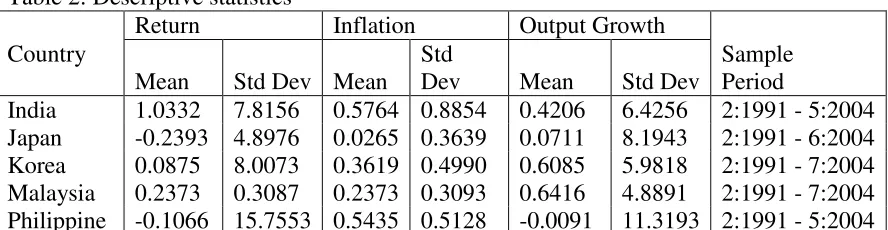
Table 2 reports the descriptive statistics for nominal stock returns, inflation and output
Philippine and Japan, but Philippine and Japan average stock returns is in negative during the sample period. While average inflation ranged from 0.5764% (India) to 0.0265% (Japan), this shows that high inflation countries such India tends to have higher stock returns while low inflation countries such as Japan are associated with relatively lower returns. Malaysia has the highest average output growth during the sample period, with a monthly growth rate of 0.64%, followed by Korea, India, Japan and Philippine. While Philippine experienced a negative output growth, -0.0091% in the sample period.
Table 2: Descriptive statistics
Country
Return Inflation Output Growth
Sample Period
Mean Std Dev Mean
Std
Dev Mean Std Dev
India 1.0332 7.8156 0.5764 0.8854 0.4206 6.4256 2:1991 - 5:2004
Japan -0.2393 4.8976 0.0265 0.3639 0.0711 8.1943 2:1991 - 6:2004
Korea 0.0875 8.0073 0.3619 0.4990 0.6085 5.9818 2:1991 - 7:2004
Malaysia 0.2373 0.3087 0.2373 0.3093 0.6416 4.8891 2:1991 - 7:2004
Philippine -0.1066 15.7553 0.5435 0.5128 -0.0091 11.3193 2:1991 - 5:2004
Note: All variables are computed as the log difference between current and previous month‟s observations, multiplied by 100. Std Dev represents standard deviation.
-30 -20 -10 0 10 20 30 40
92 94 96 98 00 02 04
IN D IA
-20 -10 0 10 20
92 94 96 98 00 02 04
JA P A N
-30 -20 -10 0 10 20 30
92 94 96 98 00 02 04
K OR E A
-0.5 0.0 0.5 1.0 1.5 2.0
92 94 96 98 00 02 04
MA LA Y S IA
-120 -80 -40 0 40 80
92 94 96 98 00 02 04
P H ILIP P IN E
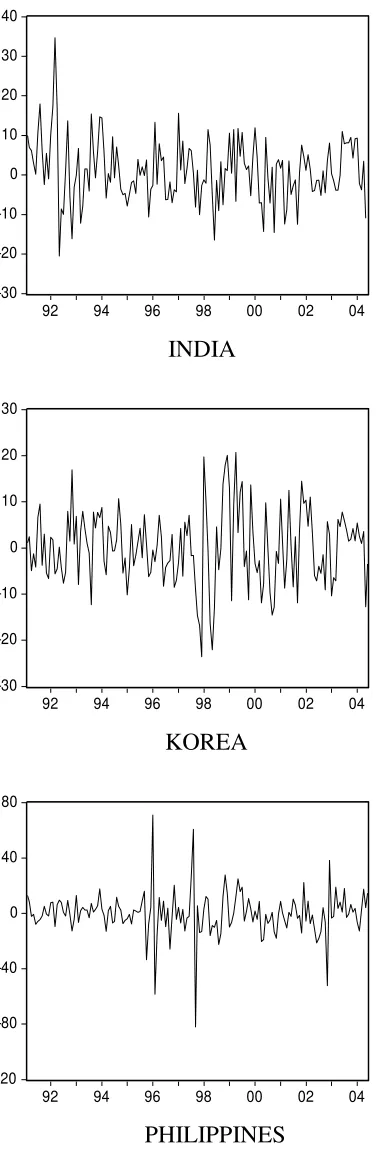
[image:15.612.101.289.138.717.2]Figure 1 below shows the flow of the stock returns for the five countries during the sample period.
Figure 1: Monthly Stock Returns from 1991 - 2004
INDIA JAPAN
KOREA MALAYSIA
[image:15.612.321.510.140.520.2]4.3 Evidence for Time-varying Volatility
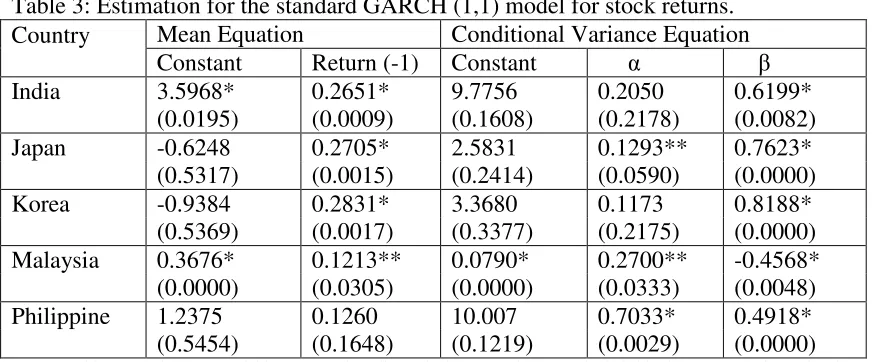
[image:16.612.89.525.159.340.2]After the stationary test, the next process is to choose an appropriate model for the stock returns. Table 3 reports the estimated coefficients for the standard GARCH (1, 1) as given by equation 3 and 4.
Table 3: Estimation for the standard GARCH (1,1) model for stock returns. Country
Mean Equation Conditional Variance Equation
Constant Return (-1) Constant α β
India 3.5968* 0.2651* 9.7756 0.2050 0.6199*
(0.0195) (0.0009) (0.1608) (0.2178) (0.0082)
Japan -0.6248 0.2705* 2.5831 0.1293** 0.7623*
(0.5317) (0.0015) (0.2414) (0.0590) (0.0000)
Korea -0.9384 0.2831* 3.3680 0.1173 0.8188*
(0.5369) (0.0017) (0.3377) (0.2175) (0.0000)
Malaysia 0.3676* 0.1213** 0.0790* 0.2700** -0.4568*
(0.0000) (0.0305) (0.0000) (0.0333) (0.0048)
Philippine 1.2375 0.1260 10.007 0.7033* 0.4918*
(0.5454) (0.1648) (0.1219) (0.0029) (0.0000)
Notes: Monthly seasonal dummy variables representing all months but Decembers were included in the mean equation estimations. The parenthesis figure is p-value. *, **, and *** denote significance level at the 1, 5, and 10%, respectively.
The results clearly suggest that there is indeed significant time-varying volatility in stock returns during the sample period and a commonly employed GARCH (1,1) specification seems to be a good fit for all the five countries considered as well. This is because the beta (β) or GARCH term for the models are all statistically significant at 1% level. The results further suggests that volatility is persistent as measured by sum of the (α+β) which is quite high, higher than 0.8 for most of the countries except for Malaysia, which is in negative sign. This means that the volatility is persistent for the period under study as exhibited by high significance of the coefficients of ARCH and GARCH terms.
Therefore, two conclusions could be made, firstly, we can predict volatility in the current period from the previous information, and secondly, the historical prices reflecting the news or the information. These results are consistent with the conclusion of the Bekaert and Harvey (1997), Aggarwal et al. (1999), Davis and Kutan (2003), Choo et al. (1999), and Zhao (1999) where the monthly stock returns exhibits significant time-varying volatility.
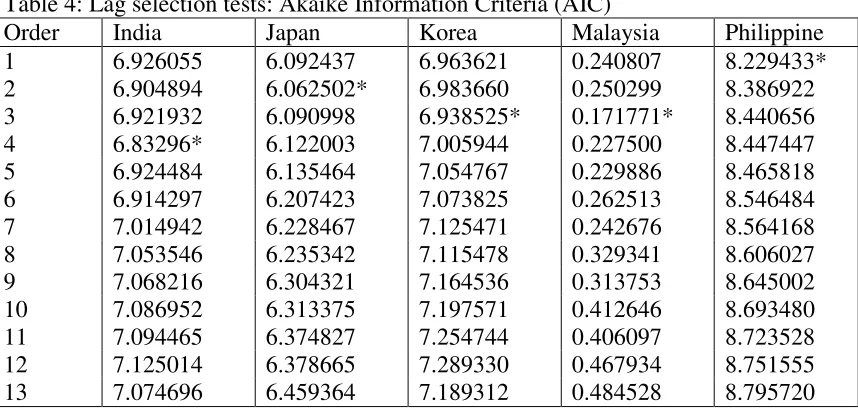
Table 4: Lag selection tests: Akaike Information Criteria (AIC)
Order India Japan Korea Malaysia Philippine
1 6.926055 6.092437 6.963621 0.240807 8.229433*
2 6.904894 6.062502* 6.983660 0.250299 8.386922
3 6.921932 6.090998 6.938525* 0.171771* 8.440656
4 6.83296* 6.122003 7.005944 0.227500 8.447447
5 6.924484 6.135464 7.054767 0.229886 8.465818
6 6.914297 6.207423 7.073825 0.262513 8.546484
7 7.014942 6.228467 7.125471 0.242676 8.564168
8 7.053546 6.235342 7.115478 0.329341 8.606027
9 7.068216 6.304321 7.164536 0.313753 8.645002
10 7.086952 6.313375 7.197571 0.412646 8.693480
11 7.094465 6.374827 7.254744 0.406097 8.723528
12 7.125014 6.378665 7.289330 0.467934 8.751555
13 7.074696 6.459364 7.189312 0.484528 8.795720
Notes: The * is the lowest figure among the 13 lags.
Table 5 reports the result for the cumulative impact of changes in the inflation and output growth on stock returns over a specific period (month) horizon, as per the lag periods determined. The statistical significance of inflation and output growth is measured by the chi-square distribution. The χ2 distribution is to test the significance of the sum of the coefficients for inflation and output growth on stock returns and volatility separately over an individual lags period. The Bollersler and Wooldridge‟s (1992) robust variance estimator is employed for computing the standard errors.
Table 5: The cumulative impact of inflation and output growth on stock returns and volatility
Country
Stock Returns Stock Returns Volatility
Σ Inflation Σ Output Σ Inflation Σ Output
India 0.8362 0.7057 -5.053 -1.799
(24.5688*) (6.1643) (6.7220) (8.0311***)
Japan -1.401 0.2409 -2.0732 -1.2195
(5.1471***) (0.8598) (3.6406) (1.5269)
Korea 0.0747 -0.4335 -1.9345 -1.5491
(1.9783) (1.2166) (8.4795**) (4.4576)
Malaysia 2.6878 -0.0081 0.067 -0.0061
(90.9564*) (1.0526) (5.7172) (1.8639)
Philippine -1.0511 -0.1432 -25.7641 1.5179
(0.1634) (69.4438*) (0.5941) (1.8689***)
[image:17.612.90.529.457.627.2]From the result for average stock returns, it can be observed that inflation has effect on stock returns in majority countries, which include India, Japan and Malaysia. Note that the sign of inflation for India and Malaysia is positive while negative for Japan. This indicates that a 1% increase in inflation increases the stock market for India by 0.8362% and 2.6878% for Malaysia respectively, but reduces -1.401% for Japan. These results are consistent with Choudhry (2001) whereby inflation and stock returns are positively correlated for high inflation countries such as India. In contrary the relationship will be negative for the countries which have moderate or low inflation, like Japan [Asprem (1989), Cochran and Defina (1993), Zhao (1999), and Adrangi et al. (1999, 2000)] though there is a contradiction for Malaysia.
As for the impact of cumulative output growth to the stock returns, there is no evidence that output growth has effect on stock returns during the period of study except for the case of Philippines, whereby for every 1% increase in the output growth, there will be a decrease in the stock returns by 0.1432%. The negative sign of the impact of output growth is in contradiction with the common finding of the previous studies of Harvey (1989), Aspreem (1989), Conova and Nicolo (1995), Peiro (1996), Mauro (2003) and Davis and Kutan (2003). But it is not an isolated finding, sharing the sentiments of Zhao (1999).
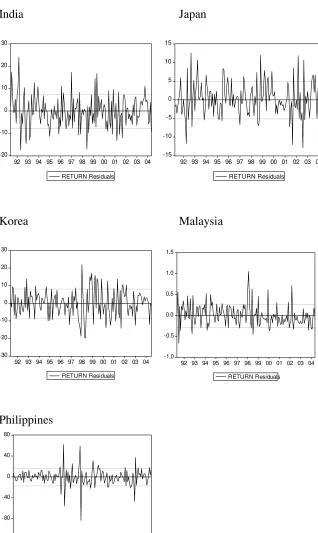
Figure 2 below shows the volatility of monthly stock returns during the sample period for all the chosen countries.
Figure 2: Monthly stock returns residual
India Japan
-20 -10 0 10 20 30
92 93 94 95 96 97 98 99 00 01 02 03 04 RETURN Residuals
-15 -10 -5 0 5 10 15
92 93 94 95 96 97 98 99 00 01 02 03 04 RETURN Residuals
Korea Malaysia
-30 -20 -10 0 10 20 30
92 93 94 95 96 97 98 99 00 01 02 03 04
RETURN Residuals
-1.0 -0.5 0.0 0.5 1.0 1.5
92 93 94 95 96 97 98 99 00 01 02 03 04
RETURN Residuals
Philippines
-120 -80 -40 0 40 80
92 93 94 95 96 97 98 99 00 01 02 03 04
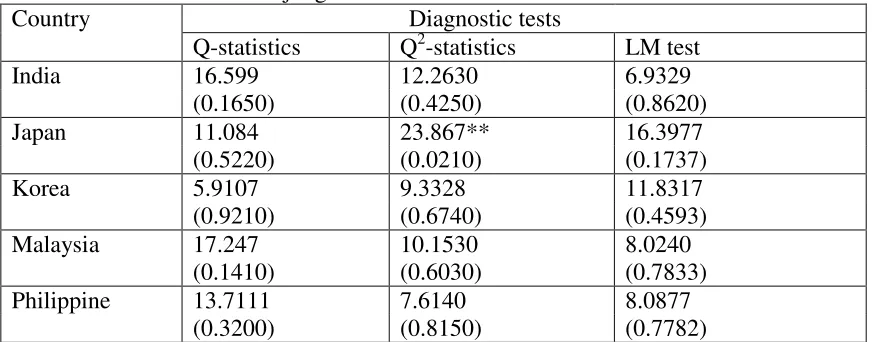
Table 6: Residual tests for Ljung-Box and LM test.
Country Diagnostic tests
Q-statistics Q2-statistics LM test
India 16.599 12.2630 6.9329
(0.1650) (0.4250) (0.8620)
Japan 11.084 23.867** 16.3977
(0.5220) (0.0210) (0.1737)
Korea 5.9107 9.3328 11.8317
(0.9210) (0.6740) (0.4593)
Malaysia 17.247 10.1530 8.0240
(0.1410) (0.6030) (0.7833)
Philippine 13.7111 7.6140 8.0877
(0.3200) (0.8150) (0.7782)
Notes: Q-test is the test for serial correlation while Q2-test is the test for dependency in squared residuals. Q and Q2 tests are calculate
based on chi-square distribution on 12 lags. The parenthesis figure is p-value. *, *, and *** denote significance level at the 1, 5, and 10%, respectively
Table 6 above shows the Q-statistics and Q2-statistics for the serial correlation and squared residuals tests (Ljung-Box Q statistic) while LM test is test for the ARCH effect. The results for the Q statistic on twelve orders show that the test statistics are insignificant at all, because all of the orders are insignificant under 10% or lower significant level. This indicates that there is no statistical evidence of autocorrelation for the stock returns in the countries during the period of study except for the case of Japan whereby there is evidence of dependency in squared residuals for Japan at 5% level.
While the Lagrange Multiplier (LM) test is to check for the presence of ARCH. The results show that it is insignificance in orders 12 in all the countries. This proves that there is also no dependency in squared residuals for the stock returns in all the five countries or indicates that there is no autocorrelation.
The results for the study show that that inflation and output growth for the mean equation could correctly and significantly predict the stock returns in most of the countries in the study. The results indicate that the inflation has a negative impact or relationship with the stock returns,consistent with the previous finding of Davis and Kutan (2003), Spiro (1990), Apprem (1989), Lee and Ni (1996), Lee (1992), Gjerde and Saettem (1999), Choudhry (2001), Spyrou (2001), Adrangi et al. (1999, 2000) and as for the impact of output growth to the stock returns, it is in contradiction with the common findings from the previous study, like Fama (1990), Canova and Nicolo (1995), Lee (1996), Peiro(1996), Choi et al. (1999), Zhao (1999), Mauro (2003) and Davis and Kutan (2003).
It can be concluded that only inflation has impact on the stock returns in most countries in study, but not for output growth. Except for Korea and Philippine which inflation and output growth has significance effect on stock returns volatility, respectively, all the remaining countries have insignificant relationship.
Conclusion
The main objective of this study is to examine the predictive power of the inflation and output growth to the stock returns and volatility in five Asian countries. While previous studies have studied the relationship between macroeconomic factors and stock return and volatility. But most of them have not placed real output and inflation together as exogenous variables in both the mean and conditional variance equations to simultaneously estimate of the effect of these variables on the first and second moments of stock market returns. By using GARCH model, this study places real output and volatility in the same forecasting model accounts for time-varying volatility in returns for these five countries.
References
Adrangi, B., Chatrath, A., and Raffiee, K. (1999). Inflation, Output and Stock Prices: Evidence from Two Major Emerging Markets. Journal of Economics and Finance, 23 (3), 266-278.
Aggrarwal, R., Inclan, C., and Leal, R. (1999). Volatility in Emerging Stock Markets.
Journal of Financial and Quantitative Analysia, 34, 33-55.
Asprem, M. (1989). Stock prices, asset portfolio and macroeconomic variable in ten European countries. Journal of Banking and Finance, 13, 589-612.
Balvers, R.J, Cosmano, T.F., and McDonald, B. (1990). Predicting Stock Returns in an Efficient Market. The Journal of Finance, 45 (4), 1109-1128.
Bekaert, G. and Harvey, C.R. (1997). Emerging equity market volatility. Journal of Financial Economics, 43, 29-77.
Binswanger, M. (2000). Stock market booms and real economic activity: Is this time different? International Review of Economics and Finance, 9, 387-415.
Bollerslev, T. (1986). Generalized Autoregressive Conditonal Heteroscedasticity. Journal of Econometrics, 31, 307-327.
Canova F., and Nicolo, G.D. (1995). Stock returns and real activity: A structural approach. European Economic Review, 39, 981-1015.
Caporale, G.M., and Spagnolo, N. (2003). Asset prices and output growth volatility: the effects of financial crises. Economics Letter, 79, 69-74.
Choi, J.J., Hauser, S., and Kopecky, K.J. (1999). Does the stock market predict real activity? Time Series evidence from the G-7 countries. Journal of Banking and Finance, 23, 1771-1792.
Choo, W. C., Muhammad Idress, A., and Mat Yusoff, A. (1999). Performamnce of GARCH models in forecasting stock market volatility. Journal of Forecasting, 18(5), 333-343.
Choudhry, T. (2001). Inflation and rates of returns on stocks: evidence from high inflation countries. Journal of International Financial Markets, Institutions and Money, 11, 75-96.
Cochrane, S.j., and Define, R.H. (1993). Inflation negative effects on real stock prices: new evidence and a test of the proxy effect hypothesis. Applied Economics, 25, 263-274.
Cutter, D.M., Poterba, J.M., and Summers, L.H. (1989). What Move Stock Prices. The Journal of Portfolio Management, 4-11.
Daly, K. (1999). Financial Volatility and Real Economic Activity. Singapore: Ashgate. Davis,N., and Kutan, A.M. (2003). Inflation and output as predictors of stock returns and
volatility: International evidence. Applied Financial Economics, 13, 693-700.
Engle, R.F. (1982). Autoregressive Conditional Heteroscedasticity with estimates of the variance of UK inflation. Econometrica, 50, 987-1008.
Engle, R.F. (1983). Estimates of the variance of U.S. inflation based upon the ARCH model. Journal of Money, Credit and Banking, 15, 286-301.
Engle, R.F., and Ng, V.K. (1993). Measuring and testing the impact of news on volatility.
Journal of Finance, 1(5), 1749-1778.
Fama, E. (1981). Stock returns, real activity, inflation and money. American Economic Review, 71, 545-64.
Fama, E. (1990). Stock returns, expected returns, and real activity. Journal of Finance, 45, 1089-1108.
French, K.R., Schwert, G.W., and Stambaugh, R.F. (1987). Expected stock returns and volatility. Journal of Financial Economics, 19, 3-29.
Gjerde, Ø., and Sættem, F. (1999). Causal relation among stock returns and macroeconomic variables in a small open economy. Journal of International Financial Markets, Institutions and Money, 9, 61-74.
Guo, H. (2002). Stock Market Returns, Volatility, and Future Output. The Federal Reserve Bank of St. Louis, 75-82.
Harvey, C.P. (September 1989). Forecasts of Economic Growth From The Based and Stock Market. Financial Analysts Journal, 38-45.
Hess, P.J., and Lee, B. (1999). Stock Returns and Inflation with Supply and Demand Disturbances. The Review of Financial Studies, 12 (5), 1203-1218.
Kaul, G. (1987). Stock returns and inflation: the role of the monetary sector. Journal of Financial Economics, 18, 253-276.
Kim, D., and Kon, S.J. (alternative models for the conditional heteroscedasticity of stock returns. Journal of Business, 67 (4), 563-598
Lamoureux, C.G., and Lastrapes, W.D. (1990). Heteroscedasticity in stock return data: volume versus GARCH effects. Journal of Finance, 45 (1), 221-229.
Lee, Bong-Soo (1992). Causal Relationship among Stock Returns, Interest Rates, Real Activity, and Inflation. The Journal of Finance, 47 (4), 1591-1603.
Lee, K. (1996). Long-term output growth as a predictor of stock returns, Applied Financial Economics, 6, 421-432.
Liu, X., Romilly, P., and Song, H. (1998). Stock returns and volatility: An empirical study of Chinese Stock Market. International Review of Applied Economics, 12 (1), 129-140.
Mauro, P. (2003). Stock returns and output growth in emerging and advanced economies.
Journal of Development Economics, 71, 129-153.
Park, Sangkyun (1997). Rationary of negative stock price responses to strong economic activity. Financial Analysts Journal, 52-56.
Peiro, Amado (1996). Stock Prices, Production and Interest Rates: Comparison of Three European Countries with the USA. Empirical Economics, 21, 221-234.
Pena, J.I., Restoy, F., and Rodriguez, R. (2002). Can output explain the predictability and volatility of stock returns. Journal of International Money and Finance, 21, 163-182.
Rangvid, Jesper (2001). Predicting return and changes in real activity: evidence from emerging economies. Emerging Markets Review, 2, 309-329.
Schwert, G.W. (1990). Stock Returns and Real Activity: A century of Evidence. The
Journal of Finance, 45 (4), 1237-1257.
Schwert, G.W., and Seguin, P.J. (1990). Heteroscedasticity in stock returns. Journal of Finance, 45 (4), 1129-1155.
Spyrou, S.I. (2001). Stock returns and inflation: evidence from emerging market. Applied Economics Letters, 8, 447-450.
Wilson, J.W., and Jones, C.P. (1987). Common stock prices and inflation: 1857-1985.
Financial Analysts Journal, 67-72.
Wooldrige, J.M. (2003). Introductory Econometrics: A Modern Approach (2 ed.). Singapore: Thomson South-Western.