http://dx.doi.org/10.4236/ijcm.2015.61007
Sinus Node Ischemia—A Unique Presentation
Jwalit Morakhia
1, Padmakumar Ramachandran
1, Naveen Chandra Ganiga Sanjeeva
1,
Harikrishna Damodaran
2, Shivani Kothari
3, Ashok Thakkar
31Department of Cardiology, Kasturba Medical College & Hospital, Karnataka, India 2Department of Cardiology, Pariyaram Medical College, Kerala, India
3Department of Clinical Trials, Sahajanand Medical Technologies Pvt. Ltd., Gujarat, India Email: [email protected]
Received 27 December 2014; accepted 13 January 2015; published 20 January 2015
Copyright © 2015 by authors and Scientific Research Publishing Inc.
This work is licensed under the Creative Commons Attribution International License (CC BY). http://creativecommons.org/licenses/by/4.0/
Abstract
Sinus node dysfunction, as the sole manifestation of an acute coronary syndrome, is rare. We re-port a case of ischemic dysfunction of the sinus node in a patient who had previously undergone coronary artery bypass grafting for triple vessel disease. Intermittent rest angina with a junctional rhythm was noted in spite of patent grafts to all three vessels, which resolved after percutaneous revascularization of the right coronary artery.
Keywords
Sinus Node, Angina, Acute Coronary Syndrome, Thrombus Aspiration
1. Introduction
Patients presenting with acute coronary syndromes, with atypical symptoms, are frequently misdiagnosed and under-treated. Embolic phenomena are sometimes overlooked by interventionalists as percutaneous coronary intervention is a specialty which primarily focuses on stenosis and occlusions [1]. We report a case of reversible sinus node dysfunction in the unique setting of post-coronary artery bypass grafting (CABG) status with patent grafts. The learning objective of the study includes:
• Isolated conduction defects are an uncommon and often misdiagnosed presentation of an acute coronary syndrome
• A bypass graft may not be protective for ischemia of proximal segments in the presence of diffuse disease • Coronary embolic phenomena can lead to intermittent symptoms and need a high degree of suspicion for
di-agnosis
2. Case Report
thrombolysis with streptokinase. On admission, there was subsidence of the chest pain and adequate ST segment resolution. Echocardiogram showed an inferior segmental wall motion abnormality with an ejection fraction (EF) of 55%. A coronary angiogram revealed triple vessel disease with a 70% stenosis in proximal right coronary ar-tery (RCA) (Figure 1).
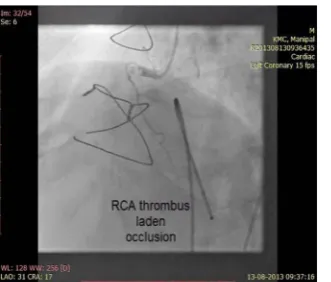
He underwent coronary artery bypass grafting with a left internal mammary artery (LIMA) grafted to left an-terior descending artery (LAD) and saphenous vein grafts to posan-terior descending artery (PDA) and left cir-cumflex artery (LCX). Subsequently, the patient had remained asymptomatic, till he presented to us with inter-mittent rest angina accompanied with junctional rhythm on the ECG without any marked ST segment shift. No new wall motion abnormality was identified. Troponin T values showed a borderline elevation. He underwent placement of a temporary pacemaker via the femoral vein and was treated with low molecular weight heparin. A coronary angiogram was performed, which revealed occlusion of all three vessels with patent grafts supplying their respective vascular territories. It should be noted that this progression of disease in native vessels had been clinically silent till the abovementioned episode of rest angina. While we noted the presence of thrombus in the proximal RCA, we chose not to intervene, as the graft to PDA was patent with retrograde flow till the mid-RCA segment (Figure 2,Figure 3).
However, over the next three days the patient continued to have recurrent episodes of chest pain accompanied by junctional rhythm, the ECG being identical to his baseline ECG in between these episodes (Figure 4,Figure 5).
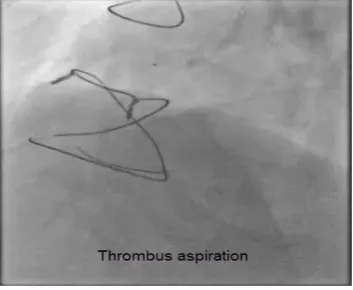
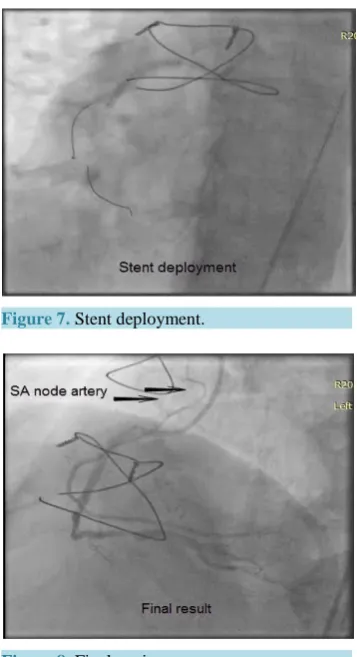
[image:2.595.234.393.385.539.2]We were unconvinced about attributing the clinical presentation to primary sinus node pathology and a possi-bility of intermittent sinus node ischemia secondary to emboli from the proximal RCA thrombus was considered. Hence, we proceeded with percutaneous thrombus aspiration and revascularization with a provisional bifurca-tion strategy for the early bifurcating RCA. A successful outcome was noted with TIMI 3 flow to both RCA branches and the sinus nodal artery (Figures 6-8). There was no recurrence of symptoms and the patient was discharged after two days. The patient continues to be in sinus rhythm and angina free at 8 months follow-up.
Figure 1. Sinus nodal artery and RCA with 70% stenosis—2006 angiogram.
[image:2.595.234.400.564.705.2]Figure 3.SVG to RCA angiogram.
Figure 4. Baseline ECG between angina episodes.
Figure 5. ECG during angina episode.
[image:3.595.223.402.411.530.2] [image:3.595.226.403.561.706.2]Figure 7. Stent deployment.
Figure 8. Final angiogram.
3. Discussion
The sinus node receives its blood supply from the right coronary artery in 59% cases, the left coronary artery in 38% and has a dual supply in 3% cases [2]. While degenerative fibrosis is accepted to be the commonest cause of sick sinus syndrome, sinoatrial (SA) nodal ischemia has also been considered as a putative mechanism in some patients [3]. In a study by Hsueh et al., 9% patients with chronic bradycardia admitted for pacemaker im-plantation were noted to have significant atherosclerotic disease in the node-related artery [4]. Sinus node ische- mia is frequently associated with inferior wall infarctions and in a vast majority the rhythm abnormality is self- limited. The SA nodal artery is usually a small vessel and often does not qualify as a “significant” side branch. Various authors have noted sinus nodal dysfunction during percutaneous coronary intervention due to side branch loss, embolization of thrombus, or during transient occlusion secondary to balloon inflation in the main branch [5] [6]. In a study by Kotoku et al., SA node dysfunction developed in about 28% percent cases, when the SA nodal branch was lost during proximal RCA intervention. However, in all cases, the dysfunction was transient [7]. Y. Abe et al. reported another case with prolonged sinus dysfunction caused by accidental occlu-sion of sinus node artery occurring during stenting of right coronary leocclu-sions [8].
Coronary emboli account for a small but significant number of patients presenting with an acute coronary syndrome. About 4% - 7% patient with an acute coronary syndrome do not show angiographic evidence of co-ronary atherosclerotic disease [9]. An autopsy study implicated coronary embolism in as many as 13% cases of myocardial infarction [1]. It is likely that emboli from the proximal RCA thrombus contributed to the episodic symptoms in our patient, and manual thrombus aspiration, which is mainly studied in acute ST elevation myo-cardial infarction, is an important adjunctive tool in such situations.
atheroscle-rotic disease. The late and incomplete opacification of the SA nodal artery through the graft probably reflected significant ischemia in our patient.
4. Conclusion
Ischemic SA nodal dysfunction is an uncommon sole manifestation of an acute coronary syndrome. A high in-dex of suspicion is needed to identify the culprit vessel, especially in presence of patent bypass grafts. Distal embolization should be prevented as far as possible, with thorough thrombus aspiration, and access to important side branches should be preserved.
Acknowledgements
None.References
[1] Prizel, K.R., Hutchins, G.M. and Bulkley, B.H. (1978) Coronary Artery Embolism and Myocardial Infarction A Clini-copathologic Study of 55 Patients. Annals of Internal Medicine, 88, 155-161.
http://dx.doi.org/10.7326/0003-4819-88-2-155
[2] Kyriakidis, M.K., Kourouklis, C.B., Papaioannou, J.T., Christakos, S.G., Spanos, G.P. and Avgoustakis, D.G. (1983) Sinus Node Coronary Arteries Studied with Angiography. The American Journal of Cardiology, 51, 749-750.
http://dx.doi.org/10.1016/S0002-9149(83)80126-X
[3] Shaw, D.B., Linker, N.J., Heaver, P.A. and Evans, R. (1987) Chronic Sinoatrial Disorder (Sick Sinus Syndrome): A Pos- sible Result of Cardiac Ischaemia. British Heart Journal, 58, 598-607. http://dx.doi.org/10.1136/hrt.58.6.598
[4] Hsueh, C.-W., Lee, W.-L., Chen, Y.-T. and Ting, C.-T. (2001) The Incidence of Coronary Artery Disease in Patients with Symptomatic Bradyarrhythmias. Japanese Heart Journal, 42, 417-423. http://dx.doi.org/10.1536/jhj.42.417
[5] Park, J.-S., Shin, D.-G., Kim, Y.-J., Hong, G.-R., Kim, H.-J. and Shim, B.-S. (2006) Successful Treatment of Ischemic Dysfunction of the Sinus Node with Thrombolytic Therapy: A Case Report. The Korean Journal of Internal Medicine,
21, 283-286. http://dx.doi.org/10.3904/kjim.2006.21.4.283
[6] Gaspardone, A. and Proietti, I. (2003) Acute Thrombosis of the Sinus Node Artery: Arrhythmological Implications. Heart, 89, e5-e5.
[7] Kotoku, M., Tamura, A., Naono, S. and Kadota, J. (2007) Sinus Arrest Caused by Occlusion of the Sinus Node Artery during Percutaneous Coronary Intervention for Lesions of the Proximal Right Coronary Artery. Heart and Vessels, 22, 389-392. http://dx.doi.org/10.1007/s00380-007-0990-0
[8] Abe, Y., Tamura, A. and Kadota, J. (2008) Prolonged Sinus Node Dysfunction Caused by Obstruction of the Sinus Node Artery Occurring during Coronary Stenting. Journal of Electrocardiology, 41, 656-658.
http://dx.doi.org/10.1016/j.jelectrocard.2008.07.003