© 2017, IRJET | Impact Factor value: 5.181 | ISO 9001:2008 Certified Journal | Page 1429
FINITE ELEMENT ANALYSIS AND FATIGUE ANALYSIS OF CRANE
HOOK WITH DIFFERENT MATERIALS
Ms. Mamta .R. Zade
ME Student Mechanical Engg . Department ,GSMCOE Balewadi Maharashtra, India
---***---Abstract -
In the earlier stage of seminar the design of thehook is done by analytical method and analysis was done for the different Cross sections by applying same load on crane hook. like rectangular and trapozoidal . Out those two area Trapozoidal area is selected for further static structural analysis with different materials . Because it gives better results in comparision with other one as because stresses induced are less in trapozoidal cross section. After the analytical method design and modeling of hook is done in modeling soft-ware .The modeling is done using the design calculation from previous work the analysis of hook is done in FEA software (ANSYS).The aim is to select the best material from aluminium alloy , structural steel, wrough iron for crane hook from analysis result and fatigue analysis
Key Words: Crane hook ,CatiaV5, Ansys14.5
1.
INTRODUCTION
Crane hooks are highly liable components and are always subjected to failure due to accumulation of large amount of stresses which can eventually lead to its failure. Crane hooks are the components which are generally used to elevate the heavy load in industries and constructional sites. A crane is a machine, equipped with a hoist, wire ropes or chains and sheaves used to lift and move heavy material. Crane hooks with trapezoidal, circular, rectangular and triangular cross section are commonly used. So, it must be designed and manufactured to deliver maximum performance without failure. In the earlier stage of seminar the design of the hook is done by analytical method and analysis was done for the different Cross sections by applying same load on crane hook out of these trapozoidal area was selected for the previous work. Now, in this stage of seminar the stress analysis are done on different materials and from that the material which has minimum deflection and stresses are selected for fatigue analysis to select best material for crane hook. Fatigue damage is the initiation of a crack due to fluctuating loading. It is caused due to stress levels which are insufficient to cause damage in a single application. The seminar work shows the stress ,deformation and fatigue life contour plots of crane hook using Ansys Workbench
2. LITRATURE SURVEY
Following litratures are studied ,
[1] Sayyedkasim Ali1, Harish Kumar2 described their work on Stress Analysis of Crane Hook with Different Cross Section Using Finite Element Method. In this analysis the material properties of hook kept constant throughout the analysis and stress is to be reduced by varying different geometric parameters. After optimizing the cross section of crane hook the approach turned towards the material saving during manufacturing of crane hook. For material saving the maximum stress region is to be identified by using FEM analysis and then material is removed by considering the maximum bending stress at failure point.
[2] Yogesh Tripathi1, U.K Joshi2 carried an" comparison of stress between winkler-bach theory and ansys finite element method for crane hook with a trapezoidal cross-section ". The induced stresses as obtained from Winkler-Bach theory for curved beams are compared with results obtained by ANSYS software.
[3] Patel Ravin B, Patel Bhakti K., Patel Priyesh M, described their work on "design and analysis of crane hook with different material". The results of stress analysis calculated from FEA analysis for various different material such as Forged Steel ,Wrougt iorn/MS, Aluminium Alloy. For the different Material, It is observed that keeping the tone are same with different Material topology we will get different results, but from that it is found that the Forged Steel material gives minimum stress.
© 2017, IRJET | Impact Factor value: 5.181 | ISO 9001:2008 Certified Journal | Page 1430
3. DESIGN OF CRANE HOOK
Machine frames having curved portions are frequently subjected to bending or axial loads or to a combination of bending and axial loads. With the reduction in the radius of curved portion, the stress due to curvature become greater and the results of the equations of straight beams when used becomes less satisfactory. For relatively small radii of curvature, the actual stresses may be several times greater than the value obtained for straight beams. It has been found from the results of Photo elastic experiments that in case of curved beams, the neutral surface does not coincide with centroidal axis but instead shifted towards the Centre of curvature. It has also been found that the stresses in the fibers of a curved beam are not proportional to the distances of the fibers from the neutral surfaces, as is assumed for a straight beam.The design of crane hook was done by taking the data pertaining to load(w), and curvatures which are used in industrial applications of crane hook
3.1 Theoretical Analysis
Winkler batch theory is used to calculate the theoretical stress. For the straight beams, the neutral axis of the cross section coincides with its censorial axis and the stress distribution in the beam is liner. But in case of curved beams, the neutral axis of the cross-section is shifted towards the centre of curvature of the beam causing a non-linear distribution of stress. The application of curved beam principle is used in crane hooks. This article uses Winkler- Bach theory to determine stresses in a curved beam.
Figure 1: Curved Beam Nomenclature Reference [1]
d2 = Distance of center of gravity from the upper side. R = Radius of curvature
σ = M/ AR [1 + R2/ H2 × Y /R+Y] ..(Tensile)
[image:2.595.302.537.123.345.2]σ = M/ AR [1 - R2/ H2 × Y /R-Y] ..(Compression)
Table 1: Dimensions For Reference [1]
Hook Cross Section Dimension
Trapozoidal B=51, b= 26 , D=75
[image:2.595.308.522.464.634.2]3.2 Trapozoidal Section :
Fig.2 Trapozoidal Section[1]
σ = M/ AR [1 + R2/ H2 × Y /R+Y] ..(Tensile)
H= 0.93 × C =0.93×25 = 23.25 mm M= W× R= 9806×888629=372628 Nmm R= C+ D/2= 38
A=5700/2= 2850mm2
(6t) total= 194 N/mm2 ≤ 250 N/mm2 Geometry of Trapozoidal Section
Fig.3 Geometry of Trapozoidal Section[3]
4. CAD MODELING
[image:2.595.40.251.518.638.2]© 2017, IRJET | Impact Factor value: 5.181 | ISO 9001:2008 Certified Journal | Page 1431
[image:3.595.37.268.314.486.2]4.1 CAD Model of Trapozoidal Section (a)
Fig.4 2D Model of Trapozoidal Section
4.2 3D Model of Trapozoidal Section
Fig. 5 3D Model of Trapozoidal Section
5. MESHING
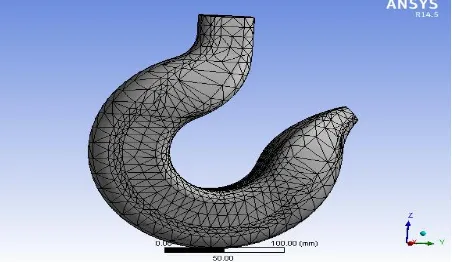
[image:3.595.37.263.554.685.2]A model prepared in CATIA is used for static analysis. Hook element is selected for creating FE model of the crane hook and a fine meshing is carried out. The meshed model created is shown in fig.6.
Fig. 6 Meshing of Trapozoidal section
6. FEA OF CRANE HOOK WITH DIFFERENT
MATERIALS
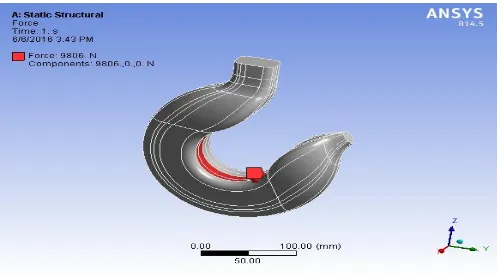
Analysis has been done for static structural, single step loading loads of 9806 N ( 1 Tonn)is applied at principal cross-section of the hook. Eye section at top of the shank, kept fixed.
6.1 Material Properties Of Structural Steel
A shank end of crane hook is fixed and a loads are applied on bunch of nodes at lower centre of hook in downward direction. A load of 1ton (9806N) is taken for analysis. First material selected for crane hook is Structural Steel and the properties of material are given below:
Structural Steel > Constants
Density 7850kgm^-3
Coefficient of Thermal Expansion
1.2e-005C^-1
Specific Heat 434Jkg^-1C^-1
Thermal Conductivity 60.5Wm^-1C^-1
Modulus of elasticity 2.5e05Mpa
Poissons Ratio 0.3
Structural Steel > Compressive Yield Strength Compressive Yield
Strength
trtrengthPa
2.5e+008Pa
Structural Steel>Tensile Yield Strength
Structural Steel > Tensile Ultimate Strength
Reference Temperature C
22
Tensile Ultimate StrengthPa 4.6e+008
Tensile Yield Strength Pa
© 2017, IRJET | Impact Factor value: 5.181 | ISO 9001:2008 Certified Journal | Page 1432 Chemical Composition of Structural Steel
Element Content (%)
Vanadium,V 0.03-0.08
Carbon, C 0.15-0.30
Phosphorus,P 0.04-0.05
Silicon, S 0.02-0.4
Nickel,N 0.25-1.25
Mangnese, Mn 0.50-1.70
Maximum Nodes = 12180
Maximum Nodes = 7499
[image:4.595.321.556.125.250.2]6.2 Boundary Conditions Applied on
Trapozoidal Hook for Structural Steel
Fig. 7 Boundry Conditions Applied on Trapozoidal Hook
6.3 Stress Plot of Hook for Structural Steel
Fig. 8 Stress Plot for Structural Steel
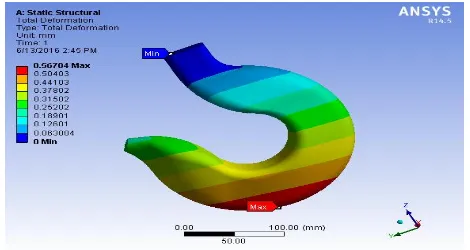
6.4 Deformation Plotfor Structural Steel
Fig. 9 Deformation PlotFor Structural Steel
7. STRESS ANALYSIS OF HOOK WITH ALUMINIUM
ALLOY
7.1 Material Properties of Aluminium Alloy
A shank end of crane hook is fixed and a various loads are applied on bunch of nodes at lower centre of hook in downward direction. A load of 1ton (9806N) is taken for analysis. Material selected for crane hook is aluminium alloy and the properties of material are given below:
Aluminium Alloy > Constants
Density 2770kgm^-3
CoefficientofThermalExpansion 2.3e-005C^-1
SpecificHeat 534Jkg^-1C^-1
ThermalConductivity 69.5Wm^-1C^-1
Resistivity 1.8e-007ohm
Aluminium Alloy > Compressive Yield Strength,E,m CompressiveYield
Strength
trtrengthPa
2.8e+008P a
Modulus of elsticity
trtrengthPa
7.1e+10Pa
[image:4.595.54.266.385.518.2]© 2017, IRJET | Impact Factor value: 5.181 | ISO 9001:2008 Certified Journal | Page 1433 Aluminium Alloy >TensileYieldStrength
[image:5.595.36.272.108.364.2]Aluminium Alloy > Tensile Ultimate Strength
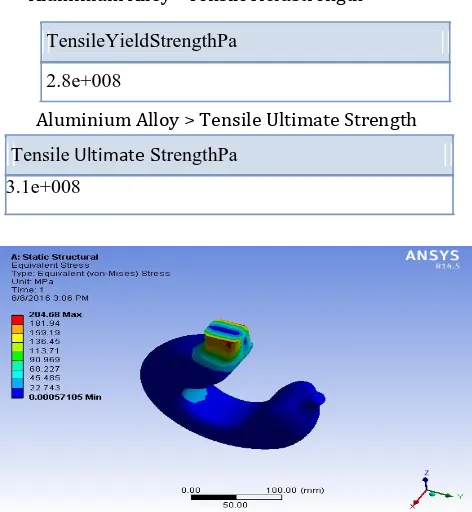
Fig.9 Max. Equivalent ( Von -Mises ) Stress For Trapozoidal Hook
7.2 Boundry Conditions Applied with
Aluminium Alloy
Fig. 10 Boundry Conditions Applied On Trapozoidal Hook
7.3 Stress Plot for Aluminium Alloy Of Hook
Fig.11 Max. Equivalent ( Von -Mises ) Stress For
Aluminium Alloy
[image:5.595.328.566.108.251.2]7.4 Deformation Plot
For Aluminium Alloy
Fig. 12 Deformation For Aluminium Alloy
8. STRESS ANALYSIS OF HOOK WITH WROUGH
IRON
8.1 Material Properties of wrough iron
A shank end of crane hook is fixed and a various loads are applied on bunch of nodes at lower centre of hook in downward direction. A load of 1ton (9806N) is taken for analysis. Material selected for crane hook is wrough iron and the properties of material are given below:
Chemical Composition of wrough iron
Element Content (%)
Iron, Fe 99-99.8
Carbon, C 0.05-0.25
Phosphorus,P 0.05-0.2
Silicon, S 0.02-0.2
Sulfur, S 0.02-0.2
Mangnese, Mn 0.01-0.1
wrough iron > Density, MP
Density 7750kgm^-3
Coefficient of ThermalExpansion
1.3e-005C^-1
Melting Point 15400C
ThermalConductivity 69.5Wm^-1C^-1
Resistivity 2.3e-007ohmm
Tensile Ultimate StrengthPa 3.1e+008
TensileYieldStrengthPa
[image:5.595.39.276.423.555.2]© 2017, IRJET | Impact Factor value: 5.181 | ISO 9001:2008 Certified Journal | Page 1434 wrough iron > Modulus of Elasticity, Poisson's Ratio
Modulus of elsticity
trtrengthPa
1.93e+008Pa
Poisson's Ratio 0.278
wrough iron > Yield Strength
Yield Strength
trtrengthPa
2.29e+008Pa wrough iron > Tensile Yield Strength
Tensile Yield Strength
trtrengthPa
2.34e+008Pa
CompressiveYiel d Strength
2.8e+008Pa
[image:6.595.312.543.96.222.2]8.2 Boundary Conditions Applied On Wrough Iron
Hook
Fig.13 Boundary Conditions Applied On Wrough Iron Hook
[image:6.595.318.560.296.464.2]8.3 Stress Plot for Wrough Iron hook
Fig.14 Max. Equivalent ( Von -Mises ) Stress For Wrough Iron
8.4 Deformation Plot For Wrough Iron
Fig.15 Deformation Plot forWrough Iron hook
9. COMPARISON OF STRESSES
Table 2: Stresses for the various materials of Hook by ANSYS
Material Load (N)
Max. Equivalent Stress (N/mm2)
Deformation in mm
Structural Steel
9806 189.77 0.56
Wrough Iron 9806 191.15 0.57
Aluminium Alloy
9806 195.63 0.93
It was observed that maximum total deformation occurred in Aluminium alloy and minimum total deformation occurred in structural steel and wrough iron. Thus among the three materials used, Structural steel is least prone to plastic deformation and stress which leads to failure of the material. It can be seen from the analysis that maximum stress concentration occurred in the upper region of the hook. From the Von Mises stress distribution it was observed that maximum stress concentration occurred in aluminium alloy and least stress concentration occurred in structural sreel and wrough iron. Thus, among the variable materials used for making hooks which were analyzed in this work, it is conclude that structural steel and wrough iron more suitable for making crane hooks as they have higher capacity to withstand loading.
10.FATIGUE ANALYSIS
[image:6.595.36.287.325.462.2] [image:6.595.50.298.512.650.2]© 2017, IRJET | Impact Factor value: 5.181 | ISO 9001:2008 Certified Journal | Page 1435 for fatigue analysis is constant amplitude load mapping.
[image:7.595.309.533.261.441.2]Constant amplitude load mapping assumes FE stress/strain results to cycle between minimum and maximum values. The nCode Design Life SN constant amplitude load mapping engine is drag onto the solution cell of the mechanical system to generate file.rst file which reads node & element information and FE stress/strain results generated
Fig. 16 S-N Curve
10.1. Fatigue Analysis Results
The available life for a specified fatigue analysis is given by the fatigue life contour plot. The contour plots of fatigue life of the actual model and the best
Table 3. Comparison of fatigue results
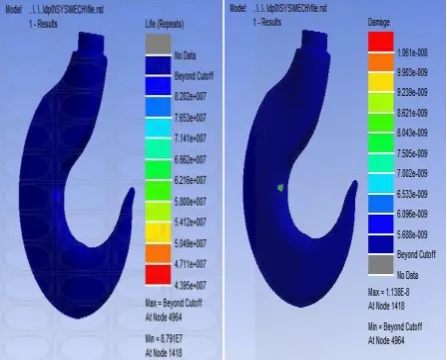
two materials obtained are shown below. It shows the number of cycles the crane hook can withstand before fatigue failure. The minimum fatigue life of the actual crane hook model is repeats as shown in fig. The comparison of the fatigue life of each material is shown in table 3. Figures given below show contour plots of the fatigue damage of the actual hook and the best two materials obtained. It is noticed that the maximum fatigue damage occurs at the inner section of the crane hooks. The variation in fatigue damage of the crane hook is shown by the colour scale. The comparison of fatigue damage of each crane hook is shown in table 3.
Fig.17 Fatigue life and damage contour plots of structural steel
Fig.18 Fatigue life and damage contour plots of wrough iron
On the basis of fatigue analysis results obtained, wrough iron can withstand the maximum number of fatigue cycles before failure i.e., the minimum fatigue life obtained is 8.805E7 repeats which is nearer to structural steel values .Hence we can use wrough iron materials for crane hook.
Materials Minimum Fatigue Life(repeats)
Maximum Fatigue Damage
Struct ural Steel
8.79E7 1.138E-8
Wroug
© 2017, IRJET | Impact Factor value: 5.181 | ISO 9001:2008 Certified Journal | Page 1436
CONCLUSION
The results of stress analysis calculated from FEA analysis for various different material such as Structural Steel ,Wrougt iron, Aluminium Alloy. For the different Material, It is observed that keeping the tone are same with different Material topology we will get different results, but from the above table it is found that the Structural Steel and Wrough Iron gives minimum stress .Further Fatigue analysis was done on the materials from that it is found that wrough iron can withstand the maximum number of fatigue cycles before failure. Hence we can use wrough iron materials for crane hook.
FUTURE SCOPE
Further it is advisable to conduct photo elasticity test for the crane hook under investigation in order to get better insight for stress concentration. Material saving approach by optimization of cross section area with consideration of stress concentration can be also done to put away manufacturing cost.
REFERENCES
[1] Sayyedkasim Ali1, Harish Kumar2, Stress Analysis of Crane Hook with Different Cross Section Using Finite Element Method, IndiaIndex Copernicus Value (2013): 6.14 | Impact Factor (2013): 4.438
[2] Yogesh Tripathi1, U.K Joshi2 IJRET: International Journal of Research in Engineering and Technology eISSN: 2319-1163 | pISSN: 2321-7308 Comparison of stress between Winkler-Bach theory and Ansys Finite Element Method for crane hook with a Trapezoidal cross-section
[3] Patel Ravin B, Patel Bhakti K., (may 2014) ISSN:2319-7900 design and analysis of crane hook with different material
[4] Amandeep Singh, Vinod Rohilla (IJMECH) Vol.4, No.4, November optimization and Fatigue Analysis of a crane hook using Finite Element Method
BIBLOGRAPHY
Ms. Mamta R. Zade P.G. Student at Dept. of Mechanical Engg. GSMCOE Balewadi Pune-45.She has received the Bachelor of Engineering. in Mechanical branch from the Nagpur
University , India, in 2012 Specialization/ Interested Area:
Design Engg. EmailAdress:
![Fig.3 Geometry of Trapozoidal Section[3]](https://thumb-us.123doks.com/thumbv2/123dok_us/8178954.810188/2.595.302.537.123.345/fig-geometry-of-trapozoidal-section.webp)