© 2017, IRJET | Impact Factor value: 5.181 | ISO 9001:2008 Certified Journal | Page 503
Design of New Evaporative Cooler and Usage of Different Cooling Pad
Materials for Improved Cooling Efficiency
Manoj Kumar Chopra
1, Rahul Kumar
2,
1
Vice Principal, Dean Academic & Head, Dept. Of Mechanical Engineering,
R.K.D.F Institute of Science & Technology, Bhopal, M.P., India
2
P.G. Scholar, Dept. Of Mechanical Engineering,
R.K.D.F Institute of Science & Technology, Bhopal, M.P., India
---***---Abstract –The concept of evaporative cooling to providecomfort to human beings in a building is not new and has been used in different parts of a world by using different ways and materials. Vapour compression refrigeration system and Air-conditioning using gases like CFCs and HFCs reduces the utility of evaporative cooling though they have capacity of ozone layer depletion. So many manufacturers have come with different shaped evaporative coolers and different types of pad materials. In this work new evaporative cooler is designed which is semi-circular in shape instead of rectangular shape (normally used now a days) and the comparison between rectangular shaped cooler and new designed semi-circular shaped cooler is made with Khus as a cooling pad material in terms of temperature drop, humidity rise and cooling efficiency. By using Semi-circular shaped utilization of water increases, more volume of air comes in contact due to steam line pattern, requires less cooling pad material and become compact, thus requires less space for installation. As well as performance of different cooling pad materials like Celdek, Khus, Coconut coir and Bamboo fiber (new material) is analyzed in terms of temperature drop, humidity rise and cooling efficiency by using normal water and chilled water with newly designed semi-circular shaped cooler. Also best cooling pad materials in terms of human comfort and finally best cooling pad materials according to climate of Bhopal is analyzed in this work. With respect to human comfort Celdek is a best material followed by Coconut, Bamboo fiber and Khus. As per weather data of Bhopal, the climate of Bhopal in summer is hot and dry so best material recommended for the evaporative cooling in the climate of Bhopal is Celdek.
Key Words: Design, Evaporative Cooler, Cooling Pad, Rectangular Cooler, Semi-Circular Cooler.
1. INTRODUCTION
1.1 Background of Evaporative Cooling
Buildings in summer seasons get continuously heated from the sun and dry wind flows during entire day time. Therefore walls and roof of building continuously store heat in its entire volume and transfer it into interior of the house and making the entire house warm and uncomfortable till the evening periods.
1.2 Introduction to Psychometric
Psychometric is a term used for measurement of properties of moist air. Generally 1kg of air contains 10 to 30 % of water vapour changing from time to time, location to location. The atmospheric air is a mixture of dry air and water vapour (a homogenous mixture).Air in climate is in superheated vapour state i.e. water vapour in dry air.
1.2.1 Various Psychometric Parameters
(1) Specific humidity or Humidity ratio or Moisture content (w)
(2) Absolute Humidity
(3) Saturated Air and Unsaturated Air (4) Relative Humidity (RH) (Ø)
(5) Dry Bulb Temperature (DBT or Tdb) (6) Wet Bulb Temperature (WBT or 𝑇wb) (7) Dew point temperature (DPT or Tdp) (8) Degree of saturation (µ)
It is defined as the ratio of actual humidity ratio to the saturation humidity ratio both being at the same
temperature and total barometric pressure
S
W
=
W
. 1.3 Human ComfortComfort simply means the absence of discomfort Human feels uncomfortable when environment are too hot or too cold, or when the air is odorous and decayed. Comfort conditions means human do not distract by unpleasant feelings of temperature, humidity and various aspect of environment. As per American Society of heating, Refrigeration and Air Conditioning Engineers (ASHRAE): human comfort is defined as the condition of mind, which expresses satisfaction with the thermal environment.
1.3.1 Factors Affecting Human Comfort
The factors which physiologically affect human comfort are as follows
1. Effective temperature
2. Temperature of surroundings surfaces (Hot and Cold surfaces)
© 2017, IRJET | Impact Factor value: 5.181 | ISO 9001:2008 Certified Journal | Page 504 4. Air motions
5. Heat production and regulation in a human body. 6. Heat and moisture losses from a human body 7. Quality and quantity of air
8. Air stratification.
2. EVAPORATIVE COOLING
2.1 Evaporative Cooling
Evaporative cooling is a thermodynamic process in which hot and humid air passes over a wet surface, thus water evaporates due to hot air and latent heat is gained by air at the expense of sensible heat thereby its temperature is reduced. Thus cooling effect depend on amount of water evaporated, larger the amount of evaporation, maximum the cooling effect. As air gains latent heat thus its relative humidity increases. Therefore this system is more useful and efficient in hot and dry climate where humidity levels are low.
In the most general evaporative cooling system air passes at a constant rate through wetted pad thus it get saturated after some time and water is fed from upper side through pump. However like air conditioning evaporative cooler is not able to control temperature and humidity accurately. Their cooling capacity depends on outside condition of air.
2.2 Direct Evaporative Cooling
When air is passed over a large sheath surface of water where the same water is again and again recirculated by using spray nozzle. The air will take the water vapour and thus humidified. The latent heat of vaporization essential for the change of phase of water into vapour is provided by the air itself and hence the temperature of moist air decreases. The process is known as adiabatic since there is no external heat interaction between whole system and surrounding.
2.3 Cool Cells or Wetted Pad Method
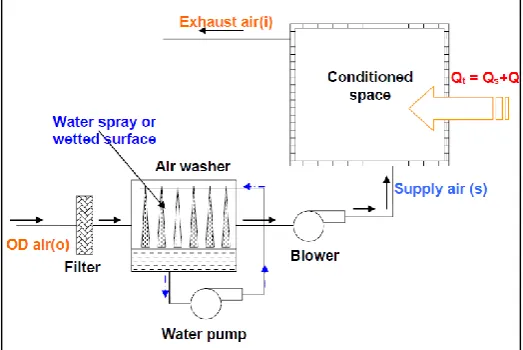
[image:2.595.308.570.101.276.2]In this method water is drenched through a different pad material like large paper or felt pack. The incoming air is driven through the cool cell by pacing it intentionally in the inlet opening of the system as shown in the above Fig.-1. In this method water is evaporated from pad by absorbing heat thus incoming warm and dry air gets cooled and humidified. While selecting material for cool cell it is necessary that there must be a sufficient size of air opening must be given in order to cause air blockage.
Fig. – 1: Direct Evaporative cooling system
2.4 Types of Evaporative Cooler
1. Portable Coolers cool small places or rooms, generally up to 300 square feet.
2. Mobile Coolers cool much larger. It also cools open spaces e.g. Ware houses or garages, and it may also be used out-of-doors on portico or on work sites.
3. Window or through-the -Wall units cool single room, a complete house or a garage.
4. Down Discharge coolers are generally installed on the roof, which discharging the cooled air down ward into the structure and are designed to cool an entire home. 5. Side Discharge units are normally installed on the side of the building directly into the upper floor area, and can also be installed on the roof, using an elbow to direct the flow of air from an opening in the roof. It can cool an entire house.
2.5 Types of Cooling Pad Material
1. Khus: It ispad material mostly found in market and recovered from agricultural waste.
2. Palash: Palash fibers were obtained from the roots of palash tree.
3. Coconut coir: Coconut fibers were obtained from the roots of coconut tree.
4. Wood wool: Wood wool is a product prepared by wood slivers cut from logs.
5. Steel wire mesh: It is made by 0.2-1.5 mm diameter of steel wire.
6. Aspen: Aspen pad evaporative media is prepared by aspen fibers, held jointly in a pad form with plastic netting.
7. GLASdek: GLASdek evaporative media is prepared by a flame retardant material equipped with special rigidifying agents.
© 2017, IRJET | Impact Factor value: 5.181 | ISO 9001:2008 Certified Journal | Page 505
2.6 Advantages of Evaporative Cooling System
(1) Reduction of environmental pollution, global warming and energy saving.
(2) Simple construction and easy to maintain.
(3) Reduces the inlet air temperature and filters the incoming air.
(4) Reduces effective temperature. (5) Provides supply of full fresh air.
2.7 Disadvantages of Evaporative Cooling
(1) Increases the final relative humidity (2) Water consumption increases (3) Dust mites effects
(4) Larger air flow rate
(5) Requirement of clean water
3. METHODOLOGY
3.1 Design of New Evaporative Cooling System
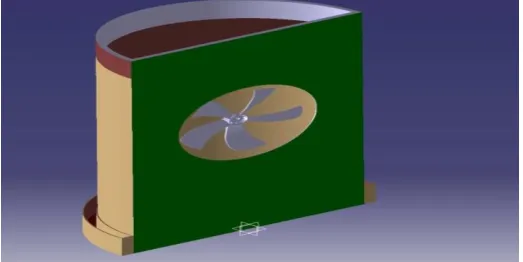
The new design of direct evaporative cooler has been proposed in this work. The new evaporative cooler is of semi-circular shape instead of rectangular shape as shown in the figure. It also consists of two tanks and is incorporated with flow control valve. Both the tanks are perfectly insulated from all sides with insulating material thermocol. A circular pipe is provided to drip the water to a cooling pad by getting water from tank through flow control valve. The dimension of cooler is 83 cm × 68.5 cm from front i.e. 83 cm in height and 68.5 cm in width .A semi-circular shape is provided by taking diameter as 68.5 cm. A hole of diameter 40 cm is also provided in front for fan space.
3.1.1 Semi- Circular Shape
[image:3.595.308.570.103.234.2]In this work semi-circular shape is provided instead of rectangular shape (usually used in evaporative coolers) as shown in figure. Evaporative coolers generally uses axial fan in which air flows along the axis of a fan thus back side cooling pad completely gets the air for cooling while on other hand, cooling pad on sides not getting air completely due to bluff body pattern. Hence by providing semi-circular shape which is completely streamlined pattern gets more volume of air in contact with pad thus more cooled air will provided in a space
Fig. – 2: Isometric view: new designed evaporative cooler.
Advantages of Semi-Circular Shape
a. Provide more volume of cooled air in a space
b. Require less cooling pad material as surface area of semi-circular shape is less than rectangular shape. c. It will require less installation space because its surface
area is less, thus easy to installed, especially outside window.
d. Simple in design and construction, thus easy to maintain.
e. It will require less material of construction, thus economic in manufacturing.
f. Utilization of water is increased as more air comes in contact with cooling pad.
3.1.2 Circular Pipe
A circular pipe is provided on periphery of new designed evaporative cooler to drip water on cooling pads as shown in figure. One end of pipe is connected to flow control valve. A small hole at a fixed distance is provided on entire circumference of a pipe so that water can dip on to the cooling pad. Amount of water comes on to the cooling pad is completely depends upon opening of flow control valve. If opening of valve is full, maximum water comes in the pipe hence maximum water will dip on to the cooling pad or vice-versa.
3.1.3 Flow Control Valve
© 2017, IRJET | Impact Factor value: 5.181 | ISO 9001:2008 Certified Journal | Page 506 using flow control valve is that water consumption also
decreases up to some extent ,which is very useful in those areas where there is a scarcity of water.
3.1.4 Heat Gain by Air (HG)
Water tank used in this new designed evaporative cooler is insulated by insulating material thermocol to reduce rate of heat transfer from water as shown in a figure. The reason for using thermocol is that it has a thermal conductivity of 0.55W/mK, which is very less as compared to all insulation material available and it is also cheap and easily available. Lesser the thermal conductivity means lesser the heat transfer to or from the system or vice-versa. While using normal water, the temperature of water is almost same as that of ambient, thus tank can also be used without insulation. As water consumption in this new designed evaporative cooling system can be controlled due to provision of flow control valve, so we can use chilled water for getting more cooling effect. While using chilled water, as tank is insulated so heat transfer from air to water is not possible, thus water remains chilled for maximum time. Hence more cooling effect will be obtained with less consumption of water.
3.2 Specification of the Component Used
The components used in this evaporative cooler with specification are as listed below.
3.2.1 Induction motor with Fan
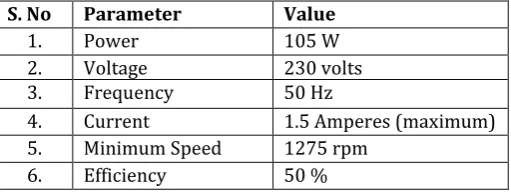
[image:4.595.302.564.122.220.2]The induction motor used in this work is single phase AC motor .It is general purpose duty motor start and run continuously. Motor used is IS: 996-2009 certified. All other specification is given below in table. The Fan used is made up from plastic and its diameter is 16 cm.
Table -1: Specification of Induction Motor
S. No Parameter Value
1. Power 105 W
2. Voltage 230 volts
3. Frequency 50 Hz
4. Current 1.5 Amperes (maximum)
5. Minimum Speed 1275 rpm
6. Efficiency 50 %
3.2.2 Pump
[image:4.595.35.291.568.664.2]Pump used of centrifugal type .Its specification is shown below.
Table -2: Specification of centrifugal pump used in cooler
S. No Parameter Value
1. Power 7 W
2. Voltage 230 volts
3. Frequency 50 Hz
4. Outlet Nozzle Size ½ inches
5. Maximum Flow 500 Lph
6. Maximum Head 1.2 m
3.2.3 Flow Control Valve
The flow control valve is used to control flow of water to reduce moisture level in the conditioned space and its size is ½ inches.
3.3 Experimental Procedure
An experimental set up is made as discussed above and temperature and humidity are measured continuously with the help of hygrometer for different pad materials with normal water and cold water. Following are the steps performed during experiment:
(1) Different cooling pad material is purchased or made. These are Khus, Celdek, Coconut coir, and Bamboo fiber. (2) Experiment is performed on rectangular shaped
evaporative cooler and newly designed evaporative cooler with Khus as a pad material.
(3) Cooling pad material Khus is attached to the rectangular and new designed evaporative cooler
(4) Fill the tank with normal water.
(5) Switch ON electric supply of evaporative cooler. (6) Open fully the flow control valve to keep water flow rate
maximum initially so that cooling pad is completely wet in newly semi-circular evaporative cooler.
(7) Then reducing the flow rate to a lower limit so that water consumption can be reduced in order to control humidity .Flow rate is kept 24 liters /hr.
(8) Hygrometer is placed in front of both rectangular shaped and semi-circular shaped evaporative cooler and also a hygrometer is kept outside room .Hygrometer continuously shows temperature and humidity. Note down this temperature and humidity at an interval of 15 minutes.
(9) After 2 hours switch OFF the cooler.
(10) Now comparison is made between rectangular shaped evaporative cooler and semi-circular shaped evaporative cooler on the basis of temperature drop, humidity rise and cooling efficiency.
(11) Now perform the experiment only on semi- circular shaped evaporative cooler.
(12) Experiment is conducted with normal water and cooling water (170C) and repeats the above procedure.
© 2017, IRJET | Impact Factor value: 5.181 | ISO 9001:2008 Certified Journal | Page 507 (13) Similarly experiment is performed for Celdek, Coconut
coir and Bamboo fiber by using normal water and cold water simultaneously only on semi-circular shaped evaporative cooler and note all the corresponding temperature and humidity shown by Hygrometer. (14) Finally a comparison is to be made between these pad
materials and suitability of best pad material is to be evaluated.
3.4 Formulae Used
Cooling efficiency is determined by using following relation is given below:
dbo dbi
cooling
dbo wbo
T
- T
η
=
T
- T
Where,
dbo
T
= 𝐷𝑟𝑦𝑏𝑢𝑙𝑏𝑡𝑒𝑚𝑒𝑟𝑎𝑡𝑢𝑟𝑒𝑖℃ of outside air.dbi
T
= 𝐷𝑟𝑦𝑏𝑢𝑙𝑏𝑡𝑒𝑚𝑒𝑟𝑎𝑡𝑢𝑟𝑒𝑖℃ inside drop.wbo
T
= 𝑊𝑒𝑡𝑏𝑢𝑙𝑏𝑡𝑒𝑚𝑒𝑟𝑎𝑡𝑢𝑟𝑒𝑖𝑛 ℃𝑜𝑢𝑡𝑠𝑖𝑑𝑒𝑎𝑖𝑟.3.5 Sample Calculation (For KHUS)
Khus as cooling pad material
(i) Rectangularshaped cooler
Tdbo = 23.80C
Tdbi = 19.90C
From psychometric chart
wbo
T
= 14.50Cdbo dbi
cooling
dbo wbo
T
- T
η
=
T
- T
23.8 19.9
23.8 14.5
= 0.4193 =41.93 %(ii) Semi-circular shaped cooler
dbo
T
= 23.80Cdbi
T
= 180CFrom psychometric chart
T
wbo= 14.50Cdbo dbi
cooling
dbo wbo
T
- T
η
=
T
- T
23.8 18
23.8 14.5
= 0.6236 =62.36 %4. RESULT AND DISCUSSION
4.1 Comparison of Rectangular Shaped Evaporative Cooler and Semi-Circular Shaped Evaporative Cooler Using Khus as a Cooling Pad Material
A comparison is made between rectangular shaped and new designed compact semi-circular shaped evaporative cooler on the basis of maximum cooling efficiency temperature drop and humidity rise by using Khus as a cooling pad material with normal water.
4.1.1 Maximum Cooling Efficiency for Rectangular Shaped and Semi-Circular Shaped Evaporative Cooler
Maximum cooling efficiency for rectangular shaped cooler is 41.93% while maximum cooling efficiency in semi-circular shaped cooler and is 62.36 % which is better.
[image:5.595.315.553.473.647.2]4.1.2 Variation of Temperature with Time for Rectangular Shaped and Semicircular Shaped Evaporative Cooler with Normal Water.
Fig. – 3: Variation of Temperature with Time
From the above graph it can be stated that temperature drop in rectangular shaped evaporative cooler is 3.90C while
temperature drop of 5.80C is obtained in semi-circular
© 2017, IRJET | Impact Factor value: 5.181 | ISO 9001:2008 Certified Journal | Page 508
[image:6.595.307.546.107.331.2]4.1.3 Variation of Humidity with Time for Rectangular Shaped and Semicircular Shaped Evaporative Cooler with Normal Water.
Fig. – 4: Variation of Humidity with Time
From the above graph it can be stated that humidity rise is less in a semi-circular shaped evaporative cooler. As the humidity rise is less so effect of dust mites can be reduce up to some extent.
4.2 Comparison of Different Cooling Pad Material in New Designed Semicircular Shaped Evaporative Cooler Using Normal Water and Chilled Water
Here, comparison is made with different cooling pad materials e.g. Khus, Celdek, Coconut and bamboo fiber on the basis of cooling efficiency, temperature drop and humidity rise.
[image:6.595.41.284.118.348.2]4.2.1 Maximum Cooling Efficiency of Different Pad Materials Using Normal and Chilled Water
Table -3: Max. Cooling Efficiency for semi-circular cooler.
Cooling Pad
Material Max. Cooling Efficiency (Normal Water)
Max. Cooling Efficiency (Chilled Water)
Celdek 57.29 % 79.16 %
Khus 62 % 68.68 %
Coconut 36.76 % 44.92 %
Bamboo Fiber 33.87 % 40.32 %
[image:6.595.308.544.531.686.2]4.2.2 Variation of Temperature with Time for a Different Cooling Pad Materials Using Normal Water.
Fig. – 5: Temperature – Time variation for different pad
materials using normal water.
From the above graph it is found that maximum drop in temperature is obtained by using Celdek as a cooling pad material (5.50C) followed by Khus (4.80C), coconut (2.50C)
and least temperature drop is obtained for Bamboo fiber (2.10C).It is also seen that during four hour of working,
temperature is continuously decreasing in case of Celdek while after 2.5 to 3 hours temperature is almost constant in Khus and coconut. But in Bamboo fiber constant temperature is obtained after 2 hour of operation.
4.2.3 Variation of Temperature with Time for Different Cooling Pad Materials Using Chilled Water
Fig. – 6: Temperature – Time variation for different pad
materials using chilled water.
[image:6.595.31.293.605.697.2]© 2017, IRJET | Impact Factor value: 5.181 | ISO 9001:2008 Certified Journal | Page 509 drop is obtained for Bamboo (2.50C).As compared to normal
water more temperature drop for all material is obtained when chilled water is used.
4.2.4 Variation of Humidity with Time for Different Cooling Pad Materials Using Normal Water
[image:7.595.305.564.167.261.2]From the graph it is found that minimum humidity rise is obtained for Bamboo fiber followed by coconut, Celdek and highest rise in humidity is obtained for Khus. As humidity rise in Bamboo fiber is less so, it give comfort for the users and also effect of dust mites is less.
Fig. – 7: Humidity – Time variation for different pad
materials using normal water.
[image:7.595.37.277.251.412.2]4.2.5 Variation of Humidity with Time for Different Cooling Pad Materials Using Chilled Water
Fig. – 7: Humidity – Time variation for different pad
materials using chilled water.
From the graph it is found that by using chilled water minimum humidity rise for Bamboo followed by coconut, Khus and maximum rise in humidity is obtained for Celdek.
4.3 Cost Estimation
4.3.1 Manufacturing Cost of Rectangular Shaped Cooler
Table -4: Manufacturing Cost of RectangularCooler
S. No Name of Component Cost (Rs.)
1. COST(Rs.) 850
2. Fan 60
3. Pump 100
4. Fabrication and Material Cost of
Cooler 2400
Total Cost 3410
[image:7.595.304.563.330.438.2]4.3.2 Manufacturing Cost of Semi-Circular Shaped Cooler
Table -5: Manufacturing Cost of Semi-Circular Cooler
S. No Name of Component Cost (Rs.)
1. COST(Rs.) 850
2. Fan 60
3. Pump 100
4. Fabrication and Material Cost of
Cooler 2130
5. Flow Control Valve 130
Total Cost 3140
From above cost estimation it is clear that manufacturing cost of newly designed compact semi-circular shaped evaporative cooler is less than rectangular shaped cooler by an amount Rs 270, which is very useful for person who is willing to buy a cooler. There is also improvement in cooling efficiency .Thus newly designed semicircular evaporative cooler gives more cooling effect at minimum purchasing cost to a customer.
4.3.3 Cost of Cooling Pad Materials Used in Rectangular Shaped and Semicircular Shaped Cooler
[image:7.595.38.272.493.671.2]Cost of each cooling pad used in rectangular shape and semi-circular shape is shown in table 6.
Table -6: Cooling Pad Material Cost for Rectangular Shaped and Semi- Circular Shaped Cooler
Cooling Pad Material
Cost for Rectangular Shaped (in Rs.)
Cost for Rectangular Shaped (in Rs.)
Celdek 300 200
Khus 1200 900
Coconut 80 50
© 2017, IRJET | Impact Factor value: 5.181 | ISO 9001:2008 Certified Journal | Page 510
4.3.4 Overall Cost of Rectangular Shaped Cooler and Semi-Circular Shaped Cooler with Different Cooling Pad Materials
Overall cost of rectangular shaped cooler and Semi-circular shaped cooler is calculated by adding manufacturing cost with cost of cooling pad materials.
Table -7: Overall Cost ofRectangular Shaped and Semi- Circular Shaped Cooler for different cooling pad materials
Cooling Pad Material
Cost for Rectangular Shaped (in Rs.)
Cost for Rectangular Shaped (in Rs.)
Celdek 3710 3340
Khus 4610 4040
Coconut 3490 3190
Bamboo Fiber 3500 3190
5. CONCLUSION
A new evaporative cooling system is designed and compared with rectangular shaped cooler with respect to temperature drop, humidity rise and cooling efficiency. Performance of four pad materials i.e Khus, Celdek, coconut and bamboo fiber is evaluated by using normal water and chilled water. The performance criterion includes temperature drop, humidity variations and cooling efficiency. The results obtained are as follows:
1. Cooling efficiency is improved by using newly semi-circular shaped design upto 20.43% with Khus as a cooling pad material.
2. Manufacturing cost of new design evaporative cooler is less by an amount of Rs 270. Also, cost of cooling pad materials is less by using new design. Hence overall cost of new designed cooler is less.
3. Now, performance of four pad materials i.e. Khus, Celdek, Coconut and Bamboo fiber is compared using normal water and chilled water in semicircular shaped cooler.
4. Thus by using normal water maximum temp. drop is achieved in Celdek followed by Khus, coconut, and least in bamboo fiber, while maximum humidity rise is obtained for Khus followed by Celdek, coconut and least rise for Bamboo fiber .Highest cooling efficiency is obtained for Khus followed by Celdek, coconut and least in Bamboo fiber. In order to maintain perfect balance between this parameter, Celdek is a best material.
5. By using chilled water maximum temperature drop is achieved in Celdek followed by Khus, coconut and least in bamboo fiber. While maximum rise in humidity is obtained for Celdek followed by Khus, coconut and least
rise is obtained for bamboo fiber. Highest cooling efficiency is obtained for Celdek followed by Khus, Coconut fiber & least for bamboo fiber. In order to maintain perfect balance between these parameters Celdek is a best material.
6. Human feels comfortable in the humidity ranging from 30 to 60 percent. Thereby, Celdek is preferred followed by Coconut, Bamboo fiber and Khus material.
REFERENCES
[1] Jain J.K., D.A. Hindoliya, (2011), “Experimental performance of new evaporative cooling pad materials”, Sustainable Cities and Society 1, 252– 256.
[2] Vivek W. Khond (2011),” Experimental investigation of desert cooler performance using four different cooling pad materials”, American Journal of Scientific and Industrial Research, 418-421.
[3] Fouda A., Z. Melikyan, (2011), “A simplified model for analysis of heat and mass transfer in a direct evaporative cooler”, Applied Thermal Engineering 31, 932-936.
[4] Krishnasamy Senthil kumar and Pss Srinivasan, (2011), “Experimental Study of Centrifugal Humidifier Fitted in an Industrial Shed Located in Tropical Climates”, Thermal Science 15, 467-475.
[5] Gomez E. Velasco, F.J. Rey Martinez, F. Varela Diez, M.J. Molina Leyva, R. Herrero Martin, (2005), “Description and experimental results of a semi-indirect ceramic evaporative cooler”, International Journal of Refrigeration 28, 654–662.
[6] Gunhan T., Demir V., Yagcioglu A.K., (2007), “Evaluation of the suitability of some local materials as cooling pads”, Biosystems Engineering 96, 369-377
[7] Sulaiman Al Faleh, (2002), “Evaluation of the performance of local fibers in evaporative cooling”, Energy conversion and management 43, 2267-2273
[8] Sharma Ashok Kumar, Bishnoi Pawan, (2013), “Development and testing of natural draught desert cooler”, International Journal of Science and Engineering Application 1, 2319-7560.
[9] Kant Krishan, Mullick S.C., (2003), “Thermal comfort in a room with exposed roof using evaporative cooling in Delhi”, Building and Environment 38, 185-193
.
© 2017, IRJET | Impact Factor value: 5.181 | ISO 9001:2008 Certified Journal | Page 511 alternative configurations and materials”, International
Journal of Advances in Engineering &Technology.
[11] Kothare Chandrakant B., Borkar Nitin B., (2011), “Modified desert cooler”, International Journal of Engineering and Technology vol.3 (2), 166-172.