© 2017, IRJET | Impact Factor value: 5.181 | ISO 9001:2008 Certified Journal | Page 1441
Real time results of a fuzzy neural network active noise controller
Tuan Van Huynh
Department of Physics and Computer Science, Faculty of Physics and Engineering Physics,
University of Science, Vietnam National University Ho Chi Minh City, Vietnam
---***---Abstract -
The basic principle of activee noisecontrol (ANC) is to create a secondary acoustic noise which has the same amplitude but opposite phase compared with the primary noise in order to attenuate noise in the controlled noise region. This paper presents a fuzzy neural network based filtered-X least-mean-square (LMS) algorithm for ANC system. The saturation of the power amplifier in ANC system is considered. A fuzzy neural network ANC system for compensating the saturation is proposed. An on line dynamic learning algorithm based on the error gradient descent method is carried out. The experimental models of ANC in real time were presented.
Key Words: active noise control, adaptive system, fuzzy neural network, real time system.
1. INTRODUCTION
Acoustic problems in the environment have gained attention due to the tremendous growth of technology that has led to noisy engines, heavy machinery, pumps, high speed wind buffeting and a myriad other noise sources. Exposure to high decibels of sound proves damaging to humans both in physical and psychological aspects. The problem of controlling the noise level in the environment has been the focus of a tremendous amount of research over the years [1, 2, 7, 9].
Several experiments and simulations are used to demonstrate the various approaches in ANC system. The acoustic and electrical control basis of ANC system is introduced in [1, 2, 3]. Noise cancellation in headphones is introduced in [4]. The filtered-x least mean square (FXLMS) algorithm is a popular adaptive filtering algorithm using a finite impulse response (FIR) filters [1, 2, 7, 12], because it is simple and has relatively low computational load. The development of digital signal processing (DSP) hardware allows more sophisticated algorithms to be implemented in real time to improve the system performance [3, 9, 16]. Linear ANC systems have been successfully used to cancel noise in air conditioning duct systems, handsets, and others [1, 2, 3, 8, 9]. However, in a practical ANC system, the secondary path and primary path of the ANC system may exhibit nonlinear behaviors. The ANC system has to be adaptive because of changes in environment, degradation of system components, and alteration of the noise source. The use of adaptive Volterra filter in ANC system has been presented in [5]. The main drawback of this approach is that the size of the filter increases exponentially with the number of inputs and the computation task is extremely heavy. The
use of neural networks has been suggested to cope with the case of nonlinear system [5-8]. The major problem with neural network based ANC system is its relatively slow learning process. In references [9-16] fuzzy-neural and recurrent neural networks have also been used in nonlinear ANC system. Since the fuzzy neural network is a local approximate model, the adaptive process can be accelerated.
This paper presents theoretical and experimental modeling of an ANC system in free space by using fuzzy neural network structure. An adaptive feedback ANC system using fuzzy neural network with saturation of the power amplifier is proposed, where the model of fuzzy neural network is simplified to meet the characteristic of an ANC system. Real time identification experiments are performed using a TI6713 floating point DSP board. The applications considered in this paper are headsets, hearing protectors and other assistive hearing devices. The remainder of the paper is organized as follows. Section 2 describe the ANC system and its adaptive algorithm. In section 3, the proposed ANC system is presented. Section 4 demonstrate real time results of the proposed ANC system. The conclusions of the work done as well as suggestions for further research are given in section 5.
2. TRADITIONAL ANC SYSTEM
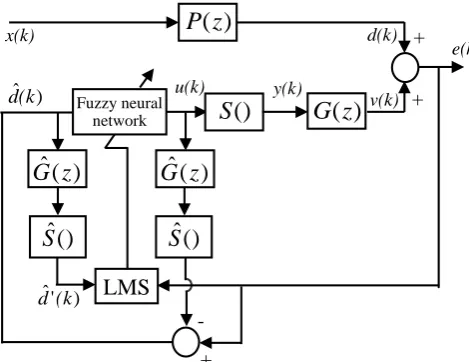
The traditional adaptive feedback ANC system is presented in figure. 1. In figure. 1, the primary noise x(k), generated by the noise source, propagates through the primary path P(z). The secondary noise y(k), generated by the ANC system, propagates through the secondary path S() and G(z) where S() stands for the saturation of the ANC system. The primary noise and the secondary noise are combined to produce the residual noise in the region where the noise is to be controlled. A microphone is placed in this region to measure the residual noise e(k).
The fuzzy neural network is used to produce the secondary noise y(k). It is trained such that the residual noise e(k) is minimized. The introduction of the secondary-path transfer function in the system using the LMS algorithm may lead to instability [16]. This is because, it is impossible to compensate for the inherent delay due to G(z) if the primary path P(z) does not contain a delay of equal length. Also, a very large FIR filter would be required to effectively model 1/G(z). This can be solved by placing a model Gˆ(z) of the secondary
© 2017, IRJET | Impact Factor value: 5.181 | ISO 9001:2008 Certified Journal | Page 1442
+
e(k)
Fuzzy neural network
y(k)
LMS
)
(
ˆ
z
G
)
) ˆ(k
d
-
)
(
ˆ
z
G
)
()
S
)
(
z
P
)
)
(
z
G
)
v(k) d(k) +
+
u(k) x(k)
) ' ˆ(k
[image:2.595.44.281.83.242.2]d
Figure 1. Diagram of adaptive feedback ANC system using fuzzy neural network
3. THE PROPOSED ANC SYSTEM
The proposed feedback ANC system is presented in figure 2, where Sˆ() is a model of S() and is used to compensate for
the saturation of the power amplifier. In figure 2, the residual noise is given by
) ( ) ( )
(k d k vk
e (1) and the secondary noise can be approximated as
1,1 2 )
( )
( ( )
uk
e k
u S k
y (2)
where S() is due to the saturation of the power amplifier, and
J
j
jy k j
g k
y z G k v
0
) ( )
( ) ( ) (
where gj are the coefficients of the Jth order FIR filter G(z).
e(k)
y(k)
LMS
)
(
ˆ
z
G
)
) ˆ(k
d
-
+
)
(
ˆ
z
G
)
()
S
)
(
z
P
)
)
(
z
G
)
v(k) d(k) +
+
x(k)
u(k)
) ' ˆ(k
d
()
ˆ
S
()
ˆ
S
Fuzzy neural network
Figure 2. The proposed ANC system with saturation compensation
The considered fuzzy neural network is shown in figure 3, where W is the weights of the fuzzy neural network. Several
neural networks, such as, multi-layer perceptron, radial basis function networks, and fuzzy neural network (FNN), etc. can be selected. In this paper, the FNN is used as a non-linear filter. A single input and single output model is considered here for convenience. The node in layer 1 is the input node that directly transmits the input signal to the next layer. The layer 5 is the output layer. The nodes in layer 2 are “term nodes, G” which act as membership functions to express the input fuzzy linguistic variables. Here, the membership function is a Gaussian function, in which the mean value m and the variance . The nodes in layer 3 are called “rule nodes, R” which represent the fuzzy rules. The nodes in layer 4, (N) perform the normalization of the firing strengths coming from layer 3. In which follows, the symbol
) (k i
d
denotes the ith input of the ith node in the kth layer, andthe symbol (k) i
a
denotes the output of the ith node in the kthlayer.
GG
G
R
R
N
R N
N
u(k)
) ( ˆk d
W
z-1 z-1 z-1
[image:2.595.313.559.309.429.2]
Figure 3.Fuzzy neural network Layer 1: input layer
a
i(1)(
k
)
d
ˆ
i(1)(
k
)
(3) Layer 2: the functions of the nodes are defined as follows:
, )
( ˆ exp )
( 2
2 )
2 ( )
2 (
ij ij i
i
m k d k
a
(4)
where mijand ijare respectively the mean and the width of the Gaussian membership function.
Layer 3: the nodes in this layer are rule nodes. The rule nodes perform a fuzzy AND operation to calculate the firing strengths,
) ( ˆ )
( (3) )
3 (
k d k a
i i
i
(5)Layer 4: the nodes in layer 4 perform the normalization of the firing strengths coming from layer 3,
) ( ˆ
) ( ˆ ) (
) 4 ( ) 4 ( )
4 (
k d
k d k a
i i i i
(6)
[image:2.595.41.276.516.697.2]© 2017, IRJET | Impact Factor value: 5.181 | ISO 9001:2008 Certified Journal | Page 1443
i
i k wk
a k
u( ) (4)( ) ( ) (7)
and
w
(
k
)
represents a column vector of all of the network weights,
Tn
k
w
k
w
k
w
k
w
(
)
1(
),
2(
),
,
(
)
where n is the number of fuzzy rules.
In order to cope with the nonlinearity in the system, we use fuzzy neural network in figure 3 with integration function and activation function such as (8) and (9) respectively,
) ( )] ( [ )
( (4)
k A k w k net T
w (8)
) ( )) ( ( )
(k f net k net k
u w w (9)
Define discrete Lyapunov function:
) ( 2 1 )
(k e2 k
V (10) The network weight update is based on a stochastic steepest descent which incrementally reduces the instantaneous squared error in the output of the neural network as, T
k
w
k
V
k
w
k
w
)
(
)
(
)
(
)
1
(
(11)where is the learning rate. Applying the chain rule to (11):
T w w J j T k w j k net j k net j k u j k u j k y j k y k v k k V k w k V
( ) ) ( ) ( ) ( ) ( ) ( ) ( ) ( ) ( ) ( ) ( ) ( 0 (12)where ( )
) ( ) ( ) ( ) ( ) ( ) ( k e k k e k e k V k k V
; gj
j k y k v ) ( ) ( ; 1 ) ( ) ( j k net j k u w ; ( ) ) ( )
( (4)
j k A k w j k netw
, and from (2), we
obtain
1 ( )
) ( 1 2 ) ( 1 ) ( 1 4 1 4 ) ( ) ( 2 2 2 ) ( 2 ) ( 2 j k y j k y j k y j k y e e j k u j k y j k u j k u From (12),
1 ( )
( )) ( ) (
)
( (4)
0 2 j k A j k y g k e k w k V J j j T
(13)where A(4)(k) is the vector of the outputs of the layer 4. Thus, according to (11), the network weights update is computed as
1 ( )
( )) ( ) ( ) 1 ( 0 ) 4 ( 2 j k A j k y g k e k w k w J j
j
(14)
where
Tn k a k a k a k
A(4)( ) (4)( ), (4)( 1), , (4)( 1)
The convergence condition of the proposed ANC system Let V(k) as (10) be the discrete-type Lyapunov function candidate. Due to the training process, we have
2 ( ) ( )
) ( 2 1 ) ( ) 1 ( )(k V k V k ek e k e k
V
(15)
The error difference resulting from the learning can be represented by
20 ) 4 ( 2 ) ( ) ( 1 ) ( ) ( ) ( ) ( ) ( ) 1 ( ) (
J jj y k j A k j
g k e k w k w k e k e k e k e
From (15), we obtain
2 0 ) 4 ( 2 2 0 ) 4 ( 2 2 ) ( )] ( 1 [ 2 ) ( )] ( 1 [ ) ( 2 1 ) ( J j j J j j j k A j k y g j k A j k y g k e k V If the learning rate ( > 0), is chosen as
2 0 ) 4 ( 2 ) ( ) ( 1 [ 2 0
J jj y k j A k j
g
(16)
then V(k)0. Therefore, the proposed ANC system is
locally convergent.
4. REAL TIME RESULTS
[image:3.595.312.558.535.708.2]Primary speaker Secondary speaker Error microphone Quiet zone Oscilloscope DSP board Pre-amplifier Frequency generator
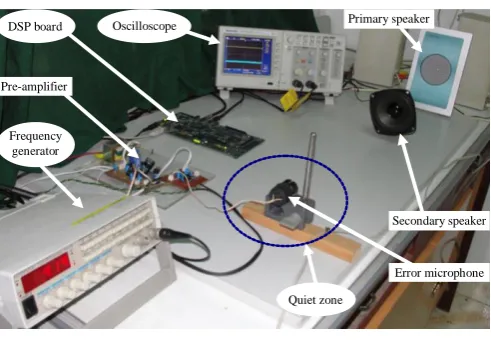
Figure 4. The ANC experiment setup
© 2017, IRJET | Impact Factor value: 5.181 | ISO 9001:2008 Certified Journal | Page 1444 desired quiet zone, and is used to provide the residual noise
signal to the DSP via a pre-amplifier and an analog-to-digital converter. The anti-noise signal, provided by the ANC system which is implemented on the DSP board, is amplified by a power amplifier before being applied to the secondary speaker. The secondary-path transfer function is estimated experimentally as,
Fs t
v
z
A
z
G
ˆ
(
)
. (17) [image:4.595.315.554.89.257.2]and the results are given in the table 1, where f is the frequency of the primary noise which is single sinusoidal signal, Fs is the sampling frequency, Av is the gain of G(z), t is the acoustic propagation time from the secondary speaker to the error microphone. G(z) includes the digital-to-analog converter, the reconstruction filter, the power amplifier, the secondary speaker, the acoustic path from the secondary speaker to the error microphone, the error microphone, the pre-amplifier, the anti-aliasing filter, and the analog-to-digital converter. Note that the distance between the secondary speaker and the error microphone is 50cm. In this experiment, the estimated secondary-path transfer function is calculated by measuring delay time and attenuation of residual noise which is transmitted from the secondary loudspeaker to error microphone.
Table 1. The estimated secondary-path transfer function
f(Hz) Gˆ(z)
0 - 300 0.5z-37 300 - 500 0.5z-38 500 - 800 0.5z-39 800 - 1200 0.5z-41 1200 - 1700 0.5z-42 1700 - 2100 0.5z-43
[image:4.595.317.549.293.464.2]As mentioned previously, modeling ANC secondary path is carried-out prior to control task execution. In this experiment, narrow band noise sources include single sinusoidal signal and multi-sinusoidal signal was applied to excite the secondary path. Sampling frequency of 8000 Hz was used throughout the experiment, the learning rate for W is chosen as = 1. Results of ANC system using fuzzy neural network implemented online on DSP board is shown in figure 5 and figure 6. When the ANC system is activated, mean square error (MSE) of the residual noise is attenuated about 39.2 dB and 29 dB respectively. This demonstrates that the ANC system using fuzzy neural network works effectively with narrow band noise sources.
Figure 5. MSE of residual noise (single sinusoidal signal)
Figure 6. MSE of residual noise (multi- sinusoidal signal)
Evaluate the effectiveness of the proposed ANC system
Figure 7. MSE of residual noise of the proposed ANC system
This section present experimental result to examine the efficiency of the proposed ANC system with saturation
MS
E
(d
B
)
Frequency (Hz)
MS
E
(d
B)
Frequency (Hz)
MS
E
(d
B
)
[image:4.595.97.229.439.573.2] [image:4.595.313.559.520.705.2]© 2017, IRJET | Impact Factor value: 5.181 | ISO 9001:2008 Certified Journal | Page 1445 compensation (where amplitude of secondary noise is
greater than amplitude of amplifier power), the result is shown in figure 7. Remark that the ANC system with saturation compensation operates effectively (solid line) even when the noise level is high, the residual noise spectrum is attenuated about 23 dB. And the ANC system without saturation compensation could not operates effectively when the noise level is high.
In addition, in order to test the effectiveness of the proposed ANC system, we investigated the attenuation of the residual noise in radius of the quiet zone (center of the quiet zone at the error microphone). In this experiment, we use another microphone to measure the attenuation of the residual noise in the quiet zone. Results are shown detail in table 2. For single frequency noise sources, the attenuation of residual noise has decreased from 5 dB to 42 dB in the quiet zone; for multi-frequency noise sources, the attenuation of residual noise has decreased from 1 dB to 36 dB in the quiet zone.
Table 2. The attenuation of residual noise
R (cm) 0 5 10 15 20 25 30 35 40 45 50 S (dB) 39 37 34 32 30 22 16 14 12 11 5 M (dB) 36 29 22 17 15 13 10 7 4 3 1
where R - radius of the quiet zone; S - single frequency noise sources; M - multi- frequency noise sources.
5. CONCLUSIONS
Based on the fuzzy neural network technique, we develop a new ANC system with saturation compensation. The learning algorithm is carried out using the gradient steepest descent method.
Real time results are provided to illustrate the performance of the proposed ANC system in both single frequency and multi frequency cases. The robustness of the proposed ANC system against the secondary path transfer function is also shown.
Results on real time system show that the proposed ANC system operated effectively.
REFERENCES
[1] S. J. Elliott, P.A. Nelson, “Active noise control”, IEEE Signal Processing Magazine, vol. 10, 1993, pp. 12-35. [2] S. M. Kuo and D. R. Morgan, “Active noise control: A
tutorial review”, Proc. IEEE, vol. 87 (no. 6), 1999, pp. 943-973.
[3] V. Narula, M. Sagar, P. Joshi, P. S. Mehta, S. Tripathi, “Real-Time Active Noise Cancellation with Simulink and Data Acquisition Toolbox”, ACEEE Int. J. on Control System and Instrumentation, vol. 3 (no. 2), 2012, pp. 26-30.
[4] Vikash Sethia, “Noise Cancellation In Headphones, Electronic Systems Group”, EE Dept, IIT Bombay, 2002.
[5] L. Tan, J. Jiang, “ Adaptive volterra filters for active noise control of nonlinear filters-Neural filters”, IEEE Transaction on Signal Processing, vol. 49, 2001, pp. 1667-1676.
[6] B. M. Siravara, B.E, “Subband Feedback Active Noise Cancellation”, The University of Texas at Dallas, 2002. [7] P. Ramos, A. Salinas, A. López, E. Masgrau, “Practical
implementation of a multiple-channel FxLMS Active Noise Control System with shaping of the residual noise inside a van”, Universidad de Zaragoza, 2001.
[8] S. V. Narasimhan, S. Veena, H. Lokesha and S. S. Shankarling, “Algorithms for Active Noise Control and their Performance”, National Aerospace Laboratories, 2005.
[9] K. R. Dhivyalakshmi, A. Indhumathi, S. Keerthana, R. Preethi, S. Premkumar, “Real Time Active Noise Cancellation System”, International Journal of Innovative Research in Computer and Communication Engineering, vol. 3 (2), 2015, pp. 109-114.
[10] J. C. Canfield, “Active Disturbance Cancellation in Nonlinear Dynamical Systems using Neural Networks”, University of New Hampshire, 2003.
[11] J. C. Carmona and V. M. Alvarado, “Active Noise Control of a Duct Using Robust Control Theory”, IEEE Transations on Control Systems Technology, vol. 8 (6), 2000, pp. 930-938.
[12] J. S. Hu, “Active Noise Cancellation in Ducts Using Internal Model-Based Control Algorithms”, IEEE Transations on Control Systems Technology, vol. 4 (2), 1996, pp. 163-170.
[13] D. S. Nelson, S. C. Douglas and M. Bodson, “Fast exact adaptive algorithms for feedforward active noise control”, Int. J. Adapt. Control Signal Process, 2000, pp. 643-661.
[14] F. Yu, M. Bouchard, “Multichannel Active Noise Control Algorithms using inverse filters”, School of Information Technology and Engineering, University of Ottawa, 2000.
[15] Deepak Pandey, Ankit, Sunder Raj Patel, “Real time active noise cancellation using adaptive filters following RLS and LMS algorithm”, International Research Journal of Engineering and Technology, vol. 3 (2), 2016, pp. 1657-1661.