© 2018, IRJET | Impact Factor value: 6.171 | ISO 9001:2008 Certified Journal | Page 730
EXPLORATORY STUDY ON PARTIAL REPLACEMENT OF COARSE
AGGREGATE BY DATE SEED
SAMA MAHAMAD AKIB
1, MR. DINESH BHUVA
2, MR. DIPESH PINDORIYA
31
P.G. Student, Department of Civil Engineering, HJD ITER, Kera, Gujrat, India
2,3Assistant Professor, Department of Civil Engineering, HJD ITER, Kera-Kutch, Gujrat, India
---***---Abstract -
Coarse Aggregates play an Essential Role in theResulting Functional Properties of Concrete. However due to its high cost and scarcity in some areas in UAE, this paper investigated the suitability of Date Seed (DS) as partial or full replacement of Coarse Aggregate in concrete production. Physical and Mechanical properties of DS were Determined and compared. Concrete mix design of M20 M25 and M30 were investigated. A total of 324 concrete cubes of size 150 × 150 ×150 mm3 with different percentages by weight of CA:DS as coarse aggregate in the order 100:0, 95:05, 90:10, 85:15, 80:20 and 75:25 were cast immersed in ordinary water for maximum of 28 days tested to determine their compressive strengths and immersed in 5% HCL with Water for maximum of 90 days for Durability test. The compressive strength and Durability test carried out on the concrete specimens showed that all the percentage replacement of DS of 5% replacement for M20 and 10% replacement for M25, M30 mix design was quite satisfactory. The research concluded that 10% DS can be used to replace CA in production of Higher mix design of concrete where it is abundantly available and can be recommended as an alternative material to coarse aggregate.
Key Words
:
Date Seed, Concrete, Coarse Aggregate andExploratory
1. INTRODUCTION
Concrete is a very strong and versatile mouldable construction material. It consist of cement, Sand and aggregate mix with water. The cement and water form paste or gel which coat the Sand and aggregate. When the cement has Chemically reacted with water. it hardens and binds the whole mix together. The initial hardening reaction usually occurs within a few hours. It takes some weeks for concrete to reach full harden and gain strength over many years.
Today UAE is a hub of construction.UAE government continually developing construction for future for Tourism. While Dubai will be the main addressee of tourism and other infrastructure related projects in light of Expo 2020, and for this projects good investment will be need for construction material.
According to Neville and Brooks (2002), concrete being relatively cheaper is the most widely used these days and as such, efforts have been made by many researchers to reduce the cost of its production. This is achieved by reducing the cost of cement and coarse aggregate since concrete basic constituents are cement, fine aggregate(sand), coarse aggregate and water. Hence, the overall cost of concrete
production depends largely on the availability of these constituents. Fine aggregates are readily available and the cost of cement can be reduced through the use of agro-industrial waste or pozzolana. However, the cost of concrete is directly proportional to the cost of crushed stones or local gravels.UAE is almost covered with desert so there is a lack of stones. And also transported expense high for course aggregate to transported stones from other country and now a days they are using stones from blasting mountain and so alternatives light weight materials are adopted for non-load bearing walls and non-structural floors in buildings. Some of these alternative materials include Palm Kernel Shell, Olive Seed and Periwinkle Shell which can be used to fully or partially replace coarse aggregate in concrete production .other side UAE also hub of date palm fruit. After using date seed being wasted so this research is about date seed that can it be used as a alternative material as a course aggregate. The use of DS in concrete production will not only reduce the problem of Agricultural wastes in the societies but will greatly reduce the cost of concrete production. It is in the light of this that this research exploratory studied the suitability of DS when used as coarse aggregate in concrete production.
1.1 Research Hypothesis
i Is DS in question Possess The Required Properties of CA.
ii What effect would each percentage replacement of CA With DS has on The Compressive Strength Of The Hardened Concrete.
iii To what Extend Would DS Lead to Reduction in Cost Of Concrete.
2.
MATERIALS AND METHODS
2.1) MATERIALSThe materials used for the Research Work include fine aggregate, Coarse Aggregate, Date Seed and binding agent which is ordinary Portland cement. The DS was collected in beat and sun dried for a period of about two months until the required quantity for the research was obtained. It was dried in the sun to reduce the moisture content. Ordinary clean tap water free for drinking was used for the experiment.
2.2) METHODS
© 2018, IRJET | Impact Factor value: 6.171 | ISO 9001:2008 Certified Journal | Page 731 Concrete mixes were properly mixed in a machine mixer for
about seven to eight minute and then cast in to 150x150x150 mm3 size Concrete moulds. Moulds are properly lubricated with oil for easy removal of casted cubes after 24 hours or hardened concrete cubes. Concrete cubes were prepared in Percentage by weight of Coarse aggregate to Date Seed as CA in the order of CA:DS, 100:0, 95:05. 90:10. 85:15, 80:20, and 75:25 ranging from zero to 25% replacement for Coarse aggregate by Date seed. Specimens were made in accordance with Bs 1881(1985) specifications. A Total of 324 Concrete cubes. Specimen were produced and used for the actual mix design for three concrete mix ratio. in this research compressive strength and durability test carried out of cubes. So 162 number of specimen of cubes were cured in ordinary water by complete immersed method and other 162 number of specimens of cubes were cured in 5% HCL with Water by complete immersed method and tested for strength at 3, 7 and 28 days. At each testing time, specimens were weighted before testing and the densities of cubes at different time of testing were measured. Prior to testing, the specimens were brought out of the water, left outside in the open air for 2 hours before crushing. The Compressive Strength of the cubes were tested in accordance to BS1881 (1983) specification with the use of universal testing machine
.
3 Results and Discussion
[image:2.595.311.569.139.410.2]3.1) Physical Properties of Materials Used for the Research
Table -1:Physical Properties of FA, CA and DS
SR No Properties F A C A D S
1 Specific
Gravity 2.64 2.74 1.00
2 Water
Absorption 2.02% 0.63% 8.8%
Sr. No Properties FA C A D S
4 Compacted
Density 1.63 g/lit 16.66 g/lit kg/m3 764 5 Impact value 11.94 % 0.27% 6 Crushing value 14.43 %
7 Abrasion test 12.03%
The specific Gravity of the materials was resolute in coherence with the requirement of BS 812: Part 2: 1975).The specific gravity of Date Seed was observed to be 1.00 This is less than the values recorded by Neville and Brooks (2002) for natural aggregate which is between 2.6 to 2.7. The Bulk Density test carried out on the samples of material used for the research was in accordance with the provisions of BS 812: Part 2: (1975). The results are shown in Table 1. The ratio of the loose bulk density to the compacted bulk density of DS was 0.89. This value is between 0.87 and 0.96 specified by the code as reported by Neville and Brooks (2002).
3.2 Workability Test
[image:2.595.30.298.465.625.2]3.2.1 Workability Test for M20
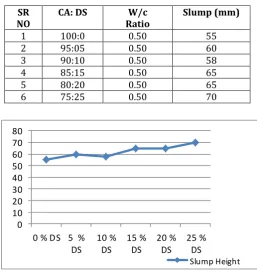
Table -2Workability of the Pastes (M20 Mix Design)
SR
NO CA: DS Ratio W/c Slump (mm)
1 100:0 0.50 55
2 95:05 0.50 60
3 90:10 0.50 58
4 85:15 0.50 65
5 80:20 0.50 65
6 75:25 0.50 70
0 10 20 30 40 50 60 70 80
0 % DS 5 % DS
10 % DS
15 % DS
20 % DS
25 % DS
Slump Height
Chart -1: Workability of the Pastes (M 20 Mix Design)
3.2.2 Workability Test for M25
Table -3Workability of the Pastes (M25 Mix Design)
SR NO CA: DS W/c
Ratio Slump (mm)
1 100:0 0.47 45
2 95:05 0.47 45
3 90:10 0.47 52
4 85:15 0.47 55
5 80:20 0.47 60
6 75:25 0.47 68
0 20 40 60 80
0 % DS 5 % DS
10 % DS
15 % DS
20 % DS
25 % DS Slump Height
[image:2.595.307.562.493.754.2]© 2018, IRJET | Impact Factor value: 6.171 | ISO 9001:2008 Certified Journal | Page 732 3.2.3 Workability Test for M20
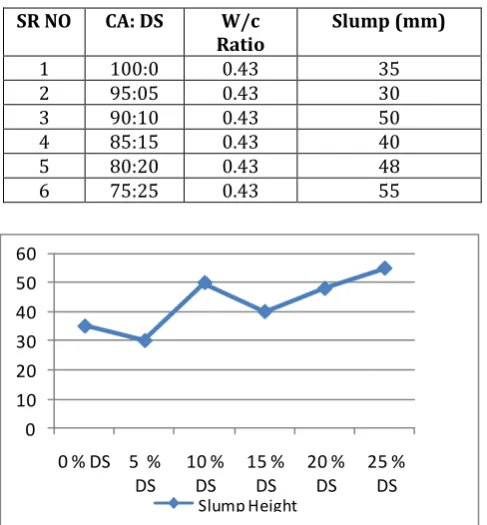
Table -4Workability of the Pastes (M 30 Mix Ratio)
SR NO CA: DS W/c
Ratio Slump (mm)
1 100:0 0.43 35
2 95:05 0.43 30
3 90:10 0.43 50
4 85:15 0.43 40
5 80:20 0.43 48
6 75:25 0.43 55
0 10 20 30 40 50 60
0 % DS 5 % DS
10 % DS
15 % DS
20 % DS
25 % DS Slump Height
Chart3 -: Workability of the Pastes (M 30 Mix Design)
3.3 Compressive Strength Test
3.3.1 Compressive Strength Test For M20
Table -5 Average Compressive Strengths Test
Compressive Strength Test of M20
CA : DS 3 Days 7 Days 28 Days
100:0 (Normal) 9.01 16.53 26.9
95 :05 8.5 15.6 26.2
90:10 6.8 14.7 18.7
85:15 5.1 13.3 16.6
80:20 4.6 12.2 15.4
75:25 3.6 10.93 12.8
3.3.2 Compressive Strength Test For M25
Table -6 Average Compressive Strengths Test
Compressive Strength Test of M25 CA : DS 3 Days 7 Days 28 Days 100:0 (Normal) 13.6 22.9 32.3
95 :05 12.7 20.8 31.8
90:10 11.5 18.7 30.6
85:15 9.8 17.9 22.06
80:20 6.2 16.86 19.6
75:25 5.2 15.3 18.3
3.3.3 Compressive Strength Test For M30
Table -7 Average Compressive Strengths Test
Compressive Strength Test Of M 30 CA : DS 3 Days 7 Days 28 Days
100:0 15.2 26.0 37.1
95 :05 14.3 23.1 36.8
90:10 13.5 21.9 35.6
85:15 11.8 19.2 28.5
80:20 9.1 17.3 26.2
75:25 7.9 16.1 22.7
From above result it can be seen that reduction of strength increase with increase of percentage of Date seed replacement with CA. maximum 25% replacement can be made, with more than 25% replacement of DS surface of cube can’t be made. M20 mix design with 5% replacement with DS and M25orM30 mix design with 10% replacement with DS concrete cube gain desired satisfactory strength.
3.3 Durability Test
3.3.1 Durability Test For M20
Table -8 Average Compressive Strengths Test
M 20 CONCRETE MIX DESIGN 5 % HCL SOLUTION Mix
Design EnvironmNormal ent Comp.
Str. N/mm2
28 Day Comp.
Str. N/mm2
56 Day Comp.
Str. N/mm2
90 Day Comp. Str. N/mm2
Normal 26.9 26.3 25.8 24.4
5 % DS 26.2 25.6 24.8 23.7 10 % DS 18.7 16.9 16.1 15.7 15 % DS 16.6 15.1 14.7 13.9 20 % DS 15.4 13.9 12.7 11.3 25 % DS 12.8 11.7 10.9 9.6
3.3.2 Durability Test for M25
Table -9 Average Compressive Strengths Test
M 25 CONCRETE MIX DESIGN 5 % HCL SOLUTION Mix
Design Environment Normal Comp .Str.
N/mm2
28 Day Comp. Str. N/mm2
56 Day Comp.
Str. N/mm2
90 Day Comp. Str. N/mm
2
Normal 31.76 31.2 30.8 30.1
5 % DS 29.8 29.01 28.5 27.9
10 %DS 27.8 27.2 26.9 26.3
15 %DS 22.0 20.7 19.8 19.5
20 %DS 19.4 18.6 18.1 17.5
© 2018, IRJET | Impact Factor value: 6.171 | ISO 9001:2008 Certified Journal | Page 733 3.3.3 Durability Test For M30
Table -10 Average Compressive Strengths Test
M 30 CONCRETE MIX DESIGN 5 % HCL SOLUTION Mix
Design EnvironNormal ment Comp.
Str. N/mm2
28 Days Comp. Str.
N/mm2
56 Days Comp.
Str. N/mm2
90Days Comp.
Str. N/mm2
Normal 36.49 35.9 35.5 35.1
5 % DS 35.2 34.8 33.9 33.2
10 % DS 33.4 33.1 32.8 32.1
15 % DS 28.5 27.9 27.4 26.9
20 % DS 26.2 25.7 25.3 24.8
25%DS 24.23 23.8 22.8 22.0
3.4 Density Test
3.4.1 Density Test For M20
Table -11 Average Density Test
M 20 Density Test
CA :DS 3 Days 7 Days 28 Days
100:00 2617 2638 2652
95:05 2509 2511 2512
90:10 2478 2481 2491
85:15 2320 2338 2359
80:20 2133 2152 2162
75:25 1965 1998 2012
[image:4.595.313.560.377.525.2]3.4.2 Density Test For M25
Table -12 Average Density Test
M 25 Density Test
CA :DS 3 Days 7 Days 28 Days
100:00 2526 2623 2624
95:05 2514 2524 2530
90:10 2523 2553 2563
85:15 2488 2519 2527
80:20 2271 2320 2360
75:25 2142 2202 2231
3.4.3 Density Test For M30
Table -13 Average Density Test
M 30 Density Test
CA :DS 3 Days 7 Days 28 Days
100:00 2526 2623 2624
95:05 2509 2516 2519
90:10 2505 2510 2517
85:15 2497 2506 2514
80:20 2472 2476 2486
75:25 2261 2301 2340
The Densities of the Three Specimens (M20, M25, M30) Decrease with increase in Percentage Replacement of CA for DS. This was so because DS is lighter than CA and as more quantity of CA is Being Replaced With DS, The Higher the Reduction in Density of The Concrete produced. The densities of all the specimens in ordinary Water at 28 days are within the Range Recommended For Normal weight concrete which is Between 2355 to 2560 kg/m3 . The Compressive Strengths Of Concrete specimens for different percentages of DS are shown in Table 5, Table6 and Table7 for concrete mix Design M20,M25,and M30. Respectively For each Mix, significant reduction in strength was Observed Between the mix with 25% CA replacement of DS. The reduction in strength increased as more quantity of CA is being replaced with DS. Concrete produced with 25% DS (Mix Ratio M20,M25,M30) Did not Attain the Minimum Compressive Strength Recommended By BS 8110 (1995).
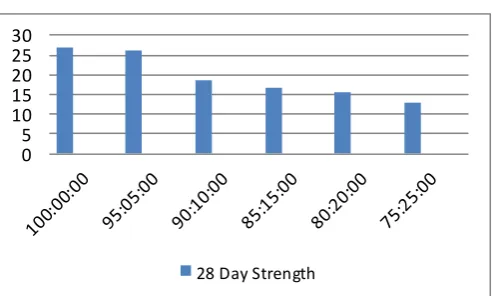
3.5 Percentage Lost in Strength of DS Concretes at 28 days For M20
0 5 10 15 20 25 30
28 Day Strength
Chart -4 28 DaysPercentage Lost in Strength Variation with Different % of DS as CA for Mix Design M20
3.6 Percentage Lost in Strength of DS Concretes at 28 days For M25
0 10 20 30 40
28 Day Strength
© 2018, IRJET | Impact Factor value: 6.171 | ISO 9001:2008 Certified Journal | Page 734 3.7 Percentage Lost in Strength of DS Concretes at 28
days For M30
0 10 20 30 40
28 Day Strength
Chart -6: 28 DaysPercentage Lost in Strength Variation with Different % of DS as CA for Mix Design M30
Chart 1,2 and3 show the percentage reduction in strength of DS concretes for all the percentage replacement level of CA for DS in the three mix Design (M20,M25 and M30). It was observed that the percentage. Reduction in strength of mix design20 was higher than that of M25 and M30 at all level.
3. CONCLUSION
DS has Physical Properties Such as Specific Gravity, Bulk Density and Absorption Capacity far less in Values to that of CA .In M20 Mix Design replacement of 5% of DS attained requires strength in 28 days in compressive strength test. but 10% replacement of DS not attained required Strength. While in M25 and M30 Mix Design till 10 Percentage Replacement of DS attained required strength. And other replacement ratio from 15 to 20 percentage of DS fail in 28 days Compressive strength Test. in Durability test also 5% Replacement of DS in M20 mix Design and 10% replacement of DS in M25 and M30 attained Required strength. So it is Recommended That for Higher Grade such As M25 And M30 10 percentage of replacement of DS is possible
ACKNOWLEDGEMENT
I would like to thank God Almighty for granting Me Health and Knowledge for completing This Work. I am indebted to Asst. Prof.Dinesh Bhuva and Mr. Dipesh Pindoriya, for helping me to find out significant topic, and with his Help I was able to gather Scholarly Sources. I would like to Thank all Faculty Members of Civil Engineering Department, HJD ITER for providing All kind of Possible Help Throughout This Work. I am extremely Grateful to My Parents, Sister, Brother and Friends For The Support and Constant Encouragement They have given me throughout the Stretch of this Work.
REFERENCES
[1] Skavitha Karthikeyan, “Exploratory Study on Partial Replacement Of Coarse Aggregate by TalipotPalm
Seed” International Journal of Civil Engineering and Technology Volume 8, Issue 7, July 2017
,
[2] Muhammad Sarwar, “Environment Friendly Construction Techniques Using Sun flower Husk, Rice Husk And Their Ashes” International Journal of Scientific & Engineering Research, January 2016,
[3] Amarnath Ramachandrudu Cb, “Properties of Concrete with Coconut Shells as Aggregate Re placemen” International Journal of Engineering Inventions Volume 1, Issue 6 (October2012),
[4] L Gulb J Setina and I Juhnevica, “Experimental studies on effect of Date Seed Ash (DSA) on strength properties of cement sand mortar” School of Civil Engineering, Earth and Environmental Science Volume 6 january2015,