© 2017, IRJET | Impact Factor value: 5.181 | ISO 9001:2008 Certified Journal | Page 2501
Smart Incubator Based on PID Controller
Zain-Aldeen S. A.Rahman
1, Farahan S. A. Hussain
21 Dept. of Electrical Techniques, Technical Institute / Qurnah, Basrah, Iraq 2 South Oil Company, Basrah, Iraq
---***---Abstract -
For supporting the economical state of thecountry a flexible, simple and economical PID controller is designed and implemented for controlling the temperature and humidity of the egg incubator. In this work the temperature and humidity of the incubator is controlled by very flexible PID controller for achieving a required environment. Here the controller parameters that included Kp (Proportional factor), Ki (Integral factor) and Kd (Derivative factor) can be adjust by two devices. The first the controller parameters can by adjust from PC, in the other hand the controller parameters can be adjust from the implemented panel (Keyboard). The system consists of the main unit that represented by an Arduino Mega board which include an ATmega1280 microcontroller, different sensors as humidity sensors and temperature sensors, heat source, humidity source, servo motor, LCD modules, and keyboard. The set points must be changed according to the specified values to satisfy the given conditions for the optimal environment, then the controller will operate according to these set points.
Key Words: PID Controller, Sensor, Automatic Incubator, Humidity, Temperature.
1. INTRODUCTION
An automatic incubator is an incubator that gives
optimal temperature and humidity with the required smooth amounts only. When matched with the unoriginal incubator that work on the standard of timer-based controller that give these parameters where is needed with the required amounts (not smooth).In this paper, a smart incubator is implemented, the principle operation of this incubator depends on the monitored parameters that include the incubator relative humidity and incubator temperature. The main
issues of the research hide in improve the economical, healthy and the rest for the costumer. The sensors that the system needed are temperature (LM35) and humidity sensor (DHT-11). The Arduino Mega board (with ATmega1280) that will be the brain for the system controller.
© 2017, IRJET | Impact Factor value: 5.181 | ISO 9001:2008 Certified Journal | Page 2502 heat of the incubator decreased below the edge value
then the bulb will be on and it still on till the heat increased to the required value. Additional oxygen can be taken in by an oxygen inlet piecing together where it is varied with the fresh air across the cleaning filter. As well as that the humidity can be amplified by the use of water steam bath or by saturated water on a heated element. In the bottom part of the incubator the air can be heat by a light corms heat. The air passes over a vessel with dissolving water, so that its humidity rises. The earnest, steamy air then flows aloft into the baby section. The baby is be concerned for through unusual access doors named support ports.
In 2010, Christina Tan, [3] proposed a integrated temperature, light and humidity monitoring system for the hospital environment. An intelligent, integrated heat, light and humidity checking system has been realistic with the use of exposed normal technology, marketable scheme and domestic matters which dynamically displays the ecological situations. A foremost goal for this system is to have it designed and realized as price efficient as likely. The scheme permits for a operator to input the wanted situations concerning a exact tolerant temperature, humidity and lighting supplies. The microcontroller then associates the ecological situations in contradiction of the customer input supplies, and actuators modify the sets until the wanted situations have been got.
In 2012, S.K. Mousavi, et. al. [4] presented an incubator with fuzzy logic. In this work the authors study success fuzzy of three factors such as temperature, moistness and oxygen that they have an real part in the incubation method in
incubator. Also inthis object they attempts to attain to the
highest efficiency in expressions of total of born chickens which was born from eggs and have a system with exact control- finally the review the normal of reversion of these three fuzzy factors.
In 2015, Sumardi Sadi, [5] designed Room Temperature Control System Prototype Industry Based Programmable Logic Controller Zelio SR2 B121 BD, in this project a trial mechanisms based on the chamber hotness increases determined programmed by encoding the PLC, the. Rise in heat of the chamber and the rate of the heat surge can be observed using the LCD. The system can work from a temperature of 0 ° C to 90 ° C degrees. Chamber heat kit manufacturing customs three devices: first controller, Zelio
Logic SR 121BD, second, Integrated Circuit (IC) LM35 and third, a 24 VDC power source. This made the scheme develops the data attainment abilities and management. In 2015, Hitu Mittal, et. al. [6] designed a design and development of an infant incubator for controlling multiple parameters. In this project a closed loop control system to adjust the hotness, wetness, light power by means of LED’s to escape the situation and the correct quantity of oxygen smooth inside a newborn incubator. A PID controller is be used for realizing the scheme. The closed loop control system is a arrangement of actuatos and sensors that functions in one time to offer a steady current surroundings in the incubator.
Here a PID controller, is employed, the principle process of this scheme be contingent on the checked factors that contain the temperature and the virtual humidity in the incubator.
2.THE AUTOMATIC INCUBATOR
Due to the rapid advances in technologies it is now possible to use various levels of smartness in agriculture fields. In this work, an automatic incubator supporting by PID controller is designed and implemented for the temperature and humidity managements. These automatic incubator are ones that can interrelate intelligently to provide comfort and safe living. The programmed incubator needs tools and machineries that can expand manufacture productivity, produce quality, postharvest processes, and reduce their ecological influence.
3. PID CONTROLLER
© 2017, IRJET | Impact Factor value: 5.181 | ISO 9001:2008 Certified Journal | Page 2503 with dissimilar real blocks, filters (compensators or
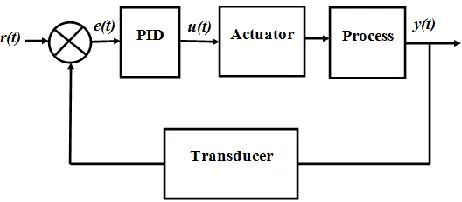
[image:3.612.43.274.209.310.2]improvement blocks) [8]. This kind of feedback controller whose output, a control flexible, is normally based on the error (e) amongst some costumers defined usual point and some measured process variable [9]. Fig. 1 shows a block diagram of a PID control system.
Fig -1: A block diagram of a PID control system.
The error signal e(t) is used to generate the
fundamentals factors of the PID controller which include Kp (Proportional factor), Ki (Integral factor) and Kd (Derivative factor, with the resulting signals weighted and summed to form the control signal u(t) applied to the plant model. The time response of the PID controller output is given by equation (1) [9].u(t)
=
K
p(e(t)
+
+T
d ) ……1……2
Where u (t) is the input signal to the multivariable
processes, the error signal e(t) is defined as in equation (2), y(t) is the process output and r(t) is the reference input signal. The factor Kp is the proportional gain, Ti is the integral time constant and Td is the derivative time constant. The time response of the PID controller output in equation (1) can be written as:u(t)=K
pe(t)+K
i+K
d…….3
Where Ki= Kp/Ti is the integral gain and Kd=KPTd
is the derivative gain. The tuning of a PID involves theadjustment of Kp, Ki and Kd to achieve the optimal gains of a system response.
Achieving of the required temperature and humidity is
one of the main issues of this work, therefore, it’s
necessary
to adopt an control for these parameters
for providing its accurate amounts in the incubator. Here a PID controller is used for controlling the temperature and humidity in the incubator. The PID will control on the voltage that provide the temperature and humidity source by PWM (Pulse Width Modulation) machinery. That is achieved by using themicrocontroller.
4. HARDWARE DESCRIPTION
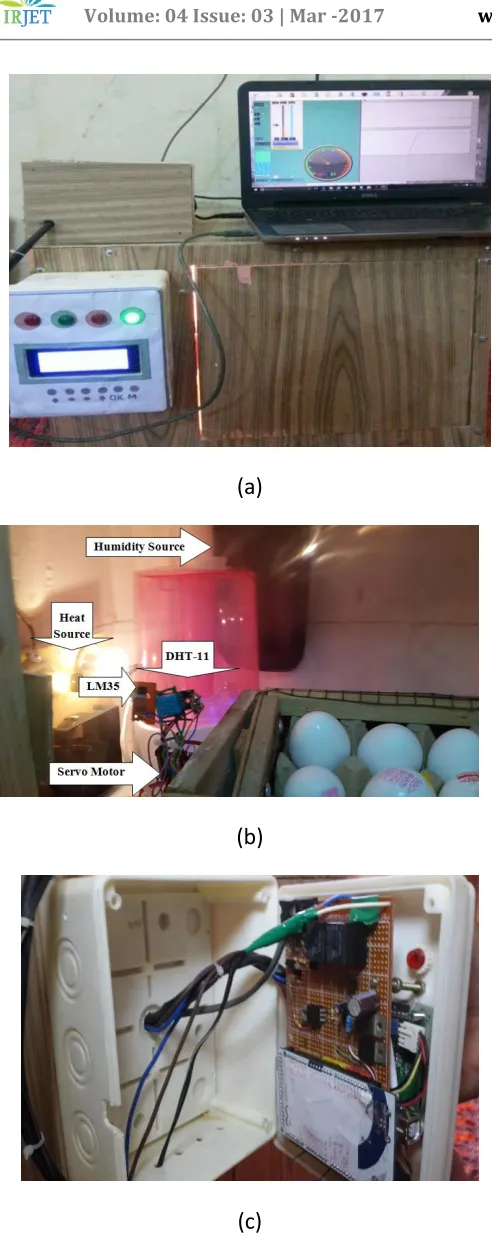
The system hardware consists of a Microcontroller (main unit), LM35 sensor, DHT-11 sensor, LCD, servo motor, keyboard and other components (sound indication, fan and LED indication). Fig. 2 shows the diagram of the whole system. The hardware construction of this incubator is illustrated in Fig. 3.
[image:3.612.343.566.376.600.2]© 2017, IRJET | Impact Factor value: 5.181 | ISO 9001:2008 Certified Journal | Page 2504
(a)
(b)
(c)
Fig -3: (a), (b) and (c) The prototype construction of the incubator
4.1 The Arduino Mega Board
[image:4.612.37.283.49.669.2]Arduino is an open-source microcontroller that uses ATmega1280, an Atmel AVR brain which can be encoded by a PC in C programing language via Universal Serial Bus (USB) port. It also has on-board analog pins and digital pins for input and output processes, assistant serial peripheral interface (SPI) and Inter-integrated circuit (IIC) which can be used to interface with other devices [10]. Fig. 4, shows the Arduino Mega board.
Fig -4:
Arduino Mega Board.
4.2. LCD
The LCD is used for monitoring the PID output, current humidity and temperature of the. The LCD size 20*4 that use IIC serial bus is used in this system. The LCD that used in this project is illustrated in Fig. 5.
[image:4.612.358.568.257.361.2] [image:4.612.328.573.491.658.2]© 2017, IRJET | Impact Factor value: 5.181 | ISO 9001:2008 Certified Journal | Page 2505 4.3 DHT-11 and LM35 Sensors
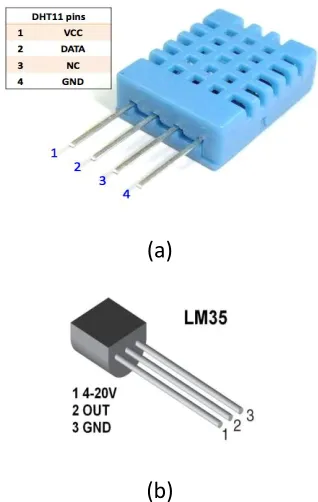
These sensors are the system motes that in charge for the measurements of humidity and surrounding temperature. The DHT-11 sensor for sensing the humidity and LM35 sensor used for sensing the temperature. DHT-11 is a capacitive humidity sensing. Application of a committed digital unit’s group technology and the surrounding temperature and air humidity detecting machinery, to ensure that the product has high reliability and excellent long standing solidity [11].
DHT-11 and LM35 sensors are shown in Fig. 6.
(a)
[image:5.612.335.533.83.216.2](b)
Fig -6: Humidity and temperature sensors (a) DHT-11, (b) LM35
4.4 Actuators
[image:5.612.82.241.294.545.2]The are many actuators in this system which include heat source humidity source and fan. Each one of them is controlled from the microcontroller throw a driving circuit Fig. 7, illustrates the driving circuit.
Fig -7: The driving circuit.
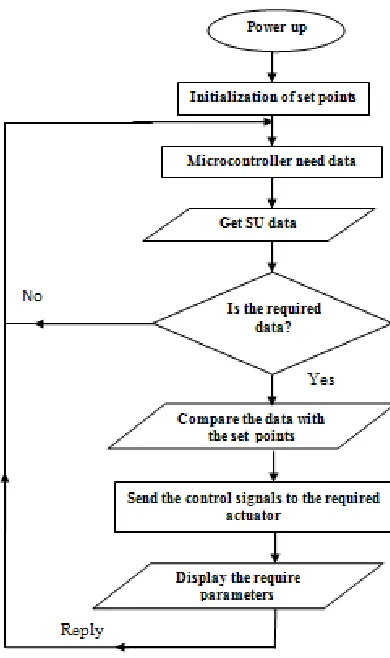
5. THECONTROLLER PROTOCOL
© 2017, IRJET | Impact Factor value: 5.181 | ISO 9001:2008 Certified Journal | Page 2506 Fig -8:
The system controller flowchart.
6. RESULTS AND DISCUSSION
The proposed system was applied on actual environments for measuring required data included the incubator humidity and temperature.
6.1 PID Factors and Its Output
The optimal values PID factors that included P, I and can be adjust by many methods depending on the application, here these factor are chosen by the trial and error methods. The optimal values of these is found as P=1, I=0.5 and D=0.1 as shown in Fig. 9.
(a)
(b)
(c)
Fig -9: PID Parameters, (a) P-Factor, (b) I-Factor, (c) D- Factor
There are two modes for adjusting the PID output,
the first is manual and the second is auto. The output of the PID changes the applied voltage for the humidity and heat source by PWM technology. Its output changes from 0 to 255 depending on the required humidity and temperature. Fig. 10, shows The PID output. [image:6.612.60.255.91.420.2]© 2017, IRJET | Impact Factor value: 5.181 | ISO 9001:2008 Certified Journal | Page 2507
(b)
Fig -10: (a) PID mode operation, (b) PID output
6.2 Test The Incubator
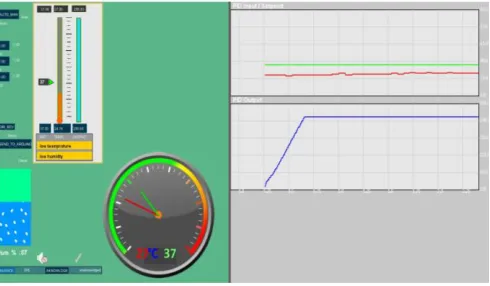
This test is performed for an suggested environments for showing the operation of the incubator. The set points that included the temperature is set to be 37C and humidity is set to be 62%. The results are displayed by PC and LCD. For displaying results by PC a GUI is designed by a processing GUI of Arduino. By the designed GUI the temperature, humidity and PID output are displayed in two forms analog and digital.
Also
the indication is displayed by this GUI as [image:7.612.341.554.83.328.2]illustrated in Fig. 11.
Fig -11: Results displayed by GUI
The LCD interfacing with the microcontroller to
display the sensed values and the PID output. Fig. 12, shows the LCD, which displays the required parameters for different states according to required threshold values of the humidity and temperature.
(a)
[image:7.612.59.268.85.205.2](b)
Fig -12:
Displaying results by LCD
7. A SYSTEM EVALUATION
[image:7.612.38.283.428.571.2]The system is tested in different environmental as shown in the previous terms. The main advantage of this system achieved in the power and cost saving. The maximum required power of system controller is shown in Table 1. From the power tables, its noted that the maximum total current drawn by the controller is 148mA. Also, noted the maximum level voltage is 5VDC, that show the system can be operated with small DC batteries with low power requirements. Table 2, illustrates the cost of the system controller.
Table -1
The system controller power requirements.
Component Current (mA) Voltage (VDC)
Arduino Mega 50 5
DHT-11 Sensor 8 5
LM 35 Sensor 60 5
© 2017, IRJET | Impact Factor value: 5.181 | ISO 9001:2008 Certified Journal | Page 2508 Table -2
The system controller cost
Cost ($) Component 20 $ Arduino Mega 6 $ LCD
5 $ DHT-11
5 $ LM-35
36 $ Total
8. CONCLUSION
In this paper, a PID controller was implemented and applied to achieve smart incubator. Its need low cost and power when compared with classical systems. Also the controller economical in power consumption. This controller has this advantage since, the system motes need low power. Finally, the system has the simplicity using by the customer.
9. REFERENCES
[1] Adhi Ksatria Theopaga, Achmad Rizal, Erwin Susanto,” Design And Implementation Of Pid Control Based Baby Incubator”, Journal of Theoretical and Applied Information Technology, Department of Electrical Engineering, Telkom University, Indonesia, pp. 19-24,Vol.70 No.1, 10th December 2014.
[2] Hitu Bansal, Dr. Lini Mathew, Ashish Gupta, “Controlling of Temperature and Humidity for an Infant Incubator Using Microcontroller”, International Journal of Advanced Research in Electrical, Electronics and Instrumentation Engineering, Vol. 4, Issue 6, pp. 4975- 4982, June 2015, 2015.
[3] Christina Tan” Integrated Temperature, Light and Humidity Monitoring System for the Hospital Environment”, Faculty of Electrical and Computer
Engineering McMaster University, Hamilton, Ontario, Canada, 2010.
[4] S.K. Mousavi, J. Ghobadi, M. Ghasem Nejad, “ Incubator with Fuzzy Logic”,University of Science and Technology, Faculty of Electric Engineering, Tehran, Iran, TJMCS Vol .5 No.3, pp. 197-204, 2012.
[5] Sumardi Sadi, “Room Temperature Control System Prototype Industry Based Programmable Logic Controller Zelio SR2 B121 BD”, Innovative Systems Design and Engineering, Vol.6, No.4, pp. 52-68, 2015. [6] Hitu Mittal, Lini Mathew, Ashish Gupta, “Design and Development of an Infant Incubator for Controlling Multiple Parameters”, International Journal of Emerging Trends in Electrical and Electronics, Vol. 11, Issue. 5, pp. 65-72 Sep-2015.
[7] Kambiz Arab Tehrani and Augustin Mpanda, " Introduction to PID Controllers - Theory, Tuning and Application to Frontier Areas ", In. Tech, February, 2012.
[8] Zoran Vukic, Faculty of Electrical Engineering and Computing, University of Zagreb, Croatia and Ognjen Kuljaca Automation and Robotics Research Institute, The University of Texas at Arlington , USA, " Lectures on PID Controllers ", April, 2002.
[9] Bijay Kumar and Rohtash Dhiman, " Optimization of PID Controller for liquid level tank system using Intelligent Techniques, " Canadian Journal on Electrical and Electronics Engineering Vol. 2, No. 11, November , 2011.
[10] R. Piyare, S. R. Lee,” Towards internet of things (iots): integration of wireless sensor network to cloud services for data collection and sharing”, Vol. 5, pp.59-72, 2013.
© 2017, IRJET | Impact Factor value: 5.181 | ISO 9001:2008 Certified Journal | Page 2509