© 2017, IRJET | Impact Factor value: 5.181 | ISO 9001:2008 Certified Journal | Page 2637
Fabrication of Multi-Purpose Variable Length Plucking/cutting
machine
Kemparaju C R
1, Tareen S R
2, Shreedhar M
3,Mazood Shafeque
4,Mohammed Faizal
5Madhusudan K
61,6
Asst Professor, Department of Mechanical Engineering, New Horizon College of Engineering, Karnataka, India,
2,3,4,5Students, Department of Mechanical Engineering, New Horizon College of Engineering, Karnataka, India
---***---Abstract -
Any job related to harvesting or cutting of branches from high trees requires skilled labour. The labour costs are high and safety of worker is also a major concern. The Multi-purpose variable length plucking/cutting machine is a device constructed to overcome these problems. It makes use of an extendable hollow cylinder to extend a multi point cutting tool to the desired position and cut branches or pluck coconuts from trees. The machine consists of multiple hollow cylinders, one inside the other (telescopic cylinder). The inner cylinders move along and inside the outer cylinder with help of a pulley which is driven by an electric motor. The cutter consists of a multi-point cutting tool which is run by a high speed motor. The cutter is mounted on to the uppermost cylinder to be carried to the required height. Both the extension and cutting operation is powered by a DC battery. The entire setup is mounted on to a framework supported by wheels to move the machine from one tree to another hence making it portable.Key Words: Telescopic cylinders, Variable length, plucking, Cutting, Multi purpose
1.INTRODUCTION
Man has always looked for ways to make his work simpler and quicker, this characteristic of him has brought the human race to where it is now. In today’s world almost anything and everything is being automated. Growth in technology over the last few decades has had significant effect in how things work and how people lead their lives and has witnessed a rapid development in technology. Different types of intelligent machines which facilitate various tasks in industry environment are becoming popular.
But harvesting of coconuts/plucking of fruits and cutting of unwanted branches of high trees has always been done manually which is difficult and risky job. Safety of the worker and the increased labor charges are the primary concerns of the coconut farm owners now. Due to the height and lack of branches, it is very difficult to climb on coconut trees. A professional climber with proper training could only be able to climb coconut tree. Due to the risk involved nowadays very less people are coming forward to climb on coconut trees, and due to the lack of professional climbers, the existing professionals may charge more from the owners,
moreover as the educational background of Indian youth is increasing most of the people may hesitate to come into this type of profession. Considering this scenario, a device which will help the user to climb a coconut tree easily will be useful for the people who are having coconut farms or even residents. These types of devices will encourage more people to come forward into the agricultural sector. There are several industries, which depend on raw coconuts, for its processing and manufacturing of various value-added products. The inflorescence sap of coconut palms used to produce Neera (sweet toddy or palm nectar), desiccated coconut and its powder, packed coconut milk, coconut cream, coconut milk powder, tender coconut water, vinegar, nata-de-coco, etc. are few of them. The growing market for all coconut products is waking up even in the American and European countries that have never used coconut in their cuisine. Hence, any impact in coconut cultivation sector will adversely affect these industries and their markets.
1.1 BACKGROUND RESEARCH
The workers employed for climbing coconut tree suffer musculoskeletal disorders than any other type of injury or illness. With sufficient attention to the larger goals of whatever work is underway, investments in ergonomics can often pay for themselves many times over. From a survey conducted it was found that total of 35.5% (78 cases out of 220 climbers) fell down from coconut trees while doing their job. A 7.9% (19/240) of the tree climbers in the study area withdrew from their traditional profession and remained unemployed. Among them, only 5.3% (1/19) stopped climbing trees due to health problems and 94.7% (18/19) withdrew because of casualties that happened during their occupation.
© 2017, IRJET | Impact Factor value: 5.181 | ISO 9001:2008 Certified Journal | Page 2638 rechargeable battery which is not convenient for people to
operate. The robot has a long retractable arm with a sharp cutting blade as an end-effector at one end and a twisting device at the other end. Its design is not compact or agile, and is less maneuverable. A team of graduate students from Amrita Vishwa Vidyapeetham University, Kerala have designed a coconut tree climber called CocoBot1. Its manipulator has three mutually orthogonal rotational joints, which are controlled using three separate motors. The elbow is modeled with single rotational joint and wrist as end effector but device is costlier
There are so many devices for cutting of branches, plucking of coconuts and fruits in the market but the users feel difficult to handle it as it requires some basic knowledge to operate
1.2 DEVELOPED MACHINE
The multi-purpose variable length cutting/plucking machine is easy to use and does not require any additional knowledge to operate it. It can be operated by an individual person as it has simple design and working mechanism.
The main aim of the project is to develop a machine which can be conveniently used and operated by rural people. The developed machine can be adjusted to our requirements. The objective to build this machine is to help reduce time and labor required for plucking/cutting coconuts from coconut trees, to find a method as a substitute for climbing high trees and to avoid the risk of falling and provide people in rural areas a safer and quicker way to pluck/cut products from high trees.
Some of the main components of this developed machine are two hollow pipes, dc motors, multi-point wood cutting tool, pulley, rope etc. Two hollow pipes are placed one inside the other, the inner pipe slide inside the outer cylinder with the help of the pulley, driven by dc motor connected to a 12volt battery.
2. LITERATURE SURVEY
Rahul V [1] and his team designed and constructed a semi-automatic tree climber. The primary goal of their project is to design a coconut tree climbing device for farmers and residents. In this project, they aim to design a mechanism which is simple and easy to operate. For this they first made a rough sketch considering average diameter of a coconut tree as 30 cm and designed it in Solid Works. Later a static analysis was done using ANSYS to ensure its stability. After that they moved on to the fabrication part. The material used is CI steel. Three linear electrical actuators are used in this mechanism – two for gripping and one for the vertical up and down motions. Each actuator can carry up to 400kg. The analysis done using ANSYS proved the design to be safe and the fabrication was completed successfully.
The automated Coconut Harvester by Senthilkumar S K [2]
is a tree climbing robot also called Treebot which does not require human labor to accompany the device but only to control it from the ground using a remote control. The device is a triangle with a movable third side and consists of three wheels, one attached to each side of the triangle. Two springs, each attached to the other two sides of the triangle help in adjusting to the varying diameter of the tree. Each wheel is driven by a high torque geared DC motor. Two L293D drivers are used to drive the three motors in a bidirectional way. These drivers are fixed on the frame of the device. A RF transmitter/receiver unit is used to provide control signals to the driver. A 12V 3ah rechargeable battery pack is used to provide on-board power supply for thereceiver, two drivers and the three motors. An arm with a rotary blade at its end is fixed to one side of the Treebot to harvest the coconuts.
Another harvesting robot is the tree climbing and harvesting robot by Akshay Prasad Dubey [3]. The kinematics and the motion of this robot are designed by referring to the motion of coconut harvester. The robot consists of two segments joined by a pair of threaded rods coupled to motors. The mechanical frame is designed in draft sight software and is implemented using aluminum segments and threaded rods. It has two arms driven by motors for holding. Locomotion of the robot is achieved using six motors out of which four motors are used in two hands and other two are used for upward and downward motion. The other part is a robotic arm for cutting down the coconuts. The robotic arm is attached on top of the climbing part. The operation of the cutting arm is done manually from the ground using a remote. The robot is automated using Arduino-Uno, motor H-bridge drivers, current and level sensors and other supporting circuits. The forward and the reverse motion of the motors are controlled by the Arduino through driver modules. Robot has automatic and manual functions fully controlled by the end-user. This paper has taken into account of the safety, reliability and the ease of use. A locomotion algorithm is developed to provide the robot with an autonomous capability for climbing. The prototype of the robot is implemented and tested successfully.
3. CONSTRUCTION AND WORKING
3.1 CONSTRUCTION
© 2017, IRJET | Impact Factor value: 5.181 | ISO 9001:2008 Certified Journal | Page 2639 motors which are powered by the same battery. The entire
setup is fabricated using mild steel.
3.1.1 DC MOTOR
[image:3.595.354.517.134.273.2]A DC motor is any of a class of rotary electrical machines that converts direct current or electrical energy into mechanical energy. The most common types rely on the forces produced by magnetic fields. Two DC motors are used in the making of the prototype. One used to run the cutter and the other to operate the pulley.
Fig -1: DC MOTOR
The motor used to operate the pulley is 12V DC, geared 60rpm and the one used to run the cutter is 12V DC, geared 500rpm. The motor used for the cutter has a higher speed to allow the tool to rotate at the required speed and to remove material at a faster rate.
3.1.2 Cutter
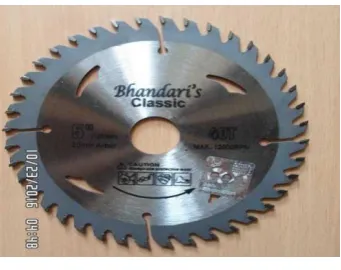
[image:3.595.105.217.240.338.2]The cutting tool used here is the common wood cutting tool. The one used in the prototype is the Bhandari’s Classic wood cutting tool. It is a 4 inch cutting tool, 20mm arbor with 40 teeth and with a max operational speed of 13000rpm. The cutter can perform smooth and fast cutting operations at speeds from 100rpm and above.
Fig-2: Cutter 3.1.3 Pulley
A pulley is a wheel on an axle or shaft that is designed to support movement and change of direction of a taut cable. The pulley used here is attached to the outer cylinder at its upper most part and is used to support the inner cylinder during extension and retraction and to prevent the change in direction it is fixed at one side. The pulley uses a rope to perform the extension mechanism. One end of the rope is
[image:3.595.77.248.512.647.2]fixed to the DC motor and the other end is fixed to the lower end of the inner pipe.
Fig-3: Pulley
3.1.4 Extension Cylinders
The cylinders used for the extension of the cutting tool are made up of mild steel and are placed one inside the other. To obtain high levels of elevation multiple cylinders can be used. In this case, the prototype makes use of two cylinders which are each eight feet long. This outer cylinder has an outer diameter of 2 inches while the inner cylinder or pipe has a diameter of about 1.5 inches. The inner pipe is attached to a rope at its lower end the other end of the rope is connected to a DC motor with the help of a pulley. The clearance between the inner and outer pipe is approximately 0.25 inch. This is to allow the rope to pass through between the cylinders. A hole is made on the outer cylinder and welded with a nut and bolt to hold the inner cylinder in one place during working. During working the rotation of the tool causes vibration which in turn makes the inner cylinder oscillate causing increased vibrations. The nut and screw provided helps to hold the inner cylinder in one place by tightening the screw which pushes the inner cylinder to one side and hold it there.
3.1..5 Base
© 2017, IRJET | Impact Factor value: 5.181 | ISO 9001:2008 Certified Journal | Page 2640
3.2 WORKING
Fig-4: Schematic diagram of variable length cutting/plucking machine
The multi-purpose variable length cutting/plucking machine makes use of extendable hollow cylinders (Telescopic cylinders) to extend a multi point cutting tool to desired height to carry out the cutting operation. The hollow cylinders made of mild steel are extended using a DC motor and a pulley. The inner cylinder is attached to a rope which goes over a pulley and wound to the shaft of a DC motor which is used to extend and retract the cylinder. The multi point cutting tool used here commonly known as wood cutting tool is run using another DC motor. The wood cutting tool is directly connected to the shaft of the DC motor and hence runs at the same speed as that of the motor. The setup is built over a frame equipped with wheels which makes the machine portable over short distances. The machine is operated using switches, one for each DC motor. The switch used for controlling the extension mechanism is a reversing circuit switch which changes the direction of current flow to the DC motor thus causing the motor to rotate in the opposite direction when the current flow is switched. This switch has ON-OFF-REV positions. Therefore the extension and retraction is performed using the same switch. The
wood cutting tool run by a DC motor is operated using another switch. This switch has only ON-OFF positions. During operation, the cutting machine is moved to the tree which has to be cut by manually moving the setup like a trolley towards the required location under the tree. Once positioned properly, the cutting tool is extended to the desired height by extending the cylinders using the extension/retraction switch. Later the cutting machine is turned on and the cutting operation is started. The machine is provided with a T-bar extension near the lower end which is used during cutting operation to manually provide force to the cutting tool. The extension is held by hand and pushed to provide the necessary force required for cutting. Once the cutting operation is complete the wood cutting tool is stopped and the retracted using the retraction switch.
4. SCOPE AND FUTURE WORK
The height of extension can be increased by adding/including more cylinders one inside the other.
The extension at the top can be made to rotate by using another DC motor, thus providing one more degree of freedom to the cutter.
Using lighter metal like aluminum for the cylinder can reduce the overall weight of the machine hence can be operated more easily.
The battery can be alternatively charged using solar panels.
This coconut harvester machine can be used with some additional features for removing unwanted dried branches of tree
Implementation of cameras to cover unseen areas at top of the tree.
The machine can be further improved by multidisciplinary projects involving electronics, electrical and computer science
5. CONCLUSION
© 2017, IRJET | Impact Factor value: 5.181 | ISO 9001:2008 Certified Journal | Page 2641 3. This machine reduces dependence on labor.
4. This machine can be easily operated by farmer . 5. It does not require any extra skill to operate. 6. Economical compared to other invented machines.
REFERENCES
[1] Rahul V, SebinBabu, Sameer Moideen CP, Vineeth VP, Nikhil Ninan, Semi-automated coconut tree climber, International Journal of Research in Engineering and Technology ISSN: 2319-.1163
[2]Senthilkumar S K, Aashika Srinivas, Maria Kuriachan, Sibi S M, Veerabhadhran, Vinod B, Sundar Ganesh C S, Development of Automated CoconutHarvester Prototype, International Journal of Innovative Research in Science,Engineering and Technology, ISSN(Online): 2319-8753.
[3]Akshay Prasad Dubeya, Santosh Mohan Pattnaikb, ArunavaBanerjeec, RajasreeSarkard, Dr.SaravanaKumar R, Autonomous control and implementation of coconut tree climbing and harvesting robot.
[4] Anoop Abraham, M. Girish, H. R. Vitala and M. P. Praveen, Design of Harvesting Mechanism for Advanced Remote-Controlled Coconut Harvesting Robot (A.R.C.H-1),Indian Journal of Science and Technology, Vol 7(10), 1465–1470, October 2014
[5] Mangesh Choudhari, Viraj Kapadia, Dhawal Bhanushali and Mayur Bhawsar, Electronic Coconut plucker, Imperial Journal of Interdisciplinary Research. ISSN:2454-1362 [6] Dileep Edacheri, Sudhindra Kumar, Prakash Unakal, Design of Coconut tree climbing device, M.S.Ramaiah School of advanced Studies.
BIOGRAPHIES
Kemparaju C R,
Assistant Professor, Department of