Munich Personal RePEc Archive
Econoghraphication
Ruiz Estrada, M.A.
University of Malaya
15 January 2005
Online at
https://mpra.ub.uni-muenchen.de/40565/
ECONOGRAPHICATION
Mario Arturo Ruiz Estrada
Faculty of Economics and Administration, University of Malaya, 50603 Kuala Lumpur, MALAYSIA Email: [email protected]
Website: www.econonographication.com Tel: +006012-6850293
The rationale of Econographication revolves around the efficacy of multidimensional graphs as the most effective visual tool to understand any economic phenomenon from a multidimensional view. The main motivation behind the creation of Econographication is to evaluate multidimensional graphs evolved so far in economics and to develop new type of multidimensional graphs to facilitate the study of economics, as well as finance and business. Thereby, the mission of Econographication is to offer academics, researchers and policy maker’s an alternative multidimensional graphical modeling approach for the research and teaching-learning process of economics, finance and business from a multidimensional perspective. Hence, this alternative multidimensional graphical modeling approach is offer a set of multi-dimensional coordinate spaces to build different types of multimulti-dimensional graphs to study any economic phenomenon. The following new types of multi-dimensional coordinate spaces are presented: the pyramid coordinate space (five axes and infinite axes); the diamond coordinate space(ten axes and infinite axes); the 4-dimensional coordinate space (vertical position and horizontal position); the 5-dimensional coordinate space (vertical position and horizontal position); the infinity-dimensional coordinate space (general approach and specific approach); the inter-linkage coordinate space; the cube-wrap coordinate space; the mega-surface coordinate space. All these multi-dimensional coordinate spaces mentioned previously, they are available to represent graphically 4-dimensions, 5-dimensions, 8-dimensions, 9-dimensions until infinity-dimensions.
1. The Evolution of Graphical Methods in Economics
Research leading to this chapter shows a strong link between the introduction of graphical methods in economics and the development of theories, methods and techniques in statistics and mathematics. In the 18th century, for example, several new graphical methods were developed as a result of some mathematics and statistics research in the same century. These graphical methods include line graphs of time series data (since 1724), curve-fitting and interpolation (1760), measurement of error as a deviation from graphed line (1765), graphical analysis of periodic variation (1779), statistical mapping (1782), bar charts (1756) and printed coordinate chapter (1794) (See Beniger and Robyn, 1978).
The application of graphical methods on the economic analysis, we have renowned economists like William Playfair (2005), Francis Ysidro Edgeworth (1888) and William Stanley Jevons (1862). According to Harro Maas (2005), William Playfair constructed a wonderful collection of plates and graphs at the end of the eighteenth century. In his book entitled
Commercial and Political Atlas, Playfair focused on the study of trade cycles. This placed him
far ahead of other economists at the time in terms of visualizing socio-economic data.
We would classify the development of the usage of graphical methods in economics into two phases. The first phase is the descriptive graphical method. It is supported by simple tables,
of a single economic variable (vertical axis = Y) through a specific period of time (horizontal axis = X) in the first quadrant in the 2-dimensional Cartesian coordinate system (See Figure 1).
The main objective of the descriptive graphical method in economics is to study the behavior of a single economic variable (e.g. exports, imports, unemployment, GDP, inflation rate etc.) within a time frame (per decade, annually, monthly, weekly or daily) based on time-series. In fact, William Playfair may be considered the pioneer and promoter of the descriptive
graphical method.
The second phase in the development of graphical methods for economics will be called
the “analytical graphical method”. The analytical graphical method in economics features by
2-dimesnional and 3-dimensional coordinate systems. According to Harro Maas is William Stanley Jevons who first explored the merits of the graphical method for political economy. Jevons did
this through the function called “King-Devenant Law of Demand” that he introduced. This is a
case of the use of analytical graphical method in economics, where the form of the graph gives an idea of the possible class of the functions describing the relationship between X and Y variablesrespectively that suggest a causal interpretation of the relationship between X and Y.
Additionally, we like to mention also that the uses of the formal graphical method based on the 2-dimensional Cartesian plane was introduced in 1637 by René Descartes (Lafleur, 1960), whose contributions to different scientific disciplines, of which economics was one, were substantial. The 2-dimensional coordinate space opened a new era in economic analysis by providing for analysis of a single economic phenomenon based on the relationship between two variables.
However, it is necessary to mention the majorcontribution of Antoine Augustin Cournot (1838). Cournot derived the first formula for the rule of supply and demand as a function of price on 2-dimensional view. He was, in fact, also the first economist to draw the supply and demand curves on a graph. Cournot believed that economists must utilize graphs only to establish probable limits and express less stable facts in more absolute terms. He further held that the practical use of mathematics in economics involves not only strict numerical precision, but also graphical visualization. Besides Cournot and Jevons, other innovator economists that contributed to the analytical graph system in economics over time are Leon Walras (with general equilibrium), Alfred Marshall (with partial equilibrium) and Joseph Schumpeter (with business cycles) (McClelland, 1975).
In the 20th century the use and application of the analytical graphical method among
The rapid development of the analytical graphical method has been facilitated by high
technology and sophisticated analysis instruments such as the electronic calculator and the computer. The development of analysis instruments in economics took place into two stages. The first stage involved the “basic computational instruments”, where electronic calculators were
used to compute basic mathematical expressions (e.g. long arithmetic operations, logarithm, exponents and squares). This took place between the 1950’s and 1960’s. The second stage called
“advance computational instruments” took place in the middle of the 1980’s. This is when high
speed and storage-capacity computers using sophisticated software were introduced for the first time. The use of sophisticated software enables easy information management, application of difficult simulations as well as the creation of high resolution graphs under 3-dimensional coordinate system. The analysis instruments undoubtedly contributed substantially to the development and research in economics.
Therefore, high computational instruments, backed by sophisticated hardware and software, are utilized to create graphical representations with high resolution and accuracy. In fact, the descriptive graphical method and analytical graphical method can be categorized
according to functions or dimensional. In terms of function, these two graphical methods are either descriptive or analytical. In terms of dimension, these two graphical methods can be either 2-dimensional, 3-dimensional and multi-dimensional coordinates systems. The descriptive
graphical method shows arbitrary information that is used to observe the historical data behavior
from a simple perspective. On the other hand, the analytical graphical method is available to generate time-series graphs, cross-section graphs and scatter diagrams to show the trends and relationships between two or more variables from a multi-dimensional and dynamic perspective.
2. A Short Review about Dimension and Coordinate Systems (Cartesian Plane and Coordinate Space)
Initially, we like to review four basic definitions about dimension. According to the first
definition about dimension by Poincarė (1912), he defines dimension as a space that is divided
by a large number of sub-spaces. It meant “however we please” and “partitioned”. The second definition about dimension is given by Brouwer (1924). He defines dimension as “between any
two disjoint compacta”. Brouwer makes references about the existence of a group of sub-sets
into different sets. It is based on the uses of the topological dimension of a compact metric space based on the concept of cuts (Fedorchuk, Levin, and Shchepin, 1999). The third definition about dimension is given by Urysohn and Menger (Shchepin, 1998), they defined dimension as “between any compactum and a point not belonging to it”. These four authors are sharing common concepts into its definitions about dimension such as the uses of spaces, subspaces, sets, subsets, partitioned and cut concepts. This mean that any dimension needs to be studied by spaces/sets or sub-spaces/sub-sets or partitioned/cuts.
different dimension(s) in the same graphical space. The coordinate systems can be divided by two types: Cartesian plane and coordinate space.
The difference between the Cartesian plane and coordinate space is originated by the number of axes. In the case of the Cartesian plane is based on the uses of two axes and the coordinate space is based on the uses of three or more axes. Therefore, the Cartesian plane and coordinate space are available to generate an idea about dimension(s) graphically through the optical visualization of several lines in a logic order by length, width and height. The concept about dimension also can be explained by the Euclidian geometry under the uses of the Euclidian spaces. The Euclidian geometry can be divided by the 2-dimensional Euclidean geometry (plane geometry) and the 3-dimensional Euclidean geometry (solid geometry). Additionally, the study of the Euclidian geometry also involves the study of the n-dimensional space represented by Rn
or En under the uses if the n-dimensional space and n-vectors respectively.
3. How Multi-Dimensional Coordinate Spaces work?
The main reason to apply multi-dimensional coordinate spaces is to study any economic phenomena from a multidimensional perspective. It is originated by the limitations that the 2-dimensional coordinate space shows in the moment to generate a multi2-dimensional optical visual effect of any economic phenomena at the same graphical space. Hence, the multidimensional coordinate spaces leads an alternative graphical modeling more flexible and innovative than the 2-dimensional coordinate space in the moment to observe multi-variable data behavior.
The study of multi-dimensional coordinate spaces requests basic knowledge about the “n
-dimensional space“. The idea about the n-dimensional space was originated by many Greeks
thinkers and philosophers such as Socrates, Plato, Aristotle, Heraclitus and Euclid (father of the geometry). The great contribution of Euclid in geometry was the design of the plane geometry under the 2-dimensional Euclidean geometry and the solid geometry under the 3-dimensional Euclidean geometry. However, the n-dimensional space can be defined as a mental refraction through the optical visualization and brain stimulation by several lines in a logic order by length, width, height and colors to represent the behavior of simple or complex phenomena in different periods of time in the same graphical space.
Usually, the study of n-dimensional space is based on the application of the “coordinate
system“. In fact, the coordinate spaces can be classified by 2-dimensional coordinate space,
3-dimensional coordinate space and multi-3-dimensional coordinate spaces. The main role of coordinate system is crucial in the analysis of the relationship between two or more variables such as exogenous variable(s) and endogenous variable(s) on the same graphical space. In fact, the Euclidean space is given only the mathematical theoretical framework, but not the graphical modeling to visualize the n-dimensions according to different mathematical theoretical research works.
On the other hand, Minkowski’s (Einstein, 1952) introduce the idea about the 4 -dimensional space or the “world“. The world according to Minkowski’s it is originated by the application of 3-dimensional continuum (or space). The difference between the 4-dimensional space and 3-dimensional space graphical model is that the first graphical model replace (X,Y,Z) by (X1,X2,X3,X4), thus X1 = X; X2 = Y; X3=Z and X4 = √-1. The X4 is based on the application
about 4-dimensional space. Moreover, the application of multi-dimensional coordinate spaces offer a large possibilities to adapt n-dimensions, sub-dimensions, micro-dimensions, nano-dimensions and ji-nano-dimensions in the visualization of any economic phenomenon.
Basically, the uses of coordinate spaces by economists are based on plot different dots that represent the relationship between two or more variables (endogenous and exogenous) in the first and fourth quadrants in the 2-dimensional coordinate space. After, they proceed to join all these dots by straights lines until is possible to visualize histograms, line graphs and scatter-plots (see Figure 1). Hence, it is possible to observe the trend and behavior of different variables of any economic phenomenon. For example the relationship between unemployment/inflation, interest-rate/investment, prices/quantity demand and supply, etc…
From our point of view, each dot is plotted on the 2-dimensional, 3-dimensional and multi-dimensional coordinate spaces represent a single rigid point. In fact, the plotting of a single rigid point in any coordinate space requests the application of two basic assumptions: first assumption is that two rigid points cannot occupy the same space at the same time. The second assumption is that different rigid point(s) deal in different n-dimensional spaces is moving under different speeds of time. The variable “time” in the case of multi-dimensional coordinate spaces needs to be classified by: the general time, partial time and constant time. The general time is running in the general-space but in the case of the sub-spaces, micro-spaces, nano-spaces are running under different partial times. In the case of JI-spaces always is fixed by the constant time.
Recently, few economists start to use the 3-dimensional coordinate space in economics by the uses of three axes: “X-coordinate“(or exogenous variable), “Y-coordinate“ (or exogenous variable) and the “Z-coordinate“ (or endogenous variable). It is based on the construction of surfaces or 3-dimensional manifolds to visualize multi-variable economic data behavior (See Figure 2). According to our research the uses of the 3-dimensional coordinate space are not so popular among economists and policy makers.
Based on one thousand five hundred (1500) chapters published in twenty one (21) reputable economics journals (see Annex) between the year 1939 and 2009 (JSTOR, 2009), it is possible to observe that the common types of graphical representations applied in the study of social sciences, especially in economics, were of the 2-dimensional coordinate spaces. It is according to 99.5% of these chapters applied 2-dimensional Cartesian coordinate system, and only 0.5% of them applied 3-dimensional coordinate spaces. Additionally, this research will find some reasons about “why” economists continue using 2-dimensional coordinate space or sometimes 3-dimensional coordinate space in the graphical representation of complex and dynamic economic phenomena, these reasons are following by:
The 2-dimensional graphical models are established for long time, since the introduction of the dimensional coordinate space by Descartes until today. The application of 2-dimensional coordinate space in the economic graphical analysis became by
“Tradition”.
The 2-dimensional space is “easy to apply” to visualize basic trends or values in the
Difficulty to find “alternative and suitable multi-dimensional graphical models” to
generate the transition from 2-dimensional coordinate space graphical modeling to multi-dimensional spaces graphical modeling. This research found some difficulties to generate this crucial visual and mental transition from 2-dimensional coordinate space to multi-dimensional coordinate space. It can be originated by some difficulties in the process to plot, draw and visualization of multi-dimensional graphs.
1
Figure 1
2-Dimensional Coordinate Space
Figure2
3-Dimensional Coordinate Space
Finally, a new set of multi-dimensional coordinate spaces is introduced in this document. The idea is to generate a new multidimensional optical visual effect to visualize complex economic phenomena. We can observe that into the multidimensional coordinate spaces can keep a large number of exogenous variables that are changing constantly and affect directly on the endogenous variable(s) behavior in the same graphical space. These new type of multi-dimensional coordinate spaces are based on the pyramid coordinate space (five axes and infinite axes), the diamond coordinate space(ten axes and infinite axes), the 4-dimensional coordinate space (vertical position and horizontal position), the 5-dimensional coordinate space (vertical position and horizontal position), the infinity-dimensional coordinate space (general approach and specific approach), the inter-linkage coordinate space, the cube-wrap coordinate space, and the mega-surface coordinate space. Being multi-dimensional, it enables economists, academics and policy makers to analyze economic phenomena from multidimensional perspectives across time and space.
4. An Introduction to Omnia Mobilis Assumption
Basically, the idea to build an economic model is to simplify the real economic world. It is based on the uses of a large number of variables that interacting together into the same economic phenomenon. To analyze an economic phenomenon can be by induction (particular observations) or deduction (simple forecasting). According to our research, any economic model will try to show the interaction of different economic actors and different possible scenarios. The main problem is how to catch-up the dynamic changes across time (period of time in analysis) and space (geographical place in analysis) in any economic model as a whole.
For long time economists and academics are applied the Ceteris Paribus assumption to build economic models. Especially in old economic models such as demand and supply model that explain basically the relationship between two variables: endogenous variable (quantity) and exogenous variable (price) into a precise period of time and space. In other words, we leave the rest of variables out currently until we can get the final result from these two specific variables in analysis.
The Ceteris Paribusassumption also can be considered the most common assumption that is learned and applied by economists to understand different economic phenomena. This assumption translated from Latin that it means “all other things [being] the same”. It facilitates the description of how a variable of interest changes in response to changes in other variables by examining the effect of one variable at a time. An extremely important contribution of Alfred Marshall, it supports the understanding of the application of Ceteris Paribus assumption in economic models. According to Marshall (1890, v.v.10):
“The element of time is a chief cause of those difficulties in economic investigations which make it necessary for man with his limited powers to go step by step; breaking up a complex question, studying one bit at a time, and at last combining his partial solutions into a more or less complete solution of the whole riddle. In breaking it up, he segregates those disturbing causes, whose wanderings happen to be inconvenient, for the time in a pound called Ceteris Paribus. The
study of some group of tendencies is isolated by the assumption other things being
equal: the existence of other tendencies is not denied, but their disturbing effect is
handling of a narrow issue, however, helps towards treating broader issues, in which that narrow issue is contained, more exactly than would otherwise have been possible.”
Marshall’s approach thus allows the analyses of complex economic phenomena by parts
where each part of the economic model can be joined to generate an approximation of the real world. This approach can be termed the Isolation Approach and according to Marshall (Schlicht, 1985) originates from two possible isolation clauses. First the Ceteris Paribus assumption allows some variables to be considered unimportant. This clause is called Substantive Isolation.
The Substantive Isolationconsiders that some unimportant variables cannot significantly affect the final result of the economic model. Second, the Ceteris Paribus assumption allows the influence of some important factors to be disregarded. The application of the Ceteris Paribus assumption in this case is purely hypothetical; therefore the second clause is called Hypothetical Isolation. It allows parts of the model to be managed more easily.
In other words, to explain a complex economic phenomenon, the Ceteris Paribus approach considers the effect partially of each variable in a set of m variables (termed usually independent variables, Xj , j = 1, 2, . . ., m) upon a variable of interest (usually termed the
dependent variable, Y). From a mathematical point of view, the Ceteris Paribus assumption in an economic model is equivalent to the partial derivative, which explains how one exogenous variable, say Xk, in a set of exogenous variables can affect directly on the endogenous variable Y
while the other exogenous variables are being held constant. From a graphical point of view, the Ceteris Paribus assumption supports the elaboration of scenarios that can be visualized on 2-dimensional coordinate space.
More precisely, if “Y” is a function of, say, X1 and X2, the (partial) relationship between
Y and X1 can be visualized in the 2-dimensional space describing Y and X1, assuming X2 is held
constant. In order to approximate real world, Marshall (1890, v.v.10) goes on to propose that “With each step more things can be let out of the pound; exact discussions can be made less abstract, realistic discussions can be made less inexact than was possible at an earlier stage.” The real-world scenario is thus approximated by the cumulative effect of the partial effects of the X variables on Y. After our review about the Ceteris Paribusassumption, according to our research we find that part of the problem to suggest the application of Ceteris Paribus assumption can be originated by three basic reasons follow by:
First reason is the historical momentum that this assumption was build to help explain a economic phenomenon, maybe the number of variables are accounted was less before than in our days.
Second reason is that the Ceteris Paribus assumption can be considered the basic and classic tool for teaching-learning economics.
The idea to introduce the Omnia Mobilis assumption -everything is moving- (Ruiz Estrada, Yap and Nagaraj, 2008) is to reduce the dependency and less uses of Ceteris Paribus assumption in the economic modeling. We propose the openness of substantive isolation through the application of the Omnia Mobilis assumption. It is based on generate the relaxation of all variables without restrictions and limitation that the Ceteris Paribus assumption generates into the economic modeling. To generate this relaxation of a large number of variables in any economic modeling, we suggest the application of multi-dimensional coordinate spaces that is offer by Econographication (Ruiz Estrada, 2007). The idea is to draw multidimensional graphs can help in the visualization all changes of several numbers of variables in the same graphical space. Additionally, the multidimensional graphs provide an alternative graphical approach to the Marshall view of step-by-step cumulative partial approach to the economic modeling. The main objective to apply multidimensional graphs is to visualize graphically all changes of the endogenous variable in response to the changes of several numbers of exogenous variables simultaneously. The multidimensional graphs can also be used to show the dynamic behavior of different variables in any economic model without any restriction. The application if the Omnia Mobilis assumption is to capture all possible economic actors and different possible scenarios into the same picture. Therefore, this chapter proposes that Ceteris Paribus assumption is not necessary to be used when economists have opportunity to use the Omnia Mobilis assumption and multidimensional graphs.
The Omnia Mobilis assumption also suggests the application of economic modeling in real time to observe the changes of all variables in real time. It is to demonstrate that the
economic modeling don’t request the application of Ceteris Paribus assumption in the study of
dynamic and complex economic phenomenon, because according to our research any economic phenomenon always still alive and never keep a constant behavior. The difference between Ceteris Paribus assumption and Omnia Mobilis assumption is that the Ceteris Paribus assumption only takes a photo just into a specific historical momentum of some economic phenomenon, but in the case of Omnia Mobilis assumption show a video that is running in real time. Moreover, the multidimensional graphs play a crucial role to understand the application of the Omnia Mobilis assumption in the economic modeling. In fact, the multidimensional graphs are available to visualize the changes of all exogenous variables simultaneously can affect on a single variable or endogenous variable in the same time and space. Finally, the Omnia Mobilis assumption opens a new era in the economic modeling under the application of multidimensional graphs and economic modeling in real time. We can say that the contribution of the Ceteris Paribus assumption in the economic modeling was great at the past, but in our days this assumption is not enough to explain the complexity and dynamicity of different economic phenomena as a whole.
5. The Classification of Multi-dimensionalCoordinate Space
5.1. The Pyramidal Coordinate Space with Five axes
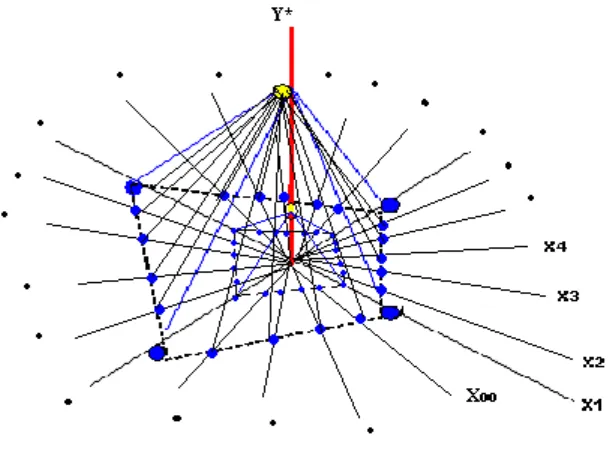
The pyramidal coordinate space with five axes consist in four independent axes (X1, X2, X3, X4) and one dependent axis (Y*). The Y* axis is positioned in the center part of this coordinate space among of the other four axes: X1, X2, X3, X4. The function used by the pyramidal coordinate space with five axes is fixed by Y* = ƒ(X1, X2, X3, X4), where X1, X2, X3, X4, Y* axes are using only real positive numbers R+ under the condition 0 ≥ R+≤ + ∞. The only uses of positive axes
in the pyramidal coordinate space with five axes request the uses of absolute values. The uses of absolute values in each axis are based on the application of the non-negative property.
Hence, all axes /X1/, /X2/, /X3/, /X4/, /Y*/ always use values large or equal than zero. The pyramidal coordinate space with five axes show clearly into the same graphical space any possible change(s) of any or all values plotted on each or all X1, X2, X3, X4 axes that can affect directly on the behavior of Y* axis value. In order to plot different values in each axis into the
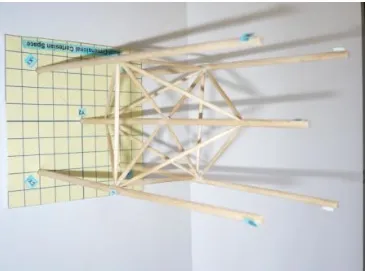
pyramidal coordinate space with five axes, we need to plot each value directly on its axis line. At the same time, all values were plotted on each axis line need to be joined together by straight lines until we can visualize a pyramid-shaped figure with five faces (see Figure 3 and Prototype 1).
Therefore, we have two possible graphical scenarios: first graphical scenario, if all or any
X1, X2, X3, X4 axes values move from outside to inside, then Y* axis value move down. Second graphical scenario, if all or any X1, X2, X3, X4 axes values move from inside to outside, then Y* axis value move up. Basically, the pyramidal coordinate system with five axes is represented by:
(1.) ([X1, X2, X3, X4], Y*)
Prototype 1
Figure 3
5.2. The Pyramidal Coordinate Space with Infinite axes
The pyramidal coordinate space with infinite axes consist in infinite independent axes (X1, X2, X3,…,X∞) and one dependent axis (Y*). The Y* axis is positioned in the center part of this coordinate space among of the other infinite axes: X1, X2, X3,..., X∞. The function used by the pyramidal coordinate space with infinite axes is fixed by Y*= ƒ(X1, X2, X3,…, X∞), where X1, X2, X3,…, X∞, Y*axes are using only real positive numbers R+ under the condition 0 ≥ R+≤ + ∞.
The only uses of positive axes in the pyramidal coordinate space with infinite axes request the uses of absolute values. The uses of absolute values in each axis are based on the application of the non-negative property. Hence, all axes /X1/, /X2/, /X3/, /X4/, /Y*/ always use values large or equal than zero. The pyramidal coordinate space with infinite axes show clearly into the same graphical space any possible change(s) of any or all values plotted on each or all
X1, X2, X3,…, X∞ axes thatcan affect directly on the behavior of Y* axis value.
In order to plot different values in each axis into the pyramidal coordinate space with infinite axes, we need to plot each value directly on its axis line. At the same time, all values were plotted on each axis line need to be joined together by straight lines until we can build a pyramid-shaped figure with infinite faces (see Figure 4).
Therefore, we have two possible graphical scenarios: first graphical scenario, if all or any X1, X2, X3,…, X∞ axes values move from outside to inside, then Y* axis value move down. Second graphical scenario, if all or any X1, X2, X3,…, X∞ axes values move from inside to outside, then Y* axis value move up. The pyramidal coordinate system with infinite axes is represented by:
[image:13.612.156.460.416.641.2](2.) ([X1, X2, X3,…, X∞], Y*)
5.3.The Diamond Coordinate Space with Ten Axes
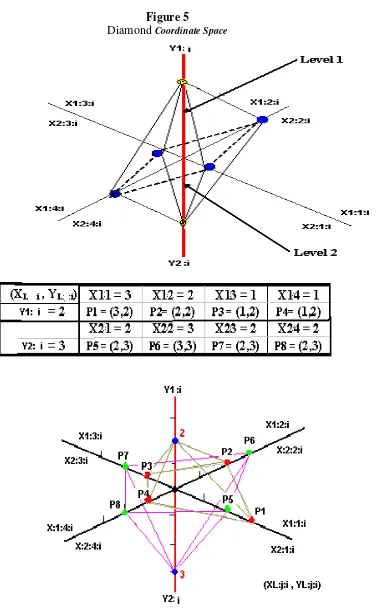
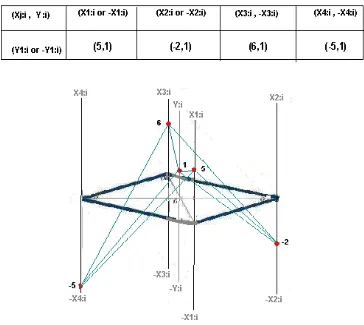
The diamond coordinate space with ten axes has two levels of analysis and ten axes. Each level of analysis is represented by (XL:i , YL:i ), where “L” represents the level of analysis, in this case either level one (L1) or level two (L2); “i” represents the quadrant level of analysis (in this
case, quadrant 1, 2, 3 or 4). In order to plot different values in each axis into the diamond
coordinate space with ten axes, we need to plot each value directly on its axis line respectively. At the same time, all values were plotted on each axis line need to be joined together by straight lines until we can build a diamond-shaped figure with eight faces (see Figure 5 and Prototype 2). It is important to mention at this juncture that the first level (L1) has five axes represented by
X1:1, X1:2, X1:3, X1:4, Y1. Four independent axes represented by X1:1, X1:2, X1:3, X1:4 and one dependent axis fixed by Y1 respectively. The second level (L2) has five axes represented by X2:1,
X2:2, X2:3, X2:4, Y2. We assume that does not exists any relationship between level one (L1) and
level two (L2) of analysis. The common issue between these two levels of analysis is that both
levels use the same XL:i axes in the diamond coordinate space. However, level one (L1) of the
analysis cannot affect level two (L2) of the analysis, and vice versa. If we draw different levels of
analysis in the diamond coordinate space, we can visualize and compare two different scenarios in the same diamond coordinate space at the same time (see Figure 5). It is crucial to mention at this point that the fifth and tenth axes (Y1 and Y2) is positioned in the center part of the diamond coordinate space among the other eight axes: X1:1, X1:2, X1:3, X1:4, X2:1, X2:2, X2:3, X2:4.
We assume that both YL (Y1, Y2) use only real positive numbers R+. Therefore, the
diamond coordinate space all X1:1, X1:2, X1:3, X1:4, Y1, X2:1, X2:2, X2:3, X2:4, Y2 axes are either on the positive side of respective axes together. The only uses of positive axes in the diamond coordinate space request the uses of absolute values. The uses of absolute values in each axis are based on the application of the non-negative properties. Hence, all axes /X1:1/, /X1:2/, /X1:3/, /X1:4/, /Y1/, /X2:1/, /X2:2/, /X2:3/, /X2:4/, /Y2/ always use values large or equal than zero. The final result, if the two levels of analysis are joined, is possible to visualize a diamond-shaped figure. The diamond coordinate system is represented by:
(3.1.) ([X1:1, X1:2, X1:3, X1:4],Y1) (3.2.) ([X2:1, X2:2, X2:3, X2:4],Y2)
Figure 5
[image:15.612.106.483.76.685.2]5.4.The Diamond Coordinate Space with Infinite Axes
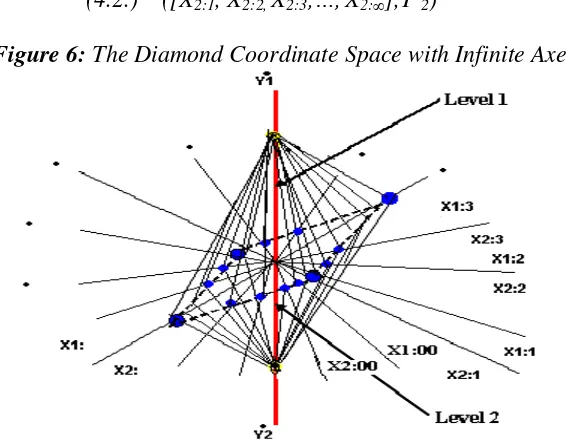
The diamond coordinate space with infinite axes has two levels of analysis and infinite axes. Each level of analysis is represented by (XL:i , Y*L:i ), where “L” represents the level of analysis, in this case either level one (L1) or level two (L2); “i” represents the quadrant level of
analysis (in this case, quadrant 1, 2, 3,…, ∞). In order to plot different values in each axis into
the diamond coordinate space with infinite axes, we need to plot each value directly on its axis line respectively. At the same time, all values were plotted on each axis line need to be joined together by straight lines until we can build a diamond-shaped figure with infinite faces (see Figure 6). It is important to mention at this juncture that the first level (L1) has infinite axes
represented by X1:1, X1:2, X1:3,…, X1:∞,Y*1. Infinite independent axes represented by X1:1, X1:2, X1:3,…,X1:∞ and one dependent axis fixed by Y*1 respectively. The second level (L2) has infinite
axes represented by X2:1, X2:2, X2:3,…, X2:∞,Y*2. We assume that does not exists any relationship between level one (L1) and level two (L2) of analysis. The common issue between these two
levels of analysis is that both levels use the same XL:i axes in the diamond coordinate space with infinite axes.
However, level one (L1) of the analysis cannot affect level two (L2) of the analysis, and
vice versa. If we draw different levels of analysis in the diamond coordinate space with infinite axes, we can visualize and compare two different scenarios in the same diamond coordinate space at the same time. It is crucial to mention at this point that the Y*1-axis and Y*2-axis is positioned in the center part of the diamond coordinate space with infinite axes (among the other infinite axes XL:i ).
We assume that both Y*L (Y*1,Y*2) use only real positive numbers R+. Therefore, the
diamond coordinate space all X1:1, X1:2, X1:3,…,X1:∞,Y*1, X2:1, X2:2, X2:3,…, X2:∞,Y*2 axes are either on the positive side of respective axes together. The only uses of positive axes in the diamond coordinate space with infinite axes request the uses of absolute values. The uses of absolute values in each axis are based on the application of the non-negative properties. Hence, all axes
/X1:1/, /X1:2/, /X1:3/,…,/X1:∞/, /Y*1/, /X2:1/, /X2:2/, /X2:3/,…, /X2:∞/, /Y*2/ always use values large or equal than zero. The final result, if the two levels of analysis are joined, is possible to visualize a diamond-shaped figure. The diamond coordinate system is represented by:
[image:16.612.98.518.363.721.2](4.1.) ([X1:1, X1:2, X1:3,…, X1:∞],Y*1) (4.2.) ([X2:1, X2:2, X2:3,…,X2:∞],Y*2)
[image:16.612.164.447.494.716.2]5.5. The 4-Dimensional Coordinate Space: Vertical Position
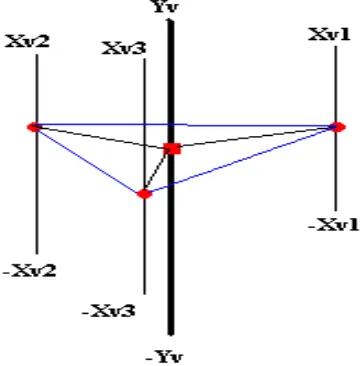
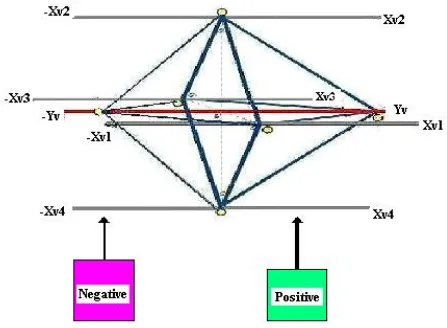
The 4-dimensional coordinate spacein vertical position offer four axes: Xv1, Xv2, Xv3, Yv. All these four axes are distributed by three independent axes: Xv1, Xv2, Xv3and one dependent axis: Yv. The Xv1, Xv2, Xv3, Yv axes are fixing positive and negative real numbers R+/-.
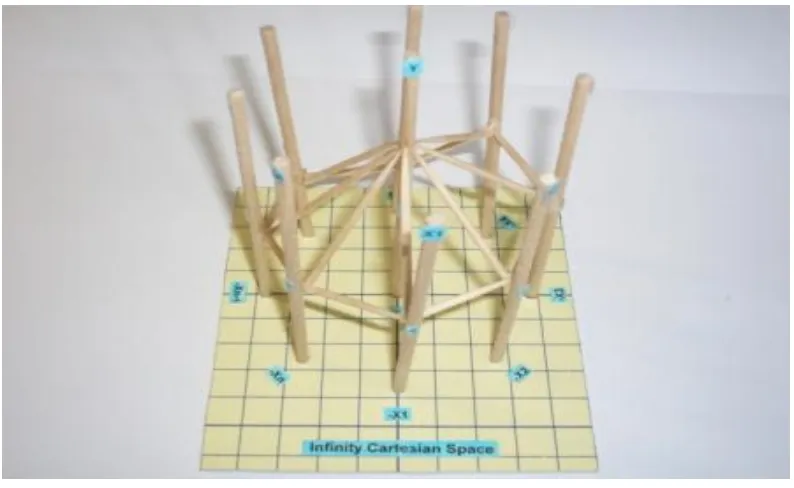
[image:17.612.172.441.265.472.2]In order to plot different values in each axis into the 4-dimensional coordinate space in vertical position, we need to plot each value directly on its axis line. All values were plotted on each axis line need to be joined together by straight lines until we can build pyramid-shaped figure with four faces in vertical position (see Figure 7 and Prototype 3).
Additionally, the Yv axis is positioned in the center part of the 4-dimensional coordinate
space in vertical position (among the other three axes). It is the convergent point of all the other three axes: Xv1, Xv2, Xv3. In other words, all Xv1, Xv2, Xv3 axes converge always in the Yv axis. The 4-dimensional coordinate system in vertical position is represented by:
(5.) ([Xv1, Xv2, Xv3], Yv)
Prototype 3: The 4-Dimensional Coordinate Space: Vertical Position
[image:17.612.220.400.510.693.2]5.6. The 4-Dimensional Coordinate Space in Horizontal Position
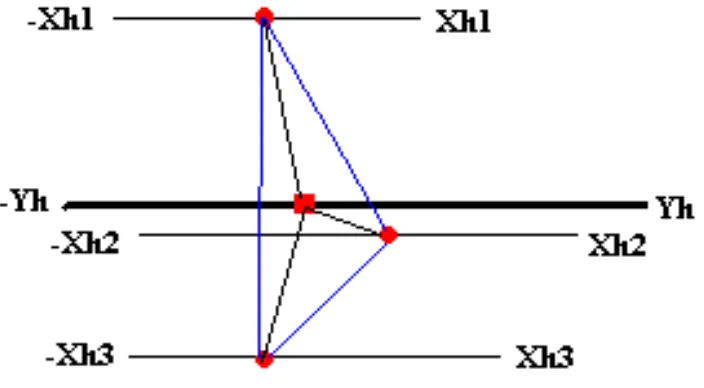
The 4-dimensional coordinate spacein horizontal position offer four axes: Xh1, Xh2, Xh3, Yh. All these four axes are distributed by three independent axes: Xh1, Xh2, Xh3 and one dependent axis: Yh. The Xh1, Xh2, Xh3, Yh are fixing positive and negative real numbers.R+/-.
In order to plot different values in each axis into the 4-dimensional coordinate spacein horizontal position, we need to plot each value directly on its axis line. All values were plotted on each axis line need to be joined together by straight lines until we can build pyramid-shaped figure with four faces in horizontal position (see Figure 8).
Additionally, the Yh axis is positioned in the center part of the 4-dimensional coordinate
space in horizontal position (among the other three axes). It is the convergent point of all the other three axes: Xh1, Xh2, Xh3. In other words, all Xh1, Xh2, Xh3 axes converge always in the Yh axis. The 4-dimensional coordinate system in horizontal position is represented by:
[image:18.612.137.489.296.490.2](6.) ([Xh1, Xh2, Xh3], Yh)
Figure 8: The4-Dimensional Coordinate Space in Horizontal Position
5.7.The 5-Dimensional Coordinate Space in Vertical Position
The 5-dimensional coordinate space in vertical position consists of five vertical axes: Xv1, Xv2, Xv3, Xv4, Yv. All these five axes are distributed by four independent axes: Xv1, Xv2, Xv3, Xv4 and one dependent axis Yv. The Xv1, Xv2, Xv3, Xv4, Yv are fixing positive and negative real numbers R+/-. In order to plot different values in each axis into the 5-dimensional coordinate
space in vertical position, we need to plot each value directly on its axis line. All values were plotted on each axis lineneed to be joined together by straight lines until we can build pyramid-shaped figure with five faces in vertical position (see Figure 9 and Prototype 4).
Therefore, the Yv axis is positioned in the center of the 5-dimensional coordinate space in
vertical position (among the other four vertical axes). The Yv axis is the convergent axis of all the other four vertical axes: Xv1, Xv2, Xv3, Xv4. The 5-dimensional coordinate system in horizontal position is represented by:
Prototype 4: The 5-Dimensional Coordinate Space: Vertical Position
5.8. The 5-Dimensional Coordinate Space in Horizontal Position
The 5-dimensional coordinate space in horizontal position consists of five vertical axes:
Xh1, Xh2, Xh3, Xh4, Yh. All these five axes are distributed by four independent axes: Xh1, Xh2, Xh3, Xh4 and one dependent axis Yh. The Xh1, Xh2, Xh3, Xh4, Yh are fixing positive and negative real numbers R+/-.
[image:20.612.119.483.69.394.2]In order to plot different values in each axis into the 5-dimensional coordinate spacein horizontal position, we need to plot each value directly on its axis line. All values were plotted on each axis lineneed to be joined together by straight lines until we can build pyramid-shaped figure with five faces in horizontal position (see Figure 10).
Therefore, the Yh axis is positioned in the center of the 5-dimensional coordinate space in
horizontal position (among the other four horizontal axes). The Yh axis is the convergent axis of
all the other four vertical axes: Xh1, Xh2, Xh3, Xh4. The 5-dimensional coordinate system in horizontal position is represented by:
Figure 10: The5-Dimensional Coordinate Space in Horizontal Position
5.9. The InfinityDimensionalCoordinates Space under the General Approach
The infinity dimensional coordinates space under the general approach shows a series of n-number of sub-cylinders “C” located in the same general cylinder, each sub-cylinder in the same
general cylinder is fixed by its Level “L” respectively. Where L = {1, 2, 3,...,k}, k → ∞…To plot into the different sub-cylinders in the same general cylinder, it is based on the sub-cylinder location, axis position and ratio. Where XC:L is the independent variable in sub-cylinder “C” at
level “L” lying in position PC:L with value RC:L. The position is based on PC:L by 0◦≤ PC:L ≤ 360◦,
is the position of XC:L in cylinder “C”at level “L”. And finally the ratios location under the RC:L
is the radius corresponding to the XC:L in cylinder “C” at level “L”. Finally, the YC:L is the
dependent variable at level “L”. The values of the independent axes XC:L affecting YC:L
simultaneously. The infinity dimensional coordinates space under the general approach, its function is given below by:
(9.) YC:L= ƒ(XC:L, PC:L , RC:L)
For example, the value of a specific independent axis at time point 1, say X1:1:1 is plotted as
R1:1:1 the radius pictured lying on a flat surface at angle P1:1:1 is measured from 0◦ line used for its
of each sub-cylinder at height Y1:1, the level “L”. The diameter of the sub-cylinder is twice the
maximum radius. In order to plot different values in each axis into the infinity dimensional coordinates space under the general approach, we need to plot each value directly on its axis line. All values were plotted on each axislineneed to be joined together by straight lines until we can build cone-shaped figure in vertical position (see Figure 11 and Prototype 5).
[image:22.612.108.505.180.424.2]Prototype 5: The Infinity Dimensional Coordinates Space (General Approach)
5.10. The Infinity Dimensional Coordinates Space under the Specific Approach
Basically, the infinity dimensional coordinates space under the specific approach offer a new coordinate system according to expression 10. The basic coordinate space system is formed by three levels of analysis: general-space (i); sub-space (j); micro-space (k). In the case of plotting into this coordinate space start with define our specific general-space (i), sub-space (j), micro-space (k), alpha-space (α) and beta-space (β) respectively.
(10.)
(α
<i:j:k>, β
<i:j:k>)
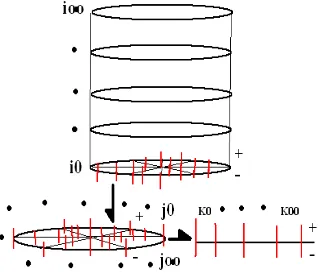
The infinity dimensional coordinates space under the specific approach is available to show different dimensional that is not possible to be observed in the classic 2-dimensional Cartesian coordinate plane and 3-dimensional coordinate space. Hence, the 2-dimensional Cartesian coordinate plane and 3-dimensional coordinate space can be considered as sub-axes systems into the infinity dimensional coordinates space under specific approach. The structure of the infinity dimensional coordinates space under specific approach is formed by infinite general-spaces (i), sub-general-spaces (j) and micro-general-spaces (k). There are distributed into different places along the general cylinder (see Figure 12). Therefore, the infinity coordinate space under the specific approach starts from the general space zero (i0)until the general space infinity (i∞). And each
sub-space starts from sub-space zero (j0) until the sub-space infinity (j∞). Finally, the micro-space
starts from micro-space zero (K0)until the micro-space infinity (K∞)(see Expression 11).
The infinity dimensional coordinates space under the specific approach is available to connect a large number of micro-spaces (k) distributed into the same sub-space (j) and general space (i) by the application of the inter-linkage connectivity of micro-spaces (╦). At the same time, the infinity dimensional coordinates space under the specific approach is also available to connect a large number of general spaces in the same coordinate space. It is based on the application of the inter-linkage connectivity of general-spaces (╬).
(11.)
(α<0:0:0>, β<0:0:0>) ╦ (α<0:0:1>, β<0:0:1>) ╦ . . . ╦ (α<0:0:∞>, β<0:0:∞>)
╬
(α<0:1:0>, β<0:1:0>) ╦ (α<0:1:1>, β<0:1:1>) ╦ . . . ╦ (α<0:1:∞>, β<0:1:∞>)
╬
(α<0:2:0>, β<0:2:0>) ╦ (α<0:2:1>, β<0:2:1>) ╦ . . . ╦ (α<0:2:∞>, β<0:2:∞>)
╬ . ╬
(α<0:∞:0>, β<0:∞:0>) ╦ (α<0:∞:1>, β<0:∞:1>) ╦ . . . ╦ (α<0:∞:∞>, β<0:∞:∞>)
╬
(α<∞:0:0>, β<∞:0:0>) ╦ (α<∞:0:1>, β<∞:0:1>) ╦ . . . ╦ (α<∞:0:∞>, β<∞:0:∞>)
╬
(α<∞:1:0>, β<∞:1:0>) ╦ (α<∞:1:1>, β<∞:1:1>) ╦ . . . ╦ (α<∞:1:∞>, β<∞:1:∞>)
╬
(α<∞:2:0>, β<∞:2:0>) ╦ (α<∞:2:1>, β<∞:2:1>) ╦ . .. ╦ (α<∞:2:∞>, β<∞:2:∞>)
╬ . ╬
Figure 12: The Infinity Dimensional Coordinates Space under the Specific Approach
5.11. The Inter-Linkage Coordinate Space
The inter-linkage coordinate space is formed by infinite number of general axes (A0, A1
[image:24.612.143.469.101.375.2],…, An …), perimeter levels (L0, L1 ,…, Ln …) and windows refraction (W0, W1,…,Wn…) (see
Figure 13 and Prototype 6). Each window refraction is based on join its sub-x axis(XA-L) with its
sub-y axis(YA-L) respectively. Therefore, the window refraction (W0, W1…Wn…) is follow by the
coordinate Space (XA-L,YA-L).
All windows refraction on the same general axis (A0, A1 ,…, An …) will be joined
together under the application of the inter-linkage connectivity of windows refraction
represented by “®”. The inter-linkage connectivity of windows refraction is represented by the
symbol “®”. The inter-linkage connectivity of windows refraction “®” will inter-connect all windows refraction (W0, W1 ,…, Wn …) on the same general axis (A0, A1 ,…, An …) but in
different perimeter levels (L0, L1 ,…, Ln …). Moreover, the inter-linkage coordinate system is
represented by (see Expression 12):
(12.) Perimeter level P0 ® Perimeter level P1 ® … ® Perimeter level Pn
General Axis 0 (A0): W0-0 = (x0-0,y0-0) ® W0-1 = (x0-1,,y0-1) ®…® W0-∞ = (x0-∞, y0-∞) General Axis 1 (A1): W1-0 = (x1-0,,y1-0) ® W1-1 = (x1-1,,y1-1) ®…® W1-∞ = (x1-∞, y1-∞) General Axis 2 (A2): W2-0 = (x2-0,,y2-0) ® W2-1 = (x2-1,,y2-1) ®…® W2-∞ = (x2-∞, y2-∞) General Axis 3 (A3): W3-0 = (x3-0,,y3-0) ® W3-1= (x3-1,,y3-1) ®…® W3-∞ = (x3-∞, y3-∞) General Axis 4 (A4): W4-0 = (x4-0,,y4-0) ® W4-1= (x4-1,,y4-1) ®… ® W4-∞ = (x4-∞,y4-∞)
General Axis 5 (A5): W5-0 = (x5-0,,y5-0) ® W5-1 = (x5-1,,y5-1)®… ® W5-∞ = (x5-∞ , y5-∞)
. . . .
. . . .
Finally, the inter-linkage coordinate space is available to fix a large number of different functions located in different windows refraction (W0, W1 ,…, Wn …), perimeter levels (L1, L2
,…, Ln…) and general axes (A1, A2 ,…, An…) (see Expression 13):
(13.) Perimeter level P0 ® Perimeter level P1 ® … ® Perimeter level Pn
General Axis 0 (A0): y0-0 = ƒ(x0-0) ® y0-1= ƒ(x0-1) ®…….® y0-∞= ƒ(x0-∞) General Axis 1 (A1): y1-0 = ƒ(x1-0) ® y1-1= ƒ(x1-1) ®…….® y1-∞= ƒ(x1-∞) General Axis 2 (A2): y2-0= ƒ(x2-0) ® y2-1= ƒ(x2-1) ®……...® y2-∞= ƒ(x2- ∞) General Axis 3 (A3): y3-0= ƒ(x3-0) ® y3-1 = ƒ(x3-1) ®…….® y3-∞= ƒ(x3-∞) General Axis 4 (A4): y4-0 = ƒ(x4-0) ® y4-1 = ƒ(x4-1) ®…….. ® y4-∞= ƒ(x4-∞) General Axis 5 (A5): y5-0= ƒ(x5-0) ® y5-1= ƒ(x5-1)®……….® y5-∞ = ƒ(x5-∞)
. . . .
.
. . .
. . . .
General Axis n (A∞): y∞-0= ƒ(x∞-0) ® ………® y∞-∞= ƒ(x∞-∞)
Figure 13: The Inter-Linkage Coordinate Space
5.12. The Cube-Wrap Coordinate Space
The cube-wrap coordinate space is willing to offer an alternative coordinate space. The main objective of the cube-wrap coordinate space is to show unknown dimensions that cannot be visualized by the 2-dimensional Cartesian plane and 3-dimensional coordinate space.
Initially, the cube-wrap coordinate space is divided by two quadrants. The first quadrant is located on the top of the cube-wrap coordinate space that represents all /Xi/-axes. The second
quadrant is located under the button of the cube-wrap coordinate space that represents all /Yj
/-axes (see Figure 14).
In the process to plot on this coordinate space start by plot each value on its axis line respectively. The space that exists between /Xi/-axes and /Yj/-axes will be called “quadratic -space refraction” because each /Xi/-axis has its /Yj/-axis respectively. The construction of the
quadratic space refraction is based on two basic steps: the first step is to plot each value on the /Xi/-axis line and /Yj/-axis line, we suggest to apply the inter-linkage connectivity of
micro-spaces (╦) (see Expression 14). Second step is to join the values located on /Xi/-axis and /Yj
/-axis by a single straight vertical line.
(14.) (/Xi/ ╤ /Yj/)
We assume that between Xi–axes and Yj–axes exists a common single straight vertical line that joint both set of axes. This common single straight line is called the zero space. Hence, the cube-wrap coordinate space starts from the quadratic space refraction zero (L0) until the
quadratic space refraction infinity (L∞). According to the cube wrap coordinate space requests
the application of absolute values /R+/-/ because the cube wrap coordinate space works only with
positive real numbers R+. The final coordinate system to build the cube-wrap coordinate space is
represented by expression 15. (15.)
In the final stage of analysis in the cube-wrap space, it is based on its size. We can have three possible stages that the cube-wrap space can experience anytime:
(16.) If all values are growing constantly in /Xi/ and /Yj/ then the cube-wrap experience
an expansion-stage
(17.) If all values are decreasing constantly in /Xi/ and /Yj/ then the cube-wrap
experience a contraction-stage
(18.) If all values are keeping constant in /Xi/ and /Yj/ then the cube-wrap experience a
[image:27.612.141.457.235.451.2]static-stage
Figure 14: The Cube-Wrap Coordinate Space and the Cube-Wrap Space
5.13. The Mega-Space Coordinate Space
The mega-space coordinate space is formed by infinite number of axes in vertical position. Each vertical axis (Xij) show positive integer numbers on the top and negative integer
numbers on the bottom in the same vertical axis. At the same time, all the vertical axes can be located by its row number (i) and column number (j) in the mega-space coordinate space (See Expression 19).
The idea to apply the surface coordinate space is to build the surface. The mega-surface can show how a large number of variables behave together in the same graphical space. Initially, the construction of the mega-surface start by join each vertical axis value by straight
(19.)
╬X11 ╬ X12 ╬ ... ╬X1∞
╬ Xij=> ╬X21 ╬ X22 ╬ ...╬X 2∞
╬X31 ╬ X32 ╬ ... ╬ X3∞
╬X∞:1 ╬ X∞:2╬ ... ╬ X∞∞
The final analysis of the mega-surface is based on its location into the mega-space coordinate space. The possible stages that the mega-surface can experience:
(20.) If all Xij values > 0 then the mega-surface shows a expansion stage
(21.) If all Xij values= 0 then the mega-surface shows a stagnation stage
(22.) If Xij values < 0 then the mega-surface shows a contraction stage
(23.) If some Xij is sharing positive, negative or zero values in different vertical
[image:28.612.133.464.390.658.2]axes then the mega-surface shows an unstable performance stage.
5.14. The CubesCoordinate Space
The cubes coordinate space is formed by infinity number of general axes (A0, A1 ,…, An).
Where each axis shows different levels (L0, L1 ,…, Ln), perimeters (P0, P1, P2…Pn), and Cubes
with different sizes and colors (C0/β, C1/β…Cn/β). Therefore, the coordinate system of the
cubes-coordinate space is represented by SA:L:P:C = (Ai, Lj, Pk, Cs/β) respectively. Where i, j, k and s
represents different values between 0 and ∞…. And β represent the different colors of each cube in different levels (L0, L1 ,…, Ln). All the cubes with different sizes and colors in the same axis
under the same level (L0, L1 ,…, Ln) and different perimeters (P0, P1, P2…Pn) will be joined
together, it is based on the application of the concept is called “macroeconomics links structures” represented by the symbol “@”. Moreover, the cubes-coordinate space coordinate system is following by (See Expression 24 and Figure 16):
(24.) Level P0@………. @ Level Pn
A0: S0:0:0:C(α/β)= (A0,L0, P0, Cα/β) @ ……... @ S0:0:λ:C(α/β)= (A0,L0, Pλ, Cα/β)
@ @
S0:1:0:C(α/β)= (A0,L1, P0, Cα/β) @ ………... @ S0:1:λ:C(α/β)= (A0,L1, Pλ, Cα/β)
@ @ . .
@ @
S0:θ:λ:C(α/β)= (A0,Lθ, Pλ, Cα/β) @ ………... @ S0:1:λ:C(α/β)= (A0,L1, Pλ, Cα/β)
@ @
A1: S1:0:0:C(α/β)= (A1,L0, P0, Cα/β) @ ……... @ S1:0:λ:C(α/β)= (A1,L0, Pλ, Cα/β)
@ @
S1:1:1:C(α/β)= (A1,L1, P0, Cα/β) @ ………... @ S1:θ:λ:C(α/β)= (A1,L1, Pλ, Cα/β)
@ @ . .
@ @
S1:θ:λ:C(α/β)= (A1,Lθ, Pλ, Cα/β) @ ………... @ S1:θ:λ:C(α/β) = (A1,Lθ, Pλ, Cα/β)
@ @
An: Sn:0:0:C(α/β)= (An,L0, P0, Cα/β) @ ……... @ Sn:0:λ:C(α/β)= (An,L0, Pλ, Cα/β)
@ @
Sn:1:1:C(α/β)= (An,L1, P0, Cα/β) @ ………... @ Sn:1:λ:C(α/β)= (An,L1, Pλ, Cα/β)
@ @
. . @ @
Sθ: λ: C: α/β= (An,Lθ, Pλ, Cα/β) @………... @ Sn+1:θ+1:λ+1:C:α+1/β= (An+1,Lθ+1, Pλ+1, Cα+1/β)
Finally, the cubes-coordinate space shows a general function, where the dependent variable
is identify by the national economy base “Ne” . The Ne is the final result from ten
macroeconomic structures. It is based on link of all macroeconomics structures (S0, S1 ,…, Sn)
under different axes (A1, A2 ,…, An), levels (L1, L2 ,…, Ln), perimeters (P0, P1, P2…Pn) and Cubes
with different sizes and colors (C0/β, C1/β…Cn/β) in the same sub-coordinate space respectively, it
is follow by See Expression 25:
Figure 16:
The Cubes-Coordinate Coordinate Space
6. Introduction to Econographication
The Econographication is originated by the necessity to generate an alternative and specialized multidimensional graphical modeling for economics, business and finance. In fact, the Econographication main objective is focused on the research, develop and application of multidimensional coordinate spaces to generate different types of multi-dimensional graphs. Therefore, Econographication will maximize the uses of multi-dimensional graphs to minimize difficulties in the process of meta-database storage and multi-variable data behavior visualization. Hence, the Econographication is defined “as a multi-dimensional graphical
modeling theoretical framework can be applied on economics, as well as finance and business.”
Additionally, the Econographication is divided into three large research areas are multidimensional graphs design, multidimensional graphs application and multidimensional graphs simulations. The multidimensional graphs design research area can be 2-dimensional, 3-dimensional and multi-3-dimensional coordinate spaces under linear and non-linear graph systems, the same section is divided into four sub-sections are coordinate spaces, graphs, charts and diagrams design. The multidimensional graphs application research area are used by two types of data, there are real and experimental data under micro and macro-level analysis in the short and long run (see Diagram 1).
Diagram 1
Econographication Research Areas
7. Concluding Remarks
Firstly, this research concludes that the 2-dimensional space shows certain limitations to visualize complex economic phenomena simultaneously in the same graphical space and time. Therefore, the multi-dimensional coordinate spaces are available to expand a multidimensional optical effect to visualize different complex economic phenomena in the same graphical space and time according to this research.
Annex
1/
American Economic Review; Canadian Journal of Economics; Econometrica; Economica; Economic History Review; Economic Journal; International Economic Review; Journal of Economic History; Journal of Economic Literature; Journal of Political Economy; Oxford Economic Papers; Quarterly Journal of Economics; Review of Economic Studies; Review of Economics and Statistics; Canadian Journal of Economics and Political Science; Journal of Economic Abstracts; Contributions to Canadian Economics; Journal of Labor Economics; Journal of Applied Econometrics; Journal of Economic Perspectives; Publications of the American Economic Association; Brookings Papers on Economic Activity. Microeconomics and American Economic Association Quarterly.
References
Avondo-Bodino, G. (1963). Economic Applications of the Theory of Graphs. USA: Gordon & Breach Publishing Group.
Barro, R. (1976). Rational expectations and the role of monetary policy. Journal of Monetary Economy. 2. 1-32.
Beniger, J. and Robyn, D. (1978). Quantitative Graphics in Statistics: A Brief History.The American Statistician, 32(1), 1-11.
Brouwer, J. (1913). Über den natürlichen Dimensionsbegriff, J. Reine Angew. Math. 142. Pp . 146-152.
Cournot, A. (1838). Mémoire sur les applications du calcul des chances à la statistique judiciaire. Journal des mathématiques pures et appliquées, 12( 3), 257-334.
Edgeworth, F. (1888). New Methods of Measuring Variation in General Prices. USA: JRSS
Einstein, A. (1952). Relativity: The Special and the General Theory. New York: Three Rivers Press.
Fedorchuk, V.V., Levin, M. and Shchepin E.V. (1999). On Brouwer's Definition of Dimension. Russ. Math. Surv. 54. Pp. 432-433
Friedman, M. (1948). A Monetary and Fiscal Framework for Economic Stability. The American Economic Review, 38(3), 245-264.
Hansen, A. (1938). Full Recovery or Stagnation ?. New York: W. W. Norton & Co., Inc.
Hicks, J. (1939). The Foundations of Welfare Economics. Economic Journal, 49, p.712.
Inselberg and Dimsdale (1994). Multidimensional Lines I: representation. SIAM Journal on Applied Mathematics, Vol. 54, No. 2. Pp. 559-577.
Jevons, W. (1862). On the Study of Periodic Commercial Fluctuations. USA: Report of BAAS
Klein, L. (1956). The Efficiency of Estimation in Econometric Models, Cowles Foundation, Yale University, Cowles Foundation Discussion Papers, paper vol. 11.
Lafleur, L. (1960). Discourse on Method, Optics, Geometry, and Meteorology (translation French to English from Rene Descartes -1637-). New York: The Liberal Arts Press.
Maas, H.. (2005). William Stanley Jevons and the Making of Modern Economics. New York and Cambridge: Cambridge University Press.
McClelland, P.D. (1975). Causal Explanation and Model Building in History, Economics, and the New Economic History. U.S.: Cornell University Press.
Nash, J. (1950). The Bargaining Problem, Econometrica, vol. 18, 155-162.
Okun, A.(1975). Equality and Efficiency: The Big Tradeoff.Journal of Economic Literature.
13(3), 917-918.
Phillips, A. (1958). The Relation between Unemployment and the Rate of Change of Money Wage Rates in the United Kingdom, 1861-1957. Economica, (25)100, 283-299.
Playfair, W. (2005). Commercial and Political Atlas and Statistical Breviary (Original version was published in 1786). UK: Cambridge University Press.
Poincarė, H. (1913). The Foundations of Sciences: Sciences and Hypothesis, the Value of Sciences, Sciences and Method. New York: The Sciences Press.
Ruiz Estrada, M. (2007) “Econographicology.” International Journal of Economic Research, 4 (1), pp. 75-86.
Ruiz Estrada, Mario, Yap, S.F. and Nagaraj, S. (2008). “Beyond the Ceteris Paribus Assumption: Modeling Demand and Supply Assuming Omnia Mobilis” International Journal of Economic Research, 5 (2), pp. 185-194.
Samuelson, P. (1947, Enlarged ed. 1983). Foundations of Economic Analysis. U.S.: Harvard University Press.
Shchepin, E.V. (1976). Topology of limit spaces with uncountable inverse spectra, Uspehi Mat. Nauk 31. No. 5-191. Pp. 191 - 226.
Solow, R. (1956). A Contribution to the Theory of Economic Growth. Quarterly Journal of Economics, vol. 70, 65-94.
Timbergen, J. (1937). An Econometrics Approach to Business Cycle Problems, Impasses Economiques. Paris: Herman & C. publisher.