TAG, Dynamic Programming, and the Perceptron
for Efficient, Feature-rich Parsing
Xavier Carreras Michael Collins Terry Koo
MIT CSAIL, Cambridge, MA 02139, USA
{carreras,mcollins,maestro}@csail.mit.edu
Abstract
We describe a parsing approach that makes use of the perceptron algorithm, in conjunction with dynamic programming methods, to recover full constituent-based parse trees. The formalism allows a rich set of parse-tree features, including PCFG-based features, bigram and trigram dependency fea-tures, and surface features. A severe challenge in applying such an approach to full syntactic pars-ing is the efficiency of the parspars-ing algorithms in-volved. We show that efficient training is feasi-ble, using a Tree Adjoining Grammar (TAG) based parsing formalism. A lower-order dependency pars-ing model is used to restrict the search space of the full model, thereby making it efficient. Experiments on the Penn WSJ treebank show that the model achieves state-of-the-art performance, for both con-stituent and dependency accuracy.
1 Introduction
In global linear models (GLMs) for structured pre-diction, (e.g., (Johnson et al., 1999; Lafferty et al., 2001; Collins, 2002; Altun et al., 2003; Taskar et al., 2004)), the optimal labely∗for an inputxis
y∗= arg max
y∈Y(x)w·f(x, y) (1)
whereY(x)is the set of possible labels for the in-put x; f(x, y) ∈ Rd is a feature vector that rep-resents the pair(x, y); andwis a parameter vec-tor. This paper describes a GLM for natural lan-guage parsing, trained using the averaged percep-tron. The parser we describe recovers full syntac-tic representations, similar to those derived by a probabilistic context-free grammar (PCFG). A key motivation for the use of GLMs in parsing is that they allow a great deal of flexibility in the features which can be included in the definition off(x, y).
c
2008. Licensed under the Creative Commons Attribution-Noncommercial-Share Alike 3.0 Unported li-cense (http://creativecommons.org/licenses/by-nc-sa/3.0/). Some rights reserved.
A critical problem when training a GLM for parsing is the computational complexity of the inference problem. The averaged perceptron re-quires the training set to be repeatedly decoded under the model; under even a simple PCFG rep-resentation, finding thearg max in Eq. 1 requires
O(n3G) time, where n is the length of the
sen-tence, andGis a grammar constant. The average sentence length in the data set we use (the Penn WSJ treebank) is over 23 words; the grammar con-stantGcan easily take a value of1000or greater. These factors make exact inference algorithms vir-tually intractable for training or decoding GLMs for full syntactic parsing.
As a result, in spite of the potential advantages of these methods, there has been very little previ-ous work on applying GLMs for full parsing with-out the use of fairly severe restrictions or approxi-mations. For example, the model in (Taskar et al., 2004) is trained on only sentences of 15 words or less; reranking models (Collins, 2000; Charniak and Johnson, 2005) restrictY(x)to be a small set of parses from a first-pass parser; see section 1.1 for discussion of other related work.
The following ideas are central to our approach: (1) A TAG-based, splittable grammar. We describe a novel, TAG-based parsing formalism that allows full constituent-based trees to be recov-ered. A driving motivation for our approach comes from the flexibility of the feature-vector represen-tationsf(x, y)that can be used in the model. The formalism that we describe allows the incorpora-tion of: (1) basic PCFG-style features; (2) the use of features that are sensitive to bigram depen-dencies between pairs of words; and (3) features that are sensitive to trigram dependencies. Any of these feature types can be combined with
sur-face features of the sentence x, in a similar way
to the use of surface features in conditional ran-dom fields (Lafferty et al., 2001). Crucially, in spite of these relatively rich representations, the formalism can be parsed efficiently (in O(n4G) time) using dynamic-programming algorithms de-scribed by Eisner (2000) (unlike many other TAG-related approaches, our formalism is “splittable” in the sense described by Eisner, leading to more efficient parsing algorithms).
(2) Use of a lower-order model for pruning. The O(n4G) running time of the TAG parser is still too expensive for efficient training with the perceptron. We describe a method that leverages a simple, first-order dependency parser to restrict the search space of the TAG parser in training and testing. The lower-order parser runs in O(n3H) time whereH ≪ G; experiments show that it is remarkably effective in pruning the search space of the full TAG parser.
Experiments on the Penn WSJ treebank show that the model recovers constituent structures with higher accuracy than the approaches of (Charniak, 2000; Collins, 2000; Petrov and Klein, 2007), and with a similar level of performance to the reranking parser of (Charniak and Johnson, 2005). The model also recovers dependencies with sig-nificantly higher accuracy than state-of-the-art de-pendency parsers such as (Koo et al., 2008; Mc-Donald and Pereira, 2006).
1.1 Related Work
Previous work has made use of various restrictions or approximations that allow efficient training of GLMs for parsing. This section describes the rela-tionship between our work and this previous work. In reranking approaches, a first-pass parser is used to enumerate a small set of candidate parses for an input sentence; the reranking model, which is a GLM, is used to select between these parses (e.g., (Ratnaparkhi et al., 1994; Johnson et al., 1999; Collins, 2000; Charniak and Johnson, 2005)). A crucial advantage of our approach is that it considers a very large set of alternatives inY(x), and can thereby avoid search errors that may be made in the first-pass parser.1
Another approach that allows efficient training of GLMs is to use simpler syntactic
representa-tions, in particular dependency structures
(McDon-1Some features used within reranking approaches may be
difficult to incorporate within dynamic programming, but it is nevertheless useful to make use of GLMs in the dynamic-programming stage of parsing. Our parser could, of course, be used as the first-stage parser in a reranking approach.
ald et al., 2005). Dependency parsing can be implemented in O(n3) time using the algorithms of Eisner (2000). In this case there is no gram-mar constant, and parsing is therefore efficient. A disadvantage of these approaches is that they do not recover full, constituent-based syntactic struc-tures; the increased linguistic detail in full syntac-tic structures may be useful in NLP applications, or may improve dependency parsing accuracy, as is the case in our experiments.2
There has been some previous work on GLM approaches for full syntactic parsing that make use of dynamic programming. Taskar et al. (2004) describe a max-margin approach; however, in this work training sentences were limited to be of 15 words or less. Clark and Curran (2004) describe a log-linear GLM for CCG parsing, trained on the Penn treebank. This method makes use of paral-lelization across an 18 node cluster, together with up to 25GB of memory used for storage of dy-namic programming structures for training data. Clark and Curran (2007) describe a perceptron-based approach for CCG parsing which is consid-erably more efficient, and makes use of a super-tagging model to prune the search space of the full parsing model. Recent work (Petrov et al., 2007; Finkel et al., 2008) describes log-linear GLMs ap-plied to PCFG representations, but does not make use of dependency features.
2 The TAG-Based Parsing Model
2.1 Derivations
This section describes the idea of derivations in our parsing formalism. As in context-free gram-mars or TAGs, a derivation in our approach is a data structure that specifies the sequence of opera-tions used in combining basic (elementary) struc-tures in a grammar, to form a full parse tree. The parsing formalism we use is related to the tree ad-joining grammar (TAG) formalisms described in (Chiang, 2003; Shen and Joshi, 2005). However, an important difference of our work from this pre-vious work is that our formalism is defined to be “splittable”, allowing use of the efficient parsing algorithms of Eisner (2000).
A derivation in our model is a pairhE, Diwhere
Eis a set of spines, andDis a set of dependencies
2Note however that the lower-order parser that we use to
(a) S
VP
VBD
ate NP
NN
cake
(b) S
VP
VP
VBD
ate NP
NN
[image:3.595.111.248.70.158.2]cake
Figure 1: Two example trees.
specifying how the spines are combined to form a parse tree. The spines are similar to elementary trees in TAG. Some examples are as follows:
NP
NNP
John S
VP
VBD
ate
NP
NN
cake
ADVP
RB
quickly
ADVP
RB
luckily
These structures do not have substitution nodes, as is common in TAGs.3 Instead, the spines consist of a lexical anchor together with a series of unary projections, which usually correspond to different X-bar levels associated with the anchor.
The operations used to combine spines are sim-ilar to the TAG operations of adjunction and sis-ter adjunction. We will call these operations
regu-lar adjunction (r-adjunction) and sister adjunction
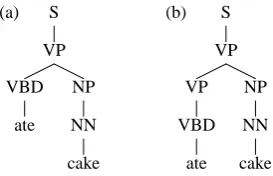
(s-adjunction). As one example, the cake spine shown above can be s-adjoined into theVPnode of the ate spine, to form the tree shown in figure 1(a). In contrast, if we use the r-adjunction operation to adjoin the cake tree into theVPnode, we get a dif-ferent structure, which has an additional VPlevel created by the r-adjunction operation: the resulting tree is shown in figure 1(b). The r-adjunction op-eration is similar to the usual adjunction opop-eration in TAGs, but has some differences that allow our grammars to be splittable; see section 2.3 for more discussion.
We now give formal definitions of the setsEand
D. Take x to be a sentence consisting of n+ 1 words, x0. . . xn, wherex0 is a special root sym-bol, which we will denote as∗. A derivation for the input sentencexconsists of a pairhE, Di, where:
•Eis a set of(n+ 1)tuples of the formhi, ηi, where i ∈ {0. . . n}is an index of a word in the sentence, and η is the spine associated with the word xi. The set E specifies one spine for each of the(n+ 1)words in the sentence. Where it is
3
It would be straightforward to extend the approach to in-clude substitution nodes, and a substitution operation.
clear from context, we will use ηi to refer to the spine inE corresponding to thei’th word.
• D is a set of n dependencies. Each depen-dency is a tuplehh, m, li. Hereh is the index of the head-word of the dependency, corresponding to the spineηhwhich contains a node that is being adjoined into. mis the index of the modifier-word of the dependency, corresponding to the spineηm which is being adjoined intoηh.lis a label.
The labellis a tuplehPOS,A, ηh, ηm,Li. ηhand
ηm are the head and modifier spines that are be-ing combined. POSspecifies which node inηh is being adjoined into. Ais a binary flag specifying whether the combination operation being used is s-adjunction or r-s-adjunction. Lis a binary flag spec-ifying whether or not any “previous” modifier has been r-adjoined into the positionPOSinηh. By a previous modifier, we mean a modifierm′that was adjoined from the same direction asm(i.e., such thath < m′ < morm < m′ < h).
It would be sufficient to define lto be the pair
hPOS,Ai—the inclusion of ηh, ηm andLadds re-dundant information that can be recovered from the set E, and other dependencies in D—but it will be convenient to include this information in the label. In particular, it is important that given this definition of l, it is possible to define a func-tion GRM(l) that maps a labell to a triple of non-terminals that represents the grammatical relation betweenmandhin the dependency structure. For example, in the tree shown in figure 1(a), the gram-matical relation between cake and ate is the triple GRM(l) = hVP VBD NPi. In the tree shown in figure 1(b), the grammatical relation between cake and ate is the tripleGRM(l) =hVP VP NPi.
The conditions under which a pairhE, Diforms a valid derivation for a sentence xare similar to those in conventional LTAGs. Each hi, ηi ∈ E must be such that η is an elementary tree whose anchor is the wordxi. The dependencies Dmust form a directed, projective tree spanning words
0. . . n, with ∗ at the root of this tree, as is also the case in previous work on discriminative ap-proches to dependency parsing (McDonald et al., 2005). We allow any modifier tree ηm to adjoin into any position in any head treeηh, but the de-pendenciesDmust nevertheless be coherent—for example they must be consistent with the spines in
E, and they must be nested correctly.4 We will
al-4
low multiple modifier spines to s-adjoin or r-adjoin into the same node in a head spine; see section 2.3 for more details.
2.2 A Global Linear Model
The model used for parsing with this approach is a global linear model. For a given sentencex, we defineY(x)to be the set of valid derivations forx, where eachy ∈ Y(x)is a pairhE, Dias described in the previous section. A functionf maps(x, y) pairs to feature-vectorsf(x, y) ∈Rd. The param-eter vector wis also a vector in Rd. Given these definitions, the optimal derivation for an input sen-tencexisy∗ = arg maxy∈Y(x)w·f(x, y).
We now come to how the feature-vectorf(x, y) is defined in our approach. A simple “first-order” model would define
f(x, y) = X
hi,ηi∈E(y)
e(x,hi, ηi) + X
hh,m,li∈D(y)
d(x,hh, m, li) (2)
Here we useE(y) andD(y)to respectively refer to the set of spines and dependencies in y. The functionemaps a sentencexpaired with a spine
hi, ηito a feature vector. The functiondmaps de-pendencies within y to feature vectors. This de-composition is similar to the first-order model of McDonald et al. (2005), but with the addition of theefeatures.
We will extend our model to include higher-order features, in particular features based on
sib-ling dependencies (McDonald and Pereira, 2006),
and grandparent dependencies, as in (Carreras, 2007). Ify=hE, Diis a derivation, then:
• S(y) is a set of sibling dependencies. Each sibling dependency is a tuplehh, m, l, si. For each
hh, m, l, si ∈Sthe tuplehh, m, liis an element of
D; there is one member ofS for each member of
D. The indexsis the index of the word that was adjoined to the spine for himmediately beforem (or theNULLsymbol if no previous adjunction has taken place).
•G(y)is a set of grandparent dependencies of type 1. Each type 1 grandparent dependency is a tuple hh, m, l, gi. There is one member of G for every member ofD. The additional information, the indexg, is the index of the word that is the first modifier to the right of the spine form.
that are further from the head.
(a) S
VP
VP
VP
VBD
ate NP
NN
cake NP
NN
today ADVP
RB
quickly
(b) S
NP
NNP
John
VP
ADVP
RB
luckily VP
VBD
[image:4.595.323.515.70.344.2]ate
Figure 2: Two Example Trees
S
NP
NNP
John
VP
VP
ADVP
RB
luckily
VP
VBD
ate NP
NN
cake NP
NN
today ADVP
RB
quickly
Figure 3: An example tree, formed by a combina-tion of the two structures in figure 2.
• Q(y) is an additional set of grandparent de-pendencies, of type 2. Each of these dependencies is a tuplehh, m, l, qi. Again, there is one member ofQfor every member ofD. The additional infor-mation, the indexq, is the index of the word that is the first modifier to the left of the spine form.
The feature-vector definition then becomes:
f(x, y) = X
hi,ηi∈E(y)
e(x,hi, ηi) + X
hh,m,li∈D(y)
d(x,hh, m, li) + X
hh,m,l,si∈S(y)
s(x,hh, m, l, si) + X
hh,m,l,gi∈G(y)
g(x,hh, m, l, gi) + X
hh,m,l,qi∈Q(y)
q(x,hh, m, l, qi)
(3)
wheres,gandqare feature vectors corresponding to the new, higher-order elements.5
2.3 Recovering Parse Trees from Derivations
As in TAG approaches, there is a mapping from derivationshE, Dito parse trees (i.e., the type of trees generated by a context-free grammar). In our case, we map a spine and its dependencies to a con-stituent structure by first handling the
dependen-5
[image:4.595.303.527.504.609.2]cies on each side separately and then combining the left and right sides.
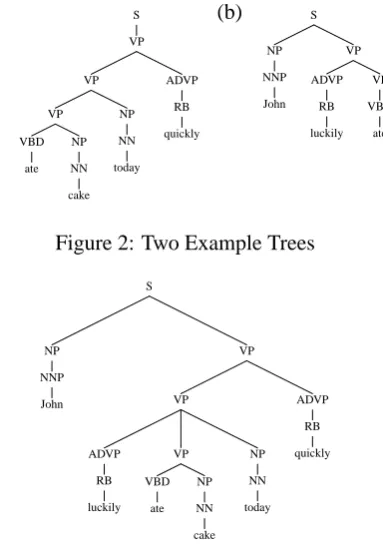
First, it is straightforward to build the con-stituent structure resulting from multiple adjunc-tions on the same side of a spine. As one exam-ple, the structure in figure 2(a) is formed by first s-adjoining the spine with anchor cake into theVP node of the spine for ate, then r-adjoining spines anchored by today and quickly into the same node, where all three modifier words are to the right of the head word. Notice that each r-adjunction op-eration creates a newVPlevel in the tree, whereas s-adjunctions do not create a new level. Now con-sider a tree formed by first r-adjoining a spine for
luckily into the VP node for ate, followed by s-adjoining the spine for John into the S node, in both cases where the modifiers are to the left of the head. In this case the structure that would be formed is shown in figure 2(b).
Next, consider combining the left and right structures of a spine. The main issue is how to handle multiple r-adjunctions or s-adjunctions on both sides of a node in a spine, because our deriva-tions do not specify how adjuncderiva-tions from different sides embed with each other. In our approach, the combination operation preserves the height of the different modifiers from the left and right direc-tions. To illustrate this, figure 3 shows the result of combining the two structures in figure 2. The combination of the left and right modifier struc-tures has led to flat strucstruc-tures, for example the rule
VP→ADVP VP NPin the above tree.
Note that our r-adjunction operation is different from the usual adjunction operation in TAGs, in that “wrapping” adjunctions are not possible, and r-adjunctions from the left and right directions are independent from each other; because of this our grammars are splittable.
3 Parsing Algorithms
3.1 Use of Eisner’s Algorithms
This section describes the algorithm for finding
y∗ = arg max
y∈Y(x)w·f(x, y) wheref(x, y) is
defined through either the first-order model (Eq. 2) or the second-order model (Eq. 3).
For the first-order model, the methods described in (Eisner, 2000) can be used for the parsing algo-rithm. In Eisner’s algorithms for dependency pars-ing each word in the input has left and right finite-state (weighted) automata, which generate the left and right modifiers of the word in question. We
make use of this idea of automata, and also make direct use of the method described in section 4.2 of (Eisner, 2000) that allows a set of possible senses for each word in the input string. In our use of the algorithm, each possible sense for a word cor-responds to a different possible spine that can be associated with that word. The left and right au-tomata are used to keep track of the last position in the spine that was adjoined into on the left/right of the head respectively. We can make use of sep-arate left and right automata—i.e., the grammar is splittable—because left and right modifiers are ad-joined independently of each other in the tree. The extension of Eisner’s algorithm to the second-order model is similar to the algorithm described in (Car-reras, 2007), but again with explicit use of word senses and left/right automata. The resulting algo-rithms run in O(Gn3) and O(Hn4) time for the first-order and second-order models respectively, whereGandHare grammar constants.
3.2 Efficient Parsing
The efficiency of the parsing algorithm is impor-tant in applying the parsing model to test sen-tences, and also when training the model using dis-criminative methods. The grammar constants G andHintroduced in the previous section are poly-nomial in factors such as the number of possible spines in the model, and the number of possible states in the finite-state automata implicit in the parsing algorithm. These constants are large, mak-ing exhaustive parsmak-ing very expensive.
To deal with this problem, we use a simple ini-tial model to prune the search space of the more
complex model. The first-stage model we use
is a first-order dependency model, with labeled dependencies, as described in (McDonald et al., 2005). As described shortly, we will use this model to compute marginal scores for dependencies in both training and test sentences. A marginal score
µ(x, h, m, l) is a value between 0 and 1 that re-flects the plausibility of a dependency for sentence
xwith head-word xh, modifier word xm, and la-bell. In the first-stage pruning model the labelsl are triples of non-terminals representing grammat-ical relations, as described in section 2.1 of this paper—for example, one possible label would be
hVP VBD NPi, and in general any triple of non-terminals is possible.
highest scoring dependency withmas a modifier:
DMAX(x, m) = max
h,l µ(x, h, m, l)
For a sentencex, we then define the set of allow-able dependencies to be
π(x) ={hh, m, li : µ(x, h, m, l)≥αDMAX(x, m)}
whereαis a constant dictating the beam size that is used (in our experiments we usedα= 10−6).
The set π(x) is used to restrict the set of pos-sible parses under the full TAG-based model. In section 2.1 we described how the TAG model has dependency labels of the formhPOS,A, ηh, ηm,Li, and that there is a function GRM that maps labels of this form to triples of non-terminals. The ba-sic idea of the pruned search is to only allow de-pendencies of the formhh, m,hPOS,A, ηh, ηm,Lii if the tuple hh, m,GRM(hPOS,A, ηh, ηm,Li)i is a member of π(x), thus reducing the search space for the parser.
We now turn to how the marginalsµ(x, h, m, l)
are defined and computed. A simple approach
would be to use a conditional log-linear model (Lafferty et al., 2001), with features as defined by McDonald et al. (2005), to define a distribution
P(y|x) where the parse structures y are depen-dency structures with labels that are triples of non-terminals. In this case we could define
µ(x, h, m, l) = X y:(h,m,l)∈y
P(y|x)
which can be computed with inside-outside style algorithms, applied to the data structures from (Eisner, 2000). The complexity of training and ap-plying such a model is againO(Gn3), whereGis the number of possible labels, and the number of possible labels (triples of non-terminals) is around
G = 1000 in the case of treebank parsing; this value forGis still too large for the method to be ef-ficient. Instead, we train three separate modelsµ1,
µ2, and µ3 for the three different positions in the non-terminal triples. We then takeµ(x, h, m, l)to be a product of these three models, for example we would calculate
µ(x, h, m,hVP VBD NPi) =
µ1(x, h, m,hVPi)×µ2(x, h, m,hVBDi)
×µ3(x, h, m,hNPi)
Training the three models, and calculating the marginals, now has a grammar constant equal
to the number of non-terminals in the grammar, which is far more manageable. We use the algo-rithm described in (Globerson et al., 2007) to train the conditional log-linear model; this method was found to converge to a good model after 10 itera-tions over the training data.
4 Implementation Details
4.1 Features
Section 2.2 described the use of feature vectors associated with spines used in a derivation, to-gether with first-order, sibling, and grandparent dependencies. The dependency features used in our experiments are closely related to the features described in (Carreras, 2007), which are an ex-tension of the McDonald and Pereira (2006) fea-tures to cover grandparent dependencies in addi-tion to first-order and sibling dependencies. The features take into account the identity of the la-bels lused in the derivations. The features could potentially look at any information in the la-bels, which are of the form hPOS,A, ηh, ηm,Li, but in our experiments, we map labels to a pair
(GRM(hPOS,A, ηh, ηm,Li),A). Thus the label
fea-tures are sensitive only to the triple of non-terminals corresponding to the grammatical rela-tion involved in an adjuncrela-tion, and a binary flag specifiying whether the operation is s-adjunction or r-adjunction.
For the spine features e(x,hi, ηi), we use fea-ture templates that are sensitive to the identity of the spine η, together with contextual features of the string x. These features consider the iden-tity of the words and part-of-speech tags in a win-dow that is centered on xi and spans the range
x(i−2). . . x(i+2).
4.2 Extracting Derivations from Parse Trees
precision recall F1
PPK07 – – 88.3
FKM08 88.2 87.8 88.0 CH2000 89.5 89.6 89.6 CO2000 89.9 89.6 89.8 PK07 90.2 89.9 90.1 this paper 91.4 90.7 91.1
CJ05 – – 91.4
H08 – – 91.7
[image:7.595.309.524.70.127.2]CO2000(s24) 89.6 88.6 89.1 this paper (s24) 91.1 89.9 90.5
Table 1: Results for different methods. PPK07, FKM08, CH2000, CO2000, PK07, CJ05 and H08 are results on section 23 of the Penn WSJ treebank, for the models of Petrov et al. (2007), Finkel et al. (2008), Charniak (2000), Collins (2000), Petrov and Klein (2007), Charniak and Johnson (2005), and Huang (2008). (CJ05 is the performance of an updated model at http://www.cog.brown.edu/mj/software.htm.) “s24” denotes results on section 24 of the treebank.
[image:7.595.93.271.71.185.2]s23 s24 KCC08 unlabeled 92.0 91.0 KCC08 labeled 92.5 91.7 this paper 93.5 92.5
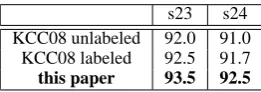
Table 2:Table showing unlabeled dependency accuracy for sections 23 and 24 of the treebank, using the method of (Ya-mada and Matsumoto, 2003) to extract dependencies from parse trees from our model. KCC08 unlabeled is from (Koo et al., 2008), a model that has previously been shown to have higher accuracy than (McDonald and Pereira, 2006). KCC08 labeled is the labeled dependency parser from (Koo et al., 2008); here we only evaluate the unlabeled accuracy.
derivations from the Penn treebank trees.
Note that the mapping from parse trees to derivations is many-to-one: for example, the ex-ample trees in section 2.3 have structures that are as “flat” (have as few levels) as is possible, given the set D that is involved. Other similar trees, but with more VP levels, will give the same set
D. However, this issue appears to be benign in the Penn WSJ treebank. For example, on section 22 of the treebank, if derivations are first extracted using the method described in this section, then mapped back to parse trees using the method described in section 2.3, the resulting parse trees score 100% precision and 99.81% recall in labeled constituent accuracy, indicating that very little information is lost in this process.
4.3 Part-of-Speech Tags, and Spines
Sentences in training, test, and development data are assumed to have part-of-speech (POS) tags. POS tags are used for two purposes: (1) in the features described above; and (2) to limit the set of allowable spines for each word during parsing. Specifically, for each POS tag we create a separate
1st stage 2nd stage
[image:7.595.116.247.289.335.2]α active coverage oracle F1 speed F1 10−4 0.07 97.7 97.0 5:15 91.1 10−5 0.16 98.5 97.9 11:45 91.6 10−6 0.34 99.0 98.5 21:50 92.0
Table 3: Effect of the beam size, controlled byα, on the performance of the parser on the development set (1,699 sen-tences). In each caseαrefers to the beam size used in both training and testing the model. “active”: percentage of de-pendencies that remain in the beam out of the total number of labeled dependencies (1,000 triple labels times 1,138,167 un-labeled dependencies); “coverage”: percentage of correct pendencies in the beam out of the total number of correct de-pendencies. “oracle F1”: maximum achievable score of con-stituents, given the beam. “speed”: parsing time in min:sec for the TAG-based model (this figure does not include the time taken to calculate the marginals using the lower-order model); “F1”: score of predicted constituents.
dictionary listing the spines that have been seen with this POS tag in training data; during parsing we only allow spines that are compatible with this dictionary. (For test or development data, we used the part-of-speech tags generated by the parser of (Collins, 1997). Future work should consider in-corporating the tagging step within the model; it is not challenging to extend the model in this way.)
5 Experiments
Sections 2-21 of the Penn Wall Street Journal tree-bank were used as training data in our experiments, and section 22 was used as a development set. Sec-tions 23 and 24 were used as test sets. The model was trained for 20 epochs with the averaged ceptron algorithm, with the development data per-formance being used to choose the best epoch. Ta-ble 1 shows the results for the method.
Our experiments show an improvement in per-formance over the results in (Collins, 2000; Char-niak, 2000). We would argue that the Collins (2000) method is considerably more complex than ours, requiring a first-stage generative model, to-gether with a reranking approach. The Char-niak (2000) model is also arguably more com-plex, again using a carefully constructed genera-tive model. The accuracy of our approach also shows some improvement over results in (Petrov
and Klein, 2007). This work makes use of a
PCFG with latent variables that is trained using a split/merge procedure together with the EM
al-gorithm. This work is in many ways
some combination of the two methods may give further gains.
Charniak and Johnson (2005), and Huang (2008), describe approaches that make use of non-local features in conjunction with the Charniak (2000) model; future work may consider extend-ing our approach to include non-local features. Finally, other recent work (Petrov et al., 2007; Finkel et al., 2008) has had a similar goal of scal-ing GLMs to full syntactic parsscal-ing. These mod-els make use of PCFG representations, but do not explicitly model bigram or trigram dependencies. The results in this work (88.3%/88.0% F1) are lower than our F1 score of 91.1%; this is evidence of the benefits of the richer representations enabled by our approach.
Table 2 shows the accuracy of the model in recovering unlabeled dependencies. The method shows improvements over the method described in (Koo et al., 2008), which is a state-of-the-art second-order dependency parser similar to that of (McDonald and Pereira, 2006), suggesting that the incorporation of constituent structure can improve dependency accuracy.
Table 3 shows the effect of the beam-size on the accuracy and speed of the parser on the develop-ment set. With the beam setting used in our exper-iments (α= 10−6), only 0.34% of possible depen-dencies are considered by the TAG-based model, but 99% of all correct dependencies are included. At this beam size the best possible F1 constituent score is 98.5. Tighter beams lead to faster parsing times, with slight drops in accuracy.
6 Conclusions
We have described an efficient and accurate parser for constituent parsing. A key to the approach has been to use a splittable grammar that allows effi-cient dynamic programming algorithms, in com-bination with pruning using a lower-order model. The method allows relatively easy incorporation of features; future work should leverage this in pro-ducing more accurate parsers, and in applying the parser to different languages or domains.
Acknowledgments X. Carreras was supported by the Catalan Ministry of Innovation, Universities and Enterprise, by the GALE program of DARPA, Contract No. HR0011-06-C-0022, and by a grant from NTT, Agmt. Dtd. 6/21/1998. T. Koo was funded by NSF grant IIS-0415030. M. Collins was funded by NSF grant IIS-0347631 and DARPA contract No. HR0011-06-C-0022. Thanks to Jenny Rose Finkel for suggesting that we evaluate dependency parsing accuracies.
References
Altun, Y., I. Tsochantaridis, and T. Hofmann. 2003. Hidden markov support vector machines. In ICML.
Carreras, X. 2007. Experiments with a higher-order projec-tive dependency parser. In Proc. EMNLP-CoNLL Shared Task.
Charniak, E. and M. Johnson. 2005. Coarse-to-fine n-best parsing and maxent discriminative reranking. In Proc. ACL.
Charniak, E. 2000. A maximum-entropy-inspired parser. In Proc. NAACL.
Chiang, D. 2003. Statistical parsing with an automatically extracted tree adjoining grammar. In Bod, R., R. Scha, and K. Sima’an, editors, Data Oriented Parsing, pages 299– 316. CSLI Publications.
Clark, S. and J. R. Curran. 2004. Parsing the wsj using ccg and log-linear models. In Proc. ACL.
Clark, Stephen and James R. Curran. 2007. Perceptron train-ing for a wide-coverage lexicalized-grammar parser. In Proc. ACL Workshop on Deep Linguistic Processing. Collins, M. 1997. Three generative, lexicalised models for
statistical parsing. In Proc. ACL.
Collins, M. 2000. Discriminative reranking for natural lan-guage parsing. In Proc. ICML.
Collins, M. 2002. Discriminative training methods for hid-den markov models: Theory and experiments with percep-tron algorithms. In Proc. EMNLP.
Eisner, J. 2000. Bilexical grammars and their cubic-time parsing algorithms. In Bunt, H. C. and A. Nijholt, editors, New Developments in Natural Language Parsing, pages 29–62. Kluwer Academic Publishers.
Finkel, J. R., A. Kleeman, and C. D. Manning. 2008. Effi-cient, feature-based, conditional random field parsing. In Proc. ACL/HLT.
Globerson, A., T. Koo, X. Carreras, and M. Collins. 2007. Exponentiated gradient algorithms for log-linear struc-tured prediction. In Proc. ICML.
Huang, L. 2008. Forest reranking: Discriminative parsing with non-local features. In Proc. ACL/HLT.
Johnson, M., S. Geman, S. Canon, Z. Chi, and S. Riezler. 1999. Estimators for stochastic unification-based gram-mars. In Proc. ACL.
Koo, Terry, Xavier Carreras, and Michael Collins. 2008. Simple semi-supervised dependency parsing. In Proc. ACL/HLT.
Lafferty, J., A. McCallum, and F. Pereira. 2001. Conditonal random fields: Probabilistic models for segmenting and la-beling sequence data. In Proc. ICML.
McDonald, R. and F. Pereira. 2006. Online learning of ap-proximate dependency parsing algorithms. In Proc. EACL. McDonald, R., K. Crammer, and F. Pereira. 2005. On-line large-margin training of dependency parsers. In Proc. ACL.
Petrov, S. and D. Klein. 2007. Improved inference for unlex-icalized parsing. In Proc. of HLT-NAACL.
Petrov, S., A. Pauls, and D. Klein. 2007. Discriminative log-linear grammars with latent variables. In Proc. NIPS. Ratnaparkhi, A., S. Roukos, and R. Ward. 1994. A maximum
entropy model for parsing. In Proc. ICSLP.
Sagae, Kenji, Yusuke Miyao, and Jun’ichi Tsujii. 2007. Hpsg parsing with shallow dependency constraints. In Proc. ACL, pages 624–631.
Shen, L. and A.K. Joshi. 2005. Incremental ltag parsing. In Proc HLT-EMNLP.
Taskar, B., D. Klein, M. Collins, D. Koller, and C. Man-ning. 2004. Max-margin parsing. In Proceedings of the EMNLP-2004.