Munich Personal RePEc Archive
Notes on contagion
Reinhart, Carmen and Kaminsky, Graciela and Goldstein,
Morris
University of Maryland, College Park, Department of Economicss
2000
Online at
https://mpra.ub.uni-muenchen.de/24569/
NOTES ON CONTAGION
Assessing Financial Vulnerability: An Early Warning System for Emerging Markets From Chapter 6
Morris Goldstein, Graciela L. Kaminsky, and Carmen M. Reinhart (Washington, DC: Institute for International Economics, 2000)
While, as noted, in most cases, the indicators did their task well and signaled ahead of
crises, Indonesia, which has witnessed a meltdown in its currency and a collapse in its banking
industry is firmly anchored at the bottom of the list presented in Table 5.5, as relatively few
indicators gave advanced warning. True, the few signals that were coming were from the more
reliable indicators, yet using this approach it would not have been labeled “vulnerable.” In a
similar vein, some of the countries that appear near the top of the list in terms of vulnerability are
not the countries that have typically been buffeted by financial markets in the wake of bad news
elsewhere. Following the crises in Mexico and Thailand, Argentina and Brazil were at the top of
the “hit list” of financial markets--yet, particularly in the case of Argentina, this would be
difficult to justify strictly on the basis of the fundamentals reviewed here.
Perhaps South Africa is in for a financial crisis in the near future (it has already been
subject to some speculative attacks); perhaps it can muddle through with less-than-pristine
fundamentals if they are not the usual targets of contagion. On the basis of the analysis
presented here, it would appear that Indonesia, poor banking practices notwithstanding, was
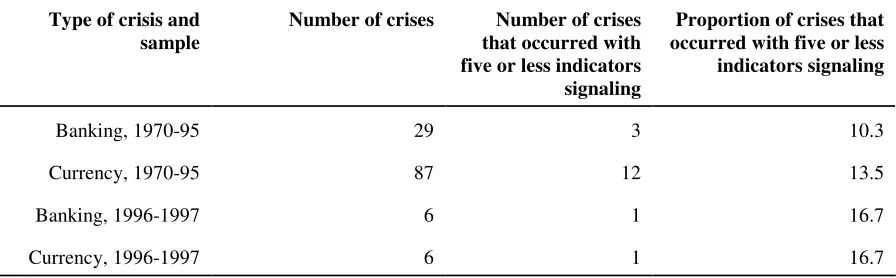
brought down by contagion. Of the 89 currency crises and nearly 30 banking crises, only a
handful occur with as few indicators (22 percent) flashing as was the case for Indonesia. As
noted in Kaminsky and Reinhart (1996), economies tend to be “frail” in the eve of a crisis. As
Indonesian characteristic of the silence of signals.
Table 6.1 On contagion: the dogs that did not bark
Type of crisis and sample
Number of crises Number of crises that occurred with five or less indicators signaling
Proportion of crises that occurred with five or less indicators signaling
Banking, 1970-95 29 3 10.3
Currency, 1970-95 87 12 13.5
Banking, 1996-1997 6 1 16.7
Currency, 1996-1997 6 1 16.7
The empirical evidence on contagion is still limited to a few papers, but the weight of the
empirical results appears to suggest it important. Eichengreen, Rose, and Wyplosz (1996)
examine the issue in the context of OECD countries. They find that knowing that there is a crisis
elsewhere significantly increases the probability of a domestic crisis--even after controlling for
domestic and external fundamentals. As in Glick and Rose (1998), they point to trade links as
the channel that is a culprit for the transmission of disease. The evidence in Calvo and Reinhart
(1996) suggests that cross border capital flows have a “contagious” element, at least in Latin
America. Schmukler and Frankel (1996) find evidence of contagion in emerging market funds.
Doukas (1988) found evidence of contagion in sovereign interest rate spreads. Indeed, one of the
very few empirical studies that does not find evidence of contagion (or in this case, “excess
comovement” in equity returns) is Wolf (1997).
In any case, to the extent that contagion is a force that is at play in international financial
markets, being near the bottom of the “vulnerability” list does not preclude a country from
having a crisis, as the Indonesian collapse and the recurring bouts of speculation against the
underpinnings for contagion and then move on to assess to what extent crises probabilities
increased for other emerging markets following the Mexican crisis of 1994 and the Asian crisis
of 1997.
Explaining Contagion: Theoretical Underpinnings
Most of the theoretical work on contagion has attempted to provide a framework that
allows us to understand how shocks in one country are transmitted elsewhere. Our review of this
literature emphasizes its empirical implications in terms of defining contagion, delineating its
channels of influence, and testing for its presence.
Defining contagion: In the only paper (that we are aware of) that examined the issue of
contagion in the context of Latin America’s debt crisis (Doukas, 1989), contagion was seen as
the influence of “news” about the creditworthiness of a sovereign borrower on the spreads
charged to the other sovereign borrowers, after controlling for country-specific macroeconomic
fundamentals. Other studies, such as Valdes (1995), defined contagion somewhat differently--as
excess comovement across countries in asset returns, whether debt or equity. The comovement
is said to be excessive if it persists even after common fundamentals, as well as idiosyncratic
factors, have been controlled for. A recent variant to this approach is presented in Rigobon
(1998) and Forbes and Rigobon (1998), who define contagion more narrowly by requiring an
increase in excess comovement in crisis periods.
Eichengreen, Rose, and Wyplosz (1996) defined contagion as a case where knowing that
there is a crisis elsewhere increases the probability of a crisis at home, even when fundamentals
have been properly taken into account. This is the definition of contagion that we will explore in
Theories of contagion and their empirical implications: To explain why crises tend to be
bunched, some recent models have revived Nurkse’s story of competitive devaluations, which
emphasized trade, be it bilateral or with a third party.1 Once one country has devalued, it makes
it costly (in terms of a loss of competitiveness and output) for other countries to maintain their
parity. In this setting the devaluation in the second country is a policy decision and its effect on
output is salutary. Hence, an empirical implication of this type of model is that we should
observe a high volume of trade among the “synchronized” devaluers.2
1See Smets and Gerlach (1996) for a model that emphasizes bilateral trade and Corsetti
et. al. (1998) for one in which emerging markets compete in a common third market.
2As a story of fundamentals-based contagion, of course, this explanation does not speak
Another family of models has de-emphasized the role of trade in goods and services and
stressed the role of trade in financial assets, particularly in the presence of information
asymmetries. Calvo and Mendoza (1998) present a model where the fixed costs gathering and
processing country-specific information give rise to herding behavior, even when investors are
rational. Kodres and Pritsker (1998) also present a model with rational agents and information
asymmetries. However, they stress the role played by investors who engage in cross-market
hedging of macroeconomic risks. In either case, these models suggest that the channels of
transmission come from the global diversification of financial portfolios. As such, they have the
empirical implication that countries with have more internationally-traded financial assets and
more liquid markets are likely to be more vulnerable to contagion. Small, highly illiquid markets
are likely to be under represented in international portfolios to begin with and, as such, shielded
from this type of contagion. In addition, cross-market hedging usually requires a moderately
high correlation of asset returns. The implication is that countries whose asset returns exhibit a
high degree of comovement with the infected country (such as Argentina with Mexico or
Malaysia with Thailand) will be more vulnerable to contagion via the cross-market hedges that
were in place as the crisis erupted.
In addition to these explanations of contagion, Calvo (1998) has stressed the role of
liquidity. A leveraged investor facing margin calls needs to sell (to an uninformed counterpart)
his or her asset holdings. Because of the information asymmetries, a “lemons problem” arises
and the asset can only be sold at a firesale price.
A variant of this story can be told about an open-end fund portfolio manager who needs
to raise liquidity in anticipation of future redemptions. In either case, the strategy will be not to
however, other asset prices are depressed and the original disturbance spreads across markets.
One potential channel of transmission that has been largely ignored in the contagion
literature but that is stressed in this paper is the role of common lenders, in particular commercial
banks. U.S. banks had an extensive exposure to Latin America in the early 1980s, much in the
way that Japanese banks did during the Asian crisis of 1997. The behavior of foreign banks can
both exacerbate the original crisis, by calling loans and drying up credit lines, but can also
propagate crises by calling loans elsewhere. The need to rebalance the overall risk of the bank’s
asset portfolio and to recapitalize following the initial losses can lead to a marked reversal in
commercial bank credit across markets where the bank has exposure.
Very few studies have gone beyond establishing that there is contagion or spillovers and
attempted to assess the underlying causes. Eichengreen, Rose, and Wyplosz (1996) attempted to
discriminate whether bilateral trade links or similarities to the crisis country in macroeconomic
fundamentals, which may lead investors to reassess the risk of the others. Glick and Rose (1998)
examined these issues further in a much broader country coverage, while Wolf (1997) attempted
to explain the pairwise correlations in stock returns by bilateral trade and other common
macroeconomic fundamentals. All studies conclude that trade linkages play an important role in
the propagation of shocks. Because trade tends to be more intra- than inter-regional in nature,
Glick and Rose (1998) conclude that this helps explain why contagion tends to be regional rather
than global. Kaminsky and Reinhart (1998b), also look at trade links--both bilateral and
third-party--but that paper emphasized financial sector links. The remainder of this chapter is devoted
Contagion in the Mexican and Asian Crises: Some Evidence
In this part of this chapter we turn our attention to two recent “contagious” episodes, the
aftermath of the Mexican peso crisis and the floatation of the Thai baht. Identifying the
countries that were affected by the initial crisis is easy; pinning down the channels through
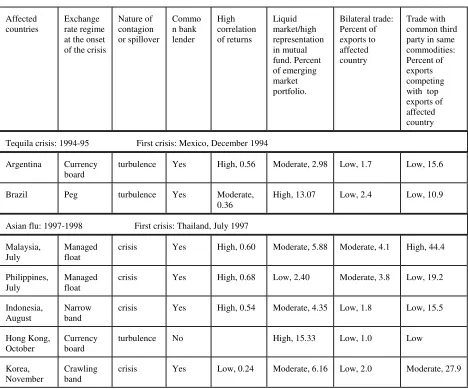
Table 6.2 summarizes some of the possible channels through which the crisis can
spread. Obviously, to the extent that there is herding behavior and investors lump all emerging
markets, or perhaps only those in the infected region, together that adds yet another dimension
through which the crisis spreads. As far as the affected countries’ exchange rate arrangements
at the outset of the crisis, these cover the range from currency board to managed float. Of
course, it is widely agreed that both the Philippine and Malaysian central banks intervened
heavily in the foreign exchange market. Hence, there was a good deal of “managing” in these
managed floats. Nonetheless, it appears that none of these exchange rate arrangements
succeeded in making the countries impervious to contagion.
As regards the potential role of bilateral and third party trade linkages, Malaysia would
be the most closely linked with Thailand, with Korea and the Philippines having more moderate
exposure. Trade can certainly not help explain Argentina and Brazil following the Mexican
devaluation nor Indonesia following the Thai crisis. Exposure to Japanese banks, which pulled
out rapidly across the region was common to all the affected countries except Hong Kong.
While both Brazil and Argentina are in the same U.S. bank cluster as Mexico, banks were not at
the heart of the problem in 1994 as they were in the early 1980s.
Most of the affected Asian countries, except Korea had high asset return correlations
with Thailand, although none except Hong Kong had particularly liquid markets. The same is
true of stock returns in Argentina, which have the highest correlation with Mexico of any
country in the region. Here it is hard to separate cause and effect. A high correlation may
reflect past contagion, but to the extent that current cross-hedging strategies use such historical
correlations as a guide, it could be the vehicle for future contagion. In sum, it would appear that
to say in how shocks are propagated in recent crises episodes, particularly for Argentina, Brazil,
Table 6.2 Recent episodes: Possible Channels of Transmission
Affected countries
Exchange rate regime at the onset of the crisis
Nature of contagion or spillover Commo n bank lender High correlation of returns Liquid market/high representation in mutual fund. Percent of emerging market portfolio. Bilateral trade: Percent of exports to affected country Trade with common third party in same commodities: Percent of exports competing with top exports of affected country Tequila crisis: 1994-95 First crisis: Mexico, December 1994
Argentina Currency board
turbulence Yes High, 0.56 Moderate, 2.98 Low, 1.7 Low, 15.6
Brazil Peg turbulence Yes Moderate,
0.36
High, 13.07 Low, 2.4 Low, 10.9
Asian flu: 1997-1998 First crisis: Thailand, July 1997 Malaysia,
July
Managed float
crisis Yes High, 0.60 Moderate, 5.88 Moderate, 4.1 High, 44.4
Philippines, July
Managed float
crisis Yes High, 0.68 Low, 2.40 Moderate, 3.8 Low, 19.2
Indonesia, August
Narrow band
crisis Yes High, 0.54 Moderate, 4.35 Low, 1.8 Low, 15.5
Hong Kong, October
Currency board
turbulence No High, 15.33 Low, 1.0 Low
Korea, November
Crawling band
REFERENCES
Agenor, Pierre-Richard, Jagdeep S. Bhandari, and Robert P. Flood. 1992. “Speculative Attacks and Models of Balance of Payments Crises.” IMF Staff Papers 39 (June), 357–94.
Bank of International Settlements. 1998. The Maturity, Sectoral, and Nationality Distribution of International Bank Lending. Basle: Bank for International Settlements.
Berg, Andrew, and Catherine Patillo. 1999. “Are Currency Crises Predictable? A Test.” forthcoming in Journal of International Money ad Finance, (August).
Blanco, Herminio, and Peter M. Garber. 1986. “Recurrent Devaluation and Speculative Attacks on the Mexican Peso.” Journal of Political Economy, 94 (February ), 148–66.
Borensztein, Eduardo, and José de Gregorio. 1998. “Devaluations and Inflation After Currency Crises.” Unpublished paper.
Calomiris, Charles, 1997. The Post Modern Bank Safety Net: Lessons from Developed and Developing Countries. Washington, DC: American Enterprise Institute.
Calvo, Guillermo A. 1998. “Varieties of Capital-Market Crises.” In Guillermo A. Calvo and M. King The Debt Burden and Its Consequences for Monetary Policy. New York:
MacMillan Press.
Calvo, Guillermo A., Morris Goldstein. 1996. “What Role for the Official Sector? “In
Guillermo A. Calvo, Morris Goldstein, and Eduard Hochreiter Private Capital Flows to Emerging Markets After the Mexican Crisis, Washington: Institute for International Economics, 233-82.
Calvo, Guillermo A., and Enrique Mendoza. 1996. “Mexico's Balance-of-Payments Crisis: A Chronicle of A Death Foretold,” Journal of International Economics 41, No. 3/4, (November), 235-264.
Calvo, Sara, and Carmen M. Reinhart. 1996. “Capital Flows to Latin America: Is There
Washington: Institute for International Economics, 151–71.
Cantor, Richard, and Frank Packer. 1996a. “Determinants and Impact of Sovereign Credit Ratings,” Federal Reserve Bank of New York Economic Policy Review, (October), 1-15.
Cantor, Richard, and Frank Packer. 1996b. “Sovereign Risk Assessment and Agency Credit Ratings,” European Financial Management, Vol. 2, 247-56.
Caprio, Gerald, Jr. and, Klingebiel, Daniela. 1996a. “Bank Insolvency: Bad Luck, Bad Policy, or Bad Banking?” in Annual World Bank Conference on Development Economics. Washington, DC: The World Bank, 79-104.
.Caprio, Gerald, Jr. and, Klingebiel, Daniela. 1996b. “Bank Insolvency: Cross-country Experiences.” Unpublished paper.
Claessens, Stijn, and Thomas Glaessner. 1997. “Are Financial Sector Weaknesses Undermining the Asian Miracle? Unpublished paper.
Cooper, Richard. 1971. “Currency Devaluation in Developing Countries.” In G. Ranis,
Government and Economic Development, New Haven: Yale University Press.
Corsetti, Giancarlo, Paolo Pesenti, and Nouriel Poubini. 1997. "What Caused the Asian Currency and Financial Crisis?". Unpublished paper.
Cumby, Robert, and Sweder van Wijnbergen. 1989. “Financial Policy and Speculative Runs with a Crawling Peg: Argentina 1979–81,” Journal of International Economics 17 (August), 111–27.
Demirguç-Kunt, Asli, and Enrica Detragiache. 1998. “Banking Crises Around the World: Are There Any Common Threads.” IMF Staff Papers, (March).
Diamond, Douglas, and Phillip Dybvig. 1983. “Bank Runs, Liquidity, and Deposit Insurance.”
Journal of Political Economy 91 (June), 401-19.
Diebold, Francis and Glen Rudebusch. 1989. “Scoring the Leading Indicators.” Journal of Business 62, No. 3 (July), 369-91.
Economic Research Working Paper No. 6300. Cambridge: National Bureau of Economic Research
Dornbusch, Rudiger, Ilan Goldfajn, and Rodrigo O. Valdés. 1995. “Currency Crises and Collapses,” Brookings Papers on Economic Activity, No. 2, 219–95.
Doukas, John. 1989. “Contagion Effect on Sovereign Interest Rate Spreads.” Economic Letters 29, 237-41.
Edwards, Sebastian. 1986. “Are Devaluations Contractionary?” Review of Economics and Statistics 68, 501-08.
Edwards, Sebastian. 1989. Real Exchange Rates, Devaluation, and Adjustment: Exchange Rate Policy in Developing Countries. Cambridge, Massachusetts: MIT Press.
Eichengreen, Barry, Andrew Rose, and Charles Wyplosz. 1995. “Exchange Market Mayhem: The Antecedents and Aftermath of Speculative Attacks.” Economic Policy 21 (October), 249–312.
Eichengreen, Barry, Andrew Rose, and Charles Wyplosz. 1996. “Contagious Currency Crises,” National Bureau of Economic Research Working Paper 5681, (July).
Eichengreen, Barry, Andrew Rose. 1997. “Staying Afloat When the Wind Shifts: External Factors and Emerging-Market Banking Crises.” Unpublished paper.
Eschweiler. 1997. Did the Market See the Asian Crisis Coming? Unpublished paper.
Fischer, Stanley. 1993. “The Role of Macroeconomic Factors on Growth,” Journal of Monetary Economics 32 (3), 395-415.
Frankel, Jeffrey A., and Andrew K. Rose. 1996. “Exchange Rate Crises in Emerging Markets.”
Journal of International Economics 41, No. 3/4 (November), 351-68.
Furman, Jason, and Joseph E. Stiglitz. 1998. “Economic Crises: Evidence and Insights from East Asia.” Forthcoming in Brookings Papers on Economic Activity 2, (June).
Galbis, Vicente. 1993. “High Real Interest Rates Under Financial Liberalization: Is There a Problem?.” International Monetary Fund Working Paper WP/93/7, January.
Gavin, Michael, and Ricardo Hausman. 1996. “The Roots of Banking Crises: The
Macroeconomic Context.” In Banking Crises in Latin America. Washington, DC: Inter-American Development Bank, 27-63.
Gerlach, Stefan, and Frank Smets. 1994. “Contagious Speculative Attacks.” CEPR Discussion Paper No. 1055, (November), London: Center for Economic Policy Research.
Goldstein, Morris. 1996. “Presumptive Indicators/Early Warning Signals of Vulnerability to Financial Crises in Emerging Market Economies.” Unpublished paper.
Goldstein, Morris. 1997. “The Case for an International Banking Standard.” Policy Analyses in International Economics 47, (April), Washington, DC: Institute for International
Economics.
Goldstein, Morris. 1998a. “Early Warning Indicators and The Asian Financial Crisis” Unpublished paper.
Goldstein, Morris, 1998b. The Asian Financial Crisis: Causes, Cures, and Systemic
Implications.”Policy Analyses in International Economics 55, (June), Washington, DC: Institute for International Economics.
Goldstein, Morris. 1998. “Commentary: The Causes and Propagation of Financial Stability: Lessons for Policy makers. In Federal reserve Bank of Kansas City Maintaining
Financial Stability in a Global Economy. Kansas City: Federal Reserve Bank of Kansas City.
Goldstein, Morris. 1998. “Banking Crises: International Experience. In Gerard Caprio, George Kaufman, and Danny Leipziger Preventing Banking Crises. Chicago: Federal Reserve Bank of Chicago; Washington, DC: The World Bank. Forthcoming.
and Policy Options.” Bank for International Settlements Economic Paper No. 46, (October). Basle: Bank for International Settlements.
Goldfajn, Ilan, and Rodrigo O.Valdés. 1995 “Balance of Payments Crises and Capital Flows: The Role of Liquidity.” Unpublished paper.
Goldfajn, Ilan, and Rodrigo O.Valdés. 1998. “Are Currency Crises Predictable?,” European Economic Review, forthcoming.
Honohan, Patrick. 1997. “Banking System Failures in Developing and Transition Countries: Diagnosis and Prediction.” Bank for International Settlements Working Paper No. 39, (January).
International Monetary Fund. 1997a. International Capital Markets, (September). Washington: International Monetary Fund.
International Monetary Fund. 1998a. World Economic Outlook, (May). Washington: International Monetary Fund.
International Monetary Fund. 1998b. International Capital Markets, (September). Washington: International Monetary Fund.
International Monetary Fund. 1998c. World Economic Outlook, (October). Washington: International Monetary Fund.
Kamin, Steven B.. 1988. “Devaluation, External Balance, and Macroeconomic Performance: A Look at the Numbers,” Studies in International Finance, No. 62, (August). Princeton: Princeton University, Department of Economics, International Finance Section.
Kamin, Steven B., and John H. Rogers. 1997. “Output and the Real Exchange Rate in Developing Countries: An Application to Mexico,” Unpublished paper.
Kaminsky, Graciela L., and Carmen M. Reinhart. 1996. “The Twin Crises: The Causes of Banking and Balance-of-Payments Problems,” International Finance Discussion Paper No. 544, (March). Washington: Board of Governors of the Federal Reserve.
Forthcoming in American Economic Review.
Kaminsky, Graciela, and Carmen M. Reinhart. 1998a. “Financial Crises in Asia and Latin America: Then and Now.” American Economic Review 88, No.2 ( May). 444-48.
Kaminsky, Graciela, and Carmen M. Reinhart. 1998b. “On Crises, Contagion, and Confusion.” Unpublished paper.
Kiguel, Miguel A., and Nita Ghei. 1992. “Devaluation in Low-Inflation Economies,” Policy Research Working Paper 1224. Washington: The World Bank.
Krueger, Anne O. 1978. Liberalization Attempts and Consequences, Cambridge, MA: Ballinger.
Krugman, Paul. 1979. “A Model of Balance of Payments Crises.” Journal of Money, Credit, and Banking 11 (August), 311–25.
Krugman, Paul. 1998. “What Happened to Asia?.” Unpublished paper.
Larraín, Guillermo, Helmut Reisen, and Julia von Maltzan. 1997. “Emerging Market Risk and Sovereign Credit Ratings,” OECD Development Centre Technical Papers No. 124, (April). Paris: The Organisation for Economic Co-operation and Development.
Lee, Suk Hun. 1993. “Are the Credit Ratings Assigned by Bankers Based on the Willingness of Borrowers to Repay?,” Journal of Development Economics 40, (April), 349-59.
Leiderman, Leonardo, and Alfredo Thorne. 1996. In Private Capital Flows to Emerging Markets After the Mexican Crisis, ed. by Guillermo A. Calvo, Morris Goldstein, and Eduard Hochreiter Washington, DC: Institute for International Economics, 1–43.
Macroeconomic Policy. Washington, DC: International Monetary Fund.
Lizondo, Saul, and Peter J. Montiel. 1989. “Contractionary Devaluation in Developing Countries: An Analytical Overview.” IMF Staff Papers 36 (March), 182-227.
Meese, Richard A., and Kenneth Rogoff. 1983. “Empirical Exchange rate Models of the Seventies: Do They Fit Out of Sample?” Journal of International Economics 14 (February), 3-24.
Mishkin, Frederic S. 1996. “Understanding Financial Crises: A Developing Country Perspective,” in Annual World Bank Conference on Development Economics, Washington, DC: World Bank, 29-62.
Moore, Geoffrey H. 1959. “The 1957-58 Business Contractions: New Model or Old? American Economic Review 49 (May), 292-308.
Morley, Samuel A.1992. “On the Effect of Devaluation During Stabilization Programs in LDCs,” Review of Economics and Statistics 74 No.1 (February), 21-7.
Obstfeld, Maurice, and Kenneth Rogoff. 1995. “The Mirage of Fixed Exchange Rates,” Journal of Economic Perspectives 9, (Fall), 73-96.
Radelet, Steven, and Jeffrey Sachs. 1998. “The East Asian Financial Crisis: Diagnosis, Remedies, Prospects,”Brookings Papers on Economic Activity, 1.
Rojas-Suarez, Liliana. 1998. “Early Warning Indicators of Banking Crises: What Works for Emerging Markets? With Applications to Latin America,” Unpublished paper.
Rojas-Suarez, Liliana, and Steven R. Weisbrod. 1995. Financial Fragilities in Latin America: The 1980s and 1990s. International Monetary Fund Occasional Paper 132, (October). Washington,DC: International Monetary Fund.
Sachs, Jeffrey, Aaron Tornell and Andres Velasco. 1996. “Financial Crises in Emerging Markets: The Lessons From 1995.” Brookings Papers on Economic Activity, No. 1, 147–215.
Sundararajan, V. and Baliño, Tomas. 1991. Banking Crises: Cases and Issues. Washington, DC: International Monetary Fund.
Valdés, Rodrigo O. 1997. “Emerging Markets Contagion: Evidence and Theory.” Unpublished paper.
Velasco, Andres. 1987. “Financial and Balance of Payments Crises: A Simple Model of the Southern Cone Experience.” Journal of Development Economics 27 (October ), 263–83.
Wolf, Holger C. 1997. “Regional Contagion Effects in Emerging Markets.” Princeton University Working Papers in International Finance, G-97-03, (October).
World Bank. 1998.
APPENDIX A: DATA AND DEFINITIONS
Crisis index: The index is a weighted average of exchange rate and reserve changes, with
weights such that the two components of the index have equal conditional volatilities. Since
changes in the exchange rate enter with a positive weight and changes in reserves have a
negative weight attached, readings of this index that were three standard deviations or more
above the mean were cataloged as crises. For countries in the sample that had hyperinflation,
the construction of the index was modified. While a 100 percent devaluation may be traumatic
for a country with low-to-moderate inflation, a devaluation of that magnitude is commonplace
during hyperinflations. A single index for the countries that had hyperinflation episodes would
miss sizable devaluations and reserve losses in the moderate inflation periods, since the historic
mean is distorted by the high-inflation episode. To avoid this, we divided the sample according
to whether inflation in the previous six months was higher than 150 percent and then
constructed an index for each subsample. Our cataloging of crises for these countries coincides
fairly tightly with our chronology of currency market disruptions. Eichengreen, Rose, and
Wyplosz (1995) also include interest rates in this index, however, our data on
market-determined interest rates for developing countries does not span the entire sample.
The indicators:
Sources: International Financial Statistics (IFS), International Monetary Fund; Emerging
Market Indicators, International Finance Corporation (IFC); World Development Indicators, the
World Bank, when data was missing from these sources, central bank bulletins and other
country-specific sources were used as supplements. Unless otherwise noted, we used 12-month
percent changes.
2. Domestic credit/nominal GDP: IFS line 52 divided by IFS line 99b (interpolated). Monthly
nominal GDP was interpolated from annual or quarterly data.
3. Real interest rates on deposits: IFS line 60l, monthly rates, deflated using consumer prices
(IFS line 64) expressed in percentage points.
4. The ratio of lending rates to deposit rates: IFS line 60p divided by IFS line60l; was used in
lieu of differentials to ameliorate the distortions caused by the large percentage point spreads
observed during high inflation. In levels.
5. “Excess” real balances: M1 (IFS line34) deflated by consumer prices (IFS line 64) less an
estimated demand for money. The demand for real balances is determined by real GDP
(interpolated IFS line99b), domestic consumer price inflation, and a time trend. Domestic
inflation was used in lieu of nominal interest rates, as market-determined interest rates were not
available during the entire sample for a number of countries; the time trend (which can enter
log-linearly, linearly, or exponentially) is motivated by its role as a proxy for financial
innovation and/or currency substitution. Excess money supply (demand) during pre-crisis
periods (mc) is reported as a percent relative to excess supply (demand) during tranquil times
(mt)--that is, 100 x (mc-mt)/mt.
6. M2 (in US dollars)/reserves (in US dollars): IFS lines 34 plus 35 converted into dollars
(using IFS line ae) divided by IFS line 1L.d.
7. Bank deposits: IFS line 24 plus 25.
8. Exports (in US dollars): IFS line 70.
9. Imports (in US dollars): IFS line 71.
(IFS line 75). For those developing countries where import unit values (or import price indices)
were not available, an index of prices of manufactured exports from industrial countries to
developing countries was used.
11. The real exchange rate: This measure used is based on consumer price indexes (IFS lines
64) and is defined as the relative price of foreign goods (in domestic currency) to the price of
domestic goods. If the central bank of the home country pegs the currency to the dollar
(Deutsche mark), the relevant foreign price index is that of the United States (Germany). Hence,
for all the European countries the foreign price index is that of Germany while for all the other
countries, consumer prices in the United States were used. The trend was specified as,
alternatively, log-linear, linear, and exponential; the best fit among these was selected on a
country-by-country basis. Deviations from trend during crisis periods (dc) were compared to
the deviations during tranquil times (dt) and are shown in Figures 2 and 3 as a percent of the
deviations in tranquil times (i.e.,100 x (dc-dt)/dt).
12. Reserves: IFS line 1L.d.
13. Domestic-foreign interest rate differential on deposits: Monthly rates in percentage
points. IFS lines 60l. Interest rates in the home country are compared with interest rates in the
United States (Germany) if the domestic central bank pegs the currency to the dollar (Deutsche
14. Output: For most countries, the measure of output used is industrial production (IFS
line 66). However, for some countries (the commodity exporters) an index of output of
primary commodities is used (IFS lines 66aa).
15: Stock returns (in dollars): IFC global indices are used for all emerging markets; for
industrial countries the quotes from the main bourses are used.