http://dx.doi.org/10.4236/ojss.2014.49034
How to cite this paper: Calvaruso, C., Collignon, C., Kies, A. and Turpault, M.-P. (2014) Seasonal Evolution of the Rhizos-phere Effect on Major and Trace Elements in Soil Solutions of Norway Spruce (Picea abies Karst) and Beech (Fagus sylvatica) in an Acidic Forest Soil. Open Journal of Soil Science, 4, 323-336. http://dx.doi.org/10.4236/ojss.2014.49034
Seasonal Evolution of the Rhizosphere Effect
on Major and Trace Elements in Soil
Solutions of Norway Spruce (
Picea abies
Karst) and Beech (
Fagus sylvatica
) in an
Acidic Forest Soil
Christophe Calvaruso
1,2,3*, Christelle Collignon
1,4, Antoine Kies
2, Marie-Pierre Turpault
1 1INRA, UR1138 “Biogeochemistry of Forest Ecosystems”, Centre INRA of Nancy, Champenoux, France 2“Radiation Physics” Laboratory, University of Luxembourg, Campus Limpersberg, Luxembourg,Luxembourg
3EcoSustain, Environmental Engineering Office, Research and Development, Kanfen, France
4INRA, UMR1136 INRA-Nancy University “Interactions Tree-Microorganisms”, Centre INRA of Nancy,
Champenoux, France
Email: *[email protected]
Received 23 July 2014; revised 12 August 2014; accepted 23 August 2014 Copyright © 2014 by authors and Scientific Research Publishing Inc.
This work is licensed under the Creative Commons Attribution International License (CC BY).
http://creativecommons.org/licenses/by/4.0/
Abstract
In low-nutrient ecosystems such as forests developed on acidic soil, the main limiting factor for plant growth is the availability of soil nutrients. The aim of this study was to investigate in a tem-perate forest: 1) the influence of the rhizosphere processes on the availability of nutrients and trace elements during one year period and 2) the seasonal evolution of this rhizosphere effect. Bulk soil and rhizosphere were collected in organo-mineral and mineral horizons of an acidic soil during autumn, winter, and spring under Norway spruce (Picea abies Karst) and beech (Fagus
sylvatica). Soil solutions were extracted by soil centrifugation. Rhizosphere solutions were en-
riched in K, and in Ca, Mg, and Na (principally in spring) compared to those of the bulk soil. Our study reveals seasonal variations of the rhizosphere effect for Ca, Mg, and Na under both species,
i.e., higher enrichment of the rhizosphere solution in spring as compared with that in autumn and winter. An enrichment of the rhizosphere solutions was also observed for trace elements regard-less of the season under both species in the mineral horizon, only. In contrast, seasonal variations of the rhizosphere effect for the trace elements were observed in the solutions of the organo-
mineral horizon under beech, i.e., enrichment in autumn and depletion in winter. This study de-monstrates that rhizosphere biological activities significantly increase nutrient bioavailability during the growth period. These complex interactions between roots, microbial communities and soils are a key-process that supports tree nutrition in nutrient-poor forest soils. This research also reveals that rhizosphere processes a) occur throughout the year, even in winter, and b) influence differently the dynamics of nutrients and trace elements in the root vicinity of the organo-mineral horizon.
Keywords
Major and Trace Elements, Rhizosphere Processes, Soil Solution, Seasonal Variations, Tree Nutrition
1. Introduction
In low-nutrient ecosystems such as temperate forests developed on acidic soil, plant growth is often limited by the availability of soil nutrients rather than by light or water [1]. The rhizosphere, defined as the volume of soil influenced by root activity [2], constitutes the interface between the solid soil phase, soil solution, and root sys-tem and is the zone where major processes take place [3]. The characteristics of the rhizosphere may be drasti-cally different from those of the bulk soil; that is to say the root-free soil material. Although the rhizosphere represents only 1% to 2 % of the total soil [4] [5], it plays a central role in the maintenance of the soil-plant sys-tem, strongly influencing the availability of organic and inorganic elements in the soil and therefore the nutrition of plants [6] [7]. Because rhizospheric soil solution is the direct source of nutrients for plants [1], the amount of elements in this compartment is significantly affected by plant uptake. Element accumulation in the rhizosphere occurs when the rate of nutrient supply from the soil is higher than nutrient uptake by plant roots; in the reverse situation, depletion of nutrients takes place [8]. The element input in the rhizosphere principally results from mass flow, i.e., the rapid transport of elements from the bulk soil to the root vicinity induced by root water up-take [9] and from the release of elements through soil mineral weathering and from organic matter mineraliza-tion [10]. Plant roots can enhance soil mineral dissolution and organic phase mineralization either directly by releasing protons and organic substances such as organic acids and enzymes [11], or indirectly by stimulating soil microbial activity [12]. This plant strategy to exploit and colonize nutrient-limited habitats is called the rhi-zosphere effect [13]. Tree roots and associated microorganisms are known to promote the mineral weathering in the rhizosphere, notably in low-nutrient environments such as forest ecosystems [14]-[16] and to increase nu-trient availability in the soil, thus improving plant nutrition. Additionally, carbon input by tree roots provides the essential energy for microbial activities and stimulates degradation and mineralization of organic matter in the rhizosphere [17]. In consequence, the availability of nutrients in the tree rhizosphere results from chemical and biochemical reactions caused by complex root-microorganism-soil interactions [18] [19].
Several studies showed a significant effect of tree roots on essential nutrients such as K, Mg, Ca or P [20]-[25]. The results, however, are contrasted and a general pattern cannot be drawn. In fact, the rhizosphere effect on element availability depends principally on climatic conditions, soil properties as well as plant species and soil microorganism characteristics. In particular, it is well known that root as well as root-associated micro-organism activity is high during spring and low during winter, suggesting that the rhizosphere effect on element availability may vary during the year. For example, [25] demonstrated that seasonal changes in the nutrient up-take by tree can rapidly modify the chemical composition of the rhizosphere. Reference [26] studied the season-al influence on the behavior of exchangeable nutrients (K, Ca and Mg) in acid temperate forest soils, and even demonstrated that processes resulting from interactions between trees, microorganisms and soil influenced not only the seasonal dynamics of nutrients in the root vicinity but also those in the bulk soil. In contaminated for-ests, previous studies have also reported an accumulation of trace elements such as Cd, Cu, Pb, Ni, Zn or Rb in the tree rhizosphere [27]-[30]. Although tree rhizosphere is known to be mineral weathering hot-spots [31]-[33], the availability of trace elements in the rhizosphere is not documented for uncontaminated forest ecosystems.
such as Ba, Cd, Ce, Co, Cr, Cs, Cu, Ga, La, Nd, Ni, Pb, Rb, Sr, Th, U, V, Y, and Zn,and 2) the seasonal evolu-tion of this rhizosphere effect. For that purpose, samples of bulk soil and rhizosphere were collected in orga-no-mineral (0 - 3 cm) and mineral (3 - 10 and 10 - 23 cm) horizons of an acid and low-nutrient soil during three seasons (autumn: November, winter: February and spring: May) under two species, i.e., the evergreen Norway spruce (Picea abies Karst) and the deciduous oak (Quercus sessiliflora Smith). The soil solutions were extracted by soil centrifugation and were analysed for pH, carbon, nitrogen, major and trace elements.
2. Materials and Methods
2.1. Study Site and Soil Properties
This study was conducted in the Breuil-Chenue experimental forest site located in the Morvan (47˚18'N, 4˚5'E, France). The forest is situated on a plateau at an altitude of 638 m. The native forest was clear-felled and re-placed in 1976 by monospecific plantations distributed in plots of 0.1 ha of various species such as oak, beech (Fagus sylvatica L.), Norway spruce, and Douglas-fir (Pseudotsuga menziesii [Mirb.] Franco). The soil derives from the “Pierre qui Vire” granite that contains quartz (34.0%), albite (31.1%), K-feldspar (24.2%), muscovite (8.9%), biotite (1.2%), and chlorite (0.5%). The soil has been classified as a Typic Dystrochrept, according to [34]. The soil characteristics of the native forest are described in detail by [35]. The bulk soil has a sandy-loam texture (55% sand and less than 20% clay). The soil is well-aerated and acid (pHKCl 3.1 - 4.3). The soil cation
exchange capacity ranges from 9.2 to 2.7 cmolc∙kg−1 with a base saturation lower than 10%. Humus is present as a moder in the native forest and carbon concentration is 7.3% in the A1 horizon.
2.2. Soil Sampling and Preparation
Soil samples were collected under beech and Norway spruce stand in November 2007 (autumn), February 2008 (winter) and May 2008 (spring). Soil samples were also collected during summer (July) but the quantity of water extracted by centrifugation from the soils at this period was insufficient for analyses. For each season and both stands, soil samplings were carried out in four replicates in independent plots (about 10 m distance between each soil sample) from pits of 120 × 80 cm. After removing the forest floor, soil samplings were carried out system-atically at three depths, i.e., 0 - 3 cm (layer I), 3 - 10 cm (layer II), and 10 - 23 cm (layer III). The choice of 0 - 3, 3 - 10 and 10 - 23 cm was motivated by the fact that these depths correspond approximately to the limits of two distinct and homogeneous soil horizons (from organo-mineral to mineral soil horizons) in both Norway spruce and beech stands [4]. The separation of soil samples into bulk soil and rhizosphere fractions was conducted in the field. In each horizon, soil material was cut and extracted from the profile. At the site, living roots with di-ameters < 2 mm were carefully removed by hand from each soil layer. The soil without roots was collected to give the bulk soil. Soil aggregates > 1 cm adherent to the roots were removed. The rhizosphere fraction was ob-tained by gently shaking fresh roots. Bulk soil and rhizosphere were sieved at 200 μm to eliminate the roots and to obtain a comparable particle size distribution in both compartments, and homogenized. These soil samples were placed in air-tight bags and stored at 4˚C for 24 to 48 h. The solutions of the bulk soil and rhizosphere were extracted by centrifugation (15˚C, 20 min, 3000 rpm; JOUAN KR422) for the 3 months (November, February and May), the three soil horizons (0 - 3, 3 - 10, and 10 - 23 cm) and the two tree species (beech, Norway spruce). Each extract was filtered with a pre-rinsed, 0.45 µm pore diameter, cellulose nitrate filter, and stored at 4˚C. The solutions collected through this extraction protocol correspond to capillary plus gravitational solutions. This method was used because the volume of solution extracted from the rhizosphere would have been insufficient for analysis if we had separated the two types of solution.
2.3. Sample Analysis
The pH of the soil solutions was determined (pHmeter SENTRON, Argus X). Total carbon and nitrogen in soil solutions were estimated using a TOC analyzer (TOC-5050, Shimadzu). The concentration of major cations (K, Ca, Mg, Na, Fe and Mn) and trace elements (Ba, Cd, Ce, Co, Cr, Cs, Cu, Ga, La, Nd, Ni, Pb, Rb, Sr, Th, U, V, Y, and Zn only in soil samples collected in layers I and III) in the solutions was determined inductively coupled plasma atomic emission spectrometer (ICP-AES; Plasma torch JY180 ULTRACE) and by ICP-MS spectrometer (ICP-MS, VG PlasmaQuad PQ2+), respectively.
greater flux in the rhizosphere, while a negative rhizosphere effect indicates a greater flux in the bulk soil.
2.4. Statistical Analysis
The mean values were calculated from our replicates (n = 4) and are given with standard errors. For each tree species, each depth and each soil compartment, a one-factor variance analysis (ANOVA) was used to assess sig-nificant differences between the different seasons, at the threshold of p < 0.05. The normality of distribution and the homoscedasticity of variances were tested. Average comparisons were made using the Student-Newman- Keuls test. Before analysis, all percentages were arcsine transformed. The paired t-Student test was performed to establish significant differences for pH, carbon, nitrogen, major and trace elements between the two soil com-partments (not independent samples) for each tree species, each depth and each season at the threshold level of p < 0.05. Statistical analyses were completed with the UNISTAT software (Unistat version 5.0, 2002, England).
3. Results
3.1. Climatic Conditions
The climatic conditions (air temperature and rainfall) measured during the period of the study in the region of the Breuil-Chenue site were presented in [26]. Briefly, the mean temperatures were 4.4˚C, 2.5˚C, and 14.9˚C in November, February, and May 2007, respectively. The mean precipitations were 58, 63, and 122 mm in No-vember, February, and May 2007, respectively. The mean annual temperature and precipitations were about 9˚C and 1300 mm, respectively.
3.2. The pH, Carbon and Nitrogen
The pH of the rhizosphere solution was significantly inferior to that of the bulk soil solution in winter whatever the soil horizon under beech and only in layer II under Norway spruce (Table 1). This difference is mainly due to a strong increase of the pH in the bulk soil between the autumn and the winter, 4.35 vs. 3.79, 4.36 vs. 4.05, and 5.37 vs. 4.52 for layer I, layer II, and layer III, respectively. The pH of the rhizosphere solution was signifi-cantly superior to that of the bulk soil solution in spring in layers II and III under beech, only. No significant difference between the pH of the bulk soil and rhizosphere solutions was observed in autumn.
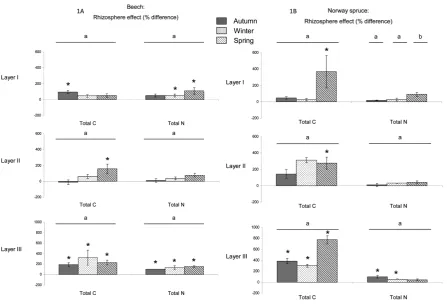
[image:4.595.92.538.529.723.2]Figure 1 represents percentages of difference for C and N between the bulk soil and rhizosphere solutions for each depth, each season, and both species. Our results showed an enrichment of the rhizosphere in C and N in layer III whatever the season and the species, with exception of the N in spring under Norway spruce (Figure 1).
Table 1. Bulk soil (B) and rhizosphere (R) solution pH for the different seasons (autumn, winter, and spring), species (beech and Norway spruce), and depths (layer I: 0 - 3 cm, layer II: 3 - 10 cm, and layer III: 10 - 23 cm) (adapted from [26]). Asterisk indicates significant difference between bulk soil and rhizosphere solution pH for the same season, species and depth,
ac-cording to a paired t-Student analysis at the threshold of p = 0.05.
Species Layer Compartment Season
Autumn Winter Spring
Beech
I B 3.79 4.35 3.80
R 3.60 3.69* 3.78
II B 4.05 4.36 3.68
R 4.00 3.80* 4.12*
III B 4.52 5.37 4.46
R 4.35 4.71* 4.72*
Norway spruce
I B 3.27 3.79 3.55
R 3.20 3.66 3.31
II B 3.82 4.08 3.91
R 3.69 3.69* 3.82
III B 4.12 4.62 4.40
Figure 1. Rhizosphere effect for total C and total N under beech (A) and Norway spruce (B) for the three depths (layer I: 0 - 3 cm, layer II: 3 - 10 cm, and layer III: 10 - 23 cm) and the three seasons (autumn, winter, and spring). Rhizosphere effect is expressed as a percentage of difference between bulk soil solution and rhizosphere solution. Histograms represent the mean value of four replicates. Bars represent standard errors. For each depth and season, bars with an asterisk are significantly different according to a one-factor (soil compartment) ANOVA and the Student-Newman-Keuls test (p < 0.05). For each depth and each soil compartment, bars with the same letter (a, b, c) are not significantly different according to a one-factor
(season) ANOVA and the Student-Newman-Keuls test (p < 0.05).
In layer I, the rhizosphere is enriched in C in autumn and in N in winter and spring for the beech as well as in C in spring for the Norway spruce. In layer II, the rhizosphere is enriched in C in spring for both species (Figure 1). We did not observe seasonal variations of the rhizosphere effect, except for an increase of this effect on N in spring in layer I under the beech.
3.3. Major Elements (K, Ca, Mg, Na, Fe and Mn)
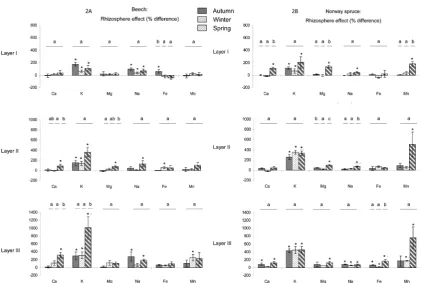
Figure 2. Rhizosphere effect for major elements under beech (A) and Norway spruce (B) for the three depths (layer I: 0 - 3 cm, layer II: 3 - 10 cm, and layer III: 10 - 23 cm) and the three seasons (autumn, winter, and spring). Rhizos-phere effect is expressed as a percentage of difference between bulk soil solution and rhizosRhizos-phere solution. Histo-grams represent the mean value of four replicates. Bars represent standard errors. For each depth and season, bars with an asterisk are significantly different according to a one-factor (soil compartment) ANOVA and the Student- Newman-Keuls test (p < 0.05). For each depth and each soil compartment, bars with the same letter (a, b, c) are not
significantly different according to a one-factor (season) ANOVA and the Student-Newman-Keuls test (p < 0.05).
layer II, i.e. higher enrichment of the rhizosphere solution in spring. For Fe, the rhizosphere solutions were enriched under beech in layer I in autumn and in layer II in winter, and under Norway spruce in layer III in au-tumn, winter and spring. Significant seasonal variations of the rhizosphere effect on Fe were observed under beech in layer I, i.e. higher enrichment of the rhizosphere solution in autumn, and under Norway spruce in layer III, i.e. higher enrichment of the rhizosphere solution in spring. For Mn, the rhizosphere solutions were enriched under beech in layer III in winter, and under Norway spruce in layers I and II in spring and in layer III in winter and spring. Significant seasonal variation of the rhizosphere effect on Mn was observed under Norway spruce in layer I, i.e. higher enrichment of the rhizosphere solution in spring.
3.4. Trace Elements (Ba, Cd, Ce, Co, Cr, Cs, Cu, Ga, La, Nd, Ni, Pb, Rb, Sr, Th, U, V, Y and Zn)
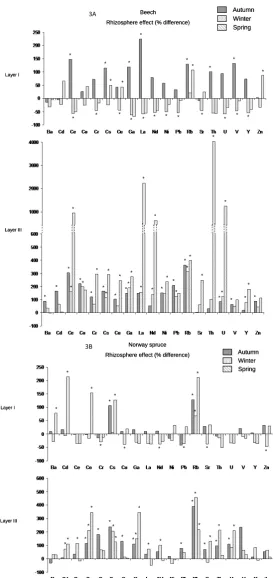
Figure 3 represents percentages of difference for trace elements between the bulk soil and rhizosphere solutions for each depth, each season, and both species. In layer I, the general tendency was a depletion of trace elements (except for Rb) in the rhizosphere solution during the winter under both species and an accumulation of trace elements in the rhizosphere solution during the autumn under beech as compared to the bulk soil solution. In layer III, we observed an accumulation of most of the trace elements in the rhizosphere solution whatever the season and the species. Interestingly, the rhizosphere solutions were enriched in Rb whatever the depth, the spe-cies and the season.4. Discussion
4.1. Rhizosphere Effect on pH, Carbon, and Nitrogen
Figure 3. Rhizosphere effect for trace elements under beech (A) and Norway spruce (B) for the two depths (layer I: 0 - 3 cm and layer III: 10 - 23 cm) and the three seasons (autumn, winter, and spring). Rhizosphere effect is expressed as a percentage of difference between bulk soil solution and rhizosphere solution. Histograms represent the mean value of four replicates. Bars represent standard errors. For each depth and season, bars with an asterisk are significantly different according to a one-factor (soil compartment) ANOVA and the Student-Newman-Keuls test (p < 0.05).
* * * * * * * * * * * * * * * * * * * * * * * Beech
Rhizosphere effect (% difference)
Layer I Layer III * * * * * * * * * * * * * * * * * * * * * * * * * * * * * * * * * * * * * 3A * * * * * * * * * * * * * * * * * * * * * * * * * * * * * * * * * * * * * * * * * * * * * * Beech
Rhizosphere effect (% difference)
Layer I Layer III * * * * * * * * * * * * * * * * * * * * * * * * * * * * * * * * * * * * * 3A Autumn Winter Spring Autumn Winter Spring 3A * * * * * * * * * * ** * * * * * * * * * * * * * * * * * * * * * * * * * * * * Norway spruce Rhizosphere effect (% difference)
Layer I Layer III * * * * * * * * * * ** * * * * * * * * * * * * * * * * * * * * * * * * ** * * * * * * * * * * * * * * * * * * * * * * * * * * * * * * * * * * * * * * * * * * Norway spruce Rhizosphere effect (% difference)
sphere solution was enriched in carbon in spring as compared to that of the bulk soil. The rhizosphere solutions were also generally enriched in N. The accumulation of C in the rhizosphere solution can result from the release by roots during the growing period of an abundant amount of carbon into the surrounding soil, called rhizode-position [36], which includes the C derived from photosynthates.
Our study also showed that pH in bulk soil solution did not significantly differ from that of rhizosphere solu-tion in autumn and spring for both species. In contrast, the rhizosphere solusolu-tion is more acidic than that of the bulk soil under beech (layers I, II, and III) and Norway spruce (layer II, only) in winter. The acidification of the rhizosphere solution can be attributed to carbonic and organic acids produced by roots and rhizosphere micro-flora through respiration and exudation as well as to proton release by roots to compensate for an unbalanced cation-anion uptake at the soil-root interface [37]. Because nutrient uptake is very low or inexistent in winter, it is likely that the decrease of pH in the rhizosphere mainly results from the activity of soil microorganisms. Our results also revealed an enrichment of the rhizosphere in carbon and nitrogen in winter for both species in the 10 - 23 cm horizon. The decrease of pH and the high production of acid compounds, carbon, and nitrogen in the rhizosphere can be explained by the fine-root decomposition but also by root and root-associated microorganism activity that can occur even in winter [38]-[40]. While roots tend to freeze and die at soil temperatures below −6˚C, minimum temperatures for root growth are thought to be between 0˚C and 5˚C. Thus, if soil temperatures warm to or stay above this minimum, as was the case during our study period with a relatively warm winter (mean air temperature > 4˚C), winter roots can break dormancy and become active thus stimulating rhizosphere microflora. In addition, [41] demonstrated that soil microorganisms can maintain both catabolic (CO2 production) and
ana-bolic (biomass synthesis) processes under frozen conditions and that no significant differences in carbon alloca-tion from [13C] glucose into [13C] CO2 and cell organic 13C-compounds occurred between +9˚C and −4˚C.
The large quantities of carbon in the rhizosphere could enhance the nutrient availability through an increase of CEC (increase of exchange sites) and a stimulation of microbial growth and activities which favours organic matter mineralization and mineral weathering [19].
4.2. Rhizosphere Effect on Major Element Availability
weather-ing and contributed thus to the increase of nutrient concentration (such as Ca, Mg, Fe and Mn) in the soil solu-tions of ectomycorrhizosphere of subalpine fine. These results suggest that high biological activities within the rhizosphere significantly improve soil nutrient availability. This hypothesis is in accordance with the conceptual model of nutrient availability in the soil-root system proposed by [5] and [53].
In addition, our study reveals that the accumulation of nutrients in the rhizosphere solution was generally higher in spring compared to that in autumn and in winter. This result is in disagreement with the study of [54] who observed a depletion of Ca and Mg in the rhizosphere solution of Douglas-fir in June compared to August, November and February. They suggested that the strong tree uptake during the spring season could cause a de-crease of Ca and Mg in the vicinity of roots. Our results, however, corroborate the inde-crease of exchangeable nu-trients (especially K) observed in the rhizosphere of Norway spruce and beech in the same soil samples collected in spring compared to the other seasons [26]. These results suggest that even if the root nutrient uptake is high in spring, the intensity of biological activities favouring organic matter degradation and mineral weathering is such as the input-output nutrient budget is higher in spring than in autumn and winter when the root nutrient uptake is low or inexistent. In the beech rhizosphere, [55] showed that enzymatic activities involved in the organic matter degradation (such as N-acetylglucosaminidase, cellobiohydrolase and β-glucosidase) were higher at the begin-ning of the vegetation period (in June) than in August and September. These authors suggested an effect of a high carbon input due to photosynthetic activity in June, when leaves have been fully developed. In addition, [56] observed an increase of mineral weathering in the rhizosphere of Douglas-fir between March and June. As demonstrated by [26] and [35], nutrient stocks are very low in the soil of the Breuil-Chenue forest. According to [57], Ca and Mg pools at the Breuil-Chenue site were amongst the lowest as compared to other monitored sites in France [58]-[60]. Our results thus suggest that in such nutrient-poor soils, trees can enhance nutrient availa-bility in spring in the rhizosphere by a positive feedback loop between roots, microbial communities and soils. This complex process may thus allow maintaining a favorable environment for tree nutrition during the tree growth period.
Interestingly, the dynamics of K in soil solutions differ from those of Ca, Mg, and Na during the year. In fact, the rhizosphere solutions were enriched in K in autumn, winter and spring as compared to the bulk soil ones while the rhizosphere solutions were enriched in Ca, Mg, and Na in spring, only. These results suggest that a weak rhizosphere activity is sufficient to mobilize K to cover tree nutrient needs all throughout the year. In con-trast, as soon as the rhizosphere activity slows down, the availability of Ca, Mg, and Na decreases. This high-lights the main role of biological rhizosphere processes in the bioavailability of these nutrients. As demonstrated by [56], soil exchangeable Mg pools are very small and decreased between 1974 and 2001 in the Breuil-Chenue forest, thus the biological rhizosphere processes are going to play a growing role in tree nutrition in the future.
4.3. Rhizosphere Effect on Trace Element Availability
In the present study, the trace element concentrations in soil solutions were significantly different between the rhizosphere and the bulk soil for both species, especially in layer III. These results show for the first time that the tree rhizosphere influences the availability of trace elements in uncontaminated forest soils. According to [61], the impact of roots on trace element availability can result from several processes, i.e., accumulation/de- pletion of ionic species in the rhizosphere, acidification/alkalinization of the rhizosphere, oxidation/reduction in the rhizosphere, and complexation/chelation in the rhizosphere. As observed in this study for major elements, the rhizosphere solution was generally enriched in trace elements as compared to that of the bulk soil. Because the mineral soil represents the main source of trace elements in terrestrial environments, this enrichment could result from the increase of mineral weathering and organic matter mineralization in the rhizosphere. For exam-ple, [29] demonstrated in forest soils that microorganisms contributed to Cu increase in the tree rhizosphere as compared to the bulk soil and suggested that microbial mineralization could partly supply Cu to the solution fraction of the rhizosphere.
addi-tion, it is known that mycorrhizal fungi play a key role in the heavy metal and radionuclide circulation in the soils [67] [68]. For example, [30] demonstrated in a forest soil that Cs was largely accumulated in fungal myce-lium compared to bulk soil and rhizosphere. Consequently, the trace elements uptake by mycorrhizal fungi could contribute to the decrease of these elements in the vicinity of roots during the winter. This hypothesis is in agreement with [38] [39] that showed that ectomycorrhizal fungi can be metabolically active during winter pe-riod in temperate forest soils. According to [69], the changes of pH in soils and soil solutions may play an espe-cially significant role in the rate of availability of certain trace elements. Between autumn and winter, we ob-served a high increase in the pH of the bulk soil solution. These conditions may have decreased the adsorption of trace elements in the bulk soil thus favouring their solubility.
It is interesting to note that Rb was the only trace element enriched in the rhizosphere solution independently of the tree species, the depth, and the season. This result confirms the enrichment of the rhizosphere solution in K we observed. Indeed, both K and Rb show the same uptake kinetic by plants and 86Rb+ has often been used in studies of K uptake [70] as it seems to emulate K to a high degree due to rather similar physicochemical proper-ties (i.e., valence and ion diameter).
5. Conclusion
Living plant roots and associated microorganisms have been recognized to influence the biogeochemical pa-rameters of soil in their vicinity. Our study demonstrates that common European tree species such as beech and Norway spruce significantly impact the chemical characteristics of the rhizosphere solution, mainly during the growing period. Whatever the depth and the species are, an enrichment of the rhizosphere solutions in K, Ca, Mg, and Na is observed in spring (autumn, winter, and spring for K). This reveals positive differences between the nutrient inputs, principallyby mineral weathering, organic matter mineralization and mass flow as well as nutrient output mainly by root uptake. Hence, our results confirm that the high biological activity is a key process that improves soil fertility and supports tree nutrition in acidic and nutrient-poor forest soils. In contrast, for the trace elements we observe an enrichment of the rhizosphere solution whatever the season and the species in the mineral horizon are, only, while seasonal variations of the rhizosphere effect appear in the organo-min- eral horizon. This suggests that other mechanisms affect the dynamics of trace elements in the organo-mineral horizon. Further studies in the long term are required to reach clearer conclusions and generalizations.
Acknowledgements
We acknowledge Krista Bateman for review of our English, and Zornitza Tosheva, Louisette and Dominique Gelhaye, Séverine Bienaimé, Bruno Simon, Pascal Bonnaud, Claude Nys, René Boutin, Robert Wagener, Ernest Apel, Astrid Tobias, for technical assistance. This work was supported by the Research National Fund of Lux-emburg and the LorLux network.
References
[1] Marschner, H. (1995) Mineral Nutrition of Higher Plants. 2nd Edition, Academic Press, London.
[2] Darrah, P.R. (1993) The Rhizosphere and Plant Nutrition: A Quantitative Approach. Plant and Soil, 155-156, 1-20.
http://dx.doi.org/10.1007/BF00024980
[3] Hinsinger, P., Gobran, G.R., Gregory, P.J. and Wenzel W.W. (2005) Rhizosphere Geometry and Heterogeneity Arising from Root-Mediated Physical and Chemical Processes. New Phytologist, 168, 293-303.
http://dx.doi.org/10.1111/j.1469-8137.2005.01512.x
[4] Calvaruso, C., N’Dira, V. and Turpault, M.-P. (2011) Impact of Common European Tree Species and Douglas-Fir (Pseudotsuga menziesii [Mirb.] Franco) on the Physicochemical Properties of the Rhizosphere. Plant and Soil, 342, 469-480. http://dx.doi.org/10.1007/s11104-010-0710-x
[5] Gobran, G.R. and Clegg, S. (1996) A Conceptual Model for Nutrient Availability in the Mineral Soil-Root System.
Canadian Journal of Soil Science, 76, 125-131. http://dx.doi.org/10.4141/cjss96-019
[6] Dessaux, Y., Hinsinger, P. and Lemanceau, P. (2007) Rhizosphere: Achievements and Challenges. Springer Science Press, Berlin.
[7] Hinsinger, P., Plassard, C. and Jaillard, B. (2006) Rhizosphere: A New Frontier for Soil Biogeochemistry. Journal of Geochemical Exploration, 88, 210-213. http://dx.doi.org/10.1016/j.gexplo.2005.08.041
Rhizosphere and Bulk Soil in a Norway Spruce Stand. Plant and Soil, 257, 133-142.
http://dx.doi.org/10.1023/A:1026257508033
[9] Tinker, P.B. and Nye, P.H. (2000) Solute Movement in the Rhizosphere. Oxford University Press, New York.
[10] Calvaruso, C., Mareschal, L., Turpault, M.-P. and Leclerc, E. (2009) Rapid Clay Weathering in the Rhizosphere of Norway Spruce and Oak in an Acid Forest Ecosystem. Soil Science Society of America Journal, 73, 331-338.
http://dx.doi.org/10.2136/sssaj2007.0400
[11] Drever, J.I. and Stillings, L.L. (1997) The Role of Organic Acids in Mineral Weathering. Colloids and Surfaces A:
Physicochemical and Engineering Aspects, 120, 167-181. http://dx.doi.org/10.1016/S0927-7757(96)03720-X
[12] Grayston, S.J., Vaughan, D. and Jones, D. (1996) Rhizosphere Carbon Flow in Trees, in Comparison with Annual Plants: The Importance of Root Exudation and Its Impact on Microbial Activity and Nutrient Availability. Applied Soil Ecology, 5, 29-56. http://dx.doi.org/10.1016/S0929-1393(96)00126-6
[13] Warembourg, F.R. (1997) The “Rhizosphere Effect”: A Plant Strategy for Plants to Exploit and Colonize Nutrient- Limited Habitats. Bocconea, 7, 187-194.
[14] Courty, P.E., Buée, M., Diedhiou, A.G., Frey-Klett, P., Le Tacon, F., Rineau, F., Turpault, M.P., Uroz, S. and Garbaye, J. (2010) The Role of Ectomycorrhizal Communities in Forest Ecosystem Processes: New Perspectives and Emerging Concepts. Soil Biology and Biochemistry, 42, 679-698. http://dx.doi.org/10.1016/j.soilbio.2009.12.006
[15] Dakora, D.F. and Phillips, D.A. (2002) Root Exudates as Mediators of Mineral Acquisition in Low-Nutrient Environ-ments. Plant and Soil, 245, 35-47. http://dx.doi.org/10.1023/A:1020809400075
[16] Uroz, S., Calvaruso, C., Turpault, M.P. and Frey-Klett, P. (2009) Mineral Weathering by Bacteria: Ecology, Actors and Mechanisms. Trends in Microbiology, 17, 378-387. http://dx.doi.org/10.1016/j.tim.2009.05.004
[17] Phillips, R.P. and Fahey, T.J. (2008) The Influence of Soil Fertility on Rhizosphere Effects in Northern Hardwood Forest Soils. Soil Science Society of America Journal, 72, 453-461. http://dx.doi.org/10.2136/sssaj2006.0389
[18] Hinsinger, P., Bravin, M.N., Devau, N., Gerard, F., Le Cadre, E. and Jaillard, B. (2008) Soil-Root-Microbe Interactions in the Rhizosphere—A Key to Understanding and Predicting Nutrient Bioavailability to Plants. 5th International Sym-posium Interactions of Soil Minerals with Organic Components and Microorganisms, Pucon, 24-28 November 2008. [19] Lambers, H., Mougel, C., Jaillard, B. and Hinsinger, P. (2009) Plant-Microbe-Soil Interactions in the Rhizosphere: An
Evolutionary Perspective. Plant and Soil, 321, 83-115. http://dx.doi.org/10.1007/s11104-009-0042-x
[20] Arocena, J.M., Göttlein, A. and Raidl, S. (2004) Spatial Changes of Soil Solution and Mineral Composition in the Rhizosphere of Norway-Spruce Seedlings Colonized by Piloderma croceum. Journal of Plant Nutrition and Soil Science, 167, 479-486. http://dx.doi.org/10.1002/jpln.200320344
[21] Dieffenbach, A. and Matzner, E. (2000) In Situ Soil Solution Chemistry in the Rhizosphere of Mature Norway Spruce (Picea abies [L.] Karst.) Trees. Plant and Soil, 222, 149-161. http://dx.doi.org/10.1023/A:1004755404412
[22] Dieffenbach, A., Göttlein, A. and Matzner, E. (1997) In Situ Soil Solution Chemistry in an Acid Forest Soil as Influ-enced by Growing Roots of Norway Spruce (Picea abies [L.] Karst.). Plant and Soil, 192, 57-61.
http://dx.doi.org/10.1023/A:1004283508101
[23] Gottlein, A., Heim, A. and Matzner, E. (1999) Mobilization of Aluminium in the Rhizosphere Soil Solution of Grow-ing Tree Roots in an Acidic Soil. Plant and Soil, 211, 41-49. http://dx.doi.org/10.1023/A:1004332916188
[24] Turpault, M.P., Uterano, C., Boudot, J.P. and Ranger, J. (2005) Influence of Mature Douglas Fir Roots on the Solid Soil Phase of the Rhizosphere and Its Solution Chemistry. Plant and Soil, 275, 327-336.
http://dx.doi.org/10.1007/s11104-005-2584-x
[25] Wang, Z.Y., Gottlein, A. and Bartonek, G. (2001) Effects of Growing Roots of Norway Spruce (Picea abies [L.] Karst.) and European Beech (Fagus sylvatica L.) on Rhizosphere Soil Solution Chemistry. Journal of Plant Nutrition and Soil Science, 164, 35-41. http://dx.doi.org/10.1002/1522-2624(200102)164:1<35::AID-JPLN35>3.0.CO;2-M
[26] Collignon, C., Calvaruso, C. and Turpault, M.P. (2011) Temporal Dynamics of Exchangeable K, Ca and Mg in Acidic Bulk Soil and Rhizosphere under Norway Spruce (Picea abies Karst.) and Beech (Fagus sylvatica L.) Stands. Plant and Soil, 349, 355-366. http://dx.doi.org/10.1007/s11104-011-0881-0
[27] Legrand, P., Turmel, M.C., Sauvé, S. and Courchesne, F. (2005) Speciation and Bioavailability of Trace Metals (Cd, Cu, Ni, Pb, Zn) in the Rhizosphere of Contaminated Soils. In: Huang, P.M. and Gobran, G.R., Eds., Biogeochemistry of Trace Elements in the Rhizosphere, Elsevier, Amsterdam, 261-299.
http://dx.doi.org/10.1016/B978-044451997-9/50010-6
[28] Séguin, V., Gagnon, C. and Courchesne, F. (2004) Changes in Water Extractable Metals, pH and Organic Carbon Con- centrations at the Soil-Root Interface of Forested Soils. Plant and Soil, 260, 1-17.
http://dx.doi.org/10.1023/B:PLSO.0000030170.49493.5f
Rhizosphere of Forest Soils. Soil Biology and Biochemistry, 40, 2441-2451.
http://dx.doi.org/10.1016/j.soilbio.2008.06.006
[30] Vinichuk, M., Taylor, A.F.S., Rosén, K. and Johanson, K.J. (2010) Accumulation of Potassium, Rubidium and Cae-sium (133Cs and 137Cs) in Various Fractions of Soil and Fungi in a Swedish Forest. Science of the Total Environment,
408, 2543-2548. http://dx.doi.org/10.1016/j.scitotenv.2010.02.024
[31] April, R. and Keller, D. (1990) Mineralogy of the Rhizosphere in Forest Soils of the Eastern United-States-Mineralogic Studies of the Rhizosphere. Biogeochemistry, 9, 1-18. http://dx.doi.org/10.1007/BF00002714
[32] Bakker, M.R., George, E., Turpault, M.P., Zhang, J.L. and Zeller, B. (2004) Impact of Douglas-Fir and Scots Pine Seedlings on Plagioclase Weathering under Acidic Conditions. Plant and Soil, 266, 247-259.
http://dx.doi.org/10.1007/s11104-005-1153-7
[33] Courchesne, F. and Gobran, G.R. (1997) Mineralogical Variations of Bulk and Rhizosphere Soils from a Norway Spruce Stand. Soil Science Society of America Journal, 61, 1245-1249.
http://dx.doi.org/10.2136/sssaj1997.03615995006100040034x
[34] USDA (1999) Soil Taxonomy: A Basic System of Soil Classification for Making and Interpreting Soil Surveys. 2nd Edition, Agriculture Handbook Number 436, US Government Printing Office, Washington DC.
[35] Mareschal, L., Bonnaud, P., Turpault, M.P. and Ranger, J. (2010) Impact of Common European Tree Species on the Chemical and Physicochemical Properties of Fine Earth: An Unusual Pattern. European Journal of Soil Science, 61, 14-23. http://dx.doi.org/10.1111/j.1365-2389.2009.01206.x
[36] Jones, D.L., Hodge, A. and Kuzyakov, Y. (2004) Plant and Mycorrhizal Regulation of Rhizodeposition. New Phytolo-gist, 163, 459-480. http://dx.doi.org/10.1111/j.1469-8137.2004.01130.x
[37] Hinsinger, P., Plassard, C., Tang, C.X. and Jaillard, B. (2003) Origins of Root-Mediated pH Changes in the Rhizo- sphere and Their Responses to Environmental Constraints: A Review. Plant and Soil, 248, 43-59.
http://dx.doi.org/10.1023/A:1022371130939
[38] Buée, M., Vairelles, D. and Garbaye, J. (2005) Year-Round Monitoring of Diversity and Potential Metabolic Activity of the Ectomycorrhizal Community in a Beach (Fagus silvatica) Forest Subjected to Two Thinning Regimes. Mycorr-hiza, 15, 235-245. http://dx.doi.org/10.1007/s00572-004-0313-6
[39] Courty, P.E., Pouysegur, R., Buée, M. and Garbaye, J. (2006) Laccase and Phosphatase Activities of the Dominant Ectomycorrhizal Types in a Lowland Oak Forest. Soil Biology and Biochemistry, 38, 1219-1222.
http://dx.doi.org/10.1016/j.soilbio.2005.10.005
[40] Meinen, C., Hertel, D. and Leuschner, C. (2009) Root Growth and Recovery in Temperate Broad-Leaved Forest Stands Differing in Tree Species Diversity. Ecosystems, 12, 1103-1116. http://dx.doi.org/10.1007/s10021-009-9271-3
[41] Harrysson Drotz, S., Sparrman, T., Nilsson, M.B., Schleucher, J. and Öquist, M.G. (2010) Both Catabolic and Ana-bolic Heterotrophic Microbial Activity Proceed in Frozen Soils. Proceedings of the National Academy of Sciences of the United States of America, 107, 21046-210515. http://dx.doi.org/10.1073/pnas.1008885107
[42] Nettleton, W.D., Nelson, R.E. and Flach, K.W. (1973) Formation of Mica in Surface Horizons of Dryland Soils. Soil Science Society of America Journal, 37, 473-478. http://dx.doi.org/10.2136/sssaj1973.03615995003700030043x
[43] Tice, K.R., Graham, R.C. and Wood, H.B. (1996) Transformations of 2:1 Phyllosilicates in 41-Year-Old Soils under Oak and Pine. Geoderma, 70, 49-62. http://dx.doi.org/10.1016/0016-7061(95)00070-4
[44] Clegg, S. and Gobran, G.R. (1997) Rhizosphere Chemistry in an Ammonium Sulfate and Water Manipulated Norway Spruce [Picea abies (L.) Karst.] Forest. Canadian Journal of Soil Science, 77, 525-533.
http://dx.doi.org/10.4141/S95-069
[45] Zhang, J.L. and George, E. (2009) Rhizosphere Effects on Ion Concentrations near Different Root Zone of Norway Spruce (Picea abies (L.) Karst.) and Root Types of Douglas-Fir (Pseudotsuga menziesii L.) Seedlings. Plant and Soil, 322, 209-218. http://dx.doi.org/10.1007/s11104-009-9909-0
[46] Bakker, M.R., Dieffenbach, A. and Ranger, J. (1999) Soil Solution Chemistry in the Rhizosphere of Roots of Sessile Oak (Quercus petraea) as Influenced by Lime. Plant and Soil, 209, 209-216.
http://dx.doi.org/10.1023/A:1004511712471
[47] Colin-Belgrand, M., Dambrine, E., Bienaimé, S., Nys, C. and Turpault, M.P. (2003) Influence of Tree Roots on Nitro- gen Mineralization. Scandinavian Journal of Forest Research, 18, 260-268.
http://dx.doi.org/10.1080/02827581.2003.9728296
[48] Calvaruso, C., Turpault, M.P., Leclerc, E. and Frey-Klett, P. (2007) Impact of Ectomycorrhizosphere on the Functional Diversity of Soil Bacterial and Fungal Communities from a Forest Stand in Relation to Nutrient Mobilization Processes.
Microbial Ecology, 54, 567-577. http://dx.doi.org/10.1007/s00248-007-9260-z
sphere on the Genotypic and Metabolic Diversity of the Soil Bacterial Communities Involved in Mineral Weathering in a Forest Soil. Applied and Environmental Microbiology, 73, 3019-3027. http://dx.doi.org/10.1128/AEM.00121-07
[50] Collignon, C., Uroz, S., Turpault, M.P. and Frey-Klett, P. (2011) Seasons Differently Impact the Structure of Mineral Weathering Bacterial Communities in Beech and Spruce Stands. Soil Biology and Biochemistry, 43, 2012-2022.
http://dx.doi.org/10.1016/j.soilbio.2011.05.008
[51] Gadd, G.M. (2007) Geomycology: Biogeochemical Transformation of Rocks, Minerals, Metals and Radionuclides by Fungi, Bioweathering and Bioremediation. Mycological Research, 111, 3-49.
http://dx.doi.org/10.1016/j.mycres.2006.12.001
[52] Arocena, J.M. and Glowa, K.R. (2000) Mineral Weathering in Ectomycorrhizosphere of Subalpine Fir (Abies lasi-ocarpa (Hook.) Nutt.) as Revealed by Soil Solution Composition. Forest Ecology and Management, 133, 61-70.
http://dx.doi.org/10.1016/S0378-1127(99)00298-4
[53] Gobran, G.R., Clegg, S. and Courchesne, F. (1998) Rhizospheric Processes Influencing the Biogeochemistry of Forest Ecosystems. Biogeochemistry, 42, 107-120. http://dx.doi.org/10.1023/A:1005967203053
[54] Wang, X.P. and Zabowski, D. (1998) Nutrient Composition of Douglas-Fir Rhizosphere and Bulk Soil Solutions. Plant and Soil, 200, 13-20. http://dx.doi.org/10.1023/A:1004240315308
[55] Esperschütz, J., Pritsch, K., Gattinger, A., Welzl, G., Haesler, J., Buegger, F., Winkler, J.B., Munch, J.C. and Schloter, M. (2009) Influence of Chronic Ozone Stress on Carbon Translocation Pattern into Rhizosphere Microbial Communi-ties of Beech Trees (Fagus sylvatica L.) during a Growing Season. Plant and Soil, 323, 85-95.
Http://dx.doi.org/10.1007/S11104-009-0090-2
[56] Turpault, M.P., Righi, D. and Utérano, C. (2008) Clay Minerals: Precise Markers of the Spatial and Temporal Variabil-ity of the Biogeochemical Soil Environment. Geoderma, 147, 108-115.
http://dx.doi.org/10.1016/j.geoderma.2008.07.012
[57] van der Heijden, G., Legout, A., Pollier, B., Mareschal, L., Turpault, M.P., Ranger, J. and Dambrine, E. (2013) As-sessing Mg and Ca Depletion from Broadleaf Forest Soils and Potential Causes—A Case Study in the Morvan Moun-tains. Forest Ecology and Management, 293, 65-78. http://dx.doi.org/10.1016/j.foreco.2012.12.045
[58] Legout, A., Walter, C. and Nys, C. (2008) Spatial Variability of Nutrient Stocks in the Humus and Soils of a Forest Massif (Fougeres, France). Annals of Forest Science, 65, 108-118. http://dx.doi.org/10.1051/forest:2007080
[59] Nys, C., Ranger, D., Ranger, J., Bonnaud, P., Gelhaye, D., Lhomme, J., Masar, L. and Vairelles, D. (1983) Compara- tive Study of Two Forest Ecosystems in French Primary Ardennes 3. Bioelement Content and Biological Cycle. Annals of Forest Science, 40, 41-66. http://dx.doi.org/10.1051/forest:19830102
[60] Nys, C. and Ranger, J. (1988) The Consequence of the Substitution of Tree Species on the Biogeochemical Mechanism of a Forest Ecosystem—The Sulfur Cycle. Annals of Forest Science, 45, 169-188.
http://dx.doi.org/10.1051/forest:19880301
[61] Hinsinger, P. (2000) Bioavailability of Trace Elements as Related to Root-Induced Changes in the Rhizosphere. In: Gobran, G.R., Wenzel, W.W. and Lombi, E., Eds., Trace Elements in the Rhizosphere, CRC Press LCC, Boca Raton, 25-41. http://dx.doi.org/10.1201/9781420039993.ch2
[62] Liu, C. and Huang, P.M. (2005) Kinetics of Cadmium Desorption from Iron Oxides Formed under the Influence of Ci-trate. In: Huang, P.M. and Gobran, G.R., Eds., Biogeochemistry of Trace Elements in the Rhizosphere, Elsevier, Am-sterdam, 183-196. http://dx.doi.org/10.1016/B978-044451997-9/50008-8
[63] Sipos, P., Németh, T., Kovács Kis, V. and Mohai, I. (2008) Sorption of Copper, Zinc and Lead on Soil Mineral Phases.
Chemosphere, 73, 461-469. http://dx.doi.org/10.1016/j.chemosphere.2008.06.046
[64] Violante, A., Ricciardella, M., Pigna, M. and Capasso, R. (2005) Effects of Organic Ligands on the Adsorption of Trace Elements onto Metal Oxides and Organo-Mineral Complexes. In: Huang, P.M. and Gobran, G.R., Eds., Biogeo-chemistry of Trace Elements in the Rhizosphere, Elsevier, Amsterdam, 157-182.
http://dx.doi.org/10.1016/B978-044451997-9/50007-6
[65] Séguin, V., Courchesne, F., Gagnon, C., Martin, R.R., Naftel, S.J. and Skinner, W. (2005) Mineral Weathering in the Rhizosphere of Forested Soil. In: Huang, P.M. and Gobran, G.R., Eds., Biogeochemistry of Trace Elements in the Rhizosphere, Elsevier, Amsterdam, 29-55. http://dx.doi.org/10.1016/B978-044451997-9/50004-0
[66] Craul, P.J. (1992) Urban Soil in Landscape Design. Wiley, New York.
[67] Leyval, C. (2005) Efect of Arbuscular Mycorhhizal (AM) Fungi on Heavy Metal and Radionuclide Transfer to Plants. In: Huang, P.M. and Gobran, G.R., Eds., Biogeochemistry of Trace Elements in the Rhizosphere, Elsevier, Amsterdam, 419-429. http://dx.doi.org/10.1016/B978-044451997-9/50016-7
[69] Kabata-Pendias, A. (2000) Trace Elements in Soils and Plants. 3rd Edition, CRC Press, Boca Raton.
http://dx.doi.org/10.1201/9781420039900
[70] Rodriguez-Navarro, A. (2000) Potassium Transport in Fungi and Plants. Biochimica et Biophysica Acta, 1469, 1-30.
![Table 1. Bulk soil (B) and rhizosphere (R) solution pH for the different seasons (autumn, winter, and spring), species (beech and Norway spruce), and depths (layer I: 0 - 3 cm, layer II: 3 - 10 cm, and layer III: 10 - 23 cm) (adapted from [26])](https://thumb-us.123doks.com/thumbv2/123dok_us/8114662.792145/4.595.92.538.529.723/table-rhizosphere-solution-different-seasons-species-norway-adapted.webp)