R E S E A R C H A R T I C L E
Open Access
Subgroups of older adults with osteoarthritis based
upon differing comorbid symptom presentations
and potential underlying pain mechanisms
Susan L Murphy
1,2*, Angela K Lyden
1, Kristine Phillips
3, Daniel J Clauw
3,4and David A Williams
3,4,5Abstract
Introduction:Although people with knee and hip osteoarthritis (OA) seek treatment because of pain, many of these individuals have commonly co-occurring symptoms (for example, fatigue, sleep problems, mood disorders). The purpose of this study was to characterize adults with OA by identifying subgroups with the above comorbid symptoms along with illness burden (a composite measure of somatic symptoms) to begin to examine whether subsets may have differing underlying pain mechanisms.
Methods:Community-living older adults with symptomatic knee and hip OA (n= 129) participated (68% with knee OA, 38% with hip OA). Hierarchical agglomerative cluster analysis was used. To determine the relative contribution of each variable in a cluster, multivariate analysis of variance was used.
Results:We found three clusters. Cluster 1 (n= 45) had high levels of pain, fatigue, sleep problems, and mood disturbances. Cluster 2 (n= 38) had intermediate degrees of depression and fatigue, but low pain and good sleep. Cluster 3 (n= 42) had the lowest levels of pain, fatigue, and depression, but worse sleep quality than Cluster 2. Conclusions:In adults with symptomatic OA, three distinct subgroups were identified. Although replication is needed, many individuals with OA had symptoms other than joint pain and some (such as those in Cluster 1) may have relatively stronger central nervous system (CNS) contributions to their symptoms. For such individuals, therapies may need to include centrally-acting components in addition to traditional peripheral approaches.
Introduction
Osteoarthritis (OA) is the leading cause of disability in US adults and its prevalence is expected to double by 2020 [1]. Historically, the “disease” of OA has been viewed primarily as damage to the cartilage and bone. As such, the magnitude of damage or inflammation of these structures is often associated with higher symptom levels. Population-based studies suggest otherwise; 30 to 50% of individuals with moderate to severe radiographic changes of OA are asymptomatic, and approximately 10% of indi-viduals with moderate to severe knee pain have normal radiographs [2,3]. Psychosocial factors do account for some of this variance in pain and other symptoms, but only modestly [4-6]. There also may be other bone, joint, or physical changes associated with symptom severity
which are still not well-understood. The current failure of peripheral damage, inflammation, or other factors to explain the presence, absence, or severity of chronic pain suggests the need to identify additional salient factors that may be contributing to the experience of OA.
There is growing evidence in OA that there is a central component to pain. Recent studies of animal models pro-vide support for central sensitization of nociceptive path-ways [7,8]. In addition, focus groups identified a subset of patients with chronic, symptomatic knee OA who used pain quality descriptors that were suggestive of neuro-pathic pain [9]. There are several studies suggesting that OA patients display diffuse hyperalgesia to mechanical or heat stimuli (that is, suggestive of central nervous system (CNS) mediation) [10-12]. Kosek demonstrated that indi-viduals with hip OA had reduced descending analgesic activity, which partially normalized following hip arthro-plasty, suggesting the involvement of central factors influ-encing the activity of peripheral nociceptive input [13]. * Correspondence: [email protected]
1
Department of Physical Medicine and Rehabilitation, University of Michigan, 300 North Ingalls, 9thfloor, Ann Arbor, MI 48109-2007, USA
Full list of author information is available at the end of the article
Gwilym and colleagues used both experimental pain test-ing and more sophisticated functional neuroimagtest-ing procedures to show evidence of augmented CNS proces-sing of pain in 20 OA patients [14]. In a separate study, this same group showed that atrophy of the thalamus was seen at baseline on OA and improved following arthro-plasty [15], again underscoring the role of the CNS in OA pain. Finally, recent randomized controlled trials have demonstrated that compounds that alter pain neurotrans-mitters centrally, such as serotonin and norepinephrine, (for example, duloxetine, tricyclics), are efficacious in OA [16,17]. In aggregate, these studies do not imply that per-ipheral factors are unimportant in OA; rather, perper-ipheral factors alone are insufficient to account for symptoms in some or many individuals with OA. Whether or not CNS augmentation plays a prominent role in OA pain is likely to be tied to genetic predisposition, environmental stres-sors, and the degree of illness burden a given person is experiencing at the time [18-25]. Non-region-specific symptoms accompanying pain, such as fatigue, cognitive problems, sleep problems, and perturbations of mood, are systemically-mediated symptoms that may index more central involvement in the maintenance of illnesses, such as pain [24,26,27]. These symptoms may be important to target treatment in addition to pain. For instance, in a pre-vious study with an OA sample, fatigue was actually more related to functional disability than to pain [28]. To opti-mize treatment, it may be necessary to better characterize people with OA and determine if there are subsets of peo-ple who have symptom presentations that may reflect dif-ferent underlying pain mechanisms. Since OA treatment is still largely focused on alleviating pain at the peripheral site (for example, strength training to reduce knee joint stress), it is particularly important to examine if there is a subgroup of people with OA that has a symptom cluster supporting a clinical presentation of centrally-mediated pain. For those people, it may be important to focus on treatment that is more commonly used in centrally-mediated pain conditions, (such as behavioral treatments and lifestyle interventions). Classification of people into empirically-derived subgroups has been done in other chronic pain conditions, such as fibromyalgia and low back pain, based upon symptoms and psychosocial factors and has successfully identified subgroups of patients with distinct phenotypic characterization and with differential response to treatment [29-31]. OA is similar to these other chronic pain conditions in that many patients experience multifocal pain, fatigue, sleep disturbances, and mood disorders in addition to joint pain; however, no stu-dies have examined if there are distinct subgroups of peo-ple with OA who differ based on their symptomatology.
The purpose of this study was to identify specific sub-groups of individuals who initially presented with sympto-matic knee or hip OA. Subgroups would be based upon
levels of comorbid centrally-mediated symptomatology, such as fatigue, sleep disturbance, mood, as well as other symptoms, which we refer to as illness burden, known to occur in other centrally-mediated pain states (for example, irritable bowel syndrome, temporomandibular joint disor-der, interstitial cystitis, and so on) [32]. We hypothesized that one subgroup would appear to represent OA patients who predominantly have joint pain, whereas other sub-groups would have different symptom presentations that support differential manifestations of CNS-mediated symptomatology.
Materials and methods
Study design, participants, and setting
Our primary study was designed to examine the relation-ship among pain, fatigue, and physical activity in older adults with osteoarthritis. Potential participants were recruited in various ways: through fliers (in clinics at the University of Michigan Hospital System, at the Ann Arbor VA Health Care System, and around several cities in southeastern Michigan), newspaper advertisements, and online through the University of Michigan’s clinical sub-jects website. All individuals first signed an informed con-sent document outlining the research project; this was approved by the University of Michigan Institutional
Review Board and Ann Arbor Veteran’s Affairs Human
Subjects Review Board. The individuals underwent a com-prehensive screening evaluation with a geriatrics nurse practitioner who was trained by a rheumatologist to ascer-tain the presence of clinical knee or hip OA using the American College of Rheumatology (ACR) clinical criteria [33,34] and to evaluate for the presence of comorbidities. A total of 129 community-dwelling adults participated; they were aged 65 years and older who initially self-reported knee or hip OA.
Inclusion and exclusion criteria
Participants also needed to have adequate cognition and be able to see, hear and operate the accelerometer used for pain reporting in the study. Individuals were excluded if: 1) they reported other medical conditions that were capable of causing fatigue (acute illnesses or exacerba-tions of chronic illnesses, including common viral or bac-terial infections, autoimmune diseases, fibromyalgia, chronic fatigue syndrome, and any uncontrolled illness); 2) they were undergoing cancer treatment or had received treatment for cancer in the previous 12 months; 3) they reported doctor-diagnosed obstructive sleep apnea; 4) they presented with untreated anemia or thyr-oid disorders per blood work; or 5) they were non-ambulatory.
Measures Pain
Individuals were provided with a wrist-worn accelerometer (Actiwatch-Score, Philips Respironics-Mini-Mitter, Bend, OR, USA) that measured physical activity patterns and allowed ecological momentary assessment of pain five times a day over a five-day home monitoring period (that is, Monday through Friday). Based on our experience in past studies, we chose sampling times that represented each part of the day (wake-up, late morning to 11 am, afternoon to 3 pm, evening to 7 pm, and bedtime). After being prompted by the device’s audible alarm, participants rated their pain on a scale of 0 to 10 ("No pain at all”to “Pain as bad as I can imagine”). Pain ratings were then summed over each day and averaged across all days to derive an average pain rating. Because of our interest in multi-focal pain mechanisms, we chose to include this measure of pain rather than the WOMAC pain subscale as we think it better captures global pain experience com-pared to a disease-specific instrument.
Mood
Depressive symptomatology was assessed using the Center of Epidemiologic Studies Depression Scale (CES-D) [36]. A score of 16 or greater on the CES-D has been associated with clinically significant depressive symptoms [37].
Fatigue
The Brief Fatigue Inventory (BFI) was used to measure total fatigue [38] calculated by averaging ratings on nine items in which participants rate fatigue severity (“No fatigue” to “As bad as you can imagine”) and interfer-ence (“Does not interfere”to “Completely interferes”) in daily life over the last week on a scale of 0 to 10 [38].
Illness burden
Illness burden is a concept that reflects the self-reported symptom load experienced by an individual. For this study, participants were asked whether they experienced any of 41 different somatic symptoms with the sum representing the“illness burden”variable in the analysis.
Examples of the types of symptoms include: stomach pains, headaches, cognitive dysfunction, muscle weakness or stiffness, restless sleep, and daytime sleepiness. Indivi-dually these symptoms may represent various health pro-blems associated with different body systems, but in aggregate they may be viewed as the amount of burden a given individual experiences stemming from centrally-mediated somatic symptoms, such as fibromyalgia, irrita-ble bowel syndrome, and chronic fatigue syndrome. In other chronic pain conditions, greater endorsement of such symptoms has been associated with greater central pain and dysfunction status [39-41].
Sleep problems
Sleep problems were assessed using the Pittsburgh Sleep Quality Index (PSQI) [42]. A total score is calculated from seven subscales. A score of 5 or more indicates greater difficulties with sleep.
Functional status
Functional status measures were not included in cluster-ing, but were of interest to determine how different symptom clusters were associated with function, included both the short-form WOMAC physical disability scale [43], and the objective“timed up and go test”[44], which measures the time (in seconds) to get up from a chair, walk 20 feet and return to the chair.
Statistical analysis
concurrent clinical and demographic characteristics that differed significantly depending upon subgroup member-ship. All analyses were completed using PASW v18.
Results
Participant characteristics
Characteristics of the sample are shown in Table 1. There were 172 people eligible for this analysis from 605 people who underwent an initial phone screening for the study. Of the 605, 27% were screened out due to not having enough pain, 15% were screened out due to not having enough fatigue, 12% were not aged 65 and older, 9% had other conditions (for example, obstructive sleep apnea, rheumatoid arthritis, inadequate cognition), and 2% had a diagnosis of fibromyalgia. Complete data were available on 129 of the 172 participants who were screened. The missing data were from participants who decided not to participate or were ineligible after full evaluation of the screening results (such as due to not meeting the clinical criteria for OA or abnormal results from blood work). Therefore, these individuals did not complete the home monitoring period required to obtain the average five-day pain rating. Compared to the 129 participants (shown in Table 1), the 43 participants had less pain on the WOMAC scale (6.7 ± 3.7,P= .06) and less physical dis-ability on the short-Form WOMAC scale (10.83/28 ± 4.26,P = .07). These participants had similar levels of fatigue on the BFI (4.4 ± 1.9,P= .91) and depression on the CES-D (12.2 ± 7.9,P= .97) compared to the sample of 129 people. A total of 79 females and 50 males were included in the current analysis with the majority of the sample identifying themselves as either Caucasian (87%) or African American (9%). Knee OA was the most com-mon diagnosis (69%), followed by both knee and hip OA
(11%), and hip OA alone (20%). Scores on the WOMAC indicated a mild-moderate pain experience among parti-cipants (8.5 ± 3.2) with overall moderate levels of self-reported physical dysfunction (12.30 ± 4.67). Average pain severity for the sample was 3.06 (1.62) and average fatigue severity was 3.77 (1.67).
Cluster analysis
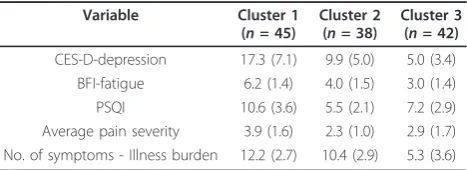
Three clusters were identified as being the best fit for these data. Significant separation of the variables contained within the clustering solution was confirmed overall by MANOVA (Wilks’l= .148, F(10,236) = 37.69,P< .0001). Subsequent univariate ANOVAs indicated significant dif-ferences were observed between clusters for all variables making up the clusters (allP≤.0001).Post-hocanalyses revealed significant differences between all variables and all pairs of clusters except for pain severity where there was not a significant difference between Clusters 2 and 3 (P= .09). Table 2 shows the characteristics of each cluster by variable.
Cluster 1 comprised 36% of the sample (n= 45). This group had the most pathological scores on all clustering variables compared to the other two groups and was characterized by the highest level of depressive symptoms (17.3 which is above the clinical cut-point of 16), highest fatigue and average pain (6.2 and 3.9/10 respectively), the worst sleep, and the greatest illness burden (endorsing 30% of somatic symptoms that were queried).
Cluster 2 comprised 30% of the sample (n= 38). The group was characterized by subclinical levels of depres-sion and moderate fatigue, but had low pain and lower levels of sleep problems (that is, 5.5). They had a mod-erate illness burden (endorsing 25% of somatic symptoms).
[image:4.595.57.292.536.729.2]Cluster 3, comprised 34% of the sample (n= 42). This group had clinically-relevant levels of sleep problems, but mild levels of average pain (that is, 2.9/10). The group had the lowest levels of fatigue and depression, and markedly low levels of illness burden compared to the two other clusters (that is, 13% of somatic symptoms endorsed).
Table 1 Characteristics of the entire study sample (n= 129, 79 female, 50 male)
Variable Mean (SD) Range
Age (years) 72.2 (9.8) 65 to 90
BMI (kg/m2) 30.5 (5.9) 21.5 to 49.9
Self-reported race Caucasian 112 (86.8%) African American 12 (9.3%)
Asian 2 (1.6%) More than one 1 (.8%) Chose not to report 2 (1.6%)
Study joint knee 88 (68.2%)
hip 41 (31.7%)
% Veterans 26/120 (20.2%)
WOMAC pain 7.9 (3.4) 2 to 20
WOMAC stiffness 3.3 (1.7) 0 to 8
WOMAC disability 20.9 (10.3) 3 to 42
BFI total 4.5 (2.0) 0.25 to 8.75
[image:4.595.305.539.611.696.2]Self-reported duration of pain (months) 132.1 (146.5) 0 to 708
Table 2 Cluster characteristicsa
Variable Cluster 1
(n= 45)
Cluster 2 (n= 38)
Cluster 3 (n= 42)
CES-D-depression 17.3 (7.1) 9.9 (5.0) 5.0 (3.4) BFI-fatigue 6.2 (1.4) 4.0 (1.5) 3.0 (1.4) PSQI 10.6 (3.6) 5.5 (2.1) 7.2 (2.9) Average pain severity 3.9 (1.6) 2.3 (1.0) 2.9 (1.7) No. of symptoms - Illness burden 12.2 (2.7) 10.4 (2.9) 5.3 (3.6)
a
Clinical and demographic variables among subgroups
Age did not differ across clusters (mean = 72 years; F(2,122) = .036, P = .97), and there was no significant relationship between gender and cluster assignment (c2 = 3.72, P = .16). Similarly, body mass index (BMI) did not differ across clusters, being within the category of obese (for example, 30 to 31) on average (F(2,122) =
1.02, P = .36). With regard to OA joints per the ACR
clinical criteria, we examined the clusters according to whether they had knee OA alone or whether OA was in both the hip and knee or in the hip joints alone. The most prevalent group in all clusters had knee OA alone (82% in Cluster 1, 64% in Cluster 2, and 63% in Cluster 3); however, location of OA joint was not significantly different across clusters (c2= 3.86;P= .15). Duration of OA pain was not significantly different across the groups and there was a large amount of variability across people (F(2,122) = 2.58, P= .08); although Clus-ter 2 had the longest pain duration at 177 months (± 180) compared to Cluster 1 and Cluster 3 (124 ± 120 and 105 ± 126).
Differences in clusters were found in stiffness, physical disability, and objective physical function. Stiffness on the WOMAC scale was significantly different across groups (F(2,121) = 5.95,P= .003), specifically between Cluster 1, which had the highest level of stiffness (3.91 ± 1.60), and Cluster 3, which had the lowest level (2.74 ± 1.70). Physi-cal disability on the WOMAC disability sPhysi-cale was also significantly different across clusters (F(2,122) = 16.18, P= .0001). The significant difference in means from post-hoctesting was 14.84 ± 4.50 in Cluster 1 compared to Clusters 2 and 3 (9.84 ± 3.84 and 11.27 ± 3.98
respectively). On the timed up and go test, Cluster 1 had a mean of 13.5 (± 8.9) which is a cut-off score denoting fall risk (43) and was significantly different from Clusters 2 and 3 which were similar in their performance on this test (10.5 ± 2.1 and 10.2 ± 2.3 respectively).
Discriminant functions
Two discriminant functions (that is, linear combinations of the independent variables) were identified that signifi-cantly differentiated the clusters accounting for 71% and
29% of the variance among them (Wilk’s Lambda for
Function 1:c2 = 168.28,P< .0001; and for Function 2:
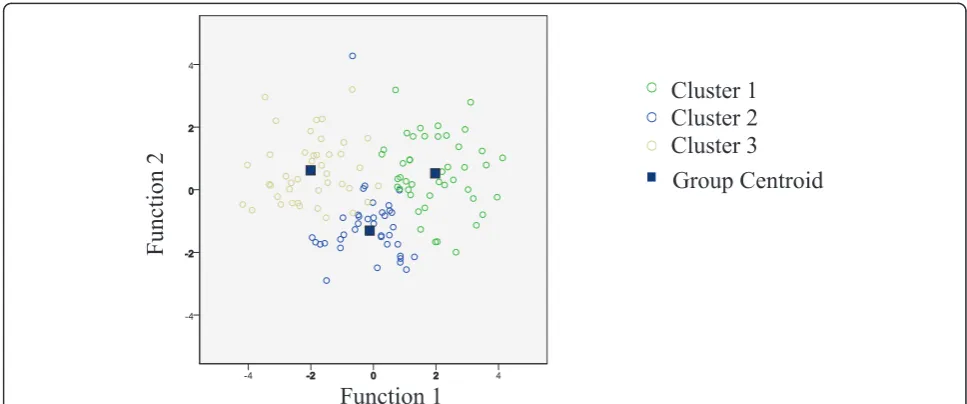
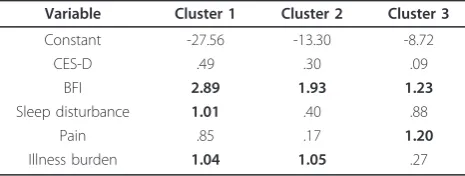
c2 = 59.10,P< .0001). The first function was weighted towards reported fatigue and number of endorsed somatic symptoms, while the second function was weighted toward reported pain and sleep quality. Figure 1 shows the multi-variate group means (called the group centroids) for the three clusters, the spread of the data in each cluster (repre-sented by the different color circles), and the discriminant functions. The distance between the centroids and amount of overlap between the circles of each cluster shows how the clusters are differentiated. The first discriminant func-tion on the x axis separates Cluster 3 from Cluster 1, while the second function on the y axis is needed to differ-entiate Cluster 2 from the other two. As a second step, we predicted group membership using a constant and coeffi-cients for each of the predictor variables. These values were applied in the same manner as for a regression where the coefficient is multiplied by the individual value and all values are summed. A value was generated for each cluster and the highest value of the three represents the cluster assignment. Table 3 shows the coefficients for
Function 1
Group Centroid
Function 2
[image:5.595.55.539.490.692.2]Cluster 1
Cluster 2
Cluster 3
Figure 1Illustration of required canonical discriminant functions to differentiate Clusters 1, 2 and 3. Two discriminant functions were identified that significantly differentiated the clusters accounting for 71% and 29% of the variance among them (Wilk’s Lambda for Function 1:
each cluster and illustrates an example of the predictive process. Based on this method, we correctly classified 95.2% of participants in the sample into their empirically derived clusters.
Discussion
In this study, we were interested in characterizing a sam-ple of older adults with symptomatic knee and hip OA. Three subgroups provided the best fit to our cluster analy-tic model and each had different symptom presentations that may be reflective of different degrees and types of CNS-mediated symptomatology. There was a group (Clus-ter 1; 36% of the sample) that appeared to have symptoms reminiscent of fibromyalgia, including the highest ratings on both pain and fatigue, as well as the worst ratings on depressive symptoms and sleep. In addition, this group also had the highest illness burden (that is, the number of somatic symptoms endorsed which are common in other centrally-mediated pain states, such as irritable bowel syn-drome, temporomandibular joint disorder, and interstitial cystitis), further supporting that a potential CNS contribu-tion to symptoms.
Cluster 2 had intermediate levels of depressive symptoms and modest levels of other somatic symptoms, suggesting these individuals were suffering from mild depression. Cluster 2 appears to be a group of relatively mixed central influence, with perhaps mild depressive symptomatology, but no significant evidence of sensory amplification symp-toms that are more classically seen in fibromyalgia and related conditions. Cluster 3 had low levels of all symptoms except difficulties with sleep, where they had slightly greater symptomatology than Cluster 2. Individuals within Cluster 3 may represent those individuals who have been tradition-ally thought of as having OA confined to the joint. With the exception of sleep problems, these individuals showed minimal evidence of known central factors to be influen-cing the overall condition.
Although our data appear to support the idea that differ-ences in symptom presentation among clusters may be due to differences in pain mechanisms, potential alternative explanations were considered. For example, clusters may have been differentiated due to differences in pain severity rather than differences in pain mechanism. However,
because all groups have mild-moderate pain (2.3 to 3.9), this seems unlikely. In addition, it could be argued that the differences among clusters may be due to physical func-tion. Specifically, Cluster 1, the group that was most symp-tomatic, also had significantly worse scores on the WOMAC physical disability scale and on the timed up and go test than members of the other two clusters. This find-ing is consistent with known associations between symp-toms, depression, and function in chronic pain [47,48], and reduced physical function could be a manifestation of hav-ing a high symptom burden. However, a longitudinal study would be needed to examine causality. In an additional analysis, we further explored the relationship between pain severity and physical function by examining correlations by cluster. Correlations between pain severity and the physical function variables (WOMAC physical disability and the timed up and go test) were strongest and only statistically significant for Cluster 3 (r = .55 and .32 respectively) sug-gesting that this cluster, the one thought to be more of a traditional OA group with joint pain and few other symp-toms, has activity-related pain.
[image:6.595.57.290.100.188.2]There is a growing body of literature that suggests pain experienced in some individuals with OA could be due to sensitization of both local and central pain pathways [49,50]. Central pain disorders, such as fibromyalgia, are characterized by widespread pain and the presence of symptoms, such as fatigue, sleep problems, mood disor-ders, and overall high illness burden, that were found in participants in Cluster 1. This is interesting in light of the fact we specifically excluded individuals with a diagnosis of fibromyalgia from participating in the study, which was further confirmed by ascertaining the presence of wide-spread pain using a modification of the 1990 ACR criteria [51]. Although we did not perform a tender-point exam, we did ask individuals about the presence of pain in each of the four body quadrants, as well as the axial skeleton, and about tenderness to pressure at different points on the body. Individuals needed to answer in the affirmative to each of the widespread pain questions to be excluded under the‘fibromyalgia’criterion. These findings suggest that treatment approaches may need to be extended beyond the joint in people with OA who present like those in Cluster 1. Similar to another study [52], this study pro-vides support for the idea that OA is likely a“mixed pain state,”with individual variability in the relative balance of peripheral (that is, nociceptive) and central elements of pain. Although it is impossible to determine from our cur-rent data, it is likely that some participants might have undiagnosed fibromyalgia or widespread pain as defined by the latest fibromyalgia diagnostic criteria [53]. This pos-sibility bolsters the idea that there is a need for a broader and more flexible approach to diagnosis and treatment of symptoms in people who have OA. Potentially such indivi-duals may benefit from treatments that target more
Table 3 Discriminative analysis of cluster characteristicsa
Variable Cluster 1 Cluster 2 Cluster 3
Constant -27.56 -13.30 -8.72
CES-D .49 .30 .09
BFI 2.89 1.93 1.23
Sleep disturbance 1.01 .40 .88
Pain .85 .17 1.20
Illness burden 1.04 1.05 .27
a
centrally acting mechanisms and that are appropriate for the management of fatigue, sleep, and depression, and might be expected to preferentially respond to drugs such as duloxetine, which has recently been shown to be effec-tive in OA [16].
These findings should be considered preliminary given that the clustering solution still requires replication in another sample of OA patients. In addition, this study was a first step into examining pain mechanisms in an OA sample using symptom presentation as a grouping vari-able. More sophisticated measurement, such as quantita-tive sensory testing, is needed to more fully investigate the pain mechanisms in these different subgroups. The struc-tural severity of knee and hip OA is not known in this study because the ACR clinical criteria was used and this information would be useful in better understanding these subgroups. Further, generalizability of the study findings are limited to people with symptomatic knee or hip OA and also may be limited by other characteristics of the convenience sample we were able to access for this study. Because a primary goal of the larger research project is to examine fatigue in OA, we excluded people that did not have enough fatigue; however, this was a relatively small portion of the sample (15%). In addition, we included both veterans and non-veterans in this study and this sample comprised about 20% veterans. Veterans are more likely than non-veterans to report chronic joint pain and activity limitations [54] and a larger study would be needed to examine differences between these two groups.
Conclusions
Among a group of community-dwelling older adults with symptomatic knee or hip OA, we found evidence of three statistically differentiated subgroups that were character-ized by differing symptom presentations which may poten-tially be due to different pain mechanisms. Although further study and replication of the clusters are needed, the heterogeneity of people with symptomatic OA in this sample highlights the need to tailor treatment strategies for symptom management.
Abbreviations
ANOVA: analysis of variance; BFI: brief fatigue inventory; CES-D: Center for Epidemiological Studies Depression Scale; CNS: central nervous system; MANOVA: multivariate analysis of variance; OA: osteoarthritis; PSQI: Pittsburgh Sleep Quality Index; WOMAC: Western Ontario and McMaster Universities Osteoarthritis Index
Acknowledgements
This work was supported by the Department of Veterans Affairs; Rehabilitation and Research Development Branch, Merit Grant IRX000410A.
Author details
1
Department of Physical Medicine and Rehabilitation, University of Michigan, 300 North Ingalls, 9thfloor, Ann Arbor, MI 48109-2007, USA.2Geriatric
Research, Education and Clinical Center (GRECC), Veterans Affairs Ann Arbor Health Care System, Michigan. 2215 Fuller Rd, Ann Arbor, MI 48105, USA.
3Division of Rheumatology, Department of Internal Medicine, University of
Michigan, Domino’s Farms, 24 Frank Lloyd Wright Drive, Lobby M, Ann Arbor, MI 48105-5737, USA.4Departments of Anesthesiology and Psychiatry, University of Michigan, Domino’s Farms, 24 Frank Lloyd Wright Drive, Lobby M, Ann Arbor, MI 48105-5737, USA.5Department of Psychology, University of Michigan, Domino’s Farms, 24 Frank Lloyd Wright Drive, Lobby M, Ann Arbor, MI 48105-5737, USA.
Authors’contributions
The idea for this manuscript arose from a meeting with all co-authors. SLM and AKL conducted the analysis with specific guidance from DAW. SLM provided an initial draft of the manuscript and all coauthors contributed intellectual content, participating in follow-up meetings and in the writing process. SLM acquired the data and assumes responsibility for the integrity of the data as well as the accuracy of the data analysis. All authors read and approved the final manuscript.
Competing interests
Dr. Clauw’s financial disclosures are from Pfizer, Lilly, Forest, Cypress Biosciences, Pierre Fabre, UCB, Jazz Pharmaceuticals, and Merck. Dr. Phillips’ financial disclosures are from Merck, United Therapeutics, and Actelion. Drs. Murphy and Williams declare that they do not have competing interests.
Received: 26 April 2011 Revised: 8 July 2011 Accepted: 24 August 2011 Published: 24 August 2011
References
1. Arthritis prevalence and activity limitations–United States, 1990. MMWR Morb Mortal Wkly Rep1994,43:433-438.
2. Hannan MT, Felson DT, Pincus T:Analysis of the discordance between radiographic changes and knee pain in osteoarthritis of the knee.
J Rheumatol2000,27:1513-1517.
3. Lethbridge-Cejku M, Scott WW, Reichle R, Ettinger WH, Zonderman A, Costa P, Plato CC, Tobin JD, Hochberg MC:Association of radiographic features of osteoarthritis of the knee with knee pain: data from the Baltimore Longitudinal Study of Aging.Arthritis Care Res1995,8:182-188. 4. Rosemann T, Backenstrass M, Joest K, Rosemann A, Szecsenyi J, Laux G:
Predictors of depression in a sample of 1,021 primary care patients with osteoarthritis.Arthritis Rheum2007,57:415-422.
5. Sale JEM, Gignac M, Hawker G:The relationship between disease symptoms, life events, coping and treatment, and depression among older adults with osteoarthritis.J Rheumatol2008,35:335-342. 6. Somers T, Keefe F, Godiwala N, Hoyler G:Psychosocial factors and the
pain experience of osteoarthritis patients: new findings and new directions.Curr Opin Rheumatol2009,21:501-506.
7. Sagar DR, Staniaszek LE, Okine BN, Woodhams S, Norris LM, Pearson RG, Garle MJ, Alexander SPH, Bennett AJ, Barrett DA, Kendall DA, Scammell BE, Chapman V:Tonic modulation of spinal hyperexcitability by the endocannabinoid receptor system in a rat model of osteoarthritis pain.
Arthritis Rheum2010,62:3666-3676.
8. Im H-J, Kim J-S, Li X, Kotwal N, Sumner D, van Wijnen A, Davis F, Yan D, Levine B, Henry J, Desevré J, Kroin JS:Alteration of sensory neurons and spinal response to an experimental osteoarthritis pain model.Arthritis Rheum2010,62:2995-3005.
9. Hochman J, French M, Bermingham S, Hawker G:The nerve of osteoarthritis pain.Arthritis Care Res2010,62:1019-1023.
10. Harden RN, Bruehl S, Stanos S, Brander V, Chung OY, Saltz S, Adams A, Stulberg SD:Prospective examination of pain-related and psychological predictors of CRPS-like phenomena following total knee arthroplasty: a preliminary study.Pain2003,106:393-400.
11. Graven-Nielsen T, Arendt-Nielsen L:Assessment of mechanisms in localized and widespread musculoskeletal pain.Nat Rev Rheumatol2010,
6:599-606.
12. Lee YC, Lu B, Bathon JM, Haythornthwaite JA, Smith MT, Page GG, Edwards RR:Pain sensitivity and pain reactivity in osteoarthritis.Arthritis Care Res (Hoboken)2011,63:320-327.
13. Kosek E, Ordeberg G:Abnormalities of somatosensory perception in patients with painful osteoarthritis normalize following successful treatment.Eur J Pain2000,4:229-238.
14. Gwilym SE, Keltner JR, Warnaby CE, Carr AJ, Chizh B, Chessell I, Tracey I:
presence of central sensitization in a cohort of osteoarthritis patients.
Arthritis Care Res2009,61:1226-1234.
15. Gwilym S, Filippini N, Douaud G, Carr A, Tracey I:Thalamic atrophy associated with painful osteoarthritis of the hip is reversible after arthroplasty: a longitudinal voxel-based morphometric study.Arthritis Rheum2010,62:2930-2940.
16. Chappell A, Desaiah D, Liu-Seifert H, Zhang S, Skljarevski V, Belenkov Y, Brown JP:A double-blind, randomized, placebo-controlled study of the efficacy and safety of duloxetine for the treatment of chronic pain due to osteoarthritis of the knee.Pain Pract2011,11:33-41.
17. Chappell A, Ossanna M, Liu-Seifert H, Iyengar S, Skljarevski V, Li L, Bennett RM, Collins H:Duloxetine, a centrally acting analgesic, in the treatment of patients with osteoarthritis knee pain: a 13-week, randomized, placebo-controlled trial.Pain2009,146:253-260.
18. Bennett RM:Fibrositis: misnomer for a common rheumatic disorder.West J Med1981,134:405-413.
19. Simms R:Fibromyalgia is not a muscle disorder.Am J Med Sci1998,
315:346-350.
20. Moldofsky H, Lue FA:The relationship of alpha and delta EEG frequencies to pain and mood in‘fibrositis’patients treated with chlorpromazine and L-tryptophan.Electroencephalogr Clin Neurophysiol1980,50:71-80. 21. Moldofsky H, England RS:Facilitation of somatosensory average-evoked
potentials in hysterical anesthesia and pain.Arch Gen Psychiatry1975,
32:193-197.
22. Hudson JI, Hudson MS, Pliner LF, Goldenberg DL, Pope HG:Fibromyalgia and major affective disorder: a controlled phenomenology and family history study.Am J Psychiatry1985,142:441-446.
23. Hudson JI, Pope HG Jr:Fibromyalgia and psychopathology: is fibromyalgia a form of“affective spectrum disorder"?J Rheumatol Suppl
1989,19:15-22.
24. Fukuda K, Nisenbaum R, Stewart G, Thompson WW, Robin L, Washko RM, Noah DL, Barrett DH, Randall B, Herwaldt BL, Mawle AC, Reeves WC:
Chronic multisymptom illness affecting Air Force veterans of the Gulf War.JAMA1998,280:981-988.
25. Kato K, Sullivan PF, Evengård B, Pedersen NL:A population-based twin study of functional somatic syndromes.Psychol Med2009,39:497-505. 26. Fukuda K, Dobbins JG, Wilson LJ, Dunn RA, Wilcox K, Smallwood D:An
epidemiologic study of fatigue with relevance for the chronic fatigue syndrome.J Psychiatr Res1997,31:19-29.
27. Kato K, Sullivan P, Evengård B, Pedersen N:Chronic widespread pain and its comorbidities: a population-based study.Arch Intern Med2006,
166:1649-1654.
28. Murphy SL, Smith DM, Clauw DJ, Alexander NB:The impact of momentary pain and fatigue on physical activity in women with osteoarthritis.
Arthritis Care Res2008,59:849-856.
29. Giesecke T, Williams DA, Harris RE, Cupps TR, Tian X, Tian TX, Gracely RH, Clauw DJ:Subgrouping of fibromyalgia patients on the basis of pressure-pain thresholds and psychological factors.Arthritis Rheum2003,
48:2916-2922.
30. Turk DC, Okifuji A, Sinclair JD, Starz TW:Pain, disability, and physical functioning in subgroups of patients with fibromyalgia.J Rheumatol
1996,23:1255-1262.
31. Talo S, Forssell H, Heikkonen S, Puukka P:Integrative group therapy outcome related to psychosocial characteristics in patients with chronic pain.Int J Rehabil Res2001,24:25-33.
32. Warren JW, Howard FM, Cross RK, Good JL, Weissman MM, Wesselmann U, Langenberg P, Greenberg P, Clauw DJ:Antecedent nonbladder syndromes in case-control study of interstitial cystitis/painful bladder syndrome.Urology2009,73:52-57.
33. Altman R, Asch E, Bloch D, Bole G, Borenstein D, Brandt K, Christy W, Cooke TD, Greenwald R, Hochberg M,et al:Development of criteria for the classification and reporting of osteoarthritis. Classification of osteoarthritis of the knee. Diagnostic and Therapeutic Criteria Committee of the American Rheumatism Association.Arthritis Rheum
1986,29:1039-1049.
34. Altman R, Alarcón G, Appelrouth D, Bloch D, Borenstein D, Brandt K, Brown C, Cooke TD, Daniel W, Feldman D,et al:The American College of Rheumatology criteria for the classification of osteoarthritis of the hip.
Arthritis Rheum1991,34:505-514.
35. Goggins J, Baker K, Felson D:What WOMAC pain score should make a patient eligible for a trial in knee osteoarthritis?J Rheumatol2005,
32:540-542.
36. Andresen E, Malmgren J, Carter W, Patrick D:Screening for depression in well older adults: evaluation of a short form of the CES-D (Center for Epidemiologic Studies Depression Scale).Am J Prev Med1994,10:77-84. 37. Radloff L:The CES-D scale: A self-report depression scale for research in
the general population.Appl Psychol Meas1977,1:385-401.
38. Mendoza TR, Wang XS, Cleeland CS, Morrissey M, Johnson BA, Wendt JK, Huber SL:The rapid assessment of fatigue severity in cancer patients: use of the Brief Fatigue Inventory.Cancer1999,85:1186-1196. 39. Geisser M, Donnell C, Petzke F, Gracely R, Clauw D, Williams D:Comorbid
somatic symptoms and functional status in patients with fibromyalgia and chronic fatigue syndrome: sensory amplification as a common mechanism.Psychosomatics2008,49:235-242.
40. Williams DA, Schilling S:Advances in the assessment of fibromyalgia.
Rheum Dis Clin North Am2009,35:339-357.
41. Wolfe F, Rasker J:The Symptom Intensity Scale, fibromyalgia, and the meaning of fibromyalgia-like symptoms.J Rheumatol2006,33:2291-2299. 42. Buysse DJ, Reynolds CF, Monk TH, Berman SR, Kupfer DJ:The Pittsburgh
sleep quality index: a new instrument for psychiatric practice and research.Psychiatr Res1989,28:193-213.
43. Whitehouse SL, Crawford RW, Learmonth ID:Validation for the reduced Western Ontario and McMaster Universities Osteoarthritis Index function scale.J Orthop Surg2008,16:50-54.
44. Podsiadlo D, Richardson S:The timed“Up & Go": a test of basic functional mobility for frail elderly persons.J Am Geriatr Soc1991,
39:142-148.
45. Clatworthy J, Buick D, Hankins M, Weinman J, Horne R:The use and reporting of cluster analysis in health psychology: a review.Br J Health Psychol2005,10:329-358.
46. Tabachnick BG, Fidell LS:Using Multivariate Statistics.5 edition. Boston: Allyn and Bacon; 2007.
47. Leveille SG, Ling S, Hochberg MC, Resnick HE, Bandeen-Roche KJ, Won A, Guralnik JM:Widespread musculoskeletal pain and the progression of disability in older disabled women.Ann Intern Med2001,135:1038-1046. 48. Smith M, Quartana P, Okonkwo R, Nasir A:Mechanisms by which sleep
disturbance contributes to osteoarthritis pain: a conceptual model.Curr Pain Headache Rep2009,13:447-454.
49. Hunter D, McDougall J, Keefe F:The symptoms of osteoarthritis and the genesis of pain.Rheum Dis Clin North Am2008,34:623-643.
50. Woolf CJ:Central sensitization: implications for the diagnosis and treatment of pain.Pain2011,152:S2-15.
51. Wolfe F, Smythe HA, Yunus MB, Bennett RM, Bombardier C, Goldenberg DL, Tugwell P, Campbell SM, Abeles M, Clark P,et al:The American College of Rheumatology 1990 Criteria for the Classification of Fibromyalgia. Report of the Multicenter Criteria Committee.Arthritis Rheum1990,33:160-172. 52. Arendt-Nielsen L, Nie H, Laursen M, Laursen B, Madeleine P, Simonsen O,
Graven-Nielsen T:Sensitization in patients with painful knee osteoarthritis.Pain2010,149:573-581.
53. Wolfe F, Clauw DJ, Fitzcharles MA, Goldenberg DL, Katz RS, Mease P:The American College of Rheumatology preliminary diagnostic criteria for fibromyalgia and measurement of symptom severity.Arthritis Care Res
2010,62:600-610.
54. Dominick KL, Golightly YM, Jackson GL:Arthritis prevalence and symptoms among US non-veterans, veterans, and veterans receiving Department of Veterans Affairs Healthcare.J Rheumatol2006,33:348-354.
doi:10.1186/ar3449
Cite this article as:Murphyet al.:Subgroups of older adults with